QATAR : BOMA – the Desert Owl – takes flight as official mascot of FIFA U-17 World Cup Qatar 2025

Mascot pays tribute to legendary coach Velibor “Bora” Milutinović for his role in advancing football in Qatar and beyond

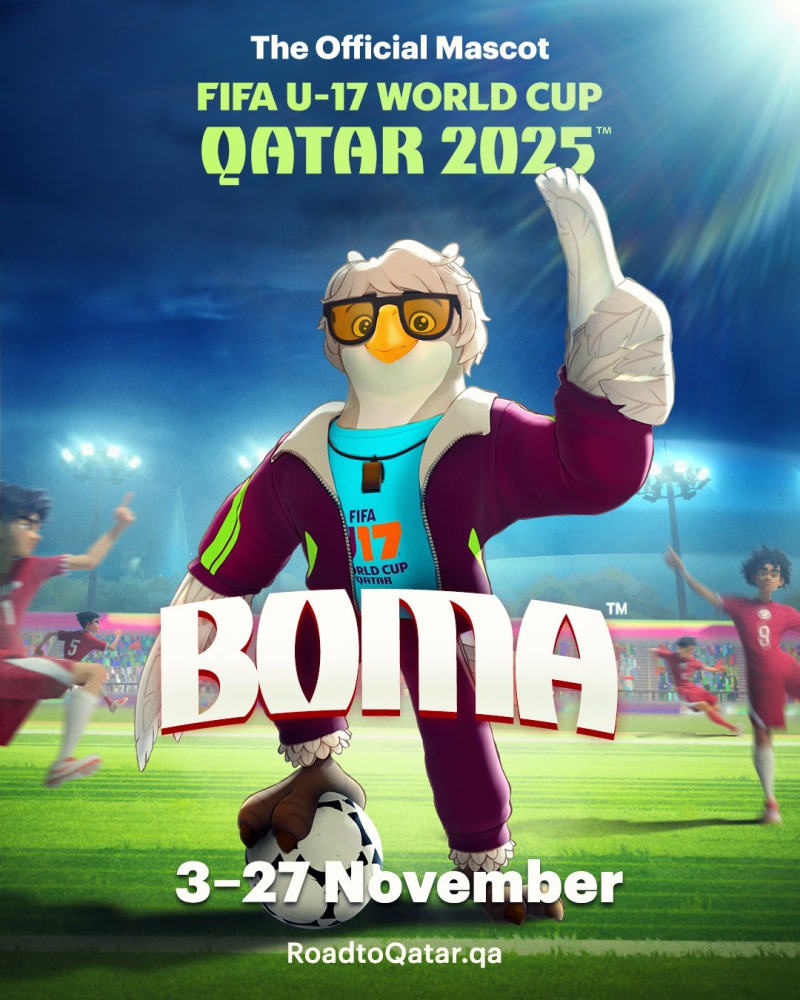
Doha, Qatar: The Local Organising Committee (LOC) for the FIFA U-17 World Cup Qatar 2025 and FIFA today unveiled BOMA – the Desert Owl as the official tournament mascot – a character inspired by the legendary Serbian coach Velibor “Bora” Milutinović, the only manager in football history to lead five different national teams in five consecutive FIFA World Cup™ tournaments.

The name “Boma,” is derived from the Arabic word for owl – regarded as a symbol of wisdom, vision, and mentorship, and is a playful nod to Bora, whose career as both coach and talent scout has profoundly influenced football development in Qatar and across the world.

For a tournament that celebrates the emergence of new talent, BOMA embodies the pivotal role of a football scout – one who sees potential where others may not and helps young players spread their wings on the global stage.

Known affectionately as Coach Bora, Milutinović guided Mexico, Costa Rica, the United States, Nigeria, and China at five successive World Cups between 1986 and 2002 – a unique achievement unmatched in football history. He went on to coach Al Sadd SC of the Qatar Stars League in 2004,leading them to win the Amir Cup in the same year, and contributed to the country’s football development programmes, making him a fitting inspiration for this tournament’smascot.

Speaking to the LOC, Bora highlights the passion he holds for nurturing future footballers and the importance of the upcoming FIFA U-17 World Cup Qatar 2025 in celebrating tomorrow’s stars.

“When it comes to discovering young talent, my greatest satisfaction as a coach has always been to promote emerging players – to show them that they must have the right attitude, believe in their dreams, and aim for the national team,” said Coach Bora. “I really like the idea behind the mascot and want to thank everyone who came up with it.” he added.

The FIFA U-17 World Cup Qatar 2025 marks a historic milestone as the first edition to feature 48 national teams, underscoring the tournament’s growing global reach.

“The World Cup is something truly special. When you’re young, you dream of playing at the highest level – and the U-17 team is the first step on that journey. It’s very important for young players to face the best in the world and see where they stand,” said Coach Bora.

“The team that scores more goals will win – it is as simple as that. But with young players, the outcome of matches often depends on inspiration, talent, and spirit. Most importantly, I hope everyone enjoys this World Cup. Enjoying the game is what truly matters, especially at the U-17 level, because that experience helps you grow both as a person and as an athlete,” he added.

The FIFA U-17 World Cup Qatar 2025, taking place at the state-of-the-art Competition Complex at Aspire Zone, will see as many as eight matches a day, for a total of 104 matches. The final will take place on November 27, 7pm local time, at Khalifa International Stadium.

“Aspire Zone is incredible – it has some of the best facilities in the world. The U-17 World Cup will be played on perfect pitches, in perfect conditions. Qatar has a distinguished track record in hosting major events, and I’m sure we’ll see high-quality football once again. I still remember the 2022 World Cup in Qatar – it was unforgettable,” said Coach Bora.

Fans can purchase tickets at: www.roadtoqatar.qa. Tickets are available as a Day Pass, which will enable fans to attend multiple matches a day as well as cultural and entertainment activities taking place around matches, in what will be an electrifying football festival-like atmosphere.

Fans can also purchase a Prime Pass, which will enable them to reserve seats for high demand matches. Supporters of the Qatar national team can avail the Follow My Team ticket, which will enable them to attend all matches of the Qatari U-17 team during the group stage.

All tickets will be digital and will include wheelchair accessible seating options for disabled fans.

The FIFA U-17 World Cup Qatar 2025 is the first of five consecutive editions that Qatar will be hosting. As the first FIFA World Cup to feature 48 teams, this will be the biggest-ever edition of the youth tournament that saw the likes of Gianluigi Buffon, Luis Figo, Xavi Hernandez, Eden Hazard, Andres Iniesta, Neymar, Ronaldinho, Son Heung-min and Francesco Totti appear on the world stage for the first time.

Qatar’s spectacular line-up of mega-sporting events will kick off with the FIFA U-17 World Cup Qatar 2025 from November 3-27, followed by the FIFA Arab Cup Qatar 2025 from December 1-18. In addition, the country is also set to host the second edition of the FIFA Intercontinental Cup 2025, which will take place on December 10, 13 and 17.

source/content: thepeninsulaqatar.com (headline edited)

___________

___________

QATAR

SAUDI ARABIA : A Look into the World’s Largest BESS Project in Saudi Arabia

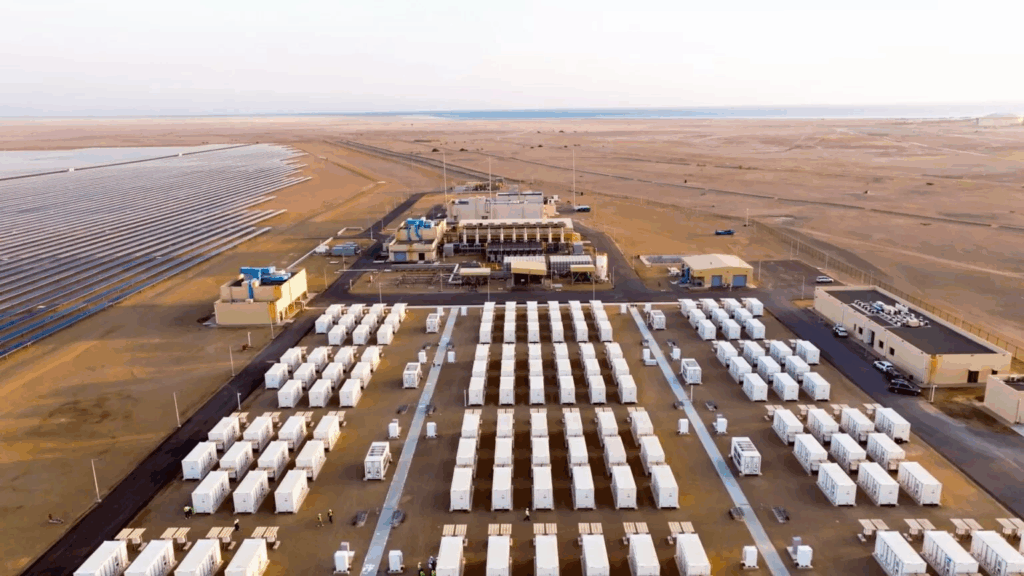
 Saudi Arabia is making advances in its BESS projects as it launches one of Middle East’s largest BESS deployments, a 4GWh BESS project. The nation’s battery storage drive comes as HiTHIUM is commissioned with a 4 GWh BESS project in a joint venture between the Saudi Electricity Company and Alfanar.

The systems, to be installed in Tabuk and Hail, will deploy HiTHIUM’s 1175 Ah long-duration technology in climate-resilient containerized units, being commissioned in 2026. This follows on the back of the earlier commissioning of the 500 MW / 2 GWh Bisha BESS, the globe’s largest single-phase grid-tied project, and a record 12.5 GWh transaction with BYD, which puts Saudi Arabia at the center of the world’s biggest in-development grid-scale storage pipeline.

By the year’s end, the Kingdom should surpass 11 GWh of operational storage and place itself among the top five utility-scale BESS leaders as it targets Vision 2030 renewable ambitions. The impact and influence of BESS projects around the world cannot be overstated, with Saudi Arabia taking the lead. Other countries such as Finland are determined to catch up as they launched the world’s largest sand battery , a monumental achievement.

The Middle East is making effort in various energy projects other than the world’s largest BESS project in Saudi Arabia. The UAE has broken ground on the world’s largest solar and BESS project,  first of its kind. Moreover, it will be capable of delivering round-the-clock baseload renewable energy. Masdar in collaboration with EWEC (Emirates Water and Electricity Company) is developing the $6 billion project. Moreover, it will deliver up to 1 gigawatt (GW) of baseload power 24 hours a day, seven days a week. The ceremony was witnessed by Sheikh Theyab bin Mohamed bin Zayed Al Nahyan, Deputy Chairman of the Presidential Court for Development and Fallen Heroes’ Affairs.

August 11, 2024: The implementation of the world’s largest battery energy system (BESS) project progresses as Saudi Arabia begins qualification tenders. A Saudi Arabian entity that has been tasked with procuring electricity generation projects has commenced the process. Saudi Power Procurement Company (SPPC) is licensed as the sole buyer of electrical energy. The government is soliciting bids to develop four battery energy storage system (BESS) projects. Furthermore, it is expected that each will have a 500MW output and 2,000MWh in storage capacity. The contract, which entails 15-year terms, will be awarded on a build-own-operate (BOO) model. It also entails the aspect of bidders holding 100% equity in special purpose vehicle (SPV) companies set up for the development and operation of projects. The SPPC, administered by the Saudi Ministry of Energy, aligns with the National Renewable Energy Program (NREP). Once completed, the BESS project is expected to be the world’s largest.

Project Factsheet

Location: Saudi Arabia

Capacity: 8GWh of storage capacity

Significance: World’s largest BESS Project

Main Company Involved: Saudi Power Procurement Company

Project duration: 15 years

Prequalified Bidders

The Saudi Power Procurement Company (SPPC) has released a list of 33 prequalified bidders for its 8GWh BESS project. The tender, structured as a build-own-operate model, attracted significant energy companies, both local and international. These include Masdar, ACWA Power, EDF, TotalEnergies, and Jinko Power, among others. The list also included prominent companies from nations such as South Korea, Japan, and China. Leading the pack were Samsung, the China Energy Overseas Investment Company, China Power Engineering, and China Southern Power Grid International. Of the 33 prequalified bidders, 21 applied, aiming to provide management and technological services. The remaining 12 applied solely for asset management roles for the BESS project.

The projects mark the first phase of Saudi Arabia’s ambitious battery storage program. It is designed to support its 50% renewable energy goal by 2030. Each 500 MW facility will operate for four hours, providing 2,000 MWh of total power capacity, said the SPPC. In early November, the state-owned limited liability company called for qualification for battery storage procurement. The company has so far contracted several gigawatts of solar PV and wind in competitive solicitation over the past years. Other technologies, such as Combined Cycle Gas Turbine (CCGT) and Water Infrastructure, have also had deals inked. Successful candidates will be granted 15-year Storage Service contracts with SPPC for respective projects they develop, featuring an output and storage capacity of 500 MW/2,000 MWh at various locations in the country. In addition, the bidders will have 100% equity in projects developed by SPV companies.

The State of Affairs Regarding the World’s Largest BESS Project in Saudi Arabia

The world’s largest BESS project in Saudi Arabia is one that has received accolades from the state government. Under Saudi Arabia’s Vision 2030 policy roadmap, the country aims to have a 50% share of renewable energy in its grid. According to energy minister, Prince Abulaziz bin Abdullah Al Saud, the government is prepared to incur the needed costs. Speaking in 2021, the Saudi government expects to spend $293 billion on power and energy projects by then. The biggest share of this revenue is expected to be spent on transmission upgrades and renewable energy.

Furthermore, investment is expected to be placed in the distribution network. SPPC noted earlier this week that the newly launched BESS procurement project will help the nation reach its 50% goal. The company also noted that the current tenders represent the first batches of solicitations. The locations of the four BESS facilities have already been decided. Two will be in Makkah province, one in Qassim province, and the other in Hail province. They have also been termed as independent storage projects (ISPs) by SPPC. Qualified bidders have been issued until midday, 25 November 2024, to submit their proposals for the BESS project.

source/content: constructionreviewonline.com (headline edited)

_______________

The Saudi Power Procurement Company (SPPC) has released a list of 33 prequalified bidders for its 8GWh BESS project.

_________________

SAUDI ARABIA

MOROCCO Is An Arab Country : Language, Culture, and the Living Fabric of Identity

Arab identity, in both historical and anthropological terms, has never been solely about genealogy.

Morocco is, in fact, an Arab country. While this assertion may appear self-evident, it has become a subject of debate in contemporary discourse. Some voices insist that Morocco’s identity lies exclusively in its Amazigh or North African roots, rejecting its place within the Arab cultural sphere. Yet, such claims overlook the complex processes through which cultural affiliations are formed, internalized, and lived. Moroccan Arab identity is neither imposed nor superficial; it is a deeply ingrained civilizational reality that is experienced, performed, and transmitted across generations.

Arab identity, in both historical and anthropological terms, has never been solely about genealogy. It is a cultural and civilizational framework, a shared language, religion, and set of symbolic practices, that transcends bloodlines and geography. The Arab Islamic expansion of the 7th-century introduced Arabic and Islam to what is known now as the Arab World, setting in motion a centuries long process of cultural integration. This integration was not a simple imposition, but a dynamic interaction between incoming and indigenous traditions, producing a distinctly Moroccan expression of Arabness. It is a process in which the Arab and the local coexist, interact, and mutually shape each other.

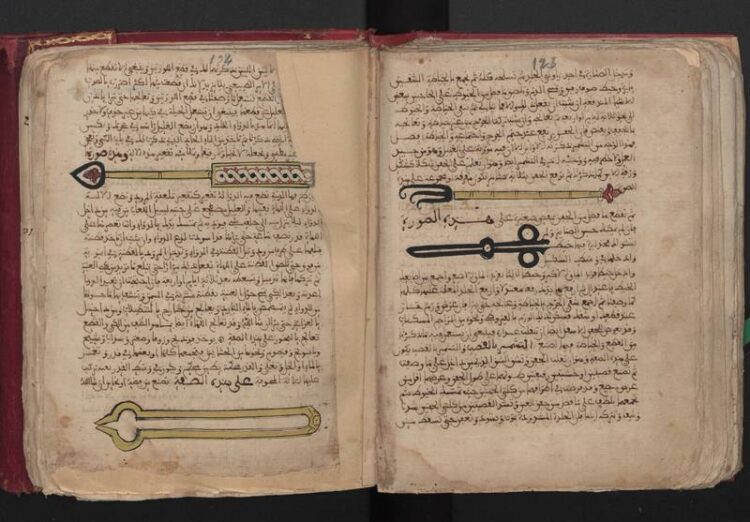
[First Illustration of surgical instruments in history] from Al-Zahrāwī, Al-Taṣrīf liman ‘aǧiza ‘an al-Ta’līf, 30th volume (Surgery). Bibliothèque Nationale du Royaume du Maroc (BNRM), as reproduced on the Islamic Studies Library Blog, McGill University

Morocco is, in fact, an Arab country. While this assertion may appear self-evident, it has become a subject of debate in contemporary discourse. Some voices insist that Morocco’s identity lies exclusively in its Amazigh or North African roots, rejecting its place within the Arab cultural sphere. Yet, such claims overlook the complex processes through which cultural affiliations are formed, internalized, and lived. Moroccan Arab identity is neither imposed nor superficial; it is a deeply ingrained civilizational reality that is experienced, performed, and transmitted across generations.

Language lies at the heart of this Arab identity. Classical Arabic became the medium of religious practice, scholarship, and literary expression, while Moroccan Darija evolved as a vernacular rooted in Arabic but enriched over centuries through interaction with Amazigh and Andalusi traditions, as well as later European influences. Computational linguistic analysis by Mrini and Bond (2018) found that approximately 42% of Moroccan Darija’s lexicon shares at least 60% similarity with Standard Arabic, while only about 3% aligns with French and 2% with Spanish. This demonstrates that, although Darija incorporates foreign and Amazigh influences, its core lexical foundation remains predominantly Arabic (Mrini & Bond, 2018, Putting Figures on Influences on Moroccan Darija from Arabic, French and Spanish Using the WordNet). This linguistic presence is more than practical; it is existential. Arabic provides the conceptual framework through which Moroccans think, communicate, and participate in a shared cultural universe. Anthropologists have long argued that language is the “house of being”, and in Morocco, Arabic offers that house, the structure within which Moroccan society organizes its collective life.

Yet Morocco’s Arab identity is not reductive. Its population is ancestrally diverse, encompassing Amazigh, Arab, sub-Saharan, Andalusi, and Mediterranean lineages. Rather than contradicting Arab identity, this diversity illustrates the inclusive, integrative nature of Arab culture, which historically has absorbed and harmonized a multitude of peoples and traditions. Being Arab in Morocco is thus defined not by ethnicity but by cultural practice, speaking Arabic, engaging with Islamic religious life, and participating in the intellectual and spiritual traditions of the Arab world. This identity is lived and internalized, a product of historical continuity and daily enactment.

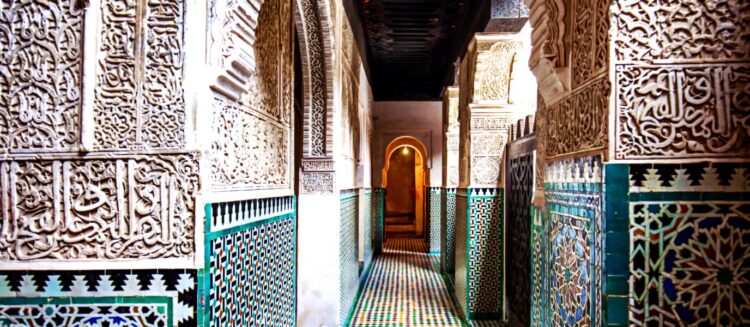
Medersa Bou Inania in Fez

Moroccan Arabness is dynamic and regionally inflected, expressed through a mosaic of Arabic dialects that embody the country’s historical and cultural layering. The pre-Hilali urban dialects, such as Fassi, Meknassi, and Rbati Arabic, spoken in the historic cities of Fez, Meknès, and Rabat-Salé, preserve many features of early Andalusian and Classical Arabic, including the conservative pronunciation of qāf as /q/ and more formal morphosyntactic patterns. In contrast, the Jebli dialect of northern Morocco, prevalent in Tetouan, Chefchaouen, and the Rif region, blends Andalusian, Amazigh, and Spanish influences, producing softer phonetics and a Mediterranean lexicon. The Hilali or ‘Aroubi (Bedouin) varieties, dominant across the Atlantic plains, Chaouia, and Souss, descend from Arab tribal migrations and underpin the speech of rapidly urbanized centers such as Casablanca and Settat. Further south, the Marrakchi dialect represents a transitional form combining urban and Bedouin traits, while Judeo-Moroccan Arabic, historically spoken in Jewish communities in Fez, Essaouira, and Sefrou, incorporates elements from Hebrew and Spanish (Haketía). In the southeast, around Errachidia and the Tafilalet region, daily speech follows Hilali Bedouin patterns, but the area also preserves a rare, literary form of Filali Arabic used in Melhoun poetry and song, reflecting a deep historical connection to Classical Arabic and regional artistic expression. Further south and toward the Sahara, Hassani Arabic, a Bedouin variety influenced by Maghrebi and Saharan linguistic currents, illustrates the continued interplay of migration, trade, and cultural exchange in shaping Moroccan Arabic. Collectively, these dialects illustrate how Moroccan Arabic varies across geography and social history, forming a linguistically plural yet distinctly Arab national identity. These variations reflect the adaptability of the language and, by extension, the adaptability of Arab identity itself. Moroccan Arabness, therefore, is neither monolithic nor static; it evolves through time while maintaining continuity with a broader Arab cultural framework.

Describing Morocco as an Arab country is to acknowledge the primacy of this linguistic, religious, and cultural fabric. Arabic is not merely an official language; it is the deep structure of Moroccan society, shaping poetry, moral discourse, social interaction, and ritual life. Arab identity in Morocco is lived in the streets of Casablanca and Fez, in the rhythms of daily prayer, and in the idioms and expressions of everyday conversation. It is experienced through shared cultural symbols and practices that bind Moroccan society to the larger Arab world while remaining distinctively local.

Recognizing Morocco as an Arab country does not erase its rich cultural diversity; rather, it highlights the central role that Arab language, culture, and religion play in the nation’s historical and contemporary identity. Moroccan Arabness is a living, evolving phenomenon, formed through centuries of interaction, internalized through daily life, and transmitted through language, ritual, and social practice. It reflects a society that is at once rooted in its local context and deeply connected to the broader Arab civilization.

In conclusion, Morocco’s Arab identity is a complex, multidimensional reality, grounded in linguistic, religious, and cultural practices. It is the result of historical processes, dynamic interactions, and the continuous enactment of shared meanings. To affirm that Morocco is an Arab country is not to deny its diversity but to recognize the living fabric of its identity, a fabric woven from Arabic language, Islamic faith, and the symbolic systems.

source/content: moroccoworldnews.com (headline edited) / Hajar Lmortaji

_______________

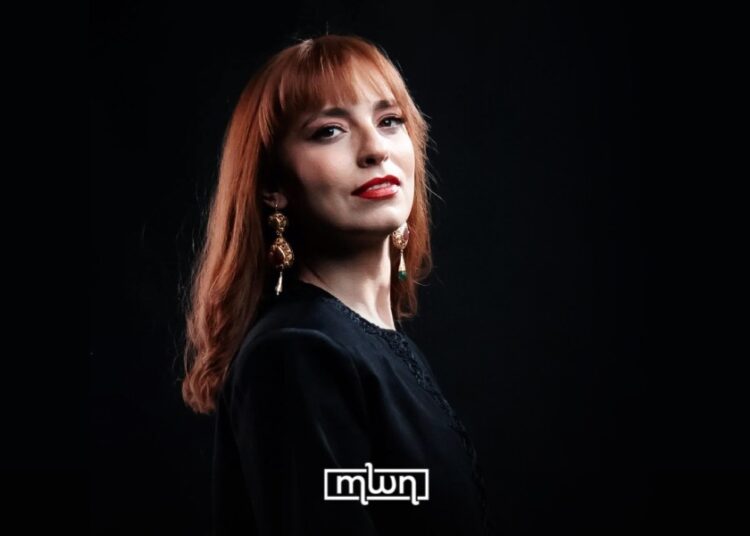
Hajar Lmortaji

_______________

MOROCCO


SAUDI ARABIA : King Faisal Specialist Hospital performs world’s first robotic intracranial tumor resection surgery

Achievement reflects ‘our growing role in shaping the future of global medicine,’ CEO Dr. Majid Al-Fayyad says

Procedure involved removing a 4.5-centimeter brain tumor with robotic arms from a 68-year-old man who had been experiencing severe headaches

In a historic leap for robotic medicine, the King Faisal Specialist Hospital and Research Centre in Riyadh has performed the world’s first robotic intracranial tumor resection.

This groundbreaking achievement sets a new global standard in neurosurgical precision and recovery.

The procedure involved removing a 4.5-centimeter brain tumor with robotic arms from a 68-year-old man who had been experiencing severe headaches and loss of concentration.

Remarkably, the patient was discharged fully conscious within 24 hours — a recovery time nearly four times faster than that of traditional brain surgeries.

Dr. Homoud Al-Dahash, KFSHRC consultant for skull base tumors and lead surgeon, stated that the robotic system provided exceptional precision and control, which enabled surgeons to navigate critical neurovascular structures with a high level of safety.

“The patient’s same-day discharge, fully conscious and without complications, represents a new benchmark for neurosurgical innovation,” he added.

Guided by a 3D optical system, the one-hour surgery enabled surgeons to operate with a clear, magnified view of the brain.

Advanced image-guided navigation technology ensured precise tumor removal while protecting vital areas of the brain.

KFSHRC CEO Dr. Majid Al-Fayyadh linked the milestone to the hospital’s ongoing transformation journey.

“This achievement reflects KFSHRC’s growing role in shaping the future of global medicine,” he said.

“It aligns perfectly with our vision, where innovation and patient-centered care define the future of healthcare.”

Before the advent of robotic neurosurgery, similar procedures required manual removal under a surgical microscope, where precision depended heavily on human steadiness and visual clarity.

Robotic systems now provide enhanced instrument stability, tremor elimination, and superior visualization — redefining global standards of safety and precision in neurosurgical care.

This landmark procedure adds to KFSHRC’s expanding portfolio of robotic surgical breakthroughs.

The institution previously performed the world’s first robotic heart transplant and robotic liver transplant, earning international acclaim and solidifying its standing among the world’s leading centers for robotic and minimally invasive surgery.

KFSHRC has been ranked first in the Middle East and North Africa and 15th globally among the world’s top 250 academic medical centers for 2025.

It was also recognized as the most valuable healthcare brand in the Middle East by Brand Finance 2024 and listed among Newsweek’s World’s Best Hospitals 2025, Best Smart Hospitals 2025, and Best Specialized Hospitals 2026.

These accolades reaffirm its position as a global leader in innovation-driven patient care.

source/content: arabnews.com (headline edited)

___________

King Faisal Specialist Hospital and Research Centre in Riyadh has performed the world’s first robotic intracranial tumor resection. (SPA

__________________

SAUDI ARABIA

SUDAN / AMERICAN : Our Black History: The UW’s Andrew Brimmer was a trailblazer and an ‘economic genius’

While researching connections between African Americans and the Sudan, University of Washington history professor came upon a name from the school’s past: Andrew Brimmer.

Born in Louisiana in the 1920s, Brimmer made his way to the Pacific Northwest when he joined the U.S. Navy during World War II and came to Bremerton, Washington. From there, he earned two degrees from the UW, where he studied economics before moving on to Harvard Business School.

Then, in 1966, Brimmer’s phone rang.

“I got a call in my office from [William] Marvin Watson who’s [President Lyndon B.] Johnson’s appointment secretary who said ‘the boss wants to see you,’ Brimmer recalled, according to The History Makers. “And I went over to the White House.”

Johnson was about to appoint him to the board of governors for the Federal Reserve, a powerful position that helps set the country’s economic policy. He would become the first African American in that role.

Brimmer’s trailblazing career in public service — and a connection to the Sudan — is something that’s fascinated Tounsel, who heads the African Studies Program at UW.

“As an African American, I asked myself, ‘Well, you know, whose shoulders am I standing on? You know, whose kind of genealogy am I a part of?’ I can’t be the only African American ever, right, who’s been interested in modern Sudan and has traveled to the Sudan? And so that really kind of sparked my interest,” Tounsel said.

“Historically, the Sudan has always had a really important role in African American pride.,” Tounsel continued.

“There was an ancient civilization just south of Egypt called Kush. And people like historian Michael Gomez have talked about the fact that Kush represented this example, of a kind of, pre-transatlantic slave trade example of African glory. The whole ‘We come from kings and queens’ narrative. But it’s one thing for ancient Sudan to have such a prominent place in kind of African American thought, but what about modern Sudan?”

Sudan won its independence from Great Britain and Egypt in 1956. Brimmer was subsequently invited to join a U.S. delegation to travel to the Sudan to explore the idea of building the country’s first post-colonial national bank.

As part of his research, Tounsel got a chance to page through Brimmer’s diary, in which Brimmer describes how many of the Sudanese were taken aback when they met him. Here was someone who looked like them, Brimmer wrote, but came from such a different place.

“You’ve got this, you know, Black man from Jim Crow, Louisiana, engaging with these, you know, formerly colonized, but now newly independent Sudanese citizens,” Tounsel said. “And so I just think that those moments in the archive where he’s talking about that are just so rich.”

Calling Brimmer a “kind of economic genius,” Tounsel described him as a civil servant who entered into and navigated corridors of power.

“Throughout his career, he was really keen on exploring Black economics, in particular,” said Tounsel, reflecting on Brimmer’s contributions as a member of the Reserve’s Board of Governors.

“He was not what, you know, Cornel West has called, kind of, ‘a Black face in a high place’…who is good for the optics, but is not really thinking about how one can use their power and influence in that role to help those disenfranchised people who look like them.”

Brimmer lived to be 86 years old before he died in 2012.

Tounsel profiled Brimmer in his latest book, Bounds of Blackness: African Americans, Sudan, and the Politics of Solidarity, which is due out later this year.

source/content: knkx.org /NPR – Emil Moffat, Freddie Monares (headline edited)

____________

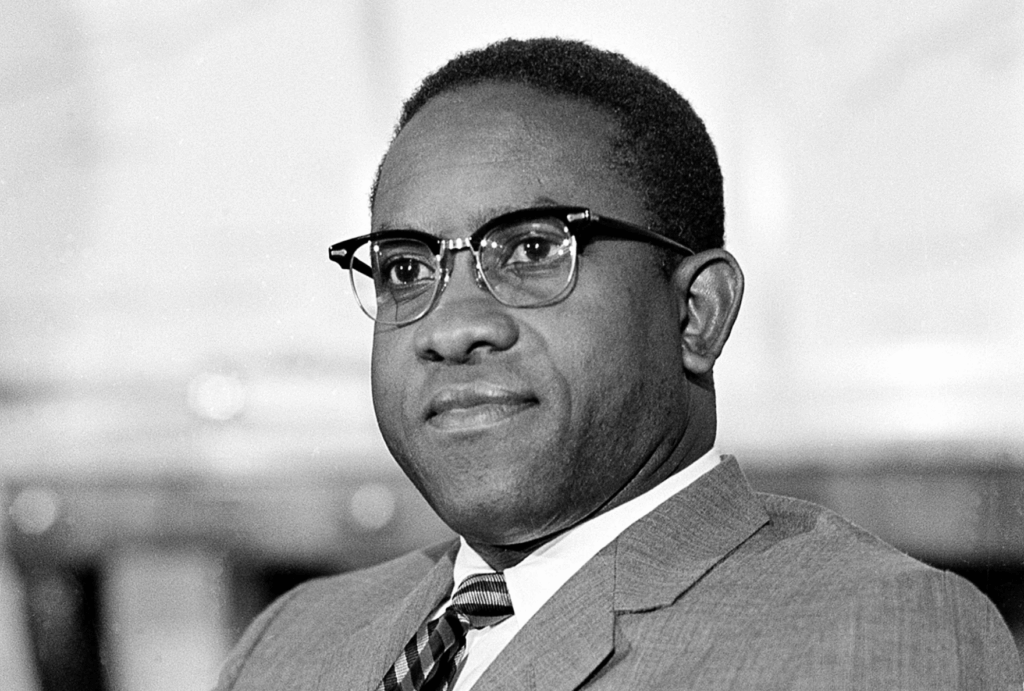
Dr. Andrew F. Brimmer, Harvard graduate and the only Black member of the Board of Governors of the Federal Reserve System, is shown in New York City in 1970.

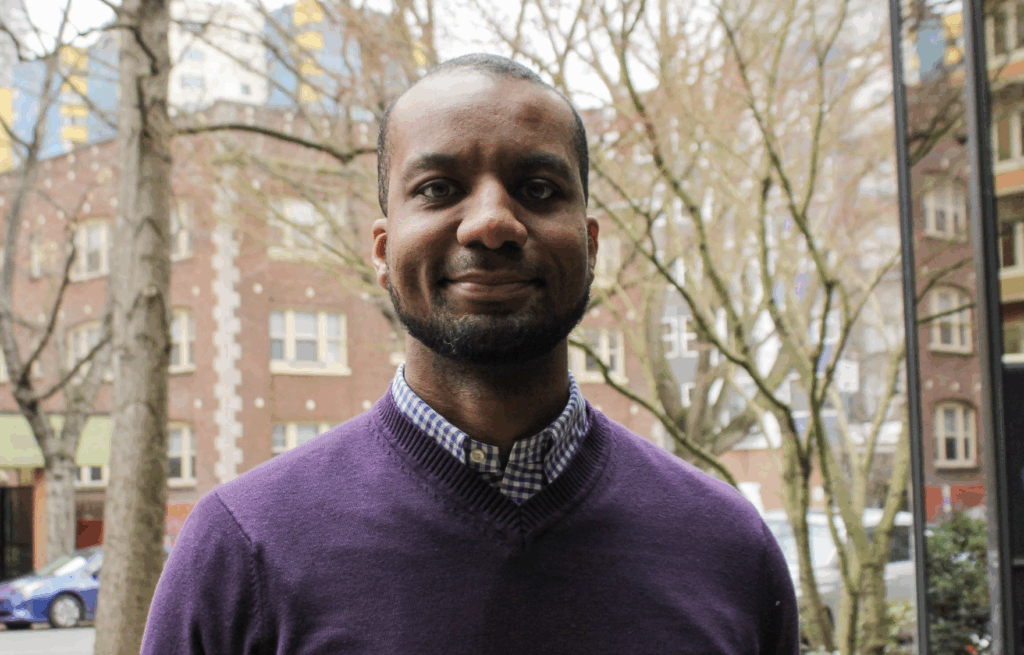
Emil Moffatt / KNKXUW History Professor Christopher Tounsel has written extensively on the connection between African-Americans and Sudan

__________________________

AMERICAN / SUDANESE

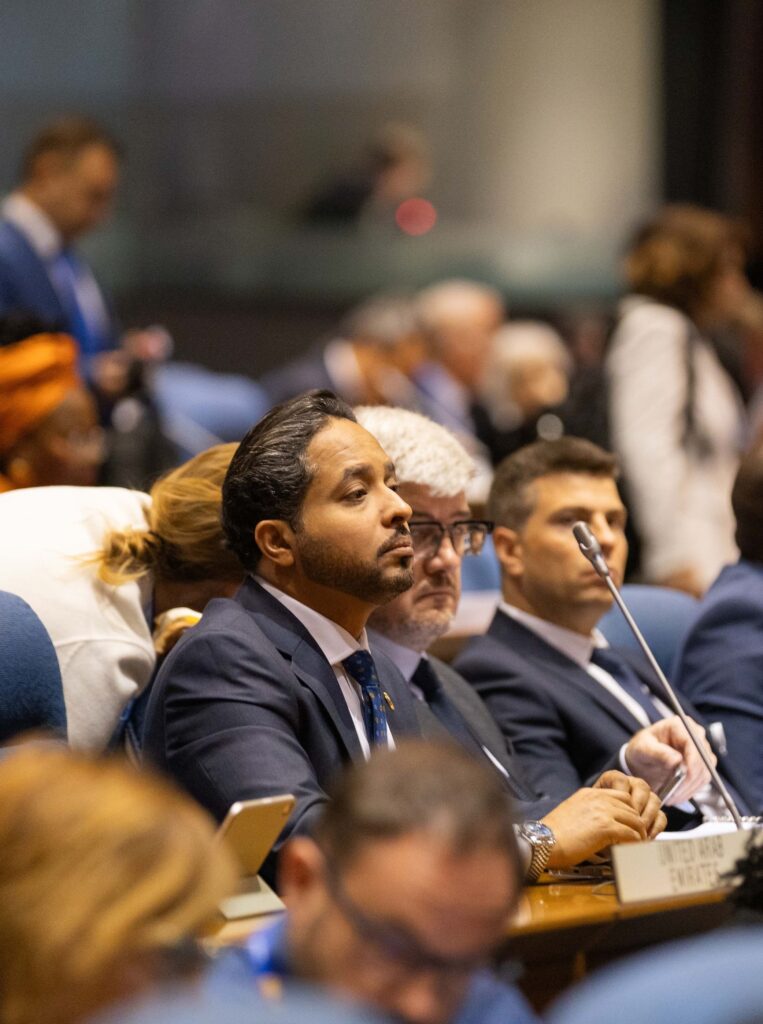
The UAE’s Permanent Representative Engineer Saeed Mohammed Al Suwaidi to ICAO is appointed Vice-President of the Council, October 2025

 The Council of the International Civil Aviation Organization (ICAO) elected Engineer Saeed Mohammed Al Suwaidi, the UAE’s Permanent Representative to the ICAO, as Vice-President of the Council.


A press release issued today by the General Civil Aviation Authority (GCAA) stated that the election of the UAE’s representative confirms the UAE’s leading position in the international civil aviation sector and reflects the great confidence it enjoys from member states on the ICAO Council, as well as the appreciation for its prominent role in supporting ICAO’s efforts aimed at enhancing the safety, security, and sustainability of the global aviation sector.


His Excellency Saif Mohammed Al Suwaidi, Director General of the GCAA, said that the election of the UAE’s representative to this high-profile position reflects the international appreciation of the country’s contributions to the development of civil aviation policies. It also underscores the UAE’s commitment to enhancing its active participation within the ICAO Council and contributing more strongly to the formulation of decisions affecting the global aviation sector, reflecting its ambitious vision for international cooperation and leadership in this field.


For his part, Engineer Saeed Mohammed Al Suwaidi, the UAE’s representative to ICAO, expressed his pride in this international assignment, stressing that his election represents a significant responsibility and an opportunity to continue strengthening the UAE’s presence within the organization and support international efforts aimed at developing the civil aviation sector according to the highest standards of efficiency and sustainability.

source/content: wam.ae (headline edited)

_______________

___________________________________

UNITED ARAB EMIRATES (U.A.E)

OMAN receives prestigious award from Japan’s top university. First Arab Government to be honoured.

The award was received by Oman’s Ambassador to Japan Dr. Mohammed bin Said Al Busaidi on behalf of the government of Oman.

The University of Tokyo has announced that it has awarded the prestigious Shokomon Award to the government of the Sultanate of Oman in recognition of its contribution to supporting scientific research and academic and cultural exchange in the field of Middle Eastern studies.

The award was received by Oman’s Ambassador to Japan Dr. Mohammed bin Said Al Busaidi on behalf of the government of Oman.

The award was based on the role played by the Sultan Qaboos Chair for Middle Eastern Studies, which was inaugurated at the university in 2011.

It is the highest honor bestowed by the University of Tokyo on individuals and institutions who have made significant and influential contributions to enriching the university’s progress and serving its academic goals.

Oman is the first Arab government to receive it.

The University of Tokyo has a significant academic relationship with Oman, primarily through the University of Tokyo Centre for Middle Eastern Studies (UTCMES), which was established with funding from Oman. The relationship includes academic exchange, research, and events such as seminars, lectures, and exhibitions focusing on Oman.

The university also works with institutions like Sultan Qaboos University and has received book donations from Oman.

UTCMES conducts and disseminates research on the Middle East and organizes events like public lectures, symposia, and exhibitions that focus on Oman.

source/content: arabnews.com (headline edited)

__________

The award was based on the role played by the Sultan Qaboos Chair for Middle Eastern Studies, which was inaugurated at the university in 2011. (Supplied)

_________

OMAN

ARAB : The Arab World’s Greatest Modern Achievements

The Golden Age never really ended

Arabs are known for having had numerous contributions to civilizations—notably in the fields of Mathematics (Arabs invented Algebra), Astronomy (Al-Biruni discussed the earth’s rotation centuries before it was confirmed by Galileo), and Medicine (Al Razi was one of the first to diagnose diseases like smallpox and measles).  

But Arab achievements didn’t end in the Golden Age and have continuously evolved to modern fields, so we’re here to round up some of the lesser-known greatest modern achievements by Arabs..

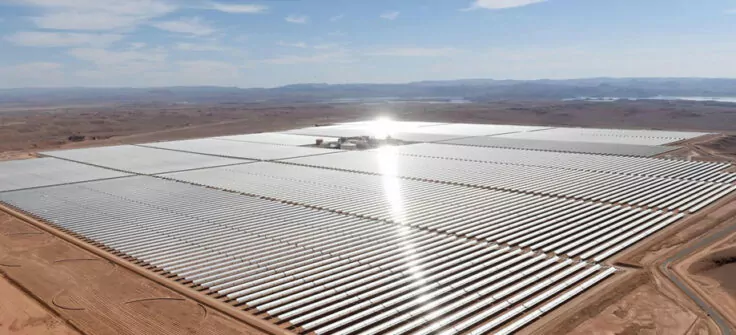
Noor Ouarzazte

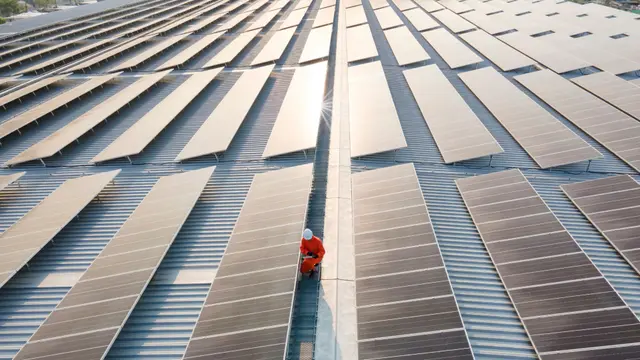
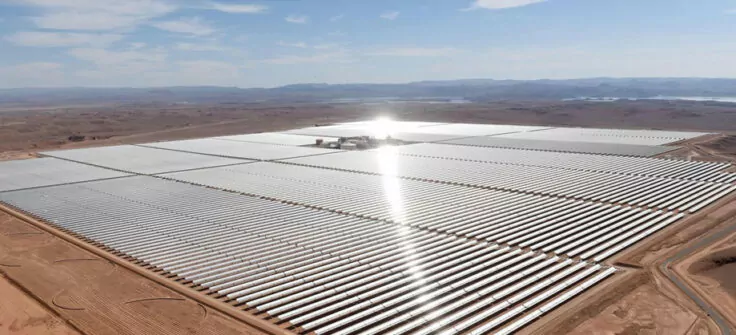
Morocco is turning the Sahara Desert into the largest concentrated power complex in the world. The project is currently in progress, due to be complete before the end of 2018.

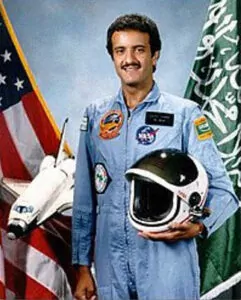
Arabs in Space

Sultan bin Salman Al Saud became the first Arab in space in 1985 – he was also the first royal astronaut ever. Syrian-born Mohammed Ahmed Faris followed in Al Saud’s footsteps in 1987.

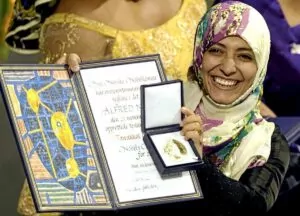
Nobel Peace Prize Winners

Photo credit ODD ANDERSEN/AFP/Getty Images

The Tunisian national dialogue quartet was awarded the Nobel Peace Prize in 2015 for their role in building a democratic state in Tunisia following the Arab Spring.

Yemeni journalist and activist Tawakkol Abdel-Salam Karman preceded the Tunisian National Dialogue Quartet in 2011 as Nobel laureate—she became the first ever Yemini and Arab Woman to win the Peace Prize, as well as the second youngest ever.

The ‘Father of Femtochemistry”

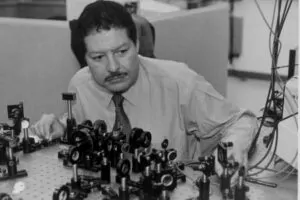
Femtochemistry is probably something too difficult for most of us to understand—but according to Wikipedia it’s “an area of chemistry that studies chemical reactions on extremely short timescales”. Ahmed Hassan Zewail, and Egyptian-American scientist, is known for pioneering a laser technique that allowed for easier analysis of chemical reactions. He even won a Nobel prize for his work in 1999.

Pritzker Architecture Prize Winners

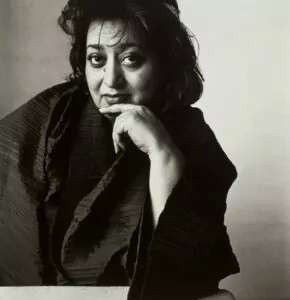
The late Iraqi-British architect Zaha Hadid was an internationally-acclaimed architect, renowned for her sci-fi creations. Having built some of the world’s most innovative spaces. In 2004, she became the first ever woman to win the prestigious Pritzker Architecture Prize—the most prestigious award in architecture.

source/content: mille.com (headline edited) / Olfa Farha

______________

__________

ARABS

MENA COMMUNITIES IN NY, USA : ‘Niyū Yūrk’ exhibition explores MENA influence on the Big Apple , Oct 04 to Mar 08th 2026

Inside the first show dedicated to NYC’s Public Library’s Middle Eastern collections .

Outside The New York Public Library’s Stephen A. Schwarzman Building, the unmistakable scent of a halal food cart mingles with the sounds of various Arabic dialects, while two marble lions stand guard over Fifth Avenue. Inside, entire worlds are waiting to be discovered — including the often-overlooked stories of New York’s Middle Eastern and North African communities. 

“Niyū Yūrk: Middle Eastern and North African Lives in the City,” the first exhibition dedicated to the Library’s Middle Eastern collections, opened Oct. 4. It will remain on view in the Ispahani-Bartos Gallery until March 8. 

Curated by Hiba Abid, the exhibition contains around 60 objects — photos, books, periodicals and audio — dating from the 1850s to 2024. It centers specifically on the library’s own holdings, rather than attempting to tell a comprehensive history of MENA life in New York, Abid tells Arab News. 

Drawing from over a century of rare materials the exhibition uses tangible objects to express the intangible: memory, identity and immigrant culture.  

“It’s not a love letter. It’s a realistic letter,” Abid says, adding that these communities have long navigated complex questions of belonging, language, and preservation.  

“The communities, from the very beginning, were wondering, ‘Where should our kids go to school? If they go to the public New York schools, they would probably lose their language, but we want them to still know Arabic and be aware of our traditions and values,’” she said. 

The exhibition is divided into four chronological sections, designed to help guide visitors of all ages, from young children to seasoned scholars. 

The first section, “Roads to New York,” focuses on the earliest waves of immigration. One of the first featured figures is Hatchik Oscanyan — later known as Christopher Oscanyan — an Armenian man born in what is now Türkiye. He came to New York in the mid-19th century and sought to educate Americans about the complexity of the Ottoman Empire. He wrote plays and newspaper articles, as well as “The Sultan and His People,” a book that offers insight into the region’s diverse ethnic and religious makeup.  

The second section, “A Life in the City,” explores how immigrant communities began to form and thrive in New York, including in what was once known as Little Syria on Manhattan’s Lower West Side — an area that still exists today. They were entrepreneurs who opened restaurants, shops, and began publishing Arabic newspapers.

One of the most groundbreaking was Al-Hoda, founded by Naoum Antoun Mokarzel and his brother Salloum. “In the basement of Al-Hoda Press, they adapted the linotype machine from Latin characters to Arabic characters, which is very hard (because Arabic is) a cursive language,” Abid says. “By this technological innovation, he actually allowed other presses to form and to publish newspapers, periodicals, and books,” which then circulated throughout North and Latin America — and back to the Middle East. 

In other words, New York was instrumental in literally building the Arabic press and exporting news to the Middle East.  

Abid emphasizes how vital the library’s historical collections are to telling these stories.  

“The library has been collecting these materials since the late 19th century,” she says, adding that many of them have been digitized, enabling audiences to interact with them in a new way. 

The third section, “Impressions,” flips the gaze, revealing how Middle Eastern immigrants perceived New York and the US.  

“Many immigrant groups embraced American values… but many (Arabs) actually didn’t like New York and didn’t like American values and left after a few years here or after a few months.” The exhibit highlights these ambivalences and the tensions of assimilation. 

The final section, “In Our Own Skin,” is the most contemporary and, for Abid, the most personal. It includes raw, vulnerable stories that reflect racial identity, Islamophobia, and resistance. Among the most powerful pieces is the short documentary “In My Own Skin,” directed by Jennifer Jajeh and Nikki Byrd, which features interviews with five Arab women in New York, and was filmed just one month after the events of Sept. 11, 2001.  

“The interviews are absolutely amazing. Every time I talk about it, I have goosebumps,” Abid says. “The way they talk about it — it is still very relevant today, as if nothing changed much, except that we’re probably more powerful because we are aware of this and we know how to organize and to fight back. We have the vocabulary now, and the community.” 

That spirit of organization is embodied by Malikah, a grassroots collective founded by Rana Abdelhamid in 2010 as a self-defense class for Muslim women on Steinway Street in Queens. The movement has since expanded into a larger project of empowerment, healing, and solidarity — and is featured in the exhibit’s final section. The powerful sound of the athan, or call to prayer, has been important to this cultural shift. 

While images of the Statue of Liberty — based on an Egyptian woman — didn’t make the cut, but Abid stresses its significance on each guided tour. On this occasion, though, she wanted to focus the visitors on lesser-known gems. 

Having lived in New York for the past four years as a Tunisian immigrant who spent much of her life in France, Abid says she finds New York to be more diverse than anywhere else she has ever lived.  

“I live on Atlantic Avenue in the Syrian corner. The things I witnessed here and in Middle Eastern parts of New York, like Astoria, I could never see anywhere else — even Paris,” she says. “When you go to the exhibition, you actually think, ‘Damn! We actually did a lot. And we’re here, you know—we’re here. 

“It shows how New York was central to all of these struggles and how New York — thanks to its MENA community — was actually connected and aware. It puts New York on a global map, you know? I think New York is incredible terrain for this. It’s the space for it. That’s what this show is about, ultimately.”  

source/content: arabnews.com (headline edited)

______________

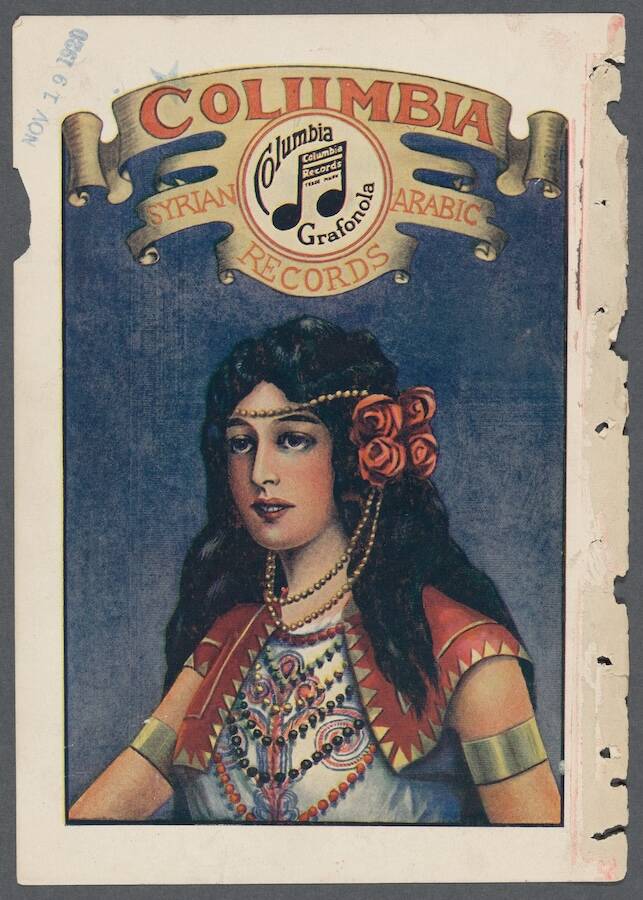
A poster from 1920 promoting Columbia Syrian Arabic Records — Columbia was one of the major American record labels to recognize the commercial potential of ethnic music markets in the US. (Courtesy of The New York Public Library)

Curator Hiba Abid. (Supplied)

___________________________________________

MIDDLE EAST & NORTH AFRICA / U.S.A

SAUDI ARABIA : Heritage leaders honored as Arab Manuscript Day celebrated in Riyadh

Annual event at King Faisal Center spotlights heritage, intellectual legacy

The official celebration of the 13th Arab Manuscript Day was inaugurated on Sunday by Prince Turki Al-Faisal, chairman of the board of directors at the King Faisal Center for Research and Islamic Studies.

Held under the theme “The Arab Manuscript: Life of a Nation and Pioneer of Civilization,” the event was organized in collaboration with the Institute of Arabic Manuscripts at the center’s headquarters in Riyadh.

Prince Turki said: “This day calls upon the memory of thought and allows the soul to listen to the echoes of centuries past.”

He added that Arab Manuscript Day went beyond celebrating paper and ink and honored the consciousness and intellectual legacy that shaped Arab and Islamic civilizations. 

He recalled that the late King Faisal bin Abdulaziz received a delegation from the Institute of Arabic Manuscripts in Riyadh more than 50 years ago, near the site of the current center. 

The meeting, he said, was a moment of “intellectual enlightenment,” during which King Faisal described heritage as a vital part of identity, comparing it to “a rich fountain of culture that never stops flowing.”

Abdulrahman Al-Khunaifer, adviser at the center, said that the day symbolized the convergence of time and place, at which “Damascus, Cairo, Baghdad, and Cordoba meet Riyadh and Diriyah” to celebrate the enduring legacy of the handwritten book.

He added that the center had produced thousands of titles and research projects that had kept the Arab manuscript “alive and beating” throughout history, and that the hosting of this year’s celebration represented the culmination of those efforts.

Three awards were presented during the ceremony: Yahya Mahmoud bin Junaid, a Saudi professor, was named the Heritage Research Personality of the Year in the Arab World.

In his acceptance speech he described heritage as a living tool for understanding modern society and the evolution of intellect, calling for the creation of a comprehensive digital index of heritage books to support researchers. 

The award for Heritage Institution of the Year in the Arab World went to the National Laboratory for the Conservation and Restoration of Parchment and Manuscripts in Kairouan, Tunisia. Its director, Manal Rimah, said the recognition was a tribute to Tunisia’s cultural institutions.

The Heritage Book of the Year went to “The Collection of the Gems of Navigation in the Compendiums of the Benefits of Agriculture,” edited by Ihsan Thannoon Al-Thamiri, a professor from Iraq.

He described the work as an encyclopedic documentation of Arab agricultural knowledge, the result of a long period of dedication.

Since its founding in 1983, the center has become one of the leading global institutions in manuscript care. Its collection includes around 30,000 manuscript titles and 150,000 digitized manuscripts, reproduced in collaboration with major libraries and museums worldwide.

The center has also cleaned and restored about 330,000 books, manuscripts, and documents, reinforcing its position as a key scientific and cultural platform for future generations.

“What King Faisal began five decades ago with the Institute of Arabic Manuscripts is now being continued by his sons and grandsons with modern awareness and cultural dedication,” Prince Turki said as he reflected on the Kingdom’s vision of knowledge and culture as pillars of progress.

source/content: arabnews.com (headline edited)

______________

Left: Prince Turki Al-Faisal gives his opening remarks on the occasion of the 13th Arab Manuscript Day at the King Faisal Center for Research and Islamic Studies; Since its founding in 1983, the center has become one of the world’s leading references in the field of manuscript care. It holds around 30,000 manuscript titles and 150,000 digitized manuscripts. (Supplied)

________________

SAUDI ARABIA