Arabs & Arabian Records Aggregator. Chronicler. Milestones of the 25 Countries of the Arabic Speaking World (official / co-official). AGCC. MENA. Global. Ist's to Top 10's. Records. Read & Enjoy./ www.arabianrecords.org
The award recognises AUC’s Rare and Special Books Library as a leading institution in the preservation and restoration of Arabic historical documents.
The American University in Cairo’s Rare and Special Books Library was awarded UNESCO Jikji Memory of The World Prize. This prestigious award places the American University in Cairo next to some of the world’s leading history conservation entities. The award ceremony is set to take place this coming September in Cheongju-si, South Korea.
Founded in 1992, the AUC Rare and Special Books Library plays a fundamental role in restoring and preserving Egyptian history. Starting with just a few collector’s items, the RBSCL then developed to contain historic maps of Egypt, archives of oral recordings, historical magazines and periodicals, and historical AUC archives.
The UNESCO Jikji Memory of the World Prize is a USD 30,000 grant, given every two years, that honours institutions that have made notable contributions to the preservation and accessibility of documented history. The prize also pays close attention to the degree of expertise in treating said documents and the presence of special circumstances in procuring them.
Funded by the Republic of Korea, the prize was created to commemorate the inscription of the ‘Buljo jikji simche yojeol’, the oldest movable metal print in the world.
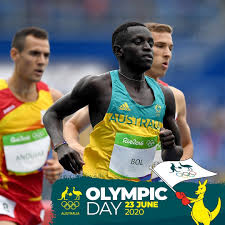
Find out how a kid from war-torn Sudan became an Australian hero who has the world at his fingertips.
You, me, The Pope, your butcher – we’ve all had those moments when we stop what we’re doing, fall silent and ask ourselves, How could this be? How could I have gotten from where I once was (Point A) to where I am now (Point B)? It’s a universal experience, for sure, but it’s going to be more intense for some than others. And it’s hard to imagine that many have felt it more powerfully than has Peter Bol.
You’ve probably absorbed snippets of this guy’s background. He was born in Khartoum, Sudan 28 years ago amid civil war. Via Egypt, he arrived in Toowoomba as a boy with no English or interest in running. That was his Point A.
His Point B was the Tokyo Olympic Stadium last August. It was lining up for the 800m final – the first Australian man to do so for more than half a century – in the fourth most-viewed event in Australian television history. It was leading the pack at the last bend before, yes, two Kenyans and a Pole outkicked him, consigning Bol to that cruel mistress of placing: fourth. It was leaving the media conference to go watch the Boomers play and getting a tap on the shoulder from an Australian Olympic Committee official.
“The Prime Minister wants to speak with you,” the official said.
“Do I have to?” /
“Yes.”
“Okay. Please give him my number.”
After some back and forth, Bol finds himself on the phone with the (then) Prime Minister, Mr Morrison, who’s calling him “mate” and thanking him for his efforts, which, the PM says, had inspired Australians during the challenges of the pandemic. The PM signs off by saying he’d love to meet Bol sometime. That’s a decent Point B.
“Yeah, I’ve come a long way,” says Bol, who’s taking time out from his preparations for this month’s World Athletics Championships, in Oregon, and next month’s Commonwealth Games, in Birmingham, to speak with Men’s Health. “And this is bigger than sports.”
Indeed. Because the story of Peter Bol can be read in any number of ways. You could see it through a purely athletic lens and marvel at how Bol became world class in the classic two-lap race – a long-busting physical examinations that takes you back to schooldays: “Two laps of the oval, boys,” your PE teacher would bark. “And let’s see some effort for a change.” Similarly, it’s easy to be intrigued by Bol’s newfound command of the psychology of performance. But trumping both those elements is how he accepted the hand fate dealt him and played it expertly, transforming from a pint-sized kid from a poor immigrant family into an inspiration – an inspiration who’s intent on being a change-maker. “Now that I am, I guess, a high-profile athlete, I have a responsibility,” says Bol. “A responsibility to call certain things out.”
THE LESSONS OF LOSING
Face to face, the first thing you notice about Bol is how busy his hands are in conversation. It’s as though words alone are insufficient to convey the scope of his meaning or the depth of his feelings, and his hands must come to life to fill the breech. Which makes sense because since Tokyo, Bol has had to grapple with a plethora of new thoughts and experiences.
Tokyo wasn’t his first Olympics. In 2016 he raced in Rio, where he was eliminated in the heats. You might figure, Oh, well, in those intervening five years he must have come on in leaps and bounds as an athlete – as a physical specimen. But that simply wasn’t the case, Bol insists. “Between Rio and Tokyo, the physical part, if it changed at all, it would have only been by five per cent.”
In Brazil, however, Bol learnt a lot about peak performance – or, more accurately, about what prevents it. It was there he battled bouts of anxiety the likes of which he could scarcely have imagined. He’d wake at 4am, trembling, his stomach in knots, his night’s sleep over. “I realised that performing in the big events is about more than running hard every single day of your training,” he says.
When he wasn’t anxious in Rio, he was most likely distracted. Because, man, talk about distractions! Free haircuts. Free food. And there’s…wait…Klay Thompson in the dining room! What’s a bloke who’d rather watch an NBA game than an 800m race supposed to do?
Between Rio and Tokyo, Bol also tested himself at two world athletics championships – in London and Doha in 2017 and 2019 respectively – and tasted no joy at either. Looking back, he sees these disappointments as necessary steps in his maturation. “You build your resilience on setbacks,” he says. “I got knocked out early [at all those meets] and it would have been easy to stop after each one. Athletics: it’s not hard to stop” – because you train relentlessly to face mighty competition, and when you get your butt kicked, stopping cries out to you. Stopping’s a siren song. But Bol covered his ears and kept running.
REALITY CHECK
For mine, one of Bol’s most admirable traits is his aversion to cliches, stereotypes and myth making. Yes, he spent his first six years in an African country wracked by civil war, but he doesn’t want you to assume that those six years were a nightmarish battle for survival, because they weren’t.
“I don’t remember too much,” he says. “I remember family. I remember going to mosque with my grandparents and a little school. And I remember playing football outside with other kids.” The third-born of five brothers, Bol and his family could have stayed in Sudan, but his father was determined they find a better life elsewhere. Travelling solo, Bol’s dad ventured north into Egypt to establish a foothold, at which point the rest of the family joined him when Peter was six.
For a while it was out there in the public domain that the Bols had lived in a refugee camp while in Egypt. But that is incorrect. If it were true, Bol says, he’d have no problem acknowledging it, but it isn’t – some people just wish it were, he suspects, because they think it would enhance his story. But his story doesn’t need enhancing. From his mother, Bol gleaned that family is everything: “For her, separation from family is unbearable.” From his father, the take-outs have been hard work and the power of hope. And bravery: “He wasn’t scared to take a risk, my dad.”
Their time in Egypt tested the Bol clan. While the Sudanese and Egyptian cultures, linked by the Arabic language, are similar, he says, “there was a lot of racism towards Sudanese people. At the same time, there were a lot of great Egyptians. My dad used to iron clothes for work, and he worked with these Egyptians who were the nicest people. But this period was a struggle for my oldest brother. He was four years older than me. He had to look after us when we walked through school, when there was racism going on or there were fights. He had to stand up and be the bigger man while trying to protect us.”
A sadness – an incomprehension – sweeps over Bol as he reflects on those times. “Just seeing people being unkind,” he says. “Why? Was it necessary? We really weren’t trying to bother anyone. We were just trying to live day by day. I hate seeing people being unkind to random people for no reason.” After four years in Egypt, the family was ready for another, bigger move. Bol’s father had relatives in Australia who helped facilitate a shift to Toowoomba, in 2004. The expectation was that the Great Southern Land would offer educational and work opportunities unavailable in Egypt. As it turned out, things didn’t happen quite fast enough in Toowoomba, so in 2008 the family headed west to Perth, where there were more and better-paid factory jobs for the father. Peter eventually landed a basketball scholarship at St Norbert College.
“My family shaped who I am as an athlete,” Bol says. “Because to be a professional athlete, you’ve got to be determined, you’ve got to be consistent, and you’ve got to be committed. My brothers and I competed over everything – PlayStation, sports, learning English. We had that competitive nature. We wanted to be the best. But when we stepped back from competition, we relaxed – we forgot about it all. And my dad was important here, too: when I didn’t make a team, he’d be like, ‘It’s okay – it’s not the end of the world.’”
It took two years’ persuasion by a St Norbert’s teacher for Bol to let go of his hoop dreams and focus on running. By this stage he was 17 – a ridiculously late start for an athlete. Bol’s first track coach was a taskmaster with no tolerance for nonattendance or half-heartedness. While a lot of teenagers would have haughtily pushed back, Bol thought about his coach and realised, You know, this man doesn’t have to be here, so don’t waste his time. “He pushed hard and held me accountable, and I needed that because I wasn’t getting it at home.”
In time, Bol’s running ambitions took flight. At first, he dreamed about being the fastest in his school. When that was ticked off, he imagined being fastest in the state. . .and then the country. “Finally,” he says, his hands waving about like a conductor’s, “it was, Okay, let’s see how far I can get internationally.” Since 2015, Bol has been guided by Justin Rinaldi, head coach of the Fast 8 Track Club. Bol says that when he moved from Perth to Melbourne and started training with athletes who were better than he was, he wanted to know why: what were they doing that he wasn’t? And what should he copy from them to make himself better? In time, however, he came to see that “when you do that, you lose a little bit of yourself each time.” Before Rio, he says, he was too preoccupied with what the Kenyans were doing, what the Jamaicans were doing. “All these different personalities and [me] trying to get a little bit of each one. . .which just doesn’t help you because it gets you so far out from who you are. To perform on the track, you need to be totally confident in who you are and in your abilities. You also need to get your values right off the track: what are your values and are you living by them? At one point I realised, OK, I’ve moved away from home, from family, and yet family is my biggest priority. Okay, let’s get back to family – not physically for now but through phone calls.”
So, in the lead-up to Tokyo, “instead of searching for what other people were doing, I was believing that we [Bol, Rinaldi, training partner Joseph Deng, manager James Templeton] were doing was right. Bring it back to yourself! And once you’re back to yourself, like 100 per cent, man, yeah, you’re kind of on fire. You’re unstoppable. Because you believe in what you’re doing. You believe in your support team and everyone else is just competition.”
A caveat applies here: not copying your adversaries doesn’t mean you ignore them. Come Tokyo, says Bol, he was a student of the 800m. “Whereas before then, I didn’t really care who I was racing against. I didn’t care less. I didn’t watch races, and to be the best you have to watch races and you have to know your competitors. That’s where you learn – off the track. But I couldn’t be bothered watching a race that went for what 1:44 seconds, but I’d watch a whole NBA game. It was crazy.”
READY FOR LAUNCH
Bol laments COVID’s toll on the world as much as the next guy. But insofar as it delayed the Tokyo Games for a year, well, that he appreciated. “Because I was still getting it together,” he says. In 2020, compared to the middle of 2021, “I wasn’t as fit, I wasn’t as strong – and I definitely wasn’t as confident. I needed that year to keep growing.” Ahead of the Games, in the first half of 2021, Bol dominated the domestic season, ultimately recording two times below the Olympic qualifying standard of 1:45.20.
Here’s Bol’s take on perfect preparation: attend meticulously to the basics – and then, on top of that foundation, stack the one-percenters like Pilates, pool running and breathing techniques. And the basics are? Never miss training sessions. Observe recovery protocols. Hydrate right. Sleep right. “I did a whole year of that, and it added up when I came to Tokyo,” he says. “I wasn’t doing that the year before. [Had the Games happened in 2020,] I wouldn’t have made the final. It would have been a completely different story. We wouldn’t be talking now.”
On the flight to Tokyo, Bol gave himself a rev-up about why he was going. It was not to be an also-ran. It was not to gather experience. “I’d served those years,” he says. “I said to myself, I’m going to perform and compete!”
High achievement in any field is about handling the pressure at each new level. Doing that involves keeping that next level – even if it’s the pinnacle – in perspective. For Bol, that meant convincing himself that even though this was the Olympics, he’d still be running two laps of a 400m track about which there was nothing magical; that everything you attach to the Olympics in terms of mystique and grandeur is an optional overlay. “You’re running exactly the same distance you’ve always run,” Bol says. “It’s just with different people on a different track in a different country, but you’re not suddenly running 850 metres.
“Everything you do on the day matters. You’ve got to make sure that everything you’ve done in preparation counts on the day, shines through on the day, because that’s all you’re judged on. The assumption is that, physically, everyone who puts their toe on the line is ready to do well, is in shape. But mentally, are you ready to perform? Are you alert? Are you focused? The best races you’ve ever run, hands down, are those races where you don’t think about anything. It’s like muscle memory. If you’re running a race and you’re thinking, I should make that move, it’s already too late. You should already have made it. Your body should make the move. It should be automatic.”
In his Tokyo heat, Bol set a new Australian record of 1:44.13. The next day, in his semi-final, he lowered the mark to 1:44.11.
Bol loathes ice baths, but with those two fibre-ripping efforts behind him and the final looming, he forced himself into one. There’s another one-percenter right there. In the same vein, he ate heartily to speed up repair of the muscles in his rippling legs and get them ready to propel him into history.
In the final, Bol led through the first lap in 53:76 – two or three seconds slower than you’d expect in a world class 800m. The leisurely pace would suit the faster finishers – the guys with a kick like a mule. Does that describe Bol? Sure. He can do a straight 400m in about 47 seconds and a straight 100m in 11 flat. But, in hindsight, maybe he didn’t trust enough in his finishing speed and kicked a little too early, allowing Kenyans Emmanuel Korir and Ferguson Rotich, as well as Poland’s Patryk Dobek, to overtake him in the straight. (Korir’s gold medal-winning time was slower than Bol’s heat-winning time. It’s a strange beast, the 800.)
THE BIGGER PICTURE
While fourth at the Olympics didn’t earn Bol a medal, it did change his life. Nowadays, he’s getting recognised in the streets. School students write to him. Bigger crowds assemble for his races. Publications want to profile him. Companies want to be associated with him. When Men’s Health spoke with Bol, the ink was still wet on a new sponsorship contract with prestige watchmaker Longines.
“Yesterday I was on a run and a lady wanted a photo,” he says. “I had to say, ‘Sorry, I’m actually running right now.’ It shows how far I’ve come. Eighteen years ago, I came to Australia. Eleven years ago, I wasn’t running – now I’m fourth in the world.” And he thinks he can improve on that by making his 63-kg frame stronger through the glutes, hips, legs and core, and by getting better at race management. He thinks he can bring down his best time to around 1:42. (For context, the world record, set by Kenya’s David Rudisha in 2012, is 1:40.91.) But medals are more important to him than times. And there’s something more important than medals.
I don’t ask Bol about Yassmin Abdel-Magied, the Sudanese-Australian writer and activist whose 2017 “lest-we-forget” Anzac Day post invoking Manus Island, Nauru, Syria and Palestine triggered a campaign of vitriol that led to her fleeing these shores for Britain. I fail to make the country-of-origin association until it’s too late. Consequently, I can only wonder what he thinks about what happened to her, about whether her fate is, for him, a warning on the precariousness of goodwill in this country for a high-achieving person of colour. As such a person, can you hope to be widely admired for only so long as you toe the line?
I do, however, ask Bol a general question about how he feels he’s been treated in Australia. “Australia. Man. [Because of athletics,] I’ve been privileged enough to travel the whole world,” he says. I’ve seen a bit of the racism and discrimination going on around the world…and the gap between rich and poor. No country is going to get it perfect. The best we can do is work towards it. But, in Australia, I’ve lived a good life. I’m living a good life. Yes, there’s racism. Yes, there’s discrimination. And I think my goal, especially now that I have a voice, is to try to change that. You do what you can and only take on what you can handle. Because a topic such as racism, it’s heavy. And it gets to you. But you can only make good changes when you’re at your best.
“But there has been racism a few times. And you have to be strong enough to call it out. And I have – I always do – whether it’s directed towards me or someone else. Now that I have a profile, I get treated differently. But if someone next to me isn’t treated [well], it’s my responsibility to call it out.”
RAPID FIRE QUESTIONS WITH PETER BOL
Favourite exercise / Squat
Least favourite /Anything core
Favourite movie / The Dark Knight Rises
Last book you enjoyed / Jasper Jones by Craig Silvey
Cheat meal /Ice cream
Best advice you’ve received /Be yourself
Biggest fear / Heights
Family motto /As long as we’ve got each other, it’ll be alright.
Words: Dan Williams /Images: Lauren Schultz / by Dan Williams
Qatari dominated his rivals to retain his title with a winning jump of 2.37 metres.
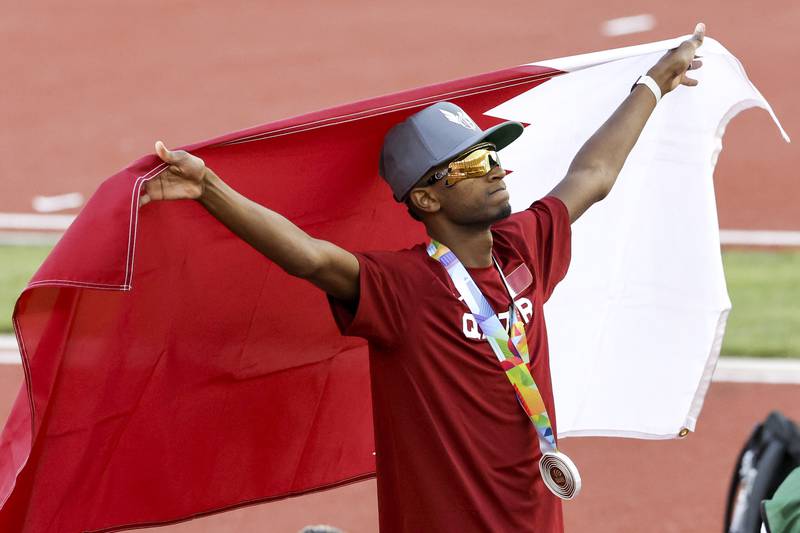
Qatar’s Mutaz Barshim turned on the style to win his third straight world high jump gold medal on Monday after clearing a world-leading 2.37 metres with ease.
Barshim, who famously shared Olympic gold with Italy’s Gianmarco Tamberi last year, jumped beautifully all night at Hayward Field in Eugene, Oregon to go well beyond his own season’s best of 2.30m.
The title was just about secure after he cleared 2.35m but he then eased over 2.37m looking almost in slow motion. With the gold medal then in the bag he had one attempt at a championship record 2.42m but failed.
“The target for me for today was gold medal, if even the world record is the only thing I still miss,” said Barshim, whose best of 2.43m is second only to Javier Sotomayor’s 2.45m set in 1993.
“Three worlds golds in a row is something that has never have been done before. I feel like I have a name in our sport, but I have been never felt like the greatest one in the field,” added the modest Qatari, who also has two Olympic silvers and a world silver to his name.
World indoor champion Woo Sang-hyeok of South Korea needed three attempts to get over 2.33m but then also cleared 2.35m at the second attempt to take silver. Ukraine’s Andriy Protsenko collected bronze on the back of his 2.33m clearance.
Tamberi had a nervous path into the final, twice failing at 2.25m and then twice again at 2.28m in Friday’s heats. In the final he failed twice at 2.30m but then cleared 2.33m at the second attempt before bowing out at 2.35m to finish fourth.
source/content: thenationalnews.com (edited)
___________
Mutaz Barshim celebrates after winning the men’s high jump final at the World Athletics Championships at Hayward Field in Eugene, Oregon, USA, on July 18 2022. EPA
After his recent achievement, El Bakkali became the “king of steeplechase.”.
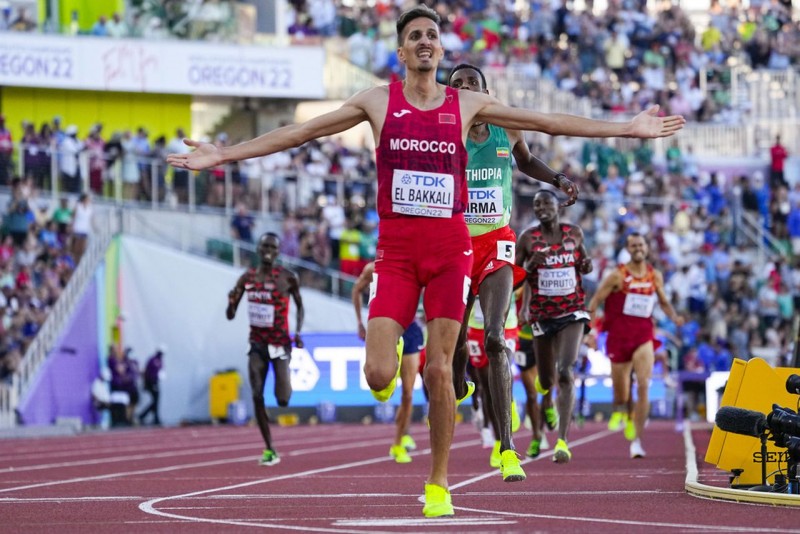
King Mohammed VI sent on Tuesday a message to Moroccan steeplechase runner Soufiane El Bakkali, congratulating him on winning the gold medal at the World Athletics Championships held in Eugene, US.
The Moroccan athlete brought Morocco its first gold in the 3,000m steeplechase in this year’s World Championships, ending Kenya’s 15-year reign in the discipline at the international competition.
The King expressed his appreciation for El Bakkali’s achievement, saying that the Moroccan athlete “was able, thanks to his competitive spirit and patriotism, to achieve this well-deserved victory.”
“As we commend this well-deserved global crown, with which you raised the flag of Morocco in this prestigious international event, we wish you success in your rich sporting career, covered by our generous sympathy and satisfaction,” the King added.
A teary-eyed El Bakkali raised the Moroccan flag after his triumph, telling the media he was dedicating this win to King Mohammed VI, his parents, and to all the Moroccans who have shown him endless support and encouragement.
Several international media reporting on El Bakkali’s recent achievement described him as the “king of steelechase” after claiming world title.
He added, “After the semi-final I had a good look at the strategy of the Kenyan athletes. I was on my own, the only Moroccan in the race, but I did not limit myself to winning silver nor bronze. Instead I managed to come first in two world league meetings and now the World Championship.”
El Bakkali began earning his first medals at international events at the 2017 World Championship in London, where he placed second, before finishing first in the 2018 Mediterranean Games in Spain.
In August 2021, Soufiane El Bakkali gave Moroccans a moment of pride after his historic achievement at the Olympics, ending Kenya’s dominance over the men’s 3,000m steeplechase and winning the gold medal at Tokyo 2020.
Saudi Aramco has been named one of the top 100 global innovators by American analytics company Clarivate.
In its report titled “Top 100 Global Innovators 2022,” Clarivate revealed that Saudi Aramco is the first-ever company from the Middle East and North Africa region to be placed in the list.
“The regional diversity continues to increase, with the first-ever Middle Eastern list entry via energy firm Saudi Aramco,” wrote Clarivate in the report.
Apart from Saudi Aramco, other new entrants to the list are China’s Alibaba, Germany’s Continental, US’ General Motors, South Korea’s Hyundai Motors and Kia Motors, US’s Philip Morris International, and UK’s Rolls-Royce.
Clarivate added that companies have been included in the list based on factors like influence, success, globalization, and technical distinctiveness.
source/content: arabnews.com (headline edited0
____________
Apart from Saudi Aramco, other new entrants to the list are China’s Alibaba, Germany’s Continental, US’ General Motors, South Korea’s Hyundai Motors and Kia Motors, US’s Philip Morris International, and UK’s Rolls-Royce.
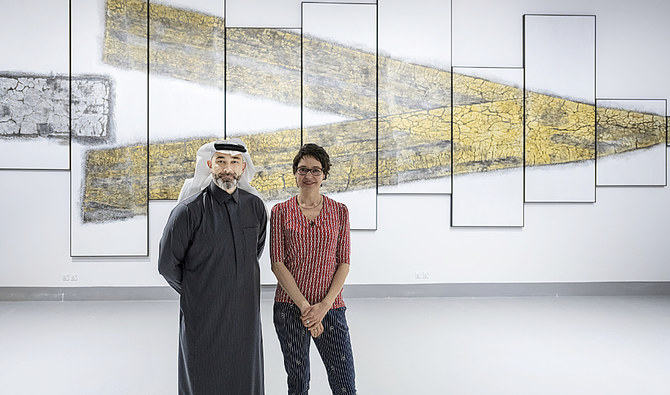
As visitors arrive at the end of the impressive first Diriyah Contemporary Art Biennale their attention is drawn by a gigantic yellow arrow nearly 20 meters long on the wall.
If they look closer at the artwork, titled “E Pluribus Unum – A Modern Fossil,” they can see the numerous cracks in the body of the arrow.
The artwork was created by Tunis-born, Berlin-based artist Nadia Kaabi-Linke, who this year won the fourth Ithra Art Prize. Each year the prize, which was set up in 2017, gives up to $100,000 for the creation of a new artwork that becomes part of Ithra’s permanent collection.
Kaabi-Linke’s massive work presents a contemplative way to look at the pandemic, notably, the decline in commercial air traffic during 2020, which, according to the artist, raises questions as to how humanity measures its progress and environmental awareness versus economic profit.
“The work is meant as a metaphor for modern times,” she told Arab News. “It is particularly relevant to 2020 because all of the airplanes in the world stopped flying.”
The artist relates it also to Tempelhof Airport in Berlin, which has been shut for around 13 years and is used as a camp accommodating up to 7,000 refugees. “I saw a parallel in this because we were all grounded, all of humanity and I think it is an exceptional moment in human history,” she added. “I also wanted to draw the parallel between the aviation industry and the economy. The symbol of economic growth is the rising arrow.”
The cracks, explains Kaabi-Linke, are there because it represents an abandoned airport. The work is a print made from an existing arrow that shows where the planes land and where they take off. “It brings you back to the earth as the cracks in the arrow also refer also to the idea of a cracked earth. The question that the work asks is: Do we want to stay in a world as we know it that has no future or do, we want to take the risk to go to something that is unknown but that probably has a future?”
“At Ithra, our commitment to contemporary art is embodied in this art prize,” Ashraf Fagih, head of programming at Ithra told Arab News. “This year is different for two reasons: First, we have opened up the prize to 22 Arab countries and not just artists in Saudi. Secondly, we are collaborating with the Diriyah Contemporary Art Biennale. To us this has special significance because it means the Ithra Art Prize came back home.”
The prize was previously unveiled during Art Dubai.
“As a distinctive landmark in the Saudi art scene, and in integration with its most prominent event ever, the prize’s artwork was unveiled during the Diriyah Contemporary Art Biennale,” said Fagih. After the biennale the artwork will travel back to Ithra in Dhahran in the Eastern Province to become part of the institution’s permanent collection.
source/content: arabnews.com (headline edited)
___________
Ashraf Fagih, head of programming at Ithra with Ithra Prize winner artist Nadia Kaabi-Linke. (Supplied)
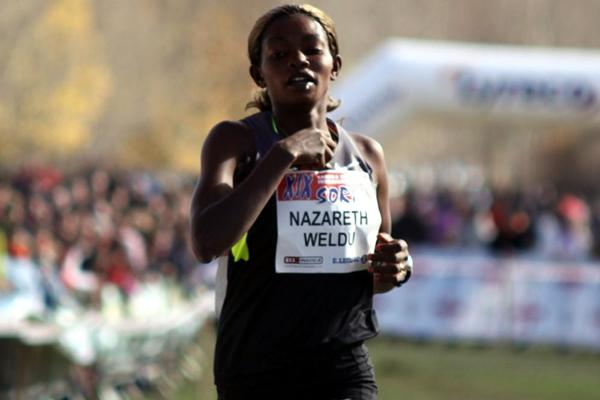
Olympian Athlete Nazareth Woldu registered new record finishing the race in 21 minutes and 28 seconds at the Seoul International Marathon (Daegu) that was held today, 03 April in Seoul, South Korea.
Athlete Nazareth improves the record that was held by herself with 7 minutes.
Moreover, Olympian Athlete Nazareth has improved the 10 km national record that was held by Athlete Simret Sultan since 2006.
Athlete Nazareth has also improved her national marathon record for the fourth time including at the Beirut Marathon 2018, Gold-Coast Marathon 2019, Australia, Milano Marathon 2021 and at this year’s Seoul Marathon 2022.
According to her coach, Livingston Abraha, Athlete Nazareth is preparing to take part at the International Athletics competition that will be held this year in the United States.
The Mereb Setit Athletics Training Center has produced many Olympian Athletes including Nazareth Woldu and Rahel Daniel.
Distributed by APO Group on behalf of Ministry of Information, Eritrea.
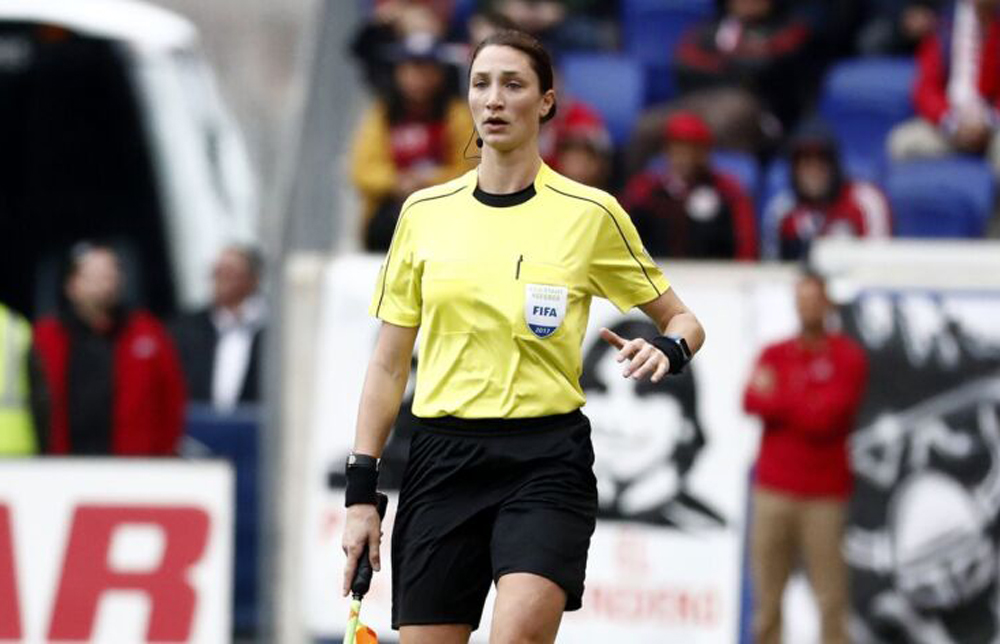
Women referees will officiate matches at the men’s World Cup for the first time in Qatar this year, the sport’s governing body FIFA announced on Thursday.
Three women referees and three women assistant referees will be part of the global showpiece event in Qatar, which will be held from Nov. 21 to Dec. 18.
Referees Stephanie Frappart from France, Salima Mukansanga from Rwanda and Japan’s Yoshimi Yamashita, as well as assistant referees Neuza Back from Brazil, Karen Diaz Medina from Mexico and American Kathryn Nesbitt have all been called up.
A total of 36 referees, 69 assistant referees and 24 video match officials have been chosen by FIFA for the tournament.
“This concludes a long process that began several years ago with the deployment of female referees at FIFA men’s junior and senior tournaments,” said Pierluigi Collina, FIFA Referees Committee chairman.
“They deserve to be at the FIFA World Cup because they constantly perform at a really high level, and that’s the important factor for us.
“As always, the criteria we have used is ‘quality first’ and the selected match officials represent the highest level of refereeing worldwide.”
Frappart became the first female official to be involved in European Championship matches after UEFA included her in the list of referees for the tournament last year.
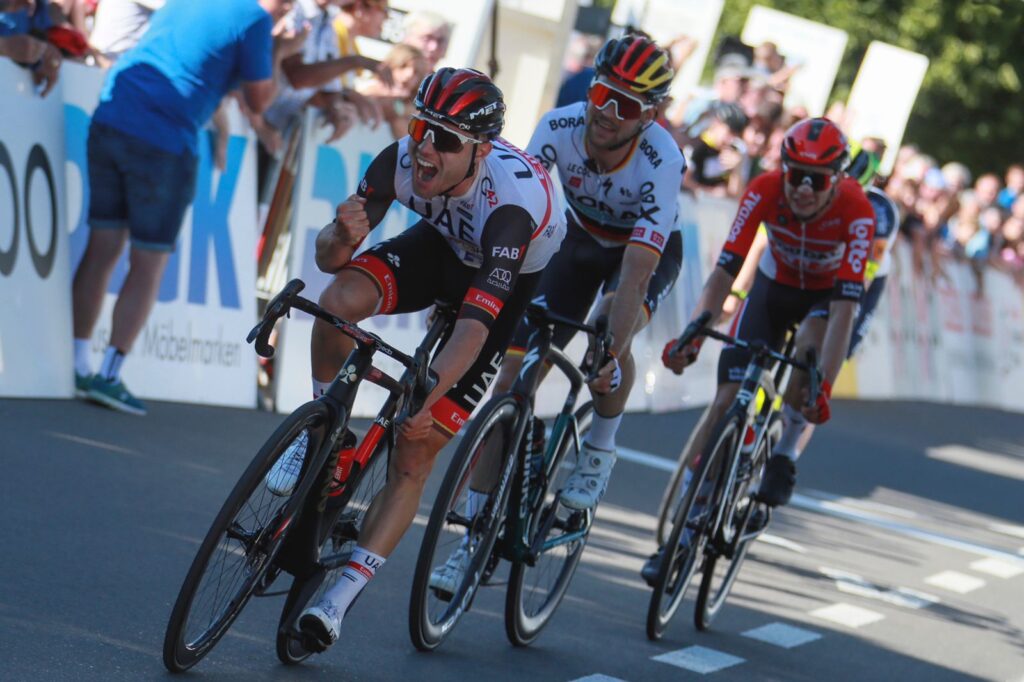
The UAE won the Grand Prix of the Canton of Aargau, Switzerland, yesterday June 10th.
The Emirati squad had strength in numbers in the final with Diego Ulissi and Matteo Trentin covering moves before Marc Hirschi infiltrated the winning break which slipped away at 7km to go.
The 23-year old hit out early from the four man group to open up the sprint at 250m to go to hold off Max Schachmann (Bora-Hansgrohe) and Andreas Kron (Lotto-Soudal) who finished on the podium.
“It was really very difficult”, said Marc Hirsch. “The final was very eventful, because a rider from AG2R Citroën has long been in the lead. In the last climb, it went very quickly behind him, but I was able to accompany in force. Then I was able to close the gap with three guys who had escaped. It was very hard”. In the end, it was a group of 7 which formed 6 terminals from the line, and the winner of the Fleche Wallonne 2020 maneuvered well to finish in the sprint.
In raising the trophy he becomes the first home winner of the race since 2013.
This result marks Hirschi’s second win of the season after storming to victory at the Per Sempre Alfredo classic in April.
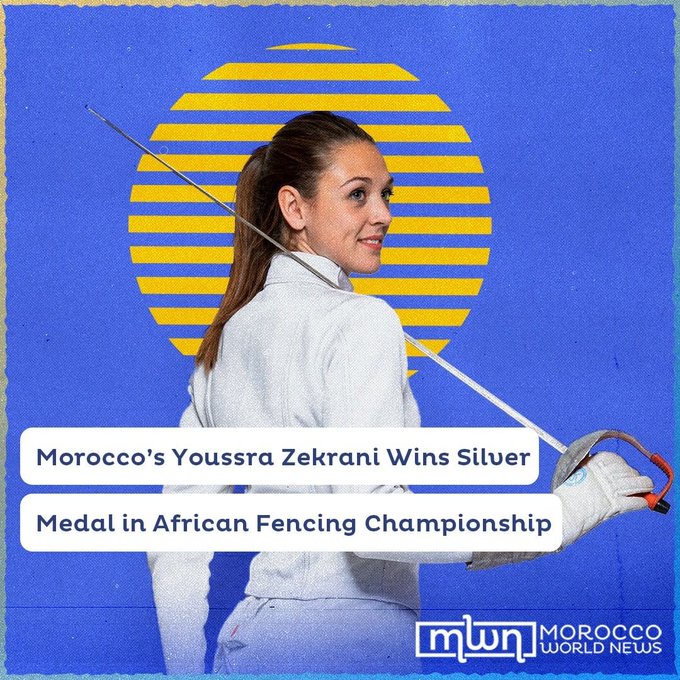
Youssra Zekrani took home a silver medal after reaching the final stage of Africa’s Fencing Championship in Casablanca.
Zekrani reached the final stages of the continental tournament, before losing to Egyptian contestant Noura Mhamad, earning her the silver medal.
In the game against the Egyptian, Zekrani lost by nine points to 15.
Zekrani, who ranked as the 91st best player in the world, faced and eliminated Algeria’s Chaymae Nihar Kamar and Egypt’s Yara Charkaoui in the quarterfinals.
While facing Algeria’s Kamar, the Moroccan athlete won by an impressive margin of 15 to 10. She equally scored a no less impressive score against Egypt’s Charkaoui, winning with nine to 15.
This is not the first time Zekrani makes national headlines for winning a tournament. The Moroccan athlete brought home a bronze medal at the 2016 African Championships. She competed at the Olympic Games in Rio, Brazil.
More than two years later, Zekrani claimed another bronze medal at the African Games in 2019.
This year’s fencing tournament in Casablanca saw the participation of several other Moroccan female contestants, including Manal Kermaoui and Ilham Belefkih.
The Casablanca tournament took place on June 15-19, under the patronage of Morocco’s King Mohammed VI. It saw the participation of athletes from across the continent, with 233 registered participants.