Arabs & Arabian Records Aggregator. Chronicler. Milestones of the 25 Countries of the Arabic Speaking World (official / co-official). AGCC. MENA. Global. Ist's to Top 10's. Records. Read & Enjoy./ www.arabianrecords.org
The festival includes 3 million items manufactured by more than 1,500 international brands.
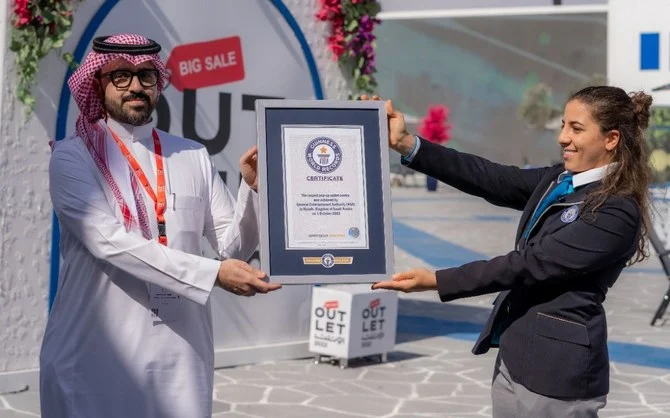
The Outlet 2022 shopping festival, being organized by the General Entertainment Authority, has won Guinness World Records recognition as the largest pop-outlet center.
Covering an area of 146,623 square meters, festival activities started on Saturday in Riyadh. It includes 3 million items, manufactured by more than 1,500 international brands, and discounts of up to 70 percent on fashion, accessories, and cosmetic products designed by international experts.
Farah Ahmed, who lives in Al-Rehab neighborhood where the outlet is located, described it as “impressive,” while Mohammed Al-Bugami, a Saudi private-sector employee, praised the “top organization” he witnessed on the first day.
“I have no words to describe how great and well-organized this festival is. I would like to thank the organizers for their efforts in making this shopping festival a reality,” he said.
Entry to the festival is free and outlet sections include home accessories, leather-made items, bridal gowns, suitcases, and electronics.
The fashion section includes products by names such as Zara, Massimo Dutti, GAP, Ralph Lauren, Diesel, Lacoste, Roberto Cavalli, Versace, and Mango. Additionally, visitors can choose between various sports shoe brands, including Adidas, Puma, and Nike.
GEA chairman, Turki Al-Asheikh, thanked Kuwaiti actresses Hayat Al-Fahad and Suad Abdullah, and Saudi actor Bashir Al-Ghunaim for taking part in the official festival promo that gained millions of views.
The GEA aims to encourage private-sector organizations to develop entertainment activities in the Kingdom. It was established in line with Saudi Vision 2030 to organize and develop the entertainment sector in the country and provide options and entertainment opportunities for all segments of society.
source/content: arabnews.com (headline edited)
__________
The “Outlet 2022” shopping festival, being organized by the General Entertainment Authority (GEA), has won Guinness World Records recognition. (Supplied)
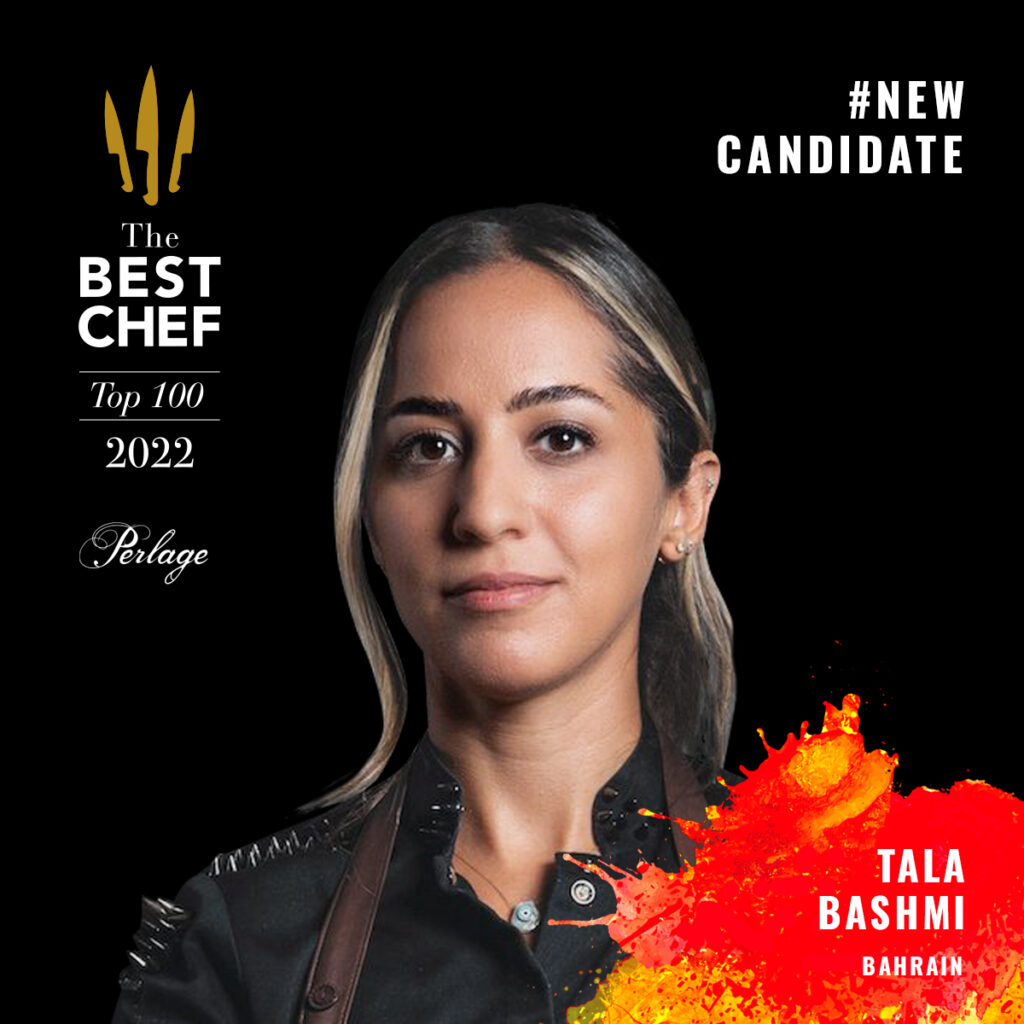
Massimo Bottura, Niko Romito, Yannick Alleno, Heston Blumenthal, Clare Smyth and Anne-Sophie Pic are the big culinary names she’s ranked alongside on the top 100 list for this year’s The Best Chef Awards.
“The people on this list are actual living legends in the culinary field, so for me to be on it at all is amazing,” she tells The National.
“What I’m currently doing is trying to put Middle Eastern cuisine on a global scale, so for me to be the only Arab on this list means I’m taking one step forward to doing that and to give our cuisine its moment in the spotlight and its culinary renaissance.”
Not only is Bashmi the only Arab, she’s also one of only 18 women who have made it on to this list of 100 culinary talents across the globe.
She ranked 93rd, but says the number didn’t “really matter” to her. “Going into this, I had no idea if I was going to make this list,” she says. “I’m from a small island that doesn’t get much exposure, so for me to get this is amazing.”
At the event, which was held at the Crystal Gallery of the Palacio de Cibeles, in Spain’s capital, she met some of her all-time heroes. This includes Andoni Luis Aduriz, a Spanish chef who ranked number five and picked up the award for The Best Science Chef Award. Bashmi describes him as “humble, down to earth and very focused on what matters in this industry rather than distractions around, which I really admire”.
Spain’s Dabiz Munoz picked up the top accolade of The Best Chef for a second consecutive year for his work at DiverXO restaurant in Madrid. Noma’s Rene Redzepi came second, while Spain’s Joan Roca i Fontane rounded out the top three.
Bashmi, who heads The Gulf Hotel Bahrain’s well-regarded restaurant Fusions by Tala, is no stranger to culinary accolades, having picked up her award for Best Female Chef in the region in Abu Dhabi this February. Her restaurant also ranked 39th on the first list of Mena’s 50 Best Restaurants.
She inherited an interest in cuisine and cultural identity from her father through his in-depth knowledge of the ingredients used. She then used this interest to launch Baked by T, before joining the Culinary Arts Academy in Lucerne, Switzerland.
Staying in the central European country, she had roles at the Grand Hotel Les Trois Rois in Basel and the Michelin-starred restaurant Prisma in Vitznau, where she learnt more about restaurant operations, as well as working in fast-paced kitchen environments.
Since returning to the Mena region, Bashmi has competed on MBC’s Top Chef Middle East television show in 2020, where she reached the finals.
In 2017, she took over the helm at Fusions by Tala, where she makes modern interpretations of Bahraini dishes, including the standout bamia, a traditional okra and meat stew, for which she uses Wagyu beef cheek, crispy okra glass and tomato broth rice.
“I try to appeal to every audience from every country, in a sense of bringing them back to a state of nostalgia,” she has previously said of her approach. Bashmi might do this through any of our senses, such as when she adds a campfire aroma to the Saudi-Bahraini dessert aseeda to evoke memories of camping, whether in the desert or the forest.
“I feel like this is still the beginning for me,” she says of her latest achievement. “People haven’t seen what came before, what led to today, so every time something is achieved, it’s a new beginning and opens new doors to opportunities I hadn’t even thought of.
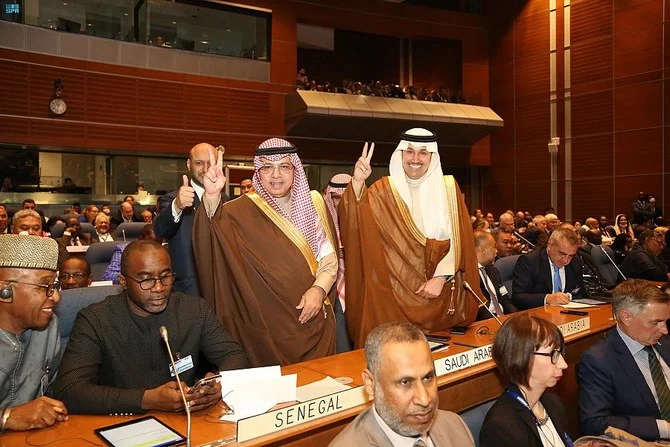
Saudi Arabia was elected to the membership of the Council of the International Civil Aviation Organization until 2025 during voting at the ICAO 41st general assembly in Montreal, Canada.
The Kingdom was re-elected after a voting process with the participation of 193 UN member states.
The council has 36 members, including the US, France, Singapore and the UK, “thus providing a voice to the Arab and Islamic countries,” the Saudi Press Agency reported on Saturday.
Saudi Minister of Transport and Logistics Saleh bin Nasser Al-Jasser praised the importance of the election for the Kingdom, saying: “Since the establishment of the first airline in 1945, the Kingdom has proven its commitment and tireless work toward the aviation sector, both domestically and internationally.”
He added that the Kingdom is now working in line with the vision of Crown Prince Mohammed bin Salman by consolidating its global leadership role in the sector.
Al-Jasser said that the election “represents a broad tribute to the tireless efforts being made by the Kingdom to be a center for air linkage between the three continents to achieve the objectives of the national strategy for transport and logistics services.”
source/content: arabnews.com (headline edited)
___________
Saudi Minister of Transport and Logistics Saleh Al-Jasser attends 41st International Civil Aviation Organization General Assembly in Canada. (SPA)
Mohammad Abdullah Al Gergawi, Minister of Cabinet Affairs, Chairman of the Committee leading Great Arab Minds, and Secretary-General of the Mohammed Bin Rashid Al Maktoum Global Initiatives (MBRGI), highlighted the details of “The Great Arab Minds” initiative.
Launched by His Highness Sheikh Mohammed bin Rashid Al Maktoum, Vice President, Prime Minister and Ruler of Dubai, in January 2022, the initiative is the Arab world’s largest movement designed to search for exceptional talents among Arab scientists, thinkers, and innovators across key fields.
The Great Arab Minds initiative, under the MBRGI, aims to identify, support and acknowledge leading thinkers in the region, amplify their impact and inspire future generations. One of its main purposes is to reduce the emigration of Arab scientists, specialists, intellectuals, doctors, and engineers.
He affirmed that “The Great Arab Minds” initiative reflect His Highness’ vision in reigniting the Arab World’s Civilisation Drive, support great Arab minds and acknowledge their work and achievements, in service of humanity.
Mohammad Al Gergawi pointed out the importance of the Arab Reading Challenge initiative launched by His Highness Sheikh Mohammed bin Rashid Al Maktoum, among many other development projects, serving more than 91 million beneficiaries.
A study conducted by KPMG, showed that ignorance costs the Arab world more than US$2 trillion. The Great Arab Minds initiative aims to change this reality and contribute to shaping a brighter future for Arab generations.
During an event organised in the Museum of the Future to announce the details of the initiative, Mohammad Al Gergawi witnessed the signing of four partnerships between “The Great Arab Minds” initiative and KPMG, LinkedIn, Meta, and Majarra.
The initiative’s mission is to search for exceptional talents among Arab scientists, thinkers, and innovators across key fields, aiming to identify, support and acknowledge leading thinkers in the region, amplify their impact and inspire future generations.
Over a 5-year period, “The Great Arab Minds” will reward scientists, thought leaders, scholars, and innovators across 6 categories: Natural Sciences (Physics and Chemistry), Medicine, Literature and Arts, Economics, Technology and Engineering, and Architecture & Design.
The initiative includes the “Mohammed bin Rashid Medal for Great Arab Minds”, which will be awarded to 6 winners of six categories each year.
The Great Arab Minds initiative aims to facilitate the recognition of Arab thought leaders, scholars, scientists, geniuses, and transforming their ideas to real-life breakthroughs and solutions. It also aims at empowering cluster of Arab scientists and thinkers and building a network of Arab thinkers, scientists, and exceptional talents in various fields to work as one team to drive the Arab world’s intellectual renaissance.
Saudi engineer Mishaal Ashemimry is the newly elected vice president of the International Astronautical Federation, becoming the first Saudi woman to hold the position after receiving 14 majority votes from international representatives.
Her role as one of the federation’s 12 vice presidents enables her to further the development of the space sector globally and consolidate the direction of the IAF.
As a Saudi woman and the first aerospace engineer in the Gulf Cooperation Council, her position strategically places the Kingdom at the forefront of the industry and highlights the country as a global leader in the field.
Since September 2021, Ashemimry has served as special advisor to the CEO of the Saudi Space Commission Mohammed Al-Tamimi, a position in which she consults on developing a national space strategy, creates and leads space programs, and advises leadership on direction and execution.
Ashemimry was previously a space nuclear technology consultant at the aerospace and defense company Northrop Grumman. She also conducted research funded by the NASA Marshall Space Flight Center during her time as a research assistant at the Florida Institute of Technology
At 26 years old, the engineer was also president and CEO of her own aerospace company, MISHAAL Aerospace, established in 2010.
The company developed space rockets, designed and launched its own line of cost-effective rockets titled the “M-rocket” series, completed static tests for hybrid rocket propulsion systems and provided global consultation.
In 2015, Ashemimry won the Inspirational Woman of the Year Award at the Arab Women Awards and in 2018 was awarded for her scientific achievements by King Salman.
She received her bachelor’s degree in applied mathematics and aerospace engineering in 2006 and her master’s degree in aerospace engineering in 2007, both from the Florida Institute of technology.
She is a certified Nitrox, rescue and open water diver, a commercial pilot and is trained in real space flight conditions of zero-gravity.
Ashemimry is an expert in aerodynamics, missile and rocket stage separation analysis, vehicle design, wind tunnel testing, simulations and analysis, and computational tool development.
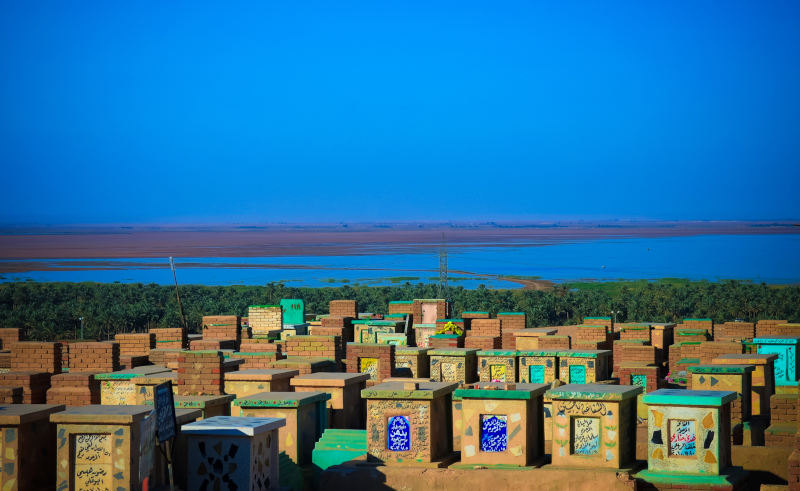
Dating back to the early middle ages, this Iraqi cemetery holds the remains of kings, dignitaries, scholars, and soldiers alike.
Wadi Al-Salam, which means ‘Valley of Peace’ in Arabic, is a necropolis in which every Shiite Muslim hopes to be buried some day, in the belief that it is these burial grounds that will hold eternal peace for them.
Located in the Iraqi city of Najaf, Wadi Al-Salam is a cemetery that dates back to the early middle ages, hosting the remains of kings, dignitaries, scholars, and soldiers alike.
Every year, an estimated 50,000 Shiite Muslims are buried in this hallowed ground. The cemetery stretches across 1500 acres, taking up almost 13% of the city, and allegedly holds over six million bodies. The necropolis, however, isn’t just a morbidly beautiful burial ground. Rather, each tombstone contains a name and an engraving that paints a vivid timeline of Iraq’s (arguably tragic) history, with a hyperfocus on internal disputes, natural disasters, and wars.
In 1981, Rahim Jabr, an Iraqi foot soldier, was martyred in the eight-year war with Iran. 25 years later, his brother, Naeem Jabr, was a casualty of the sectarian civil war that killed hundreds in Baghdad in 2006. The siblings are buried next to each other, united in the necropolis that holds many others whose stories are eternally intertwined with that of the bloody history of this country.
The 2003 invasion of Iraq by the United States and its subsequent conflicts alone led to the graveyard expanding by over 40% (7.5 square kilometres) to contain the bodies of the martyred Shiites.
Wadi Al-Salam has been the responsibility of a single Shiite family for over three centuries, and the Abu Seiba’s stand testament to the cruelty of war, having carried hundreds of thousands of bodies belonging to their brethren into the ground.
Wadi Al-Salam is considered a UNESCO World Heritage site and has been since 2011, as the cemetery stands witness to thousands of years of history, religious tradition and dedication by Shiite Muslims.
Nujoud Fahoum Merancy started the Twitter hashtag ‘YallaToTheMoon’ to support latest mission.
A Palestinian-American woman is one of the leaders of the Artemis missions, a programme by Nasa that aims to fly astronauts to the Moon.
Nujoud Fahoum Merancy, 43, is the chief of exploration mission planning at the US space agency and has been working in the space sector for more than two decades.
She started the Twitter hashtag ‘YallaToTheMoon’ to support the Artemis 1 mission, which is scheduled for another launch attempt on Saturday, from Florida’s Kennedy Space Centre. ‘Yalla’ is an Arabic word that translates to ‘let’s go’ or ‘come on’.
Before the historic event, Ms Merancy spoke to The National about her Palestinian roots and her involvement in the Artemis programme.
A stellar career
The Artemis 1 mission is an unmanned flight around the Moon that will test the performance of the Space Launch System rocket and Orion spacecraft.
If successful, it would pave the way for Nasa to launch Artemis 2 and 3, crewed flights around the Moon and the first human lunar landing mission under the programme.
“As a Palestinian-American, I’m very excited to be a part of this programme,” she said.
“And, really, Nasa and Artemis, it is a much more diverse workforce than it was during the Apollo era.
“It’s important to me and to a lot of us that it represents all of humanity and Artemis itself is international because we have international partners.”
Ms Merancy, a mother-of-two, earned her bachelor’s degree in aerospace engineering from the University of Washington in Seattle.
From there, she joined the aerospace company Boeing to work on the International Space Station.
She then started working on the development of Orion, the spacecraft launching on top of Nasa’s mega Moon rocket on Saturday that will fly around the Moon — and one day carry astronauts.
“From that, I’ve transitioned into the mission planning for Artemis, which is designing and integrating the missions across all the programmes for Artemis, and that’s my current role,” she said.
Connecting with her Palestinian roots
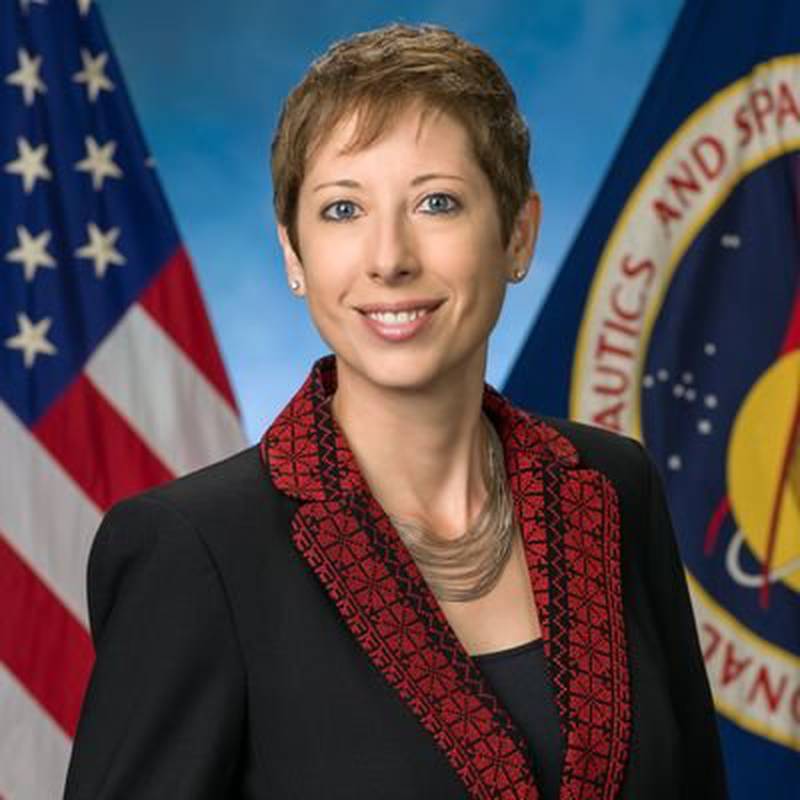
Ms Merancy went viral on the internet in 2019 when she posted her official Nasa photo, in which she wore a blazer embroidered with Palestinian tatreez, a traditional cross-stitch, that she bought during a visit to her father’s home town of Nazareth.
Her father moved to the US more than 40 years ago to go to college.
Although she was born in the US and does not speak fluent Arabic, she said her Palestinian roots were important to her.
“I don’t speak Arabic, unfortunately, it’s one of those regrets that I’ll always have,” she said.
“I know the basics, a few words here and there, and the polite greetings.
“But I do enjoy the food and that is something I grew up on. And then as an adult, I started cooking.
“So, I have a whole bunch of Palestinian cookbooks just to learn other recipes that my family didn’t teach me.
“I do like to cook Palestinian food and that’s probably the biggest connection to the culture that I have.”
Palestinian presence in the space sector
Other Palestinians are involved in the Artemis programme or are making a name for themselves in the US space sector through other projects.
Soha Alqeshawi, born and raised in Gaza city with her seven siblings, currently works for Lockheed Martin as a software engineering associate manager and looks after Orion’s back up-flight software.
And Loay Elbasyouni is a Palestinian-American electrical engineer who helped design Nasa’s Mars rover, Perseverance.
“My parents did their best to provide me and my siblings with a good education and shield us from the effects of the continuous horrific conflict that Gaza has been living under,” Ms Alqeshawi told Portuguese journalist Margarida Santos Lopes in 2015.
“Living under constant fear and despair where everything is uncertain and basic life necessities such as electricity and sometimes water are unavailable for most of the day.
“Although I was the only one in my family who had the opportunity to leave Gaza for the US to study and work, all of my brothers and sisters are college-educated with degrees in science, engineering and business.”
“Going to school was sometimes a dangerous journey that could have death waiting at any step of the way.
“However, that made us more determined to achieve our dreams in receiving an education.’
Nujoud Fahoum Merancy went viral in 2019 when she posted her official Nasa photo, in which she wore a blazer embroidered with Palestinian tatreez, a traditional cross-stitch that she purchased during a visit to her father’s hometown of Nazareth. Photo: @nujoud
It is in times of crisis and conflict that we reveal our character most clearly. This is true today in Yemen, where even the promise of a truce brokered largely by the UN, the US and Saudi Arabia has yet to cement peace or accelerate reconstruction. To do these things, Yemenis must also rebuild the bonds of faith and community that allow any society to thrive.
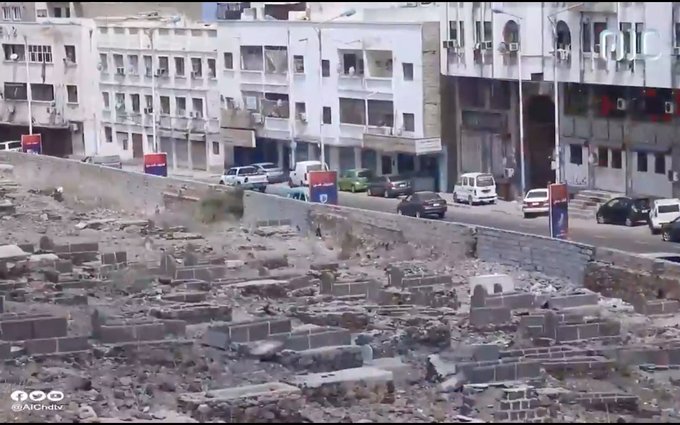
Within the context of these challenges, it is all the more remarkable that Yemenis recently started restoring a 160-year-old Jewish cemetery in Aden. What started as a volunteer effort has now garnered the support of local authorities and Yemeni institutions.
It amounts to a project of interfaith tolerance and embrace in a place where such sentiments have been in short supply. In the last couple of years, Yemen’s Jewish community — one of the world’s most ancient — has disappeared. Most of the remaining few fled to nearby countries after facing persecution and even arrest by the Houthi rebels. Just a century ago, they counted in the tens of thousands and could claim a lineage of almost 3,500 years.
Jewish tradition holds that the cemetery in Aden is where the biblical Abel was buried millennia ago. He is part of the tradition of each Abrahamic faith and the collective memory of Yemeni tolerance remains despite the societal havoc of the last decade.
Each of the Abrahamic religions instructs us to act with kindness toward our brothers and sisters of other faiths. It should be inspiring to all of us to see Yemen’s internationally recognized government and the people of Aden acting in this spirit. I hope this renewed focus on a Jewish cemetery can demonstrate how faith and incremental action can help us overcome the tribulations and pitfalls of extremist politics, sects and conflicts of the past — real or imagined.
The Jewish community of Yemen is no longer, but Yemenis are honoring their own shared past and patrimony by preserving its memory. By respecting the role of Jews in Yemen’s long and storied history, Yemeni leaders are showing inclusivity and a will to protect minorities in the nation’s future as it emerges from this tragic conflict.
The contrast with the Houthi rebels and the racist ideology they propagate is stark. The Houthis prey on religious differences of doctrine and ritual to divide once-harmonious communities in Yemen. Children are drilled to hate in schools, while state workers must chant mantras of death for peoples, such as those in the US and Israel, whom they have never met and of whom they have no conception. Their celebration of innocent Yemenis or Saudis killed is reprehensible.
Analysts today speak of the truce in Yemen in terms of money, men and ideology. These things shift and change, but the need for a functioning society to incorporate people of different beliefs holds true.
The Houthis seem to hold a firm grip over large parts of Yemen. But in this land, with its rich and resilient tribal, religious and societal mosaic, intolerance makes any sense of “control” inherently fragile. The history of Yemen shows that cultish indoctrination does not change a people. Some of its most ancient buildings have crumbled and priceless literature has been lost, but the tolerant Yemen of yore remains alive in stories, poetry and prayer, as well as the hearts of its people.
The cemetery restoration effort is a microcosm of what will need to take place to return Yemen to its true form and traditions of tolerance. While some tear down history and desecrate places of worship and commemoration to create a vacuum to fill with hate for their own benefit, reconstruction efforts like the cemetery can remind all Yemenis of the primacy of tolerance in their culture.
We all pray for an end to the war in Yemen, continued peace and rapid reconstruction. Let us add to these prayers that Yemenis remain on the path to rebuild not just brick by brick, but to rebuild and restore the diversity of the Aden of old in the image of tolerance of our Creator.
As Egypt promotes the trail of the Holy Family as a major tourist experience, Ahram Online republishes an account of stops and cities where the Virgin Mary, Joseph and Jesus found safety and shelter in the country.
“Now when Jesus was born in Bethlehem of Judaea in the days of Herod the King, behold, there came wise men from the east to Jerusalem, saying, Where is he that is born King of the Jews? For we have seen his star in the east, and are come to worship him.”
(Matthew 2:1-2)
———-
The story of the holy family’s journey from Palestine to Egypt has long been recorded with dedication by historians and authors around the world. Many look upon the journey as a mark in the history of Egypt, not merely a religious event. Egyptians look with fondness and pride on the passage of the holy mother and her child through the land of Egypt, and the fact that they found solace here.
The flight to Egypt
The Virgin Mary gave birth to Jesus in Bethlehem of Judaea in Palestine. Upon his birth, wise men preached to the people of the city, declaring that Jesus was the chosen one, and that, “according to prophecies” they had seen in the stars, he would become the next king of the Jews. Upon hearing the news, King Herod was overcome by terror at the possibility of losing his throne. He decided that killing Jesus was the only way to protect his royal status.
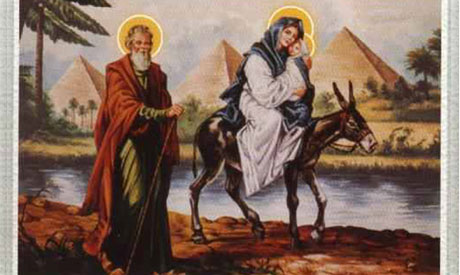
In a dream, Joseph, the carpenter, was ordered by God to escort Jesus and his mother to Egypt, where they would find refuge. Both Western and Eastern traditions agree that the method of transport most likely used by the holy family on their journey to Egypt would have been a donkey. In this situation, the Virgin Mary would have been seated on the donkey, holding the child Jesus in her arms and Joseph would have walked by their side, leading the way.
The holy family in Sinai
Keller writes in his book, The Bible as History (1955): “A day’s journey from Gaza brought the holy family to the ancient township of Jenysos, which is mentioned by Herodotus, the Greek historian.” Today, this village, which is part of the Gaza Strip, is known as Khan Younis. “The next town on the holy family’s route would have been Raphia (Rafah), the frontier town between the Gaza Strip and the province of Egypt.”
Continuing for another 44 kilometres, beyond Raphia, and after almost two days of traveling, the mother and child reach Wadi Al-Arish, a point at which they are safe enough to obtain food and shelter. The holy family passes by other towns in Sinai such as Al-Muhammadia and Al-Farma, located 35 kilometres east of El-Qantara City. Churches from the 5th and 6th century have recently been discovered in Al-Farma.
Route to the Nile Delta
The holy family continued on its trip to the Nile Delta, stopping at the city of Musturod, only 10 kilometres from Cairo. “The Virgin Lady”, a 12th century church, was found in the city.
Keller adds in his book: “The city of Musturod was again visited by the holy family on their return journey to Palestine.” After leaving Musturod and passing by Belbes, the holy family travel west to the Valley of Natroun, crossing the western branch of the Nile (the Rasheed branch).
The holy family in Cairo
The movie Journey of the Holy Family portrays the settlement of the blessed family in Al-Mataraya district near Ein Shams (Old Heliopolis). They find shade under a sycamore tree that came to be known as “Mariam’s Tree,” which has evolved into an engrossing attraction for religious tourists. The holy “Mayron oil,” or the “Chrism,” is nowadays prepared from the oil of the tree.
An ancient church was built in the area by the name of “The Virgin Mary” and is visited by people to this day. Paintings can be found inside the church, including maps of the holy family’s journey, as well as a statue of Jesus and his blessed mother guarded by Joseph the Carpenter.
In his book The Geography of Coptic Egypt (1989), French historian Amelenio narrates some of the stories passed down about the miracles of “Mariam’s Tree.”
One such story tells how “the French army sat by the tree, drank from its well and wrote their names on its stems.” It is believed that some of the wounded soldiers were healed by its oil. Amelenio adds: “Al-Matarya district became the most popular shrine in Egypt; a place where people flooded to for blessings and spiritual remedies.”
The second district visited by the holy family in Cairo was Al-Zeitun, where a church by the name “The Virgin Mary” was constructed in Toman Bey Street. It is said that appearances of the blessed lady were witnessed around the domes of the church up until recent years.
Another spot visited by the holy family was Zowela Avenue on at Been El-Soreen Street in El-Gamaleya district. An ancient church is found there with the same name, “The Virgin Mary”. It is considered one of the largest churches in Egypt and is distinguished by its basaltic style.
The holy family moved on to “Old Egypt” (Al-Fustaat) where they dwelled for a short time in a cave in Abi Serja’s Church, within the walls of the Roman Babylon fortress. “The cave is about 20 feet tall, 15 feet wide and does not have any windows,” as described by Amelenio, who believes the holy family’s stay in the cave did not exceed a week. After leaving Al-Fustaat, they moved to Maadi district and settled at the location where the Virgin Mary Monastery and church were later built by the Nile.
Amelenio explains that during Ottoman rule in Egypt, the church had a marina for boats allocated for the transport of people and soldiers traveling to and from Egypt. Some villages in Upper Egypt were visited by the holy family such as Assiut and Minya. In the book History of the Coptic Nation, author Samy Saleh records that the holy family took the same route on their journey back to Palestine. They first go to Maadi, passing through Old Egypt, then follow the road to Ein Shams, back to the city of Mustorod, and finally El-Arish, and from there to Gaza.
The trail of the blessed
At present, many Egyptian historians and archeologists are calling for a project to track each town or city visited by the holy family, so as to make it easier for tourists to visit the blessed spots, thus reviving the symbolism of the holy journey and its message of peace and goodwill to all men.
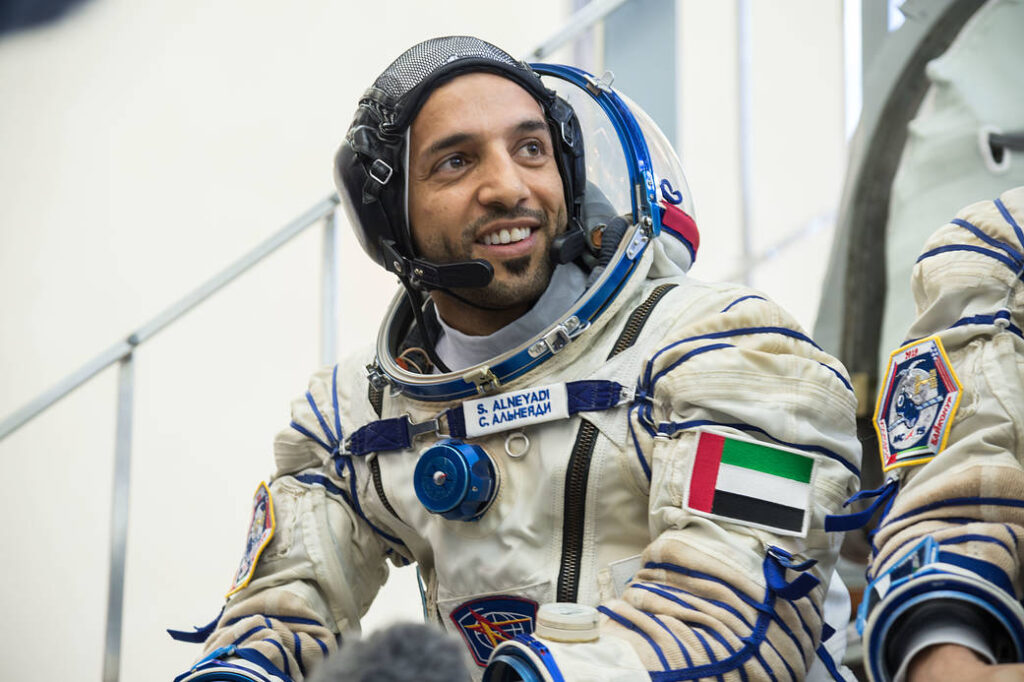
The United Arab Emirates (UAE) became the third Middle Eastern nation to send a man into space in 2019 when it launched Hazza Al Mansouri to the International Space Station, making him the nation’s first astronaut according to catapult. The UAE then rose to the position of the 40th spacefaring nation. Now, Sultan Al Neyadi is another astronaut embarking on a new journey to set new records. An announcement was made earlier last week that UAE’s Al Neyadi will be flying to the orbiting lab on SpaceX’s Crew-6 mission, which is expected to launch in the first half of 2023 from Florida’s Kennedy Space Centre in the U.S. His participation was arranged through a previously disclosed agreement with Axiom Space, a Texas-based aerospace company.
Al Neyadi was chosen among a group of Emirati astronauts to serve as the first Arab astronaut on a protracted space mission to the International Space Station (ISS). The Crew-6 mission will be launched by NASA and SpaceX. Al Neyadi will carry out numerous intricate and sophisticated scientific experiments throughout the flight as a part of the UAE Astronaut Program.
Last year, the UAE made history with its unmanned Hope Probe to Mars by becoming the first Arab country and the fifth globally to reach the Red Planet. The mission has since discovered a new type of aurora on Mars, challenging scientists’ understanding of the planet, which was thought not to possess auroras at all. It is clear that the UAE is looking for possibilities to utilize advanced satellite communications, and use cutting-edge space technology on Earth. Therefore, the UAE established the National Space Fund which is an AED 3 billion fund from UAE Space Agency.
The fund will promote innovative initiatives that assist foreign and Emirati businesses in working together on applications in the engineering, sciences, and research fields related to space. A constellation of sophisticated remote sensing satellites using radar technologies will be the fund’s first project to be sent into orbit and will offer unmatched imaging capabilities.
This fund is crucial since it has made other projects possible and enabled economic diversification. A unifying factor among many of the Gulf Region’s nations is the transition away from an economy reliant on the production and sale of oil. In addition to the UAE, other nations like Saudi Arabia, Bahrain, and Kuwait are currently investing billions of dollars in research and development to open up new businesses, which has gradually raised regional interest in space.
The UAE’s trajectory is one that is ambitious to expand its space sector which was made official In March 2019. This is when the UAE Government launched the National Space Strategy 2030, which sets the general framework for the UAE’s space industry and activities carried out by public and private sectors for the years leading up to 2030.