Category: Uncategorized
14
13
12
Saudi Arabia wins senior leadership role in key UN space body
SOMALIAN-BRITISH : Former refugee from Somalia Cllr Yassin Mohamud becomes lord mayor of Bristol in ‘greatest privilege’
The new lord mayor was born in Mogadishu and came to Bristol over two decades ago.
A former refugee who fled war in Somalia has become the lord mayor of Bristol and will represent Bristol City Council for the next year. The lord mayor is largely a ceremonial role and acts as a figurehead for the city council as well as playing a key part in citizenship ceremonies.
Green Councillor Yassin Mohamud was sworn in as lord mayor for the new civic year during a full council meeting on Tuesday, May 12. The “first citizen” of Bristol stays in post for a year, and is chosen by other councillors. They chair full council meetings and attend a range of events.
Speaking during the meeting, he said he wanted to use the platform to celebrate Bristol’s diversity and celebrate the different cultures and faiths in the city. He added that serving as lord mayor was the “greatest privilege of my life”.
Cllr Mohamud said: “It’s a deep honour to stand before you today as the first lord mayor of Somali origin in Bristol. I look forward to serving all of Bristol over the next year.”
The lord mayor was born in Mogadishu, the capital of Somalia, and grew up in the south of the country. He later worked in the government’s plant protection department, before fleeing the war there and coming to Bristol with his family. They now live in St Jude’s. He was first elected as a councillor in 2021, representing the ward of Lawrence Hill, and was then re-elected in 2024.
He added: “Like so many people who arrive in a new country, the transition was not easy. But luckily for me, the city I arrived in was Bristol. Moving to a country is a great challenge: you must learn a new language and new customs, and work out unfamiliar systems. You must find schools for your children, a job, and most importantly, find community.
“Like many people in our city, my understanding of politics did not begin in a formal setting. It came from my lived experience of moving to Bristol. It came from seeing how decisions affect everyday life, the quality of housing, the safety of streets, the opportunities available to young people, and whether communities feel seen and heard.”
Following the Barton House evacuation in 2023, he worked with colleagues to push for changes that better support residents affected by unsafe housing conditions, and has supported efforts to reopen and protect community spaces in tower blocks.
The outgoing lord mayor was Conservative Cllr Henry Michallat, who will become the deputy lord mayor for this year. Colleagues praised his “wisdom above his years”, while he said he had attended more than 420 events over the course of last year, and oversaw more than 1,200 people becoming British citizens.
Cllr Michallat said: “One of my highlights was championing my theme as lord mayor: supporting the arts, culture and history of the city. It was great to go to so many historic institutions across our city, as well as lots of music venues. I particularly enjoyed sitting through the amateur dramatics performance of Les Mis in my chain, that was very good.
“It was also an honour to represent Bristol on the world stage. In March I went to Guangzhou in China and met the mayor and various politicians and people within the local community, as we approach our 25th anniversary of our twinning relationship. In April I went to Bordeaux in France and met the deputy mayor at their City Hall, ahead of our 80th anniversary of our twinning.”
source/content: bristolpost.co.uk (headline edited)
_____________
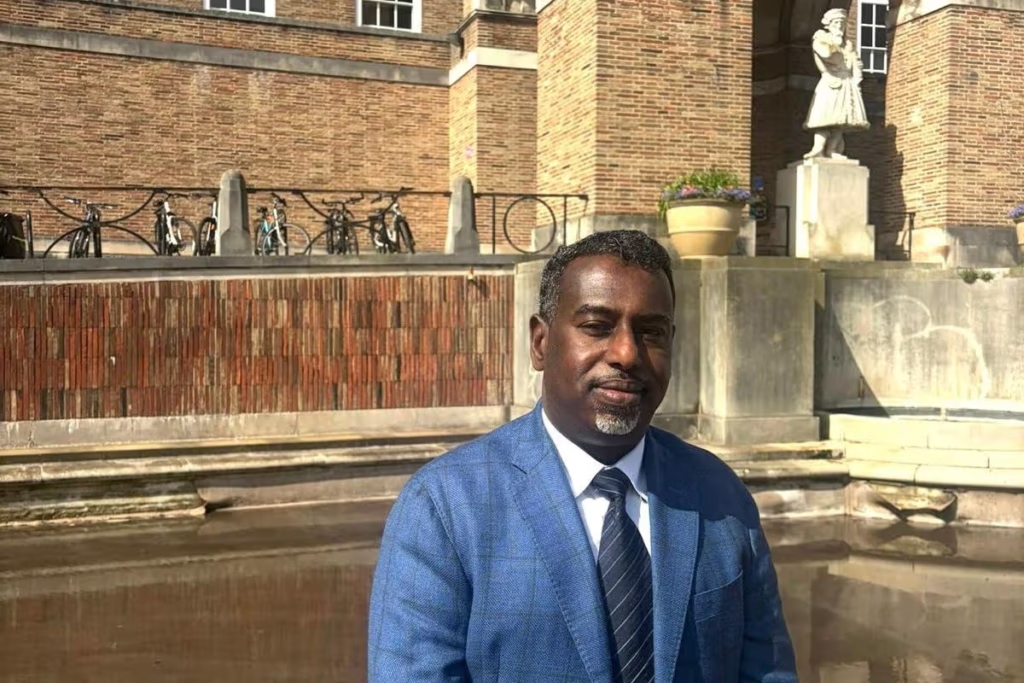
Cllr Yassin Mohamud outside of Bristol City Hall (Image: Bristol Green Party)
______________________
BRITISH / SOMALIAN
ALGERIAN Yasser Triki Records World’s Best Triple Jump Result This Season, Liévin International Meeting
Algerian athlete Yasser Triki recorded the world’s best triple jump result this season on Thursday evening, achieving a leap of 17.35 meters during the events of the Liévin International Meeting in France, part of the World Athletics Indoor Tour Gold.
Yasser Triki succeeded in taking first place deservedly, recording a jump of 17.35 meters, which is the best globally so far in 2026, and the third-best mark in Triki’s sporting career.
The victory of the Algerian champion came in a strong competition that saw the participation of an elite group of the most prominent specialists in this sport, led by Jamaican Jordan Scott and Cuban Lázaro Martínez, the bronze medalist at the 2025 World Championships.
Following the end of the competition, Triki expressed his happiness with this achievement, saying: “I am very happy to be here in Liévin once again, and I hope to participate in this meeting until the end of my career.” He added, “My coach and I expected to achieve (a jump) between 17.30 and 17.40 meters after reaching the final stages of preparation for the World Championships. The main goal for me is the World Championships a month from now (…) The best performance, you haven’t seen it yet.”
With this new achievement, Triki continues to honor Algerian athletics on the international stage, enhancing his chances of achieving positive results during the upcoming international events.
source/content: news.radioalgerie.dz/en (headline edited)
_____________

______________
ALGERIA
SAUDI ARABIA hosts 39th ARAB INTER-PARLIAMENTARY UNION (AIU) CONFERENCE by videoconference, June 10-11
Arab parliament speakers to meet online June 10-11
AIPU gathering to focus on coordination, stability and Arab solidarity
Saudi Arabia will host the 39th Conference of the Arab Inter-Parliamentary Union by videoconference on June 10-11 under the patronage of King Salman.
The meeting, organized by the Saudi Shoura Council and the AIPU, will bring together speakers of Arab parliaments and legislative councils along with delegates from several regional organizations.
Shoura Council Speaker Sheikh Abdullah bin Mohammed Al Al-Sheikh said the royal patronage reflected Saudi Arabia’s support for joint Arab cooperation and efforts to reinforce regional security and stability.
He said Arab parliamentary coordination was essential to confront shared challenges, unify positions and promote development and integration in the Arab world.
Al Al-Sheikh added that the conference was expected to strengthen parliamentary diplomacy and support coordination on Arab issues at regional and international levels.
Founded in Damascus in 1974 after the October War, the AIPU is a regional body that seeks to deepen cooperation among Arab parliaments, coordinate positions on regional and international issues, support Arab solidarity and national security, and promote dialogue, representative democracy and human rights.
The 38th Conference of the AIPU was hosted by Algeria on May 3, 2025.
source/content: arabnews.com (headlines edited)
_______________
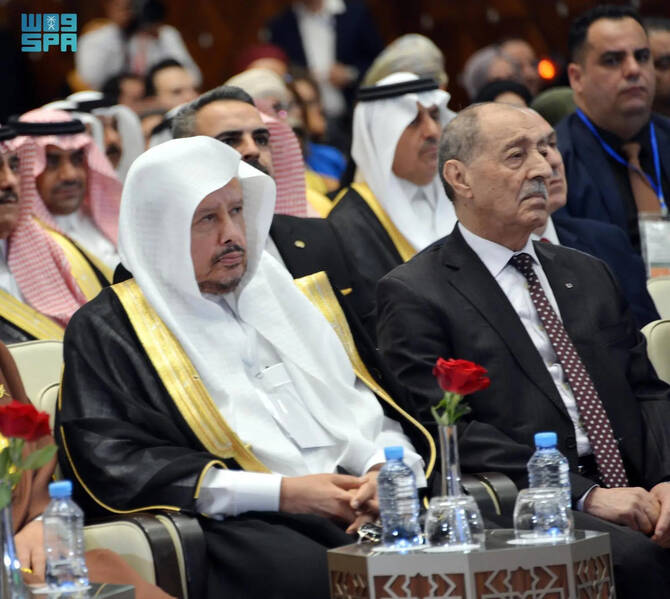
This photo taken on May 3, 2025, shows Sheikh Abdullah bin Mohammed Al Al-Sheikh, speaker of Saudi Arabia’s Shoura Council, attending the 38th AIPU Conference in Algiers. (SPA)
__________________________________________________________
SAUDI ARABIA / ARAB INTER-PARLIAMENTARY UNION
MOROCCO: ‘The Maghreb, a French Colonial Invention’
Anthropologist Abdelmajid Hannoum has just published a fascinating historical enquiry into the origin of the term Maghreb, invented to a large extent by the theoreticians of French colonialism. That word, which he has studied in various archives, especially those of the Bureaux Arabes, did much to cut the region off from the rest of the African continent and the Middle East.
Abdelmajid Hannoum is an anthropologist who teaches at Kansas University and is the author of a scholarly tome on the history of North African mythologies. Based on Arab sources and colonial archives, his work has led him to analyse with remarkable precision the figure of the Berber queen Kahina or the relationship between colonialism, violence and modernity. Cambridge University Press has published this year his latest book: The Invention of the Maghreb. Between Africa and the Middle East, a work which raises a major question: is the Maghreb a colonial invention?
Hannoum exposes the consequences which the colonial narrative had—and continues to have—on the genesis of North-African regional groupings since, in his view, colonial rhetoric was not content to wreak havoc among existing identities and traditions but created others out of whole cloth. These seem authentically local but have never been any such thing. The term Maghreb, he claims, is not the least of these inventions.
Consider the name Maghreb; it is almost unchallenged. It appears Arab, even local, from the heart of the local tradition, yet it is a francophone name as well, invented from a translated Arabic tradition, its ’foreign’ resonance hiding its colonial invention. (p. 232)
Nation-building narratives
As a geographical, historical, and anthropological construction, the Maghreb was isolated by the theoreticians of French colonialism in Africa as well as the Middle East. Of course, as Hannoum reminds us, the notion that Egypt and the Maghreb constitute two separate zones is not only a colonial idea. Both Romans and Arabs distinguished Egypt from Africa/Ifriqia. However, nowhere do they mention the idea of a “white” Africa as opposed to a “black” Africa, notion developed much later by geographer Emile-Félix Gautier and taken up by historian Charles-André Julien.
Hannoum’s book inaugurates a reflection on the function of history and its relation to the structures of power. He points out that contrary to the colonising nations, the Ottomans made few efforts to develop methods of power based on historical narratives intended for societies under the sway of the Sublime Porte. Their writings describing the past took the form of chronicles or annals but were not meant to be nation-building instruments. The idea was to confer legitimacy on the Sultan’s power, not to grant any to his subjects by way of an historical narrative:
The conception of history (of which archaeology is a part) as a” science” of the past, one that is politically useful, and even vital since it provides the substance of the nation and the validation of the state, is part of modernity (p. 19)
Hannoum shows that Western modernity is characterised not so much by the elevation of history to the rank of sconce as by its accession to the rank of discipline capable of legitimising the construction of a nation and the validation of the State. In the Ottoman provinces, on the other hand, “Even in the work of Ibn Abi Diyâf 1, history remains an auxiliary of religion, not a major tool for building nationhood” (p. 19). Nationhood is achieved without any separation from the centrality of Islam.
As early as the 17th C., he reminds us, the ruling regimes present in Tunisia and Algeria were perceived as autonomous and negotiated as such with the European powers. The efforts made later to conceptualise and describe the geography and boundaries of the Maghreb were accomplished by French officers, scientists and colonial officials. Even after independence, a good many local and national historians continued to use models inspired by the colonial narrative and to write them down in French:
Hence, the sad observation that French—not Arabic—remains the language of the study of the area, its history, its culture, its population, even its intimate sexuality. (p. 23)
A cartographic invention
Several sections lend credence to the idea that the Maghreb is a French invention. The first associates geography and cartography. Maps are cultural artefacts produced by the power structure and State institutions. “For even as states have the monopoly over historical production, so do they over cartographic production” (p. 31). Thus, the map of the Maghreb is a graphic representation produced by the colonial power structure: “(…) the Maghreb itself is not only a French colonial creation but also the product of and the field of colonial power”.
18th C. cartographers depicted a region called Barbary, sometimes split up in different units (Kingdoms of Morocco, Algeria, Tunisia and Tripoli) from which Egypt was excluded as was “Black Africa” (called “Nigrita”). While the region did not wait until the 1830s to be mapped, the occupation of Algeria and its annexation by France constituted a decisive break with the old maps. As the conquest of the country proceeded, the French presence in Algeria served as an argument to justify its occupation of Tunisia to the detriment of Italy, and Morocco, to the detriment of Spain.
Maps were soon showing a North Africa devoid of Libya—under Italian influence—and of Egypt under the sway of Britain, —in other words an Africa identified with French possessions. In Hannoum’s view, “Atlases are not just maps whose signs are to be read and deciphered” (p. 65). They express power relationships and the cartographic division between North Africa, West Africa and East Africa was based not so much on anthropological realities as on the rivalries between colonial powers.
A partial vision of archaeology
The author’s second approach is through archaeology, which he designates as one of the most important disciplines involved in the creation of modern identities.
Dealing with the importance attached to the ancient ruins unearthed in Algeria and the Maghreb, Hannoum points out that the French colonial imaginary encompassed Islamic as well as Roman history, the former being envisaged as “other” while the latter was “ours”. The presence of Roman ruins in Algeria and the interest they aroused contributed to the construction of a narrative which made Algeria an extension of Rome and, by identification, a part of France. Prioritising Roman archaeology, colonial research made short shrift of other narratives: Punic, Arab, Islamic or Berber. Thus, the Arabs were regarded as an illegitimate population since they came from the East to a region which was “historically” Western.
Hannoum develops the concept of historiographic state. After 1870 a colonial state asserted itself in Algeria. Not content to produce the tools for knowing and governing the colony, it also transformed the colony thanks to that very knowledge. From then on, history became the key discipline, serving to legitimise colonial sovereignty. This later became more sophisticated with the creation of such institutions as the University of Algiers, where the faculty included such important figures as Stéphane Gsell and Fernand Braudel.
The historiographic state made Algeria a French territory and created the semantic foundations for a region called the Maghreb. In this sense it was different from the ethnographic state, the form taken by the power in the early days of armed conquest. It was in 1870 that the civil authorities took over from the military and the historiographic state replaced the ethnographic state. Historians took over from the officers with ethnographic training who had manned the Bureaux Arabes and assumed the task of validating colonisation through the traces of the past. In other words, history—as is so often the case—placed itself at the service of present-day needs.
Hannoum also shows how that conception was popularised by way of tourist guides:
Tourist guides of the Maghreb reinforce the idea that the region is a single unit and yet, despite distance and geographical interruption between it and France, it constitutes a continuous part of the metropole, linked to it by historical connections (p. 113).
The ruins of Volubilis, that “Moroccan Pompei”, served to bind Morocco to a Latinity of which France claimed to be the heir. This picture postcard Maghreb, made up of shots of archaeological diggings was also illustrated by French novelists, from Flaubert to Camus.
Language, race, and territory
The author’s third approach is threefold, associating language, race, and territory. Descriptions of the Maghreb have, to this very day, ascribed a key importance to the distinction between Arabs and Berbers. That dichotomy was built on a racialist basis drawn from Arthur de Gobineau’s theory of races which held sway in Europe well beyond the 19th C. Hannoum points out that immediately after its military conquest, the first visitors to Algeria—among them de Tocqueville and Louis-Adrien Berbrugger—did not fail to observe the diversity of the population.
While Berbrugger saw the inhabitants of Algeria as belonging exclusively to the Semitic race, he did admit that the latter was highly varied, made up of Jews, Turks, Moors, Kouloughlis, Berbers, and Arabs. On the other hand, Hannoum tells us, a decade later, i.e. after the 1850s, this description of racial diversity vanishes to be replaced by the Arabs/Berbers dichotomy. Hannoun thinks the Bureaux arabes are at the origin of that dichotomy. It was in Algeria that they first made this sharp distinction between Arabs and Berbers, and later Morocco, when the Native Affairs Service was established to replace the Bureaux Arabes.
Hannoum believes that the idea of setting up a barrier between Arabic and Berber, defining Arabic as a non-native language, differs from the Arab conception of the language, less rigid if we abide by the one established by Ibn Khaldùn. The latter distinguished between two language categories: lisân (لسان) and lughât (لغة). The lughât is the abstract language spoken and written by a generation. The lisân is an updating of the lughât, now spoken by the present generation, the everyday language of practical things, a living language that changes as it passes from one generation to the next. Ibn Khaldùn was also aware that it was likely to vary through contact with non-Arabic speakers, and his conception of the language was a dynamic one.
Hannoum goes on:
Colonial linguists constructed Berber as a single language that crosses northern Africa from central Morocco to Libya. But the various “Berber languages” are as distinct from one another as Hebrew from Arabic and as Arabic from Aramaic (p. 137).
According to him, a new generation of orientalists seem to have refined the racial concept using a linguistic argument. But in the last analysis, they hitched language to the concept of race in order to create geographical and cultural particularities equivalent to the old racial prioritisations. The colonial postulate remained that of the purity of language—be it Arabic or Berber—in line with the purity of race. In this sense, Arabic was described as a language foreign to Algeria and by extension to North Africa.
One strange fact revealed by Hannoum concerns Emile-Félix Gautier who was the chief historian of North Africa in the inter-war years and yet who spoke neither Arabic nor Berber. It was he, nonetheless, who imposed the name Maghreb for the three French colonies in Morocco, Algeria and Tunisia2. He built a legitimacy inscribed in ancestral times to justify the colonial separation between French Maghreb, Italian Libya and British Levant. He cast aside Arab historiography—which he could only read in translation—on the pretext that it was unintelligible for a Western mind and undertook to reinterpret the region by emphasising the role of the Berbers and their European connections. In Gautier’s interpretation, Hannoum explains, if the Berbers, sedentary villagers, who have much in common “with us”, were incapable of forming a nation it was because they were prevented from doing so by the predations of the nomadic Arabs.
Hammoun does not confine his critical analysis to French and European authors but extends it by pointing out how modern authors in the Moslem and/or African traditions have sought to elaborate a different narrative. He concludes that whether they come from Muslim traditionalism, Arab nationalism or “négritude”, they often turn the colonial narrative upside down but without changing it in any way.
source/content: orientxxi.info / julien lacassagne (headline edited)
_____________
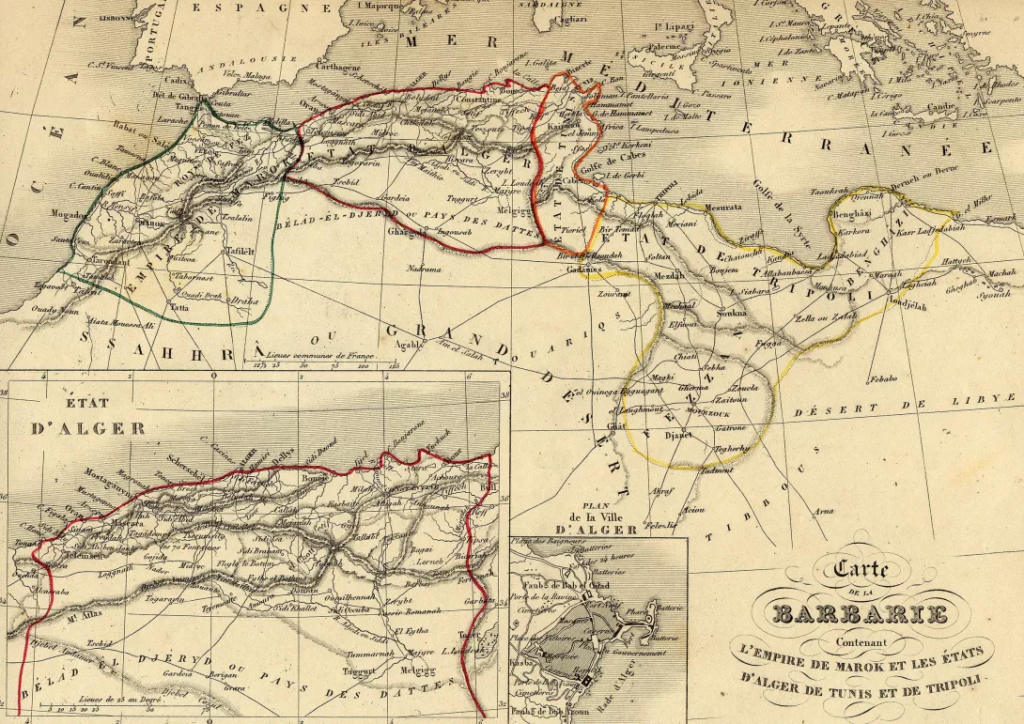
Map of the Maghreb (1843) by the geographer Alexandre Vuillemin, taken from his Atlas universel de géographie ancienne et moderne à l’usage des pensionnats (Universal Atlas of ancient and modern geography for the use of boarding schools)
Wikimedia Commons
_____________
MOROCCAN / FRENCH / AMERICAN
ABU DHABI, U.A.E: AD Ports enters Latin America with $835m Brazil terminal deal
Abu Dhabi’s AD Ports Group has entered the Latin American market through the acquisition of Brazil’s Corredor Logistica e Infraestrutura, a leading independent agri-bulk port terminal operator, in a deal valued at 3.1 billion dirhams ($835 million).
The move strengthens AD Ports Group’s exposure to global agricultural supply chains through key export terminals at the ports of Santos and Itaqui. CLI operates two strategic assets under long-term concessions.
CLI Sul, located at the Port of Santos, is a major sugar export terminal and an important gateway for corn and soybean shipments. CLI Norte operates at the Port of Itaqui in Brazil’s rapidly growing “Arc of the North” logistics corridor, a major route for agricultural exports.
The acquisition reflects growing efforts by Gulf logistics and infrastructure companies to expand internationally through investments in strategic assets along global trade routes. Brazil, one of the world’s largest exporters of agricultural commodities, has attracted increasing investor interest amid rising demand for food security, supply-chain resilience and export infrastructure.
Mohamed Juma Al-Shamisi, managing director and CEO of AD Ports Group, described the acquisition as a “game changer” for the company.
“The transaction extends our group’s international reach for the first time into Latin America, and deepens our growing agrifoods activities, one of our core verticals,” he said.
AD Ports Group, which operates in more than 50 countries, said it is acquiring CLI from joint owners Macquarie Asset Management and IG4 Capital. CLI owns 100 percent of CLI Norte and an 80 percent stake in CLI Sul.
Al-Shamisi said the investment would strengthen the company’s global network while supporting trade in one of the world’s fastest-growing agricultural commodities markets.
Fernando Lohmann, head of Macquarie Asset Management in Brazil, said the country’s agricultural export sector continues to demonstrate resilience, reinforcing its role as a leading global supplier of agricultural commodities.
He added that AD Ports Group is well-positioned to support CLI’s next phase of growth.
Paulo Todescan L. Mattos, co-founder, managing partner and CEO of IG4 Capital, said the company had focused on strengthening CLI’s operations and positioning it for long-term growth since becoming a shareholder.
He said AD Ports Group brings global trade expertise, infrastructure capabilities and a long-term investment horizon that will support the business going forward.
According to the company, ports and terminals in northern Brazil recorded the country’s fastest growth in 2025, underscoring the rising importance of the Arc of the North corridor in reshaping Brazil’s logistics network.
The transaction is expected to close in the second half of 2025, subject to regulatory and antitrust approvals. CLI’s senior management team will remain in place following completion.
The acquisition expands AD Ports Group’s global footprint across maritime, logistics and trade infrastructure while establishing a presence in South America’s growing agri-bulk terminal sector.
source/content: arabnews.com (headline edited)
______________
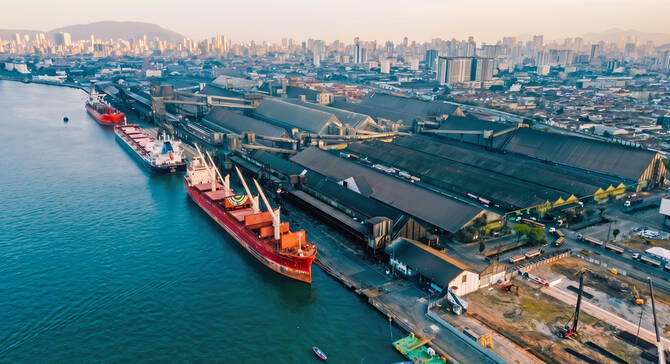
The move strengthens AD Ports Group’s exposure to global agricultural supply chains through key export terminals at the ports of Santos and Itaqui.
_____________________
ABU DHABI, U.A.E