Arabs & Arabian Records Aggregator. Chronicler. Milestones of the 25 Countries of the Arabic Speaking World (official / co-official). AGCC. MENA. Global. Ist's to Top 10's. Records. Read & Enjoy./ www.arabianrecords.org
After the COVID-19 pandemic sparked a near-two-year closure, the Arab American National Museum in Dearborn, Michigan, has finally reopened its doors to visitors.
Founded in 2005, AANM bills itself as America’s first and only museum devoted to telling the stories of Arab-American history and culture. Its location is apt; Dearborn is home to the largest Arab community in the US — around 40 percent of the city’s population is of Lebanese, Syrian, Yemeni, Iraqi, or Palestinian origin.
eaturing a courtyard, a fountain, and thematic spaces, the interior of AANM pays homage to Middle Eastern and North African design and architectural aesthetics. Through its galleries, the museum details Arabs’ varied contributions to humanity, and the phases of Arab immigration: the challenges of coming to America, the challenges of establishing a life there, and the impact of Arab-Americans in the public and private spheres.
It tells the stories of peddlers, entrepreneurs, scholars, military men and women, artists, and entertainers. There are some important but relatively unknown names highlighted. Take Ruth Joyce Essad, a fashion designer born in 1908, for example. She became one of Detroit’s first couturiers — dressing socialists and singers, including big-band vocalist Dinah Shore. Another interesting personality is the Syrian business owner Leon B. Holwey, who claimed to have co-invented the ice-cream cone in the early 1900s.
On a national level, the profile of Arab-Americans was raised last year by President Joe Biden, who made history by establishing National Arab American Heritage Month, which will take place in April every year.
source/content: arabnews.com
_________
The Arab American National Museum is in Dearborn. (Supplied) / arabnews.com
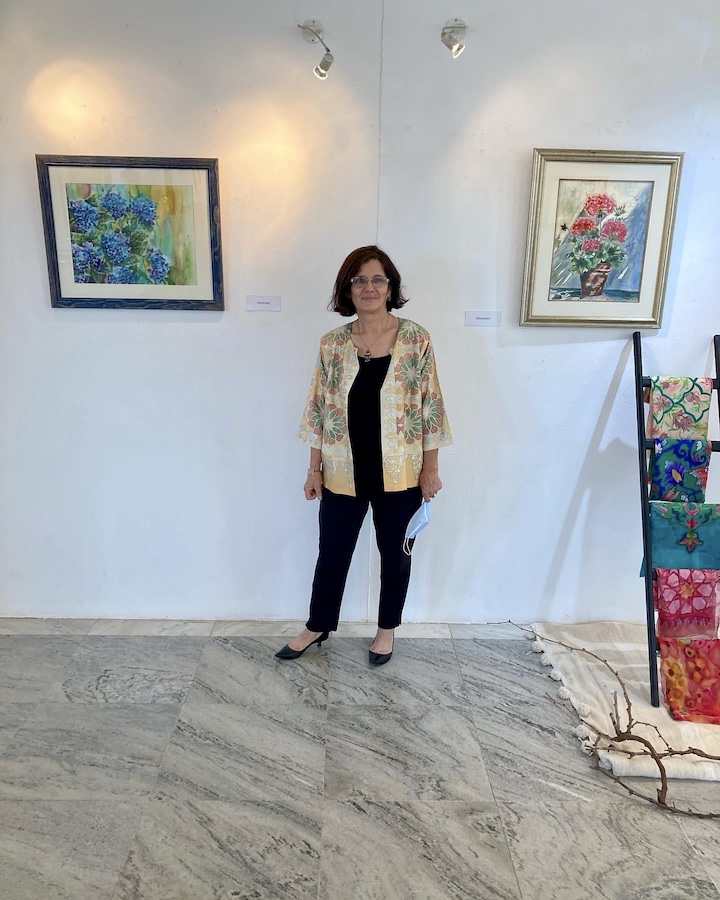
In her latest exhibiton, “My Silk Road,” the Algerian visual artist Salima Ayadi presents a tribute to her cultural heritage with 19 paintings and 30 scarves inspired by — among other things — Islamic architecture, ceramic and faience patterns, and calligraphy.
The exhibition opened at the National Museum of Antiquities and Islamic Art in Algiers on January 22 and runs until February 13.
Ayadi graduated from the School of Fine Arts of Algiers with a degree in visual communication in 1982. For more than 37 years, she has produced silk-painted works — a technique to which she was introduced by an artist friend while on a trip to Switzerland. She has created artworks and scarves for national institutions such as the Senate and the People’s National Assembly, or for large companies including Sonatrach, Sonelgaz, Air Algeria, to name a few.
“For national institutions, I have worked on the cultural and historical heritage of Algeria, which is particularly rich. My works represent landscapes and monuments of all regions of the Casbah of Algiers, the Tassili n’Ajjer in the South-East, or the Berber patterns of Kabylia,” Ayadi tells Arab News. “These creations have been exhibited and some of them have been offered to foreign partners.” Her work has been shown in numerous group and individual exhibitions both at home and in Libya, Morocco and Iran.
Her first solo exhibition, held in 2017 at the Palace of Culture Moufdi Zakaria in Kouba, was a great success. “This exhibition (was very important), because it allowed me interact and mingle with the public,” she says. Each painting is created over a series of stages, each with its own potential pitfalls. Ayadi says that her selection of colors — reds, blues and greens are particular favorites — is based on the idea behind each painting. Once the selection process is complete, she can get to work — an often-painstaking process.
Behind each piece lies her passionate love of her Algerian heritage and her country’s rich and diverse culture. Currently, besides the “My Silk Road” exhibition, she is focused on producing a book of her work, which she hopes to release in the next year or so.
source/content: arabnews.com
____________
Salima Ayadi is an Algerian visual artist. (Supplied)
Merryhan Al-Baz’ has been taking apart cars and indulging her curiosity in the world of vehicles since she was 13 years old.
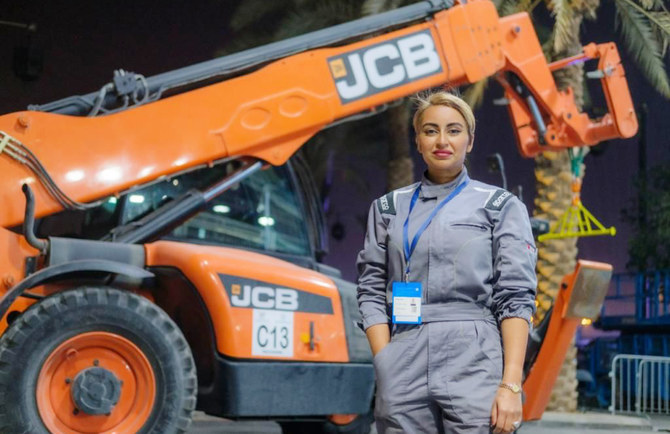
This passion for motors and engines, inherited from her father, lead the now 30-year-old to participate in the Diriyah E-Prix 2022 as a recovery marshal last month, becoming the world’s first female crane driver in race competitions.
“No one ever thought a woman could enter this field — the world of mechanics is a male dominated career. Fortunately, in my household, my mother and father always support any talents, ideas, or anything you desire to do,” Al-Baz told Arab News.
Al-Baz explained that there are four types of marshals at the E-Prix; fire, recovery, flag, and trackside. On the ground, authorities saw her capabilities and assigned her to join the recovery marshal team.
Recovery marshals must clean up the circuit immediately after an accident happens in order for a race to continue its course.
Al-Baz is a self-taught mechanic, with her educational background completely different from her career path. “I actually studied psychology and media in Lebanon, but I see myself in the world of cars,” she said. Al-Baz registered at an institute in Jeddah to receive a certificate to pursue her career in a more official manner. Her autodidactic reputation earned her a position as an instructor too, and she hopes that she will be able to open her own automobile repair shop in the near future.
source/content: arabnews.com
__________
Merryhan Al-Baz, 30-year-old Saudi woman with passion for motors and engines, becomes the world’s first female crane driver in race competitions. (Supplied)
Meet the Queen Bikers, Tunisia’s first all-female motorcycle club.
“There are more than 300 women who have a motorcycle driving licence in Tunisia, but do not practise this sport,” Khadija Hsaini, one of the founding members of the group, told Reuters.
She said there are a host of reasons holding women back. “They do not feel safe, or because they can’t find clubs that they can belong to, or because they don’t want to drive with men and want an all-female group.”
Dozens of motorcycle clubs exist around the country, but are almost exclusively composed of men – many of whom think women should only ride motorcycles as passengers.
So Hsaini set about to find other women to ride with. Among them is Wafa Khalifa.
“The idea [for the club] came when we were all separated,” Khalifa told Reuters. “Each woman owned a motorcycle, but was alone.”
Hsaini reached out to her and others. “She looked for us on social media and found every person in the area. Then she sent messages asking why we were so far from each other.”
Now the women gather regularly to ride their motorcycles along Tunisia’s scenic coastal roads, past Roman ruins and through endless stretches of olive groves. They pause along the way to take selfies with their bikes, and with one another.
source/content: thenationalnews.com
___________
Chaima Ben Ammou, member of a women’s-only motorcycle club, cleans her bike at her shop in Nabeul, Tunisia. Reuters
The first Egyptian aviator set out to fly from Berlin to Cairo on 25 January 1930 and arrived one day later on 26 January, now celebrated as Egypt’s National Civil Aviation Day.
Mohamed Sedki the Egyptian pilot who took off from Berlin, and went from one place to Europe with another plane until he arrived in Cairo on January 26, 1930 / pix: egyptian-gazette.com
One of the most intriguing chapters in Egyptian history records early attempts by the country’s aviators to fly solo from Mohamed Sedki the Egyptian pilot who took off from Berlin, and went from one place to Europe with another plane until he arrived in Cairo on January 26, 1930Europe to Egypt, with 26 January, Egypt’s National Civil Aviation Day, marking the first successful flight of Egyptian pilot Mohamed Sedki from Berlin to Cairo in 1930.
Sedki’s success and earlier attempts earned the support of former king Fouad, always interested in supporting exploration and discoveries whether in the air or on land. But how much do we know today about these attempts and of the Egyptian pioneers who courageously flew these planes, sometimes risking their lives?
The successful attempt by Sedki in January 1930 to fly from Europe to Egypt was preceded by other unforgettable attempts.
There were those by Ahmed Hassanein Pasha, a legendary figure in the history of aviation. Better known for his exploration of the Western Desert, he was one of the most powerful men in various governments under king Fouad and king Farouk and an adventurer at heart, attempting to fly from Europe to Egypt several times before 1930.
His wish was to fly from Egypt to London in a small plane across the Mediterranean. On his first attempt, he succeeded in flying over the Mediterranean, but a few hours later his plane crashed in southern France and was destroyed. However, Hassanein survived to continue to pursue his obsession, and he bought another small plane to fly again.
This time, the plane fell in Switzerland, but Hassanein once again escaped death and decided to buy a third plane and try again. On his third attempt, the plane fell in Italy, and Hassanein was so seriously injured that the Italian doctors that rescued him considered he had died. But according to the story told in celebrated journalist Mustafa Amin’s book Unforgotten Figures, Hassanein recalled the words of Egyptian poet laureate Ahmed Shawki and described himself as a layth or lion.
He started repeating the words “courage lion” to himself at the hospital in an attempt to defeat death. The words seemed to work magic, and he surprised his doctors with a speedy recovery despite his condition.
Whether true or not, the story speaks of Hassanein’s unrelenting spirit. Rather than give up on further attempts at flying after his near death, Hassanein made a fourth endeavour to fly to Europe. A few days after leaving the hospital, he bought a fourth plane. But half an hour before flying, one of the technicians boarded the plane to do a final check, and five minutes later the plane turned into a ball of fire, with Hassanein watching in disbelief.
This was the fourth and last attempt that sealed Hassanein’s flying adventures and put an end to his aspirations.
The Egyptian Eagle
Hassanein’s plane was named Faiza after one of king Fouad’s daughters, also the name of the first plane that successfully crossed the Mediterranean to land in Egypt in 1930 piloted by “Egyptian Eagle” Mohamed Sedki.
The plane Sedki flew was a small one-seater that weighed 250 kg and had a 40 horsepower engine. Sedki used it to fly from Berlin to Alexandria, where he landed at the Abu Kir airport on 25 January. He had started his epic flight across Europe on 12 January, passing through the former Czechoslovakia, the former Yugoslavia, and Italy all the way to Egypt in unfavourable weather. Governor of Alexandria Hassan Sabry Pasha welcomed him at the Airport, before he flew again to Heliopolis Airport in Cairo, arriving on 26 January.
Sedki’s successful flight caused a sensation at the time, as thousands of people cheered him on at Heliopolis Airport, where a model plane made of flowers awaited him. Captain Goldsmith, in charge of the Abu Kir Airport at the time, exclaimed that Sedki’s was the smallest airplane he had ever set his eyes on. In Cairo, Sedki’s feat was celebrated at a formal ceremony that included representatives of king Fouad, such as Yehia Pasha, as well as prince Abbas Halim, prime minister Mustafa Al-Nahhas Pasha, minister of transport Mahmoud Al-Nokrashi, and the delegated German minister.
Kamal Elwi, another Egyptian pilot who had learned to fly before Sedki and whose private plane was the first registered plane in Egypt, was also present during the ceremony. It was graced by the presence of poet laureate Ahmed Shawki, the same poet who had earlier called Hassanein the lion. Sedki, Shawki said, was like a young Egyptian leader coming back from battle crowned with victory, adding that he saw in Sedki’s face the lines of a true ancient Egyptian, with this being the secret behind his courage.
His words chimed with the rising sense of Egyptian nationalism and pride in Egypt’s roots at a time of British colonisation, a pride that manifested itself in the literary sphere with works dedicated to Egypt’s past like Shawki’s own magnificent play The Death of Cleopatra.
The royal reception Sedki received was complemented by king Fouad’s awarding him the Gold Medal of Excellence and a gift of LE1,000 for his services to the nation. His successful flight also resulted in the establishment of the first club for Egyptian aviation in Cairo, which held another celebration for Sedki as Egypt’s first international pilot on 29 January 1930. Sedki was awarded a share in the club to the value of LE50.
Together with Kamal Elwy, and Talaat Harb, founder of the first Egyptian bank, Sedki called for the establishment of EgyptAir, Egypt’s first airline company. His success was considered a national feat at a time when the British were reluctant to allow Egypt to enter the field of aviation, since Britain had its own airline company operating in Egypt and did not want the competition.
One obstacle that Sedki encountered when trying to realise his dream was obtaining the approval of the British to fly to Egypt from abroad, an approval that he only obtained after long weeks of anticipation. Harb said during the celebration that before Sedki’s success, Egypt had been deprived of having its own pilots and its own national airports, but now that Sedki had debunked British claims that the Egyptians were unable to act as pilots, there was hope that they could be equal to other nations in the field of aviation.
A series of domestic flights followed Sedki’s international flight as he flew to Upper Egypt, first to Luxor and then to Aswan before flying back to Luxor. From there, he flew to Minya and Assiut on 27 March. Yet, for all this, Sedki did not stay in the limelight for long, and on 27 June that same year he flew back to Germany, claiming that the government in Egypt had not given him the proper appreciation, offering him a minor post with a meagre salary and barely enough to look after his plane.
He rejected the job offer and left Egypt from Heliopolis Airport, the same one where he had received a hearty welcome on his successful arrival earlier the same year.
Graduate Number 34
Al-Nadi /pix: english.ahram.org.eg
Between Sedki’s solo flight in 1930 and 1933, 33 male pilots graduated from Egypt’s School of Aviation. But graduate number 34 was certainly different, as this time the graduate was Lotfia Al-Nadi, the first Egyptian and African woman aviator to earn a pilot’s licence after US pilot Amelia Earhart with whom she exchanged letters.
In a later interview explaining her decision to train as a pilot, Al-Nady said that “I was young, eager to learn things and to accomplish something, but there were few directions that I could pursue. I read about a programme for flying that was being established,” and this was invitation enough for her to join. She was 26 when she flew her first plane from Alexandria to Cairo after training for just 67 days.
However, Al-Nadi’s career as a pilot was not an easy one. She had a reluctant mother and an initially unsupportive father, and she had to find a way to afford her flying lessons and to take them secretly. Kamal Elwy, the then director of EgyptAir, offered her a job as a telephone operator and secretary with the company, and Al-Nadi used her salary to pay for flying classes. Her secret was later revealed when her father saw a picture of her in the international press.
She was finally able to appease her father and earn his support when she took him as her first passenger on a ride above Cairo and around the Pyramids. “I took my father for a flight,” she later said. “At first, he sat stiffly, but then I noticed that his head was swiveling to the right and left. I asked him about it after we landed, and he told me he had been frightened, but then he had decided that he was in the hands of his daughter. He knew that if we crashed, we would crash together, so he relaxed and began to enjoy the flight.”
Al-Nadi’s singular career was undertaken at a moment that overlapped with the fight for women’s rights in Egypt and for women’s rights to education. Not surprisingly, Hoda Shaarawi, the famous Egyptian feminist leader of the time, honoured Al-Nadi and held a fundraising drive for her so that she could buy a plane of her own.
Among her adventures, Al-Nadi recalls how on one occasion her engine failed and she had to land in the desert where she was helped by Bedouin and given a bony mule to ride on her way back to Cairo. “I often laughed that the mule was more dependable than my Moth airplane,” she said.
Sadly, Al-Nadi’s remarkable aviation career ended abruptly in the early 1950s when she had a tragic accident while landing that left her with a broken spine. She left Egypt for Switzerland for a long period of treatment, remaining in the country for many years. Eventually, she was awarded Swiss nationality.
In 1989, Al-Nady was given the Order of Merit, the highest distinction of the Egyptian Aerospace Education Organisation. She returned to Egypt permanently, dying in the country in 2002 at the age of 95. Today, she is considered to have opened the way for other women pilots, among them Linda Masoud, the first female pilot coach, and Aziza Moharram, the first female director of the Aviation Academy, not to mention other pilots like Dina Al-Sawy, Hasnaa Taymour, and Heba Darwish.
Less well known than Al-Nadi, yet equally important to the history of Egyptian aviation is Esmat Ahmed Fouad, another woman who learnt to fly but did not obtain a pilot’s license.
Esmat’s story remains inspiring because she joined the School of Aviation and was flying at the age of just 14. Her two sisters, Kadreya and Aisha, followed suit and also learnt to fly. But the three sisters could not obtain pilot’s licenses as they were under the age of 17. They did not pursue flying careers, which is why in his book Civil Aviation in Egypt author Abdel-Latif Al-Sabbagh considers Al-Nadi to be the real pioneer of Egypt’s women aviators.
EgyptAir
The stories of individual endeavours to fly solo internationally interweave with the story of commercial flights in Egypt and the attempt to establish the national airline Egypt Air.
In 1924, the Ministry of Transportation formed a committee to launch commercial flights in Egypt, and this suggested the establishment of the Egyptian Civil Aviation Authority (ECAA), whose mission would be to oversee air navigation and the country’s newly established airports. The project was highly acclaimed at the time, as it was needed to organise the arrival and departure of international planes. It was planned to establish the ECAA within five years.
In the same year, a group of Egyptian businessmen headed by Hassan Anis Pasha started to establish a company for commercial flights in Egypt. After much searching for the right types of plane, they recommended one made entirely of metal with three engines and the capacity to carry 12 passengers and two tons of merchandise. This project signalled the establishment of EgyptAir, Egypt’s national airline. In 1927, the government established the ECAA, and between 1927 and 1929 it sent three missions to train abroad.
EgyptAir was not formally established until 1931, when, thanks to the Egyptian young people who had received their training abroad, the idea of civil aviation eventually saw a revival after years of stagnation. Almaza Airport, the country’s first, was established in the same year — the earlier Heliopolis Airport mainly served the British air force, and other flights were not allowed to use it.
The history of civil aviation in Egypt is an inspiring one, a story of persistence, hope, and freedom for a whole country to have the right to fly. Stories of Egypt’s early aviators cannot fail to make future flights with EgyptAir more meaningful, and they deserve to be commemorated in a national museum dedicated to civil aviation, something which at present does not exist.
It is perhaps high time we thought of establishing such a museum in order to remind ourselves of the meaning of National Civil Aviation Day and to keep the day alive.
*A version of this article appears in print in the 3 February, 2022 edition of Al-Ahram Weekly.
A Qatari doctor won His Highness Sheikh Sabah Al Ahmad Al Jaber Al Sabah Prize for Research in Health Care for the Elderly and in Health Promotion.
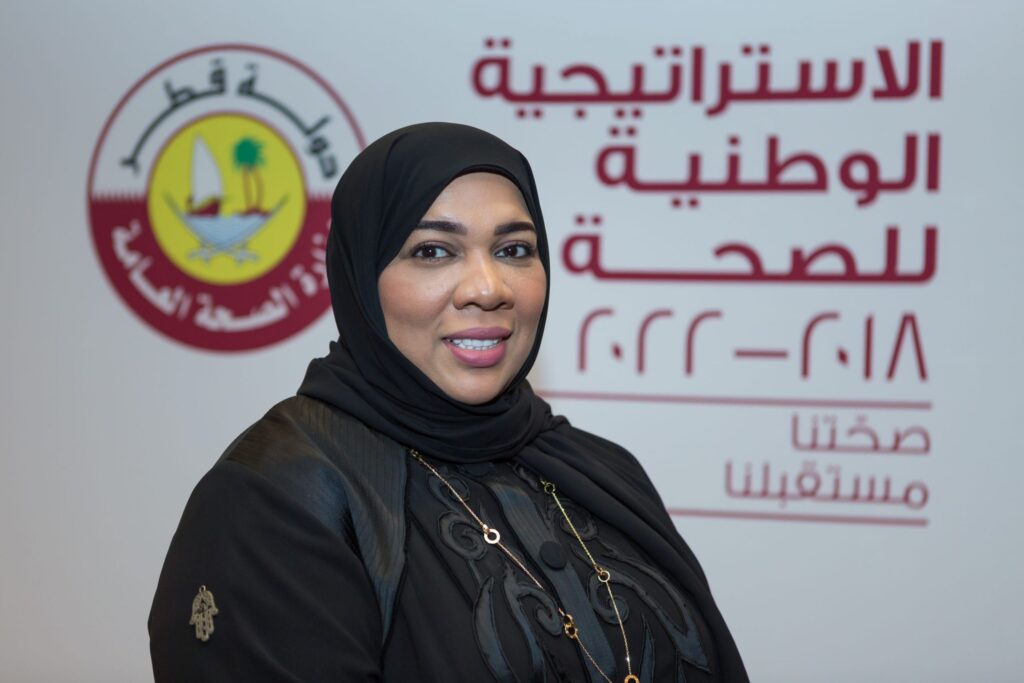
The announcement that National Lead for Healthy Ageing for the Qatar Ministry of Public Health (National Health Strategy 2018 2022) and Medical Director of Rumailah Hospital and the Qatar Rehabilitation Institute Dr. Hanadi Al Hamad, was unanimously awarded “His Highness Sheikh Sabah Al-Ahmad Al-Jaber Al-Sabah Prize for Research in Health Care for the Elderly and Health Promotion” was made during the participation of the State of Qatar in the 150th session of the Executive Board of the World Health Organization (WHO), which was held from 24 to 29 Jan. 2022.
Speaking on the occasion, Dr. Hannadi Al Hamad said that winning the His Highness Sheikh Sabah Al-Ahmad Al-Jaber Al-Sabah Prize for Research in Health Care for the Elderly and Health Promotion was the culmination of the efforts exerted by the health sector in the State of Qatar to care for elderly health and health promotion, adding that the prize is one of the most prestigious World Health Organization (WHO) awards in the world.
Dr. Hanadi Al Hamad explained that several training programs targeting non-geriatricians and caregivers of the elderly have been developed, as well as a training program on dementia in partnership between the Hamad International Training Centre and Alzheimer’s Disease International London, UK, for program accreditation.
She indicated that “RAHA” national helpline service has been launched, with a multi-disciplinary team of experts to provide support and advice to Alzheimer’s patients and their family members to help them cope with the challenges caused by dementia and enable them to access the services designated for them,In addition to spreading awareness among them about dementia and the importance of early diagnosis and treatment
It is noteworthy that His Highness Sheikh Sabah Al-Ahmad Al-Jaber Al-Sabah Prize for Research in Health Care for the Elderly and in Health Promotion” is biannually awarded to the winners who have made an outstanding contribution to research in the areas of healthcare for the elderly and in health promotion at the World Health Organization level.
The Selection Panel meets to decide on the recommendation to be made to the Executive Board, which designates the recipient (or recipients) of the prize in a ceremony held on the sidelines of the WHO meetings in Geneva in May. (QNA)
Dana Al-Sulaiman., Ph.D. Biomedical Engineer. Scientist. Educationist
Saudi engineer Dana Al-Sulaiman won the “Innovators Under 35” award, for her ability to create a chip that detects different types of cancer inside the patient’s body.
Eng. Dana explained to Alekhbariya channel about her innovation, saying, “It is a small chip made of micro needles covered with a substance that is placed on the skin, and it is able to absorb liquid, and detect cancer biomarkers in an easy and non-invasive way.”
The Saudi inventor, who also works as an assistant professor of Material Science and Bioengineering at KAUST, elaborated, “The reason that prompted me to create the slide is the painful and tedious process of the traditional way where a sample is taken from the patient.”
Al-Sulaiman pointed out that the chip she created reveals different types of cancer, adding that innovation saves a lot of effort, money and time.
She added that the innovation was granted an American patent, and the technology is currently being developed and manufactured from sustainable materials at King Abdullah University and then it will be delivered to doctors in all hospitals soon.
The “Innovators Under 35 Award” seeks to honor technical experts, male and female researchers, male and female scientists, whose age does not exceed 35 years.
The conditions for nomination for the award include a wide range of fields, including biomedicine, computing and communications, energy, materials science, software and even transportation, the Internet, and more, where the innovations and research they have accomplished can make a qualitative leap in our contemporary world.
The selected innovators will give a brief presentation on their work of no more than 3 minutes per innovator. Candidates must also be citizens or residents of a country in the Middle East and North Africa region, or of Arab origin.
The AlUla Design Award has announced the winners of its various categories for outstanding products inspired by AlUla.
The categories adjudicated at the Saudi Design Festival in Riyadh’s Jax district included jewelry, leather goods, footwear, homeware accessories, and other lifestyle products.
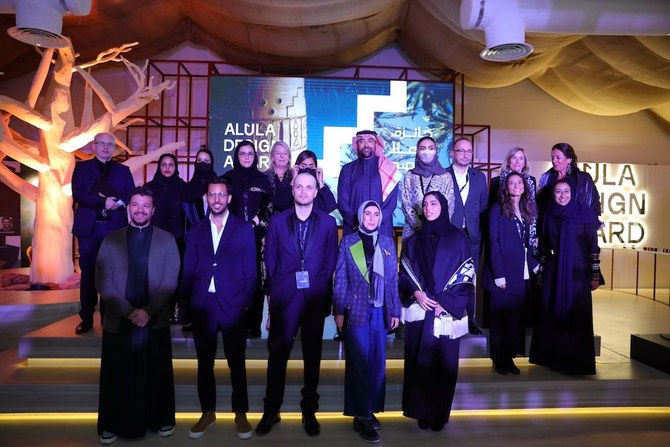
Over 400 applications were received, with shortlisted designs reviewed by a jury. The six best products were selected to receive the prestigious AlUla Design Award, including Harry Dobbs Design x Rukun, a collaboration between a British and Saudi design studio, which proposed a distinctive set of artifacts that capture AlUla’s spirit and memory.
The other five winners included Nour Shourbagy, a Saudi-based designer, who proposed a collection of travel carry-ons and clutches inspired by AlUla’s aesthetics and motifs.
Tarek Elkassouf, a Lebanese designer, now based in Australia, proposed a collection of gifts crafted by traditional artisans, while Mohamad Baalbaki x AlJoharah Al-Rasheed, a Saudi-based studio, put forward a collection of products evoking all five senses, with an interaction between play and memory.
Niko Kapa, a Greek designer based in Dubai, offered a collection of accessories inspired by the natural landscapes of AlUla, and Reem Bashawri, a Saudi-based designer, entered a line of luxurious winter shawls echoing the region’s natural beauty.
Prince Badr bin Abdullah bin Farhan, governor of the Royal Commission for AlUla, stated that the award was an important milestone in AlUla’s flourishing arts and cultural sector, to make AlUla a region for inspiration to all designers globally.
source/content: arabnews.com
__________
Winners and jury of AlUla Design Awards in Saudi Design Festival. (AN Photo/Saleh Al Ghannam)
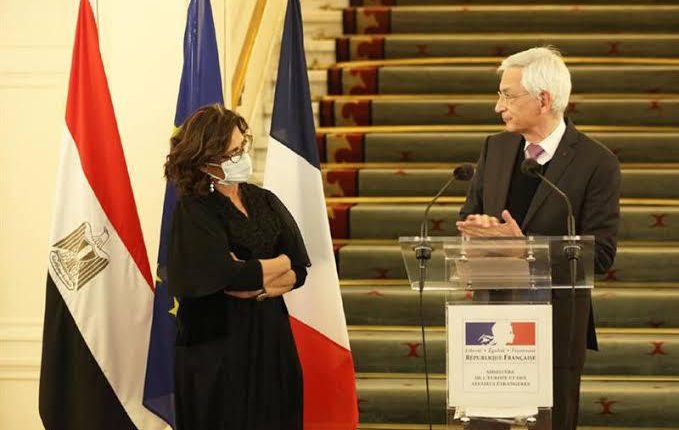
Egyptian Producer and director Marianne Khoury was awarded France’s Legion of Honour in the degree of Chevalier (Knight).
The award was given to Khoury by the Ambassador of France to Egypt in Cairo Marc Baréty. The Legion of Honour is the highest French decoration and one of the most famous in the world. For two centuries, it has been presented on behalf of the Head of State to reward the most deserving citizens in all fields of activity.
It is highest French decoration, one of most famous in world.
Born in 1958, Khoury is a graduate of economics from both Cairo and Oxford Universities. She has directed and produced films on controversial issues such as identity, memory, and social exclusion. Khoury, who is the niece of late great Egyptian director Youssef Chahine, is a managing partner in prominent Cairo-based Misr International, one of Egypt’s production companies, which Chahine founded.
She is also a co-founder of the Panorama of The European Film. She directed her first documentary, ‘The Times of Laura’ in 1999. She then worked on ‘Women Who Loved Cinema’ in 2002 and ‘Shadows’, which tackles personal and social perceptions of the mentally ill.
Shadows premiered at the Opening of the Venice Film Festival in 2010 and won the FIPRESCI award at the Dubai Film Festival of the same year and the Italian television Rai Award in 2011 at the International Festival of Mediterranean Documentary and Current Affairs Films.
She also produced and directed ‘Let’s Talk’ in 2019, which received the Audience Award at the 41st Cairo International Film Festival. Very personal in character, the film is a conversation between her and her daughter about ordinary things in life: Death, life, illness, identity, marriage, etc.
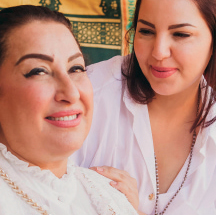
Doum was founded by mother-daughter duo Samira Madrane and Yasmine Erguibi in 2017.
Samira and Yasmine Erguibi are the Moroccan mother-daughter duo who have made it their mission to make a positive impact in fashion. The designers are playing an active role in promoting sustainability and ethical practices with their accessories label, Doum.
Each design in their bag line is handmade by underprivileged women. The totes, clutches and pouches support fair trade and sustainable practices to preserve local artisanal traditions and invite local women from rural areas around Marrakech to provide for their families via the production of the bags, according to the label’s manifesto.
The brand takes its name from the Moroccan palm leaf, which is collected, pruned and then woven by the artisans. “It is a nod to our culture, heritage and craftsmanship,” explained Yasmine of the decision to name the label Doum.
Today, Doum operates its own cooperative in Morocco, Doum For Women, which currently employs 235 women artisans.
Doum For Women is the first basketry cooperative in Morocco to have obtained SEDEX certification, meaning that the organization ticks all of the boxes of ethical business practices.