Arabs & Arabian Records Aggregator. Chronicler. Milestones of the 25 Countries of the Arabic Speaking World (official / co-official). AGCC. MENA. Global. Ist's to Top 10's. Records. Read & Enjoy./ www.arabianrecords.org
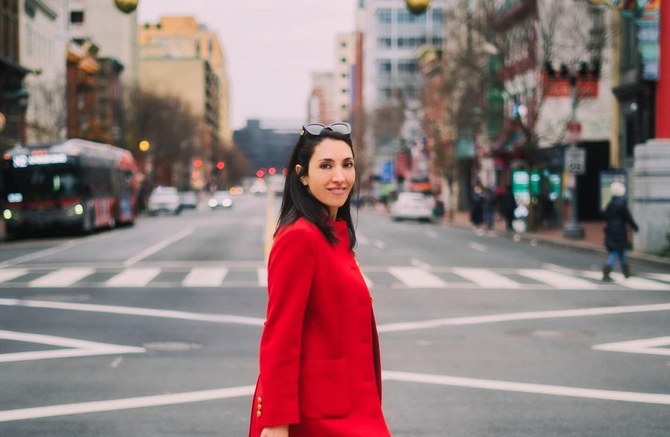
US Jordanian contestant Farah Abu Adeela from the state of Illinois was crowned Miss Arab USA at the beauty pageant’s finale in Arizona over the weekend.
The new Miss Arab USA, who is a model, takes over from 2022’s winner, Moroccan American Marwa Lahlou.
The annual pageant, which returned in 2022 after a two-year hiatus due to the COVID-19 pandemic, was held in Arizona this year. Produced by The Arab American Organization (AAO), the pageant is “founded on the basis of advancing the cause of young ladies of Arab descent,” according to its website.
The swimsuit category does not feature in the pageant, with the stated aim of organizers being to “select an honorable Arab young lady to represent our culture in the US and worldwide for one year.”
This year’s ceremony featured a performance by dance troupe Zeffa of Phoenix.
source/content: arabnews.com (headline edited)
____________
Farah Abu Adeela nabbed the coveted tiara at the 2023 Miss Arab USA pageant. (Instagram)
Fady Dagher is the first minority-background officer to head Canada’s second-largest force.
A map of Lebanon hangs in Chief Fady Dagher’s office in the grey stone headquarters of Montreal’s police force. It is a constant reminder of where he is from and the place he hopes to return to.
“For me, it helps me to stay connected to my roots and not to forget where I come from,” Mr Dagher said.
The 55-year-old Lebanese-Canadian officer, who moved to Canada when he was 17, is the first person from a minority background to lead Montreal police in the force’s nearly 200-year history.
His appointment in January was the culmination of a lifetime of service to his adopted homeland.
“I always felt I had a debt to the Montreal community,” Mr Dagher told The National. “They welcomed me so well and it was a duty for me to serve them.”
Softly spoken with a slightly gravelly voice, Mr Dagher said that when he came to Canada in 1985 his original plan was to go to university and then return to Abidjan in the Ivory Coast, where his father ran a manufacturing company. But a chance encounter with a police officer drew him to a different life, despite strong opposition from his father.
“Oh my God, he lost it,” Mr Dagher recalled with a chuckle.
Not even an unplanned trip from his beloved father could dissuade Mr Dagher from pursuing a career in law enforcement.
“I didn’t see my father from 1985 to 1991 and he came right away to discourage me.”
While policing may not have held the same allure and status in Lebanon and Ivory Coast as it did in Canada, Mr Dagher has brought the values of both places to his role leading Montreal’s nearly 5,000 officers.
“In Lebanon and Africa, we really have the community spirit deep in us and in the police, if you don’t have the community spirit, you cannot be close to the community and you cannot find your resolve to apply the law,” he said.
Mr Dagher has championed a community approach that involves immersing officers in the neighbourhoods they patrol.
The police chief leads by example. Earlier this year, he spent five days living and sleeping at various Montreal homeless shelters to better understand the struggles faced by the city’s homeless population.
“There is no way you can lead without walking the talk,” Mr Dagher said.
At the heart of his approach to policing is a Lebanese ethos.
“I want to be able to be inside those houses, sit with them, cook with them, clean with them, eat with them and see what their stories are,” he said.
He is hoping he can help to transform a police force that is facing a severe shortage of personnel and a city grappling with a sharp rise in gun violence.
Mr Dagher estimated that the force is 20 per cent to 30 per cent short of the officers it needs. A huge part of his first few months on the job has been to go on a charm offensive trying to attract new recruits.
“That’s my first priority,” he said. “To be able to recruit and to keep the recruit is huge.”
He’s looking at immigrant communities and hoping his own career can help new Canadians see a potential future in the ranks of the Service de Police de la Ville de Montreal.
Like many cities across North America, Montreal recorded a sharp increase in violent crime during the pandemic, a trend that continued in 2022.
Mr Dagher said the force was actively looking at ways to reverse that trend and was optimistic it would.
In terms of gun violence, “last year was the worst year that we went through”, he said, but noted that since he took over in January gun violence appears to be down, a trend he hopes will continue through to the end of the year.
Mr Dagher, who signed a seven-year contract, is determined to help recharge the department, but he dreams of having one more professional act after he retires.
“I am hoping that one day I will finish my career as ambassador of Canada in Lebanon, so I can go back to where I come from,” he said.
It would be the cherry on top of an exceptional life and allow Mr Dagher to spend time closer to his ancestral village of Bikfaya in the Mount Lebanon region.
Even while he is busy leading Canada’s second-largest police force, his mind and heart are never far from the small Mediterranean country that generations of Daghers have called home.
Throughout his busy career, he said, Lebanon has always held a restorative power.
“Every time I go back to Lebanon my heart beats better, again and again. My heart is in good health when I go to Lebanon because I feel welcomed,” he said.
The newly established restoration center at the King Abdulaziz Public Library in Riyadh has succeeded in preserving more than 3,000 rare scientific materials of cultural heritage. This includes photographs, documents, maps and rare books, as well as manuscripts.
The center was able to restore rare images depicting the old city of Diriyah, showcasing its location surrounded by a sea of palm trees.
The center restored 415 rare images of the city of Jeddah. The team of experts were also able to also restore 117 rare books, including their leather covers and internal pages.
In addition, the center restored a group of Saudi currencies, issued on 14 Dhu Al-Qa’da 1372 AH, corresponding to July 25, 1953 AD, when the Saudi Monetary Agency issued what was then known as the “receipts of pilgrims.” These were lightweight banknotes distributed and used during Hajj, starting at ten Riyals, of which 5,000 were printed with phrases in both Arabic and English.
The restoration center rehabilitated more than 615 rare documents and restored a series of rare magazines.
The center also cleaned up 2,235 rare and valuable maps in preparation for their restoration and preservation. The most notable was a map of the continent of Africa and the Arabian peninsula, drawn by Abraham Ortelius in 1570 AD.
The restoration center was inaugurated in late 2022, and has served as a space to handle artifacts carefully. Careful consideration is given to each item to maintain and preserve these pieces of history for future generations.
Rise of national team matched by that of country’s female referees.
When the Moroccan national women’s football team next takes to the pitch, their feat will be recorded for ever in the history books.
The Atlas Lionesses play Germany in Australia on July 24, becoming the first Arab nation to play in the Fifa Women’s World Cup.
But it is not just the players who are changing the future of the sport.
The rise of the Moroccan women’s team goes hand in hand with the successes of the country’s female referees, who have made huge strides in breaking the long male monopoly on football officiating.
Three female Moroccan football referees, Bouchra Karboubi, Fatiha Jermoumi and Soukaina Hamdi, have been appointed by Fifa, the sport’s world governing body, to referee at the Women’s World Cup, which kicks off on Thursday in Australia and New Zealand.
Aside from Palestinian Heba Saadieh, the women are the only female Arab football officials at the tournament.
“Morocco’s female football teams have witnessed a significant growth in recent years, in terms of numbers, age categories and locations, which [created the need for] qualifying female referees to officiate their games, and hence creating opportunities for those with great potential in that field,” said Brahim Chokhmane, sports editor at Tunisian newspaper Le Matin.
Mr Chokhmane pointed to a growing trend in the region to try to close the gender gap in sports — and in football in particular.
He said the Royal Moroccan Football Federation (RMFF) has begun to follow the trend.
In June, the Confederation of African Football (CAF) said clubs wanting to participate in the 2023-2024 Champions League and Confederation Cup competitions must have women’s professional teams.
Last year’s African Cup of Nations was the first time the tournament put out an all-female line-up of match officials – among them Morocco’s Jermoumi and Karboubi.
Women refereeing men’s matches
Women in Morocco have never been closer to equality with their male counterparts on the football pitch.
In March 2023, the federation appointed the first female coach in North Africa to train a men’s football team.
Last year, it appointed Karboubi to be the first woman in the Arab world to officiate a final of a men’s professional competition. Jermoumi was a first assistant at the country’s most prestigious football tournament, the Moroccan Throne Cup.
In 2020, the RMFF launched several football tournaments for women footballers and set a target of 90,000 amateur female players.
The moves have inspired more women to play – and referee – football.
Zakia El Grini, 33, who earned her Fifa badge as a football referee in 2022, said: “More Moroccan women feel confident nowadays to train, and work, as football referees, thanks to those who pioneered in the field and paved the way for others, and to the increasing number of female footballers.”
Less than two decades ago, there were fewer than 15 locally accredited Moroccan female football referees.
There are now eight internationally accredited female referees and more than 120 locally licensed ones.
Hafsa Ayab, 15, a student at the refereeing school for the Chaouia Doukkala Regional Football League, in the west of Morocco, told The National that she sees Karboubi as a role model and dreams of reaching the same success.
“I was not a fan of football itself as a game, but have found my passion in refereeing,” she said. “I am lucky to be able to pursue this dream.”
As the number of Moroccan players increase significantly, Moroccan referee Soukaina Hdia, 32, said more women will be encouraged to take part.
“And it will continue to increase, especially as more Moroccan women partake in global events,” she said. “It will encourage more females to do the same. I recall how, in 2009, I was the only female football referee in the Chaouia Doukkala region, but now there are dozens”.
‘Bullying doesn’t stop’
The pursuit of a refereeing career for women is not an easy one, Hdia said.
“I have been in this profession since 2009, and the bullying doesn’t stop, especially during interviews, or from the audience. I did grow immune to negative comments, though.”
Karboubi too has been the target of harassment and bullying.
After officiating Morocco’s Throne Cup’s final last year, images of the referee side by side with pictures of a kitchen went viral on social media, as some football fans took umbrage at Karboubi’s decision to show a yellow card to one player.
Ranked 136 of 146 countries in the World Economic Forum’s Gender Gap Index, Morocco’s women live lives strongly determined by deeply ingrained gender roles.
“The bullying is sometimes worse against female referees with headscarves, like what happened to me,” said El Grini, who officiated the kingdom’s Throne Cup this year.
“But the main obstacle preventing many Moroccan women from pursuing football refereeing as a career is the family. Many still view refereeing as meant only for men, but the truth of the matter is that sports and refereeing are open to all,” she said.
This story is published in collaboration with Egab.
Saudi Arabia’s Crown Prince Mohammed bin Salman welcomed on Wednesday the heads of delegations participating in a summit of Gulf Cooperation Council and Central Asian countries.
Participants in the Jeddah summit include the presidents of Kazakhstan, Kyrgyz Republic, Tajikistan, Turkmenistan, and Uzbekistan.
From the GCC side, the Emir of Qatar Sheikh Tamim bin Hamad Al-Thani, the Crown Prince of Kuwait Sheikh Meshal Al-Ahmad Al-Jaber Al-Sabah, the Vice President of the UAE Sheikh Mohammed bin Rashid are attending.
Oman and Bahrain’s rulers are being represented by Sayyid Asaad bin Tariq Al-Said and Sheikh Nasser bin Hamad Al-Khalifa respectively.
Sheikh Nasser praised the active role played by the Kingdom in enhancing cooperation and coordination among GCC countries and consolidating friendship and joint cooperation with other countries.
Google search engine features late Sudanese musician Asma Hamza celebrating anniversary of her winning the Laylat AlQadr AlKubra music competition in Sudan.
According to Google’s description on 17 July, “On this day in 1997, Asma was among the winners of the Laylat AlQadr AlKubra music competition in Sudan. This win was a turning point in her career and helped her gain recognition in a male-dominated field.”
Considered the first female composer in Sudan, Hamza was born in 1932 and loved music while growing up, dreaming of becoming a singer. However, her vocal cords were not equipped to handle singing safely, so she switched to whistling the tunes instead. When her father heard her whistle in harmony, he borrowed an oud (similar to a lute but with a thinner neck and no frets) so Asma could practice.
Despite the fact that it was not socially acceptable for women to practice music in Sudan during her time, her father encouraged her interest in music. In fact, the whole family enjoyed singing and was fond of music.
Hamza did not like her own voice and directed her interests towards playing the oud, which her father purchased for her. Surrounded by musicians who often visited her family home, including Ahmed Mustafa, Osman Hussein, Hassan Attia, and Abdel Aziz Mohamed Daoud, Hamza started by playing the oud while listening to other performers and copying their strokes by ear. As she began mastering the instrument, she soon became the very first Sudanese woman with formal training on the oud, which she received in response to her perseverance.
As she started carving her own place in Sudan’s music scene, she performed in small gatherings, followed by bigger stages. She often used lyrics by renowned poets, leading to compositions that were then performed by renowned singers. Her melodies resonate with many people in Sudan and across the Arab world.
On 17 July 1997, Hamza was announced as one of the winners of the Laylat AlQadr AlKubra song competition held in Sudan, standing among many male musicians. This win is considered an important turning point in her career.
A report by the Financial Times has said that the country’s sovereign wealth fund, Qatar Investment Authority (QIA), has taken a stake in the owner of Washington’s professional basketball and hockey teams in US sport.
As per the report, the fund is paying $200mn for a 5% stake in Monumental Sports and Entertainment (MSE) in a deal that values the owner of the National Basketball Association’s Washington Wizards, the Women’s National Basketball Association’s Washington Mystics and the National Hockey League’s Washington Capitals at $4.05bn.
The report also mentions that the investment from QIA, at an estimated $450bn in assets, comes less than a year after the NBA amended its bylaws to allow sovereign wealth funds to invest in clubs.
The QIA said, “As one of the largest integrated sports and entertainment companies in the country, MSE’s platform provides unique opportunities and scalability for growth and partnerships”.
As per the report, people familiar with the Monumental deal said that the QIA was taking a stake in the group as a financial transaction to gain exposure to a company with a diverse range of assets. As per reports, QIA will not gain board representation as part of the transaction.
PM chairs opening ceremony of 15th Arab Sports Games.
On behalf of the President of the Republic, Abdelmadjid Tebboune, the Prime Minister, Aimene Benabderrahmane chaired the opening of the 15th Arab Sports Games organized by Algeria from on 5-15 July at Mohamed-Boudiaf Olympic Complex in Algiers, with the participation of nearly 2,000 athletes representing 22 Arab countries.
The opening ceremony of the 15th Arab Sports Games hosted by Algeria (July 5-15) started Wednesday in the Mohamed Boudiaf Olympic Complex in Algiers, in the presence of Prime Minister Aymen Benabderrahmane, members of government and guests from various countries and organizations.
Fatimetou Mint Abdel Malick has been the mayor of a district of the Mauritanian capital Nouakchott for 14 years. She is living proof that women can make it to the top even in conservative Muslim societies. Elisa Rheinheimer introduces a courageous Mauritanian.
Fatimetou Mint Abdel Malick has a warm, maternal demeanour and a firm handshake. Keen eyes sparkle behind her glasses. A petite woman in a traditional flowing robe and a blue headscarf decorated with pink flowers, she doesn’t look like a politician in charge of a 60,000-strong community – at least not to Western eyes.
She is mayor of a district of the Mauritanian capital Nouakchott – and has been for 14 years. That makes her not only a pioneer in her own country, but also a role model for many African women. “I never actually wanted to go into politics,” she says with a laugh, “but I have a very social vein and it was a kind of calling. I wanted to change things in my city for the better.”
Now 57, she originally studied computer science in Belgium. It was during her time there that her eyes were opened to women’s opportunities. Years later, in 2001, she ran for mayor in a district in her home city of Nouakchott – and won at the first attempt. During her first period in office, she was still the only woman mayor in the country. “216 men – and me,” she says, her voice betraying well-earned pride.
Opening the door to politics for other women
In Tevragh-Zeina, the district of the capital of Nouakchott for which she is responsible, everyone knows her. She has achieved a great deal there, improving school education – particularly for girls – reforming the administration, reorganising refuse disposal and investing in infrastructure. Fatimetou Mint Abdel Malick wanted to build car parks, playgrounds and football pitches – and she did.
It sounds so easy when she talks about it now, but it certainly wasn’t quite that simple: “To begin with, I found the responsibility and the expectations people placed on my shoulders a burden,” she says. “After all, I had to be successful so as to open the door for other women and enable them to get into politics.”
She has had some success in this respect. There are now three other women mayors in Mauritania. She herself has never felt uncomfortable in her country’s male-dominated political arena. “Women have a very good status in our society,” she explains, “that made it easier for me.”
Development and religion hand in hand
And religion? What role does faith play in her life? Fatimetou Mint Abdel Malick looks rather perplexed, cocking her head in surprise as if she considers the question superfluous. “A very important one,” she says after a pause, “I am a Muslim.”
Development and religion, she says, are not mutually exclusive but belong together. She rejects the idea that Islam oppresses women and makes it hard for them to have a career of their own. In the Mauritanian religious tradition, she says, Islam virtually demands that women play an active role in society.
A mother of three grown children, Fatimetou Mint Abdel Malick is not only a local politician but also president of the Network for Locally Elected Women of Africa. She is invited to conferences and panel discussions all over the world, flying from one continent to the next. “Being up in the air is perfectly normal for me,” she says. Sometimes 24 hours are not enough to get everything done that she wants to do.
Raising awareness of environmental issues in Mauritania
One reason for that lack of time is that she also feels responsible for environmental protection and catastrophe management in her country. Mauritania has to deal with water shortages, sandstorms and desertification.
She organises workshops in schools, for instance, to raise awareness of environmental issues among children and young people. She has launched campaigns for the protection of dunes, planted date palms in the city with women’s groups, and called on local people to clean up the country’s beaches.
Her calm, relaxed demeanour is certainly part of her recipe for success. Fatimetou Mint Abdel Malick was recently re-elected for her third term in office, and has enough plans and projects in mind for the next 20 years. Mauritania is at No. 158 on the Human Development Index, close to the bottom of the ranking.
This hardworking mayor has a lot of work ahead of her. She currently has more than 3,000 fans on Facebook; in real life, there are no doubt many more than that.
While winning an Olympic medal is a personal goal for thousands of athletes, for 24 nations it is a dream that has only ever come true once. Tokyo2020.org looks at the glorious moment and the impact it had on the lives of the athletes who achieved it.
The background
Sudan made its Olympic debut at Rome 1960 and since then the country has participated in most of the Olympic Games.
Despite its nearly 50 years of participation in the Olympics, Sudan’s first medal on the world’s greatest sporting stage didn’t come until Beijing 2008, when Ismail Ahmed Ismail won silver in the men’s 800m.
Born in a Darfur farming tribe, Ismail was introduced to athletics at school. Surprisingly, instead of 800m, he started as a 3,000m runner and participated in 1,500m races as well. After watching his performance in long-distance races, the then national athletics coach Omer Khalifa advised him to move down to 800m. So he did and went to win the National Junior Championships.
In 2002, Ismail participated in the World Junior Championships in Kingston, Jamaica and finished fifth in a time of 1:47.20. Two years later, he had his first Olympic experience at Athens 2004, where he made to the 800m final after a personal best in the semi-final. But he would go on to finish last in the final.
In an interview with IAAF in 2008, Ismail explained that he was not optimistic at the prospect of winning at the Games and was exhausted in the final.
“I just wanted to do my best,” he said.
History in the making Al though Ismail continued improving his performance in 800m, since Athens he had been troubled by injuries and only took part in a few races throughout 2007. But he did not allow this setback to seize his dreams on the track.
“I knew I was going to come back. My coach (Jama Aden) was the one talking to me. I ran in the African Championships (2008, in Addis) and I was 2nd. I know I can do it again,” he said in the IAAF interview.
Somali-born Jama Aden is an Olympian himself and had coached Abdi Bile to a world title in 1987. He saw great potential in Sudanese runners like Ismail.
Aden’s confidence became a driving force behind the athletes, who trained on a land troubled by conflicts and poverty. According to a report by The Christian Science Monitor back in 2008, Ismail and his teammates had to use old paint cans filled with concrete for weight training and would run at the track at the never-completed athletics stadium surrounded by rubble. They also had to finish training before sunset as there were no floodlights.
Thanks to a rebound in early 2008, Ismail made it to Beijing 2008 together with another home favourite Abubaker Kaki, who ran a world junior 800m record of 1:42.79 at the Oslo Bislett Games in June 2008.
But a small injury stopped Kaki in the 800m semi-final in Beijing with Ismail making the final. This time, he did not let the chance go.
Placed at lane eight, Ismail had a relatively slow start but then he sped up on the second lap to pass reigning world champion Alfred Yego of Kenya. He kept the momentum until the finish line to finish behind Wilfred Bungei of Kenya. Clocking 1:44.70, he won Sudan’s long-awaited Olympic medal, a silver.
Life-changing impact
Ismail’s historic win in Beijing has another huge significance on the world outside sport. His success came in a time when Sudan was facing an unprecedented political crisis. To him and his teammate, Beijing was a chance to show people the positive side of Sudan.
After securing the country’s first Olympic medal, according to AP, people in Sudan hailed Ismail as a national hero and the picture of him wrapped in a Sudanese flag landed him on the front pages of the country’s newspapers.
Quoted by the Sudan Media Centre, Ismail said, “I can’t find words to express my joy. This is an achievement for my country first and then for me. I was able to achieve this honour because of a lot of hard training.”
With his achievement at the Beijing 2008 Games saw Ismail became the flagbearer at the Opening Ceremony of London 2012. However, in London he failed to make the 800m final.
At Rio 2016, no Sudanese athlete participated in the men’s 800m.
Scrolling through Sudan’s Olympic record, one could easily notice that athletics has been their major field of competition. Among the 81 Olympic participants, 33 of them are in athletics, followed by 17 in boxing. With Ismail’s historic breakthrough, there is a fair reason to expect Sudanese athletes to mark another milestone in the future.