IRAQI-AMERICAN : Who is Mark Savaya, Donald Trump’s special envoy to Iraq?

Savaya, a Michigan-based entrepreneur of Iraqi Chaldean descent, was appointed in a statement on Trump’s Truth Social page on Sunday.

United States President Donald Trump has named Detroit businessman and cannabis entrepreneur Mark Savaya as special envoy to Iraq, sparking debate in Baghdad and Washington.

Savaya, a Michigan-based entrepreneur of Iraqi Chaldean descent, was appointed in a statement on Trump’s Truth Social page on Sunday.

“Mark’s deep understanding of the Iraq–US relationship and his connections in the region will help advance the interests of the American people through his diplomatic engagement and direct communication with Iraqi officials as special envoy. As special envoy, he will act as a direct representative for US interests in Iraq, coordinating joint initiatives, maintaining diplomatic negotiations, and ensuring transparent communication between US and Iraqi governments on security, political, and economic priorities,” Trump wrote.

Trump praised Savaya’s contribution to his 2024 campaign, particularly his efforts to mobilise support among Muslim American voters in Michigan.

Savaya, born in Detroit in 1983, owns Leaf and Bud dispensaries and, according to his public profile, has no previous government experience. His family left Iraq for the US in the 1990s.

The appointment has sparked discussion among Iraqi political circles, though the Iraqi Prime Minister has welcomed the move. 

On Monday, Iraqi Prime Minister Mohammed Shia al-Sudani described the appointment of US President Donald Trump’s special envoy to Iraq as “an important step,” noting the envoy’s Iraqi roots.

“The appointment of a special envoy by President Trump to Iraq is an important step, especially as he is of Iraqi origin. We wish him success in his mission,” Sudani said during a meeting with Arab and foreign journalists in Baghdad.

In a post on X (formerly Twitter), Savaya said he was “deeply humbled, honoured and grateful” to be appointed and committed to “strengthening the US–Iraq partnership under President Trump’s leadership.”

The announcement came after the release of Elizabeth Tsurkov, an Israeli-Russian doctoral student who was kidnapped in Baghdad in 2023 by the Kataib Hezbollah militia.

Tsurkov, who spent more than 900 days in captivity and was freed on 9 September, wrote on X that Savaya had played “an instrumental role” in securing her release, calling the move “terrible news for anyone serving Iran’s interests in Iraq.”

On his part, Nechirvan Barzani, the President of the Kurdistan Region, welcomed the appointment, describing it as underscoring  “The strategic importance of Iraq and the Kurdistan Region in advancing our shared interests and regional stability.”

Senior Kurdistan Democratic Party (KDP) figure and former foreign minister Hoshyar Zebari welcomed the appointment, describing it in a post on the X social media platform as “a bold decision to restore Iraqi sovereignty and independence away from corruption, mismanagement and militia rule.”

Zebari also said Savaya’s appointment, as “an American of Chaldean Christian and Iraqi descent”, reflected recognition in Washington that Iraq’s political situation “is neither stable nor normal”, and called for “decisive measures beyond traditional diplomatic frameworks”.

However, others have questioned the timing and nature of the role.

Iraqi writer and political analyst Falah Al-Mashaal described the decision to appoint a special envoy, rather than a traditional ambassador, as “puzzling” and “unusual under diplomatic norms”.

“A special envoy is usually sent for a specific mission—during a crisis, war, or to deliver a particular message,” he wrote in a post on the X. “Is President Trump planning something unusual for Iraq?”

He linked the appointment to Trump’s recent comments at the Sharm el-Sheikh peace summit in Egypt, where he referred to Iraq’s “vast oil wealth” and accused its leaders of mismanaging it.

“It sounded like an invitation for Trump’s allies in Iraq to sue Prime Minister Sudani for negligence and mismanagement of public funds,” al-Mashaal said.

Some analysts believe the appointment may be connected to Trump’s regional agenda and his longstanding focus on Iraq’s oil sector.

Alex Warkes, a UK-based Iraqi political analyst, said the decision could also have domestic political implications for Baghdad.

“I think the back door of the US embassy will be quite busy with the arrival of Trump’s special envoy,” Warkes said in a post on X. “I believe the appointment was coordinated with Prime Minister Mohamed Shia  Al-Sudani’s team, perhaps to support his bid for a second term. We don’t yet know what the exchange might be—but time will tell.”

Warkes also questioned whether Savaya’s appointment had been coordinated with Israel, given that Trump’s Middle East policy “has always prioritised Israeli interests more than any of his predecessors”.

“These are legitimate questions,” he said. “Especially at a time when Iraq’s stability, oil policy, and relations with Iran remain central to the region’s balance of power.”

source/content: newarab.com (headline edited)

____________
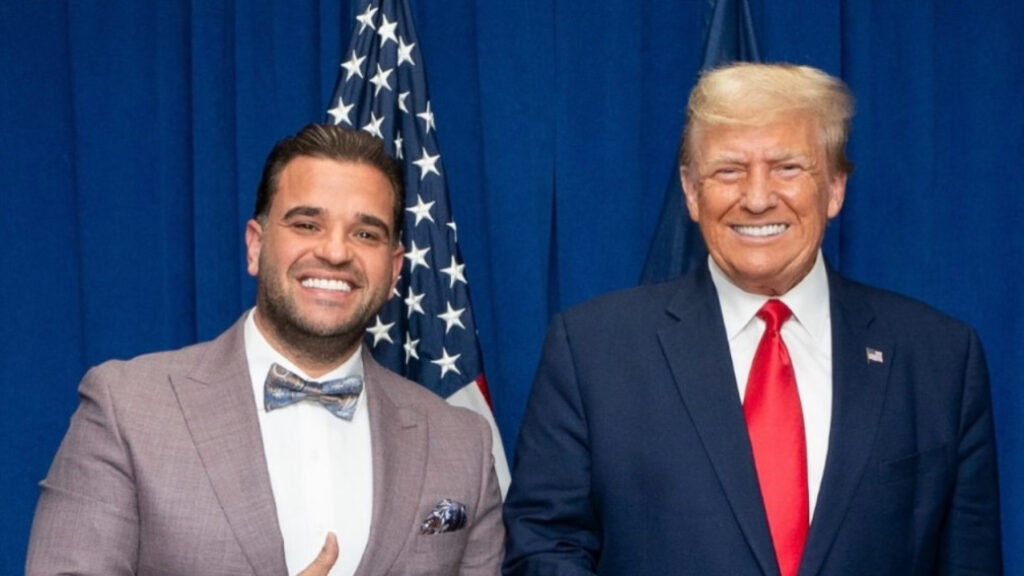
Mark Savaya and US President Donald Trump. [Screengrab from Mark Savaya/Instagram]

_____________________

AMERICAN / IRAQI

IRAQI AMERICAN – Miss Arab USA 2024 Zenovia Jafar talks pageant experience and aspirations

Iraqi American Zenovia Jafar was over the moon for “having made it” as she was crowned winner of the Miss Arab USA 2024 pageant in Arizona on Sunday.

“My experience with Miss Arab USA is one of the best experiences of my life. When I walked in, I had no idea what was going to happen, if I was even going to win. But most importantly, when I walked in, I will honestly say that winning was the only thing on my mind. I didn’t think about anything else,” Jafar told Arab News in an interview.

“But once I actually got there, I realized the friendships and the connections I’ve made with the people here is priceless and it is far more important than winning … I genuinely wanted to connect with every single person that I met, and I think that’s what helped me win Miss Arab USA. Because I focused more on genuine connection and doing what I need to do. And I was committed to just being myself,” she added.

When asked about her goals going forward, the Michigan resident said: “I’m going to be using my platform to raise awareness on issues regarding people who are … from underdeveloped communities, people who are in need. I’m going to be raising more money for charities. I’m here to serve Miss Arab USA and use my voice to amplify the voices of people who are not heard all over the world.”

Jafar’s family moved to the US — having escaped the war in Iraq and spent two years in Syria after — in the late 90s, when she was a toddler.

“When I moved here, I remember one thing that my mother told us is that we should never forget our roots and where we come from. My mother was committed to teaching us how to read and write and speak Arabic. And that is something that I am so grateful to my mother for because I can read Arabic, I can write Arabic, I can speak Arabic, I can understand many Arabic dialects. And I never let go of who I was and where my family came from. And I think that’s something that is so important when you grow up away from home, is to stay connected to who you are. Because at the end of the day, all you have is your roots,” she said.

When asked if she had any advice for young Arab American women, Jafar said: “I will say that as an Arab woman, it is very, very important to push your limits and always do things outside of your comfort zone because you will never grow as a person if you are stuck in your comfort zone. Always push yourself to be better.”

source/content: arabnews.com (headline edited)

________________

Iraqi American Zenovia Jafar (centre) was over the moon for “having made it” as she was crowned winner of the Miss Arab USA 2024 pageant in Arizona on Sunday. (Supplied)

_____________________

AMERICAN / IRAQI
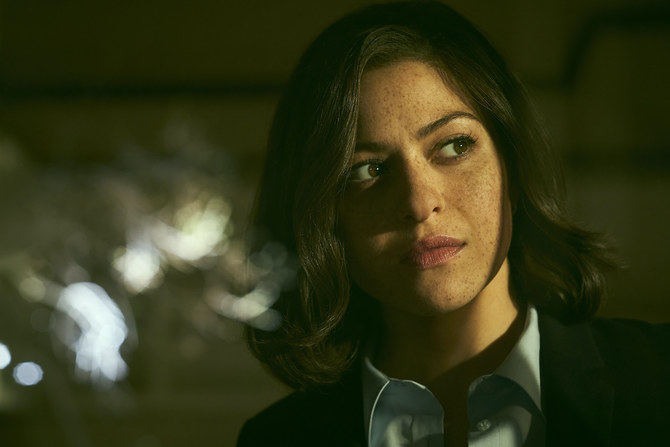
US-Iraqi TV Star Alia Shawkat Pushes for New Narratives

If you never realized that Alia Shawkat has Arab heritage, there’s a reason for that: The Iraqi-American actress — who has been stealing pretty much every scene she has appeared in since 1999, when she was 10 years old — rose to fame at a time when Hollywood was much less receptive to non-white identities.

Now, though, the 33-year-old star is entering the next phase of her career, one in which her heritage will be front and center.

“It’s interesting, because when I started acting, I always had to say I was half-whatever the role was. I would say I was half-Spanish, or half-French, just trying to blend in. I was always seen as ‘too ethnic’ when I was young,” Shawkat tells Arab News. “Now my ethnicity is a strength, because the conversation is shifting. It’s funny to watch actors actually talk about where they’re coming from, or playing roles that they’re actually connected to, when I grew up having to basically hide it.”

Not that it ever slowed Shawkat down. While she is perhaps still best-known for playing Maeby Fünke on the acclaimed cult comedy “Arrested Development,” which also reinvigorated or launched the careers of Jason Bateman, Will Arnett, Michael Cera and Tony Hale, she has been an inimitable presence across dozens of acclaimed independent films, before becoming the star and a key creative voice in the series “Search Party” (2016-2022), a pitch-black comedy and noir crime drama hybrid that defines Shawkat’s unique spirit better than anything has thus far.

She didn’t have to search too hard to find inspiration for the show. “My father is Middle Eastern, and he owns a club in Palm Springs. So that’s the show,” she deadpanned to the New Yorker last fall.

While “Desert People” will tackle that by putting Arab characters at its center, Shawkat took “The Old Man” in part because of the way that it, too, dives into righting some of the wrongs that were committed in the post-9/11 landscape.

source / content: arabnews.com (edited)

_________

Alia Shawkat in ‘The Old Man.’ (FX)

_____________________

AMERICAN / IRAQI
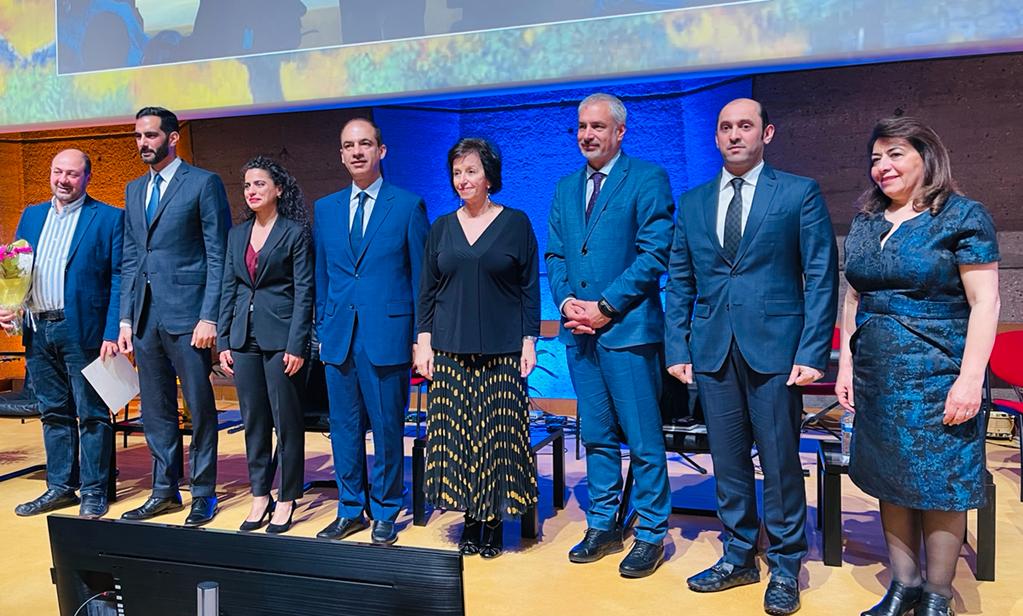
18th ‘UNESCO-Sharjah Prize for Arab Culture (SPAC)’ Awarded to Dunya Mikhail and Helen Al Janabi. Simultaneously Celebrates the Winners of its 17th Session in Paris.

The United Nations Educational, Scientific and Cultural Organisation (UNESCO) headquarters in Paris held a ceremony for the 18th edition of the Sharjah Prize for Arab Culture (SPAC), organised by the Sharjah Department of Culture in cooperation with UNESCO.

The Prize has been awarded to Dunya Mikhail, an American-Iraqi poet, and Helen Al Janabi, a Swedish actress of Syrian-Iraqi origin.

Sheikh Salem Khalid Abdullah Al Qasimi, Deputy Secretary of State for Heritage and Arts Sector, UAE’s Permanent Representative to the UNESCO, along with Professor Mohammed Ibrahim Al Qaseer, Director of Cultural Affairs at the Department, in addition to dignitaries, writers, intellectuals and members of the diplomatic corps accredited to the United Nations.

Ernesto Otuni Ramirez, UNESCO’s Assistant Director-General for Culture, gave a speech in which he expressed his gratitude and appreciation to H.H. Dr. Sheikh Sultan bin Muhammad Al Qasimi, Supreme Council Member and Ruler of Sharjah, and for his cultural and humanitarian renaissance role at the local, regional and global levels.

Afterwards, Abdullah bin Muhammad Al Owais, Chairman of the Sharjah Department of Culture, gave a speech in which he expressed his happiness at the continuation of the UNESCO-Sharjah Prize for Arab Culture editions, appreciating the role of UNESCO in managing the prize and sponsoring many cultural programmes.

Al Owais and Ernesto Ramirez awarded the 18th Sharjah Prize for Arab Culture to Dunya Mikhail and Helen Al Janabi, in addition to honouring the winners of the 17th session.

source/content: wam.ae (edited)

____________

__________________________________________

AMERICAN / IRAQI / SWEDISH / SYRIAN

Obituary – Iraqi Poet Lamia Abbas Amara : June 18th, 2021

Lamai Abbas Amara. Arabic Poetess. Writer. Columnist. Cultural Ambassador.

Published her first poem when she was thirteen (13).

Popular Poems:

  • The Empty Corner – 1960
  • I Am Iraqi –
  • They Call Him Love – 1972
  • Had The Fortune Teller Told Me – 1980’s
  • etc..

Posts held:

  • Member, Board of Directors, Iraqi Writers Association – 1963-1975
  • Deputy to the Iraqi Representative for UNESCO in Paris – 1973-1975
  • Director of Culture, Arts – University of Technology, Baghdad – 1974

Laid to rest in California, US – June 18th, 2021

______________

pix: twitter/iraqesque

____________________

AMERICAN / IRAQI