This is the month in which Palestinians commemorate the Nakba, a catastrophe often described in historical accounts as having displaced some 750,000 people.
It is true that Israel expelled this number of Palestinians from the territories it occupied unlawfully during the 1948 War. Yet the victims of Israel’s seizure of lands that had not been allocated to it under the UN Partition Plan — territories it appropriated by force during the conflict — are many times that number. Official statistics indicate that nearly 5.9 million Palestinian refugees are registered with the United Nations Relief and Works Agency (UNRWA), in addition to countless Palestinians who settled in other Arab or foreign countries and became part of their host societies, so they are no longer officially classified as refugees.
All of these people are victims of the Nakba that befell the Palestinian people as a result of the establishment of a Jewish state on Palestinian land. This reality makes the Nakba far more than a passing historical episode. It represents a profound transformation that redrew the map of the Middle East and altered the destiny of an entire people.
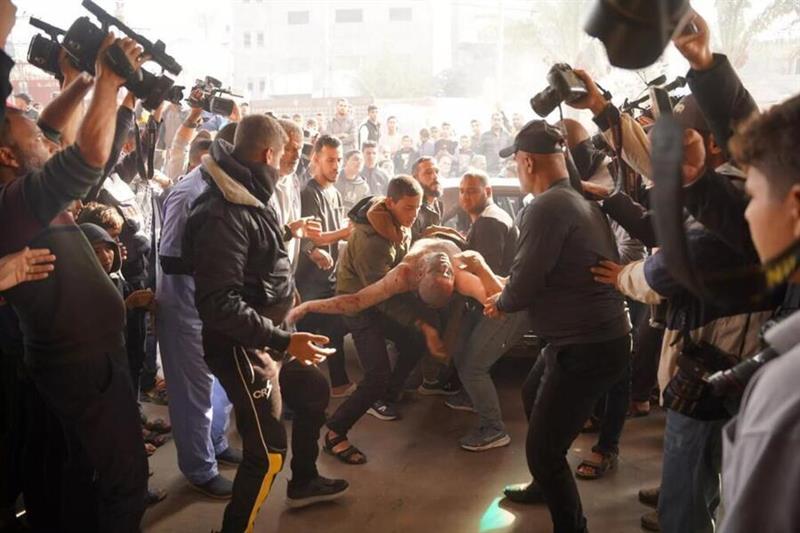
When we look at the images commonly associated with the Nakba, they usually depict masses of Palestinians leaving their homes and carrying their belongings on their backs, as though the tragedy unfolded in a single day. But this is misleading. Photographs capture only the instance in which they are taken, whereas the Nakba was never a single moment or an isolated event in Palestinian history. It was a prolonged process that began during the British Mandate in Palestine and continued long after its end.
Throughout this process, more than 500 Palestinian towns and villages were destroyed. The Deir Yassin massacre, for example, took place even before the outbreak of the 1948 War, claiming the lives of more than 110 men, women and children. When we speak of the Nakba, therefore, we are speaking of the systematic dismantling of an entire society that had once been stable and deeply rooted in its land, a deliberate project aimed at erasing a people’s geographic and civilisational identity.
That project, moreover, has never truly ceased. What happened in Gaza, and what is now unfolding in the West Bank, reflects the continuation of the same logic: emptying the land of its inhabitants through expulsion, displacement or killing; transforming the identity of the place; and erasing its cultural character. This confirms that the Nakba was not confined to the war of 1948. It is an ongoing process that began before the war and continues to this day.
* A version of this article appears in print in the 28 May, 2026 edition of Al-Ahram Weekly
source/content: english.ahram.org.eg / Mohamed Salmawy (headline edited)
_____________
_______________
PALESTINE