Arabs & Arabian Records Aggregator. Chronicler. Milestones of the 25 Countries of the Arabic Speaking World (official / co-official). AGCC. MENA. Global. Ist's to Top 10's. Records. Read & Enjoy./ www.arabianrecords.org
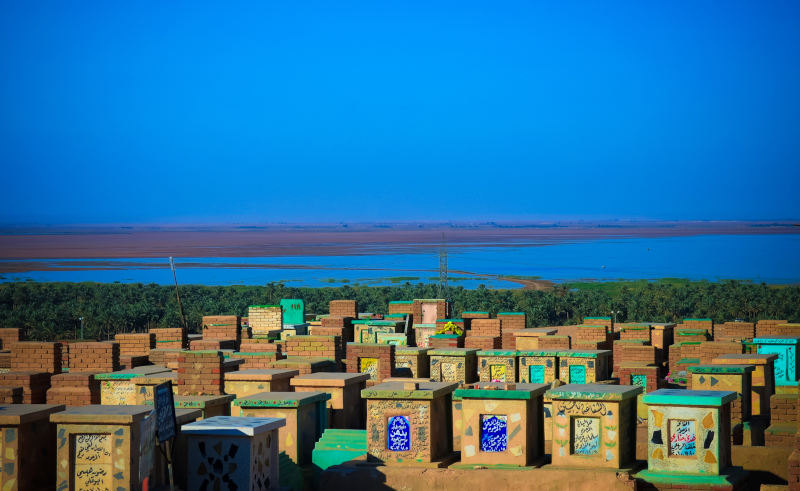
Dating back to the early middle ages, this Iraqi cemetery holds the remains of kings, dignitaries, scholars, and soldiers alike.
Wadi Al-Salam, which means ‘Valley of Peace’ in Arabic, is a necropolis in which every Shiite Muslim hopes to be buried some day, in the belief that it is these burial grounds that will hold eternal peace for them.
Located in the Iraqi city of Najaf, Wadi Al-Salam is a cemetery that dates back to the early middle ages, hosting the remains of kings, dignitaries, scholars, and soldiers alike.
Every year, an estimated 50,000 Shiite Muslims are buried in this hallowed ground. The cemetery stretches across 1500 acres, taking up almost 13% of the city, and allegedly holds over six million bodies. The necropolis, however, isn’t just a morbidly beautiful burial ground. Rather, each tombstone contains a name and an engraving that paints a vivid timeline of Iraq’s (arguably tragic) history, with a hyperfocus on internal disputes, natural disasters, and wars.
In 1981, Rahim Jabr, an Iraqi foot soldier, was martyred in the eight-year war with Iran. 25 years later, his brother, Naeem Jabr, was a casualty of the sectarian civil war that killed hundreds in Baghdad in 2006. The siblings are buried next to each other, united in the necropolis that holds many others whose stories are eternally intertwined with that of the bloody history of this country.
The 2003 invasion of Iraq by the United States and its subsequent conflicts alone led to the graveyard expanding by over 40% (7.5 square kilometres) to contain the bodies of the martyred Shiites.
Wadi Al-Salam has been the responsibility of a single Shiite family for over three centuries, and the Abu Seiba’s stand testament to the cruelty of war, having carried hundreds of thousands of bodies belonging to their brethren into the ground.
Wadi Al-Salam is considered a UNESCO World Heritage site and has been since 2011, as the cemetery stands witness to thousands of years of history, religious tradition and dedication by Shiite Muslims.
The Iraqi scholar Suhad Yasin has waged a long battle against financial and administrative obstacles to continue her work on purifying polluted water.
Her graduate studies started later than most and became a long journey over 13 years of dropping out and restarting, but she persevered. Two years ago, the University of Duhok awarded her a doctorate in polymer chemistry.
Now Yasin works from an independent laboratory she set up at the University of Duhok, where she and her students use cheap, available materials to treat polluted water.
Iraq, like many Arab countries, suffers from water scarcity and stress. One study predicts the Tigris and Euphrates rivers will dry up completely by 2040.
Apart from the scarcity issue, some Iraqi waterways also face problems with contamination by heavy metals like aluminum, cadmium and chromium, adding urgency to research like Yasin’s.
An Interrupted Academic Journey
In an interview with Al-Fanar Media, Yasin described her career in industry and academe.
After obtaining her bachelor’s degree in chemistry at the University of Mosul in 1993, she joined a laboratory in a local pharmaceutical factory, eventually becoming production manager.
As violence increased in Mosul over the next decade, however, Yasin was forced to return to her family’s home city of Duhok in 2006. She got an administrative job at the Ministry of Industry of the Kurdistan Region of Iraq.
But she did not find administrative work satisfying, Yasin said, so she took a competitive exam to study for a master’s degree at the University of Duhok.
By then a wife and mother, Yasin faced challenges in studying at the University of Duhok, both with learning in English and in overcoming the skepticism of some academics. Her thesis supervisor questioned her ability to complete the work. “He told me, ‘I regret being involved in the supervision of your thesis. It will be difficult for you to complete your studies at your age because of your family responsibilities.’”
But Yasin said his words only increased her motivation. “I needed to prove to my supervisor and myself that I was not a problem, but an energetic researcher who had missed an opportunity,” she said.
Yasin got her master’s degree with excellence in 2009 with a thesis on removing chromium from water using modified pomegranate peel .
Starting from Scratch on a Ph.D.
She then applied to transfer from her job at the ministry to work as an assistant teacher in the chemistry department of the University of Duhok’s Faculty of Science.
She taught at the University of Duhok for six years but was not given an opportunity to pursue a Ph.D. because the university lacked facilities and funds for research in her specialisation. Throughout this time, she continued her research on purifying polluted water.
In 2015, the university offered her an opportunity to pursue a doctorate and she took it. There was considerable opposition to her studying for a Ph.D. at the age of 50, but she managed to convince the head of the department.
Based on the advice of her master’s supervisor, who had changed his mind about her ability, she chose nanofiber technology as the subject of her doctorate. Her new supervisor initially opposed the idea, saying the university could not afford the materials required for research on this topic. But he finally relented when she persisted.
Yasin said she had nothing but the lab walls when she started her doctoral research: no equipment, devices, or “cofactors”, molecular compounds needed in certain chemical reactions. “The resources were almost zero,” she said. “I had to buy everything myself and start from scratch.”
Lining up Support
Yasin contacted professors and scholars from various Arab countries to ask for help. By chance, she heard of a physics professor at the University of Basrah who had designed a device that would help her with her research. “I contacted the professor at the University of Basrah immediately and she agreed to help me,” Yasin said.
Yasin then had to convince her dean at the University of Duhok to manufacture a similar device so she could work. He agreed, but she still needed funding for her research.
She wrote to several international organisations asking for financial support and eventually received a three-year grant of about $207,000 from the National Academy of Sciences in the United States, in 2018. She used the money to establish an independent laboratory at the University of Duhok to conduct her research on using nanomaterials to treat water.
Yasin acknowledges that funding scientific research is a general problem in Arab countries, but she insists that scholars themselves have a duty to find funding for their research.
“We must not stand idly by. I work day and night to get new financial support,” she said. “With each refusal, I realise that I have to work more.”
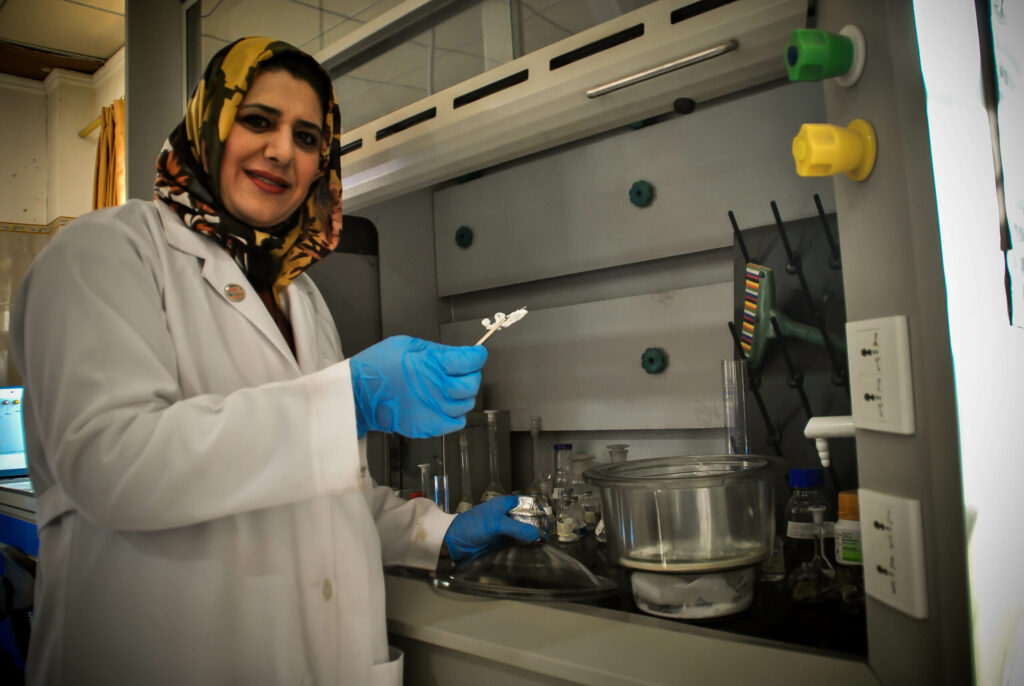
Suhad Yasin, of the University of Duhok, overcame many obstacles during 13 years of interrupted graduate study to continue her research on purifying polluted water. (Photo courtesy of Suhad Yasin)
If you never realized that Alia Shawkat has Arab heritage, there’s a reason for that: The Iraqi-American actress — who has been stealing pretty much every scene she has appeared in since 1999, when she was 10 years old — rose to fame at a time when Hollywood was much less receptive to non-white identities.
Now, though, the 33-year-old star is entering the next phase of her career, one in which her heritage will be front and center.
“It’s interesting, because when I started acting, I always had to say I was half-whatever the role was. I would say I was half-Spanish, or half-French, just trying to blend in. I was always seen as ‘too ethnic’ when I was young,” Shawkat tells Arab News. “Now my ethnicity is a strength, because the conversation is shifting. It’s funny to watch actors actually talk about where they’re coming from, or playing roles that they’re actually connected to, when I grew up having to basically hide it.”
Not that it ever slowed Shawkat down. While she is perhaps still best-known for playing Maeby Fünke on the acclaimed cult comedy “Arrested Development,” which also reinvigorated or launched the careers of Jason Bateman, Will Arnett, Michael Cera and Tony Hale, she has been an inimitable presence across dozens of acclaimed independent films, before becoming the star and a key creative voice in the series “Search Party” (2016-2022), a pitch-black comedy and noir crime drama hybrid that defines Shawkat’s unique spirit better than anything has thus far.
She didn’t have to search too hard to find inspiration for the show. “My father is Middle Eastern, and he owns a club in Palm Springs. So that’s the show,” she deadpanned to the New Yorker last fall.
While “Desert People” will tackle that by putting Arab characters at its center, Shawkat took “The Old Man” in part because of the way that it, too, dives into righting some of the wrongs that were committed in the post-9/11 landscape.