- The Task of the Translator Research Lab, developed and facilitated by artist and editor Sarasija Subramanian, runs until Aug. 30
- Brings participants together for collective reading, watching and listening sessions, alongside exercises exploring language, accessibility, subjectivity and the idea of the original
A research lab at Jameel Library is inviting people to take a broader view of translation — as a way of moving between languages, images, sounds, experiences and different forms of knowledge.
The Task of the Translator Research Lab, developed and facilitated by artist and editor Sarasija Subramanian, runs until Aug. 30. It brings participants together for collective reading, watching and listening sessions, alongside exercises exploring language, accessibility, subjectivity and the idea of the “original.”
“The starting point for us was the idea of translation as something much bigger than moving from one language to another,” said Khaled Al-Qahtani, library and research coordinator at Jameel Library.
“We are constantly translating between languages, but also between images and words, between what we see and what someone else might experience, between different ways of knowing and understanding.”
The week-long program explores what happens when an image is described for someone who cannot see it, when sound is translated into words, or when an experience is communicated through another form.
Al-Qahtani said: “We wanted the lab to create a space where we could slow down and actually examine those processes. What happens when you describe an image for someone who cannot see it? What happens when you translate sound into words, or an experience into another form? What is gained, what is lost, and what kinds of new meanings can emerge?”
For Subramanian, the project comes from her interest in “expanded translation,” a concept that considers movement between mediums as translation.
“The lab comes from my own interest as an artist and editor in the field of expanded translation, where translation is not only about moving from one language to another, but also thinking of information and ideas moving from one medium to another,” she said.
Subramanian works with drawing and tracing as forms of translating images, while her publishing house, Reliable Copy, works with artists to translate their ideas and research into books.
“The primary drive of the lab is to be able to consider these kinds of shifts between mediums as translation, and consequently to question translation’s need to be faithful to the ‘original’, and to rethink the mandate that we must be objective and impersonal during the process,” she said.
The lab also examines accessibility through tools including alt-text, audio descriptions and closed captions.
Subramanian said such tools were often viewed as additional accommodations for visually impaired audiences but could also encourage people with sight to look more closely.
“When we write alt-text for a painting, or audio-descriptions for a film, we see the image or the video through a very different point of view, which reveals to us details and nuances that we would otherwise overlook,” she said.
She compared translating an image to translating a text from English into Arabic, where every word, punctuation mark and piece of context must be considered.
“It is the same with an image, or a video,” she said, adding: “As such, the lab as a whole is to look at material we encounter on a daily basis closely, and rethink the ways in which we communicate and share.”
Subramanian said this approach also challenges the idea of a single, fixed interpretation, allowing different perspectives to become part of the process: “The question then, or the task, is to be able to use these subjectivities as a tool and an aid, instead of seeing them as inherently wrong.”
For Al-Qahtani, Jameel Library was a natural setting for the project because libraries already bring together different languages, histories and forms of knowledge.
“Libraries are already spaces of translation in a way,” he said.
The project, he added, sought to make the library more than a place for presenting research, turning it into a space where research could unfold collectively through experimentation, conversation and making.
Accessibility also requires cultural institutions to question assumptions about how audiences are expected to look, listen, read or participate.
“We often design cultural experiences around an assumed audience and an assumed way of looking, listening, reading or participating,” Al-Qahtani said. “Accessibility asks us to question those assumptions.
“For me, accessibility is not something that should come at the end of a process, as an additional service or adjustment. It can actually change the way we think about the work from the beginning.”
Guest lecturer Sara H. Hammami, a librarian, book artist and poet, sees translation as closely connected to culture and human connection.
She said translation could create movement toward understanding, curiosity and respect, but that this required openness from everyone in a multilingual environment.
“In any multilingual space this requires a curiosity regardless of the language one is starting in/moving towards it must be reciprocated by everybody for the kind of fluidity and warmth that can be brought forward from a space of translation,” she said.
Her work across libraries and translation has also shaped her view of accessibility. Cultural institutions, she said, have a responsibility to make audiences feel welcome: “The more people are given the opportunity and chance to attend and participate in these conversations and spaces, the stronger and more imaginative we become as a cultural landscape,” Hammami said.
In Saudi Arabia, she sees language equity as an important starting point.
“I feel language equity in a multilingual space is one of the first and most accessible ways to start building accessibility for our public,” she said. “I wonder what it might do for us and our language if we were to enter more cultural landscapes and find materials not only in Arabic, English, or French, but also in Tagalog, Urdu, or Bengali. I imagine a future in which everyone feels invited to these spaces and moments.”
Artist Park McArthur also approaches translation through questions of access, language and power.
“Translation and access could be shared phenomenon known by different names,” McArthur said, adding that stories and ideas move between languages through translation, whether through curiosity or other forces: “The power dynamics of language and access make something like force hard to pin down, actually. Power is an element of language and access.”
McArthur said language also extends beyond the linguistic.
“Artistic traditions and experimentation teach me that language is linguistic, while it is also a way of doing things, a means of gathering, a ritual, a performance,” she said.
She wants audiences to reconsider the traditional relationship between an original work and its translation. She also argued that the original also depends on translation for its circulation and continued use.
“We are perhaps more accustomed to approaching the act of translation as ‘dependent upon’ an originary text. An originary text is dependent upon versioning and translation for its circulation, its use, for its ongoing care,” she said.
Her own contribution to the program illustrates that relationship. An artistic experiment describing a day at the beach as a space for gathering was translated from English into Arabic by Al-Qahtani.
“Khaled’s translation, which I have no linguistic access to, extends this gathering, this day at the beach, which I dream of,” McArthur said.
While the lab is designed for participants who responded to the open call, its wider public programming opens the conversation to a broader audience.
source/content: arabnews.com (headline edited)
______________
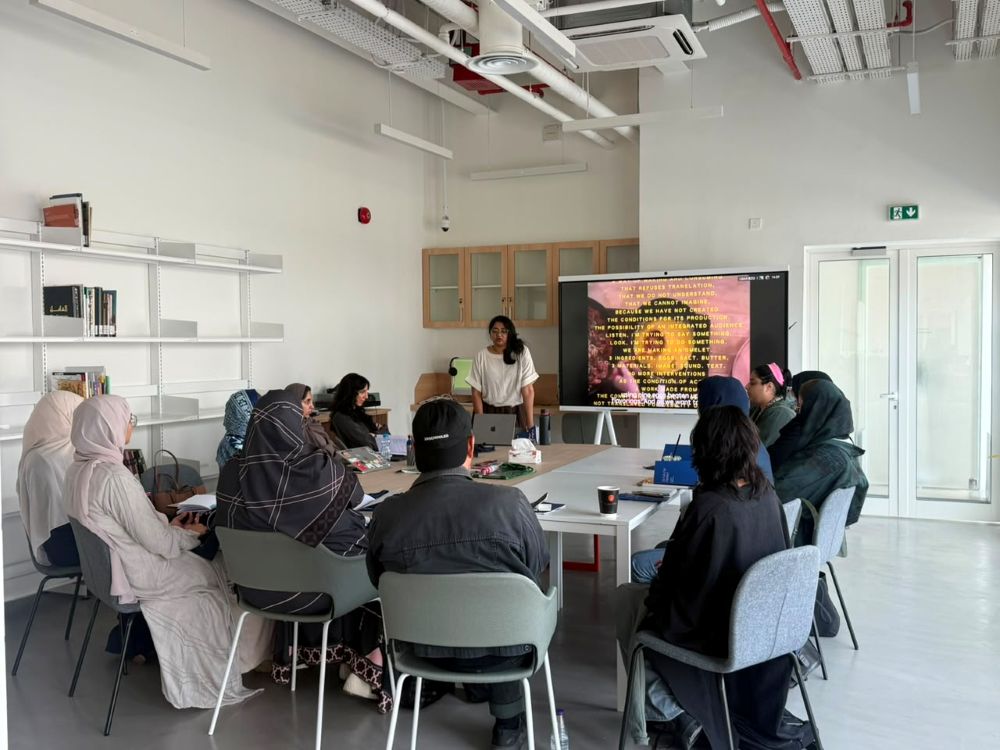
A research lab at Jameel Library is inviting people to take a broader view of translation — as a way of moving between languages, images, sounds, experiences and different forms of knowledge. (Supplied)
__________________
SAUDI ARABIA