Arabs & Arabian Records Aggregator. Chronicler. Milestones of the 25 Countries of the Arabic Speaking World (official / co-official). AGCC. MENA. Global. Ist's to Top 10's. Records. Read & Enjoy./ www.arabianrecords.org
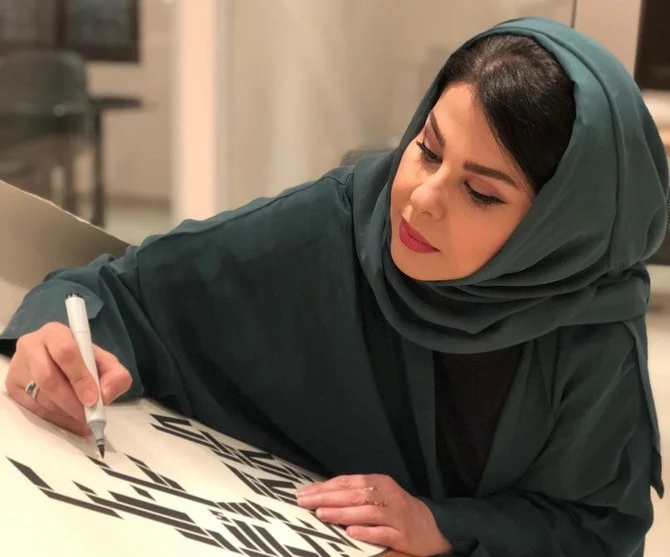
An iconic table shared by Gulf Cooperation Council leaders at a recent summit was designed by a Saudi artist.
Lulwah Al-Hammoud produced the drawings for the item of furniture that took center stage at the meeting of GCC member states Saudi Arabia, the UAE, Bahrain, Oman, Kuwait, and Qatar, along with representatives of Jordan, Egypt, and Iraq.
She told Arab News of her pride and thrill at seeing the table being used by the organization’s leaders. Its design was inspired by the changes taking place in Saudi Arabia and her commission brief had been, “we are entering a new era, but we are not forgetting about our traditions.”
After accepting the design challenge, Al-Hammoud was initially nervous because she was not a furniture designer, however it turned out to be “a very beautiful experience.” And her background in Islamic contemporary art and calligraphy helped.
The round table is made of wood and in its center are triangles of different color tones of wood that rotate outwards with lines made of copper, a metal, she noted, not often used in Saudi Arabia.
Al-Hammoud pointed out that she opted for triangles in her design because the shape was common in traditional Saudi architecture.
She said: “The triangle can also be modern and universal, but at the same time I wanted to capture growth and the act of evolving.”
The idea behind the design was to create something that represented, “the vision of Saudi Arabia while staying true to our roots,” she added.
One of the challenges for Al-Hammoud was to create a round table that could seat different numbers of people.
“It can be odd or even, so the design had to be smart. It took me a while to figure out how to do that. With guidance, I was able to work it out.
“I am really happy, because for a table like that they could have easily gone to the best furniture designers in the world, but they chose to believe in a local talent.”
Al-Hammoud has nine solo exhibitions to her name, with some of her artworks displayed at The British Museum, the Jeju National Museum in South Korea, the Greenbox Museum of Contemporary Art from Saudi Arabia in the Netherlands, and the Los Angeles County Museum of Art.
The UAE-based Barjeel Art Foundation has described Al-Hammoud as a pioneer in Saudi Arabia’s contemporary art movement.
She said: “I take art very seriously; I feel like it is a very important tool for education. It’s a window to tell people about who we are, it gives the true story of a certain civilization.”
She fell in love with Islamic art while conducting research on the topic and was fascinated by the philosophies and sciences behind each shape.
“My art has always had spiritual elements; it doesn’t talk about the moments I live in or the space I occupy. I speak about a higher dimension, spirituality, my place in the bigger scheme of things, and my connection to God,” she added.
source: arabnews.com (headline edited)
___________
Lulwah Al-Hammoud said that she opted for triangles in her design because the shape was common in traditional Saudi architecture. (AN Photo)
With the newly emerging social entrepreneurship movement, Moroccan youth are keen to develop entrepreneurial solutions to respond to local challenges.
Driven by innovation and the spirit of entrepreneurship, a student-led team from Enactus Club at Morocco’s Mohammadia School of Engineering (EMI) has developed a fabric made from milk to reduce dairy waste.
A team of 10 engineering students took the lead to make a positive impact within Moroccan society after observing the alarming amount of milk waste discharged in rivers and lakes. The dumping of milk waste has severe consequences for the balance of marine ecosystems as well as on the quality of drinking water.
The “S-ILK” project is a promising alternative to classic fabrics, by focusing on creating a tissue based on casein, a protein extracted from milk.
So far, the team has been able to develop the first prototype of its biodegradable fabric in the form of textile yarns and now seeks to begin mass production.
Speaking to Morocco World News, S-ILK Project Manager Omar Dirane stressed that synthetic fabrics, made from nonrenewable fossil fuels, are often bad for health and the environment. This became the reason why the team decided to use milk as a fabric to make clothes while reducing the pollution of dairy products.
Research quoted by The Guardian has found that 16% of dairy products, approximately 128 million tonnes, is lost or discarded globally each year; an efficient solution is therefore needed to reduce the environmental impacts of this large-scale food waste.
Ghita Dahhou, a project associate, told MWN that their long-term goal consists of making “S-ILK” a startup in which they seek to develop and sell eco-friendly clothes, while also raising awareness about food waste and making people eco-responsible through what they wear.
“The idea of creating a brand of ecological fibers is present and could be a big step for the textile industry in Morocco,” Dahhou said. As eco-responsible alternatives to fast fashion keep growing worldwide, the industry is significantly becoming more competitive.
Project associate Taoufiq Saaad spoke on the difficulties they could potentially face in implementing their startup in the future, especially as young students without years of experience in the field.
S-ILK team members, however, are keen to keep their optimism and ambitions to achieve their professional aspirations, noting that “our young age will not stop us from being invested in the engineering field and giving everything we have to improve it.”
Social entrepreneurship: challenges and opportunities
Eager to position their product in the Moroccan market, the team has conducted a market study to identify their niche while focusing on customers that support environmental advocacy and are eco-responsible.
Similar customers that follow the ecological trend are harder to find in Morocco due the “traditional mindset” some people still have, Ghita argued. Such a mindset, in addition to societal pressures, hinder young project holders from “taking risks and exploring what is beyond our comfort zone.”
As part of their market research, they also conducted interviews with people in the streets of Rabat. Taoufiq Saaad highlighted that people were “intrigued by the product especially when we told them that the piece will be cheaper than actual silk.”
“As we have been showing a potential to grow, we have been able to find clients who are interested in purchasing our product,” he added.
Supported by Moroccan hypermarket chain Marjane Holdings and Orange Maroc, one of three major licensed telecommunications operators in the country, the project manager expressed the team’s interest in securing more funds to be able to expand their project.
He explained that “Orange digital center” provides them with the tools needed to elaborate their research while “Orange Fab Lab” is where they experiment on their product and work on improving it.
When asked how they manage to finance projects within Enactus EMI, especially those starting from scratch, Dirane underlined that when a project within the EMI network wins a prize, they split it so that all projects can be able to expand.
Meanwhile, Ghita underlined that in recent years, Morocco has been offering several opportunities for young project holders to show their potential, either through financial aid or other facilities that banks provide, in addition to the support and mentoring from several incubators.
“With over 300 alumni of Enactus EMI, and 66 current members, we have much expertise, and engineers in different industries across Morocco, all coming together to contribute to the growth of innovative projects,” he added.
For Omar, Taoufiq, and Ghita, the project is helping them become the leaders of tomorrow by.being engaged in extracurricular activities to develop soft skills such as teamwork, communication, and problem-solving, among others, while also seeking expertise in the engineering field.
source/content: moroccoworldnews.com (edited)
____________
S-ILK: Moroccan Engineering Students Create Innovative Fabric From Expired Milk
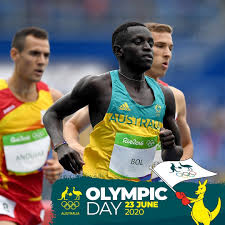
Find out how a kid from war-torn Sudan became an Australian hero who has the world at his fingertips.
You, me, The Pope, your butcher – we’ve all had those moments when we stop what we’re doing, fall silent and ask ourselves, How could this be? How could I have gotten from where I once was (Point A) to where I am now (Point B)? It’s a universal experience, for sure, but it’s going to be more intense for some than others. And it’s hard to imagine that many have felt it more powerfully than has Peter Bol.
You’ve probably absorbed snippets of this guy’s background. He was born in Khartoum, Sudan 28 years ago amid civil war. Via Egypt, he arrived in Toowoomba as a boy with no English or interest in running. That was his Point A.
His Point B was the Tokyo Olympic Stadium last August. It was lining up for the 800m final – the first Australian man to do so for more than half a century – in the fourth most-viewed event in Australian television history. It was leading the pack at the last bend before, yes, two Kenyans and a Pole outkicked him, consigning Bol to that cruel mistress of placing: fourth. It was leaving the media conference to go watch the Boomers play and getting a tap on the shoulder from an Australian Olympic Committee official.
“The Prime Minister wants to speak with you,” the official said.
“Do I have to?” /
“Yes.”
“Okay. Please give him my number.”
After some back and forth, Bol finds himself on the phone with the (then) Prime Minister, Mr Morrison, who’s calling him “mate” and thanking him for his efforts, which, the PM says, had inspired Australians during the challenges of the pandemic. The PM signs off by saying he’d love to meet Bol sometime. That’s a decent Point B.
“Yeah, I’ve come a long way,” says Bol, who’s taking time out from his preparations for this month’s World Athletics Championships, in Oregon, and next month’s Commonwealth Games, in Birmingham, to speak with Men’s Health. “And this is bigger than sports.”
Indeed. Because the story of Peter Bol can be read in any number of ways. You could see it through a purely athletic lens and marvel at how Bol became world class in the classic two-lap race – a long-busting physical examinations that takes you back to schooldays: “Two laps of the oval, boys,” your PE teacher would bark. “And let’s see some effort for a change.” Similarly, it’s easy to be intrigued by Bol’s newfound command of the psychology of performance. But trumping both those elements is how he accepted the hand fate dealt him and played it expertly, transforming from a pint-sized kid from a poor immigrant family into an inspiration – an inspiration who’s intent on being a change-maker. “Now that I am, I guess, a high-profile athlete, I have a responsibility,” says Bol. “A responsibility to call certain things out.”
THE LESSONS OF LOSING
Face to face, the first thing you notice about Bol is how busy his hands are in conversation. It’s as though words alone are insufficient to convey the scope of his meaning or the depth of his feelings, and his hands must come to life to fill the breech. Which makes sense because since Tokyo, Bol has had to grapple with a plethora of new thoughts and experiences.
Tokyo wasn’t his first Olympics. In 2016 he raced in Rio, where he was eliminated in the heats. You might figure, Oh, well, in those intervening five years he must have come on in leaps and bounds as an athlete – as a physical specimen. But that simply wasn’t the case, Bol insists. “Between Rio and Tokyo, the physical part, if it changed at all, it would have only been by five per cent.”
In Brazil, however, Bol learnt a lot about peak performance – or, more accurately, about what prevents it. It was there he battled bouts of anxiety the likes of which he could scarcely have imagined. He’d wake at 4am, trembling, his stomach in knots, his night’s sleep over. “I realised that performing in the big events is about more than running hard every single day of your training,” he says.
When he wasn’t anxious in Rio, he was most likely distracted. Because, man, talk about distractions! Free haircuts. Free food. And there’s…wait…Klay Thompson in the dining room! What’s a bloke who’d rather watch an NBA game than an 800m race supposed to do?
Between Rio and Tokyo, Bol also tested himself at two world athletics championships – in London and Doha in 2017 and 2019 respectively – and tasted no joy at either. Looking back, he sees these disappointments as necessary steps in his maturation. “You build your resilience on setbacks,” he says. “I got knocked out early [at all those meets] and it would have been easy to stop after each one. Athletics: it’s not hard to stop” – because you train relentlessly to face mighty competition, and when you get your butt kicked, stopping cries out to you. Stopping’s a siren song. But Bol covered his ears and kept running.
REALITY CHECK
For mine, one of Bol’s most admirable traits is his aversion to cliches, stereotypes and myth making. Yes, he spent his first six years in an African country wracked by civil war, but he doesn’t want you to assume that those six years were a nightmarish battle for survival, because they weren’t.
“I don’t remember too much,” he says. “I remember family. I remember going to mosque with my grandparents and a little school. And I remember playing football outside with other kids.” The third-born of five brothers, Bol and his family could have stayed in Sudan, but his father was determined they find a better life elsewhere. Travelling solo, Bol’s dad ventured north into Egypt to establish a foothold, at which point the rest of the family joined him when Peter was six.
For a while it was out there in the public domain that the Bols had lived in a refugee camp while in Egypt. But that is incorrect. If it were true, Bol says, he’d have no problem acknowledging it, but it isn’t – some people just wish it were, he suspects, because they think it would enhance his story. But his story doesn’t need enhancing. From his mother, Bol gleaned that family is everything: “For her, separation from family is unbearable.” From his father, the take-outs have been hard work and the power of hope. And bravery: “He wasn’t scared to take a risk, my dad.”
Their time in Egypt tested the Bol clan. While the Sudanese and Egyptian cultures, linked by the Arabic language, are similar, he says, “there was a lot of racism towards Sudanese people. At the same time, there were a lot of great Egyptians. My dad used to iron clothes for work, and he worked with these Egyptians who were the nicest people. But this period was a struggle for my oldest brother. He was four years older than me. He had to look after us when we walked through school, when there was racism going on or there were fights. He had to stand up and be the bigger man while trying to protect us.”
A sadness – an incomprehension – sweeps over Bol as he reflects on those times. “Just seeing people being unkind,” he says. “Why? Was it necessary? We really weren’t trying to bother anyone. We were just trying to live day by day. I hate seeing people being unkind to random people for no reason.” After four years in Egypt, the family was ready for another, bigger move. Bol’s father had relatives in Australia who helped facilitate a shift to Toowoomba, in 2004. The expectation was that the Great Southern Land would offer educational and work opportunities unavailable in Egypt. As it turned out, things didn’t happen quite fast enough in Toowoomba, so in 2008 the family headed west to Perth, where there were more and better-paid factory jobs for the father. Peter eventually landed a basketball scholarship at St Norbert College.
“My family shaped who I am as an athlete,” Bol says. “Because to be a professional athlete, you’ve got to be determined, you’ve got to be consistent, and you’ve got to be committed. My brothers and I competed over everything – PlayStation, sports, learning English. We had that competitive nature. We wanted to be the best. But when we stepped back from competition, we relaxed – we forgot about it all. And my dad was important here, too: when I didn’t make a team, he’d be like, ‘It’s okay – it’s not the end of the world.’”
It took two years’ persuasion by a St Norbert’s teacher for Bol to let go of his hoop dreams and focus on running. By this stage he was 17 – a ridiculously late start for an athlete. Bol’s first track coach was a taskmaster with no tolerance for nonattendance or half-heartedness. While a lot of teenagers would have haughtily pushed back, Bol thought about his coach and realised, You know, this man doesn’t have to be here, so don’t waste his time. “He pushed hard and held me accountable, and I needed that because I wasn’t getting it at home.”
In time, Bol’s running ambitions took flight. At first, he dreamed about being the fastest in his school. When that was ticked off, he imagined being fastest in the state. . .and then the country. “Finally,” he says, his hands waving about like a conductor’s, “it was, Okay, let’s see how far I can get internationally.” Since 2015, Bol has been guided by Justin Rinaldi, head coach of the Fast 8 Track Club. Bol says that when he moved from Perth to Melbourne and started training with athletes who were better than he was, he wanted to know why: what were they doing that he wasn’t? And what should he copy from them to make himself better? In time, however, he came to see that “when you do that, you lose a little bit of yourself each time.” Before Rio, he says, he was too preoccupied with what the Kenyans were doing, what the Jamaicans were doing. “All these different personalities and [me] trying to get a little bit of each one. . .which just doesn’t help you because it gets you so far out from who you are. To perform on the track, you need to be totally confident in who you are and in your abilities. You also need to get your values right off the track: what are your values and are you living by them? At one point I realised, OK, I’ve moved away from home, from family, and yet family is my biggest priority. Okay, let’s get back to family – not physically for now but through phone calls.”
So, in the lead-up to Tokyo, “instead of searching for what other people were doing, I was believing that we [Bol, Rinaldi, training partner Joseph Deng, manager James Templeton] were doing was right. Bring it back to yourself! And once you’re back to yourself, like 100 per cent, man, yeah, you’re kind of on fire. You’re unstoppable. Because you believe in what you’re doing. You believe in your support team and everyone else is just competition.”
A caveat applies here: not copying your adversaries doesn’t mean you ignore them. Come Tokyo, says Bol, he was a student of the 800m. “Whereas before then, I didn’t really care who I was racing against. I didn’t care less. I didn’t watch races, and to be the best you have to watch races and you have to know your competitors. That’s where you learn – off the track. But I couldn’t be bothered watching a race that went for what 1:44 seconds, but I’d watch a whole NBA game. It was crazy.”
READY FOR LAUNCH
Bol laments COVID’s toll on the world as much as the next guy. But insofar as it delayed the Tokyo Games for a year, well, that he appreciated. “Because I was still getting it together,” he says. In 2020, compared to the middle of 2021, “I wasn’t as fit, I wasn’t as strong – and I definitely wasn’t as confident. I needed that year to keep growing.” Ahead of the Games, in the first half of 2021, Bol dominated the domestic season, ultimately recording two times below the Olympic qualifying standard of 1:45.20.
Here’s Bol’s take on perfect preparation: attend meticulously to the basics – and then, on top of that foundation, stack the one-percenters like Pilates, pool running and breathing techniques. And the basics are? Never miss training sessions. Observe recovery protocols. Hydrate right. Sleep right. “I did a whole year of that, and it added up when I came to Tokyo,” he says. “I wasn’t doing that the year before. [Had the Games happened in 2020,] I wouldn’t have made the final. It would have been a completely different story. We wouldn’t be talking now.”
On the flight to Tokyo, Bol gave himself a rev-up about why he was going. It was not to be an also-ran. It was not to gather experience. “I’d served those years,” he says. “I said to myself, I’m going to perform and compete!”
High achievement in any field is about handling the pressure at each new level. Doing that involves keeping that next level – even if it’s the pinnacle – in perspective. For Bol, that meant convincing himself that even though this was the Olympics, he’d still be running two laps of a 400m track about which there was nothing magical; that everything you attach to the Olympics in terms of mystique and grandeur is an optional overlay. “You’re running exactly the same distance you’ve always run,” Bol says. “It’s just with different people on a different track in a different country, but you’re not suddenly running 850 metres.
“Everything you do on the day matters. You’ve got to make sure that everything you’ve done in preparation counts on the day, shines through on the day, because that’s all you’re judged on. The assumption is that, physically, everyone who puts their toe on the line is ready to do well, is in shape. But mentally, are you ready to perform? Are you alert? Are you focused? The best races you’ve ever run, hands down, are those races where you don’t think about anything. It’s like muscle memory. If you’re running a race and you’re thinking, I should make that move, it’s already too late. You should already have made it. Your body should make the move. It should be automatic.”
In his Tokyo heat, Bol set a new Australian record of 1:44.13. The next day, in his semi-final, he lowered the mark to 1:44.11.
Bol loathes ice baths, but with those two fibre-ripping efforts behind him and the final looming, he forced himself into one. There’s another one-percenter right there. In the same vein, he ate heartily to speed up repair of the muscles in his rippling legs and get them ready to propel him into history.
In the final, Bol led through the first lap in 53:76 – two or three seconds slower than you’d expect in a world class 800m. The leisurely pace would suit the faster finishers – the guys with a kick like a mule. Does that describe Bol? Sure. He can do a straight 400m in about 47 seconds and a straight 100m in 11 flat. But, in hindsight, maybe he didn’t trust enough in his finishing speed and kicked a little too early, allowing Kenyans Emmanuel Korir and Ferguson Rotich, as well as Poland’s Patryk Dobek, to overtake him in the straight. (Korir’s gold medal-winning time was slower than Bol’s heat-winning time. It’s a strange beast, the 800.)
THE BIGGER PICTURE
While fourth at the Olympics didn’t earn Bol a medal, it did change his life. Nowadays, he’s getting recognised in the streets. School students write to him. Bigger crowds assemble for his races. Publications want to profile him. Companies want to be associated with him. When Men’s Health spoke with Bol, the ink was still wet on a new sponsorship contract with prestige watchmaker Longines.
“Yesterday I was on a run and a lady wanted a photo,” he says. “I had to say, ‘Sorry, I’m actually running right now.’ It shows how far I’ve come. Eighteen years ago, I came to Australia. Eleven years ago, I wasn’t running – now I’m fourth in the world.” And he thinks he can improve on that by making his 63-kg frame stronger through the glutes, hips, legs and core, and by getting better at race management. He thinks he can bring down his best time to around 1:42. (For context, the world record, set by Kenya’s David Rudisha in 2012, is 1:40.91.) But medals are more important to him than times. And there’s something more important than medals.
I don’t ask Bol about Yassmin Abdel-Magied, the Sudanese-Australian writer and activist whose 2017 “lest-we-forget” Anzac Day post invoking Manus Island, Nauru, Syria and Palestine triggered a campaign of vitriol that led to her fleeing these shores for Britain. I fail to make the country-of-origin association until it’s too late. Consequently, I can only wonder what he thinks about what happened to her, about whether her fate is, for him, a warning on the precariousness of goodwill in this country for a high-achieving person of colour. As such a person, can you hope to be widely admired for only so long as you toe the line?
I do, however, ask Bol a general question about how he feels he’s been treated in Australia. “Australia. Man. [Because of athletics,] I’ve been privileged enough to travel the whole world,” he says. I’ve seen a bit of the racism and discrimination going on around the world…and the gap between rich and poor. No country is going to get it perfect. The best we can do is work towards it. But, in Australia, I’ve lived a good life. I’m living a good life. Yes, there’s racism. Yes, there’s discrimination. And I think my goal, especially now that I have a voice, is to try to change that. You do what you can and only take on what you can handle. Because a topic such as racism, it’s heavy. And it gets to you. But you can only make good changes when you’re at your best.
“But there has been racism a few times. And you have to be strong enough to call it out. And I have – I always do – whether it’s directed towards me or someone else. Now that I have a profile, I get treated differently. But if someone next to me isn’t treated [well], it’s my responsibility to call it out.”
RAPID FIRE QUESTIONS WITH PETER BOL
Favourite exercise / Squat
Least favourite /Anything core
Favourite movie / The Dark Knight Rises
Last book you enjoyed / Jasper Jones by Craig Silvey
Cheat meal /Ice cream
Best advice you’ve received /Be yourself
Biggest fear / Heights
Family motto /As long as we’ve got each other, it’ll be alright.
Words: Dan Williams /Images: Lauren Schultz / by Dan Williams
A female Saudi beekeeper is tasting sweet success on the international stage after winning a gold medal for her honey in a prestigious global competition.
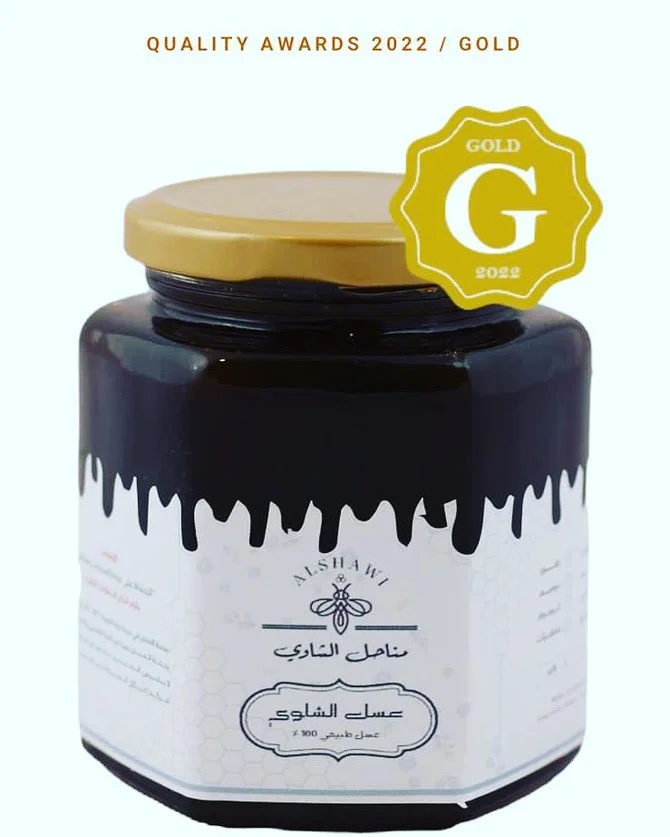
Businesswoman Norah Shawi Al-Shimmari, from the Hail region, scooped the accolade for best-quality talah (acacia) honey in the world at the London Honey Awards.
It was the first time the enterprising apiarist had taken part in the awards scheme, and she told Arab News: “Winning was one of my biggest wishes for this year. I could not believe it at first, to win is a wonderful feeling.
“It gave me a great boost to keep the good work up and participate in more competitions.”
The annual London Honey Awards competitions aim to inform honey-growers, producers, beekeepers, processors, and retailers, who distribute their standardized products legally, to preserve and ameliorate the quality of their branded items by promoting high-quality honey products in all aspects of its use and consumption.
Al-Shimmari is the only female honey farmer in Hail and is known in the Kingdom as “the beekeeper of the north.”
She and two other award winners were recently honored for their achievements by Hail Deputy Gov. Prince Faisal bin Fahd bin Muqrin.
It was while exhibiting at an event in Riyadh that she was urged to enter the London Honey Awards. “I was highly encouraged by one of my beekeeper colleagues, and I am so grateful for him and his recommendation and all the help he offered.”
Al-Shimmari runs her business from Al-Khita village, on the outskirts of the city of Hail, and moves her hives on a daily basis to different locations in the area to allow her bees access to colorful and nectar-rich athel, sidr, and acacia flowers.
Acacias are distinguished by their small, often fragrant yellow, and occasionally white, flowers, that have many pollen-producing stamens and a fuzzy appearance.
To win her award, Al-Shimmari’s honey was laboratory checked for humidity levels, sucrose and glucose content, texture, and other factors. Samples were then evaluated by a jury panel, with each judge conducting an organoleptic taste analysis and marking the product based on criteria such as appearance, odor, and flavor.
Up against competitors from around the world including the UK, China, Saudi Arabia, and other Middle Eastern countries, she said: “The competition was huge, and my winning was a surprise and a shock.
“Beekeeping is about persistence and being eager to produce distinguished honey. However, my goals do not stop here. I would like to walk a steady journey; I am still dreaming of more success and achievements. This is just the beginning. I want to see my products everywhere worldwide.”
Al-Shimmari has been in the honey trade for more than five years producing 11 different products, and she recently launched a skincare line made of organic honey and honeycomb materials.
Last year, she was the only woman among 33 beekeepers who took part in the Hail Honey Festival. The event helps apiarists market their products, while increasing investment opportunities.
The Welsh-Iraqi artist will represent the country’s diverse cultures and languages.
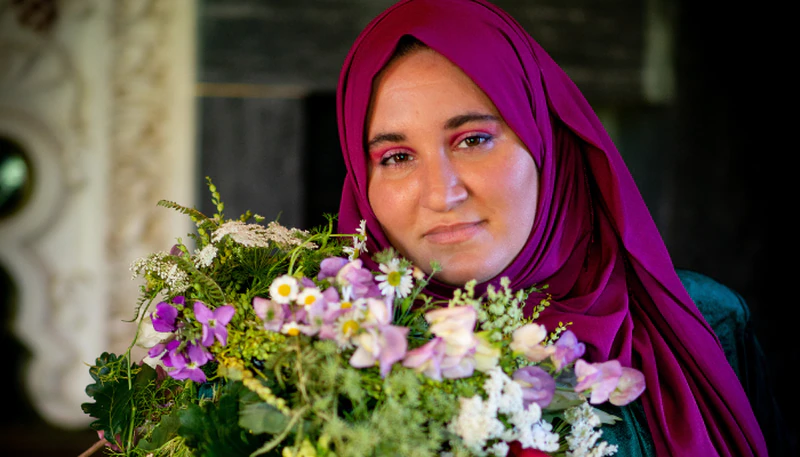
Wales has named Hanan Issa as its fifth national poet, making her the first Muslim to hold the title.
The Welsh-Iraqi poet, filmmaker and artist will serve a three-year term, representing the country’s diverse cultures and languages and acting as an ambassador for the people of Wales.
Her recent works include her poetry collection My Body Can House Two Hearts, published in 2019, and her contributions to Welsh (Plural): Essays on the Future of Wales and The Mab.
Issa grew up in Cardiff surrounded by different languages, including Arabic, which was spoken by her Iraqi parents. She described the role as an “incredibly positive step” and said it was “exciting to think that Wales is taking the lead on this aspect of representation”.
“Poetry exists in the bones of this country. I want people to recognise Wales as a country bursting with creativity; a land of poets and singers with so much to offer the arts,” she said.
“I’d like to continue the great work of my predecessors in promoting Wales, Welshness, and the Welsh language outside of its borders.
“More than anything, I want to capture the interest and inspiration of the public to see themselves in Welsh poetry and encourage a much more open sense of what Welshness is.”
Ashok Ahir, who led the selection panel for the National Poet of Wales, said: “This is a hugely exciting appointment. Hanan’s is a cross-community voice that speaks to every part of the country. She will be a great ambassador for a culturally diverse and outward-looking nation.”
Issa said she hopes that her appointment will allow women from all walks of life, but especially Muslim women, to see her success and think “that’s a thing that’s achievable for me”.
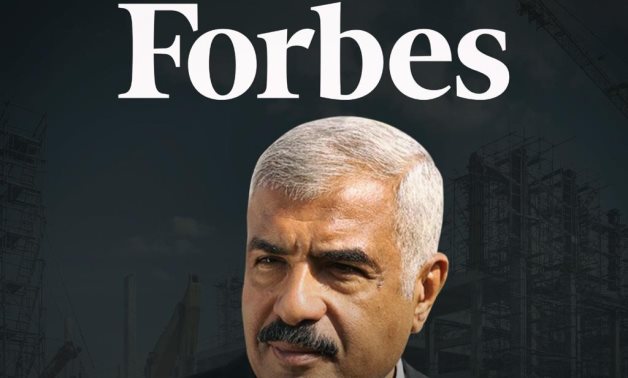
Forbes Middle East has announced its annual list of the 100 Most Powerful CEOs in the Middle East for 2022.
The American magazine confirmed the status of businessman Hisham Talaat Moustafa, CEO and Managing Director of Talaat Moustafa Holding Group, who ranked 61st, up 6 places from last year’s ranking.
Forbes Middle East magazine said that Hisham Talaat Moustafa is the youngest son of the founder of the Talaat Moustafa Group, which is currently the largest listed real estate company in Egypt.
The magazine stated that the assets of Talaat Moustafa Company amounted to 7.5 billion dollars in 2021, while the group owns a portfolio of land with an area of 74 million square meters.
The group’s revenues amounted to 825 million dollars last year, while the company developed more than 33 million square meters of land, and sold more than 90 thousand housing units.
Forbes reported that the Talaat Moustafa Group recently launched giant projects, including: Privado – Madinaty, Celia and Noor City.
The magazine said that the group has extensive investments in the hospitality sector, including: Four Seasons Resort Sharm El Sheikh, Four Seasons Nile Plaza, Four Seasons San Stefano Alexandria, and Kempinski Nile Cairo.
About the methodology used in the classification, Forbes indicated that its methodology in preparing the list was based on collecting information from financial market disclosures, industry reports, annual reports of companies, financial statements, and other primary sources.
As for the classification of CEOs, it is based on several factors: the influence of the CEO and the company on society and the country, the markets they supervise, the CEO’s experience in his current position, as well as his general experience.
Forbes indicated that the factors affecting the evaluation include: the size of the company in terms of revenues, assets, market value, the CEO’s achievements and performance in the past year, the innovations and initiatives he implemented.
This year, Forbes magazine’s list of the most powerful CEOs in the Middle East includes 100 business leaders from 26 different nationalities, led by the Emiratis with 19 CEOs, followed by the Egyptians with 16 leaders, and the Saudis with 15 business leaders.
The CEOs in the banking and financial services sector topped the list with 27 CEOs, followed by the leaders of the communications sector with 8 heads, and then 7 leaders in each of the energy and logistics sector.
The companies on the list run by CEOs are worth more than 5 trillion dollars, while revenue was more than 1 trillion dollar last year.
source/content: egypttoday.com (headline edited)
_________
Among the most powerful CEOs of 2022 Forbes highlights the CEO of Talaat Moustafa Group
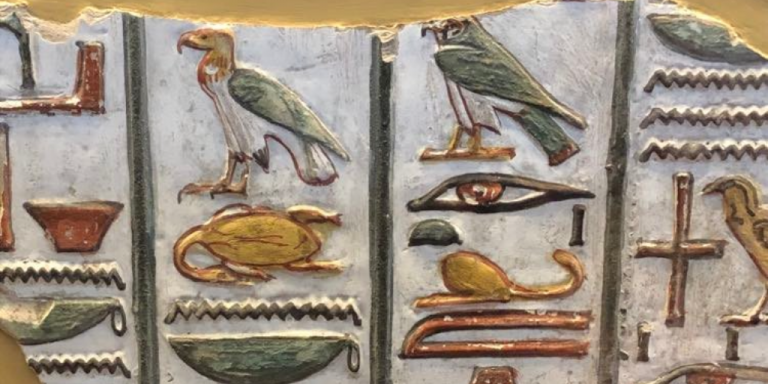
Did you know that many of the Egyptian colloquial words Egyptians use on a daily basis are not actually Arabic?
The Egyptian Arabic dialect is fundamentally Arabic, but with the influence of history and local populations, some of the peculiarities that set the Egyptian dialect apart come from the integration of ancient Egyptian, Greek and Coptic words and expressions. Surviving for thousands of years, many commonly used, modern-day Egyptian words and phrases can actually be traced back to the current dialect’s ancient predecessors.
Here are some examples of words Egyptians use, often not knowing their ancient origin, as per the books ‘From Pharaoh’s Lips’ (2003) by Ahmad Abdel-Hamid Youssef, and ‘Al Logha Al Masrreya Al Qadeema’ (Ancient Egyptian Language, 2012 ) by Abdelhaleem Nour El-din.
UMBU (DRINK)
Often, in communication with infants or toddlers, broken down or simplified words are used to allow the news speakers to express themselves without too much difficulty. For example, umbu is the word commonly used by Egyptian children to express their thirst. The ancient Egyptian term simply means “from the water”.
TA TA (STEP BY STEP)
When Egyptian parents try to help their crawling baby how to walk, they use the phrase “ta ta” derived from the ancient Egyptian word “ti ti”. Though Arabic became the primary language in Egypt, the Coptic language was initially still being used in everyday life for the majority of the population. The term “ti ti” was adopted by the Coptic language and modified to “ta ta”, which is used until today.
MAMM (FOOD)
The word Mumm is an Egyptian slang word derived from the ancient Egyptian “my wnm”, which means ‘give to eat’. Many Egyptians, until this day, teach their babies to say “mumm” whenever they are hungry — as it is easy and quick to sound out.
DAHYA TIWADDIH AL AMENDI (MAY A DISASTER SEND HIM TO HELL)
The Egyptian phrase “Dahya tiwaddih al amendi”, is originally ancient Egyptian. The word “amendi” is a Coptic word meaning “hell”, which was derived from the ancient Egyptian word “imntt”, meaning the ‘underworld’.
BIKH (BOO!)
The word “Bikh!”, meaning “Boo!”, is often used in modern day Egypt to sneak up on someone and scare them. The term is an ancient Egyptian word “pa akh” meaning “demon” or “ spirit”.
WAHAWY YA WAHAWAY IYUHA (THE MOON HAS APPEARED)
The Egyptian phrase “Wahawy ya Wahaway iyuha” is part of a song Egyptians sing during the holy month of Ramadan. Families and young children swing their fanoos (lanterns) as they sing the lyrics to Wahawy ya Wahaway iyuha. The popular lyric is believed to be inspired from the ancient Egyptian word “wah” meaning ‘to put’ or ‘appear’, and “iyah” meaning “moon”. Thus, comprising the lyric “the moon has appeared” during the month of Ramadan, which is decided upon according to the lunar calendar in Islam.
KRKR (LAUGHING)
The word “krkr” is used frequently in modern Egyptian day to describe someone who is laughing uncontrollably. The term is originally ancient Egyptian “ķrķr” and was adopted into modern day Egyptian society.
GATEK MAW (MAY A LION FETCH YOU)
The phrase “jak maw” or “gatek maw”, often switched depending on the region it is used in, essentially means “may a lion come to you”. The phrase is an Egyptian expression used as an insult. The ‘maw’ is based on a pun on the words “lion” and “mother”. The expression is often used by mothers bothered by their children.
Qatari dominated his rivals to retain his title with a winning jump of 2.37 metres.
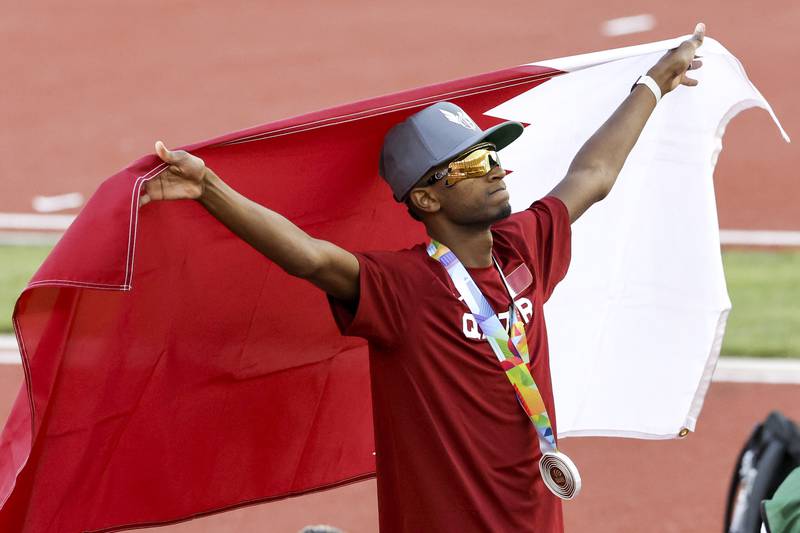
Qatar’s Mutaz Barshim turned on the style to win his third straight world high jump gold medal on Monday after clearing a world-leading 2.37 metres with ease.
Barshim, who famously shared Olympic gold with Italy’s Gianmarco Tamberi last year, jumped beautifully all night at Hayward Field in Eugene, Oregon to go well beyond his own season’s best of 2.30m.
The title was just about secure after he cleared 2.35m but he then eased over 2.37m looking almost in slow motion. With the gold medal then in the bag he had one attempt at a championship record 2.42m but failed.
“The target for me for today was gold medal, if even the world record is the only thing I still miss,” said Barshim, whose best of 2.43m is second only to Javier Sotomayor’s 2.45m set in 1993.
“Three worlds golds in a row is something that has never have been done before. I feel like I have a name in our sport, but I have been never felt like the greatest one in the field,” added the modest Qatari, who also has two Olympic silvers and a world silver to his name.
World indoor champion Woo Sang-hyeok of South Korea needed three attempts to get over 2.33m but then also cleared 2.35m at the second attempt to take silver. Ukraine’s Andriy Protsenko collected bronze on the back of his 2.33m clearance.
Tamberi had a nervous path into the final, twice failing at 2.25m and then twice again at 2.28m in Friday’s heats. In the final he failed twice at 2.30m but then cleared 2.33m at the second attempt before bowing out at 2.35m to finish fourth.
source/content: thenationalnews.com (edited)
___________
Mutaz Barshim celebrates after winning the men’s high jump final at the World Athletics Championships at Hayward Field in Eugene, Oregon, USA, on July 18 2022. EPA
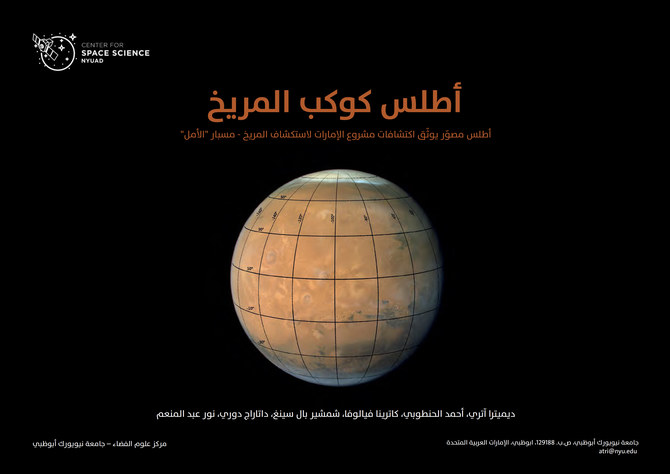
NYU Abu Dhabi research scientist Dr. Dimitra Atri has produced the world’s first ever Mars atlas in Arabic, Emirates News Agency reported.
The atlas uses data from the UAE’s Emirates Mars Mission (EMM) — also known as Hope or Al-Amal — in order to make the findings of the probe more accessible to both the UAE’s Arabic-speaking population and the rest of the world.
The Mars Atlas Project combines various images from the Hope probe to map the planet’s surface.
The end result is a comprehensive view of Mars and stunning images of a planet that once had similar atmospheric conditions to Earth.
Dimitra Atri used data from UAE’s Hope probe to map the red planet.
Atri and his team compiled the atlas by processing observational data from EMM’s Emirates eXploration Imager, one of three instruments onboard the orbiter. The device will also assist the team in showing how the planet changes over the course of one Mars year, which is roughly equivalent to two Earth years.
As more data from the Hope probe becomes available, the atlas will be gradually updated.
The data will help scientists gain a better understanding of the planet’s atmospheric thinning, which has caused it to cool and dry over the last 4 billion years.
Atri predicts that the collected data will be used to answer unsolved scientific questions about the erosion of Mars’ atmosphere.
The findings could help the international scientific community to better understand Earth’s atmospheric processes, he said.
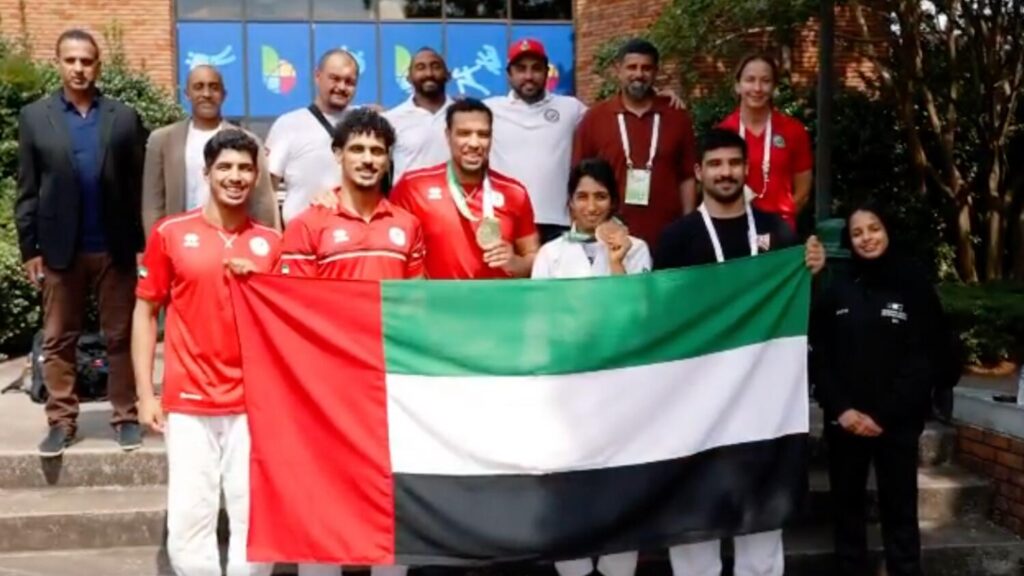
The UAE national jiu-jitsu team of five athletes has added two medals in the 11th edition of the World Games hosted by Birmingham, USA, from 7 to 17 July, 2022, bringing its total harvest to five medals (two gold medals, two bronze and one silver).
UAE’s Faisal Al Ketbi captured the gold medal in the 85kg category, while the 19-year old Shamma Al Kalbani won the bronze in the open weight division, becoming the first Emirati athlete to achieve such a global landmark victory.
A jiu-jitsu squad of five athletes from the UAE qualified for the games, building on an impressive performance at the 2017 Games in Warsaw, Poland. Last time out, Al Ketbi won the gold medal in the under-94kg.
Abdel Moneim Al Hashemi, Chairman of the UAEJJF, and Senior Vice President of the International Jiu-Jitsu Federation (JJIF), called the UAE team to offer his congratulations.
Fahad Ali Al Shamsi, Secretary General of the UAE Jiu-Jitsu Federation (UAEJJF), attended the award-giving ceremony, and congratulated Faisal Al Ketbi and Shamma Al Kalbani on the winning.
Tariq Al-Bahri, Director of the Abu Dhabi Professional Jiu-Jitsu Association, Mubarak Al Menhali, Director of the Technical Department, UAE Jiu Jitsu Federation’s (UAEJJF), and Joachim Thumfart, Director-General of the Jiu-Jitsu International Federation (JJIF), watched the closing day competitions.
Considered a global showpiece for sports yet to be included in the Olympic Games, the prestigious World Games 2022 featured approximately 3,600 participants from 100 nations competing across more than 30 sports.
The Emirati stars included Faisal Al Ketbi (85kg), Muhammad Al Amri (77kg), Muhammad Al Suwaidi (69kg), Shamma Al Kalbani (63kg) and Balqees Abdelkareem (48 kg).