Arabs & Arabian Records Aggregator. Chronicler. Milestones of the 25 Countries of the Arabic Speaking World (official / co-official). AGCC. MENA. Global. Ist's to Top 10's. Records. Read & Enjoy./ www.arabianrecords.org
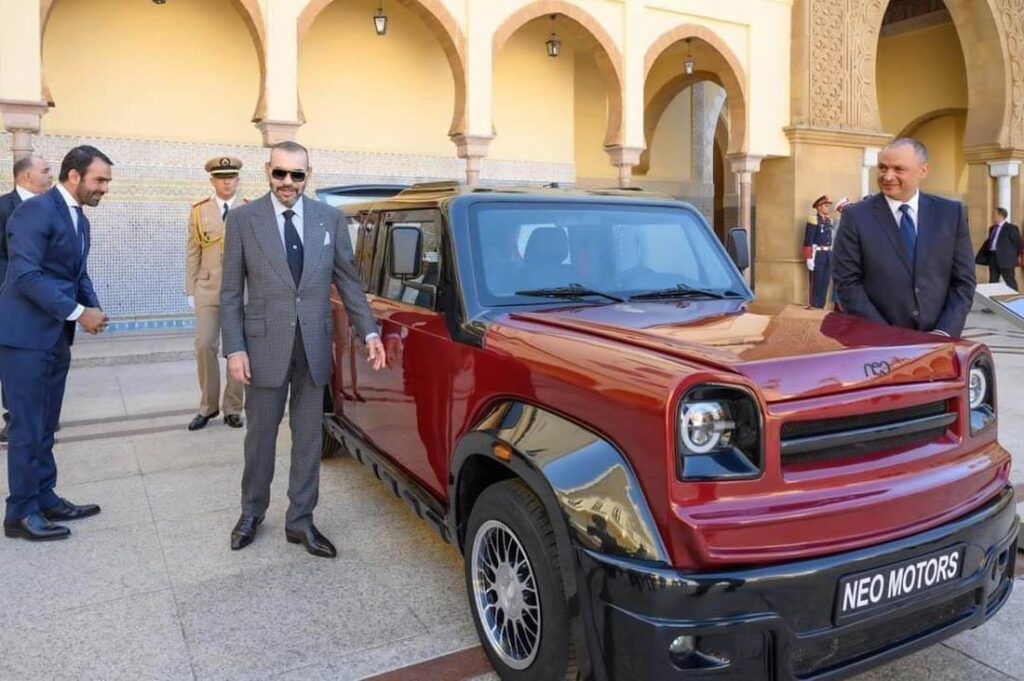
Morocco’s King Mohammed VI presides at the Royal Palace in Rabat the presentation ceremony of the model of the first Moroccan car manufacturer “Neo Motors” and the prototype of a hydrogen vehicle “NamX” developed by a Moroccan.
Morocco’s King Mohammed VI presided, on Monday at the Royal Palace in Rabat the presentation ceremony of the model of the first Moroccan car manufacturer and the prototype of a hydrogen vehicle developed by a Moroccan, two innovative projects that will strengthen the promotion of the “Made In Morocco” label and consolidate the Kingdom’s position as a competitive automotive production platform.
The presentation to the King of the car of “Neo Motors”, a company owned by Moroccan capital, and of the prototype of a hydrogen vehicle of the company NamX, named HUV (Hydrogen Utility Vehicle), underlines the Sovereign’s willingness to encourage and promote the pioneering national entrepreneurial initiatives and the creative capacities, particularly of the Moroccan youth, that these projects embody.
These two industrial initiatives are in line with the High Royal Directions aiming at directing the private sector towards productive investment, in particular in the advanced and future sectors and at stimulating the emergence of a new generation of companies in the Kingdom.
They also confirm the King’s far-sighted vision in terms of sustainable development and the promotion of renewable energies, particularly the emerging field of green hydrogen.
Neo Motors company has set up an industrial unit in Ain Aouda (Rabat-Salé-Kenitra Region), to manufacture motor vehicles for the local market and for export, with a projected annual capacity of 27,000 units and a local integration rate of 65%.
The total projected investment for this project amounts to 156 million dirhams ($15.6 million) and will eventually create 580 jobs.
The final approval of the first vehicle was issued by the National Agency for Road Safety in February 2023. The company has launched the pre-production and plans to inaugurate the industrial unit during the month of June 2023 and to launch the marketing.
This project, which gives birth to the first Moroccan consumer car brand, is carried by national skills. It relies mainly on the ecosystem of local automotive suppliers developed by the Kingdom.
As for the prototype of the hydrogen vehicle of NamX, it was designed in collaboration with the Italian design office and coachbuilder of reference Pininfarina. The interior design of the vehicle has been realized by Moroccan talents.
Indeed, the HUV model will be supplied with hydrogen by a central tank that will be completed by six removable capsules, guaranteeing a significant autonomy and facilitating the hydrogen recharge in a few minutes.
This pilot project places Morocco firmly in the ongoing worldwide momentum to develop new forms of transport that combine efficiency and respect for the environment.
The monarch awarded the Wissam Al Kafaa Al Fikria to Nassim Belkhayat, founder and CEO of Neo Motors company, and Faouzi Annajah, President and founder of NamX company.
Dr Hamada Elkady, executive director of Delta Farm, believes that the Egyptian desert has the potential to be a successful shrimp producing region.
Dr Elkady has been the executive director of Delta Farm – a tilapia and shrimp farm in Wadi El Natrun – since 2019.
Can you briefly describe your aquaculture career?
I obtained a doctorate and a master’s degree in aquaculture, but upon graduation, I worked as the production manager of the Al-Amana Feed Factory until 2013. Then I worked in tilapia farms for my family in Kafr El-Sheikh. I have been the director of Delta tilapia and shrimp farm in Wadi El Natrun since 2019.
What inspired you to become a shrimp farmer?
We were looking for an alternative to tilapia culture, and shrimp was the ideal solution. What helped us were the factors available at our Wadi El Natrun farm, such as the salinity of the water and the appropriate climate for vannamei shrimp culture.
What were the main challenges to overcome when you set the farm up?
The first aquaculture season there in 2019 was dedicated to Nile tilapia culture. We started trialling vannamei shrimp farming in 2021 in two ponds and the success of the trial was an incentive for us to convert more of the farm to shrimp production, and perhaps move purely to shrimp in the future.
A key challenge was to search for a place with a water source with a suitable salinity for aquaculture, which was also close to the markets. After that, the design of the farm itself, in order to save energy, adjust production intensity, improve feed conversion ratios and ensure the best waste disposal methods.
Can you provide as many details as possible about the scale, design and operation of the farm?
The total land area is 70 acres and includes nine 70 by 70 metre ponds lined with polyethylene, in addition to four 40 by 40 metre ponds used for rearing and nursery. The ponds are fed by groundwater from wells and we use the waste water in a hydroponic component, which produces crops that tolerate salt, such as alfalfa (Medicago sativa) and the Barhi date palm (Phoenix dactylifera ‘Barhi’) in the parts of the farm with no ponds.
How many tonnes does the farm currently produce per year?
Our production is mixed between tilapia and shrimp. There are three shrimp ponds with a production average of 2.6 tonnes of shrimp, with production sizes ranging from 30 to 40 shrimp per kilogram. There are also four nursery tanks each holding 100,000 shrimp larvae. The current year’s production consisted of one cycle of shrimp because we are still developing a plan to produce more than one cycle.
Meanwhile, we produce around 135 tonnes of tilapia from six ponds, selling them at sizes ranging from 250 to 350 grams.
What does a typical day’s work consist of on the farm?
Most of the day is split between the disposal of organic waste from the ponds, which we do three times, and feeding, which takes place four times. We also take samples to ensure that the water conditions are good.
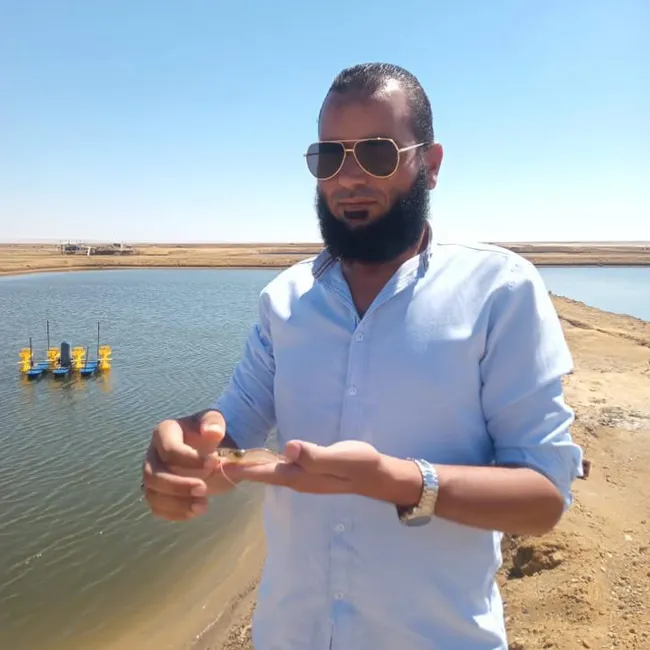
Dr Elkady next to one of the shrimp ponds at Delta Farm
The farm has three shrimp ponds with a production average of 2.6 tonnes of shrimp, while six additional ponds produce around 135 tonnes of tilapia
What was the project’s original goal and what has been achieved so far?
The original goal was to produce high-quality fish in an area far from all sources of pollution and with the highest production rates. Next season, we aim to produce 10 tonnes of shrimp per acre, and then ramp this up until we reach optimal global production rates.
What are the most important factors for ensuring efficient shrimp production in a desert environment?
The salinity level of the water source needs to be reasonable for shrimp culture, and the level of 20-30 ppt has the advantage of high feed conversion rates and low disease incidence.
A sandy loam soil which retains water can save the cost of lining the ponds with polyethylene
A reliable source of electricity to operate the aerators and pumps from the wells – solar energy can reduce costs.
Trained workers and experience are required because aquaculture in the desert differs greatly from other climates.
What impact has the rising costs of inputs such as feeds had on you?
The rise in feed prices represents a major challenge but the price of shrimp is still high enough to make profits. However, it is harder to make profits from tilapia.
What regions and production systems have the most scope for shrimp farming growth in the coming years?
Promising production systems depend mainly on the type of surrounding environment and the availability of water, but in desert lands, intensive and semi-intensive systems – including biofloc and recirculation aquaculture systems (RAS) – are among the best options.
One of the most promising areas for aquaculture in Egypt is the Al Maghrah area in Matrouh Governorate, which is characterised by good soil, a suitable climate and a water source with suitable salinity.
How would you like your farm to develop in the coming years?
The most important part of our development plan is installing alternative energy sources, such as solar panels, and developing the nursery unit so that we can do more than one cycle of shrimp per season. We are also looking to cover the ponds with polytunnels.
The Banker highlighted Jouahri’s strategies to safeguard Morocco’s economic stability in 2023, as well as his dedication to social causes.
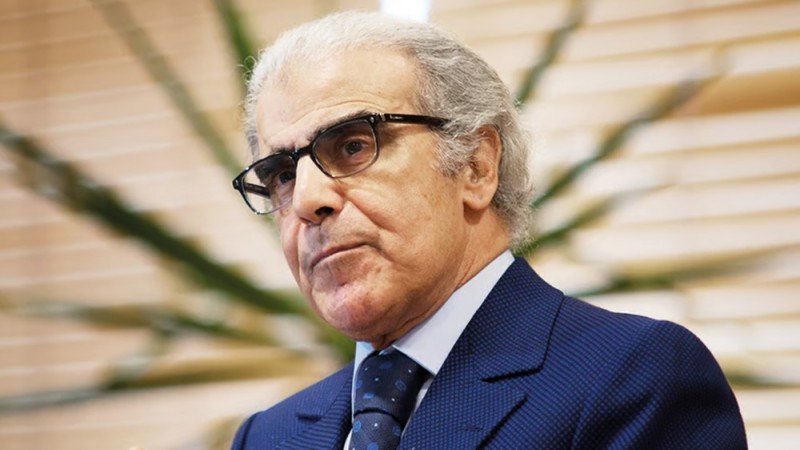
International financial affairs magazine The Banker has named the Governor of Morocco’s Bank Al-Maghrib (BAM) Abdellatif Jouahri Africa’s Central Bank of the Year 2024.
Earning the top spot for Africa in the Financial Times-owned outlet’s ranking highlightedJouahri’s leadership in the African banking sector, as well as his contributions during a period of remarkable growth and resilience.
Jouahri’s tenure spans two decades, marked by his adept steering of Morocco’s banking sector and the broader economy.
The Banker acknowledged Jouahri’s role in the relief efforts following the devastating Al Haouz earthquake that hit central Morocco in September of 2023.
The magazine noted that Bank Al-Maghrib, Morocco’s central bank, donated MAD 1 billion to the country’s relief fund for the earthquake, and “was quick to offer support for sectors of the economy most impacted by the tragedy.”
In addition, the Banker lauded Jouahri’s decisions, including BAM’s “relative success” in tackling inflation. The Moroccan central bank was one of the first African central banks to hold interest rates in 2023, after lifting them to 3% in March, allowing the economy to absorb the impact of rate rises.
“After a slight uptick in August, the bank continued to hold its nerve, a move that was vindicated by inflation falling back down to 4.3% in October from a high of 10.1% in February,” the magazine explained.
The Banker also highlighted the launch of Morocco’s instant payment system (IPS) in June, which aimed to advance the country’s financial infrastructure.
Commenting on the recognition, Jouahri expressed “considerable satisfaction” for receiving the top spot in the ranking, emphasizing the key role of central banks in overcoming global challenges.
“I am convinced of central banks’ pivotal role in overcoming the major challenges that beset the world. Foremost among these is climate change: the consequences of which are steadily worsening,” he said.
In light of escalating political tensions and the prolonged inflationary trends, Jouahri underlined the heightened challenges that central banks face.
He called on these financial institutions to “optimise their monetary policy decisions to safeguard the purchasing power of citizens, especially the most underprivileged among them, and improve investor confidence in the future of their companies.”
Yasmine Idriss hopes her ‘heroine’s journey’ will inspire others to take the road less traveled.
Earlier this year, Yasmine Idriss sat down with Arab News just before setting off to Iceland to cycle the country’s Ring Road on the journey of a lifetime. Now, she has become the first Arab woman to complete the grueling trip.
Initially, she thought her time on the road — which runs for almost 1,400 km — would give her the chance to plan her next career move. Little did she know she would pedal her way to much deeper enlightenment.
Her entire journey, from raging winds to sweet serenity, is captured in a documentary film titled “Threshold,” due out in 2024.
“I open up quite a bit (in the film) about what this was for me and what the ‘heroine’s journey’ is. The heroine’s journey isn’t just a woman going through the hero’s journey. (It) has a lot more surrender embedded in it, and that’s a huge theme of what Iceland was for me,” she told Arab News.
While Idriss knew there was no way to replicate the effects of Iceland’s biting winds during her training period, she hadn’t expected them to be quite as fierce as they were — she faced the highest winds of the entire season and was blown off track in all directions. With oncoming traffic on one side and sharp rocks on the other, she prayed for stability.
HIGHLIGHTS
• Yasmine Idriss’s entire journey is captured in a documentary film titled ‘Threshold’ due out in 2024.
• Kathi Hendrick helped create the narrative for the documentary while Madison Hoffmann is the lead filmmaker.
“It was a very brutal welcoming to what this Ring Road journey was going to be about,” she said.
With the exception of just two days in her three-week trip, the wind was constant — not stopping “even for a second,” she said. While most life challenges come in waves, ebbing and flowing, the continuous assault brewed frustration.
“Why? What is the purpose? What can I be learning from this? Why is this so hard?” Idriss says she wondered.
Her close friend — and one of her two companions on the road — Kathi Hendrick, said to her: “Wind stops inertia, wind forces you to move, it forces you to be awake, otherwise you would fall.”
The physical challenges paralleled the emotional. Realizing that she was exerting more strength than needed, she surrendered.
“The muscles that needed to be working were working, and the muscles that didn’t need to be working were relaxed. Psychologically, how that translated was: I just let anything that needed to happen, happen,” she explained.
I feel proud to be able to represent Saudi women. I don’t feel like I’m the first. There are so many amazing Saudi women who have paved the way for me, (who have) done amazing things (and) are doing amazing things.
Yasmine Idriss, Cyclist
Hendrick supported the cyclist on the trip and helped create the narrative for the upcoming documentary, while Madison Hoffmann, also a good friend, was the lead filmmaker.
Idriss said: “Somehow the three of us were mirroring each other’s experiences. Each of us was going through something very similar; even though I was on a bike and they were in the van, there was a sort of synchronicity that was happening. It was just really beautiful to see the magic that can happen when women come together in a supportive way.”
The trip was meant to help clarify what the next chapter of her life would look like. Idriss had just left her position as the head of a sustainable footwear company, which she thought was her dream job.
Removing herself from the responsibilities of daily life, and being disconnected from family and friends, ignited a deep transformation, as trips of this nature tend to do. “Over 20 days on the bike, it was an inward journey,” she said.
While there was no hiding from the elements, there was no avoiding the self either. From ending a close relationship to facing difficult questions, “everything was brought to light,” Idriss said, adding that that was exactly what she needed.
Idriss is now advocating for time away to recharge and innovate in a hyper-productive society, packed with intense working hours and social commitments.
She explained: “For Vision 2030, we’re developing like crazy. We’re one of the fastest developing countries in the world, and it’s happening with such beautiful leadership. We also need rest, and we need space, and we need to take care of ourselves in order to be as productive as our communities need us to be right now.”
While she primarily embarked on the journey for her own self-exploration, she humbly hopes to drive others to do the same.
“I feel proud to be able to represent Saudi women. I don’t feel like I’m the first. There are so many amazing Saudi women who have paved the way for me, (who have) done amazing things (and) are doing amazing things,” she said. “If I can be a mirror for the world to look at what women are doing in Saudi Arabia, then that would be a huge privilege. And if I can inspire others to go on their own road, whether that’s a walk in the neighborhood, or climbing Mount Everest like Raha Moharrak, then I have accomplished my mission.”
Immersing herself in the landscapes of Iceland, with all the challenges and revelations that it brought, inspired her to “(bring) this work to others and invite others into similar journeys of transformation in a very different form. This is what I’m working on next.”
source/content: arabnews.com (headline edited)
_________
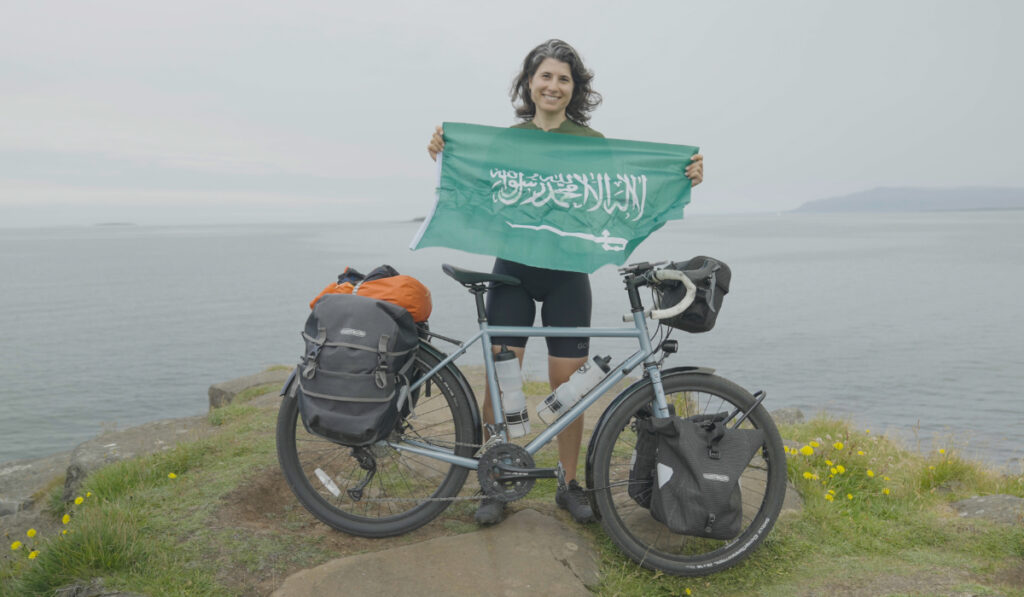
Yasmine Idriss has made history as the first Arab woman to complete the grueling 1,400 km cycling trip along the Nordic Ring Road. (Supplied)
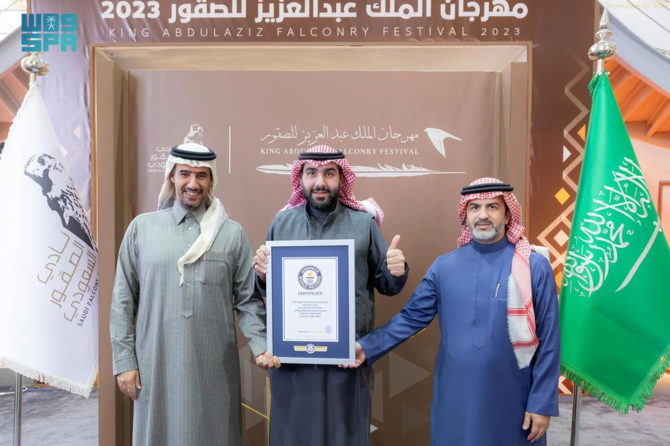
It is now recognized as the largest falconry competition in the world, with 2,654 falcons participating.
The King Abdulaziz Falconry Festival 2023 has set a new world record by entering in the Guinness World Records for the third time in its history, the Saudi Press Agency reported on Saturday.
It is now recognized as the largest falconry competition in the world, with 2,654 falcons participating.
The festival was held between Nov. 28 and Dec. 14 and was organized by the Saudi Falcons Club at its headquarters in Malham, north of Riyadh.
The accomplishment stands as a testament to the backing of the Saudi leadership in safeguarding the Kingdom’s cultural heritage.
In its inaugural year, the festival secured a Guinness World Record with 1,723 falcons, and in the following year in 2019, it repeated this feat by including 2,350 falcons.
The event drew falconers from the Kingdom, Gulf countries and across the world, who competed for the festival’s awards over 17 days. Falconers vied for places in the Al-Mazayen and Al-Milwah competitions, with prizes exceeding SR33.6 million ($8.91 million).
As part of efforts to enhance the ancient falconry heritage of the Kingdom, the Saudi Falcons Club is partnering with the Royal Commission for AlUla governorate to organize the first AlUla Falconry Cup 2023.
The competition will be held in AlUla governorate from Dec. 28 to Jan. 5, with prizes worth up to SR60 million in the Al-Milwah and Al-Mazayen competitions. These represent the largest financial prizes in the history of falconry competitions in the world.
source/content: arabnews.com (headline edited)
_________
The festival was held between Nov. 28 and Dec. 14 and was organized by the Saudi Falcons Club at its headquarters in Malham, north of Riyadh. (SPA)
The London-born aspiring actress has a deep appreciation for her Moroccan heritage – which may explain why migration is an issue so close to her heart.
Nora Attal has the index finger of one manicured hand extended across the bridge of her nose, and the straightest face she can muster in the circumstances.
It started as an attempt to brush aside the fuss made about her eyebrows, which are, according to various beholders, glorious, serious, stunning, bold, thick, enviable and — somewhat at odds — natural and well groomed.
But now the British-Moroccan fashion model is mulling over a new signature look. “Oh, no! They’re just hair on my face,” Attal tells The National, embarrassed and amused by the attention. “I get them from my Dad — he has very bushy eyebrows.
“If I didn’t groom them, they would be a monobrow. Actually, I saw the film Frida yesterday. It was incredible. I think,” she pauses to regard the mocked-up effect in the zoom camera, “I might just do that … grow a monobrow.”
Perhaps such thinking is to be expected after a 48-hour infusion of cultural rebellion. The day before watching the biopic on the hirsute and indomitable Mexican artist Frida Kahlo, Attal was celebrating turning 23 at her first ever music festival near her home in Spain.
There, she was among the crowd asked by flamboyant American rapper and actress Megan Thee Stallion to make a particular gesture of protest to the US Supreme Court for overturning Roe v. Wade.
“Megan Thee Stallion’s my new icon,” Attal, an enthusiastic gesticulator in daily life, says, “but who I look up to evolves all the time.”
She favours strong, not-so-silent types. Michelle Obama, the former first lady of the US, was top for a while for always telling it as it is — “I still respect her a lot” — along with actor, musician and serial disrupter Riz Ahmed and the Arab writer and women’s rights champion Leila Slimani.
“People like this, I love. I really try to take in their energy,” she says.
It’s a fighting spirit that Attal herself embodied recently when Maria Grazia Chiuri, the creative director of the French fashion house Dior, reportedly said that “models don’t represent women … the model is only a girl who passes in front of you”.
Having walked the runway for Dior 20 times since Chiuri took over, an indignant Attal vented on her Instagram stories, posting: ‘And to hear that I’m not a woman … she is very vocal about her feminism narrative, yet so archaic in thinking that models should only be hangers”.
“Coming into adulthood has been quite nice,” she tells The National. “I understand myself more and, because of modelling, I’ve travelled such a long time alone, experienced a lot, and I’ve maybe grown up quicker.
“I’m definitely more confident, like the way I speak to adults in the industry.”
She recalls being a shy, studious little girl, born in London to two Moroccan parents, Charhabil (Charlie) and Bouchra, and growing up on a council estate in Battersea until the family moved to Surrey.
Sport was an outlet, sometimes whether she liked it or not because of her talent for everything from gymnastics, basketball and tennis to golf and representing her county in long-jump.
Saturday mornings in the house were full of music, regularly featuring Michael Jackson, Prince, Stevie Wonder, and Diana Ross, to whose live performance Attal would dance the night away at a star-studded after party in Marrakech a decade later.
The walls of her childhood bedroom were plastered with magazine covers and fashion campaigns, America’s Next Top Model was the programme of choice, and she would doodle clothes on mannequins in English class instead of writing, say, the set essay on Thomas Hardy.
Yet the industry wasn’t one that young Nora easily identified with or conceived of entering, not least because “there weren’t many people who looked like me”.
“I don’t think she would have ever imagined anything like this,” Attal says, her hands making an all-compassing vertical circle in the air. “Ever, ever, ever.”
It wasn’t long, though, before the striking 12-year-old in blue Converse trainers and a hoodie was first spotted while out in a shopping mall.
“My Dad said ‘yeah, no’ when I went to see the agency,” she remembers with a smile, “and I really appreciate that now …
“It’s tough. I don’t think that young girls should be working in such an adult industry, which doesn’t have a union or HR department that you can go to.”
Modelling, it seems, wasn’t going to take no for an answer. Two years later, the British fashion and documentary photographer Jamie Hawkesworth turned up at her high school, casting for a JW Anderson campaign.
Attal subsequently debuted as Anderson’s muse, dubbed “the mystery girl”, and spent the next few years fitting fashion shows and shoots around education, poring over textbooks while waiting at castings or back stage after hair and make-up.
A fortnight before receiving her A-Level results in History, Psychology and Art at Ewell Castle School, the September issue of British Vogue landed in newsagents with Attal on the cover beside Kate Moss, Edie Campbell, Stella Tennant and Jean Campbell.
The avid true-crime fan was offered a place at Greenwich to study criminology but “took a gap year, deferred it and then dropped it”.
“Working in this industry, I can see that almost anything is possible if you put your mind to it,” she says. “I think everyone should know that.
“My family, being Moroccan, would have loved it if I became a doctor or a lawyer or a pharmacist, and had a normal life but you should do what makes you happy — and you will be successful.”
Represented by Viva Model Management, her own success can be measured by the fact that it would be faster to name the exclusive brands, designers, magazines and celebrity photographers that she hasn’t collaborated with than those she has.
Her brown doe-like eyes, long dark hair and slender 5ft 10in figure quickly became a mainstay on the global circuit in an ascent likened to that of Gigi Hadid.
As with Hadid, she has come to treasure her Mena heritage, and an appreciation has deepened over the years for the hardships that her parents overcame as immigrants “for me to get where I am”.
“It is really important for me to remind myself of that,” she says.
It makes her all the more sensitive to the migration issues prevalent in the UK, particularly the controversial policy of deporting asylum seekers to Rwanda. She has just sent an email opposing the plan to her local MP in England, and urged her 71,000 Instagram followers to do the same.
“I think it’s terrible, I really do. My mum has friends from Syria and Iraq. It could be anyone. Even if you don’t have Syrian friends or Iraqi friends, it’s just a basic human right.”
She talks about what it has meant to have been able to incorporate her North African roots into modelling work many times during a vibrant career.
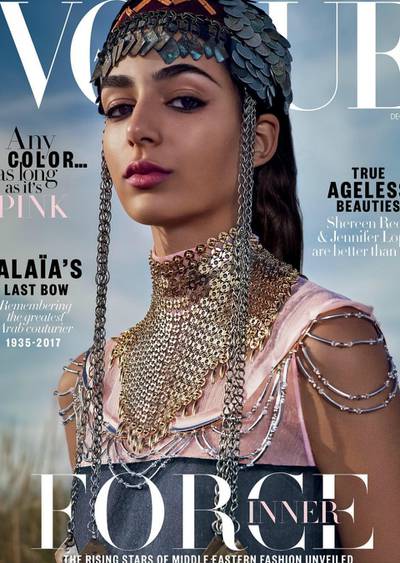
The editor of Vogue Arabia, Manuel Arnaut, described her as “cool, contemporary and a great ambassador of the Arab world” when she graced the December 2017 cover in a Berber ceremonial headpiece.
Among several shoots with the noted American photographer Steven Meisel was one set against the dunes of the Sahara, and she has traversed a catwalk at El Badi Palace in Marrakech.
But perhaps her favourite fashion “story” ever was for a Vogue Italia issue devoted to DNA. The editorial team descended on Attal’s ancestral home in Larache, near Tangier, where she has spent two months every year since she was a toddler.
Her abiding memories of those visits are the aromas of tagine and couscous emanating from the kitchen of her grandmother, Fatna, and forays to the picturesque old town of Chefchaouen in the surrounding hills or along the coastline in search of quiet bays.
This time, though, Fatna lined up in the family living room next to Attal, her brother, Adam, sister, Yesmin, and parents, all dressed top to toe in Chanel for a black and white photo shoot.
“My grandma had never seen anything like it in her life,” she says, fondly. “She thought it was quite strange but was excited. She really loved it.”
More recently, her extended family fronted Ralph Lauren’s holiday campaign for Eid in a video clip that also included Attal’s then fiance, Victor Bastidas, a director and cinematographer 10 years her senior.
The couple met on location at the 16th-century Samode Palace nestled in the ancient Aravalli hills outside Jaipur, but it is all a bit of a blur to Attal now.
What stands out most is being photographed aged 17 by Mario Testino alongside an elephant painted with orange and pink food dye, and embellished in heavy jewellery.
“Arrrgh!,” she says, reliving the excitement and leaning back to show the proximity with her hands. “I shot with an elephant in real life that had to be just here.”
Happily, Bastidas and Attal bonded years later in London over their mutual love for the music written and performed by Thom Yorke for Luca Guadagnino’s supernatural horror film Suspiria, and began dating just before the coronavirus tightened its grip on the world.
Their fairy-tale wedding was held a few months ago at Cortijo San Francisco, a 1,900-square-metre “farmhouse” in Estepona, near Marbella, built as a refuge by the Hollywood actor Stewart Granger who starred in King Solomon’s Mines with Deborah Kerr.
There is a picture from the day of an ornate Mexican fireplace that would have dominated the room until Attal, in strappy skyscraper heels and a breathtaking Lanvin gown, stepped down a narrow passageway into the scene.
The pandemic has marked many other new beginnings for Attal. She did a Run for Heroes in support of the NHS, painted and made lino prints, learnt to cook (pizza, ramen noodles from scratch, a mean carrot cake), and moved to Barcelona for the fresh air and to be closer to nature.
At such a time, it is unsurprising that someone whose favourite poem is William Blake’s Auguries of Innocence — “To see a World in a Grain of Sand. And Heaven in a Wild Flower …” — began to consider the wider picture.
“It was a very big reset. It made me sit down and think about what I wanted to do with my life,” Attal says.
The answer was to act, and she has just graduated from the prestigious Baron Brown Studio in California after two years of studying the Meisner technique over the internet.
Asked if she’s thought much about who she would like to work with, Attal whips out her phone. “Yes, I have lists for everything. A list of directors, of actors, films that I like, references of things.”
For the record, Guadagnino is director number one, leading, in no particular order, Todd Phillips, Pedro Almodovar, Tim Burton, Wes Anderson and the Iranian Asghar Farhadi, “though I don’t speak Farsi, but…,” she says, trailing off hopefully.
Whether theatre or independent film, Attal doesn’t mind. Just having undertaken the training is, she believes, her biggest triumph, which is saying something.
“I’m actually very proud of myself for going back to school, even though it’s on Zoom or it’s not necessarily as heavy as being a doctor.
“I’m doing things that maybe I wouldn’t have done before. I’ve taken the step to tell agents and brands that ‘No, I can’t do that job because I’m studying acting’, and I’m putting my foot down. I think, before, I doubted my abilities, and now I’m like: ‘Yeah, just do it, why not?’”
It is hard not to wonder where Attal’s forthright tendency, fervour and self-determination, so unusual in a young woman in her early 20s, come from.
A clue may lie in a single line buried among the Moroccan press coverage that describes her paternal great-grandfather as a revolutionary, poet and director. The snippet is, it has to be said, uncorroborated, but sounds just about right.
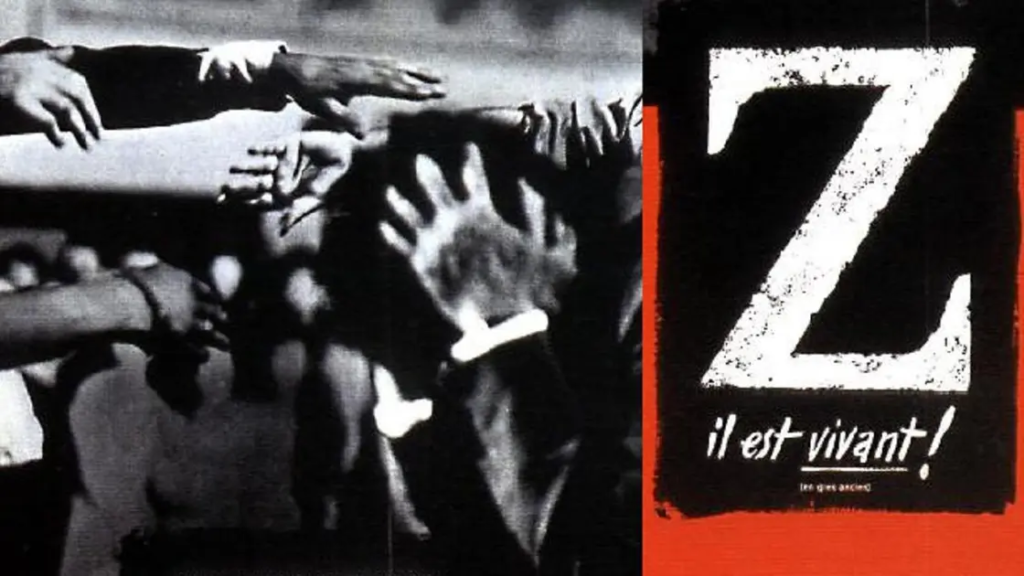
8 years have passed since the Algerian film “Z,” the only Arab film, received an Oscar award for best foreign film and best montage.
In 1970, American actor Clint Eastwood and Claudia Cardinal, the famous Italian actress, announced Algeria’s win.
It was received by Ahmed Rashdi, on behalf of the production department of the National Organization for Algerian Cinema, which produced the film.
The film “Z”, one of the most prominent political films in the history of international cinema, was a joint French-Algerian production, dealing with the assassination of the politician Gregory Lambrax in 1963, and the uprising of youth and students condemning dictatorship and repression.
The story was an adaptation of a book by Greek novelist Vassilis Vassilikos inspired by the events of the coup which took place in Greece in the mid-sixties as the army took control of power.
It focused on the assassination of the of democratic Greek politician Grigoris Lambrakis in 1963, and the uprisings of youth and students angry at his assassination, denouncing dictatorship and repression.
Most of the scenes were filmed in Algeria by director Costa-Gavras in areas similar to the nature of the city of Athens.
French actors including Jean-Louis Trintignant, Yves Montand along with Greek actress Irene Papas, Algerians Hassan Hassani, Sayed Ahmed Akoumi and Alal al-Mohaib were among the actors.
The letter “Z” was chosen as the title of the film, because it represents a symbolic political connotation in the Greek language, meaning “living.”
It was used by political adversaries of the coup in Greece, as they wrote it on the walls of the Greek cities to denounce the politics of repression and the death of Lambrax.
The news follows a memorandum of understanding signed in July 2022 between the Ministry of Health and Social Protection and the IAEA.
Morocco and the International Atomic Energy Agency (IAEA) have signed an agreement for the Rabat-based Sidi Mohammed Ben Abdellah National Oncology Institute, which is affiliated with the Ibn Sina University Hospital, to become a collaborating center for the IAEA.
IAEA made the announcement was made on Friday. The Moroccan institution was elected as an IAEA collaborating center during the 67th regular session of the IAEA General Conference held in Vienna from September 25 to 29.
The news constitutes a recognition of Morocco’s commitment to advancing nuclear sciences in Africa, improving access to cancer treatments, and combating animal-transmitted diseases across the continent.
Khalid Ait Taleb, the Minister of Health and Social Protection, presided over the official announcement ceremony, emphasizing that the IAEA’s accreditation is an acknowledgment of the institute’s prolonged dedication to battling cancer.
He praised the institute’s exceptional staff and expertise having elevated its standards to a commendable level of quality.
Maintaining the prestigious accreditation in the upcoming years is now a primary challenge, Minister Ait Taleb stressed. He underscored the institute’s pivotal role in combating cancer and nurturing medical expertise in the field, both nationally and continentally.
For his part, Director-General Raouf Mohsine of the Ibn Sina University Hospital in Rabat emphasized the profound significance of this election within Morocco and across the continent.
This recognition is a source of immense pride for Morocco amid ongoing reforms in the national healthcare system, he said. The milestone follows a memorandum of understanding signed in July 2022 between the Ministry of Health and Social Protection and the IAEA, through which the two institutions committed to reinforcing collaboration in the fight against cancer and zoonotic diseases.
source/content: moroccoworldnews.com (edited)
_____________
Morocco and the International Atomic Energy Agency (IAEA)
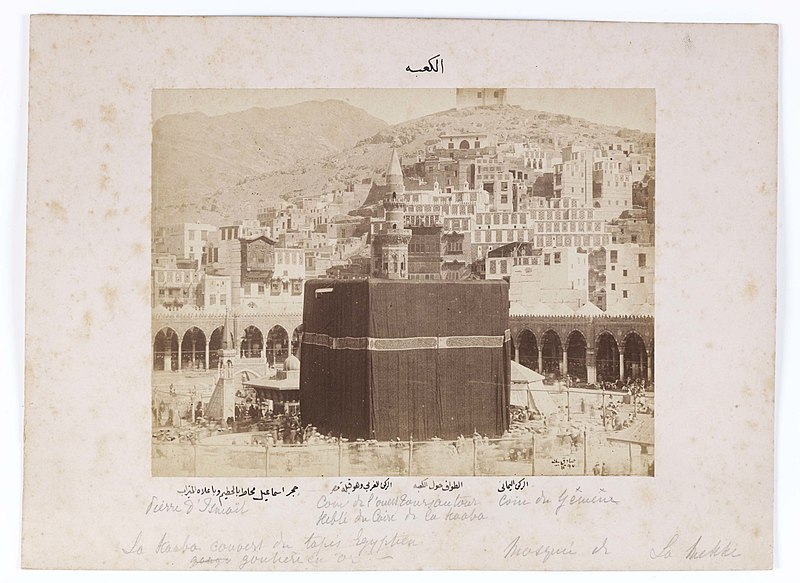
Photographers from all over the world compete to capture the most beautiful images of the oldest holy place on earth, hardly anyone in the world has not seen the image of the Kaaba.
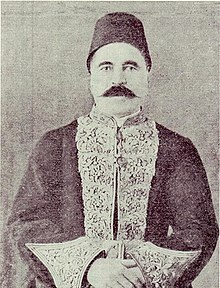
Egyptian Mohammed Sadiq Bey, was the first photographer to take pictures of the Kaaba through the lens of a camera; about 138 years ago in 1880 when he went to Mecca.
Sadiq Bey took the earliest pictures on records and wrote four books about his visits to the Grand Mosque and the Prophet’s Mosque during that period.
Nowadays photographers take pictures of the Kaaba to capture its beautiful gold threaded black silk cover and the Koranic verses that adorn it.
We explore the Moroccan community in Belgium, their origins and contributions to various industries as well as politics, arts, food and literature.
Bachir M’rabet was a newborn when his father, a weaver from Tangier, received an offer to work in the textile sector in Belgium.
Despite his wife’s reservations, M’rabet’s father left Morocco in 1966 with the goal of earning as much as possible and returning to his home country after a few years. However, things did not go as planned.
A year later, an infant M’rabet and his mother and siblings joined the family patriarch in the Belgian capital Brussels.
His parents were part of a generation of Moroccan workers recruited by Belgium in the 1960s to make up for labour shortages in industries such as mining, steel, manufacturing and construction.
“I don’t believe any Moroccan migrated to Belgium with the notion that it would be a permanent move,” the younger M’rabet tells Middle East Eye.
Today, there are around 600,000 people with Moroccan heritage in Belgium, with the community accounting for almost one in every five people in Brussels alone, according to figures from the Migration Museum.
Initially, the community was made up of male workers, but in time, like the M’rabet family’s example, women and children joined them, leading to the growth of the Moroccan community which is today the largest minority in the country.
Despite the dramatic change in environment, initially at least, they were “warmly welcomed” by the local Belgian population, M’rabet says.
“It was cold and the winters were harsh. We left behind the Mediterranean blue sky and arrived in the darkness.
“We were kind of an attraction, an exotic sight in the neighbourhood. Locals used to invite my father for coffee, they would touch his hair,” M’rabet recalls.
Overcoming challenges
Many other Moroccans arrived in the 60s and despite the friendliness of some locals, it was not always smooth sailing.
The 1980s witnessed a rise in unemployment and increased anti-foreign sentiment.
“In those years, there was a noticeable presence of racism,” M’rabet recalls. “An extreme right discourse that we had forgotten since WWII resurged.”
____________
‘While being Belgian, I don’t forget my Moroccan roots. I won’t forget that my parents gave up everything to give us a chance for a better life’
– Bachir M’rabet, Moroccan living in Belgium
____________
Discrimination became more prevalent, with landlords refusing to rent to non-Belgians and establishments denying entry to foreigners, particularly Arabs and Blacks. “The most common reproach was that foreigners came to steal our jobs and our women,” M’rabet continues.
The situation worsened following 9/11 and the 2016 Brussels attacks in the metro and the airport that killed 32 people.
In the early days of their move to Belgium, the M’rabet family lived in financially austere conditions.
“There was no bath or shower. We did the laundry by hand or washed in public baths,” M’rabet recalls.
In school, his limited French language skills also made things difficult, but he was determined to help others.
Eventually, he started working for Foyer, an organisation created in 1969 to offer activities for the children of migrant workers.
According to M’rabet, the Belgian population does not consider people of Maghrebi origin as Belgians, nor are they fully accepted as such. “It is something that can be felt in the way they look at us, in daily life.”
Today, M’rabet is a coordinator at the community centre in Molenbeek, one of the poorest Belgian municipalites.
In his role, he encourages youngsters with foreign roots to embrace their Belgian identity, as Belgium is their country.
“While being Belgian, I don’t forget my Moroccan roots. I won’t forget that my parents gave up everything to give us a chance for a better life.”
Moroccan coal miners in Belgium
Following World War II, Belgium faced the need for reconstruction but suffered from a shortage of workers.
The government resorted to recruiting workers from abroad for the job as coal mining was the primary source of energy, and required strenuous labour.
The Men for Coal agreement signed in 1946 with Italy attracted men to work in the mines, but miners faced harsh conditions and discrimination leading to a halt in emigration ten years later after the death of 136 Italians in Marcinelle, Belgiums’s worst-ever mining disaster.
To fill the labour shortage, Belgium signed agreements with Spain and Greece in 1957 and with Morocco and Turkey seven years later.
Poverty and unemployment in Morocco drove people, particularly those from rural backgrounds, to leave, and in 1964, hundreds of Moroccan men between the ages of 20 and 35 arrived in Belgium.
Due to Moroccans’ “fairly good” understanding of French, they were seen positively by employers, who also regarded them as neutral, religious and submissive.
When their families joined them, it anchored them in Belgium further, eventually helping rejuvenate the country through economic expansion.
Building up Belgium
The 1960s witnessed growth in Belgian cities with new roads, tunnels, tram tracks, offices, and bridges being built.
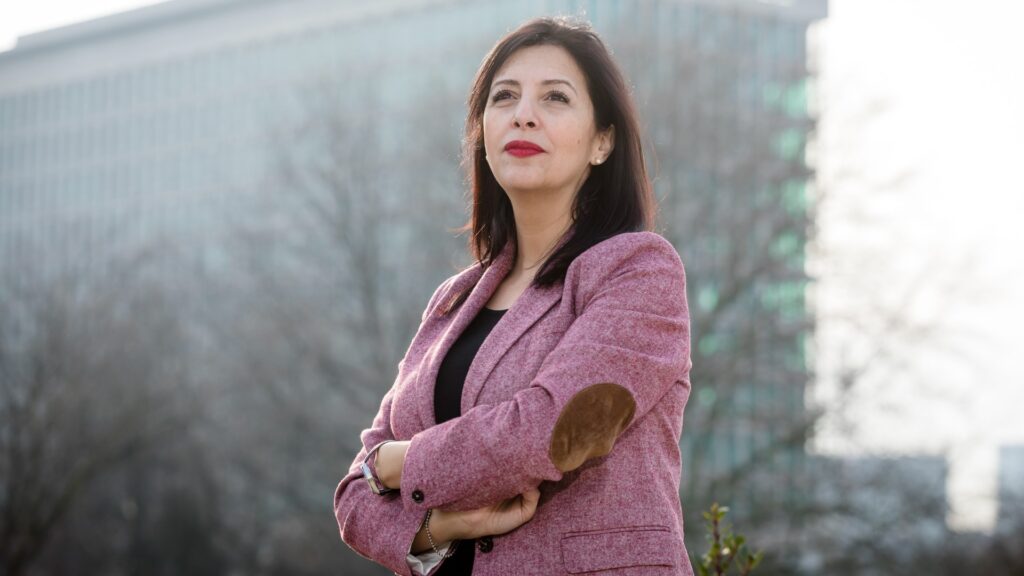
“My father helped build many of the emblematic buildings in Brussels,” Zakia Khattabi, Belgium’s minister for climate and environment, tells MEE.
“Brussels was built with the help of the labour force of this first generation of Moroccans. The value of Moroccan immigration lies in my father’s hands,” she adds.
In the 1970s, Moroccans constituted a significant portion of the city’s public transportation system employees, with the percentage rising to 80 percent in certain depots.
The Migration Museum collected testimonies from workers, including Mohammed, who stated that “Belgians were reluctant to work for the trams due to the challenging schedules”.
When economic growth came to a halt in the late 1960s, unemployment began to rise.
Immigrants chose to stay in Belgium, having already settled their families and established a life there.
Official immigration agreements ended in 1974, but migration from Morocco continues to this day, with people seeking economic opportunities that their compatriots had benefitted from, as well as for family reunification.
Nowadays negative incidents involving individuals of Moroccan heritage often receive disproportionate attention, overshadowing their achievements.
“A falling tree makes more noise than a growing forest. We never talk about the many successful careers of Moroccan immigrants, whether in key positions of responsibility or in positions at any other level,” Khattabi continues.
“Although I’m very attached to my Moroccan ancestry, I consider myself part of the Belgian community as I was born here,” she adds.
Moroccan achievements
Today, the Moroccan community in Belgium has excelled in numerous fields, from politics to arts, academia, medicine, business and sports.
During the 2019 elections, six nationals of Moroccan origin were elected to the Chamber of Representatives, while 21 Belgian-Moroccan deputies secured seats in regional parliaments.
Adil El Arbi and Bilall Fallah are internationally recognised film directors, celebrated for movies such as Black and Bad Boys for Life and the series Ms Marvel, while Lubna Azabal has performed in critically acclaimed films like Paradise Now and Incendies.
Moroccan food has also had a strong impact on Belgian cuisine.
It is common to find dishes like tagine and especially couscous on the menus of some restaurants and in households across the country.
“People have embraced couscous as an ingredient, incorporating it into innovative and contemporary culinary creations,” chef Faty Khalis tells Middle East Eye.
Based in the Flemish city of Hasselt, Khalis adds that couscous has become a versatile base for various dishes, from salads to stews.
According to Khattabi, the young descendants of the Moroccan diaspora are asserting their right to belong to the community in Belgium today.
“In the past, the parents used to apologise for being there, while today’s youth confidently assume that they are home and claim their rights. They are also aware of their obligations and acknowledge them.”
Feeling at home in Belgium
Writer Taha Adnan left Marrakesh in 1996 to study at a university in Brussels.
In his work Reflections on Writing and Exile, he explains that he is “neither an exile nor an immigrant but rather someone who had to find a new way of life after facing two years of unemployment” in Morocco.
Today, Adnan advocates for Belgian literature in Arabic, during a time when many authors of Arab origin in Belgium choose to write in Dutch or French.
For him, Arabic contributes to a diverse Belgian identity.
He has published poetry, plays and has amplified the voices of Arab writers residing in Belgium through literary festivals and collective books.
Adnan curated two anthologies: Brussels, the Moroccan, which gathers works by Moroccan writers portraying the capital of Europe, and This is not a Suitcase featuring texts by Arab authors sharing their experiences in the northern European country.
Strolling along the canal in Molenbeek, Adnan tells MEE that he “feels at home in Belgium”.
Many people with Moroccan roots feel the same way and have taken their place in all spheres of life.
As Khattabi says: “Perhaps we need to make their presence more visible. It’s the pathways to success that need to be standardised.”
Minister Zakia Khattabi is photographed in Brussels and says that her father was part of the generation of Moroccans that helped build Belgium (MEE/Hatim Kaghati)