Arabs & Arabian Records Aggregator. Chronicler. Milestones of the 25 Countries of the Arabic Speaking World (official / co-official). AGCC. MENA. Global. Ist's to Top 10's. Records. Read & Enjoy./ www.arabianrecords.org
Tunisian film Four Daughters (Les filles d’Olfa) was nominated for an Oscar for Best Documentary Feature, becoming the director’s second nomination for the Academy Awards.
Ben Hania’s 2020 feature film The Man Who Sold His Skin was nominated for Best International Feature Film at the Oscars in 2021.
Written and directed by Ben Hania, the film Four Daughters, nominated for Best Documentary Feature, focuses on a woman’s search for truth as she gets tangled in a web of lies in her family history. As a daughter and filmmaker, Ben Hania fuses personal and national history as she reflects on the 1981 Bread Riots, drawing connections to modern Morocco.
The film follows Olfa, a Tunisian woman and the mother of four daughters. One day, her two older daughters disappear. To replace them, the filmmaker Ben Hania invites professional actresses and invents a unique cinema experience which would lift the veil on Olfa and her daughters’ life stories.
The film blurs the boundaries between documentary and fiction and between being on-screen and off-screen.
The film has received critical acclaim, winning the Golden Eye award at the Cannes Film Festival, the Best International Film at the Munich Film Festival, and the Jury Award at the International Competition of the Brussels Film Festival. Most recently, it won the Asharq Award for Best Documentary at the Red Sea International Film Festival.
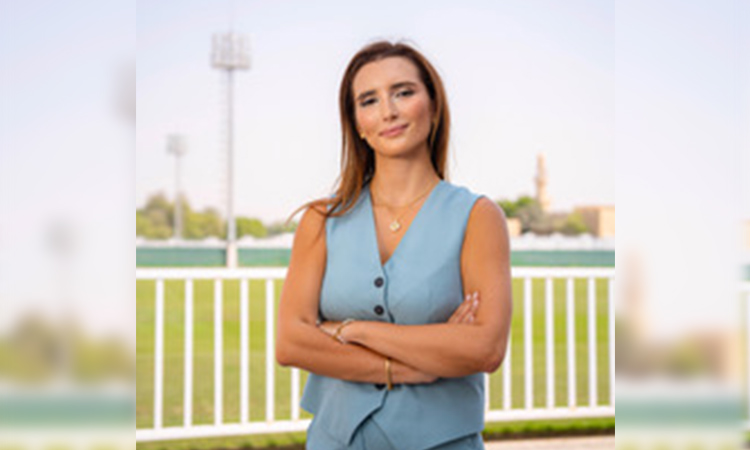
Zineb, a remarkable 34-year-old Moroccan woman with a passion for football and an extraordinary career journey, has made history as the first Arab woman in the UAE to obtain a FIFA Football Agent licence. This achievement marks the pinnacle of a multifaceted career that spans two decades of professional football, executive leadership roles in global corporations.
Born with a profound love for the beautiful game, Zineb embarked on her professional football journey at the tender age of 14. For an impressive 20 years, she showcased her exceptional skills on the pitch, earning acclaim and respect both locally and internationally. Her unwavering dedication and talent opened doors that would eventually lead her to a groundbreaking role as a FIFA agent.
Parallel to her football career, Zineb pursued her academic dreams, earning a Trilingual Finance Degree from HEC Montreal and further honing her skills at ICADE Business School. Armed with a strong educational foundation, she ventured into the corporate world, joining prestigious global corporations such as GE. Zineb seamlessly balanced her roles on and off the football field, demonstrating exceptional leadership and managerial prowess.
One of Zineb’s most impressive accomplishments is her cultural and linguistic versatility. Having lived in 13 countries, she possesses a deep understanding of international cultures, fostering an open-mindedness and adaptability that have been instrumental in her career success. Fluent in four languages – Arabic, English, French & Spanish – she transcends cultural and geographical boundaries with ease. Her ability to connect with individuals from diverse backgrounds has played a pivotal role in her professional success and global experiences. Her journey through these diverse landscapes has imbued her with a unique perspective that she now brings to her role as a FIFA agent.
In a life defined by extraordinary achievements, Zineb’s latest feat as the first Arab female FIFA agent in the UAE is nothing short of groundbreaking. She successfully passed the rigorous FIFA Football Agent exam, solidifying her position as a trailblazer in the world of sports and representation. Her new role will enable her to empower athletes, foster talent, and advocate for gender equality in the world of football.
Zineb serves as an inspiration to aspiring athletes, young professionals, and women worldwide, proving that determination, passion, and a commitment to excellence can break down barriers and open doors to limitless possibilities.
With this historic achievement, Zineb continues to write her own remarkable story, leaving an indelible mark on the world of sports, corporate leadership, and international relations. Her journey stands as a testament to the power of ambition and the potential of the human spirit.
Acamar, Rasalased, Kochab.. these words are examples of star names. At a first glance, they look unidentifiable. So where do they come from? The short answer is Arabic, but the long answer is a bit more nuanced than that.
The story begins in 8th century Middle East , Abbasid Caliphs became more and more interested in science and exploration. So they requested that the scientific works of previous translators be translated in Arabic, the rising scientific lingua franca of the world at that era. Greek and Roman scientific texts, notably Claudius Ptolemy’s Almagest, were translated into Arabic. But this was not merely a linguistic transfer; it also involved a comprehensive assimilation and expansion of knowledge. Ptolemy’s Almagest, translated in the 8th and 9th centuries, became a cornerstone in Islamic astronomy, enriched with commentaries and refinements by scholars of the time. It inspired many Arabs to take on the study of astronomy and carry on the study of space.
The advent of Islamic astronomy
Islamic astronomers like Al-Ḥasan Ibn al-Haytham and Ibn al-Shatir made significant strides in refining observational techniques and developing advanced instruments. Astrolabes and sundials, products of this new civilization, enabled precise measurements of celestial positions and movements. The practical application of astronomy was paramount in the Islamic civilization, particularly in the context of trade and navigation. The vast Islamic trade routes necessitated accurate navigation, and astronomy provided the means to achieve this. Bright stars, visible without telescopes, became vital reference points for navigation, leading to the naming of stars in Arabic, a practice that persisted due to its utility.
The influence extended beyond astronomy into mathematics, where the adoption of Arabic numerals revolutionized calculations. The spread of these numerals to Europe further increase the influence of Arab-Islamic scientific practices on the continent. As Europe entered the Middle Ages and Renaissance, Arabic astronomical texts, including star names, were reintroduced through translations. However, linguistic challenges and imperfect translations led to alterations and Latinizations of some names. Despite these modifications, many Arabic star names have endured and continue to be used in contemporary astronomy, which is why, while most of these names come from Arabic, they are often Latinized, and sometimes slightly modified. Other star names from Arabic include Altair, from Arabic Al-ta’ir, meaning the flying, Menkar, from Arabic Minkhar meaning the nostril, or Sulafat, from Arabic Sulahfat, meaning the tortoise.
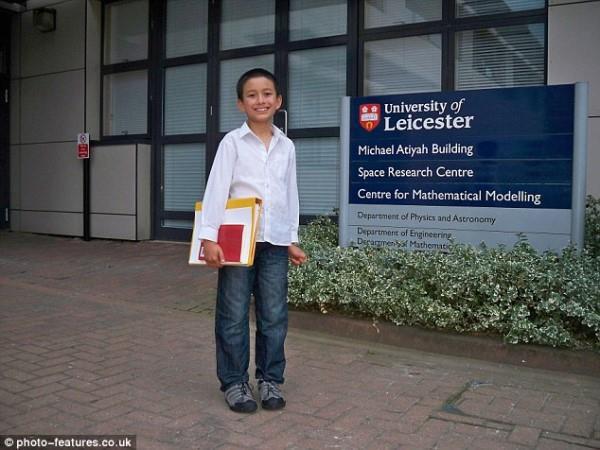
He may be younger than their children but one of Britain’s brainiest children, a Muslim, has been hired by a University to help adults with their sums as reported by Daily Mail .
Yasha Asley, 14, is employed by the University of Leicester – where he is also a degree student – to run tutorials.
He became the youngest ever student at the University and is now the youngest ever employee.
Yasha was interviewed and offered the paid job when he was just 13–years old – beating adult applicants. Admin staff had to apply to Leicester city council for special permission to employ him because he was so young. The weekly tutorials Yasha runs are for adult students who need help and support solving problems following lectures. Proud Yasha said:’I am having the best years of my life. I love going to university and I love my new job helping other students.
No more school uniform for me thank you very much.’
Yasha, who has been dubbed a ‘human calculator’, is now in his final year and plans to start a Phd when he finishes his course.
The child genius attended a state primary school before winning his place to study degree level maths at just 12 years old in 2014.He was the first child in the world to achieve an A grade in maths A Level scoring 100 per cent and 99 per cent in two of the six papers when he was just 8 years old.
He passed more A levels in maths and statistics aged 9 and 10.
After finishing year 6 at primary he went straight to University. Of his achievements, Yasha said:’I love maths because it is an exact science. It is the only science where you can prove what you say is correct. It is so easy and an enjoyable subject to study.’
Proud father Moussa Asley, 53, who raised him single-handedly at their home in Leicester, said his son had been made welcome by staff and students alike.
Mr Asley, who drives his son to lectures every day, said:
‘I am just so proud watching him flourish and grow doing something he loves.
He is so good at understanding problems and explaining them in a clear way he is perfect for the job.’
The Academy will nurture the development of the language in Mauritania and beyond, bringing together an elite group of scholars dedicated to the cause.
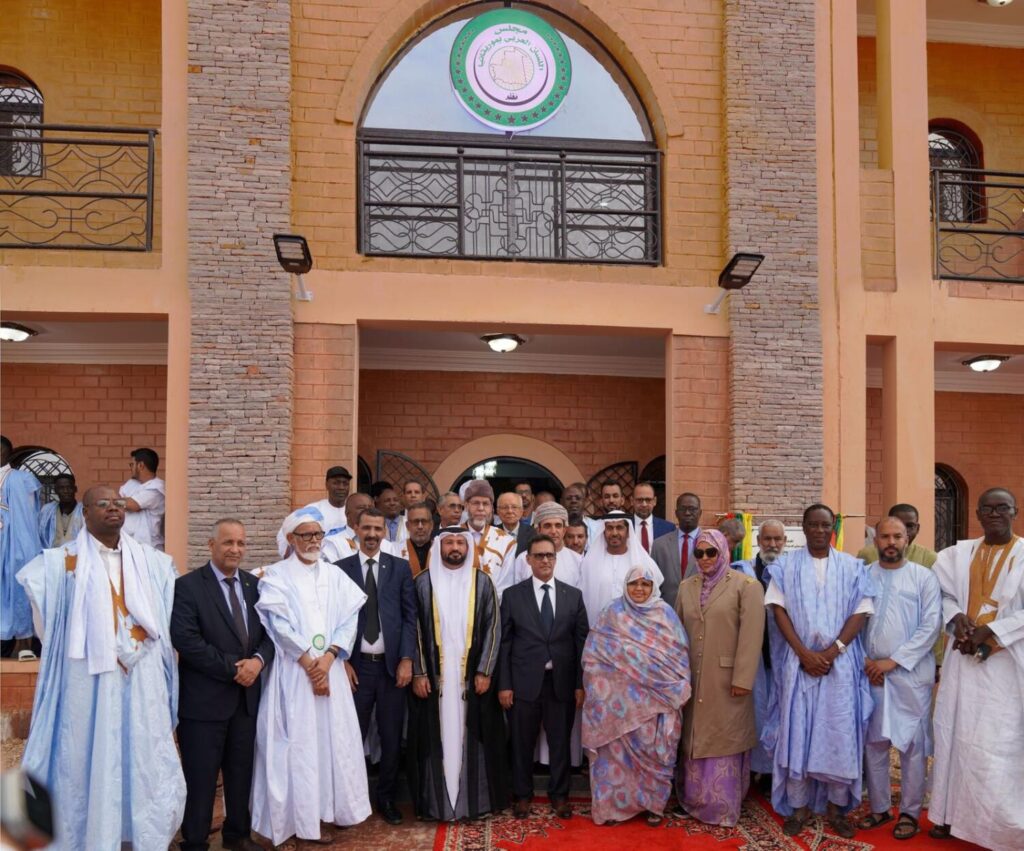
The new headquarters of the Arabic Language Council in Nouakchott, Mauritania, was inaugurated on Monday under the patronage of Mauritania President Mohamed Ould Cheikh El Ghazouani, and through the contribution of His Highness Sheikh Dr. Sultan bin Mohammed Al Qasimi, Member of the Supreme Council and Ruler of Sharjah, and Supreme President of the Arabic Language Academy (ALA) in Sharjah.
Development of the Arabic language
Ahmed Sid Ahmed Dié, Mauritanian Minister of Culture, Youth, Sports and Relations with Parliament, presided over the ceremony, expressing gratitude for the generous contribution from Sheikh Dr. Sultan. The Academy in Mauritania will nurture the development of the Arabic language in Mauritania and beyond, bringing together an elite group of scholars dedicated to this noble cause.
The ceremony was also attended by several senior diplomatic and media figures, as well as heads of Arab language academies.
During the event, Mohamed Hassan Khalaf, an ALA Board of Trustees member and Director-General of the Sharjah Broadcasting Authority, conveyed a message to the community of linguists and researchers in Mauritania from the Ruler of Sharjah. He also spoke about the importance of supporting major scientific projects and continuous efforts to empower the Arabic language in various countries worldwide, highlighting the strong relationship between the UAE and the Mauritania.
Championing Islamic and Arabic culture
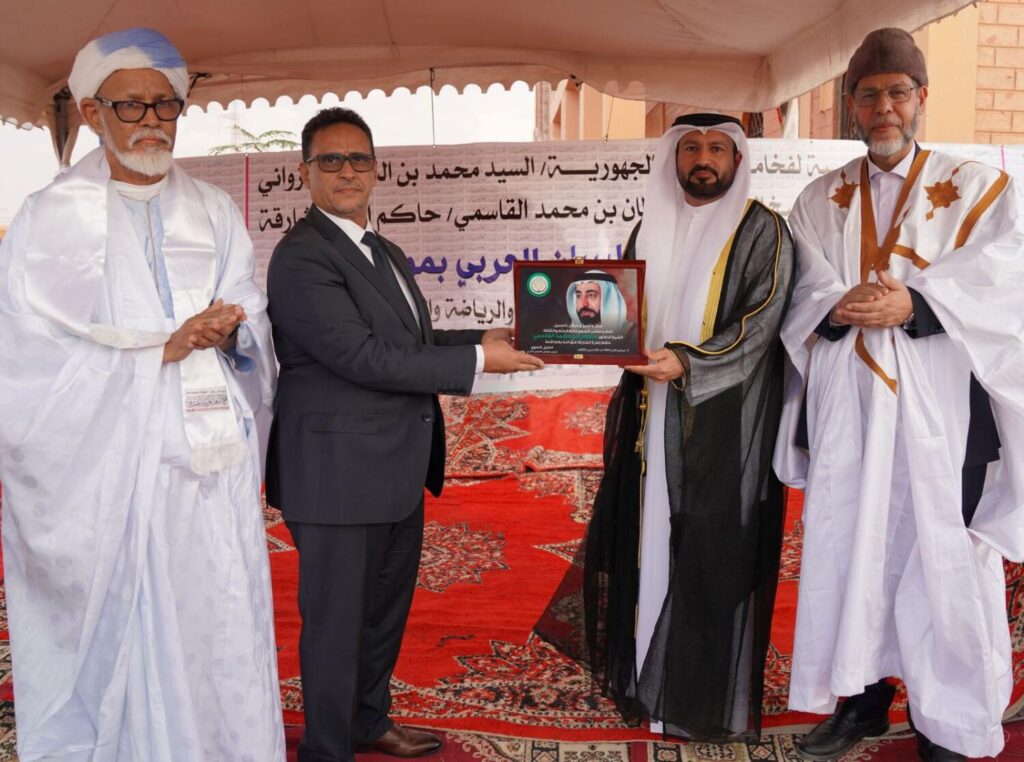
Ahmed Sid Ahmed Dié presented a commemorative shield to the Ruler of Sharjah, and was received by Mohamed Hassan Khalaf in appreciation of Sheikh Dr. Sultan’s efforts in championing Islamic and Arabic culture and language, in various countries around the world.
Dr. Khalil Al Nahwi, Chairman of the Arabic Language Council in Mauritania, delivered a speech congratulating the attendees, the entire Mauritanian population and all guardians of the Arabic language. He also reviewed the council’’s achievements over the past five years, praising the support it receives directly from the Ruler of Sharjah and the Arabic Language Academy in Sharjah.
Ahmed Sid Ahmed Dié, along with Mohamed Hassan Khalaf and Dr. Mohamed Safi Al Mosteghanemi, Secretary-General of ALA, unveiled a commemorative plaque marking the opening of the building before the ceremonial cutting of the ribbon, and was followed by a tour of the impressive building, designed in the Mauritanian architectural style.
Built with eco-friendly materials, the new headquarters consists of two floors and includes several administrative offices, study halls, meeting rooms, and an expansive library. The main building is accompanied by a hall named Al Qasimiya Hall to be used for seminars and events. The headquarters also houses a mosque that can accommodate more than 300 worshippers.
Situated in the University district on land provided by the Mauritanian government, the entire construction and furnishing of this significant establishment were funded by the Ruler of Sharjah.
Cloud computing to add $181 bn to UAE’s economy by 2033.
The UAE has been chosen to lead the Cloud Computing Working Group within the World Bank, a testament to its remarkable progress in advanced technology and digitization. Recognized as a global pioneer in digital transformation and the successful implementation of cloud computing best practices, the UAE assumes this role to support both government entities and private sector companies in their transition to cloud computing systems. By prioritizing the utilization of cutting-edge data protection and cybersecurity solutions, the UAE reaffirms its commitment to facilitating the seamless adoption of cloud technology while ensuring utmost security for all stakeholders.
Sheikh Hamdan congratulates Dr. AlBlooshi
Sheikh Hamdan bin Mohammed bin Rashid Al Maktoum, Crown Prince of Dubai and chairman of the Executive Council, extended his congratulations to Dr. Bushra AlBlooshi from the Dubai Electronic Security Center (DESC) on being appointed as the leader of the Cloud Computing division within the World Bank Group.
In addition, Sheikh Hamdan posted the message on X (formerly Twitter) and said, “Congratulations to Dr Bushra AlBlooshi of the Dubai Electronic Security Center (DESC) on being appointed by the World Bank as the head of the World Bank Group for Cloud Computing, comprising of 27 countries, organisations, and major international technology firms.”
He added, “We are immensely proud of the continuous achievements of Emirati talent. With their expertise and accomplishments, they further strengthen the UAE’s international stature and role in advancing global sustainable digital development.
According to her profile on the World Economic Forum (WEF), Dr. AlBlooshi possesses more than 17 years of expertise in digital transformation, cybersecurity, and strategy management. She is recognized as an author and a prominent speaker in the areas of cybersecurity and digital transformation, demonstrating her extensive experience in the field.
Significance of cloud adoption for GDP growth
A report commissioned by Amazon Web Services (AWS) revealed in May that the widespread adoption of cloud technology among the public is projected to contribute an estimated $181 billion in economic value to the UAE over the next decade. This figure represents approximately 2.5 percent of the UAE’s economy. The paper further highlighted that a mere 1 percent increase in cloud adoption by organizations in the UAE would result in an average gross domestic product (GDP) growth of 0.21 percent or $854.7 million. This growth rate is three times higher than the regional average for the Middle East and North Africa, making it the highest in the region.
Dr. Bushra AlBlooshi of the Dubai Electronic Security Center (DESC) appointed by the World Bank as the head of the World Bank Group for Cloud Computing, comprising of 27 countries, organisations, and major international technology firms.
Rajaa Cherkaoui El Moursli was part of the research team that made the groundbreaking discovery of the Higgs Boson particle.
Moroccan prominent nuclear physicist Rajaa Cherkaoui El Moursli was featured this year on the list of Forbes 50 Over 50 for the Middle East and Africa (MENA) in recognition of her outstanding scientific contributions.
El Moursli’s research has helped prove the existence of the Higgs Boson, which is the particle responsible for the creation of mass.
“While her almost 30-year-long career in science has been filled with achievements, it’s a career that would not have existed had she not convinced her father to let her seek out a graduate degree in France in the early 1980s,” Forbes wrote. This was a time when Moroccan women were “expected to leave home to marry and not pursue a vocation.”
After earning her Ph.D in Nuclear Physics from the University of Joseph Fourier in Grenoble, France, El Moursli returned to Morocco in 1982. There, she joined the Faculty of Sciences at the University Mohammed V in Rabat.
Early in her career, she took the helm as the head of the Laboratory of Nuclear Physics in Rabat. El Moursli’s research focuses on the applications of nuclear physics, medical physics, and high-energy physics.
A pivotal moment in her career occurred in 1996 when she became an integral part of Morocco’s participation in the international ATLAS collaboration at the European Organization for Nuclear Research (CERN). The event marked her entry into one of the world’s most prestigious scientific research centers, located in Geneva.
El Moursli’s contributions have extended beyond the laboratory giving her membership with international organizations such ATLAS, KM3NET, and ANTARES.
Within these roles, she has been vital in creating and implementing master’s degree programs at her university, notably creating Morocco’s first master’s program in medical physics. Currently, over thirty graduates from her program hold crucial positions as radio physicists in Moroccan hospitals.
Throughout her career, she has supervised numerous doctoral and master’s students and has played a crucial role in building and strengthening academic programs.
In 2015, she became the first Moroccan to receive the L’Oreal-UNESCO award for Women in Science, representing Africa and the Arab States.
El Moursli served as VP of Research, Innovation, Cooperation, and Partnership at Mohammed V University. She also chaired the competition program “My Thesis in 180 Seconds.”
Her accolades include being a fellow of the World Academy of Sciences (TWAS) and serving on the “For Women in Science” international jury.
In 2017, she was honored by the Organization of Islamic Cooperation for her outstanding contributions to science and technology in the Islamic world.
Now in 2024, El Moursli continues to play a pivotal role in shaping the global scientific landscape and showcasing Moroccan achievements to the world.
Event will cement the Kingdom’s efforts to promote cultural communication and exchange, scientific and social development.
Saudi Arabia, represented by its National Commission for Education, Culture and Science, is hosting the 44th session of the executive council of the Islamic World Educational, Scientific and Cultural Organization in Jeddah from Jan. 16 to Jan. 18.
ICESCO media department told Arab News: “The proceedings of the executive council of the 44th Islamic Educational, Scientific and Cultural Organization will kick off in Jeddah, Saudi Arabia on Tuesday (Jan. 16, 2024) with the participation of 54 member states. The event will run until Thursday.”
As the representative of the Kingdom, the NCECS said that hosting the event comes as part of the support provided to the education, culture and science sectors. It is also indicated the Kingdom’s role in driving forward educational, cultural and scientific development, both regionally and globally, it said.
Among the items on the executive council agenda are future strategies and action plans. The organization’s budget will also be discussed.
The council’s final recommendations will be handed over and included in a report to be endorsed by the ICESCO’s biannual general conference, the organization’s policy governing body event.
Prince Badr bin Abdullah bin Farhan, minister of culture and chairman of the NCECS, said: “The event will cement the Kingdom’s efforts aiming at creating spheres of cultural communication and exchange as well as scientific and social development. These sectors are considered to be cornerstones for developed human societies.”
As a prominent member of ICESCO, it is the strategy of the Kingdom to pursue all avenues supporting the organization’s goals in the best interests of the Muslim world.
Operating under the Organization of Islamic Cooperation, ICESCO is an intergovernmental organization specializing in the development of education, science and culture. Established in 1982 with its headquarters in Rabat, Morocco, ISESCO acts in line with the OIC’s general strategy aimed at achieving sustainable development in these sectors across all Muslim states.
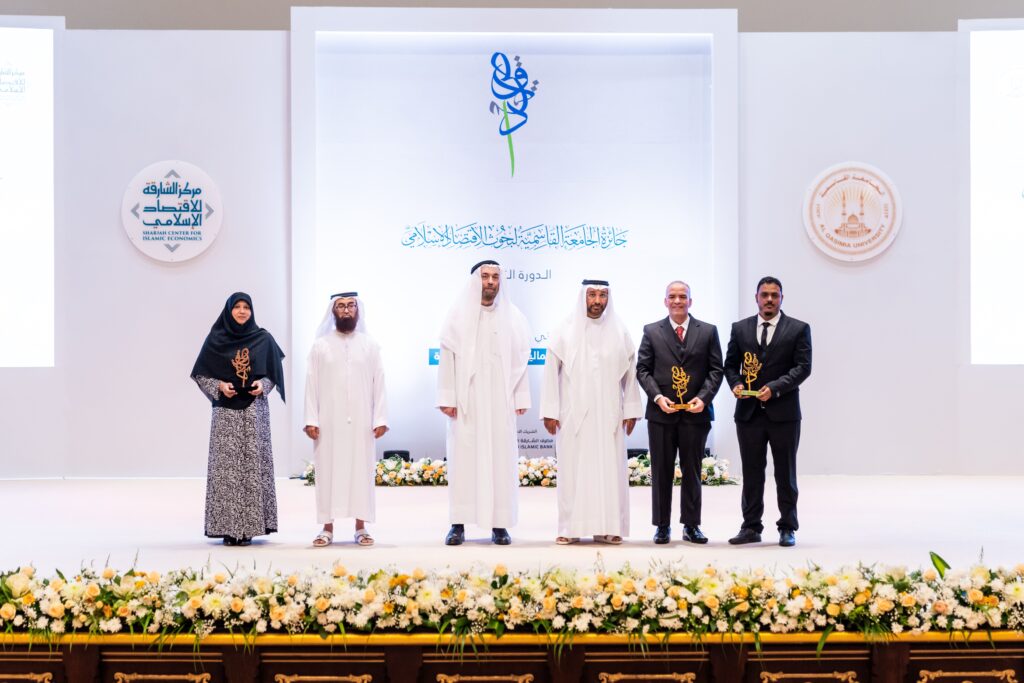
Under the patronage of H.H. Dr. Sheikh Sultan bin Muhammad Al Qasimi, Supreme Council Member and Ruler of Sharjah, Sharjah Centre for Islamic Economics (SCIE) at the university organised a ceremony to honour the winners of the Al Qasimia University Award for Islamic Economics Research, held in the university theatre, in the presence of the President of the University, members of the Board of Trustees, the University Rector, deans of colleges, and members of the Academic, and administrative bodies and students.
Professor Jamal Salem Al Tarifi, President of Al Qasimia University, honoured the award winners and congratulated them on the quality of research presented in Islamic economics studies.
Professor Dr. Awad Al Khalaf, Acting Chancellor of the University, expressed his highest thanks and gratitude to the Ruler of Sharjah, and founder of the University, for His Highness’s generous patronage of the award, as this sponsorship adds value to one of the most important scientific activities that contribute to the renaissance of the economic sector, and the dissemination of the principles and values of Islamic economics, according to scientific foundations, and qualitative scientific research taking into consideration the real need of building a solid economy that achieves UAE development.
The list of researchers included honouring Dr. Badr Al Zaman Khamqani, from the Republic of Algeria, winner in the field of economics, in his research entitled: “A proposed strategy to accelerate the pace of digital transformation in Islamic banks.” Dr. Ahmed Abdel Rahman Ahmed Al Majali, from the Hashemite Kingdom of Jordan, won in the field of law, in his research entitled: “blockchain technology compatibility with Islamic financial transactions.” Professor Dr. Aisha Muniza, from the Maldives, won in the field of economics, in her research entitled: “Development of a digital Islamic social stock exchange”.
Dr. Yasser Al Hosani, SCIE Director, announced the launch of the fourth edition of the award under the title “Smart Islamic Financial Engineering”.
The Egyptian architect turned photographer walks us through his award-winning photographs in Dubai.
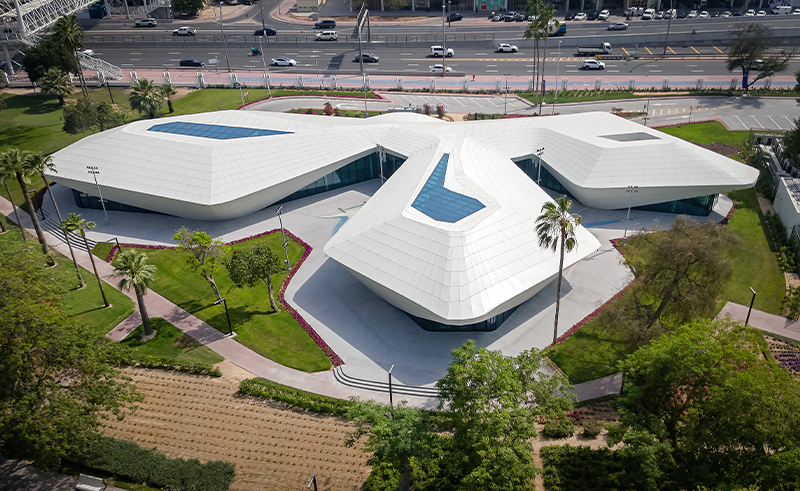
Renowned Egyptian architectural photographer Nour El Refai was announced as the winner of Architecture Masterprize 2023 Photography Award in the ‘Healthcare-Exterior’ category for his work on Thukher Club, a seniors social club in Al Wasl, Dubai which was designed by Naga Architects. This is the second year in a row that El Refai wins the prestigious award, after his shots of Museum of the Future won the ‘Cultural-Interior’ category in 2022.
Capturing the organic architecture and layout of Thukher Club, the brilliance of El Refai’s photographs rest in their nuanced approaches. From meticulous compositions and dramatic perspectives to calm lighting and consistent tones, his work helped translate Naga Architects’s design and concept.
Over the past decade, El Refai has steadily grown into a benchmark in architectural photography within the MENA region. Whether it’s stunning summer houses or cultural centres, his work is helping document the design upheaval taking over the region. In Al Wasl, he delivers a masterclass in the relationship between architecture and lighting.
Light rain set the tone to the first day of photographing Thukher Club. “Clouds felt dramatic. For Naga Architects, it made sense to opt for a clear sky to define the architecture,” El Refai tells SceneHome. “I adjusted the composition based on the natural sky and clouds to balance the architecture without overshadowing it.”
A key parameter of El Refai’s work on Thukher Club was our yellow dwarf star. “The sun’s movement helped define the masses. I visited early in the day and imagined the shape of shadows against them,” he recalls. After almost completing his work, El Refai revisited Thukher Club at noon, which required a new set of permissions since it was during a peak time, when crowds of people would pass through. “When the sun’s perpendicular there’s contrast between the masses and the foreground. Human elements add a sense of scale. It shows you how the masses overlap, that’s why I needed the sun to be high. Had it been low, both surfaces would’ve been white and lacked shade.”
The exterior masses of Thukher Club featured irregular and organic forms. Its main entrance, covered by undulating architecture, was photographed from two different angles; one emphasises its curves before sunset and the other has a wider view that establishes context. “Lines guide me in terms of where to stand and look, and lenses provide the freedom to shift in direction,” El Refai says. Both perspectives guided him and how shifts were illustrated in the former entrance image.
“I exaggerated the curve by getting closer to the building with an acute angle. I wasn’t photographing elevations but accentuating them,” he says, referring to the dramatic perspective where the building appears in motion towards its vanishing point. On the far right side of the same image, Thukher Club’s logo (which is the abstracted layout of the buildings) appears from within the club. To get this shot, El Refai kept adjusting the frame until it felt right.
Every architectural project presents unique challenges to photographers. Once they’ve become confident in their process and tools, only then will they be able to showcase it in the best light possible. That’s something El Refai learned from practice. “Practice makes you understand that you don’t have to be perfect,” he says. “You understand the parameters of perfection but more importantly you’re able to tell when it’s enough, how to have vision and imagine situations in advance.”
In Al Wasl, El Refai predicted that night shots would be challenging because lamp posts close to the building switched between too many colours. A full day was spent solving the issue and as a result, instead of having 10 colours switching during twilight, there were only three. This was an example of the importance of preparing in advance and understanding the project.
From inside, Thukher Club was composed of three main spaces with skylights providing natural light. An all-white interior provoked nuanced approaches by El Refai, which conveyed the desired level of brightness intended by the design, highlighted the importance of toning and how subtle changes in composition make all the difference. In one of the shots, El Refai pictures a space flanked by a corridor, followed up by a closer shot that places viewers within the seating area.
“I tried to show different levels without appearing too overlapped,” El Refai says. “The oddity of photographing a 3D space into a 2D plane is that people don’t experience space in 2D, so when you add it on a page the masses blend together, and you have to figure out the point from which you’re photographing and the lens you’re using in order to ease the composition.”
Once the composition is settled, the rest of the process includes lighting, editing and adjusting the layers and tones. “Consistency of tones is crucial. Depending on camera measuring, sunlight and timings, tones are always changing but they need to remain consistent,” El Refai adds. Between day and night, there are naturally changes in tones but in both sets of images the tones of each need to remain consistent.
“Most of the work is in the composition and the rest is timing,” El Refai continues. “It’s all about enjoying the process. I roam around the project to get a feel for the spaces and the relationships between them.” To be able to get these shots, El Refai schedules the entire day and determines how much time each perspective will have, the window of opportunity so to speak.
presentation. “Transitioning from day to night needs to be seamless, unless designers request to emphasise different moods of the same space,” he says. “I prefer telling the story of the project as an experience, walking from one space to another. Visual storytelling is of paramount importance, I don’t deliver an album without ordering it. It may not be the same order of photography because that depends on context, presenting the images is a different story. The order depends on the story that I want people to feel.”
When asked for advice for upcoming photographers, El Refai says, “Research the designer and the design to understand the project. If you receive plans or renders, use them to envision the space. On the ground, there will be some changes but when you imagine the project’s architecture you can interpret it properly through images.”
If El Refai’s insights are an indication of anything, it’s that preparing for a shoot is equally as important as the shoot itself. Whether it’s the scheduling or communication, proper briefing and communication, when a photographer understands the context, they find the freedom to explore nuanced angles. With time, as demonstrated by El Refai’s serial award-winning approach, there will be less photos and more keepers.