Arabs & Arabian Records Aggregator. Chronicler. Milestones of the 25 Countries of the Arabic Speaking World (official / co-official). AGCC. MENA. Global. Ist's to Top 10's. Records. Read & Enjoy./ www.arabianrecords.org
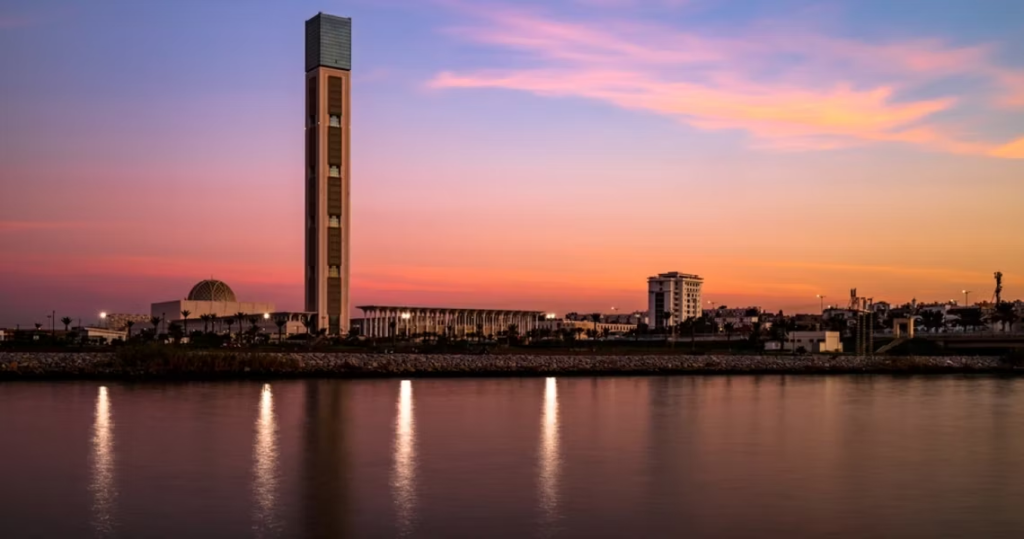
One doesn’t have to be a Muslim to visit the mosque or see the tallest minaret in the world.
Many people who think of a vacation to Africa make plans with Morocco in mind, South Africa at times, maybe Kenya, and definitely Egypt—to see the famous pyramids—or the 4,100-mile-long river that gave birth to that momentous civilization. Yet, as a continent, Africa has 54 countries, almost as many as the number of states in the U.S. Though it may come as a surprise, almost all of these countries are safe and have nearly the same conveniences as those found in many First World countries. Take Algeria, for instance, the biggest country in Africa and more than three times the size of Texas. This northern African country has pyramids, just like Egypt, and several fascinating ruins that would interest any history buff or anyone who’s out for some real adventure.
The Great Mosque Of Algiers And Its Record-Breaking Minaret
Also known as Djamaa el Djazaïr, the Great Mosque of Algiers is itself a monumental structure and an architectural marvel in its own right. However, what really puts it in the Guinness Book of World Records is its minaret. The reason is that the Great Mosque of Algiers is noted for having the tallest minaret in the world. For those who may be scratching their heads, a minaret is a tower—or a tower-like structure—built into mosques primarily to project the “Adhan,” the Muslim call to prayer. Of course, today, minarets serve other purposes as well. For instance, they are important landmarks of Islamic presence. Coming to the minaret of the Great Mosque of Algiers, we would not be remiss to expect a structure described as the world’s tallest to answer to that exceptional description. Well, the minaret of the Great Mosque of Algiers is 265 meters tall and hence, by all accounts, impressive.
For perspective, that’s the same height as Truist Plaza, the 60-story skyscraper in downtown Atlanta or the Panorama Tower in Miami, Florida. It’s also about half the height of the One World Trade Center, the tallest building in the United States. Minarets, however, have never been this tall. Before the Great Mosque of Algiers secured a page in the Guinness Book of World Records for its minaret, the tallest minaret was the 670-feet tower of the Hassan II Mosque in Casablanca, Morocco. The Algiers minaret, according to the Guinness Book of World Records, is now not just the tallest minaret in the world but the tallest building in Africa as well. This minaret is designed to withstand a magnitude nine earthquake, the highest earthquake magnitude. This type of earthquake can cause major damage over a region more than 1,000 km across.
Here’s A Brief History Of The Great Mosque Of Algiers And Its Minaret
The government of Algeria launched the construction of the Great Mosque and its record-breaking minaret in 2012. However, according to an adviser to the minister of housing responsible for the construction, the idea of constructing a mega-mosque had been in the cards from way back in 1962 when Algeria got its independence after 132 years of French occupation and after a 7-year brutal war that would send seismic revolutionary waves across the continent. For some reason, the efforts to put up a mega-mosque in Algiers had failed and foundered. However, with the election of Abdelaziz Bouteflika as President of Algeria in 1999, the building efforts would soon receive significant impetus.
Famous for his religious zeal and devotion to Muslim art and culture, Bouteflika would, unsurprisingly, actualize the mega-mosque dream even though his tenure as president would dramatically come to a premature end before the completion of his pet project. The mosque, however, including its record-breaking minaret, was an outstanding architectural masterpiece. According to the Guinness Book of World Records, the Great Mosque of Algiers sits on an expansive area of around 400,000 square meters (about 50 acres). For perspective, the building itself, plus the outside courtyard, can seat up to 120,000 worshipers.
Other Reasons Why The Great Mosque of Algiers Is Worth Visiting (& How To Visit)
The mosque looks towards the scenic Bay of Algiers, which features dazzling white buildings and panoramic views as far as the eye can see. Part of the mosque is a library that can stock more than a million volumes. In addition, the mosque has a Koranic school and a museum of Islamic art and history.
Where Is The Great Mosque of Algiers Located? This mosque is located on the Rue de la Marine in Algeria’s capital city, Algiers.
A crucial travel tip is to get in as a worshiper, probably during worship. Some visitors even carry a prayer mat or wear a scarf, especially women. Of course, one doesn’t have to be a Muslim to visit the mosque or see the tallest minaret in the world.
Tunisia’s prestigious industry event enjoys another successful year, helping spread a love of culture across the country.
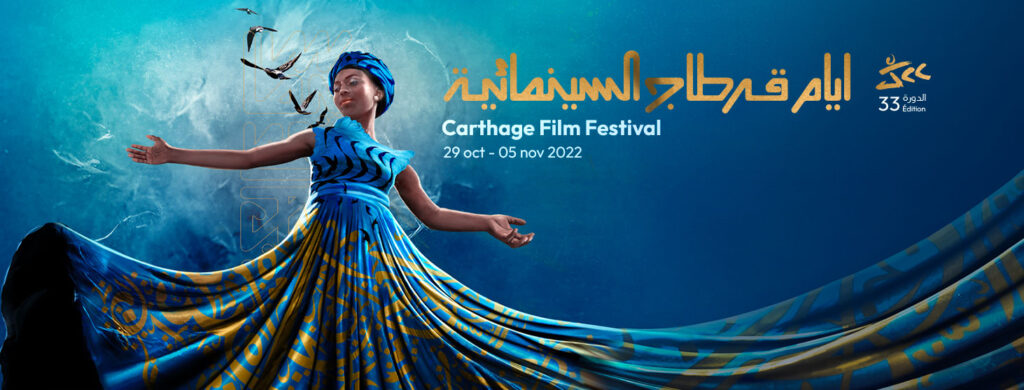
Another week of movie magic, street art and music has come to an end following the 33rd edition of the International Carthage Film Festival in Tunisia.
Titled “Hel Thneya”, which means “Open the Path” in Tunisian dialect, the festival once again cemented its status as a major cultural attraction for visitors of all ages, who flocked to cinemas and filled the streets en masse.
The festival, one of the eldest and most prestigious in the Mena region, ended on Sunday.
As is tradition, the capital Tuniswas transformed into an open celebration of not only cinema but all forms of arts, with independent young painters getting the chance to show their artworks to the public for the first time and musicians performing every evening to audiences in the middle of Avenue Habib Bourguiba. For many, it was an opportunity to watch films that they don’t usually have the means or the opportunity to see.
Speaking outside the Theatre de Region Cinema, Downtown Tunis, Amina told The National she had been waiting for the festival to introduce her two children to the world of the cinema.
“As a family, we always discuss films together but we never find the time nor age-appropriate films to watch. This is a great opportunity to let them discover the big screen,” Amina said.
Amina’s daughter Ritej, who is in the sixth grade, was grinning with happiness as she prepared to enter the cinema hall. “I’m excited, I’m sure I’m going to enjoy this and tell my friends about it,” Ritej said.
Amina said that she often encourages her children to value the arts, with Ritej currently rehearsing for a school play, and she wishes there were more events like it in Tunisia.
This year’s International festival was an opportunity to revive the city. According to organisers, the festival aimed to showcase both new cinema productions and also timeless films that the younger generations needed to be introduced to.
This year, 72 countries participated with Saudi Arabia being the guest of honour and special emphasis placed on Palestinian and Spanish Cinema — a choice that organisers said highlighted the intersection between north and south, placing migration under an artistic lens.
The festival also paid tribute to Arab filmmakers, both living and dead, namely the Moroccan director Mohamed Abderrahmen Tazi and Egyptian director Daoud Abdel Sayed, as well as the late Algerian director Yamina Chouikh and late Tunisian director Kalthoum Bornaz.
“Through this 33rd edition, we continued to foster cultural decentralisation by bringing new sections to the festival and programming screenings in different parts of the country,” journalist and cinema critic Yosra Chikhaoui told The National.
“This year marks the first edition of JCC for kids. We are bringing more screenings as part of our “street cinema” section as well as continuing the special screenings for prisoners and members of the Tunisian army inside military bases,” Chikhaoui, who is a member of the festival’s media committee, added.
JCC in Prisons, now in its eighth year,is the fruit of a partnership between the Tunisian Ministries of Culture and Justice and the International Organisation Against Torture. This year, 12 films were showcased in three prison facilities, while juvenile detainees were transferred to Tunis for a special showcase in a cinema.
According to Ridha Behi, general director of this year’s festival, film screenings in prisons serve as a reminder of the right all people have to access and experience culture.
Awards, meanwhile, highlighted the multitude and variety on show, with a focus on filmmakers whose work depicts the struggles of their respective societies.
The Tanit d’Or award for best feature film was given to Tug of War, directed by Amil Shivji — marking the first time a film from Tanzania has won the award. Meanwhile, the Tanit d’Argent and Tanit de Bronze were respectively awarded to the films Under the Fig Trees by Erige Sehiri from Tunisia and Sharaf by Samir Nasr from Egypt
Over 1,200 years old, and after facing extreme neglect for decades, the Basatin Jewish Cemetery finally reopens.
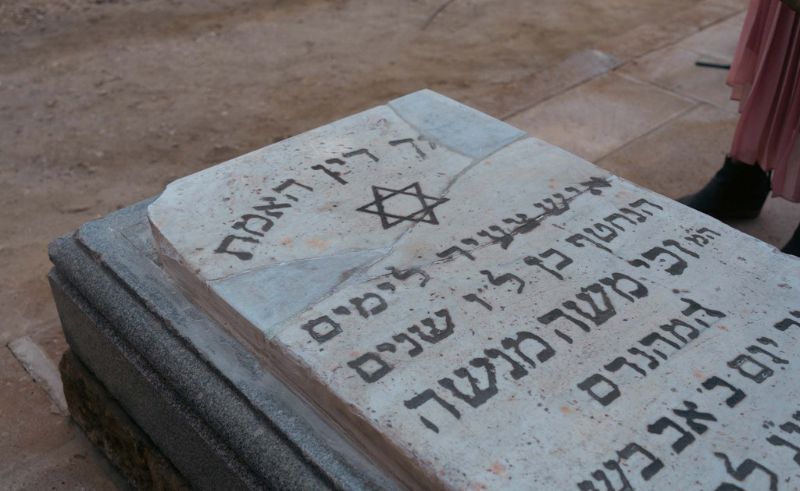
The Basatin Jewish Cemetery – the second oldest Jewish cemetery in the world, and one of Cairo’s few remaining Jewish cemeteries – has undergone extensive renovations and opened its doors once more.
With a foundation dating to the 9th century during Egypt’s Tulunid Dynasty, the 147 acres of land designated for the cemetery at the time included separate areas for Rabbanite and Karaite Jews and extended beyond the Tulunid capital of Egypt.
In more recent times, allegedly during the reign of Mamluk Sultan Qaitbay in 1482, the cemetery was divided into separate pieces of property totaling roughly 27 acres. These plots include the Basatin graveyard’s common burial grounds, the private Mosseri family cemetery, Rav Haim Capusi’s grave, the private Moise Cattaui Pasha cemetery, and the remaining Karaite section of the original cemetery.
Over the past three years, the American Research Centre in Egypt and the United States’ Ambassadors Fund for Cultural Preservation and Drop of Milk Foundation have been working to restore the neglected cultural and religious heritage site.
After the completion of the conservation project, members of the Karaite Jewish community – known for exclusively respecting the principles of the Torah and disowning oral traditions like the Talmud and other writings of the Rabbis – from various nations attended the ribbon-cutting ceremony, and were able to revisit their families’ graves for the first time in decades.
With a strong determination to help women’s inclusion in the mining industry, Bensetti has a strong belief in women’s ability to defy norms and pursue a career in any industry.
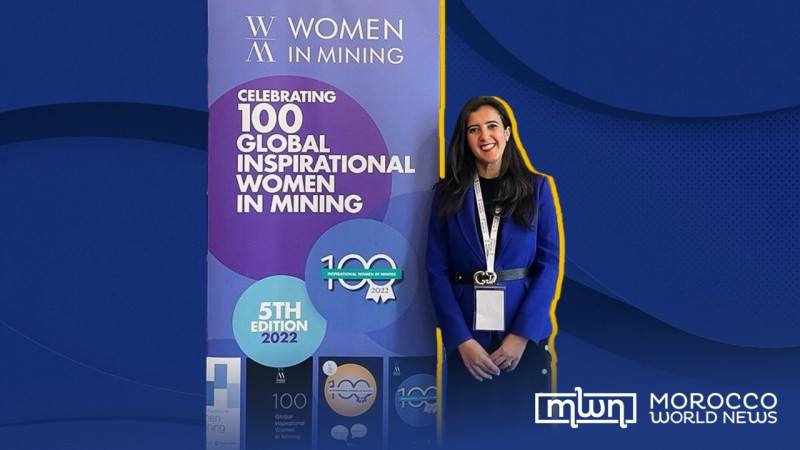
Women in Mining UK, an NGO dedicated to supporting women in the mining sector, selected CEO of OCP subsidiary DOOC Ibtissam Bensetti to feature in the 2022 “100 Global Inspirational Women in Mining” (WIM100) in recognition of her contributions to the global mining industry.
With this nomination, Bensetti became the first OCP personnel and Moroccan national to feature in the 100 Global Inspirational Women in Mining.
The NGO’s global top 100 list celebrates women’s contribution to the mining industry at all levels. The biennial publication stresses women’s skills and expertise in the global mining industry and celebrates role models for future generations.
Women inclusion in mining
The organization selects nominees based on different criteria, including creative innovation and sustainable working.
“A WIM100 woman offers proactive advocacy to those working in the mining industry and beyond. She empowers her colleagues to ensure everyone feels heard, welcomed, and respected,” the NGO said.
Bensetti has been able to take her place in the WIM100 for her leadership in OCP as a CEO at the group’s subsidiary DOOC, which specializes in industrial operations consulting, safety, and sustainability.
Having joined OCP in 2012, Bensetti has more than a decade of experience in the mining industry at different levels, particularly in sustainability roles in mining and chemical industrial operations, as well as corporate development.
Carrying the spirit of women’s empowerment during her journey, Bensetti has been working on spreading that spirit among her team members, particularly women, through supporting OCP’s female talent as well as increasing the number of women in management.
Delighted to be part of the WIM100 list, Bensetti stressed her emphasis and belief in women’s talents.
“In my mind, there is no impenetrable fortress for women, women can defy the norms and pursue a career in any industry,” she said, conveying her encouragement and endorsement for the inclusion of women in the mining industry.
The CEO acknowledged that the industry might have been a male-dominated industry but claimed that that’s in the past thanks to global efforts seeking to ensure gender equality at different levels. Women make up between 8% and 17 % of the global mining workforce, a McKinsey report has found.
The report also identified, however, several reasons and challenges that prompt women’s exit from the industry.
“The top reasons for leaving the industry are feeling that work is no longer intellectually challenging and having the perception that there are fewer advancement opportunities than there are for their male colleagues,” the report stressed.
Appointment and education
Bensetti was appointed as CEO of DOOC in June 2021 to replace Hamid El Mahfoudi, who retired.
She joined OCP a decade ago, filling positions related to strategy, corporate development, and industrial operations.
Graduating from Telecom Paris in 2004, Bensetti amassed 18 years of experience in management consulting, industry managing, coaching, and leading teams in transformation journeys.
Bensetti is also a graduate of The World Business Council for Sustainable Development’s LEAP Program, a one-year sustainability training program that seeks to empower women and help advance their positions and careers.
Having gender equality as a center of focus during her career, Bensetti is determined to continue her battle to help empower women in the mining industry.
“Being a woman engineer in industry, I have been fighting this battle all my life,” she wrote on her LinkedIn bio.
Ohood bint Khalfan Al Roumi, Minister of State for Government Development and The Future, honoured the winners of the Women in Tech MENA Awards, during a ceremony held in partnership between the Sharjah Research, Technology and Innovation Park (SRTIP) and Women in Tech.
The award, which is one of seven regional awards covering various areas of the globe, celebrates talented women from around the world who innovate, inspire and transform the technology sector.
Held under the theme, “Women in Green”, the event was attended by Hussain Al Mahmoudi, CEO of STRIP, and several leading experts, entrepreneurs and the award’s female nominees.
The awards were introduced by Ayumi Moore Aoki, Founder and CEO of Women in Tech, who affirmed the need to increase the presence of women in technology.
The eight winners were:
-The Uplifting Syrian Women Initiative in the Most Impactful Initiative Award;
-Fatma Atawna, CEO of Siraj in the Best Ally Award;
-Aida Kandil, CEO of MyTindy in the Start-up Award;
-Wesam Sarhan, Co-Founder of Colibri Care in the ID and E Disruptor’s Award;
-Mirna Arif, Country General Manager of Microsoft in the Global Leadership Award;
-Dr. Fatmah Boothman, Associate Professor at the King AbdulAziz University in the Lifetime Achievement Award;
-Amna Usman Choudhry, Financial Economist and Strategist for Blockchain at Metaverse and Web 3.0 in the Woman in Web3 Award
– Uditi Sharma, Founder and Executive Director in the Aspiring Teen Award.
Al Roumi highlighted the key role of women in shaping the future of technology, noting that the UAE has devoted significant attention to empowering women to actively engage in shaping the future of vital sectors, especially the technology sector.
She also highlighted the UAE’s pioneering experience in empowering Emirati women in technology, as they account for 56 percent of Emirati government university graduates in science, technology, engineering and mathematics (STEM).
Al Roumi added that the Women in Tech Award recognises women who lead the technology sector and inspires other women to actively participate in this vital sector, stressing that the partnership between the Sharjah Research, Technology and Innovation Park and Women in Tech is a leading model of global partnerships aimed at encouraging women to participate in various fields of technology.
She also congratulated the winners of the award’s eight categories and commended their achievements, which reflect the overall capacities of women and inspires other women to strive for excellence in the technology sector.
In his welcome address, Al Mahmoudi said, “Hosting the Women in Tech MENA Awards is a milestone moment for us, because it reflects our deep commitment to gender equity and women’s empowerment. We are happy to say that more than 50 percent of the SRTIP workforce are women, some holding senior positions in technology, engineering and labs. Our commitment is also evident in our scheme for women entrepreneurs at SRTIP, under which we grant them subsidies and special benefits.”
“To make the Women in Tech MENA Awards a memorable event, we have lined up high-profile speakers who will enhance the prestige of the event with their insights and shared experiences. The keynotes and panels will offer a rich harvest of ideas, which would go a long way in promoting women’s empowerment in the UAE and the region,” he added.
Panel discussions held before the presentation of the awards provided interesting insights into the role of women in technology. The panel on “Gender equity and climate change, an intersectional approach to sustainability” explored how women and other underserved groups are disproportionately impacted by the global climate crisis, and are uniquely positioned to help achieve sustainability. The panel’s participants were Nadia Mannell, General Partner at Seed South Capital; Geraldine Wessing, Chief Political Analyst at Shell; Cecelia Carlsward, Founding Partner at Violet Hill and Co, and Tatiana Abella, Founder and Managing Director of Goumbook FZE.
A second panel on “Driving inclusion through innovation” discussed how the MENA region is driving innovation while considering human diversity and building inclusive economies.
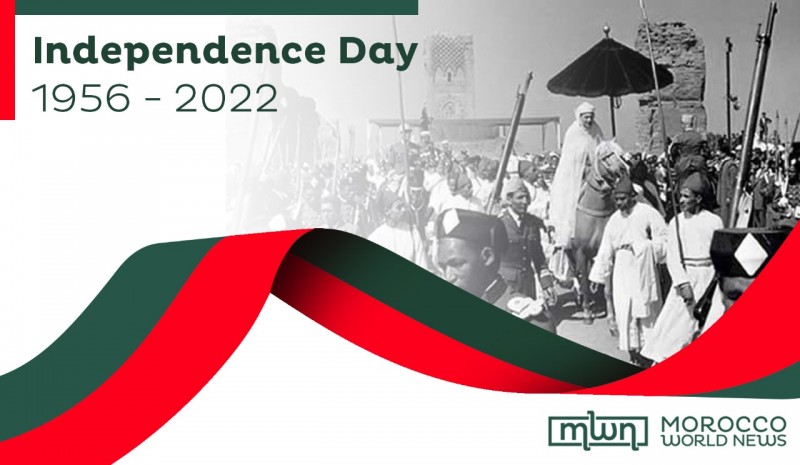
November 18: A Reminder of Morocco’s Long Fight for Independence.
The day marks a celebration of Moroccan bravery in the face of the French and Spanish colonial regimes.
On November 18, Moroccans will celebrate the 67th anniversary of Morocco’s independence. The date, which once commemorated King Mohammed V’s ascension to the throne in 1927, celebrates nowadays the country’s long fight for freedom and independence against the French and Spanish protectorate.
The colonial history dates back to March 30, 1912, with the signing of the Treaty of Fez, laying the foundation for the French protectorate and the division of Moroccan territories between Paris and Madrid with Spain controlling the northern and southern provinces with the exclusion of Tangier, which became an international zone in 1923.
However, Tangier’s special status was temporarily revoked between June 14, 1940, and August 31, 1945, as Spanish dictator and general Francisco Franco occupiedthe international zone.
As for the Ceuta and Melilla enclaves, they have remained under Spanish control since the 17th and 15th centuries, respectively.
A fierce fight
Since the establishment of the French and Spanish protectorate regimes in Morocco, local communities led numerous revolutionary missions fighting back the expansion of the colonial forces.
The establishment of the Republic of the Rif by Abdelkrim al Khattabi in 1921 and its continuity until 1926 strongly reflected the Moroccan will for independence. Despite being defeated by the Spanish Army of Africa with the support of French forces, the republic remained a prominent example of Moroccan-led resistance movements.
In November 1925, the Moroccan nationalist movement was initiated to put an end to the oppressive colonial regimes. The movement was instrumental in voicing Moroccan demands in not only urban and rural centers but also on the international stage.
In January 1944, 66 members of the Moroccan national movement signed the country’s Manifesto of Independence and presented it to the French and Spanish colonial authorities, as well as representations of the US, Great Britain, and the Soviet Union.
The manifesto was a turning point in Morocco’s struggle for independence. Aware of the threat that the declaration represented to the continuity of the French protectorate in the North African country, French colonial forces worked on pressuring Sultan Mohammed V to condemn the proclamation, while leading a purge of Moroccan nationalists and intellectuals and accusing some of the signatories of spying for Nazi Germany.
This was a time when Muslim and Jewish nationalists were discussing the prospect of establishing a modern and free Morocco that can equally celebrate both communities and reverse discriminatory measures forced by colonial authorities such as the Berber Dahir and Vichy’s anti-Jewish policies.
Despite facing fierce oppression from French colonial forces, the Moroccan nationalists continued to voice their demand for self-determination.
The movement further worked in coordination with Sultan Mohammed V to obtain freedom. The Sultan’s calls for independence eventually led to his forced exile along with his family members on the eve of Eid al-Adha in August 1953 to Corsica, and then to Madagascar in 1954.
The Sultan’s forced exile fueled public uproar with many nationalists organizing protests and calling for the return of the Sultan and his family as well as the right of the people to self-determine their fate.
Faced with rising pressure from the Moroccan public for independence, France allowed the return of Sultan Mohammed V to his homeland on November 16, 1955.
Two days later, the monarch delivered an iconic speech, stating, “We are delighted to announce the end of the trusteeship system and protectorate and the advent of freedom and independence.”
Incomplete independence
By late 1955, Mohammed V agreed to the gradual restoration of the country’s territorial integrity in line with agreements reached with France.
On March 2, 1956, Morocco officially gained independence from the French regime. That same year, Morocco re-integrated Tangier and the northern part of Morocco that was under Spanish rule.
However, the Ceuta and Melilla enclaves, as well as the country’s south remained under the Spanish regime at the time.
Morocco gradually recovered its territorial integrity in the south with the withdrawal of Spain from Tarfaya in 1958, Sidi Infni in 1969, and Saqia al Hamra and Oued Eddahab region in 1975.
A significant part of the Moroccan recovery of southern territories was led by the late King Hassan II (1961-1999) who orchestrated the Green March that contributed to the full withdrawal of Spain from southern Morocco.
After over six decades of fighting for independence, Morocco regained the majority of its territories with the exception of the Ceuta and Melilla enclaves that remain under Spanish rule.
The country’s southern provinces, known as Western Sahara, are also subject to disputes with the eastern neighbor and the Polisario Front, a self-proclaimed separatist group challenging Morocco’s territorial integrity and sovereignty of the region.
Today, Rabat continues to defend its territorial integrity in international gatherings with the support of friendly states.
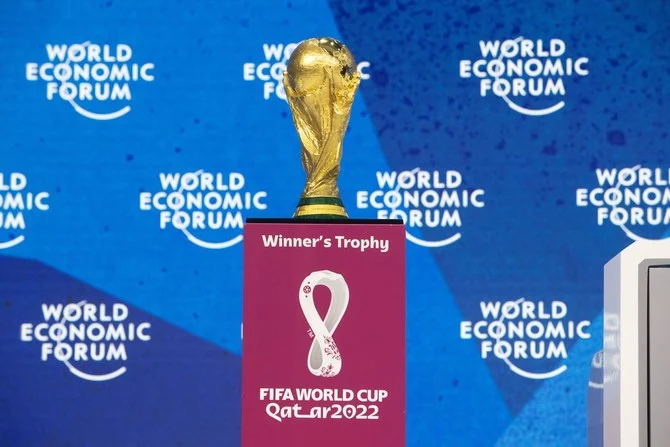
With the biggest show in football 24 hours away, Arab News takes a look at the 12-year journey to make Qatar 2022 happen.
The first FIFA World Cup to take place in the Arab world will kick off Sunday in Doha when the host nation take on Ecuador in the tournament’s opening match at Al-Bayt Stadium.
The journey from winning the nomination on Dec. 2, 2010 to the big kick off on Nov. 20, 2022 has not been without challenges and controversies, but for the teams and fans who have landed in Qatar, and for millions around the world, the moment of truth has arrived.
As in Russia four years ago, there will be four Arab nations taking part in the tournament. This time around they are Qatar, Saudi Arabia, Morocco and Tunisia.
Qatar and Saudi Arabia are among a record six Asian Football Confederation members taking part, along with Japan, South Korea, Iran and Australia.
Of the Arab nations, Qatar have an immediate chance to get three points on the board against Ecuador — arguably the easiest of their three matches in group A, which also includes the Netherlands and Senegal.
A win would leave the Asian champions requiring perhaps just a single point from their two other matches to become only the fourth Arab nation — after Morocco (1986), Saudi Arabia (1994), and Algeria (2014) — to reach the knockout stages of a World Cup.
Saudi Arabia have the toughest start of the Arab nations, taking on Argentina in their Group C opener, before facing Poland and Mexico in two matches that are only marginally less difficult.
A strong Morocco squad will have high hopes of causing an upset in Group F against Belgium Canada and Croatia, while Tunisia were dealt a tough hand when placed with champions France, Denmark and Canada in Group D.
While the Arab teams might struggle to progress beyond the group stages, it is a mission they should embrace. Players like Qatar’s Akram Afifi and Almoez Ali, Saudi’s Salem Al-Dawsari, and Tunisia’s Hannibal Mejbri could introduce themselves to a whole new audience.
Others, like Seville keeper Yasssine Bounou, and his Moroccan colleagues Achraf Hakimi of PSG and Hakim Ziyech of Chelsea are already familiar to audiences worldwide.
Standout matches for the Arab contingent will be Qatar’s showdown with the Netherlands on Nov. 29; Saudi’s second Group C fixture against Poland, which could provide their best chance of an upset; Tunisia’s clash with champions France; and Morocco’s final Group F match against Canada, potentially a match in which they could seal their progress to the round of 16 if they already have points on the board.
Elsewhere, there will be titanic clashes (Spain vs. Germany), international “derbies” (England vs. Wales), politically charged matches (Iran vs. USA) and revenge missions (Ghana vs. Uruguay)
Among the favorites for the trophy will be France and Brazil, both of whom have named fearsome squads, as well as Euro 2020 finalists England and South American champions Argentina.
The latter have become many people’s sentimental favorites, with a swell of emotion building behind Lionel Messi’s bid to end a glorious career with the trophy he craves the most.
Win it on Dec. 18, in what would be the Argentine maestro’s 1000th professional game, and the title of greatest footballer of all time will no longer be debated.
Messi’s rival for the title of greatest player of his generation, Cristiano Ronaldo, will also be playing in what is surely his last World Cup. And while things have not gone smoothly for the Portugal captain at Manchester United this season, his army of fans will no doubt be watching to see if he can pull one last rabbit out of the hat.
With Messi and Ronaldo walking into the sunset at the end of Qatar 2022, the position of world’s best player is up for grabs. The contender most likely to fill the void is Kylian Mbappe.
Already a world champion, the Frenchman has long been many people’s choice as the world’s “next” best player, and though he has continued to excel for club and country, the fact that he has remained at Paris Saint-Germain and, crucially, failed to land the coveted Champions League for them, means the jury is still out.
And then there is Neymar. This World Cup could well be the final chance for the Brazilian teammate of Messi and Mbappe at PSG to prove that he belongs among the greats after two World Cups plagued by injuries and underwhelming performances.
Other veterans including Ballon d’Or winner Karim Benzema, Uruguay’s Luis Suarez, Poland’s Robert Lewandowski and Croatia’s Luka Modric will also have the chance to bid their fans a fond farewell at the highest level.
Among a new generation of players to watch in Qatar are the likes of Brazil’s Vinicius Jr, Raphinha and Bruno Guimaraes; France’s Eduardo Camavinga and Aurelien Tchouameni; Uruguay’s Darwin Nunez; Germany’s Jamal Musiala; and the brilliant 19-year-old Spaniard Pedri.
The stage is set, the curtain rises on Sunday night.
source/content: arabnews.com (headline edited)
__________
The first FIFA World Cup to take place in the Arab world will kick off Sunday in Doha when the host nation take on Ecuador in the tournament’s opening match. (Reuters/File Photo)
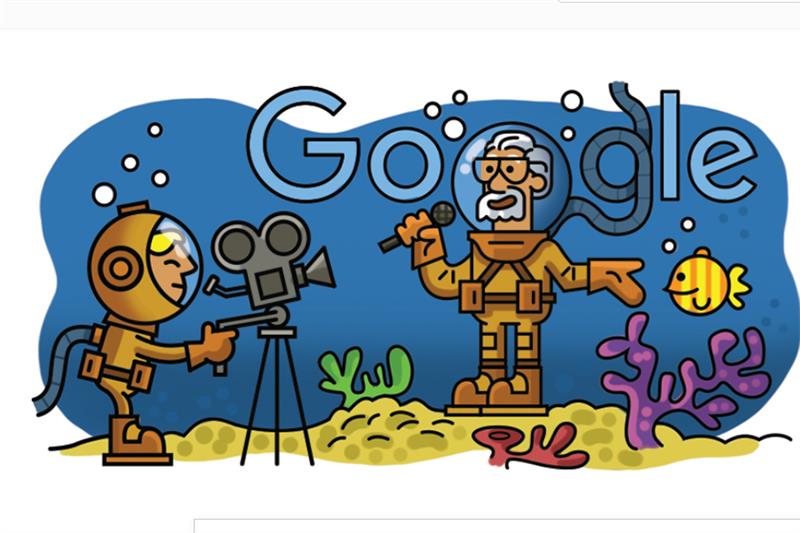
Google search engine celebrated the late Hamed Gohar’s 115th birth anniversary on 15 November with a Google Doodle.
The Egyptian scientist, marine biologist and TV host, Gohar is considered the founding father of oceanography in Egypt and the Arab world.
Born on 15 November 1907, he studied medicine at Cairo University in 1925 before shifting to biology. He then received his master’s degree in oceanography from Cambridge University in 1931.
The note under the doodle adds that “Gohar discovered that dugong, a sea mammal that was thought to be extinct in the region, still existed in the Red Sea. He continued studying underwater life for 25 years at the Hurghada marine biological station.”
He worked with the Arabic Language Academy to create scientific dictionaries in Arabic and served as an adviser to the United Nations’ Secretary General and helped organize the first International Conference on Law of the Sea in Geneva.
The general public knows Gohar for his educational show called “The Sea World” which he hosted on national television for 18 years. The programme highlighted underwater scenery and natural sea life, bringing the viewers closer to marine biology.
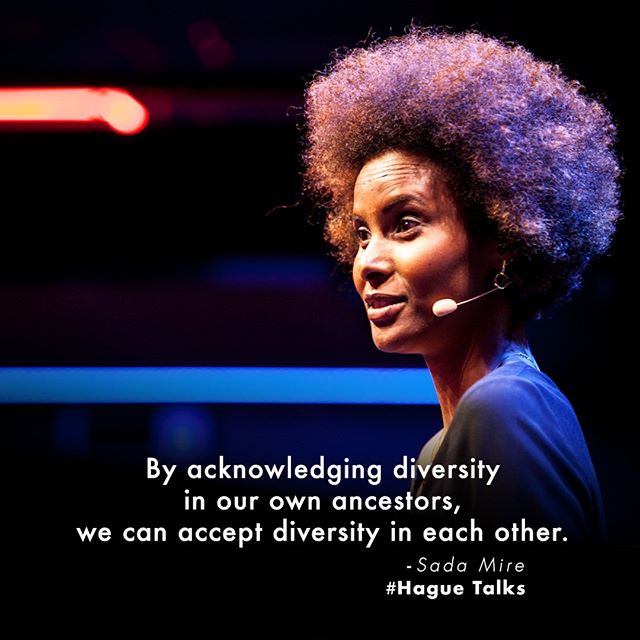
An interview with Sada Mire dives into the difficulties and rewards of preserving history and letting local perspectives guide heritage management in Somalia and Somaliland.
SOMALIA AND SOMALILAND are home to a rich heritage of archaeological treasures. But until recently, there was only one active, formally trained Somali archaeologist working in the region: Sada Mire.
In 1991, Mire was forced to flee Somalia with her family as a teenager after her father was killed by a genocidal government. She gained asylum in Sweden and eventually earned her Ph.D. in archaeology from University College London. During her studies, she learned that some of the significant stone tools that shaped scientists’ views of evolution came from Somaliland but were taken to Europe during the colonial era.
Inspired, Mire returned to her homeland determined to retell the history of the Horn of Africa and preserve its heritage—despite the difficulty of working in a region where religious sects jealously control narratives around Somali history and identity, and political conflict is causing humanitarian crises.
Somaliland is not officially a nation-state. It’s a self-declared country that is considered part of Somalia. A British protectorate since the 1880s, Somaliland became an independent country recognized by the United Nations on June 26, 1960. Less than a week later, it merged with the newly independent country Somalia. Early political tensions worsened in 1969 when Gen. Mohamed Siad Barre staged a coup and installed himself as president, imposing ethnic nationalist policies that favored one of the main Somali clans over the rest.
In the 1980s, civil war broke out between Barre’s dictatorship and the Somali National Movement, primarily composed of the Isaaq clan, the largest in northwest Somalia, including what is today Somaliland. The Barre government committed acts of genocide against the Isaaq clan, reportedly killing 200,000 Isaaq people between 1987 and 1989. Millions fled during the conflict, including Mire and her family, who belong to the Isaaq clan.
In 1991, with Barre ousted, Somaliland reasserted itself by declaring unilateral independence, this time without international recognition. But Mire always refers to Somalia and Somaliland as separate nations because, she says, “as an anthropologist, I call people what they say they are, and I respect that’s the decision of the country and its people.”
Mire has worked tirelessly to create change that fosters heritage preservation in a region with scant infrastructure to support archaeological work. She established the Department of Tourism and Archaeology in Somaliland and is creating a digital museum that features Somali objects and materials. Mire is deliberate about teaching archaeological skills to local people so they may carry out their own work at the community and institutional levels. All these are steps toward sharing the rich legacy of African peoples with African communities and the rest of the world.
Wenner-Gren Foundation project director and anthropologist Eshe Lewis interviewed Mire via Zoom in May. This interview has been edited for length and clarity.
EL:
Can you talk about your background and how you came to be an archaeologist working in Somalia and Somaliland?
SM:
It’s incredible that I am here now, that I have a university degree, that I even went to high school. My father and mother were educated. My brother now teaches in a university in Somaliland. My twin sister is a gynecological oncologist. In my family, it was understood that you got an education or you did what you could to educate yourself. My twin sister and I were very studious.
But because of the political situation in Somalia at the time, our clan became a target. At the age of 12, I lost all my rights to have an education. We were expelled from school, and we never thought we would be able to go back. From then on, I was self-taught. I read books and learned languages at home. The habit of learning and teaching myself has never left me.
EL:
Why is it important to conduct archaeological research in Somaliland and Somalia? And what are the most fulfilling aspects of the work you’re doing?
SM:
Right from the start, it was all about why we have so little representation of African history and African people, who have existed for over 200,000 years on the African continent. We have contributed so much to culture, science, technology, governance, philosophy, and literature, and there is nothing about it in the history books. In 2022, you have people who have no idea about what Africa has done. So, that is the number one reason I do what I do.
Also, I feel I can make the world a better place. I know that sounds like such a cliché, but I really think that if history books are revised, people will understand what others are worth, and they will appreciate their trajectory. Removing African history and experiences and holistic images from books creates a situation where people know nothing about, and hence fear, African people. And the few that live up to the negative stereotypes become the rule for them.
If your classmate doesn’t know your history, they don’t know you. They cannot. I believe that by understanding a nation’s past, a people’s past, a person’s past, we can appreciate them. We may not like what they do, but we understand them. I feel that there is so much work to be done to shed light on the history of Black people, Africans, and people of color.
EL:
What research and heritage protection work do you do in the region?
SM:
One of the longest research projects I’ve been doing is on medicinal and sacred plants through medical anthropology. I’m also a zooarchaeologist and a bone specialist. So, some of what we are preserving is that kind of archaeological material, including massacre sites from the recent genocide. I’m working on another project about astronomy. We found one of the earliest calendars—a whole ancient rock art site with the calendars painted. We are working with local researchers who study folklore and have created the first traditional Somali calendar.
In Somali nomadic culture, we have our own way of preserving heritage and an understanding of heritage that really clashed with [Western] best practices and this notion of monuments and artifacts—the more dogmatic UNESCO formula. UNESCO now covers intangible heritage, but often when Westerners do archaeology in the Horn of Africa—and especially in the Somali region—it’s really extractive. It comes from a tradition of going somewhere with the agenda of getting data out and filling a gap. That scientific and/or, often, Eurocentric gap is not the gap of the people.
Somalis challenged me right from the start when I said, “You don’t protect archaeological sites. The museums are being looted. You don’t care about your heritage!” They said, “No, that’s not our heritage.” I was confused, as a Western-educated student, that we did not care about these objects. I asked, “What is your heritage if you don’t care about this?” And they said, “Ah! Now we’ll tell you.”
EL:
How did you respond?
SM:
I developed something I called the Knowledge-Centered Approach based on what I learned about heritage from them, and this is what guides me. It’s the preservation of knowledge and skill rather than objects and artifacts. Heritage is performance that takes place on different mediums. You know, if you are in a scene, there is a sofa, maybe a chair, the way you are dressed, how you look, speak, and act. That is our heritage! That shows us as living, thinking human beings with logic.
I developed a framework to study this. It is called the ritual set, and I outlined it in my book Divine Fertility. Understanding African peoples’ logic links us with our past. In my own work it’s about an ideology of a sacred kinship and sustainability. This is the whole idea behind my book.
I explore Somalis’ questions about their identity. Who were we? Where do we come from? Why have we been told we are Arabs when we are Africans? Clearly, we are Black, and we are in Africa.
I also have personal questions about my heritage. Somalis are Muslims, but did we ever have any other ideology? Were we at some point something else? Why do we only know Islam?
Why do we think our ancestors were all from Arab countries, when in fact we are genetically the same as the Oromo, who are our neighbors? We have 50 percent lexical similarity. They look like me, I look like them, we practice the same traditional rituals. They may be Christian, and we may be Muslim, but we share Indigenous culture. Those questions have really not been answered by archaeologists or historians working in the Horn of Africa, local or foreign. There is a huge scientific gap, and for that public, I fill that gap.
EL:
Has there been any backlash to your work?
SM:
In 2009, my Ph.D. dissertation was put under restricted access because I was threatened by extremists. As soon as my book was published in 2020, I faced fresh threats from ideologues who are not interested in scientific research or common sense.
EL:
What is the source of this reaction?
SM:
This is misogyny. These are people who hate women and who use anything they can to stop them. They also fear intellectual women—and are afraid that there’s somebody researching and finding diversity in our past. However, this is not only restricted to my region; extremists of all religions have always dogmatically advanced a certain purity and homogeneity. Look at what is happening in India. I wrote my first ever academic article on the Ayodhya conflict in India, and I was prepared when I entered the Horn that I would have to deal with dogmatic views on our past.
There is a plurality of practices, identities, landscape hues, and traditions that link us to our African heritage. And it’s not a bad place to be from if you really open your mind and understand the heritage of this place, the history of food production, the linguistic plurality of Ethiopia, the Nile civilizations of Meroe, Aksum, Nubia, all the way to Upper and Lower Egypt. You have Rwanda and Uganda, with [one of] the earliest iron productions anywhere in the world, an independent invention! The history and heritage are incredible!
EL:
What are some of the challenges you face when doing heritage preservation in a conflict zone?
SM:
Everything I do in this region is soaked in challenges.
This is a post-conflict situation where the country is not officially recognized, where there are no legal instruments and no notion of heritage. My paper in 2007 was the first study of heritage in Somaliland. The heritage work I’ve been doing the past 15 years has involved establishing a law for heritage protection and physically protecting sites through measures like fencing and hiring guardians and custodians, but also preservation so that we have digital documentation and heritage research.
But the lack of understanding of heritage creates more challenges. People see Westerners who have worked there, and without exception, none of them has worked on heritage. Everything has been “go and dig.” This has also led to conflict within the people I train. They say, “Sada, you never do excavations. You’re the odd one because you’re not digging.” And I say, “How can we excavate when we don’t have laws or a single museum?” We dig a grave, and then what? What is protecting that grave? What are the legal instruments that oblige anybody to protect it or to hold others accountable?
The people who are coming here to dig have laws and museums in their countries. The contracts are signed with their laws, even though it’s our country. There’s a knowledge and awareness gap with the locals who don’t understand the way they are being exploited. There’s a sense of archaeology as a White man’s sport, as fun and extractive and magical—all these words that mystify it for local people. If someone comes along and says, “Let’s dig up what’s in there,” it appeals to our human curiosity.
That was the archaeological stance 400 years ago. But in Africa, [some people think] it’s OK for it to be at that level today.
There are so many Africans who are interested in this field, have awareness, and want to change things.
EL:
Can you talk about your efforts to encourage more Africans to get involved in heritage preservation and to collaborate across countries?
SM:
When I was at Leiden University, I created the online course Heritage Under Threat because I knew a lot of people didn’t have the opportunity to come to a place like Leiden to study a world-class course. Over 7,000 people have taken part. This was around 2015, when not many Black people were professors of archaeology and teaching online courses. So, for students it was a free, advanced course taught by a Black woman with a lot of African material that everybody could take part in. From that experience, I realized there are so many Africans who are interested in this field, who have awareness, and who want to change things.
When I created the Horn Heritage Foundation, the idea was to work in Ethiopia, Kenya, Somalia, Somaliland, Eritrea, and to have a regional exchange. And that’s what we’re doing—coordinating on a regional level so we are not isolated in our thinking. This has been one of the colonial goals within Africa: to isolate people from each other so they don’t value each other or each other’s experiences and contributions—to keep them unaware.
Academic divide and rule continues through gatekeeping. For example, funding is allocated through Western institutions by Western, and often White, male panels. Often, those coming to Africa with the funding prefer to work with people who will go along with whatever they are doing. There’s a lot of that going on, unfortunately.That is exactly what I was hinting at in my piece in The Guardian —that African heritage is still very much neglected, and the whole system is rather self-serving. It does not help that in various parts of Africa there are conflicts that limit how much can be done on the ground. So people, including foreign teams, tend to not leave the beaten track—not just physically but also conceptually. This impacts African heritage and its future.
What archaeology analyzes are things we have shed over the generations that come from our bodies, our movement, our intellectual process. When that continuity is denied, we are alienated from our history and then reintroduced to it by someone coming from hundreds of miles away. In this way, archaeological tools have been used to aid the colonial process.
EL:
What can be done to change this, to create a path toward a different future?
SM:
I am one of the few African archaeologists who have worked in several African countries. We need greater interaction and collaboration between African archaeologists in the continent. Africans need to have access to tools so they can do the work themselves. Online courses and free or accessible outlets help to do that.
When we were doing the digital heritage project documenting rock art, we were interested in training people using what they have. You have an iPhone? You can do a lot with an iPhone. You can edit and be the author and present [at a conference]. You can advocate. As Africans, we should have our own organic questions about our own identity and culture, and have the opportunity to explore them.
That’s what I mean when I say “cultural heritage is a basic human need.” It’s not something we should get from somewhere else; it’s already here. We are experienced. We are living that reality. It’s ours.
Syrian girl, 7, who survived horrors of civil war crowned Arab Reading Challenge champion.
Sham Al Bakour named sixth winner of prestigious title at Dubai Opera House awards ceremony.
A Syrian schoolgirl who survived a deadly missile attack during the civil war in her country has been crowned Arab Reading Challenge champion in Dubai.
Sham Al Bakour, 7, was only six months old when her family’s car was struck during violence in Aleppo in December, 2015.
Her father was killed while she and her mother survived the horrific attack.
She has now completed a remarkable journey from tragedy to triumph to win words of praise from Sheikh Mohammed bin Rashid, Vice President and Ruler of Dubai.
In footage released by Dubai Media office, Sheikh Mohammed is seen speaking to Sham as she clutches her winner’s trophy at a ceremony at Dubai Opera House on Thursday.
Her success was met with warm applause by a large audience at the Downtown Dubai culture spot.
“She sustained injuries in the head and at the hospital doctors stitched them,” said Sham’s mother, Manal Matar, 33.
“I have been her support along with my family and her father’s family.
“I noticed she had a passion for memorising texts and Quran verses since she was less than three years old so I supported her.”
A young symbol of hope
She said that Sham has been an inspiration for the children in her family and school.
“Her cousins wait to see what she reads to learn from her.
“Her school mates will certainly be inspired. This challenge will help raise a generation that can rebuild Syria.
“Love of reading must start at a very young age.”
The young literature lover read 70 books to win a competition that attracted 22 million entrants from 44 countries.
When asked about what she would do with the Dh1 million prize money, she said she would give it to her mother.
“We haven’t thought of what to do with the money yet. The focus is on Sham, she is my investment for a better future,” Ms Mattar said.
Sham secured top spot ahead of Adam Al Qasimi from Tunisia in second, and Rashid Al Khateeb from Jordan, in third.
Reading is ‘food for soul and mind’
The young winner said reading offers an opportunity to transport yourself to new places with every turn of a page.
“I’m very happy to win and would like to invite all my friends and all young people to read. Reading is food for soul and mind,” Sham said.
“Reading takes you places, every story introduces you to different people and takes you to a new place.”
The youngster impressed judges with the confidence and clarity with which she expressed her ideas and opinions.
“It was a unanimous decision on Sham, who showed confidence,” said Lailah Al Obaidi, professor in Arabic language and literature at the University of Sharjah, and one of three judges.
“Sham will pave the way for the generation of the future because at this young age, she will be a motivation for more young readers in the Arab world.”
The annual winner is selected based on the pupil’s ability to articulate general knowledge, their critical thinking and communication skills, plus the diversity of books they have selected.
The Arab Reading Challenge was launched by Sheikh Mohammed in 2015 to encourage a million young people to read at least 50 books in a year.
Helping to shape young minds
Noor Aljbour, from Jordan, won Dh300,000, along with the title of Outstanding Supervisor, in recognition of her work guiding and motivating pupils through the challenges of the Covid-19 pandemic.
“The obstacles and the amount of work to prepare for this edition of the reading challenge were huge because its the first to happen after Covid-19,” Ms Aljbour said.
“Pupils returned to schools lacking the passion for reading, this meant that we needed to encourage pupils not only to read but to also pick up on their studies.”
Morocco’s Mukhtar Jasoulet school won the Dh1 million Best School award.
In the category for Arab pupils living in foreign countries, Nada Al Satri from Belgium was named the champion.
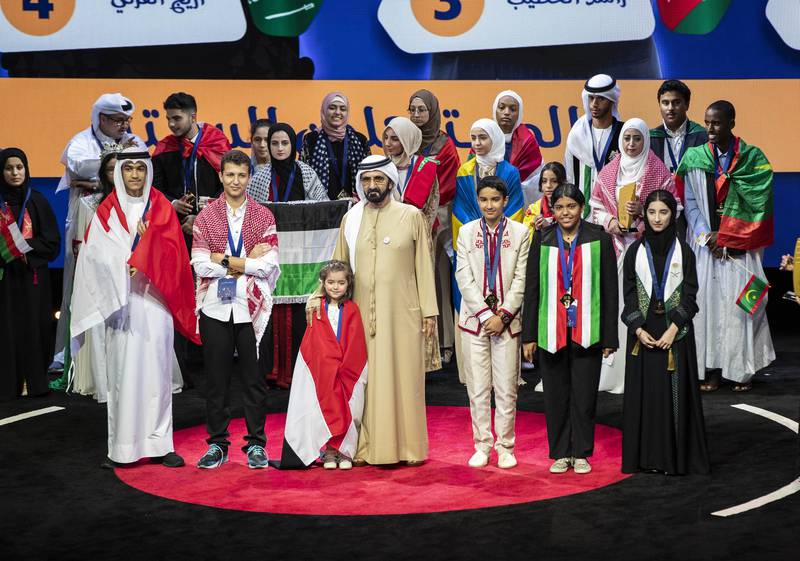
Sheikh Mohammed bin Rashid, Vice President and Ruler of Dubai, with the six finalists at the Arabic Reading competition at Dubai Opera. Left to right, Mohammed Jamil (Bahrain), Rashid Al Khateeb (Jordan), Sham Bakour (Syria), Adam al Qasimi (Tunisia), Ghala Al Enzi (Kuwait) and Areej Al Qarni (Saudi Arabia). All photos: Ruel Pableo for The National