Arabs & Arabian Records Aggregator. Chronicler. Milestones of the 25 Countries of the Arabic Speaking World (official / co-official). AGCC. MENA. Global. Ist's to Top 10's. Records. Read & Enjoy./ www.arabianrecords.org
Hamza Taouzzale, 22, became the youngest person to hold the office
Serving as councilor offers chance to connect with people left behind by politics, he tells Arab News
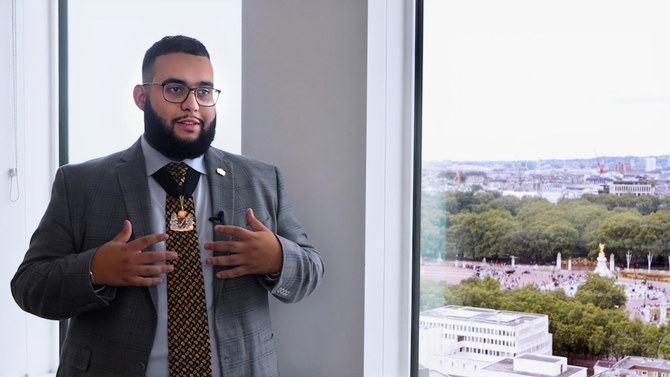
At London’s Westminster City Hall, 22-year-old Hamza Taouzzale warmly welcomes us into his dynamic working environment.
The councilor made history in the political heart of the UK last year when he became Westminster City Council’s first Arab and Muslim, and youngest, lord mayor.
He introduced us to his realm of responsibilities, shedding light on the multifaceted nature of his duties. With a passionate demeanor, he delved into the rich history of Westminster and its surrounding boroughs, painting a vivid picture of inspiring local stories.
Taouzzale described his emotions upon learning of the news of his election as a mixture of nerves and excitement. Calling his mother, he recalled her shock, as well as the astonishment of his entire family.
“But for me, it was that pride and that representation to understand that I was going to be the first Muslim, the first person from a minority ethnicity and the youngest ever at the age of 22 to become lord mayor of Westminster,” Taouzzale added.
The role, which he held until earlier this year, involves acting as a community representative, offering a chance to connect with those who may feel disconnected from local politics and decision-making.
Taouzzale emphasized his commitment to engaging with various segments of the community, including schools, youth clubs and care homes, highlighting the need to meet the demands of locals.
Growing up on the nearby Lisson Green Estate, the 22-year-old acknowledged the importance of community support in his journey.
He recalled his initiation into politics at the age of 16, when a youth leader, Tariq, encouraged him to join the local Youth Council.
From there, Taouzzale was elected as a youth MP. That position paved the way for him to later become a Westminster City councilor.
The journey, guided by mentors and a desire to make a positive change, led to his eventual appointment as lord mayor of Westminster in May 2022.
As the first Muslim and Arab in the position, Taouzzale described his background as having provided representation to local communities. He underestimated the impact he would have globally, but gradually realized the importance of his role as a symbol of empowerment and inspiration, especially for young people.
He said: “I had people in my first week from countries I’ve never been to in the Middle East message me on Facebook: ‘I’m so, so proud of you,’ ‘This is brilliant,’ ‘Masha Allah.’
“That sort of pushed me to understand who I was representing. I wasn’t representing just Westminster; I wasn’t representing just my community. I was representing all those people who had never done something that I had been able to do, as a present in the Arab world, the Muslim world,” Taouzzale added.
Through his work, the councilor hopes to encourage others, especially young people, to see the possibilities that lie ahead. He wants to leave a legacy that motivates people to believe that, like him, they too can overcome challenges.
source/content: arabnews.com (headline edited)
___________
Hamza Taouzzale, describing his political journey to Arab News at Westminster City Hall in London, United Kingdom. (AN Photo)
Oral history, which is gradually taking hold as an academic discipline, captures potentially hidden corners of the historical record by listening to those whose voices might otherwise have been ignored.
“Oral history provides a big challenge to the people who are powerful, including historians, who think that they should get to decide whose stories are being told and what counts as evidence,” says Wesley Hogan, director of the Center for Documentary Studies at Duke University, in the United States, perhaps the best-established academic institute in the discipline.
In the Arab world, where official histories often reflect political viewpoints, oral history has taken on an increasingly important role, scholars say. Rosemary Sayigh, a retired faculty member at the American University of Beirut who has used oral history to record the stories of dispossessed Palestinians, says oral history has particular value in recording the status and experiences of women, agricultural and industrial workers, linguistic minorities, colonized societies, immigrants, refugees, and gypsies.
“The most powerful thing oral history does is force the researcher to look the subject in the eye—forcing the historian to be an ethnographer, actually sitting face to face with the narrator, listening to their voice and sensing their emotions and body language,” says Hana Sleiman, a Ph.D. candidate at the University of Cambridge and manager of a Palestinian Oral History Archive at the American University of Beirut. “It puts you in contact with the entire life narrative.”
The U.S.-based Oral History Association describes the field as gathering, preserving, and interpreting the narratives of people, communities, and participants in past events. The discipline is the oldest form of documenting history, dating back to times when sharing stories was the only form of creating a historical record. At the same time, it is one of the most modern means of documenting history, expanding with the use of tape recorders.
“
“The most powerful thing oral history does is force the researcher to look the subject in the eye—forcing the historian to be an ethnographer, actually sitting face to face with the narrator, listening to their voice and sensing their emotions.”Hana Sleiman Manager of the Palestinian Oral History Archive at the American University of Beirut
“
Oral history as an academic sub-discipline was first established in the mid-1960s. “For a long time in the 1940s and 1950s, there was just not enough access to equipment,” says Hogan, at Duke. “We did not have access to portable tape recorders until 1963.”
One of the earliest uses of oral history by scholars was at Spelman College, a historically black institution for women in Atlanta, Georgia. Academics would take portable tape recorders to civil-rights movement meetings in the mid-1960s to record discussions and interview participants. Despite the clear value of having such on-the-spot recordings, many historians at the time viewed them with suspicion.
“Even though historians started to use [portable tape recorders] in the early ’60s, most history departments only started to admit oral history as evidence in the late 1970s, so it took a very long time for historians to be willing to accept oral history as evidence, comparable to evidence material, such as journals or written documentation,” added Hogan.
Oral History and Palestinians
Perhaps the event that has been the most documented by oral historians in the Arab world is the Palestinian Nakba. The 1948 Palestinian exodus, also known as the Nakba, occurred when more than 700,000 Palestinians—which was then more than half of the Palestinian population—were displaced from their homeland by the creation of Israel.
Much of that work has been collected by the Palestinian Oral History Archive, launched in June at the American University of Beirut. The archive contains more than 1,000 hours of video and tape-recorded interviews with Palestinians, made available to the public through a digital archive. Some of the interviews are available on the Internet.
Sleiman, the archive manager, says it “offers a push back in the face of the destruction of the villages and the attempts at erasing the records, and captures an entirely different layer of history that is not captured by written archives, including the most intimate texture of human life.” The collection includes folktales, songs, and the stories of the Palestinian refugees who fled to Lebanon.
Even Palestinian national cultural institutions have been slow to record Nakba experiences, but individual scholars and activists have moved in to fill the gap, says Sayigh.
“History is often written by the victors, and the story of the Nakba has been presented through the accounts of the Zionists and the colonial regimes,” said Lena Jayyusi, a professor emeritus at Zayed University.
“The details of the massacres and how civilians were forced out of their homes [during the Nakba] are very important to understand what happened; a general idea is not enough to build a foundation for the continuity and the remembrance of a certain community,” added Jayyusi.
Jayyusi also said oral history was important to “reconstruct Palestinian life before the Nakba: the social life, the religious life, the relationships between the people.”
Rising Respect for Oral History
Technological advances in managing sound and video files have made oral historians’ lives easier lately and increased the power of the discipline. Scholars can now more easily archive and index sound and video files, search files for particular speakers, and label emotions, as pointed out on the Oral History and Technology website.
Also, the average citizen now has easy access to powerful oral-history tools. “In a world where many people have access to a smartphone and an app that can record, and where data storage is cheap, we have increasing access to creating oral history archives,” says Hogan. “The more information we have from everyday people, people who are on the margins, the more we can understand societies, especially the ones in rapid transition.”
Many resources on the web, such as the International Oral History Organization, are also increasingly providing instructions and encouraging people to start their own oral history projects, filling a gap because universities do not often offer such courses. Archiving social media history is an important complement to oral history, scholars say, especially in societies where governments might delete what is now online.
Oral History and Academia
Oral history, just like any other qualitative research methodology, must be conducted with a critical eye, scholars say. Much of oral history relies on memory and a lot of subjectivity comes into play.
“People’s ideas and perceptions are reflected in oral history, and researchers should be aware of that,” explained Jayyusi.
Jayyusi said that no methodology is straightforward and objective, and researchers must be critical even when dealing with numbers. Methodologies must be triangulated, compared, and assessed, before producing a final report.
If oral history catches on with younger scholars, who fan out and capture the stories of today’s refugees and others whose stories are not being chronicled well in official channels, those scholars will be creating an evidence-rich gift for future historians.
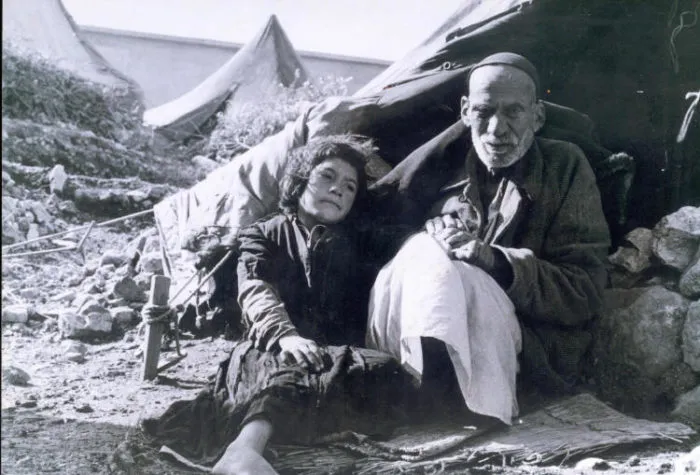
An old man and a young girl were made refugees by the Arab-Israeli war of 1948. Experiences like theirs are being recorded by oral historians, so the story is not told only by the victors (Photo: Creative Commons).
UNESCO chooses theme for World Arabic Language Day 2023
Arabic is one of the most widely spoken languages, used daily by more than 400m people
Language is a main pillar of any society, and a driving force for connecting communities. As one of the six official languages in the UN, and one of the most spoken languages globally, Arabic is an incubator of culture, science and knowledge.
It is also one of the most widely spoken languages in the world, used daily by more than 400 million people.
World Arabic Language Day has been celebrated by UNESCO every year on Dec. 18 since 2012, the date coinciding with the day in 1973 that the UN General Assembly adopted Arabic as the sixth official language.
UNESCO recently chose “Arabic — the Language of Poetry and Arts” as the theme of World Arabic Language Day 2023 to highlight the role Arabic has played in poetry and art for centuries.
Experts told Arab News that Arabic has many characteristics and aesthetic values, both in written text and spoken discourse.
“Arabic language is very closely linked to the arts, literature and various cultural styles, from poetry to prose, to the rest of the literary genres, such as the story, the novel, the narrative, and poems in various artistic and scientific fields,” Mohammed Alfrih, a member of the board of directors of the Saudi Publishers Association, said.
“We can hardly find another language that mimics the Arabic language in its elegance and its different expressive ability, and it is not surprising that non-native speakers confirmed that, let alone its native speakers,” he said.
Yousef Rabab’ah, a professor of Arabic language and literature at Jordan’s Philadelphia University, said: “The Arabic language is characterized by features and characteristics in derivation, vocabulary, and idiomatic expressions that make it able to keep pace with developments in various fields, and this is proven objectively.”
Rabab’ah, who is editor-in-chief of Afkar Magazine, which is published by the Jordanian Ministry of Culture, said: “The Arabic language has been able throughout its history to influence many arts related to it, for example the arts of decoration, in which the Arabic calligraphy was essential in its formation. Artists were able to adapt the Arabic letters and Arabic calligraphy to produce artistic paintings and beautiful decorations that we see in places of worship, the walls of castles, palaces, and on the covers of books.
“Likewise, Arab voices, and the way they are performed and controlled, have a great role in the arts of singing, music and mirth, and we will not forget the plastic arts that adopt the formations of Arabic calligraphy which enter into the drawings of this type of art,” he said.
According to Hanan Al-Sharnouby, assistant professor of literature and criticism at Alexandria University, the Arabic language has a profound association with various forms of arts, and it is necessary for those seeking to engage in linguistic arts and speech sciences to master the language.
Al-Sharnouby noted that language and art are interconnected, influencing each other. She emphasized that quality content for films, series, and theater necessitates a language that reflects Arab identity effectively and that the rich heritage of Arabic serves as a solid foundation for sophisticated art that fully engages its audience.
Mohammed Daud, a professor of Arabic language and dean of the Faculty of Linguistics at Sudan University of Science and Technology, said: “There are formative and structural characteristics common to natural human languages, in addition to what is specific to each language.
“The Arabic language is distinguished by these formative and structural characteristics without the rest of the languages. It is represented by the fact that Arabic is concerned with the aesthetic values in the written text and spoken discourse, taking into account the semantic differences between words that appear synonymous in different structural contexts, which enabled it to express the same meaning in different ways and with amazing accuracy.
“This is reflected in its illustrative styles and its individual and collective creative arts, and applies to the ways of thinking of its speakers in their keenness to portray the details of artistic situations and the integrity of their creative production,” he said.
Daud said that the future of the Arabic language is bright due to the stability of its morphological, grammatical and semantic systems, and its ability to derive words and generate meanings through these means.
Tha’er Alethari, a professor of criticism and literature at University of Wasit in Iraq, said: “It is important to realize that Arabic is the only language in the world that has been understood for 2,000 continuous years.
“We read pre-Islamic poetry, understand it, and perhaps quote it on a contemporary issue, and this communication has given the language vitality and the ability to adapt to every era.
“There are two linguistic characteristics that helped it in this, the first of which is the abundance of linguistic roots in it, and the second is its etymological nature. Arabic does not depend on antecedents and suffixes in generating connotations, as is the case with most human languages. subject, noun, adverbs, etc,” he said.
source/content: arabnews.com (headline edited)
______________
World Arabic Language Day has been celebrated by UNESCO every year on Dec. 18 since 2012. (Reuters)
Morocco currently ranks first totaling a number of 38 medals, with 13 gold, 11 silver, and 14 bronze.
On August 3, Moroccan athletes bagged 6 medals in athletics and 4 in judo on a single day, confirming the Kingdom’s leading position at this ninth edition of the Francophone Games taking place in Kinshasa, the capital of the Democratic Republic of Congo.
In athletics and para-athletics, the women’s 5,000-meter discipline representing the Kingdom conquered the podium with a trio comprising Rahma Tahiri, who claimed the gold medal and set a new competition record with a time of 15 minutes 56 seconds 71 milliseconds.
In second place came Kaoutar Farkoussi with a time of 15 minutes 57 seconds 91 milliseconds, while Soukaina Atanane took bronze with a time of 16 minutes 05 seconds 34 milliseconds.
In the men’s 1,500 meters, the runners Hicham Akankam and Hafid Rizqy won gold and silver recording 3 minutes 41 seconds 08 milliseconds and 3 minutes 41 seconds 89 milliseconds respectively.
In para-athletics, Abdelkbir Jaddi won bronze in the long jump with a leap of 6.30 meters.
In judo, Hassan Doukkali won gold in the under-73 kilograms category, while Chaimae Taibi, Hamza Kabdani, and Ziane Wissal took bronze in the under-63 kilograms, under-81 kilograms and under-57 kilograms categories respectively.
In the same competition event on Tuesday, Morocco claimed three simultaneous medals in the women’s 1,500-meter event.
The three Moroccan athletes who stood on the podium were Wafa Zaroual, Soukaina Hajji, and Rababe Arafi.
Morocco currently has a total of 38 medals, with 13 gold, 11 silver, and 14 bronze, well ahead of second-placed Romania with 25 medals.
This year’s Francophone Games, which runs until August 6, brings together 2,500 young people aged 18 to 35 representing 88 countries, including Morocco, to take part in the various sporting disciplines and cultural activities scheduled for this event.
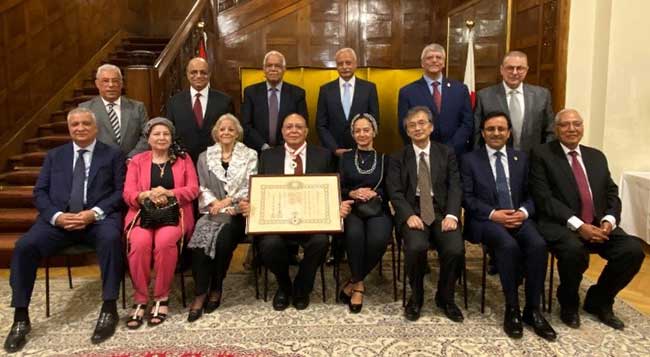
Former president of the Egyptian-Japanese University of Science and Technology (E-JUST) professor Ahmed El-Gohary received the Order of the Rising Sun, Gold Rays with Neck Ribbon from the emperor of Japan on 31 July.
The order is in recognition of El-Gohary’s outstanding achievement for advancing the friendly relations between Japan and Egypt through promoting educational cooperation and scientific research exchanges over the years.
El-Gohary was crowned by Ambassador of Japan to Egypt Oka Hiroshi at the residence of the Japanese ambassador in Garden City.
El-Gohary assumed the presidency of the university for eight years, enhancing the educational and research standard of E-JUST by actively accepting Japanese professors as its faculty members to introduce practical Japanese-style engineering education in E-JUST. In 2017, he contributed to the establishment of the new Faculty of Engineering and the Faculty of International Business and Humanities. These two faculties are the two pillars to sustain E-JUST.
The ceremony was attended by members of the university’s board of trustees, led by ambassador Faiza Abul-Naga, University President Amr Adly, former minister of education Ahmed Zaki Badr, former minister of transport Galal El-Said, former governor of Daqahliya Kamal Sharubim, and Maher El-Domyati, former governor of Beni Suef. Also in attendance were former Egyptian ambassadors in Japan Ayman Kamel and Hisham El-Zemiti, Director-General of the Arab Organization for Administrative Development Ambassador Nasser Al-Qahtani, President of the British University in Egypt (BUE) Mohamed Lotfy, professor Ahmed Bayoumi, former president of Mansoura University Salwa El-Ghareeb, as well as former secretary-general of the Supreme Council of Universities, and a group of scholars and researchers in various fields.
In his inaugural speech, Japanese Ambassador Hiroshi said, “El-Gohary’s long journey of cooperation with Japan started as many as 30 years ago in 1992 when he came to Japan as a JICA-trained student. In this training he had learnt the latest medical knowledge and advanced examination techniques.
When he returned to Egypt, as a lecturer at Suez Canal University, he not only used his experience to teach younger Egyptian students, but he generously shared his expertise with students from Africa through the JICA sponsored Third Country Training Programme since 1996.”
El-Gohary’s efforts promoted Third Country Training in Egypt. “Thanks to his pioneering role in promoting Third Country Training in Egypt, countless numbers of students and experts from Africa and Middle East have come to Egypt to benefit from this unique type of cooperation between Egypt and Japan supported by JICA.
The third country training programmes have now come to include many fields such as education, electricity engineering, agriculture, and freshwater aquaculture, in addition to health, making Egypt the hub of third country cooperation programme. Professor El-Gohary has thus made a significant contribution to the successful expansion of the Third Country Training Programme as vice president of the Suez Canal University, and then as president of Fayoum University.”
“When a plan was announced at the Japan-Egypt summit on the occasion of TICAD 7 in 2019 that E-JUST accept African students by offering as many as 150 scholarship over the three years, professor El-Gohary toured Africa to promote E-JUST to accept excellent students from Africa. Thanks to his dedicated efforts, promising African students from more than 10 countries are now pursuing higher study at E-JUST.
Building on this successful TICAD scholarship, Prime Minister Kishida and President El-Sisi agreed in their meeting in April this year to provide additional 150 TICAD scholarships to African students. This time scholarships will go to PhD students. Professor Gohary has contributed to make E-JUST as the Centre of Excellence in Africa,” added Ambassador Hiroshi.
The opening ceremony of the E-JUST main campus with the participation of President Abdel-Fattah El-Sisi in 2020 was successfully organized by El-Gohary, contributing to enhancing the profile of E-JUST both inside and outside Egypt. The second phase of the campus construction, which was approved by the president at the time of the opening ceremony, is scheduled for completion soon. In addition, El-Gohary has made efforts to strengthen collaboration with industries by actively promoting joint research with Egyptian and Japanese companies.
El-Gohary expressed his pride and happiness at being crowned with this prestigious award, thanking the government of Japan for its close cooperation with Egypt to establish the Egyptian-Japanese University as a distinguished scientific and research edifice.
“I hope that the university will continue its growth and development in the future as a symbol of cooperation between Japan and Egypt,” said El-Gohary.
Egypt assumed on Saturday the rotating presidency of the Arab Network for National Human Rights Institutions (ANNHRI) during the convocation of the network’s conference and its 20th General Assembly in Cairo.
Ambassador Moushira Khattab, President of the National Council of Human Rights (NCHR), took over the presidency of the network from Ahmed Bouhoubeyni, president of the National Human Rights Commission (NCDH) in Mauritania and ANNHRI chairman since June 2021.
Egypt previously assumed the presidency of the network in 2018.
The two-day conference represented an opportunity to discuss the main challenges facing national human rights institutions to enhance the role of the networks and the international and regional organisations in promoting national human rights institutions.
The ANNHRI, established in 2011 in Nouakchott, is a regional network of Arab national institutions aiming to protect and promote human rights in the Arab world.
source/content: english.ahram.org.eg/
____________
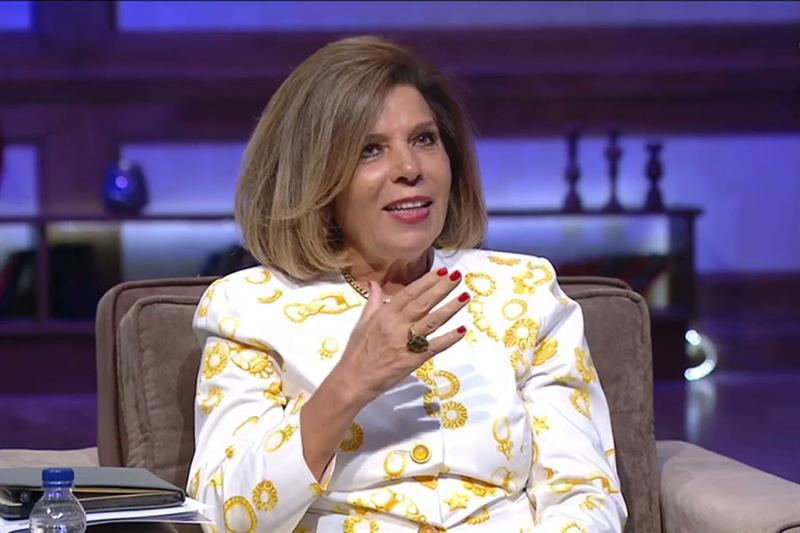
Ambassador Moushira Khattab, President of the National Council of Human Rights
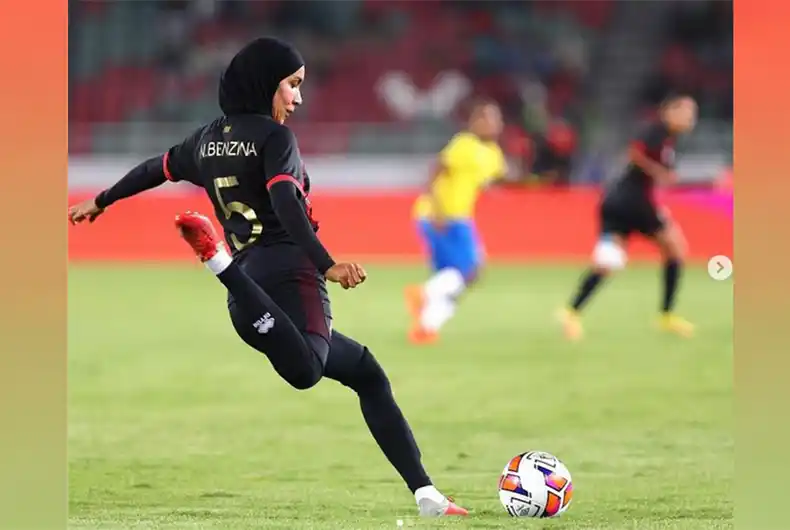
When Nouhaila Benzina stepped onto the field for Morocco’s first match of the Women’s World Cup against Germany, she made history.
She became the first player to wear the Islamic headscarf at the senior-level Women’s World Cup.
Had Morocco qualified for the Women’s World Cup a decade ago, a player who wanted to wear the hijab during a game might have been forced to choose between faith and football.
That was until 2014, when head coverings were officially authorised by FIFA.
Who is Nouhaila Benzina?
She’s a 25-year-old defender on Morocco’s Atlas Lionesses.
In recent weeks, Benzina shared social media posts from others about the history-making nature of her World Cup appearance.
“Lots of work was done over many years, and thank God it had a positive result,” Benzina told Al Jazeera.
“We hope to play at a high level and honour Moroccans.”
‘That could be me’
Morocco are one of eight teams making their debut at the FIFA Women’s World Cup this year, alongside Haiti, The Republic of Ireland, Panama, the Philippines, Portugal, Vietnam and Zambia.
“We are honoured to be the first Arab country to take part in the Women’s World Cup,” Morocco captain Ghizlane Chebbak said on Sunday.
“Girls will look at Benzina (and think) ‘That could be me,’” said Assmaah Helal, a co-founder of the Muslim Women in Sports Network said of the hijab.
“Also the policymakers, the decision-makers, the administrators will say, ‘We need to do more in our country to create these accepting and open and inclusive spaces for women and girls to participate in the game.’”
Why did FIFA ban the hijab before?
FIFA cited “health and safety” concerns, some related to possible choking, with regulations forbidding “equipment that is dangerous to himself or another player.”
An incident in 2007 instigated the official ban.
Canadian girl Asmahan Mansour — who was 11 years old at the time — attempted to wear a headscarf at a tournament but the referee said it wasn’t permitted.
She was told she could remove it and play, but her hijab would not be permitted on the pitch.
When the issue reached FIFA, the sport’s global governing body banned head coverings in competitions it sanctioned, except for coverings that exposed the neck.
Initially, FIFA cited “religious symbolism” as a reason for not permitting head coverings.
But considering the multitude of tattoos, signing of the cross and goal celebrations by footballers, it became too difficult to enforce.
Helal was among the social activists, Muslim athletes, and government and soccer officials who worked to overturn the ban.
Speaking on the 2007 ban, Helal said it “sent a strong message to Muslim women, particularly those who wear hijabs, (that) we don’t belong.”
A two-year trial was granted
In 2012, the International Football Association Board (IFAB) allowed players to wear head coverings at international competitions over a two-year period following a request from the Asian Football Confederation (AFC).
No senior-level World Cups, men’s or women’s, were scheduled during the trial period.
Ban on head coverings lifted in 2014
In March 2014, FIFA lifted its ban on head coverings.
The decision was announced at a meeting of International Football Association Board in Zurich.
FIFA’s then secretary general Jérôme Valcke said hijabs and turbans were permitted on the field.
“It was decided that female players can cover their heads to play,” he said.
“Male players can play with head covers too.
“It will be a basic head cover and the colour should be the same as the team jersey.”
Helal said that since the ban was lifted, she has seen an increase in Muslim girls and women playing soccer, pursuing coaching pathways and leading their own football clubs.
“I think it’s key to understand that the hijab is an essential part of a Muslim woman, should she choose to wear it,” Helal said.
“It’s actually part of our identities.”
A Melbourne resident who attended Morocco’s public practice session last week, Maryan Hagi-Hashi, said she is supporting the Atlas Lionesses alongside tournament co-host Australia.
She appreciates the representation that the Moroccan team and Benzina provide, she said.
“There’s a mixture of (Muslim) women that wear hijab and don’t wear a hijab,” Hagi-Hashi said.
“I think the world has realised there is diversity.”
Two years after the ban was lifted, the under-17 Women’s World Cup in Jordan marked the first time Muslim players wore headscarves during an international FIFA event.
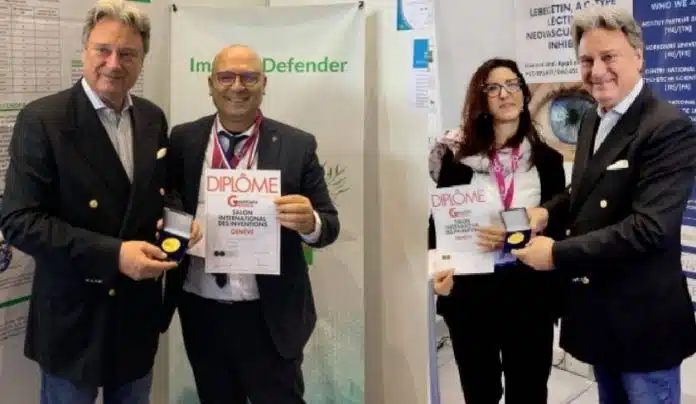
This is a new consecration for Tunisia on an international scale. This is the International Exhibition of Inventions Geneva 2023, one of the largest events dedicated to invention organized by the World Intellectual Property Organization and the Swiss government. Two gold medals were awarded to Erij Messadi, researcher, and Mounir Bezzarga, professor, for their inventions.
Tunisia causes a stir with two revolutionary inventions
The two Tunisian winners were distinguished among a total of 1,000 other inventions from 50 different countries, thanks to the gigantic potential of their projects.
Dr. Erij Messadi, representative of the Institut de Pasteur, presented a one-of-a-kind project at this prestigious event. Baptized “Lebecetine, Lectin type C, as an inhibitor of neovascularization”, it was able to capture the attention of the public and was able to win the gold medal with congratulations from the jury. His innovative invention aims to demonstrate the crucial role of Lebecetine in blocking the formation of new blood vessels, which could slow the progression of several diseases such as cancer.
The ImmunoDefender project won in the Q category. Designed and produced by Dr. Mounir Bezzarga to fight against COVID-19, this winning invention continues to receive awards and shine on an international scale. After winning a prize at TICAD and another at the Euro-Mediterranean Intellectual Property Conference, this plant-based project was on the way to winning the gold medal with congratulations from the jury at the Geneva fair.
Beyond the obstacles, Tunisia continues to shine
Despite the turbulent political scene and the difficult economic situation, Tunisia continues to shine thanks to the exploits of its talents. Indeed, the country is always represented on the podium of international events, especially those dedicated to technologies and inventions. Tunisian inventors like Erij Messadi and Mounir Bezzarga are often awarded for their inventions covering several fields. All this bears witness to remarkable innovation and dynamism on the Tunisian scene.
This immense potential can only be an incomparable asset for our Tunisia. The future therefore looks promising in this area.
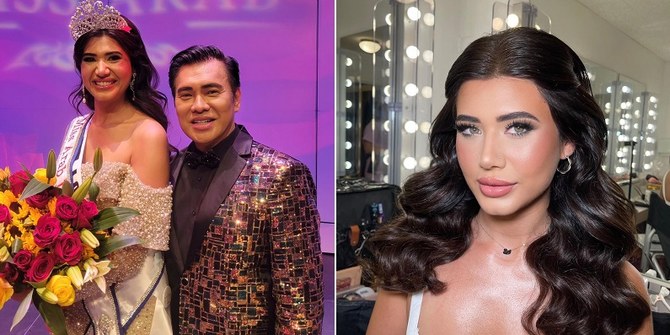
US Jordanian contestant Farah Abu Adeela from the state of Illinois was crowned Miss Arab USA at the beauty pageant’s finale in Arizona over the weekend.
The new Miss Arab USA, who is a model, takes over from 2022’s winner, Moroccan American Marwa Lahlou.
The annual pageant, which returned in 2022 after a two-year hiatus due to the COVID-19 pandemic, was held in Arizona this year. Produced by The Arab American Organization (AAO), the pageant is “founded on the basis of advancing the cause of young ladies of Arab descent,” according to its website.
The swimsuit category does not feature in the pageant, with the stated aim of organizers being to “select an honorable Arab young lady to represent our culture in the US and worldwide for one year.”
This year’s ceremony featured a performance by dance troupe Zeffa of Phoenix.
source/content: arabnews.com (headline edited)
____________
Farah Abu Adeela nabbed the coveted tiara at the 2023 Miss Arab USA pageant. (Instagram)
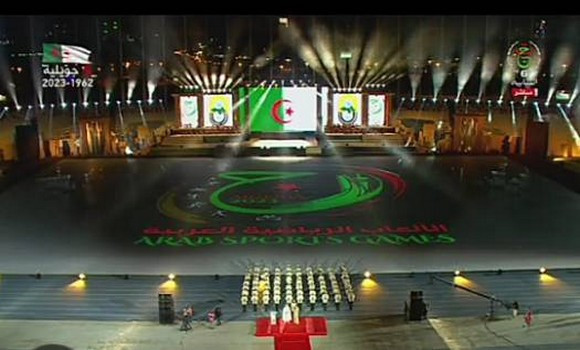
PM chairs opening ceremony of 15th Arab Sports Games.
On behalf of the President of the Republic, Abdelmadjid Tebboune, the Prime Minister, Aimene Benabderrahmane chaired the opening of the 15th Arab Sports Games organized by Algeria from on 5-15 July at Mohamed-Boudiaf Olympic Complex in Algiers, with the participation of nearly 2,000 athletes representing 22 Arab countries.
The opening ceremony of the 15th Arab Sports Games hosted by Algeria (July 5-15) started Wednesday in the Mohamed Boudiaf Olympic Complex in Algiers, in the presence of Prime Minister Aymen Benabderrahmane, members of government and guests from various countries and organizations.