Arabs & Arabian Records Aggregator. Chronicler. Milestones of the 25 Countries of the Arabic Speaking World (official / co-official). AGCC. MENA. Global. Ist's to Top 10's. Records. Read & Enjoy./ www.arabianrecords.org
The decree for the first time grants Kurdish Syrians rights, including recognition of Kurdish identity as part of Syria’s national fabric
It designates Kurdish as a national language alongside Arabic and allows schools to teach it.
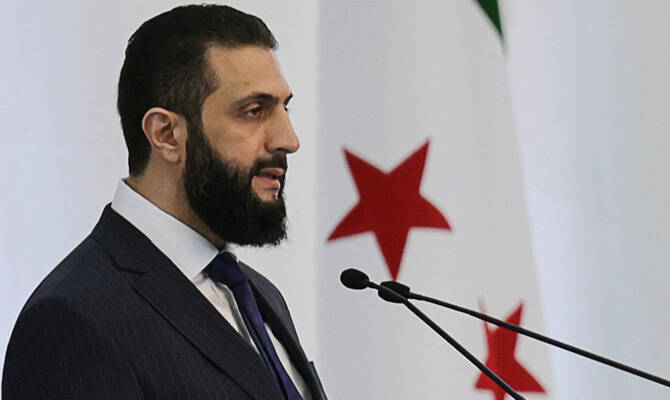
Syria’s President Ahmed Al-Sharaa issued a decree affirming the rights of the Kurdish Syrians, formally recognizing their language and restoring citizenship to all Kurdish Syrians, state news agency SANA reported on Friday.
Sharaa’s decree came after fierce clashes that broke out last week in the northern city of Aleppo, leaving at least 23 people dead, according to Syria’s health ministry, and forced more than 150,000 to flee the two Kurdish-run pockets of the city.
The clashes ended after Kurdish fighters withdrew.
The violence in Aleppo has deepened one of the main faultlines in Syria, where Al-Sharaa’s promise to unify the country under one leadership after 14 years of war has faced resistance from Kurdish forces wary of his Islamist-led government.
The decree for the first time grants Kurdish Syrians rights, including recognition of Kurdish identity as part of Syria’s national fabric. It designates Kurdish as a national language alongside Arabic and allows schools to teach it.
It also abolishes measures dating to a 1962 census in Hasaka province that stripped many Kurds of Syrian nationality, granting citizenship to all affected residents, including those previously registered as stateless.
The decree declares Nowruz, the spring and new year festival, a paid national holiday. It bans ethnic or linguistic discrimination, requires state institutions to adopt inclusive national messaging and sets penalties for incitement to ethnic strife.
The Syrian government and the Kurdish-led Syrian Democratic Forces (SDF), that controls the country’s northeast, have engaged in months of talks last year to integrate Kurdish-run military and civilian bodies into Syrian state institutions by the end of 2025, but there has been little progress.
source/content: arabnews.com (headline edited)
________________
Syria’s President Ahmed Al-Sharaa issued a decree affirming the rights of the Kurdish Syrians, formally recognizing their language and restoring citizenship to all Kurdish Syrians, state news agency SANA reported on Friday. (Reuters/File)
His Highness Sheikh Mohammed bin Rashid Al Maktoum, Vice President, Prime Minister and Ruler of Dubai, honoured the six winners of the Great Arab Minds 2025 edition at the Museum of the Future in Dubai.
Great Arab Minds is the largest Arab initiative dedicated to celebrating outstanding Arab achievement, highlighting contributions to advance human civilisation, support the expansion of scientific and knowledge-based endeavours, and showcasing the creative impact of Arab talent across the region and globally.
His Highness affirmed that the Great Arab Minds initiative was designed to expand the horizons for established and emerging Arab talent, nurturing and investing in their potential; recognise Arab achievement across research, development, innovation, technology, culture, and architecture; and to reinforce a culture of pride and sustained support for Arab individuals who have inspired significant progress in key fields.
His Highness Sheikh Mohammed said, “Today, we honour Great Arab Minds in recognition of achievements that advance civilisation and build societies. From the Museum of the Future in Dubai, we reaffirm our support for Arab talent committed to innovation, creativity, and excellence.”
His Highness further said, “We congratulate the winners of the Great Arab Minds 2025: Professor Abbas El Gamal in the Engineering and Technology category, Dr. Nabil Seidah in the Medicine category, Professor Badi Hani in the Economics category, Professor Majed Chergui in the Natural Sciences category, Dr. Suad Amiry in the Architecture and Design category, and Professor Charbel Dagher in the Literature and Arts category. We encourage them to continue their journey of achievement and contribution, serving as true role models for younger generations in our region and around the world, inspiring them to shape a better future through science and knowledge.”
His Highness expressed his confidence in the ability of Arab talent to drive progress in scientific research, knowledge creation, and the cultural sector, supported by expertise, institutional support, and the ambition of young people across the region.
Focused on a better future
Sheikh Mohammed noted that the Great Arab Minds initiative will continue to highlight the achievements of Arab individuals who look to the future with optimism and pursue ambitions that recognise no limits.
The awards ceremony was attended by H.H. Sheikh Maktoum bin Mohammed bin Rashid Al Maktoum, First Deputy Ruler of Dubai, Deputy Prime Minister and Minister of Finance of the UAE; H.H. Sheikh Ahmed bin Mohammed bin Rashid Al Maktoum, Second Deputy Ruler of Dubai and Chairman of the Dubai Media Council; H.H. Sheikh Ahmed bin Saeed Al Maktoum, President of the Dubai Civil Aviation Authority, Chairman of Dubai Airports, and Chairman and Chief Executive of Emirates Airline and Group; His Highness Sheikh Mansoor bin Mohammed bin Rashid Al Maktoum, President of the UAE National Olympic Committee; H.H. Sheikha Latifa bint Mohammed bin Rashid Al Maktoum, Chairperson of the Dubai Culture and Arts Authority (Dubai Culture); and H.H. Sheikh Mohammed bin Rashid bin Mohammed bin Rashid.
Mohammed bin Abdullah Al Gergawi, Minister of Cabinet Affairs and Chair of the Higher Committee for the Great Arab Minds initiative, was among numerous ministers and senior officials in attendance along with scientists, academics and diplomats.
His Excellency Al Gergawi stated that the Great Arab Minds initiative launched by His Highness Sheikh Mohammed represents a profound recognition of Arab achievement across disciplines, and a significant strategic investment in empowering talent and encouraging renewed contributions to Arab intellectual and scientific progress.
He added that the Great Arab Minds initiative embodies Sheikh Mohammed’s vision to inspire confidence in Arab capabilities and motivate individuals to take an active role in shaping their societies and the future of a region that has long contributed to human civilisation through science, literature, thought, and architecture.
‘Powerful message’
He praised the achievements of the Great Arab Minds awardees across medicine, engineering, technology, sciences, architecture, arts, and literature, saying, “Your presence today on the Great Arab Minds 2025 platform at the Museum of the Future sends a powerful message to hundreds of millions of young people to pursue excellence, achievement, and leadership in research, innovation, creativity, and knowledge, and to help shape a brighter future for Arab and human civilisation.”
The award recognised one winner in each of its six categories: Medicine, Economics, Engineering and Technology, Natural Sciences, Architecture and Design, and Literature and Arts.
In Medicine, Dr. Nabil Seidah was honoured for his medical and research achievements in cardiovascular health and cholesterol regulation.
In Economics, Professor Badi Hani was awarded for his pioneering contributions to econometrics and the development of economic analysis tools, particularly in panel data analysis. His work enabled more accurate and in-depth analysis by combining data across multiple time periods and sources.
In Engineering and Technology, Professor Abbas El Gamal was awarded for his pioneering contributions to network information theory.
In Natural Sciences, Professor Majed Chergui was honoured for his contributions to understanding light-matter interactions, developing techniques and applications that enable the study of ultrafast molecular and material dynamics at the atomic level.
In Architecture and Design, Dr. Suad Amiry was honoured for her contributions to preserving Palestinian architectural heritage through documentation, restoration, and adaptive reuse of historical buildings.
In Literature and Arts, Professor Charbel Dagher was honoured for a body of work that constitutes a key reference in the study of Arab and Islamic arts, Arabic calligraphy, and modern visual arts.
Professor Abbas El Gamal said, “I extend my sincere gratitude to His Highness Sheikh Mohammed bin Rashid Al Maktoum for his vision in launching Great Arab Minds. Being honoured in this way is deeply meaningful to me.”
Professor Majed Chergui said, “I am Algerian of Syrian origin, born in Morocco and raised in Algeria and Lebanon. In this way, the Arab world comes together in who I am. For me personally, this award is not only the highest recognition of my achievements; it touches me deeply because it comes from an Arab country.”
Dr. Suad Amiry said, “In 1981, when I decided to live in the city of Ramallah, my aim was to study traditional architecture in rural Palestine. Ten years later, I founded the Riwaq Centre, which since then has been dedicated to documenting, restoring, and rehabilitating architectural heritage in Palestine. Winning this award is a great honour for me and for the Riwaq Centre.”
Professor Badi Hani said: “This award recognises not only my work, but also the people and places that shaped me, my family, my mentors, my city, and the Arab world that nurtured my earliest aspirations.”
Dr. Nabil Seidah said, “My father’s adage, that knowledge is something no one can ever take away from you, has been the principle that guided me throughout my journey. Your trust represents a powerful motivation for Arab scientists to serve as role models for future generations, and I pledge to continue serving science with the same passion that has always driven me.”
Professor Charbel Dagher said: “Commitment to the Arabic language has remained a defining hallmark of everything I have done: teaching, writing, and research, to the point that I live within Arabic itself. We cannot exist outside our language or our culture. Allow me to share this award with those who supported me, and my gratitude extends to everyone who has worked and continues to work to ensure that Arabic remains a living language of science, knowledge, and culture.”
The awardees were chosen by six high-level specialised committees, one for each category. Abdulla bin Touq Al Marri, Minister of Economy and Tourism, chaired the Economics Committee; Sarah Al Amiri, Minister of Education, chaired the Engineering and Technology Committee; Mohammed Ahmed Al Murr, Chairman of the Board of Directors of the Mohammed bin Rashid Al Maktoum Library Foundation, chaired the Literature and Arts Committee; Dr. Amer Sharif, Chief Executive Officer of Dubai Health and President of the Mohammed Bin Rashid University of Medicine and Health Sciences headed the Medicine Committee; Professor Sehamuddin Galadari, Senior Vice Provost-Research and Managing Director of the Research Institute at New York University Abu Dhabi chaired the Natural Sciences Committee; Professor Hashim Sarkis, Dean of the School of Architecture and Planning at the Massachusetts Institute of Technology chaired the Architecture and Design Committee.
In addition to the committee chairs, the specialised committees also included Essa Kazim, Governor of the Dubai International Financial Center; Dr Mohammed Madhi, Dean of the College of Business and Economics at UAE University; Dr Rabah Arezki, Chief Economist for the Middle East and North Africa (MENA) region at the World Bank and Senior Fellow at Harvard University’s John F. Kennedy School of Government; Ferid Belhaj, Fellow at the Policy Center for the New South; and Dr Jihad Azour, Director of the Middle East and Central Asia Department at the International Monetary Fund.
The committees also included Professor Ismael Al Hinti, President of Al Hussein Technical University; Adel Darwish, Regional Director of the International Telecommunication Union; Dr Ahmed Zayed, Director of the Bibliotheca Alexandria; His Excellency Dr. Alawi Alsheikh-Ali, Director General of Dubai Health Authority; Professor Elias Zerhouni, Professor Emeritus at Johns Hopkins University; Dr Noureddine Melikechi Dean of the Kennedy College of Sciences and Professor of Physics at the University of Massachusetts Lowell; Professor Nader Masmoudi, Professor at the Courant Institute of Mathematical Sciences at New York University Abu Dhabi; Dr Latifa Elouadrhiri Laboratory Directed Research Staff Scientist at the Thomas Jefferson National Accelerator Facility; and Professor Dr Jehane Ragai, Emeritus Professor of Chemistry at The American University in Cairo.
The specialised committees also included Dr Adrian Lahoud, Dean of the School of Architecture at the Royal College of Art; and Professor Ali Malkawi, Professor of Architectural Technology, Director of the Doctor of Design Studies Program, and Founding Director of the Harvard Center for Green Buildings and Cities.
The Nominations Committee included Huda Al Hashimi, Deputy Minister of Cabinet Affairs for Strategic Affairs; Chucrallah Haddad, Partner and Head of Advisory at KPMG Lower Gulf; Abdulsalam Haykal, President and Founder of Majarra Company; Ali Matar, Head of LinkedIn Middle East and North Africa and Emerging Markets in Africa and Europe; and Saeed Al Nazari, Secretary-General of the Great Arab Minds Initiative.
Widely known as the ‘Arab Nobel,’ the Great Arab Minds initiative recognises distinguished Arab achievement and highlights extraordinary contributions that reflect the region’s historic role in advancing knowledge and human progress globally. For a third consecutive edition, the initiative continues to strengthen its position as a platform for celebrating Arab creators and as a point of reference for promising Arab talent, by highlighting achievements that inspire young people and contribute to expanding Arab participation in global knowledge and civilisational advancement.
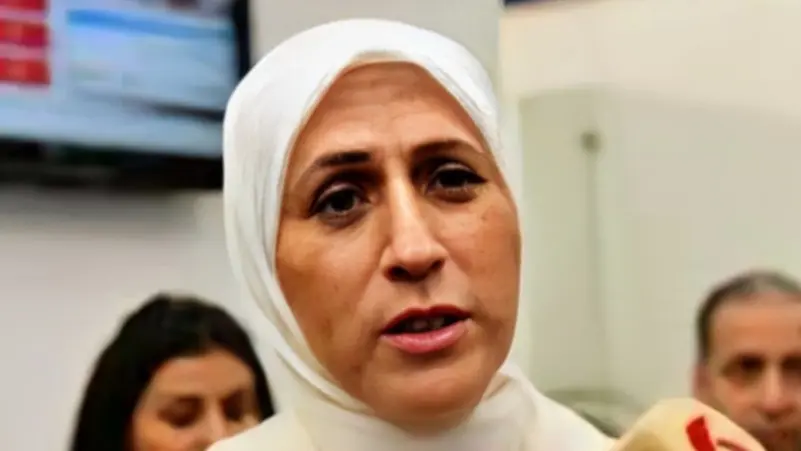
Syria’s new administration announced on Monday the appointment of Maysaa Sabrine as the governor of the Central Bank of Syria, making her the first woman to hold this position in the bank’s history.
Prior to her new role, Sabrin held several prominent positions within the Central Bank, including First Deputy Governor and Supervising Director. She also served as the Head of the Office Supervision Department.
In addition to her roles within the Central Bank, Sabrin has been a member of the Board of Directors of the Damascus Securities Exchange since 2018, representing the Central Bank.
Sabrine holds a master’s degree in accounting.
Her appointment comes amid calls for the inclusion of Syrian women in the new Syrian government.
Earlier this month, Aisha al-Dibas was appointed as the head of the Office for Women’s Affairs, becoming the first woman to hold an official position in the new Syrian administration.
source/content: english.alarabiya.net / AlArabiya English (headline edited)
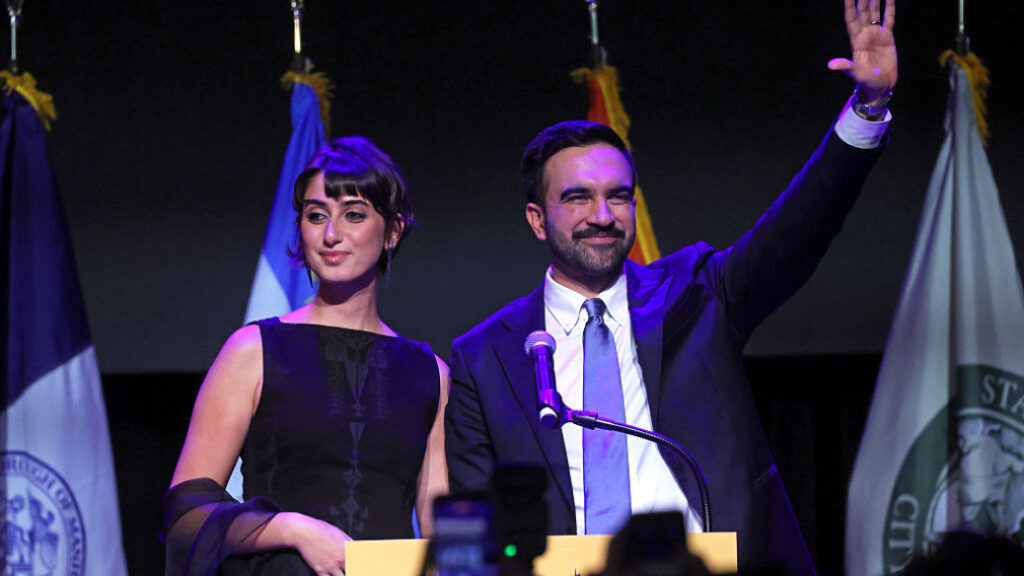
While the world is hailing New York mayor-elect Zohran Mamdani for his win, his artist wife, Rama Duwaji is now also in the spotlight.
With Zohran Mamdani making history on 4 November after being elected New York’s first Indian-American and Muslim mayor, attention has turned to his wife, First Lady Rama Duwaji.
Duwaji was born in Houston, Texas, in the US but her parents are originally from Damascus, Syria, and she spent most of her childhood in Dubai after relocating there. She returned to the US in 2016.
Dubbed a “modern-day Princess Diana”, the 28-year-old works as an illustrator and animator in Brooklyn, New York, graduating from Virginia Commonwealth University in 2019 with a Bachelor of Arts in Communications, then moving to New York City in 2021 to pursue a career in art.
Her work has been featured by Spotify, The New Yorker, The Washington Post, the BBC, Apple, and the Tate Modern in London.
After meeting on dating app Hinge in 2021, while the now-mayor was a member of the state assembly, Duwaji and Mamdani tied the knot in a private Muslim religious ceremony in 2024, followed by a civil ceremony in New York City Hall the following year.
While the illustrator has kept a low profile, reportedly turning down interviews and mostly sharing her work across social media, she paid tribute to Mamdani on Instagram after winning the primary in July.
Mamdani has previously praised his wife as “an incredible artist who deserves to be known on her own terms”.
Pro-Palestine art
Along with Arabic culture and feminist themes, Duwaji frequently uses her art to speak out about current events and politics, including Israel’s war on Gaza and immigration issues, such as the heavy-handed activities of ICE, which has been conducting mass deportation raids in the US since Trump’s appointment.
In May, Duwaji created an animation of a young Palestinian girl holding a large empty pot with the words “not a hunger crisis”, followed by a transition into drawings of several people also holding empty vessels with texts reading “it is deliberate starvation”.
“As I was making this, Israel has been bombing Gaza nonstop with consecutive airstrikes. Keep your eyes on Gaza and support”, the artist said in the caption.
Duwaji had also created an illustration in support of pro-Palestinian activist Mahmoud Khalil, who was detained by ICE over his activism. She called it “an attack on freedom of speech, and sets a scary f**king precedent for anyone who speaks up for what’s right”.
Following her husband’s win, the artist wore a black top made by Palestinian-Jordanian designer Zeid Hijazi on stage as he delivered his winning speech. Hijazi’s designs fuse ancient folklore with Arab futurism.
MAGA supporters were also quick to target Duwaji after she publicly mourned the death of Palestinian influencer Saleh al-Jafarawi, who was accused of “celebrating” the 7 October attacks.
Mandani has been quick to defend his wife against “right-wing trolls”, who are “trying to make this race – which should be about [the people] – about her”.
Attacks by right-wingers
Like her partner, Duwaji has also been subjected to attacks from American right-wing personalities and the media, particularly the New York Post, which described the illustrator as “aloof”, claiming she “quietly steered” her husband’s campaign from behind the scenes.
MAGA supporters were also quick to target the artist after publicly mourning the death of Palestinian influencer Saleh al-Jafarawi, who was accused of “celebrating” the 7 October attacks.
Mandani has been quick to defend his wife against “right-wing trolls”, who are “trying to make this race – which should be about [the people] – about her”.
There will be a ceremony honoring the winners held under the patronage of His Highness Prince Badr bin Abdullah bin Farhan, minister of culture
The King Salman Global Academy for the Arabic Language announced the names of the winners of its awards celebrating efforts to serve the language.
Mahmoud Al-Batal won an award for his work in teaching Arabic in the US, which included carrying out in-depth research into linguistics, much of which has been published in peer-reviewed studies.
The Saudi-based Manahij International Foundation received an award recognizing its development of educational materials and curricula for early years language learning and Arabic for non-native speakers.
Manahij was also highlighted for developing training packages for teachers, and praised for its “originality, methodology and innovation” in the field, the Saudi Press Agency reported.
Algerian Ahmed Khorssi was recognized with an award for his contributions to the language by developing more than 30 computer programs including tools for correcting pronunciation.
He has published more than 15 studies in peer-reviewed journals and international conferences.
King Abdulaziz City for Science and Technology won an award for developing systems including an audio database, an automatic speech recognition system in local dialects, and other advanced tools.
Ramzi Mounir Baalbaki, from Lebanon, won an award that recognized his academic career that has spanned four decades
Baalbaki has authored 12 books and more than 80 research papers in Arabic and English in peer-reviewed scientific journals.
Saad Abdel Aziz Maslouh, from Egypt, received an award recognizing a lifetime of academic achievements including the publication of 33 books and 29 research papers.
The Arabic Education Training Center for Gulf States, in the UAE, was awarded for developing evaluation tools and other educational content.
Mazen Abdulqader Mohammed Al-Mubarak, from Syria, won an award for his extensive scholarly work including the well-known book “Towards Linguistic Awareness.”
The National Coalition for Arabic Language in Morocco also received an award for promoting linguistic awareness in Moroccan society through lectures, seminars and intellectual forums.
There will be a ceremony honoring the winners held under the patronage of His Highness Prince Badr bin Abdullah bin Farhan, minister of culture and chairman of the board of trustees of the academy, next Sunday in Riyadh.
source/content: arabnews.com (headline edited)
_____________
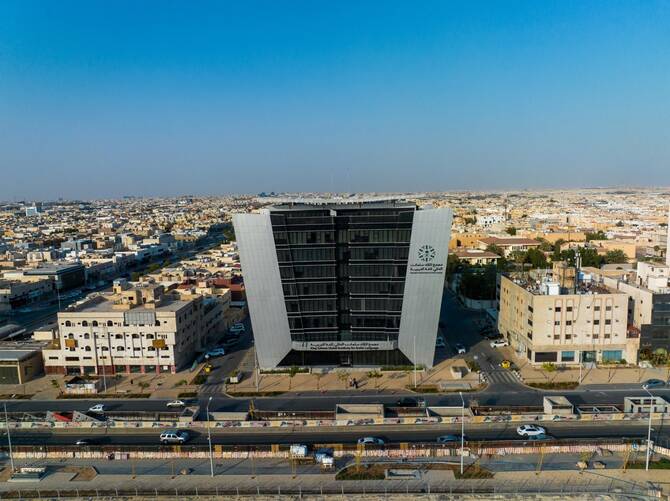
The King Salman Global Academy for the Arabic Language’s headquarters in Riyadh. (OIC)
Unveiled during a ceremony in Damascus on Thursday
New emblem reimagines iconic Syrian golden eagle with symbolic elements representing country’s history, geography and post-conflict aspirations
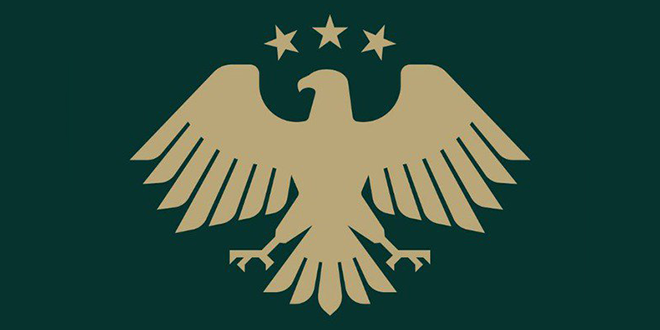
The Syrian Arab Republic has launched a new national visual identity featuring a redesigned golden eagle emblem, in what officials described as a break from the legacy of authoritarianism and a step toward a state defined by service, unity and popular legitimacy.
Unveiled during a ceremony in Damascus on Thursday, the new emblem reimagines the iconic Syrian golden eagle with symbolic elements representing the country’s history, geography and post-conflict aspirations, the Syrian Arab News Agency reported.
The redesign forms the centerpiece of a wider national branding effort aimed at redefining Syria’s image at home and abroad.
The eagle has long held significance in Syrian history, appearing in early Islamic military symbolism, notably in the 7th-century Battle of Thaniyat Al-Uqab, and later as part of the 1945 emblem of Syria.
The new design retains this historic continuity but shifts its meaning, and the combative shield clutched by previous iterations of the eagle has been removed.
Instead, the emblem now features the eagle topped by three stars representing the people symbolically placed above the state.
The redesigned wings are outstretched, balanced rather than aggressive, with seven feathers each to represent Syria’s 14 governorates.
The tail carries five feathers symbolizing the country’s major geographical regions: north, south, east, west, and central Syria — a nod to national unity and inclusivity, SANA reported.
Officials described the design as a “visual political covenant,” aimed at linking the unity of land with the unity of national decision-making.
“The people, whose ambitions embrace the stars of the sky, are now guarded by a state that protects and enables them,” said a statement accompanying the launch. “In return, their survival and participation ensure the renaissance of the state.”
The emblem is designed to signal historical continuity with the original post-independence design of 1945, while also representing the vision of a modern Syrian state born from the will of its people, SANA said.
Officials said the elevation of the stars above the eagle was intended to reflect the empowerment and liberation of the people, and the transition from a combative state to a more civic-minded one.
The symbolism also reinforces Syria’s territorial integrity, with all regions and governorates represented equally. The design, they said, reflects a new national pact, one that defines the relationship between the state and its citizens based on mutual responsibility and shared aspirations.
The new emblem is also intended as a symbolic end to Syria’s past as a security-driven state, replacing a legacy of repression with one of reconstruction and citizen empowerment.
President Ahmad Al-Sharaa, who has positioned his administration as one of reform and renewal, described the change as emblematic of “a government emanating from the people and serving them.”
The visual identity was developed entirely by Syrian artists and designers, including visual artist Khaled Al-Asali, in a deliberate effort to ground the new identity in local heritage and creativity.
Officials said that the process was intended not only as a rebranding exercise but as a reflection of Syria’s cultural and civilizational legacy — and its future potential.
Foreign Minister Asaad Al-Shaibani, speaking at the event, framed the launch as part of a broader transformation in Syrian governance and diplomacy.
“In every encounter, we carried a new face of Syria,” he said. “Our efforts brought Syria back to the international stage — not as a delayed hope, but as a present reality.”
He said the country was now rejecting the “deteriorated reality” inherited from decades of authoritarian rule, and described the new emblem as a symbol of Syria’s emergence as a state that “guards” and empowers its people, rather than controlling them.
Al-Shaibani concluded his remarks by calling the moment “a cultural death” for the former regime’s narrative.
“What we need today is a national spirit that reclaims the scattered pieces of our Syrian identity, that is the starting point for building the future.”
source/content: arabnews.com (headline edited)
____________
The Syrian Arab Republic has launched a new national visual identity featuring a redesigned golden eagle emblem, in what officials described as a break from the legacy of authoritarianism and a step toward a state defined by service, unity and popular legitimacy. (SANA)
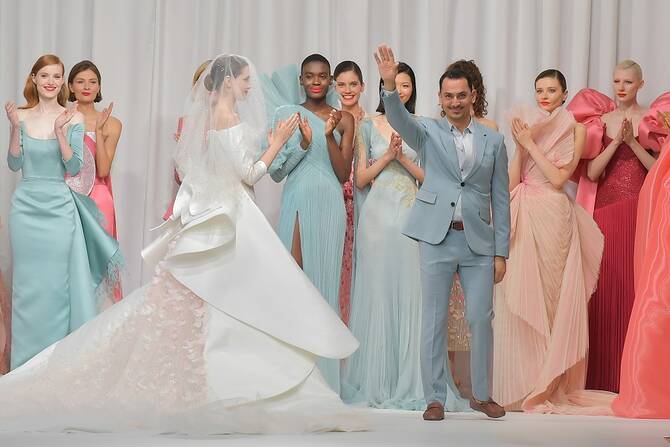
Rami Al-Ali has become the first Syrian designer to join France’s prestigious Federation de la Haute Couture et de la Mode as a guest member, giving him the chance to showcase his Autumn/Winter 2025 collection on the official haute couture calendar.
The invitation signifies Al-Ali’s entry into fashion’s upper echelons — to qualify, fashion houses must meet rigorous “haute couture” or “high fashion” standards and the title is legally protected under French law.
Al-Ali joins the likes of Chanel, Dior, and Schiaparelli on the official calendar next month. His latest collection will be presented on July 10, according to the provisional calendar.
It is a “historical milestone, celebrating a lifelong devotion to craftsmanship, culture, and creative expression, rooted in heritage and elevated by vision,” the fashion house posted on Instagram.
Originally from Damascus, Al-Ali honed his fashion skills in Dubai and Beirut before founding his label, Rami Al-Ali Couture, in 2001.
His creations have been worn by a variety of celebrities, including Amal Clooney, Eva Longoria, Jennifer Lopez, and Jessica Chastain.
Al-Ali’s work has been praised for seamlessly blending his Middle Eastern heritage with Western sensibilities. He is known for designing flowing silhouettes adorned with intricate, playful embellishments—creations that are both timeless and runway-worthy.
Al-Ali is one of just a handful of Arab designers on the official haute couture calendar. The lineup also includes Lebanese designers Georges Hobeika, Elie Saab, and Zuhair Murad, as well as Saudi couturier Mohammed Ashi.
Ashi, founder of Paris-based label Ashi Studio, became the first designer from the Gulf region to join the exclusive group in 2023 as a guest member. His designs have also been worn by global celebrities such as Beyonce, Anna Kendrick, and Jennifer Hudson.
“This appointment is the highlight of my career,” Ashi said in a statement posted on Instagram when the announcement was made in 2023. “I will honor it in the memory of the great couturiers who came before me and whom I now join in the pursuit of this grand tradition of excellence in creativity and savoir-faire.
source/content: arabnews.com (headline edited)
__________
Rami Al-Ali has become the first Syrian designer to join France’s prestigious Federation de la Haute Couture et de la Mode as a guest member. (Getty Images)
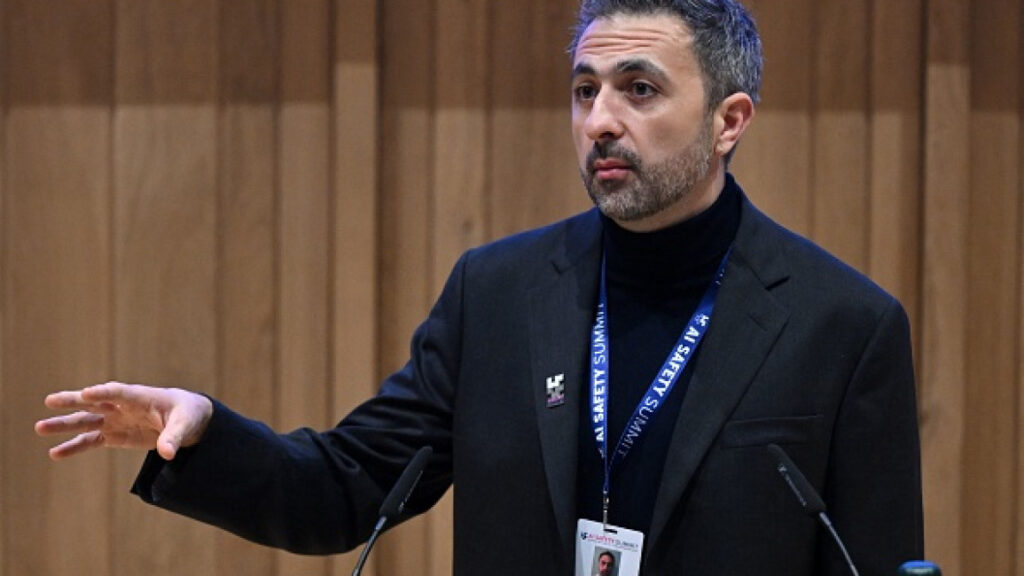
Microsoft has hired British-Syrian Mustafa Suleyman to head its AI business, cementing his role in the industry.
Mustafa Suleyman , a highly respected British-Syrian AI expert, has been named as Microsoft’s artificial intelligence business head, as the company cements its position in this booming field.
Suleyman co-founded DeepMind , which Google purchased in 2014, before starting up Inflection.ai in 2022 with LinkedIn co-founder Reid Hoffman, to guide AI away from racist, sexist or violent behaviour. It has also been named a rival to Microsoft in the field of AI.
He also co-wrote ‘The Coming Wave’, a highly influential book in the tech industry that examines the potential and pitfalls of AI.
Microsoft said in a post on LinkedIn on Monday named Sulyaman as CEO of Microsoft AI, leading all of its consumer products and research, including its generative AI service Copilot as well as its Bing search engine and Edge browser.
He will report directly to Microsoft CEO Satya Nadella , who welcomed his appointment in a blog post.
“This infusion of new talent will enable us to accelerate our pace yet again,” Nadella wrote.
The hiring is likely to bolster Microsoft’s lead position in the booming AI industry, as big tech companies battle for positions to capitalise on the demand for AI services.
Microsoft has teamed up with ChatGPT maker OpenAI, investing billions of dollars into the San Francisco company, and recently partnered with France’s Mistral , a hot AI startup.
Suleyman is the son of a Syrian taxi driver and English nurse and grew up in North London. He dropped out of Oxford University aged 19, before founding the Muslim Youth Hotline, which became one of the biggest counseling services for Muslims in the UK.
His appointment to the top Microsoft position has been welcomed by British Arabs and Syrians worldwide, who have commended him for his journey from relatively humble beginnings to one of the leading positions in the IT industry.
He was named in The New Arab‘s ‘The notable British Arabs making a difference’ list in 2021 .
source/content: newarab.com (headline edited)
____________
Sulayman is one of the most influential people in the field of AI [Getty]
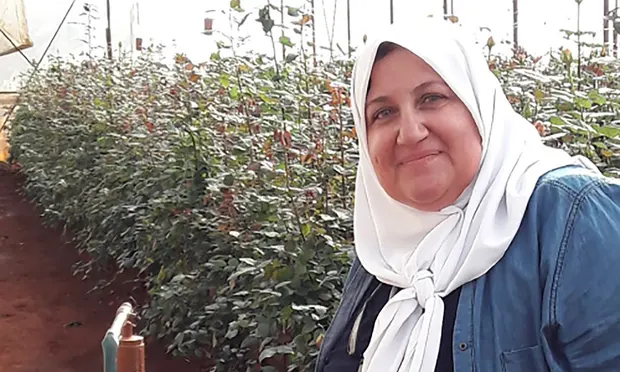
Plant virologist Dr Safaa Kumari discovered seeds that could safeguard food security in the region – and risked her life to rescue them from Aleppo.
The call came as she sat in her hotel room. “They gave us 10 minutes to pack up and leave,” Dr Safaa Kumari was told down a crackling phone line. Armed fighters had just seized her house in Aleppo and her family were on the run.
Kumari was in Addis Ababa, Ethiopia, preparing to present a conference. She immediately began organising a sprint back to Syria. Hidden in her sister’s house was a small but very valuable bundle that she was prepared to risk her life to recover.
Kumari is a plant virologist. Her work focuses on a quiet yet devastating development crisis. Climate-fuelled virus epidemics affecting fava beans, lentils and chickpeas are spreading from Syria to Ethiopia, gradually destroying the livelihoods of low-income populations. Known as “poor man’s meat”, these pulses are vital for both income generation and food security in many parts of the world.
Finding a cure was urgent, Kumari explains. Hopeless farmers were seeing increasing levels of infected crops turning yellow and black. The cause? “Climate change provides aphids with the right temperatures to breed exponentially and spread the epidemics,” she says.
For 10 years, Kumari worked to find a solution. Finally, she discovered a bean variety naturally resistant to one of the viruses: the fava bean necrotic yellow virus (FBNYV). “When I found those resistant seeds, I felt there was something important in them,” says Kumari from her lab in Lebanon where she now works. Only the fighting in Syria had moved. “I had left them at my sister’s in central Aleppo to protect them from the fighting,” she says.
Determined not to let a war get in the way of her work “for the world’s poor”, Kumari felt it her duty to rescue the seeds in Aleppo. “I was thinking: how am I going to get those seeds out of Syria?
“I had to go through Damascus, and then drive all the way to Aleppo. There was fighting and bombings everywhere.” After two days’ driving along dangerous roads, seeds in hand, Kumari made it to Lebanon, where she now works as a researcher at Icarda (International Center for Agricultural Research in the Dry Areas) in the Bekaa valley, close to the Syrian border. Hassan Machlab, Icarda’s country manager says: “Many of the Syrian scientists we welcomed here have suffered. It is tough.”
But bringing the seeds to safety was only the beginning. Kumari needed to turn them into a sustainable solution.
As crop production collapsed in the region, producers started to rely heavily on insecticides. “Most farmers go to the field and spray it without safety material – masks and appropriate jacket,” she says. “Some are dying, others are getting sick or developing pregnancy issues.”
At first, the sample failed. “So we crossed them with another variety that had a better yield and obtained something that is both resistant and productive,” says Kumari. “When we release it, it will be environment-friendly and provide farmers with a good yield, more cheaply and without insecticide.”
Kumari now plans to distribute her super-seeds free to farmers. She has already turned down an offer from a large company for the virus detection technology.
“They wanted to buy our product and then sell it to the farmers, but we refused,” says Kumari. “Ours is free. It’s our responsibility to provide our solutions to people everywhere,” she says.
But, as for many Syrian refugees, the war is never far from her thoughts, “Something she won’t tell you is that it wasn’t easy for her,” says Machlab. “She was working on all this and she didn’t have a clear mind as her family were in Aleppo and her house was destroyed.”
Kumari adds: “Last week I saw my family in Turkey. I have five sisters and three brothers, scattered in Germany, Turkey, Syria. The last time we met was in Aleppo in 2012. When I came back someone told me ‘Safaa, you’re looking great today!’ Of course, I had just spent time with my family again!” she says, laughing.
But she adds: “It’s not easy for me, it’s not easy for a woman to work on agriculture (research). It’s not easy, but it’s OK.
“When I’m working, I’m not thinking I am a Syrian or a woman though. But I do feel I sometimes receive funding [from westerners] because I’m a woman,” she says. “Perhaps!”
Dr Safaa Kumari’s seeds are resistant to the climate-fuelled viruses that have destroyed crops of pulses in Syria. Photograph: Courtesy of Arab Society for Plant Protection
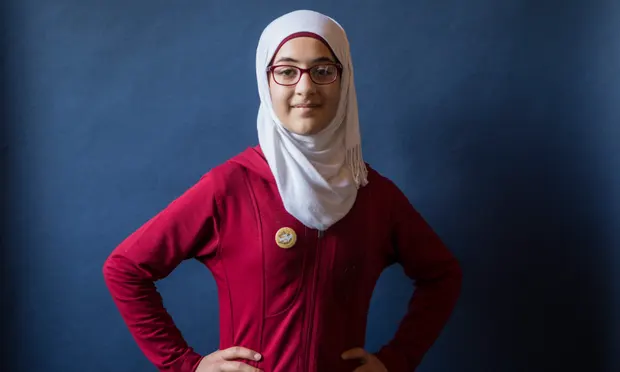
A year after learning to speak English, Amineh Abou Kerech has won this year’s Betjeman prize. She tells us how she found her voice.
I take words from anywhere,” says Amineh Abou Kerech, moments after winning the 2017 Betjeman poetry prize for 10- to 13-year-olds last week. “I take them from songs and films, from what I see on the computer or the television. And I put them all together.”
She makes it sound so simple. It’s anything but, according to her older sister Ftoun, who is smiling at Amineh across a pub table in London’s St Pancras station. “She sits in her bedroom all the time and practises, practises.”
Amineh, who was born in Syria 13 years ago, nods. She started writing poems during the four years her family spent in Egypt, but since moving to England last summer, with a new language to master and a new culture to get to grips with, she has been working doubly hard on her verses.
Her prizewinning poem, Lament for Syria , was written half in English, half in Arabic, and translated fully into English with help from her sister, her teacher and Google Translate. At the prizegiving, which took place on National Poetry Day last Thursday, next to the statue of John Betjeman at St Pancras, she read the first part of it in English before switching to Arabic at the words “I am from Syria.”
Amineh was eight when they left. The civil war had begun a year earlier, in 2011, sparked by the Arab spring and kindled by disaffection towards the Assad regime. Her family lived in Darayya, a Damascus suburb known as a centre of anti-government protest. When violence flared up, Amineh’s parents Tammam and Basmeh fled the city with their young family. They moved around for a year, sleeping wherever they could find shelter, until remaining in Syria was no longer viable and they escaped to Egypt.
“In Syria, all the time we were scared,” says Amineh. When they settled in Cairo, despite the fact that her family had lost everything (her father had owned a shop in Damascus selling fabric) and were living in the most basic conditions, Amineh’s fear abated. She began writing poetry, she says, as a way of putting her dislocation into words. “When I remember my Syria I feel so sad and I cry and start writing about her.” She tells me she doesn’t remember the country very well, though her poem suggests otherwise: it is, she writes, “a land where people pick up a discarded piece of bread / So that it does not get trampled on … a place where old ladies would water jasmine trees at dawn.”
After four years, the family moved to England as refugees, settling in Oxford where Amineh and her two siblings – Ftoun, 14, and Mohammad, 11 – now go to school. At Oxford Spires, a multicultural academy in the east of the city where more than 30 languages are spoken, the two sisters joined a workshop led by the Iraqi poet Adnan Al-Sayegh. That’s where they met Scottish author Kate Clanchy, the school’s writer-in-residence since 2009, who has been nurturing Amineh and Ftoun’s talents at weekly classes.
When I speak to Clanchy at the prizegiving, she marvels that Amineh has been speaking English for only a year. “Some of my most amazing writers lost a language at an early age,” she says, “in the sense that they arrive suddenly in England and are no longer able to tell stories and make themselves powerful in that way. It can turn them in on themselves. But I also think they have a special capacity at that age to produce really unusual rhythms and sounds in English, which makes them into really interesting poets.”
This year’s judges, the poet Rachel Rooney and Observer cartoonist Chris Riddell (until recently, children’s laureate), agree that Amineh’s poem stood out from more than 2,000 entries, drawn from schools across the UK and the Republic of Ireland. “I found it really moving,” says Rooney. “It was passionate and complex. She was asking: ‘How can I do myself justice through a poem? How can I create a homeland on paper?’ And then she was actually doing it. Amazing.”
“It addresses a contemporary issue that’s been breaking all our hearts,” adds Riddell. “It has a solemnity to it, but also the profound view that you get through a child’s eyes. It stands up as a poem, in any context.”
Though it’s named after a most English poet, the Betjeman prize has been showcasing diverse voices since it was set up in 2006. The perspective here is global – one of Amineh’s fellow finalists, 10-year-old Shanelle Furtado, evokes her grandparents’ home in Mangalore in six vivid haikus – and it shows that adults are not the only ones with important and timely things to say.
Speaking before the winner is announced, its director (and Betjeman’s granddaughter) Imogen Lycett Green makes a case for poetry’s importance in an uncertain world. “Poets are in the fringes of society, they’re not in the establishment,” she says. “They look at events, at lives, at love and at themselves from a sideways position. And in glancing from the side, the truth can sneak in. If adult poets are seeking the truth, I think children who are burgeoning writers are even closer to the truth.”
When her poem won, Amineh looked stunned, then buried her head in her hands and wept. A moment later, as her family gathered round to congratulate her, she was beaming.
“It’s a surprise for me, like a dream,” her father tells me afterwards. He never imagined his daughter winning a prize like this: poetry doesn’t run in the family. “I used to write simple things, but after the war, after the hard time that we had, we didn’t think that we needed to write anything,” he says. “We survived.”
At the end of her poem, Amineh asks, “Can anyone teach me / how to make a homeland?” Although the future of her birthplace remains gravely uncertain, there are consolations to be had in her new home. “I feel so happy here because I have a future and things won’t be scary any more,” she tells me. “Everything will be good,” she adds, “and we will always be in peace.”
Lament for Syria by Amineh Abou Kerech
Syrian doves croon above my head their call cries in my eyes. I’m trying to design a country that will go with my poetry and not get in the way when I’m thinking, where soldiers don’t walk over my face. I’m trying to design a country which will be worthy of me if I’m ever a poet and make allowances if I burst into tears. I’m trying to design a City of Love, Peace, Concord and Virtue, free of mess, war, wreckage and misery.
Oh Syria, my love I hear your moaning in the cries of the doves. I hear your screaming cry. I left your land and merciful soil And your fragrance of jasmine My wing is broken like your wing.
*
I am from Syria From a land where people pick up a discarded piece of bread So that it does not get trampled on From a place where a mother teaches her son not to step on an ant at the end of the day. From a place where a teenager hides his cigarette from his old brother out of respect. From a place where old ladies would water jasmine trees at dawn. From the neighbours’ coffee in the morning From: after you, aunt; as you wish, uncle; with pleasure, sister… From a place which endured, which waited, which is still waiting for relief.
*
Syria. I will not write poetry for anyone else.
*
Can anyone teach me how to make a homeland? Heartfelt thanks if you can, heartiest thanks, from the house-sparrows, the apple-trees of Syria, and yours very sincerely.
source/content: theguardian.com (headline edited)
_____________
‘I feel so happy here because I have a future’: Amineh Abou Kerech. Photograph: Antonio Olmos / The Observer