Arabs & Arabian Records Aggregator. Chronicler. Milestones of the 25 Countries of the Arabic Speaking World (official / co-official). AGCC. MENA. Global. Ist's to Top 10's. Records. Read & Enjoy./ www.arabianrecords.org
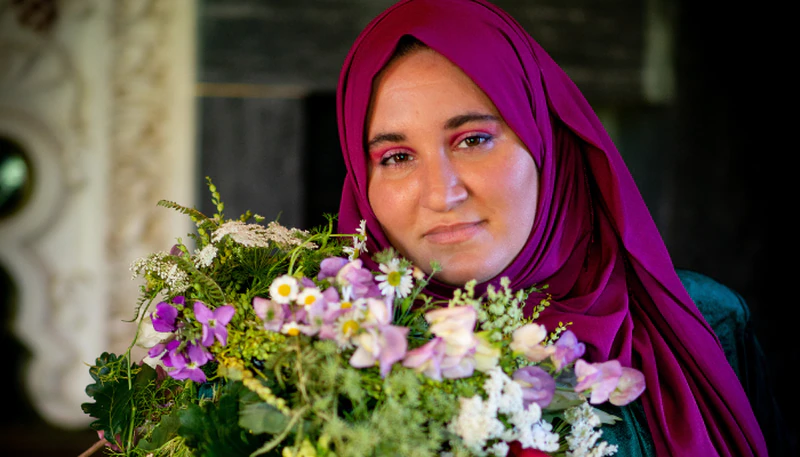
The Welsh-Iraqi artist will represent the country’s diverse cultures and languages.
Wales has named Hanan Issa as its fifth national poet, making her the first Muslim to hold the title.
The Welsh-Iraqi poet, filmmaker and artist will serve a three-year term, representing the country’s diverse cultures and languages and acting as an ambassador for the people of Wales.
Her recent works include her poetry collection My Body Can House Two Hearts, published in 2019, and her contributions to Welsh (Plural): Essays on the Future of Wales and The Mab.
Issa grew up in Cardiff surrounded by different languages, including Arabic, which was spoken by her Iraqi parents. She described the role as an “incredibly positive step” and said it was “exciting to think that Wales is taking the lead on this aspect of representation”.
“Poetry exists in the bones of this country. I want people to recognise Wales as a country bursting with creativity; a land of poets and singers with so much to offer the arts,” she said.
“I’d like to continue the great work of my predecessors in promoting Wales, Welshness, and the Welsh language outside of its borders.
“More than anything, I want to capture the interest and inspiration of the public to see themselves in Welsh poetry and encourage a much more open sense of what Welshness is.”
Ashok Ahir, who led the selection panel for the National Poet of Wales, said: “This is a hugely exciting appointment. Hanan’s is a cross-community voice that speaks to every part of the country. She will be a great ambassador for a culturally diverse and outward-looking nation.”
Issa said she hopes that her appointment will allow women from all walks of life, but especially Muslim women, to see her success and think “that’s a thing that’s achievable for me”.
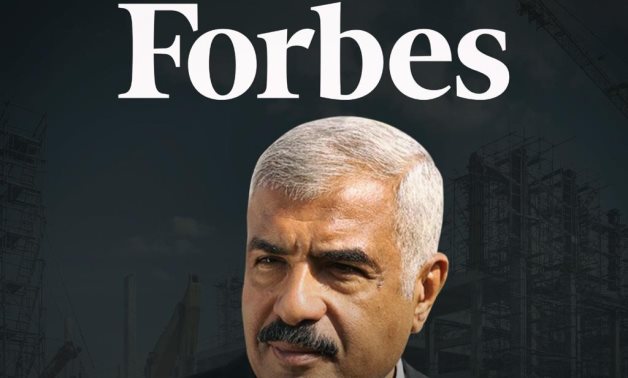
Forbes Middle East has announced its annual list of the 100 Most Powerful CEOs in the Middle East for 2022.
The American magazine confirmed the status of businessman Hisham Talaat Moustafa, CEO and Managing Director of Talaat Moustafa Holding Group, who ranked 61st, up 6 places from last year’s ranking.
Forbes Middle East magazine said that Hisham Talaat Moustafa is the youngest son of the founder of the Talaat Moustafa Group, which is currently the largest listed real estate company in Egypt.
The magazine stated that the assets of Talaat Moustafa Company amounted to 7.5 billion dollars in 2021, while the group owns a portfolio of land with an area of 74 million square meters.
The group’s revenues amounted to 825 million dollars last year, while the company developed more than 33 million square meters of land, and sold more than 90 thousand housing units.
Forbes reported that the Talaat Moustafa Group recently launched giant projects, including: Privado – Madinaty, Celia and Noor City.
The magazine said that the group has extensive investments in the hospitality sector, including: Four Seasons Resort Sharm El Sheikh, Four Seasons Nile Plaza, Four Seasons San Stefano Alexandria, and Kempinski Nile Cairo.
About the methodology used in the classification, Forbes indicated that its methodology in preparing the list was based on collecting information from financial market disclosures, industry reports, annual reports of companies, financial statements, and other primary sources.
As for the classification of CEOs, it is based on several factors: the influence of the CEO and the company on society and the country, the markets they supervise, the CEO’s experience in his current position, as well as his general experience.
Forbes indicated that the factors affecting the evaluation include: the size of the company in terms of revenues, assets, market value, the CEO’s achievements and performance in the past year, the innovations and initiatives he implemented.
This year, Forbes magazine’s list of the most powerful CEOs in the Middle East includes 100 business leaders from 26 different nationalities, led by the Emiratis with 19 CEOs, followed by the Egyptians with 16 leaders, and the Saudis with 15 business leaders.
The CEOs in the banking and financial services sector topped the list with 27 CEOs, followed by the leaders of the communications sector with 8 heads, and then 7 leaders in each of the energy and logistics sector.
The companies on the list run by CEOs are worth more than 5 trillion dollars, while revenue was more than 1 trillion dollar last year.
source/content: egypttoday.com (headline edited)
_________
Among the most powerful CEOs of 2022 Forbes highlights the CEO of Talaat Moustafa Group
Did you know that many of the Egyptian colloquial words Egyptians use on a daily basis are not actually Arabic?
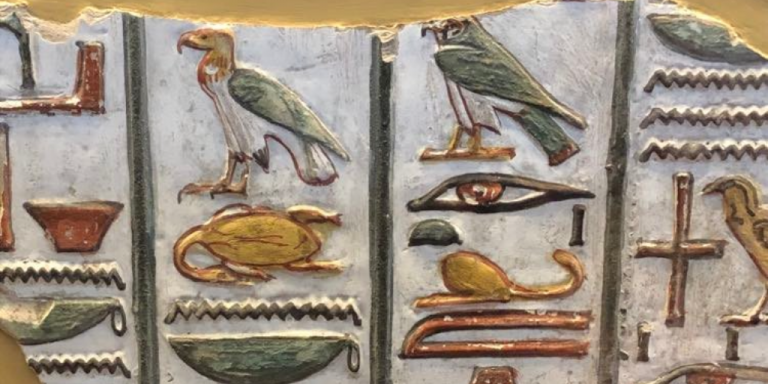
The Egyptian Arabic dialect is fundamentally Arabic, but with the influence of history and local populations, some of the peculiarities that set the Egyptian dialect apart come from the integration of ancient Egyptian, Greek and Coptic words and expressions. Surviving for thousands of years, many commonly used, modern-day Egyptian words and phrases can actually be traced back to the current dialect’s ancient predecessors.
Here are some examples of words Egyptians use, often not knowing their ancient origin, as per the books ‘From Pharaoh’s Lips’ (2003) by Ahmad Abdel-Hamid Youssef, and ‘Al Logha Al Masrreya Al Qadeema’ (Ancient Egyptian Language, 2012 ) by Abdelhaleem Nour El-din.
UMBU (DRINK)
Often, in communication with infants or toddlers, broken down or simplified words are used to allow the news speakers to express themselves without too much difficulty. For example, umbu is the word commonly used by Egyptian children to express their thirst. The ancient Egyptian term simply means “from the water”.
TA TA (STEP BY STEP)
When Egyptian parents try to help their crawling baby how to walk, they use the phrase “ta ta” derived from the ancient Egyptian word “ti ti”. Though Arabic became the primary language in Egypt, the Coptic language was initially still being used in everyday life for the majority of the population. The term “ti ti” was adopted by the Coptic language and modified to “ta ta”, which is used until today.
MAMM (FOOD)
The word Mumm is an Egyptian slang word derived from the ancient Egyptian “my wnm”, which means ‘give to eat’. Many Egyptians, until this day, teach their babies to say “mumm” whenever they are hungry — as it is easy and quick to sound out.
DAHYA TIWADDIH AL AMENDI (MAY A DISASTER SEND HIM TO HELL)
The Egyptian phrase “Dahya tiwaddih al amendi”, is originally ancient Egyptian. The word “amendi” is a Coptic word meaning “hell”, which was derived from the ancient Egyptian word “imntt”, meaning the ‘underworld’.
BIKH (BOO!)
The word “Bikh!”, meaning “Boo!”, is often used in modern day Egypt to sneak up on someone and scare them. The term is an ancient Egyptian word “pa akh” meaning “demon” or “ spirit”.
WAHAWY YA WAHAWAY IYUHA (THE MOON HAS APPEARED)
The Egyptian phrase “Wahawy ya Wahaway iyuha” is part of a song Egyptians sing during the holy month of Ramadan. Families and young children swing their fanoos (lanterns) as they sing the lyrics to Wahawy ya Wahaway iyuha. The popular lyric is believed to be inspired from the ancient Egyptian word “wah” meaning ‘to put’ or ‘appear’, and “iyah” meaning “moon”. Thus, comprising the lyric “the moon has appeared” during the month of Ramadan, which is decided upon according to the lunar calendar in Islam.
KRKR (LAUGHING)
The word “krkr” is used frequently in modern Egyptian day to describe someone who is laughing uncontrollably. The term is originally ancient Egyptian “ķrķr” and was adopted into modern day Egyptian society.
GATEK MAW (MAY A LION FETCH YOU)
The phrase “jak maw” or “gatek maw”, often switched depending on the region it is used in, essentially means “may a lion come to you”. The phrase is an Egyptian expression used as an insult. The ‘maw’ is based on a pun on the words “lion” and “mother”. The expression is often used by mothers bothered by their children.
Qatari dominated his rivals to retain his title with a winning jump of 2.37 metres.
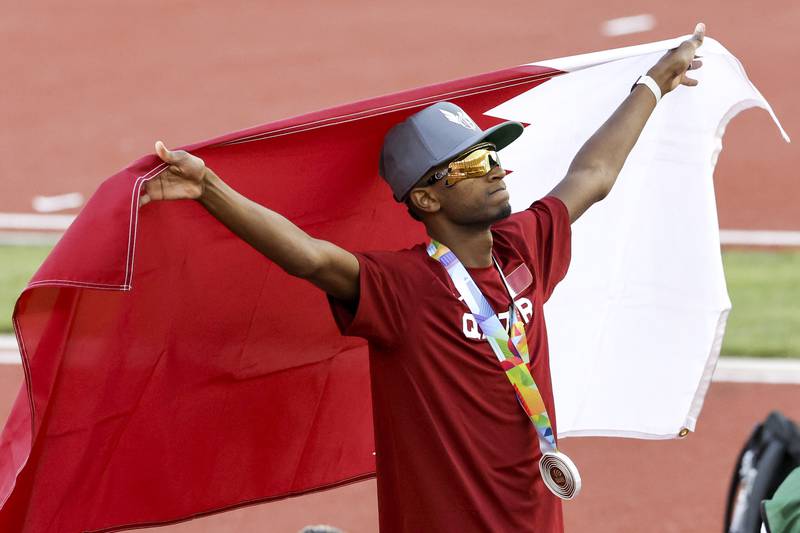
Qatar’s Mutaz Barshim turned on the style to win his third straight world high jump gold medal on Monday after clearing a world-leading 2.37 metres with ease.
Barshim, who famously shared Olympic gold with Italy’s Gianmarco Tamberi last year, jumped beautifully all night at Hayward Field in Eugene, Oregon to go well beyond his own season’s best of 2.30m.
The title was just about secure after he cleared 2.35m but he then eased over 2.37m looking almost in slow motion. With the gold medal then in the bag he had one attempt at a championship record 2.42m but failed.
“The target for me for today was gold medal, if even the world record is the only thing I still miss,” said Barshim, whose best of 2.43m is second only to Javier Sotomayor’s 2.45m set in 1993.
“Three worlds golds in a row is something that has never have been done before. I feel like I have a name in our sport, but I have been never felt like the greatest one in the field,” added the modest Qatari, who also has two Olympic silvers and a world silver to his name.
World indoor champion Woo Sang-hyeok of South Korea needed three attempts to get over 2.33m but then also cleared 2.35m at the second attempt to take silver. Ukraine’s Andriy Protsenko collected bronze on the back of his 2.33m clearance.
Tamberi had a nervous path into the final, twice failing at 2.25m and then twice again at 2.28m in Friday’s heats. In the final he failed twice at 2.30m but then cleared 2.33m at the second attempt before bowing out at 2.35m to finish fourth.
source/content: thenationalnews.com (edited)
___________
Mutaz Barshim celebrates after winning the men’s high jump final at the World Athletics Championships at Hayward Field in Eugene, Oregon, USA, on July 18 2022. EPA
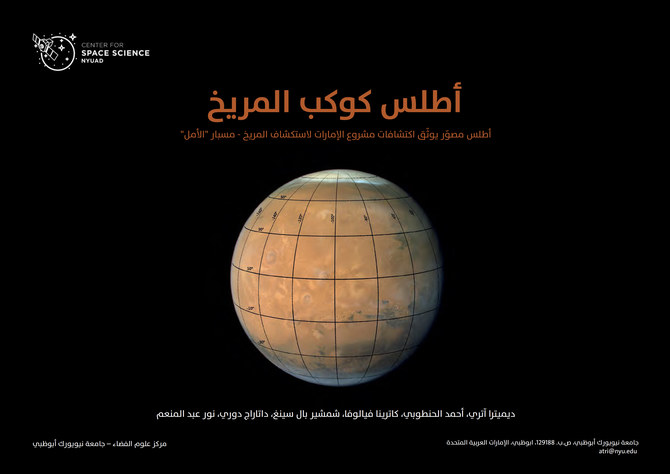
NYU Abu Dhabi research scientist Dr. Dimitra Atri has produced the world’s first ever Mars atlas in Arabic, Emirates News Agency reported.
The atlas uses data from the UAE’s Emirates Mars Mission (EMM) — also known as Hope or Al-Amal — in order to make the findings of the probe more accessible to both the UAE’s Arabic-speaking population and the rest of the world.
The Mars Atlas Project combines various images from the Hope probe to map the planet’s surface.
The end result is a comprehensive view of Mars and stunning images of a planet that once had similar atmospheric conditions to Earth.
Dimitra Atri used data from UAE’s Hope probe to map the red planet.
Atri and his team compiled the atlas by processing observational data from EMM’s Emirates eXploration Imager, one of three instruments onboard the orbiter. The device will also assist the team in showing how the planet changes over the course of one Mars year, which is roughly equivalent to two Earth years.
As more data from the Hope probe becomes available, the atlas will be gradually updated.
The data will help scientists gain a better understanding of the planet’s atmospheric thinning, which has caused it to cool and dry over the last 4 billion years.
Atri predicts that the collected data will be used to answer unsolved scientific questions about the erosion of Mars’ atmosphere.
The findings could help the international scientific community to better understand Earth’s atmospheric processes, he said.
After his recent achievement, El Bakkali became the “king of steeplechase.”.
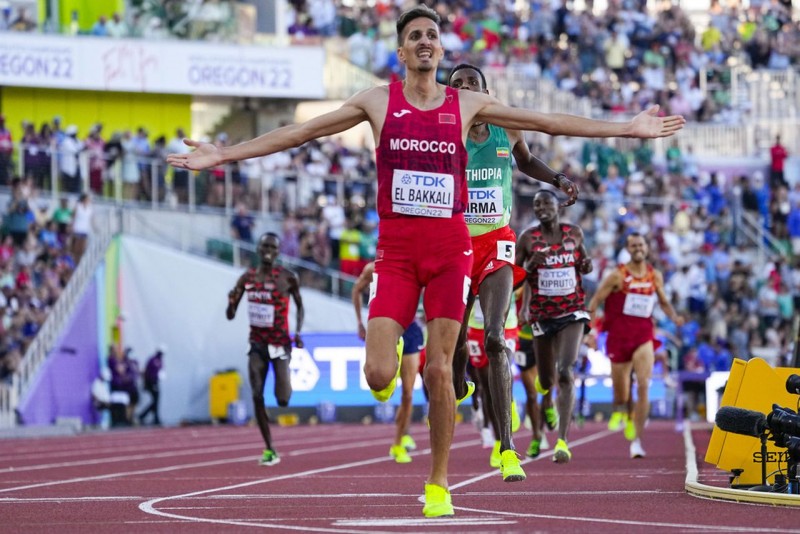
King Mohammed VI sent on Tuesday a message to Moroccan steeplechase runner Soufiane El Bakkali, congratulating him on winning the gold medal at the World Athletics Championships held in Eugene, US.
The Moroccan athlete brought Morocco its first gold in the 3,000m steeplechase in this year’s World Championships, ending Kenya’s 15-year reign in the discipline at the international competition.
The King expressed his appreciation for El Bakkali’s achievement, saying that the Moroccan athlete “was able, thanks to his competitive spirit and patriotism, to achieve this well-deserved victory.”
“As we commend this well-deserved global crown, with which you raised the flag of Morocco in this prestigious international event, we wish you success in your rich sporting career, covered by our generous sympathy and satisfaction,” the King added.
A teary-eyed El Bakkali raised the Moroccan flag after his triumph, telling the media he was dedicating this win to King Mohammed VI, his parents, and to all the Moroccans who have shown him endless support and encouragement.
Several international media reporting on El Bakkali’s recent achievement described him as the “king of steelechase” after claiming world title.
He added, “After the semi-final I had a good look at the strategy of the Kenyan athletes. I was on my own, the only Moroccan in the race, but I did not limit myself to winning silver nor bronze. Instead I managed to come first in two world league meetings and now the World Championship.”
El Bakkali began earning his first medals at international events at the 2017 World Championship in London, where he placed second, before finishing first in the 2018 Mediterranean Games in Spain.
In August 2021, Soufiane El Bakkali gave Moroccans a moment of pride after his historic achievement at the Olympics, ending Kenya’s dominance over the men’s 3,000m steeplechase and winning the gold medal at Tokyo 2020.
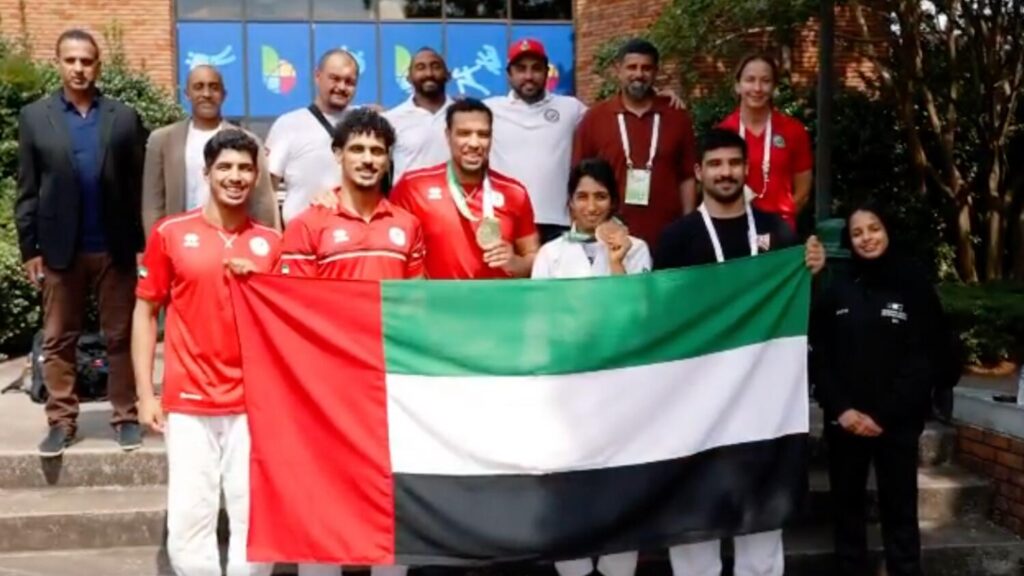
The UAE national jiu-jitsu team of five athletes has added two medals in the 11th edition of the World Games hosted by Birmingham, USA, from 7 to 17 July, 2022, bringing its total harvest to five medals (two gold medals, two bronze and one silver).
UAE’s Faisal Al Ketbi captured the gold medal in the 85kg category, while the 19-year old Shamma Al Kalbani won the bronze in the open weight division, becoming the first Emirati athlete to achieve such a global landmark victory.
A jiu-jitsu squad of five athletes from the UAE qualified for the games, building on an impressive performance at the 2017 Games in Warsaw, Poland. Last time out, Al Ketbi won the gold medal in the under-94kg.
Abdel Moneim Al Hashemi, Chairman of the UAEJJF, and Senior Vice President of the International Jiu-Jitsu Federation (JJIF), called the UAE team to offer his congratulations.
Fahad Ali Al Shamsi, Secretary General of the UAE Jiu-Jitsu Federation (UAEJJF), attended the award-giving ceremony, and congratulated Faisal Al Ketbi and Shamma Al Kalbani on the winning.
Tariq Al-Bahri, Director of the Abu Dhabi Professional Jiu-Jitsu Association, Mubarak Al Menhali, Director of the Technical Department, UAE Jiu Jitsu Federation’s (UAEJJF), and Joachim Thumfart, Director-General of the Jiu-Jitsu International Federation (JJIF), watched the closing day competitions.
Considered a global showpiece for sports yet to be included in the Olympic Games, the prestigious World Games 2022 featured approximately 3,600 participants from 100 nations competing across more than 30 sports.
The Emirati stars included Faisal Al Ketbi (85kg), Muhammad Al Amri (77kg), Muhammad Al Suwaidi (69kg), Shamma Al Kalbani (63kg) and Balqees Abdelkareem (48 kg).
Medical pioneer was one of the first women from the country to study abroad.
The life of doctor Saniya Habboub is being celebrated by Google’s Doodle on Friday, commemorating her graduation from medical school on June 10, 1931.
Born in 1901 to a Lebanese leather merchant and Turkish mother, Habboub was one of the first female doctors from Lebanon to study medicine abroad, in the US.
When she returned to Beirut she opened her own practice, inspiring other Lebanese girls and women to get an education of their own, according to Google’s description.
In 1926, Habboub was one of the first three students to graduate from the American Junior College for Women in Beirut, going on to study at the American University of Beirut.
In 1931, she received her degree in gynaecology and obstetrics from the Women’s Medical College in Pennsylvania and, in gratitude, left future students with a scholarship in her name.
She started her own practice two years later, in Bab Idriss, and went on to co-found the Lebanese Red Cross Association, as well as served as a board member for the Muslim Orphan’s Home, the Young Women’s Muslim Association and Maqassed Hospital.
In 1982, in honour of her devotion to medical services, the Lebanese government awarded her with a Health Medal of Merit, and there’s even a street in Beirut named after her.
Habboub died aged 82 in September 1983.
“Dr Saniya was an inspiring figure who paved the way for future generations of women to come,” Google says.
Dr William Stoltzfus, former president of Beirut University College, described her life as a “get-started signal” for the professional lives of many Arab women, according to Al–Raida, the bi-annual journal published by the Arab Institute for Women.
The Doodle can be seen on devices across the Middle East and North Africa.
source/content: thenationalnews.com
___________
Dr Saniya Habboub died in 1983 aged 82. Photo: Public DomainGoogle Doodle of Dr Saniya Habboub. Photo: Google
July 10 marks the death anniversary of the late iconic international Egyptian actor Omar Sharif.
On this occasion Egypt Today looks back at some of the milestones that led to his international debut.
Sharif’s childhood
Born in Alexandria as Michel Dimitri Chalhoub on April 10, 1932, he was of Lebanese descent, but was born and bred in Egypt. His parents were of good social standards; his father in the wood business and his mother a notable society hostess who often hosted King Farouk to play cards.
Growing up, Sharif easily became multilingual as he was brought up by his French speaking mother and attended an English boarding school and Victoria College; he also became fluent in Italian, Portuguese and Spanish.
After graduating from Cairo University with a mathematics and physics degree, he attempted to follow his father’s path of work but quickly receded and went on to London to the Royal Academy of Dramatic Art.
Sharif realized his passion for acting at the tender age of 13 when he participated in his English boarding school’s theatre program.
This horrified his father, since it would stop his son from following in his footsteps and becoming a timber merchant. Later, Sharif’s talent overcame all obstacles and he became a world-renowned actor.
The immortal cinematic and romantic couple Sharif and Hamama
In 1954, Sharif starred in “The Desert’s Devil” (Shaytan al-Saharaa), but his break was the same year when he acted in “Struggle in the Valley” (Sira’ Fi al-Waady) alongside his wife, the late great Egyptian actress Faten Hamama.
The love story of Hamama and Sharif began when they worked together in Youssef Chahine’s “Struggle in the Valley.”
Despite being born Catholic, he changed his name and converted to Islam to marry her in 1955. A marriage that lasted for 20 years, the famed couple were the symbol of love to all the Egyptian audience.
They portrayed their love in a number of successful movies that will live on for years after their death; movies that taught us the true meaning of love, such as “Ayamna el Helwa” (Our Beautiful Days), “Nahr El Hob” (River of Love), “ Saydet el Kasr” (The Palace Lady), “Sra’a fe El Mena” (Struggle in the Port), among others.
El Sherif’s international Stardom
He achieved international stardom in 1962 by acting in Lawrence of Arabia alongside Peter O’Toole.
He maintained his status as a foreign heartthrob by leading in films like Dr. Zhivago and Funny Girl, which caused outrage in Egypt due to the romance with his leading co-star, Barbara Streisand, who won an Oscar for her role.
Funny Girl was based on a play with the same title also starring Streisand. This musical comedy drama is a biographic, based on the life of Fanny Brice, a famous female Jewish comedian of the 1900s who dreams of stardom in New York City’s Broadway.
Against all odds she rises to the top and falls for Nick Arnstein, played by Sharif, a businessman and compulsive gambler.
While the 60s were the best and busiest years of Sharif’s acting career, they were the ones which took a toll on his marriage with Hamama, and the couple shocked their fans by getting a divorce in 1974.
A resonating talent
His impeccable acting skills speak for themselves, but his mastery of contract bridge also precedes him. He wrote books on bridge, his favorite card game, and even established the Omar Sharif Bridge Circus.
However, his addiction to gambling eventually caused him money troubles, which led to his acting flops and his downward spiral.
Living alone and with little money, Sharif spent his later days living in hotels in Paris and London until he made a brief comeback with his role in the 2003 French film “Monsieur Ibrahim.”
The film received positive reviews, and Sharid even won the audience award for Best Actor at the Venice Film Festival.
Sharif was always keen to support and encourage young talents such as the famed Egyptian actor Mohamed Ramadan, who had a small role in Sharif’s only Egyptian soap opera “Hanan w Hanin” ( Tenderness and Nostalgia).
Ramadan previously announced in a number of TV interviews that Sharif encouraged him a lot and praised his acting talent, predicting at that time that he will be a superstar in the future.
“When I first met Omar Sharif, he greeted me as if I was family. He was someone who really loved people; when he found out that we were [both] Egyptian, we bonded instantly.
The main piece of advice he gave me was to start in Egypt and get that experience under my belt before trying to have a career internationally,” recounted the Egyptian rising international actor Amir El-Masry in an interview with Egypt Today.
The End
Sharif moved back to Egypt to spend his final days while struggling with Alzheimer’s disease. Sharif passed away at the age of 83 due to a heart attack on July 10, 2015. Sharif is a cheerful, handsome, talented and iconic artist who will remain forever alive in the hearts of his audience around the world.
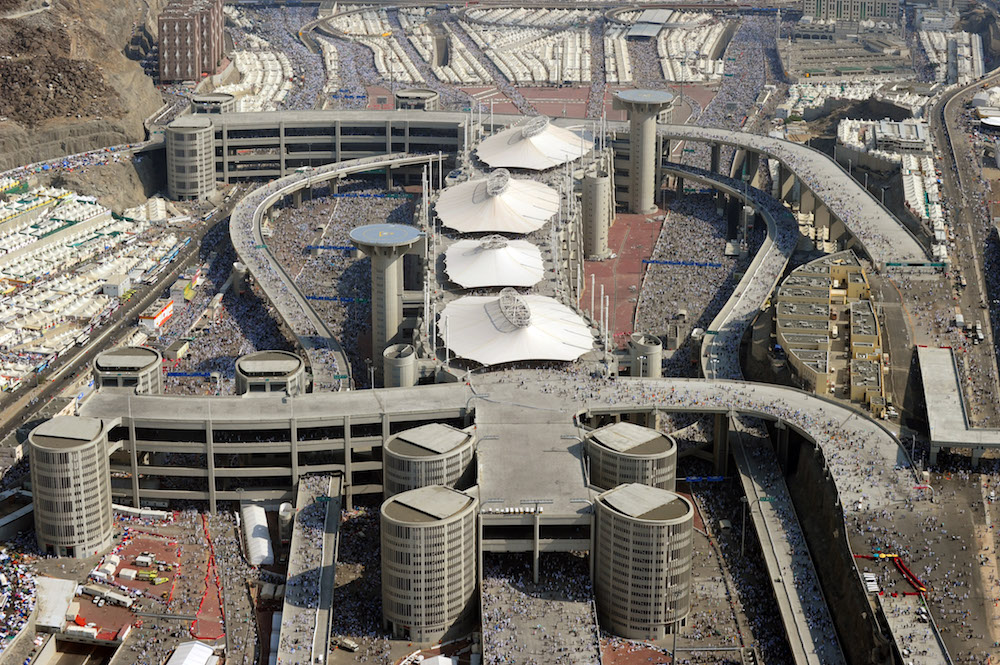
The Jamarat Bridge project is a massive structure built to save pilgrims’ lives and facilitate a crucial Hajj ritual.
Pilgrims gather in this place to throw stones at the devil in a symbolic act as part of their Hajj. Without this act, their pilgrimage is incomplete and considered to be unaccepted.
The concept of stoning the devil began when Prophet Ibrahim intended to sacrifice his son Ismael upon Allah’s order. The devil tried to dissuade the prophet three times from carrying out the order.
On each of the three occasions, the prophet pelted the devil with seven small pebbles to drive him away, after which the devil disappeared. This act has become a symbolic ritual and an integral part of Hajj.
It takes place over two or three days, from the 10th day of Dhul Hijjah until before sunset on the 13th.
The three pillars were previously built of stone and mud with low barriers surrounding them. They were then covered with cement, with the size of the pillars remaining unchanged for years.
However, the increasing number of pilgrims called for a project to help manage the hundreds of thousands of worshippers gathering in one place.
According to Mohammed Idris, former vice dean of The Custodian of the Two Holy Mosques Institute for Hajj and Umrah Research, the three pillars were surrounded by circular walls until 1975.
“A substantial enlargement of the area took place in 1987, and other expansions followed to upgrade the Jamarat area’s capacity to ease pilgrim movement and avoid accidents. The exit points and entrances to the pillars were amended, and the curved paths to the Jamarat were made straight,” he told Arab News.
The Jamarat Bridge was originally a pedestrian structure built in 1963 to facilitate the stoning ritual. Since then, it has been expanded several times to accommodate the increasing number of pilgrims.
A substantial enlargement of the bridge took place in 1974, and other expansions followed to upgrade the bridge’s capacity to ease pilgrim movement and avoid accidents.
Despite this, the structure witnessed several deadly incidents owing to actions of pilgrims who violated instructions, thereby sparking stampedes and deaths.
In 1990, over 1,400 pilgrims were killed by trampling and suffocation in Al-Ma’aisim pedestrian tunnel, which led from Makkah to Mina. Between 1994 and 2006, more than 1,030 pilgrims were killed in stampedes while trying to stone the pillars. Around 470 others were injured.
The worst stoning-related incident in recent memory occurred on Sept. 25, 2015, when more than 700 pilgrims died and another 800 were injured when pilgrims surged toward the intersection of Street 204 and Street 223.
A doctor at an emergency department of a Mina hospital told Arab News at the time that most of the pilgrims died of asphyxiation.
A Saudi interior ministry spokesman had blamed the stampede on “unprecedented high numbers of pilgrims” as compared to previous years, plus the fact that a majority of the victims had descended onto a pathway during a time that they were not allowed to enter it.
Witnesses to the tragedy had confirmed that a large group of Iranian pilgrims passed through Souq Al-Arab Street and refused to return, ignoring Hajj guidelines.
__________
FASTFACTS
• Stampedes and surges caused thousands of deaths at the Jamarat Bridge before the infrastructure was upgraded.
• The project, to alleviate overcrowding and avoid tragedies, cost $1.12 billion.
_________
Regardless of the causes of the tragedies, they prompted the Saudi government to devise a solution that could save lives. After the 2015 incident, Saudi Arabia’s King Salman offered condolences and immediately ordered an urgent review of the Hajj plan.
Over four years, Saudi authorities studied and researched the site before the old structure was completely removed and replaced by the existing engineering marvel known as the Jamarat Bridge.
The new project details were approved by top engineering and architectural committees consisting of local experts and highly experienced US, German, and British engineers. The opinion of senior Muslim scholars was taken into consideration for the religious position on the project details.
“In 2005, the circular walls around the pillars were reshaped, making them elliptical to facilitate the movement of the pilgrims,” Idris told Arab News.
“ In 2007 the old Jamarat project was discarded, and work on the new project began. A year later, one floor as per the project was fully constructed. In 2009, the second floor was made ready to serve pilgrims. By 2010, the entire planned construction was fully complete.”
The bridge, which was constructed over three years by more than 11,000 workers, is 950 meters long and has six floors, including the basement, with a height of 12 meters per floor. Each floor can absorb up to 120,000 pilgrims per hour.
Its foundation was constructed to withstand 12 floors to accommodate 5 million pilgrims by 2030.
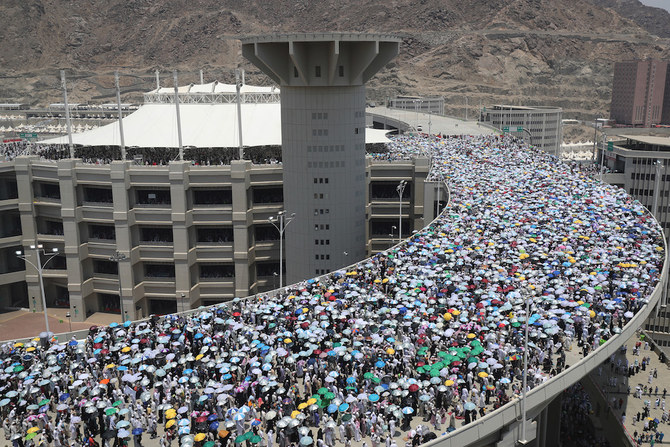
On the fifth level, umbrellas cover the site of the three Jamarat to enhance the comfort of pilgrims and protect them from the sun and heat.
The Hajj infrastructure showpiece, which has won several local and global awards, was built at a cost of over SR4.2 billion ($1.12 billion).
It has 12 entrances, 12 exit roads from four directions, two tunnels, 19 ramps, escalators, emergency exits, helipads, six service buildings, and an air-conditioning system with water sprinklers to cool the atmosphere and reduce the area’s temperature to 29 degrees Celsius.
The building also contains three electric stations and a standby generator that automatically supplies electricity in case of any temporary power cut.
Unlike the old circular shape of the walls around the three pillars, the new oval design has contributed to a better pilgrim flow. It has also assisted in increasing the bridge’s capacity for pilgrim numbers.
The new bridge was designed by Dar Al-Handasah and constructed by the Saudi Binladin Group. It features a wider and column-free interior space, longer Jamrah pillars, additional ramps and tunnels for easier access, large canopies to cover each of the three pillars to protect pilgrims from the sun, and ramps adjacent to the pillars to speed up evacuation in the event of an emergency.
No casualties have been reported at the Jamarat sites in six years. However, both Saudi Hajj and health authorities are prepared for any scenario. This year, 17 emergency centers will be present at Jamarat Bridge to assist in any emergencies — from crowd surges and falls to illness — that pilgrims may face on their Hajj journey.
source/contents: arabnews.com (headline edited)
___________
The walkway leading to the symbolic stoning of the devil, the oval design has contributed to better pilgrim flow and boosted the structure’s capacity for accommodating people. (AFP)A substantial enlargement of the bridge took place in 1974, and other expansions followed to upgrade the bridge’s capacity to ease pilgrim movement and avoid accidents. (AFP/File Photo)