Savaya, a Michigan-based entrepreneur of Iraqi Chaldean descent, was appointed in a statement on Trump’s Truth Social page on Sunday.
United States President Donald Trump has named Detroit businessman and cannabis entrepreneur Mark Savaya as special envoy to Iraq, sparking debate in Baghdad and Washington.
Savaya, a Michigan-based entrepreneur of Iraqi Chaldean descent, was appointed in a statement on Trump’s Truth Social page on Sunday.
“Mark’s deep understanding of the Iraq–US relationship and his connections in the region will help advance the interests of the American people through his diplomatic engagement and direct communication with Iraqi officials as special envoy. As special envoy, he will act as a direct representative for US interests in Iraq, coordinating joint initiatives, maintaining diplomatic negotiations, and ensuring transparent communication between US and Iraqi governments on security, political, and economic priorities,” Trump wrote.
Trump praised Savaya’s contribution to his 2024 campaign, particularly his efforts to mobilise support among Muslim American voters in Michigan.
Savaya, born in Detroit in 1983, owns Leaf and Bud dispensaries and, according to his public profile, has no previous government experience. His family left Iraq for the US in the 1990s.
The appointment has sparked discussion among Iraqi political circles, though the Iraqi Prime Minister has welcomed the move.
On Monday, Iraqi Prime Minister Mohammed Shia al-Sudani described the appointment of US President Donald Trump’s special envoy to Iraq as “an important step,” noting the envoy’s Iraqi roots.
“The appointment of a special envoy by President Trump to Iraq is an important step, especially as he is of Iraqi origin. We wish him success in his mission,” Sudani said during a meeting with Arab and foreign journalists in Baghdad.
In a post on X (formerly Twitter), Savaya said he was “deeply humbled, honoured and grateful” to be appointed and committed to “strengthening the US–Iraq partnership under President Trump’s leadership.”
The announcement came after the release of Elizabeth Tsurkov, an Israeli-Russian doctoral student who was kidnapped in Baghdad in 2023 by the Kataib Hezbollah militia.
Tsurkov, who spent more than 900 days in captivity and was freed on 9 September, wrote on X that Savaya had played “an instrumental role” in securing her release, calling the move “terrible news for anyone serving Iran’s interests in Iraq.”
On his part, Nechirvan Barzani, the President of the Kurdistan Region, welcomed the appointment, describing it as underscoring “The strategic importance of Iraq and the Kurdistan Region in advancing our shared interests and regional stability.”
Senior Kurdistan Democratic Party (KDP) figure and former foreign minister Hoshyar Zebari welcomed the appointment, describing it in a post on the X social media platform as “a bold decision to restore Iraqi sovereignty and independence away from corruption, mismanagement and militia rule.”
Zebari also said Savaya’s appointment, as “an American of Chaldean Christian and Iraqi descent”, reflected recognition in Washington that Iraq’s political situation “is neither stable nor normal”, and called for “decisive measures beyond traditional diplomatic frameworks”.
However, others have questioned the timing and nature of the role.
Iraqi writer and political analyst Falah Al-Mashaal described the decision to appoint a special envoy, rather than a traditional ambassador, as “puzzling” and “unusual under diplomatic norms”.
“A special envoy is usually sent for a specific mission—during a crisis, war, or to deliver a particular message,” he wrote in a post on the X. “Is President Trump planning something unusual for Iraq?”
He linked the appointment to Trump’s recent comments at the Sharm el-Sheikh peace summit in Egypt, where he referred to Iraq’s “vast oil wealth” and accused its leaders of mismanaging it.
“It sounded like an invitation for Trump’s allies in Iraq to sue Prime Minister Sudani for negligence and mismanagement of public funds,” al-Mashaal said.
Some analysts believe the appointment may be connected to Trump’s regional agenda and his longstanding focus on Iraq’s oil sector.
Alex Warkes, a UK-based Iraqi political analyst, said the decision could also have domestic political implications for Baghdad.
“I think the back door of the US embassy will be quite busy with the arrival of Trump’s special envoy,” Warkes said in a post on X. “I believe the appointment was coordinated with Prime Minister Mohamed Shia Al-Sudani’s team, perhaps to support his bid for a second term. We don’t yet know what the exchange might be—but time will tell.”
Warkes also questioned whether Savaya’s appointment had been coordinated with Israel, given that Trump’s Middle East policy “has always prioritised Israeli interests more than any of his predecessors”.
“These are legitimate questions,” he said. “Especially at a time when Iraq’s stability, oil policy, and relations with Iran remain central to the region’s balance of power.”
source/content: newarab.com (headline edited)
____________
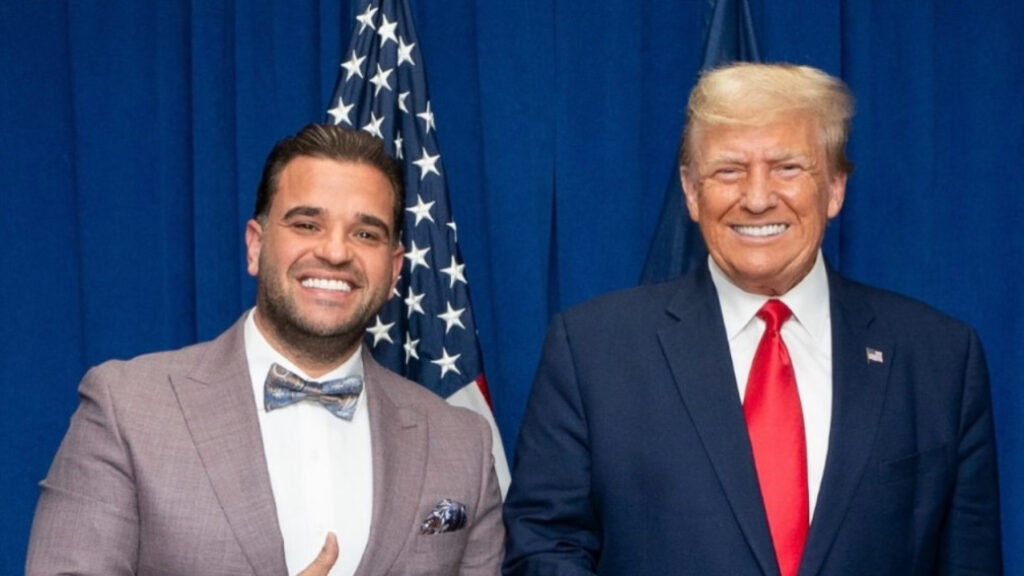
Mark Savaya and US President Donald Trump. [Screengrab from Mark Savaya/Instagram]
_____________________
AMERICAN / IRAQI