Arabs & Arabian Records Aggregator. Chronicler. Milestones of the 25 Countries of the Arabic Speaking World (official / co-official). AGCC. MENA. Global. Ist's to Top 10's. Records. Read & Enjoy./ www.arabianrecords.org
Algeria boosted its medal tally on Tuesday with three additional bronze medals at the ongoing Mediterranean Games in Taranto, Italy.
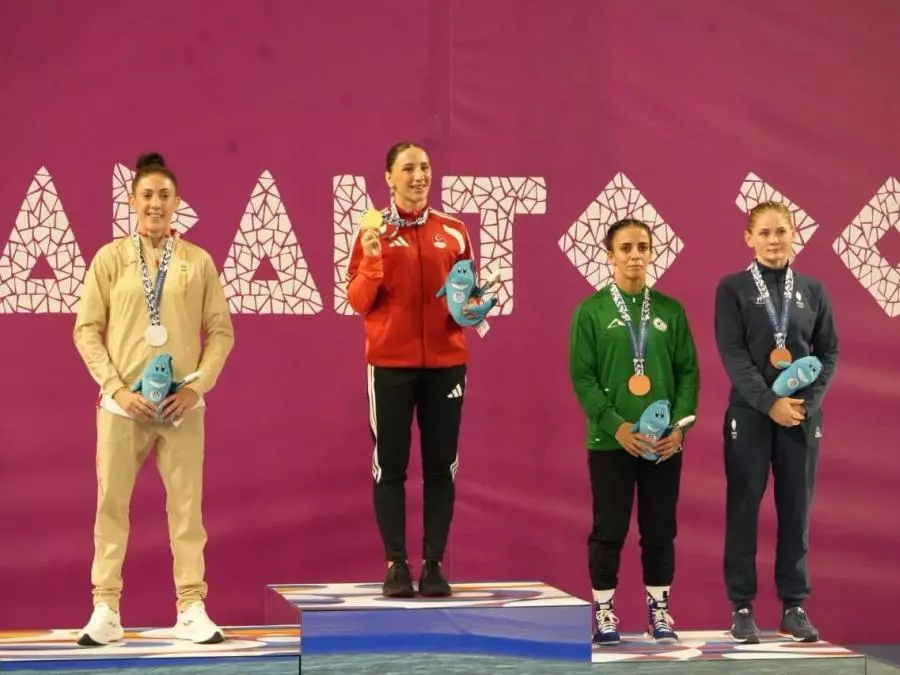
In freestyle wrestling, Chaïma Chebila claimed the bronze medal in the Under 53 kg category after a dominant 6-1 victory over Morocco’s Zineb Ech-Chabki.
Earlier on Tuesday, another Algerian wrestler, Ibtissem Doudou, secured the bronze medal in the Under 50 kg category by overcoming Egypt’s Malak Ahmed Hassan Mohamed with a tight 3-2 score.
These two bronze medals raise the Algerian wrestling team’s overall tally to seven medals (one gold, one silver, and five bronzes).
Meanwhile, Nour El Houda Maïdi earned a bronze medal in the “Raffa” (Boules) competition. Maïdi successfully edged past San Marino’s Stella Paoletti with a narrow 7-6 victory.
Boxing: A Trio Advances to the Semi-Finals
In boxing, three Algerian fighters punched their tickets to the semi-finals, officially guaranteeing at least three more bronze medals for the national delegation. The advancing boxers are:
Mustapha Abdou (80 kg), who defeated Tunisia’s Youssef Rafrafi via unanimous decision (5-0).
Ismaïl Bekhsis (66 kg), who secured a flawless 5-0 victory over his Turkish opponent, Kanli.
Amine Zanaz (55 kg), who edged past Morocco’s Ismail Bin Siyar with a 3-2 split decision.
These three boxers join their compatriot, Djoher Bennan (65 kg), who had booked her spot in the women’s semi-finals earlier in the tournament.
Following the fifth day of the 20th Mediterranean Games which are set to run until Thursday, September 3, Algeria’s overall medal count has climbed to ten, comprising one gold, one silver, and eight bronzes.
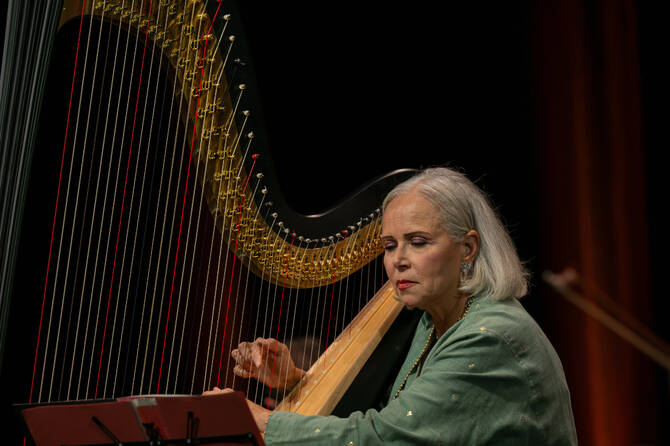
Egyptian harpist Manal Mohei Eldin captivated audiences at the King Abdulaziz Center for World Culture, or Ithra, with three nights of performances blending classical harp techniques with traditional Arabic rhythms and melodies. The final show will be on Friday.
Known as one of the most prominent musicians in the Arab world, she is celebrated for calibrating the harp strings to speak “fluent Arabic” by incorporating traditional Oriental rhythms and melodies with classic techniques.
Arab News spoke exclusively to Mohei Eldin on Thursday night.
“As an Egyptian harpist, it is such an honor to receive this important invitation to showcase my work and my art in the Kingdom of Saudi Arabia,” she said.
“It is not my first time here (at Ithra) — I’ve had the pleasure of working with the great Omar Khairat two years ago, but it is my absolute honor to say that this is my debut as a soloist playing my Arabic, oriental rhythms with my ensemble in the Kingdom.”
Indeed, while she was on stage previously at Ithra in 2024 as a key orchestra member supporting the legendary Egyptian composer and pianist, Khairat, this is her first show as a soloist, with her ensemble.
The Oriental Strokes Ensemble, who joined her on stage, consists of Shady Abdel Salam on violin I, Hossam Ezzat on violin II, Emad Morsy on the viola, Alaa Abdallah on cello. Also, Karim Wassef on bass guitar, Beshoy Rezkalla on accordion, Mahmoud Kamal on nay, Hesham Kamal on percussion, and Doha El-Guerzawi on percussion.
“It pleases me greatly that our first presence in the Kingdom is at Ithra specifically, where we are performing three nights,” Mohei Eldin added.
“The audience at Ithra is very involved and passionate. To be honest, I expected the majority of the seats to be occupied by Egyptians, but to my surprise, most turned out to be Saudis.”
On Thursday night, in between songs, someone from the audience shouted out a request for the musicians to play “Nassam Alayna El Hawa” by Lebanese songstress Nouhad Wadie Haddad, better known by her stage name, Fairouz.
“I don’t know him (the person who shouted out the request), but I played it even though it was not in the original program. It is clear to me that he knew my work and knew I had played that before. It makes me very happy that the Saudi audience loves music and they really know music,” she added.
The program consisted of such crowd favorites as “Zourouni Kol Sana Marra,” composed by Sayed Darwish; “Asmahan Medley,” composed by Farid Al-Atrash, Mohammed El-Qasabgi and Medhat Assem; and “Aziza Dance,” composed by Mohamed Abdul Wahab.
Images of the classic Egyptian stars who inspired the sounds were shown on the large screen as a backdrop.
A professor at the Cairo Conservatoire, Mohei Eldin began her musical journey in her native Egypt and has since performed on some of the world’s greatest stages.
She became a pioneer when she enrolled at 10 years old to pursue learning the harp at the Cairo Conservatoire, where she graduated with honors in 1987.
Upon receiving the coveted German Academic Exchange Service scholarship, she continued her journey with the instrument in Germany with Prof. Buss Lorberth at the Hochschule fur Musik und Darstellende Kunst in Frankfurt and training with Giselle Herbert at the Hoch Conservatory Musik Hochschule in Wurzburg.
Since then, she became the first Egyptian solo harpist at the Cairo Symphony Orchestra, and she famously performed at the opening of the Egyptian Pavilion at the Louvre Museum in Paris and the Ancient Treasures Exhibition at the National Museum of Women in the Arts in Washington, D.C.
“The vast majority of Arabs love to sing along to words, and the fact that they came to listen to only musical instruments, and on an instrument (the harp) that isn’t very familiar to many in the region, honestly made me very, very happy,” she concluded.
source/content: arabnews.com (headline edited)
_______________
Known as one of the most prominent musicians in the Arab world, Manal Mohei Eldin is celebrated for calibrating the harp strings to speak “fluent Arabic” by incorporating traditional Oriental rhythms and melodies with classic techniques. (Supplied)