‘It’s a case study for everything we’ve lost in the process of colonization,’ the Kuwaiti artist says.
For years, Kuwaiti artist Aseel AlYaqoub worked without a gallery, a grant, or any certainty that her research-heavy work was reaching people. Winning the seventh Ithra Art Prize this month, she tells Arab News, gave her validation she did not realize she had been seeking.
AlYaqoub won for “Flora Incognita,” an installation of invented hybrid desert plants escaping the colonial-era archives that named them. The prize comes with a $100,000 grant, and the work will join the permanent collection of the King Abdulaziz Center for World Culture (Ithra) in Dhahran.
“It was very emotional, to be honest,” she says. “(The nominees) all have very different practices, so you couldn’t guess who was going to win.”
What moved her most was hearing the jury explain why the work had resonated with them. “I’ve always been independent,” she says. “I sell my own work, and I create my own practice on my own. After a while, you’re like, ‘Am I even going in the right direction?’ (But this shows that) people actually do care about what I care about, and there’s something meaningful in what I’m doing.”
She plans to put the money into a new research-based project and a solo exhibition, and to give part of the prize to charity.
The acquisition of “Flora Incognita” by Ithra means a lot, she says, “because it has a longevity now. It shows that I’m part of a trajectory and a conversation that’s happening in the region.”
“Flora Incognita” was born out of a longstanding frustration. AlYaqoub came across “The Wild Flowers of Kuwait and Bahrain” by British botanist and author Violet Dickson, which presents a purple, lavender-like flower as a new discovery. Known in Arabic as Al-Khuzama, the plant had been used by locals for centuries before it was given its Latin name — Horwoodia dicksoniae, after Dickson.
“It’s this external gaze looking on the desert flower as something that wasn’t there until they arrived,” she says. “This Latinized name becomes the official botanical name for this indigenous plant, and that’s where I draw a line. It’s a case study for everything that we’ve lost in the process of colonization — and also independence from it.”
The installation takes the form of a herbarium.
Its plants — 3D-printed sculptures and graphite botanical drawings — are invented hybrids of two existing species.
“They’re from my imagination. They’re not real,” AlYaqoub says, explaining that she chose invented species to turn the idea of the “alien” back on the classifiers.
“It’s so easy to just reclassify something without really understanding its origins or the people that are familiar with it,” she says. “The colloquial becomes insignificant, and the Western idea of what this flower is becomes more significant. So these plants are alien creatures that defy that classification. It’s like, ‘Well, if you see me as an alien, then here I am.’”
One hybrid pairs a parasitic plant with one capable of cell regeneration. “One is invasive and one is placid. What would happen if they were married, and what would it look like?” she says.
The hybrids are left unnamed. “It’s open to interpretation as to who gets to name them now.”
The drawings, she says, also question who gets to produce scientific knowledge. “Anyone can come and decide what the inside of a seed looks like, and it feels like scientific truth. So I’m challenging that by saying: ‘If I can do these botanical drawings, then anyone can.’”
The plants sit in raw steel cabinets that AlYaqoub fabricated from scratch to resemble a Victorian archive. The idea came from a visit to the Royal Botanic Gardens, Kew, in London, where pressed specimens are stored in coded drawers.
“I just felt so sorry for these plants squished in there, in their little sheets,” she says. “It felt more like a prison than an archive.” In the installation, some of the plants escape. “They break free from the drawers, they leave the page, and they rebel against the classification system that they’ve been imprisoned in.”
Research drives all of AlYaqoub’s work, which looks at how states, institutions and scientific disciplines build and sustain authority over territory, history and identity.
“I’m always curious about whose story I’m reading, and how much it is really rooted in truth,” she says. Views from above, including maps and satellite imagery, are a recurring theme. “Who’s looking, and how are they looking?”
She often buys material from antique dealers she has befriended on Instagram, such as a “Free Kuwait” lighter that she calls “so significant in terms of its symbology.” She writes an essay on what she has found, then cuts it to 500 words and then to 150, which becomes her artist statement. She then works in threes: text, object and image.
Saudi Arabia has become central to her career (she describes Saudi audiences as “very eager to learn”), with commissions at Desert X AlUla and in Diriyah before Ithra.
“Once I had my foot in Saudi Arabia, everything just kept rolling,” she says. “When I investigate the landscapes in Saudi, they’re not very far from the landscapes of Kuwait. It just feels like a continuation of the land that’s been separated due to nation-building.”
She is now considering extending “Flora Incognita” into a local, colloquial encyclopedia of plant names and has begun meeting botanists and farm owners. She is also researching the Dilmun civilization that once extended into present-day Kuwait. Next, she says, she would like to exhibit at home in Kuwait.
Gaining recognition regionally first matters to her. “I don’t want to be talking about our landscapes and our places and our histories to ‘them,’ in exile, away from ‘us,’” she says. “I want to talk to us, and then they can hear what we have to say about it.”
source/content: arabnews.com (headlines edited)
______________
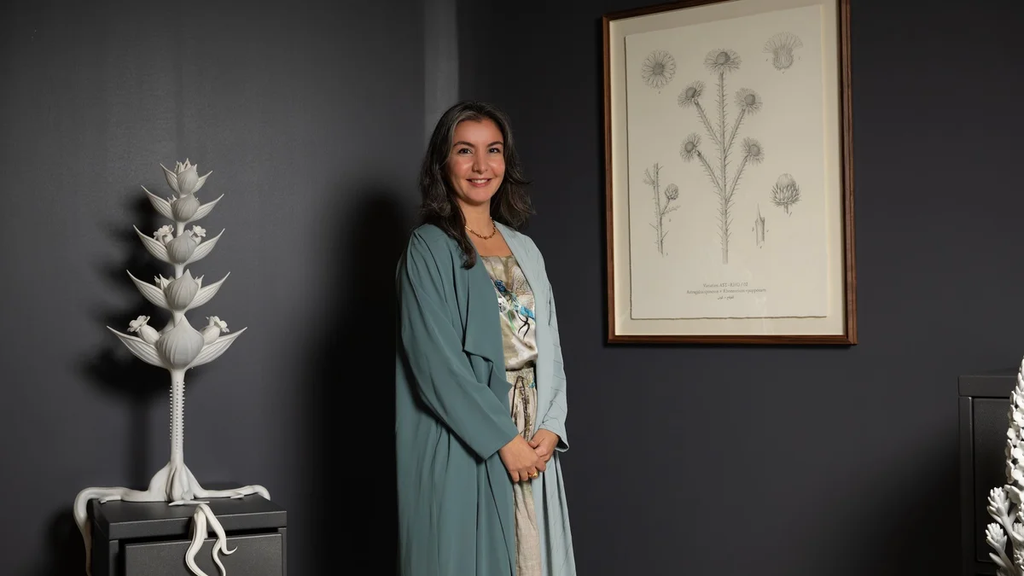
Kuwaiti artist Aseel AlYaqoub. (Supplied)
___________
KUWAIT