UNESCO’s unanimous decision was announced during a meeting held in Busan, South Korea.
Tunisia’s picturesque village of Sidi Bou Saïd has been inscribed on the UNESCO World Heritage List after a unanimous decision by the 48th session of the World Heritage Committee of the United Nations Educational, Scientific and Cultural Organisation, held July 19-29, 2026, in Busan, South Korea
Speaking before the Committee, Tunisia’s Ambassador and Permanent Delegation to UNESCO Khaled Dhia emphasised the universal values represented by the village of Sidi Bou Saïd, as a renowned centre of artistic, spiritual, and architectural inspiration.
He also highlighted the richness of Tunisia’s cultural and civilisational heritage, adding that the UNESCO decision reinforces his country’s commitment to safeguarding its rich heritage.
In a statement, the Tunisian ministry of culture said the site was recognised for its outstanding universal values, distinct architectural identity, rich cultural heritage, and centuries-long contribution to Mediterranean civilisation.
With the inscription of Sidi Bou Said, Tunisia now boasts 10 entries on the UNESCO World Heritage List, making it one of the Arab and African countries with the highest number of World Heritage sites.
UNESCO describes Sidi Bou Said on its official website as “a picturesque village perched on a promontory overlooking the Mediterranean Sea, harmoniously integrated into the cliff topography. “
“It developed around the tomb of a Sufi master and saint, known as Sidi Bou Saïd, who lived in the 12th-13th centuries. Through its architectural fabric and urban planning in symbiosis with the natural environment, its recognisable aesthetic created by emblematic colours, and a mystic aura associated with the Sufi spirituality that permeates the site, the property brings together geomorphology, architecture, and spirituality. It has long inspired artists and continues to attract visitors seeking spiritual serenity, “ adds the UNESCO website.
Experts hope the UNESCO inscription will help raise domestic and international awareness about the need to lend support to the village as it struggles to meet the challenges of soil erosion and over- crowdedness especially during the high tourism season.
Ridha Shili, a heritage professor and advisor to Tunisian cultural authorities, told Xinhua that Sidi Bou Said attracts approximately 4.5 million international tourists annually.
source/content: thearabweekly.com (headline edited)
________________
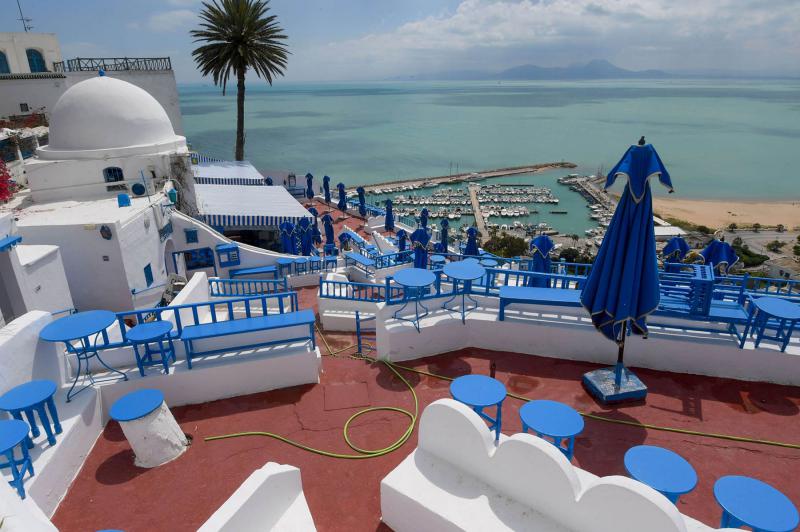
An empty cafe overlooking the sea in the village of Sidi Bou Said, some 20 kilometres northeast of Tunis, usually a major attraction to tourists but deserted amid the pandemic.
____________
TUNISIA