8 Arabic Colloquial Words That Were Originally Ancient Egyptian

Did you know that many of the Egyptian colloquial words Egyptians use on a daily basis are not actually Arabic?

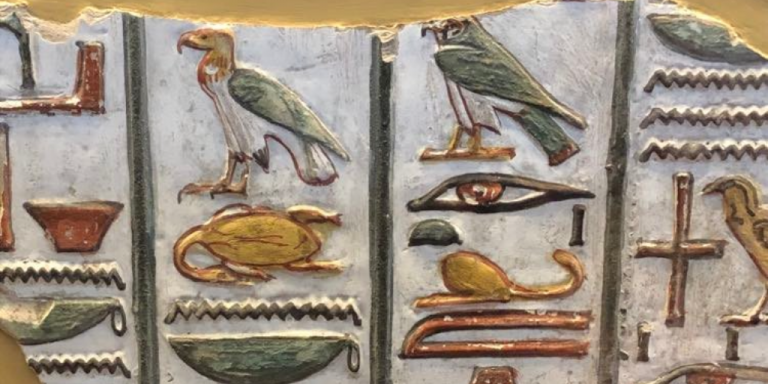
The Egyptian Arabic dialect is fundamentally Arabic, but with the influence of history and local populations, some of the peculiarities that set the Egyptian dialect apart come from the integration of ancient Egyptian, Greek and Coptic words and expressions. Surviving for thousands of years, many commonly used, modern-day Egyptian words and phrases can actually be traced back to the current dialect’s ancient predecessors.

Here are some examples of words Egyptians use, often not knowing their ancient origin, as per the books ‘From Pharaoh’s Lips’ (2003) by Ahmad Abdel-Hamid Youssef, and ‘Al Logha Al Masrreya Al Qadeema’ (Ancient Egyptian Language, 2012 ) by Abdelhaleem Nour El-din.

UMBU (DRINK)

Often, in communication with infants or toddlers, broken down or simplified words are used to allow the news speakers to express themselves without too much difficulty. For example, umbu is the word commonly used by Egyptian children to express their thirst. The ancient Egyptian term simply means “from the water”.

TA TA (STEP BY STEP)

When Egyptian parents try to help their crawling baby how to walk, they use the phrase “ta ta” derived from the ancient Egyptian word “ti ti”. Though Arabic became the primary language in Egypt, the Coptic language was initially still being used in everyday life for the majority of the population. The term “ti ti” was adopted by the Coptic language and modified to “ta ta”, which is used until today.

MAMM (FOOD)

The word Mumm is an Egyptian slang word derived from the ancient Egyptian “my wnm”, which means ‘give to eat’. Many Egyptians, until this day, teach their babies to say “mumm” whenever they are hungry — as it is easy and quick to sound out.

DAHYA TIWADDIH AL AMENDI (MAY A DISASTER SEND HIM TO HELL)

The Egyptian phrase “Dahya tiwaddih al amendi”, is originally ancient Egyptian. The word “amendi” is a Coptic word meaning “hell”, which was derived from the ancient Egyptian word “imntt”, meaning the ‘underworld’.

BIKH (BOO!)

The word “Bikh!”, meaning “Boo!”, is often used in modern day Egypt to sneak up on someone and scare them. The term is an ancient Egyptian word “pa akh” meaning “demon” or “ spirit”.

WAHAWY YA WAHAWAY IYUHA (THE MOON HAS APPEARED)

The Egyptian phrase “Wahawy ya Wahaway iyuha” is part of a song Egyptians sing during the holy month of Ramadan. Families and young children swing their fanoos (lanterns) as they sing the lyrics to Wahawy ya Wahaway iyuha. The popular lyric is believed to be inspired from the ancient Egyptian word “wah” meaning ‘to put’ or ‘appear’, and “iyah” meaning “moon”. Thus, comprising the lyric “the moon has appeared” during the month of Ramadan, which is decided upon according to the lunar calendar in Islam.

KRKR (LAUGHING)

The word “krkr” is used frequently in modern Egyptian day to describe someone who is laughing uncontrollably. The term is originally ancient Egyptian “ķrķr” and was adopted into modern day Egyptian society.

GATEK MAW (MAY A LION FETCH YOU)

The phrase “jak maw” or “gatek maw”, often switched depending on the region it is used in, essentially means “may a lion come to you”. The phrase is an Egyptian expression used as an insult. The ‘maw’ is based on a pun on the words “lion” and “mother”. The expression is often used by mothers bothered by their children.

source/content: egyptianstreets.com

____________

___________

EGYPT

How British-Sudanese Basketball Player Asma Elbadawi Shakes Things Up Both On And Off The Court

The hijab is a part of a woman’s faith and identity. At the end of the day, it’s about choice”

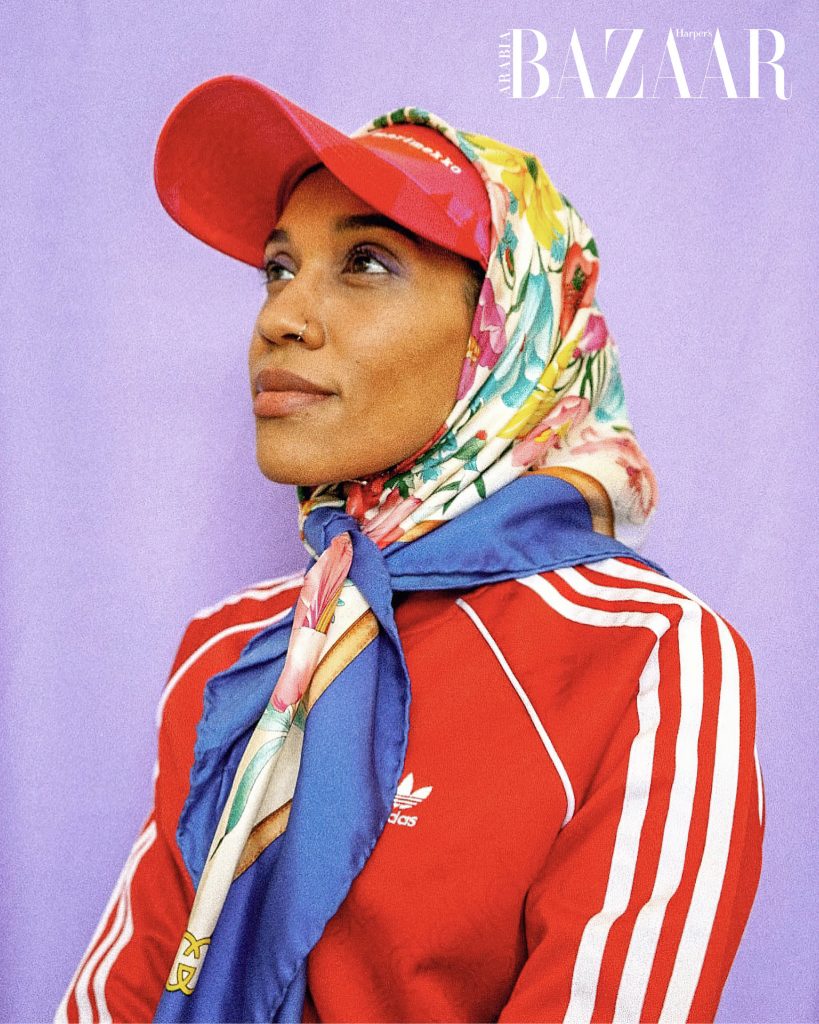
Risk it for the biscuit. I first came across the term when researching British-Sudanese basketball player and activist Asma Elbadawi, an athlete who doesn’t shy away from adversity when championing change and inclusivity within her sport. While all players possess the ability to take calculated risks, both on and off the court, what’s truly remarkable about Asma is that she seems to thrive when it comes to pushing the boundaries, shining brightest when challenging exclusion and sticking up for what’s right.

In 2017 Asma was at the forefront of social change, where she and other women convinced 130,000 individuals to sign an online petition to overturn FIBA’s (International Basketball Federation) ban on religious headgear in professional basketball – a feat that made the sport not only accessible to hijabi women, but anyone who chooses to cover their head due to their faith . “At the time, it felt a bit surreal. Because it was a bunch of girls that got together and decided to take on a huge governing body,” she says, looking back at the David and Goliath-esque moment which overturned the ban in 2018. “And when they listened to us, it just felt like such a relief, but also for me, personally, it felt like if I can do something like that, then I can do anything that I want.”

Fast forward four years later. While she’s still championing inclusivity in sport and being a role model for young basketball players, Asma is also a published author, multifaceted creative (she studied Photography, Video and Digital Imaging at the University of Sunderland) and the face of adidas’ Impossible is Nothing campaign – which was recently shot in Dubai on a glow-in-the-dark rooftop basketball court on the Palm Tower.

“It aligns with a lot of my values in terms of feeling like nothing is off limits, and that I can continue to push my own boundaries in any way that I can,” she says, touching on how it also extends to her artistic endeavours – something which she has put on the front burner in recent years.

A spoken word poet and playwright – who happens to have dyslexia – she shares the somewhat unusual way she fell in love with prose. “I always used to have red markings in my school books, because of my spelling,” she says, referring to her teachers constant corrections when she was growing up in Bradford, West Yorkshire. “When we learned about poetry, I was just so fascinated by its potential. I love daydreaming and I have such a wild imagination. With poetry, you can almost take other people on that adventure with you.”

For many years she kept her writing private, eventually including it within her photography work throughout her degree, a side dish of poems to go along with the visual feast.

“Eventually, I felt like I wanted to see what that was like by itself,” she says, touching on how she made the jump into performing her word. “I’d seen a lot of poetry camps when I was growing up and I felt like there was a lot of power in standing on a stage, in front of people and sharing your words without any distractions.”

Despite her success, the game of fighting for inclusivity within the sporting world – and beyond – is far from being finished business. As lawmakers in countries like France and India continue to propose banning the hijab and other religious headgear in public spaces, Asma admits she can’t help but feel concerned and frustrated. “It’s just such an annoying thing to have to deal with it every few years, regurgitating the idea that the hijab doesn’t affect the players’ safety. The hijab is a part of a woman’s faith and identity. At the end of the day, it’s about choice,” she says, touching on how the “our way or the highway” mentality of some legislatures is a step back.

Nevertheless, she still has some solid advice for female hijabi players looking to go pro: while foregoing the status quo may seem intimating, taking a risk and venturing beyond your comfort zone is the key to success.

“Go out into your community, into your city and find out which coaches are out there, that are coaching the sport that you really love – and then find out how to get into those spaces where scouts are actually going and selecting players, so you can move forward,” she advises. “Don’t worry about being the first person [like yourself] in a space. Often, if you’re a person of colour, you might play a sport that not a lot of people from your community play. Go and stay, and eventually, someone [else] will arrive there and they’ll see you.” She pauses, and then says, with conviction “And then they’ll feel like they belong also – and then, eventually, there’ll be more than just you. You’re the starting point of a bigger movement.”

With great risk often comes great reward; and nobody understands it better than Asma herself.

source/content: harpersbazaararabia.com

___________

Images courtesy of Adidas and supplied /From Harper’s Bazaar Arabia’s June 2022 issue.

___________________________________

UNITED KINGDOM (U.K) / SUDAN

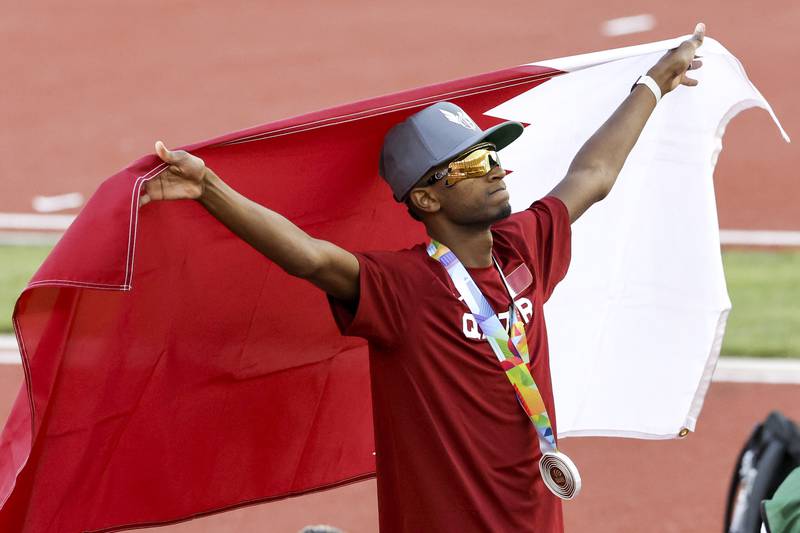
WORLD RECORD: QATAR: Mutaz Barshim turns on the style to Win Third Straight World High Jump Gold Medal at the ‘World Athletics Championships, Eugene,USA

Qatari dominated his rivals to retain his title with a winning jump of 2.37 metres.

Qatar’s Mutaz Barshim turned on the style to win his third straight world high jump gold medal on Monday after clearing a world-leading 2.37 metres with ease.

Barshim, who famously shared Olympic gold with Italy’s Gianmarco Tamberi last year, jumped beautifully all night at Hayward Field in Eugene, Oregon to go well beyond his own season’s best of 2.30m.

The title was just about secure after he cleared 2.35m but he then eased over 2.37m looking almost in slow motion. With the gold medal then in the bag he had one attempt at a championship record 2.42m but failed.

“The target for me for today was gold medal, if even the world record is the only thing I still miss,” said Barshim, whose best of 2.43m is second only to Javier Sotomayor’s 2.45m set in 1993.

“Three worlds golds in a row is something that has never have been done before. I feel like I have a name in our sport, but I have been never felt like the greatest one in the field,” added the modest Qatari, who also has two Olympic silvers and a world silver to his name.

World indoor champion Woo Sang-hyeok of South Korea needed three attempts to get over 2.33m but then also cleared 2.35m at the second attempt to take silver. Ukraine’s Andriy Protsenko collected bronze on the back of his 2.33m clearance.

Tamberi had a nervous path into the final, twice failing at 2.25m and then twice again at 2.28m in Friday’s heats. In the final he failed twice at 2.30m but then cleared 2.33m at the second attempt before bowing out at 2.35m to finish fourth.

source/content: thenationalnews.com (edited)

___________

Mutaz Barshim celebrates after winning the men’s high jump final at the World Athletics Championships at Hayward Field in Eugene, Oregon, USA, on July 18 2022. EPA

_________

QATAR

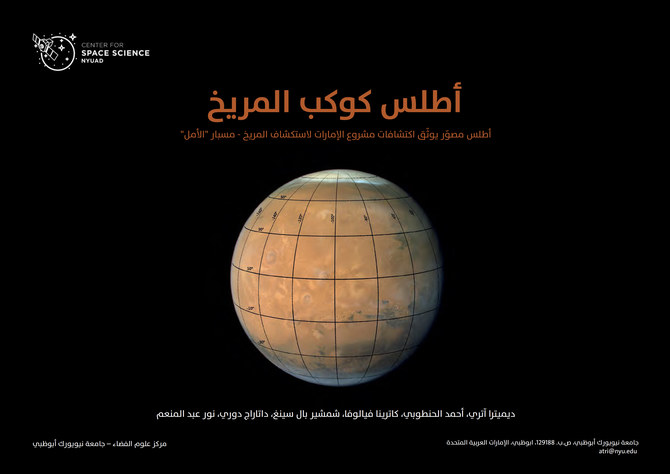
WORLD RECORD: EMIRATES (U.A.E) : NYU Abu Dhabi Research Scientist to Publish the World’s First Arabic Mars Atlas

NYU Abu Dhabi research scientist Dr. Dimitra Atri has produced the world’s first ever Mars atlas in Arabic, Emirates News Agency reported.

The atlas uses data from the UAE’s Emirates Mars Mission (EMM) — also known as Hope or Al-Amal — in order to make the findings of the probe more accessible to both the UAE’s Arabic-speaking population and the rest of the world.

The Mars Atlas Project combines various images from the Hope probe to map the planet’s surface.

The end result is a comprehensive view of Mars and stunning images of a planet that once had similar atmospheric conditions to Earth.

Dimitra Atri used data from UAE’s Hope probe to map the red planet.

Atri and his team compiled the atlas by processing observational data from EMM’s Emirates eXploration Imager, one of three instruments onboard the orbiter. The device will also assist the team in showing how the planet changes over the course of one Mars year, which is roughly equivalent to two Earth years.

As more data from the Hope probe becomes available, the atlas will be gradually updated.

The data will help scientists gain a better understanding of the planet’s atmospheric thinning, which has caused it to cool and dry over the last 4 billion years.

Atri predicts that the collected data will be used to answer unsolved scientific questions about the erosion of Mars’ atmosphere.

The findings could help the international scientific community to better understand Earth’s atmospheric processes, he said.

source/content: arabnews.com (headline edited)

____________

______________________________________________

ABU DHABI, UNITED ARAB EMIRATES (U.A.E)

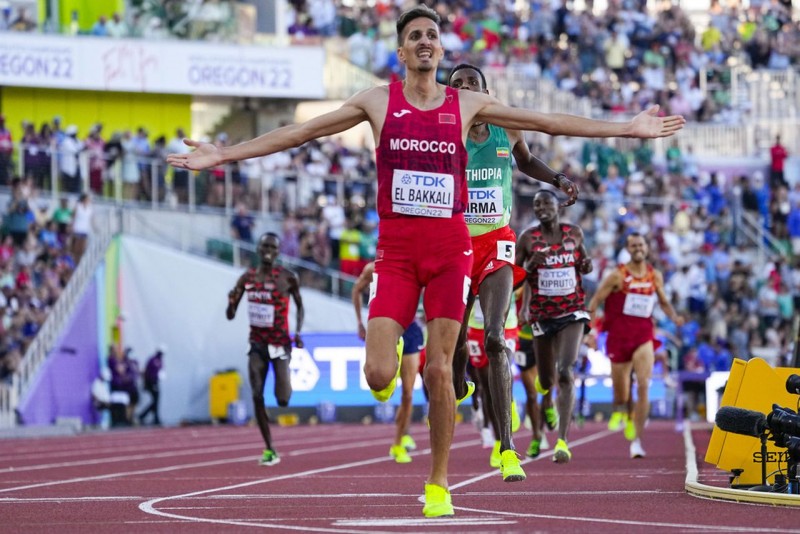
WORLD RECORD: MOROCCO: Soufiane El Bakkali Creates History Wins Gold in Steeplechase at the ‘World Athletics Championships’, Eugene,USA. Creates History- Becomes First Moroccan Athlete to Win Gold in 3,000m Steeplechase at World Championships.

After his recent achievement, El Bakkali became the “king of steeplechase.”.

King Mohammed VI sent on Tuesday a message to Moroccan steeplechase runner Soufiane El Bakkali, congratulating him on winning the gold medal at the World Athletics Championships held in Eugene, US.

The Moroccan athlete brought Morocco its first gold in the 3,000m steeplechase in this year’s World Championships, ending Kenya’s 15-year reign in the discipline at the international competition.

The King expressed his appreciation for El Bakkali’s achievement, saying that the Moroccan athlete “was able, thanks to his competitive spirit and patriotism, to achieve this well-deserved victory.”

“As we commend this well-deserved global crown, with which you raised the flag of Morocco in this prestigious international event, we wish you success in your rich sporting career, covered by our generous sympathy and satisfaction,” the King added.

A teary-eyed El Bakkali raised the Moroccan flag after his triumph, telling the media he was dedicating this win to King Mohammed VI, his parents, and to all the Moroccans who have shown him endless support and encouragement.

Several international media reporting on El Bakkali’s recent achievement described him as the “king of steelechase” after claiming world title.

He added, “After the semi-final I had a good look at the strategy of the Kenyan athletes. I was on my own, the only Moroccan in the race, but I did not limit myself to winning silver nor bronze. Instead I managed to come first in two world league meetings and now the World Championship.”

El Bakkali began earning his first medals at international events at the 2017 World Championship in London, where he placed second, before finishing first in the 2018 Mediterranean Games in Spain.

In August 2021, Soufiane El Bakkali gave Moroccans a moment of pride after his historic achievement at the Olympics, ending Kenya’s dominance over the men’s 3,000m steeplechase and winning the gold medal at Tokyo 2020. 

source/content: moroccoworldnews.com (headline edited)

_____________

_____________

MOROCCO

RECORDS: SAUDI ARABIA: Al-Jum’ah Mosque in Madinah, where the Prophet (pbuh) Performed the First Friday Prayer after Migration from Makkah

As a site of historical significance with a prominent role in Islamic history, today it sees a number of visitors who come to perform their prayers.

Madinah is home to a number of mosques and historic Islamic sites, a veritable tourist destination where visitors can explore places from Prophet Muhammad’s life.

Al-Jum’ah Mosque is one such place, linked to the migration of Prophet Muhammad from Makkah to Madinah.

The mosque is the site where the prophet stopped in the Wadi Ranuna region and performed the Jum’ah, or Friday, prayer.

Al-Jum’ah Mosque holds different names, such as Al-Wadi Mosque and Atikah Mosque.

As a site of historical significance with a prominent role in Islamic history, today it sees a number of visitors who come to perform their prayers.

It is situated southwest of Madinah, near Wadi Ranuna, 900 meters north of the Quba Mosque and 6 kilometers from the Prophet’s Mosque.

It was built with rocks initially then demolished and renovated several times. Before the last expansion, the mosque was built over a small mound, with one dome made of red bricks. Then it was rebuilt and expanded to accommodate 650 pilgrims.

The mosque also includes a minaret, a main dome in the middle of a praying area and four small domes on its sides.

source/content: arabnews.com (headline edited)

_________

Al-Jum’ah Mosque in Madinah. (SPA)

_________________

SAUDI ARABIA
UAE National Jiu-Jitsu Team Harvests Five Medals in ‘World Games Competition 2022’ in Alabama, USA

The UAE national jiu-jitsu team of five athletes has added two medals in the 11th edition of the World Games hosted by Birmingham, USA, from 7 to 17 July, 2022, bringing its total harvest to five medals (two gold medals, two bronze and one silver).

UAE’s Faisal Al Ketbi captured the gold medal in the 85kg category, while the 19-year old Shamma Al Kalbani won the bronze in the open weight division, becoming the first Emirati athlete to achieve such a global landmark victory.

A jiu-jitsu squad of five athletes from the UAE qualified for the games, building on an impressive performance at the 2017 Games in Warsaw, Poland. Last time out, Al Ketbi won the gold medal in the under-94kg.

Abdel Moneim Al Hashemi, Chairman of the UAEJJF, and Senior Vice President of the International Jiu-Jitsu Federation (JJIF), called the UAE team to offer his congratulations.

Fahad Ali Al Shamsi, Secretary General of the UAE Jiu-Jitsu Federation (UAEJJF), attended the award-giving ceremony, and congratulated Faisal Al Ketbi and Shamma Al Kalbani on the winning.

Tariq Al-Bahri, Director of the Abu Dhabi Professional Jiu-Jitsu Association, Mubarak Al Menhali, Director of the Technical Department, UAE Jiu Jitsu Federation’s (UAEJJF), and Joachim Thumfart, Director-General of the Jiu-Jitsu International Federation (JJIF), watched the closing day competitions.

Considered a global showpiece for sports yet to be included in the Olympic Games, the prestigious World Games 2022 featured approximately 3,600 participants from 100 nations competing across more than 30 sports.

The Emirati stars included Faisal Al Ketbi (85kg), Muhammad Al Amri (77kg), Muhammad Al Suwaidi (69kg), Shamma Al Kalbani (63kg) and Balqees Abdelkareem (48 kg).

source/contents: wam.ae (edited)

__________

Photo: @uaejjf/Instagram

____________________________________

UNITED ARAB EMIRATES (U.A.E.)

4 Arab Cities Listed Among World’s Best

Time Out magazine ranks Marrakech 7th among top 53 cities. List also includes Dubai, Abu Dhabi, Doha

Marrakech has been ranked seventh in a new list of the world’s 53 best cities, compiled by British events magazine Time Out.

Dubai (40), Abu Dhabi (45) and Doha (53) were the other Arab cities receiving plaudits for their offerings in nightlife, liveability, and practical issues such as walkability and sustainability.

The magazine’s annual ranking this year was the first since 2019 to not revolve around resilience to the COVID-19 pandemic, instead focusing on the fun and practical frills that each city has to offer.

Time Out said it had “added extra weight to the things that make cities great places to visit as well as to live.”

It added: “Our top cities this year are the ones with thriving nightlife, amazing food and drink, and art, culture and museums galore.

“We’ve highlighted places that aren’t boring or overly expensive or overrated, and we’ve ensured that our top picks also score well for practical stuff like walkability, good public transport and safety, as well as sustainability.”

The editors were charmed by the “community, creativity and faith in the future” that made Marrakech “come roaring out of the pandemic with a new lease of life.”

Time Out spoke to local guides and experts to get a feel for what is particularly excellent about each urban hub.

Highlighting the new international storytelling festival in February, it said post-pandemic Marrakech has attracted “big players like La Mamounia” that were “sporting sassy new looks.”

The Moroccan cultural capital was described as “thriving,” with the magazine pointing to a range of exhibitions.

It added that El-Fenn had launched “the hottest Sunday music nights in town,” with visitors desperate to return.

Time Out said Dubai “has all the stuff you’d want from a travel destination — from incredible restaurants and buzzing nightlife to some of the world’s best shopping and simply stunning beaches.”

It also pointed to its modernity and cleanliness, highlighting that 97 percent of the locals say the city is clean.

Dubbed “a city of superlatives,” Time Out pointed to the emirate boasting the world’s highest infinity pool, tallest building and largest manmade island. Dubai heard the phrase “go big or go home” and truly took it to heart.

But while those “world’s largest” structures are static, the city is anything but. A vibrant events scene has introduced the newly opened Museum of the Future, with Time Out recommending that you follow your visit “with a beach club crawl along the rapidly expanding Palm West strip and a DJ set at Electric Pawn Shop.”

Time Out noted that Emirati capital Abu Dhabi is also the “unofficial arts and culture capital” of the UAE.

Pointing out that the city’s safety and cleanliness made it popular with expats, the magazine referenced the constant stream of exciting things to do, “from cutting-edge restaurant openings to major new museums including the Guggenheim Abu Dhabi and the National History Museum Abu Dhabi,” both of which are on the horizon.

Local expert Heather Cichowski, from Time Out Abu Dhabi, said the city “ranks among the least dirty, stressful and rude. In short, it’s an all-round comfortable and pleasant place to live and work.”

Like Dubai and Abu Dhabi, Doha was similarly praised for its cleanliness, but locals and expats have also lapped up the Qatari capital’s stream of events and activities.

As Doha gears up to host this year’s FIFA World Cup, the pinnacle of the world’s most popular sport, the city has been promoting its local events for every taste and persuasion.

Time Out said: “There’s loads of great stuff to see and do here, whether you fancy heading out to one of the city’s many cafés for breakfast (and we mean many, Doha’s coffee-and-cake culture is absolutely thriving), touring public art spots from Al Sadd Metro Station to Katara Cultural Village, or visiting a bar after hours.”

Boasting a slower and less stressful pace of life, the city is pouring attention into its arts scene.

The magazine said from now until the turn of 2023, some 17 new exhibitions are set to open, including an “immersive light installation from Pipiliotti Rist at the National Museum of Qatar,” which it described as “particularly stunning.”

source/content: arabnews.com

_____________

Marrakech. (Shutterstock)

A view of the downtown skyline is seen from the Museum of the Future in Dubai, United Arab Emirates, February 23, 2022. (REUTERS)
Buildings are seen on a coast line in Doha, Qatar. (REUTERS)

_________________________________________________________________________

MOROCCO / QATAR / SAUDI ARABIA / UNITED ARAB EMIRATES (U.A.E)

 Saudi Health Minister Fahad Al-Jalajel Names Dr. Samiha Sinan a Retired Doctor as the ‘Mother of Volunteers’

Dr Samiha Sinan worked as an internal medicine doctor for 43 years in several Saudi hospitals

Saudi Minister of Health Fahad Al-Jalajel has named 65-year-old retired doctor and volunteer Dr. Samiha Sinan the “Mother of Volunteers.”

“One retires from office work, not from serving pilgrims,” Al-Jalajel said, praising Sinan’s efforts in providing health care to pilgrims.

Sinan told Arab News that volunteering to serve pilgrims is a work of great honor if done sincerely and honestly. 

She worked as an internal medicine doctor for 43 years in several Saudi hospitals, retiring four years ago.

As soon as the pandemic hit across the world, placing great pressure on the health sector, Sinan jumped back into the field to help out.

“I am still able to give, and I tried to think of how a person could serve their religion, country and king, so I submitted a request on the volunteer platform at the Ministry of Health. I was afraid I would be rejected given my age, but my instinct told me to apply because I wanted to give and serve. The Ministry of Health approved my request, and I immediately decided to get back in the field and fight the pandemic,” she said.

Sinan added: “The Makkah health authorities tried to put my comfort first and asked me to work in a small medical clinic in Makkah, but I refused since the pandemic was growing stronger. I headed directly to a COVID-19 center in an isolated area in Al-Masfalah, in Makkah. No one was allowed to enter or leave, but we worked in a comfortable environment thanks to the measures the state had taken to support citizens. I volunteered there for two years, 12 hours a day, seven days a week.”

Even though COVID-19 has witnessed a steady decline in the Kingdom over the past few months, Sinan still volunteers in one of the squares at the Grand Mosque by providing medical care to injured pilgrims. 

source/content: arabnews.com (headline edited)

________

Dr Samiha Sinan volunteers by providing medical care to injured pilgrims at the Grand Mosque. (Supplied)

________________

SAUDI ARABIA

LEBANON: Google Doodle Honours Lebanese Doctor Saniya Habboub

Medical pioneer was one of the first women from the country to study abroad.

The life of doctor Saniya Habboub is being celebrated by Google’s Doodle on Friday, commemorating her graduation from medical school on June 10, 1931.

Born in 1901 to a Lebanese leather merchant and Turkish mother, Habboub was one of the first female doctors from Lebanon to study medicine abroad, in the US.

When she returned to Beirut she opened her own practice, inspiring other Lebanese girls and women to get an education of their own, according to Google’s description.

In 1926, Habboub was one of the first three students to graduate from the American Junior College for Women in Beirut, going on to study at the American University of Beirut.

In 1931, she received her degree in gynaecology and obstetrics from the Women’s Medical College in Pennsylvania and, in gratitude, left future students with a scholarship in her name.

She started her own practice two years later, in Bab Idriss, and went on to co-found the Lebanese Red Cross Association, as well as served as a board member for the Muslim Orphan’s Home, the Young Women’s Muslim Association and Maqassed Hospital.

In 1982, in honour of her devotion to medical services, the Lebanese government awarded her with a Health Medal of Merit, and there’s even a street in Beirut named after her.

Habboub died aged 82 in September 1983.

“Dr Saniya was an inspiring figure who paved the way for future generations of women to come,” Google says.

Dr William Stoltzfus, former president of Beirut University College, described her life as a “get-started signal” for the professional lives of many Arab women, according to AlRaida, the bi-annual journal published by the Arab Institute for Women.

The Doodle can be seen on devices across the Middle East and North Africa.

source/content: thenationalnews.com

___________

Dr Saniya Habboub died in 1983 aged 82. Photo: Public Domain

Google Doodle of Dr Saniya Habboub. Photo: Google

____________

LEBANON