Arabs & Arabian Records Aggregator. Chronicler. Milestones of the 25 Countries of the Arabic Speaking World (official / co-official). AGCC. MENA. Global. Ist's to Top 10's. Records. Read & Enjoy./ www.arabianrecords.org
The call invites emerging photographers residing and working in the Arab region to develop documentary projects within a structured process.
Submissions are open for the 12th Cycle of the Arab Documentary Photography Program (ADPP) from the Arab Fund for Arts and Culture (AFAC), in partnership with the Prince Claus Fund and the Magnum Foundation, and with support from the Norwegian Embassy to Lebanon and Syria.
The call invites emerging photographers residing and working in the Arab region to develop documentary projects within a structured process.
Selected grantees receive three intensive workshops led by regional and international experts, tailored one-on-one mentorship sessions, and a production grant to complete their projects.
Since its inception in 2014, ADPP has supported more than 120 photographers across the Arab region, building a community of visual storytellers working on regional narratives.
Visit the AFAC website to learn more and apply.
The deadline for submission falls on December 10th, 2025 at 5:00 PM Beirut Time.
The third edition of the Asian Arabic Debating Championship began on Tuesday at Arab Open University in Seeb.
The opening ceremony was held under the patronage of H E Mohammed bin Saeed al Balushi, Undersecretary in the Ministry of Information, in the presence of H E Basil bin Ahmed al Rawas, Undersecretary for Sports and Youth in the Ministry of Culture, Sports and Youth (MCSY).
The event has been organised by MCSY, Oman Debate Center and Qatar Debate Center. The championship aims to promote dialogue among young people and enhance the presence of the Arabic language in international platforms.
A total of 145 students from 40 educational institutions from 18 Asian countries are taking part. Organisers said the competition encourages logical reasoning, respect for differing views and persuasion skills within a multicultural environment. The championship will run till November 1.
Hilal bin Saif al Siyabi, Director General of the Youth Affairs at MCSY, said Oman takes pride in hosting the tournament, which reflects the country’s growing role in intellectual and cultural activities.
He said this edition includes competitive debate rounds, workshops, cultural site visits in Muscat, and an Omani cultural evening to provide a complete cultural and social experience for participants.
Reem al Musallam, Director of QatarDebate Center, said debates demonstrate that the strength of words lies in logic and that dialogue builds understanding.
Oman is hosting the event for the second consecutive year, following the success of the 2024 edition.
Organisers stated that the championship reinforces the country’s commitment to supporting educational and cultural initiatives that develop youth skills and encourage informed discussion on current issues.
Arab identity, in both historical and anthropological terms, has never been solely about genealogy.
Morocco is, in fact, an Arab country. While this assertion may appear self-evident, it has become a subject of debate in contemporary discourse. Some voices insist that Morocco’s identity lies exclusively in its Amazigh or North African roots, rejecting its place within the Arab cultural sphere. Yet, such claims overlook the complex processes through which cultural affiliations are formed, internalized, and lived. Moroccan Arab identity is neither imposed nor superficial; it is a deeply ingrained civilizational reality that is experienced, performed, and transmitted across generations.
Arab identity, in both historical and anthropological terms, has never been solely about genealogy. It is a cultural and civilizational framework, a shared language, religion, and set of symbolic practices, that transcends bloodlines and geography. The Arab Islamic expansion of the 7th-century introduced Arabic and Islam to what is known now as the Arab World, setting in motion a centuries long process of cultural integration. This integration was not a simple imposition, but a dynamic interaction between incoming and indigenous traditions, producing a distinctly Moroccan expression of Arabness. It is a process in which the Arab and the local coexist, interact, and mutually shape each other.
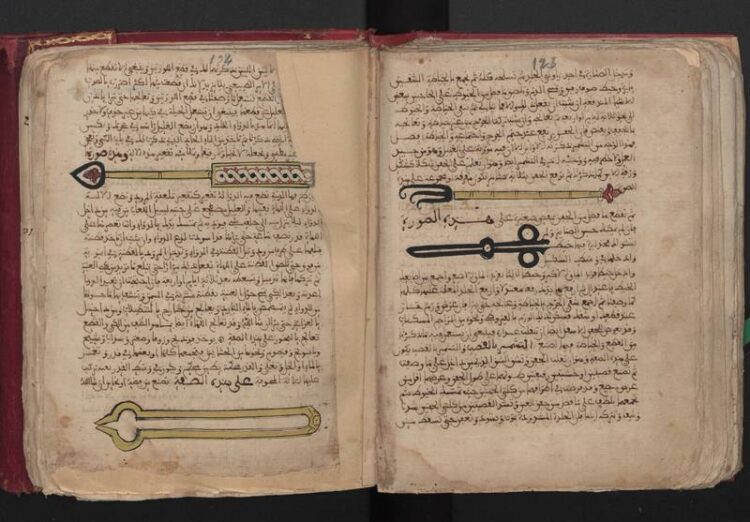
[First Illustration of surgical instruments in history] from Al-Zahrāwī, Al-Taṣrīf liman ‘aǧiza ‘an al-Ta’līf, 30th volume (Surgery). Bibliothèque Nationale du Royaume du Maroc (BNRM), as reproduced on the Islamic Studies Library Blog, McGill University
Morocco is, in fact, an Arab country. While this assertion may appear self-evident, it has become a subject of debate in contemporary discourse. Some voices insist that Morocco’s identity lies exclusively in its Amazigh or North African roots, rejecting its place within the Arab cultural sphere. Yet, such claims overlook the complex processes through which cultural affiliations are formed, internalized, and lived. Moroccan Arab identity is neither imposed nor superficial; it is a deeply ingrained civilizational reality that is experienced, performed, and transmitted across generations.
Language lies at the heart of this Arab identity. Classical Arabic became the medium of religious practice, scholarship, and literary expression, while Moroccan Darija evolved as a vernacular rooted in Arabic but enriched over centuries through interaction with Amazigh and Andalusi traditions, as well as later European influences. Computational linguistic analysis by Mrini and Bond (2018) found that approximately 42% of Moroccan Darija’s lexicon shares at least 60% similarity with Standard Arabic, while only about 3% aligns with French and 2% with Spanish. This demonstrates that, although Darija incorporates foreign and Amazigh influences, its core lexical foundation remains predominantly Arabic (Mrini & Bond, 2018, Putting Figures on Influences on Moroccan Darija from Arabic, French and Spanish Using the WordNet). This linguistic presence is more than practical; it is existential. Arabic provides the conceptual framework through which Moroccans think, communicate, and participate in a shared cultural universe. Anthropologists have long argued that language is the “house of being”, and in Morocco, Arabic offers that house, the structure within which Moroccan society organizes its collective life.
Yet Morocco’s Arab identity is not reductive. Its population is ancestrally diverse, encompassing Amazigh, Arab, sub-Saharan, Andalusi, and Mediterranean lineages. Rather than contradicting Arab identity, this diversity illustrates the inclusive, integrative nature of Arab culture, which historically has absorbed and harmonized a multitude of peoples and traditions. Being Arab in Morocco is thus defined not by ethnicity but by cultural practice, speaking Arabic, engaging with Islamic religious life, and participating in the intellectual and spiritual traditions of the Arab world. This identity is lived and internalized, a product of historical continuity and daily enactment.
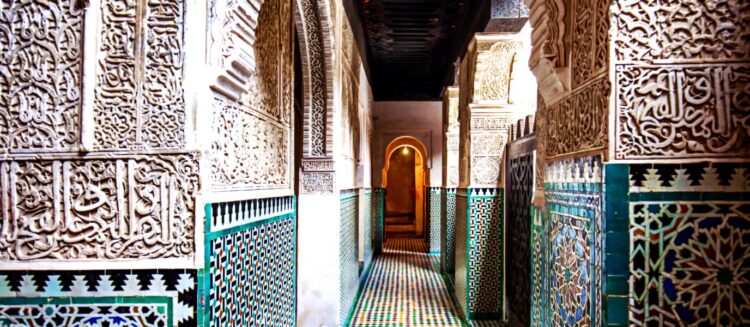
Medersa Bou Inania in Fez
Moroccan Arabness is dynamic and regionally inflected, expressed through a mosaic of Arabic dialects that embody the country’s historical and cultural layering. The pre-Hilali urban dialects, such as Fassi, Meknassi, and Rbati Arabic, spoken in the historic cities of Fez, Meknès, and Rabat-Salé, preserve many features of early Andalusian and Classical Arabic, including the conservative pronunciation of qāf as /q/ and more formal morphosyntactic patterns. In contrast, the Jebli dialect of northern Morocco, prevalent in Tetouan, Chefchaouen, and the Rif region, blends Andalusian, Amazigh, and Spanish influences, producing softer phonetics and a Mediterranean lexicon. The Hilali or ‘Aroubi (Bedouin) varieties, dominant across the Atlantic plains, Chaouia, and Souss, descend from Arab tribal migrations and underpin the speech of rapidly urbanized centers such as Casablanca and Settat. Further south, the Marrakchi dialect represents a transitional form combining urban and Bedouin traits, while Judeo-Moroccan Arabic, historically spoken in Jewish communities in Fez, Essaouira, and Sefrou, incorporates elements from Hebrew and Spanish (Haketía). In the southeast, around Errachidia and the Tafilalet region, daily speech follows Hilali Bedouin patterns, but the area also preserves a rare, literary form of Filali Arabic used in Melhoun poetry and song, reflecting a deep historical connection to Classical Arabic and regional artistic expression. Further south and toward the Sahara, Hassani Arabic, a Bedouin variety influenced by Maghrebi and Saharan linguistic currents, illustrates the continued interplay of migration, trade, and cultural exchange in shaping Moroccan Arabic. Collectively, these dialects illustrate how Moroccan Arabic varies across geography and social history, forming a linguistically plural yet distinctly Arab national identity. These variations reflect the adaptability of the language and, by extension, the adaptability of Arab identity itself. Moroccan Arabness, therefore, is neither monolithic nor static; it evolves through time while maintaining continuity with a broader Arab cultural framework.
Describing Morocco as an Arab country is to acknowledge the primacy of this linguistic, religious, and cultural fabric. Arabic is not merely an official language; it is the deep structure of Moroccan society, shaping poetry, moral discourse, social interaction, and ritual life. Arab identity in Morocco is lived in the streets of Casablanca and Fez, in the rhythms of daily prayer, and in the idioms and expressions of everyday conversation. It is experienced through shared cultural symbols and practices that bind Moroccan society to the larger Arab world while remaining distinctively local.
Recognizing Morocco as an Arab country does not erase its rich cultural diversity; rather, it highlights the central role that Arab language, culture, and religion play in the nation’s historical and contemporary identity. Moroccan Arabness is a living, evolving phenomenon, formed through centuries of interaction, internalized through daily life, and transmitted through language, ritual, and social practice. It reflects a society that is at once rooted in its local context and deeply connected to the broader Arab civilization.
In conclusion, Morocco’s Arab identity is a complex, multidimensional reality, grounded in linguistic, religious, and cultural practices. It is the result of historical processes, dynamic interactions, and the continuous enactment of shared meanings. To affirm that Morocco is an Arab country is not to deny its diversity but to recognize the living fabric of its identity, a fabric woven from Arabic language, Islamic faith, and the symbolic systems.
There will be a ceremony honoring the winners held under the patronage of His Highness Prince Badr bin Abdullah bin Farhan, minister of culture
The King Salman Global Academy for the Arabic Language announced the names of the winners of its awards celebrating efforts to serve the language.
Mahmoud Al-Batal won an award for his work in teaching Arabic in the US, which included carrying out in-depth research into linguistics, much of which has been published in peer-reviewed studies.
The Saudi-based Manahij International Foundation received an award recognizing its development of educational materials and curricula for early years language learning and Arabic for non-native speakers.
Manahij was also highlighted for developing training packages for teachers, and praised for its “originality, methodology and innovation” in the field, the Saudi Press Agency reported.
Algerian Ahmed Khorssi was recognized with an award for his contributions to the language by developing more than 30 computer programs including tools for correcting pronunciation.
He has published more than 15 studies in peer-reviewed journals and international conferences.
King Abdulaziz City for Science and Technology won an award for developing systems including an audio database, an automatic speech recognition system in local dialects, and other advanced tools.
Ramzi Mounir Baalbaki, from Lebanon, won an award that recognized his academic career that has spanned four decades
Baalbaki has authored 12 books and more than 80 research papers in Arabic and English in peer-reviewed scientific journals.
Saad Abdel Aziz Maslouh, from Egypt, received an award recognizing a lifetime of academic achievements including the publication of 33 books and 29 research papers.
The Arabic Education Training Center for Gulf States, in the UAE, was awarded for developing evaluation tools and other educational content.
Mazen Abdulqader Mohammed Al-Mubarak, from Syria, won an award for his extensive scholarly work including the well-known book “Towards Linguistic Awareness.”
The National Coalition for Arabic Language in Morocco also received an award for promoting linguistic awareness in Moroccan society through lectures, seminars and intellectual forums.
There will be a ceremony honoring the winners held under the patronage of His Highness Prince Badr bin Abdullah bin Farhan, minister of culture and chairman of the board of trustees of the academy, next Sunday in Riyadh.
source/content: arabnews.com (headline edited)
_____________
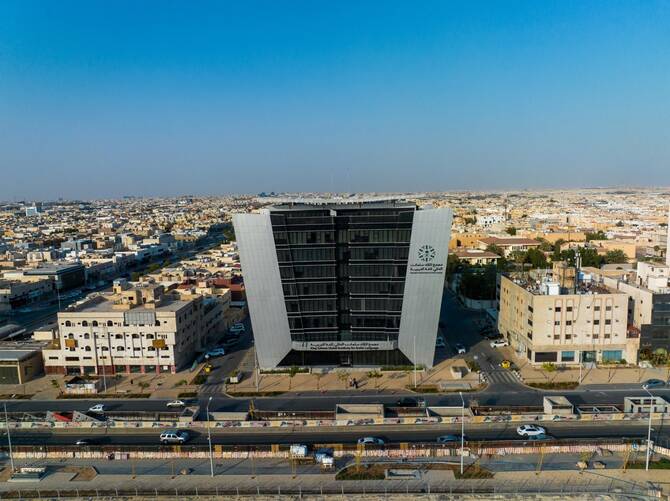
The King Salman Global Academy for the Arabic Language’s headquarters in Riyadh. (OIC)
Astrophile magazine reimagines how science could speak to readers across the Arab world
It reminds young Saudis and Arabs that science is not foreign, but is part of their own story
Saudi science communicator Reyam Alahmadi is bringing the cosmos closer to home. At just 25, the Madinah-born innovator has launched Astrophile, the Kingdom’s first Arabic astronomy magazine, to make space science accessible, accurate, and part of everyday conversation across the Arab world.
“What began as a personal fascination with the cosmos evolved into a full-fledged movement to revive Arab contributions to astronomy, and to give today’s generation the tools and language to rediscover them,” she told Arab News.
“The Arab world truly needed something like Astrophile. There wasn’t a single comprehensive Arabic astronomy platform, which left a huge gap in accurate knowledge. That gap led to misconceptions about space, and that’s what we wanted to fix.”
When Astrophile launched, the magazine did not simply translate international astronomy news, but also reimagined how science could speak to readers across the Arab world.
Through storytelling, visual design, and educational offerings, Alahmadi built a brand that feels both modern and deeply cultural. Every article blends cosmic wonder with accessible language, transforming scientific terms into relatable concepts.
“I believe the wonder of space belongs to everyone,” she said. “So I share what I learn in the simplest way possible, not with overwhelming numbers or formulas, but through storytelling and curiosity. My goal is to make readers feel the beauty of the universe, not the heaviness of its equations.”
In a region where complex STEM subjects often feel distant, Alahmadi’s approach bridges the emotional and intellectual, transforming astronomy into a shared cultural experience.
For Alahmadi, Astrophile is more than a publication, it is a revival. She sees it as part of a wider effort to reclaim the Arab world’s historic leadership in astronomy, from scholars who once mapped the stars to modern-day dreamers shaping the space economy.
“Astronomy, chemistry, and physics, many of these sciences were born from Arab minds,” she said. “Reviving that heritage isn’t nostalgia; it’s responsibility. We’re continuing what our ancestors began, adapting their legacy to today’s society.”
By publishing in both Arabic and English, Astrophile bridges global and regional audiences. It reminds young Saudis and Arabs that science is not foreign, but is part of their own story.
Her vision, she said, is to “restore curiosity as a national habit.”
Behind Astrophile’s elegant visuals and clean scientific precision lies a deeper challenge: language itself.
“One of the hardest parts is translation,” Alahmadi said. “Some technical terms, especially about rockets or engineering, simply don’t exist in Arabic. It can be frustrating, but also exciting; it gives us space to innovate linguistically.”
As well as science writing, each issue of the magazine also involves linguistic invention, as her team refines and localizes terminology to suit Arabic readers without losing scientific accuracy.
“In a way, it feels like exploration on two fronts,” she said. “We explore space, and at the same time, we explore our language.”
That approach has given Astrophile a distinctive voice: poetic, informed, and proudly Saudi, blending design aesthetics with factual clarity.
In just a few years, Astrophile has evolved from a passion project into a respected reference point for young science enthusiasts, teachers, and even regional media outlets seeking verified space updates in Arabic.
Under Alahmadi’s leadership, the magazine has tackled global milestones such as the James Webb Space Telescope, the Artemis lunar missions, and Saudi Arabia’s astronaut program, translating these topics into stories that resonate with Arab identity and vision.
Her message is consistent: Science is not distant, it is personal.
“My vision is for Astrophile to become the leading reference for every Arabic-speaking space enthusiast,” she said. “I want it to inspire a generation who see space as part of their world, not beyond it.”
Alahmadi’s blend of scientific precision and cultural sensitivity has positioned her as a voice for both innovation and inclusion, proving that women in Saudi Arabia are not only joining, but also shaping global scientific conversations.
Her journey also reflects a broader transformation within the Kingdom, where young women are leading initiatives that merge research, creativity, and public engagement.
As part of the new wave of Saudi science communicators, Alahmadi represents the next phase of Vision 2030’s knowledge economy, where education and innovation converge to build cultural and intellectual self-reliance.
“Vision 2030 gave people like me permission to dream bigger,” she said. “It showed us that the Saudi youth can lead global conversations, not just follow them.”
Through her work, Alahmadi has made the cosmos feel closer, in both words and ownership. She believes every child who reads Astrophile could become the next scientist, engineer, or astronaut to carry Saudi Arabia’s ambitions beyond Earth.
Looking ahead, she plans to expand Astrophile into a regional science communication hub, combining digital platforms, educational workshops, and multimedia storytelling.
Her long-term goal is simple, yet profound: to make Arabic the language of discovery again.
“Science belongs to everyone,” she said. “But when we tell it in our own language, we don’t just understand it, we own it.”
As the night sky continues to inspire humankind, young innovators such as Alahmadi are proving that Saudi Arabia’s brightest stars are not just above, but right here, building the future.
Inside the first show dedicated to NYC’s Public Library’s Middle Eastern collections .
Outside The New York Public Library’s Stephen A. Schwarzman Building, the unmistakable scent of a halal food cart mingles with the sounds of various Arabic dialects, while two marble lions stand guard over Fifth Avenue. Inside, entire worlds are waiting to be discovered — including the often-overlooked stories of New York’s Middle Eastern and North African communities.
“Niyū Yūrk: Middle Eastern and North African Lives in the City,” the first exhibition dedicated to the Library’s Middle Eastern collections, opened Oct. 4. It will remain on view in the Ispahani-Bartos Gallery until March 8.
Curated by Hiba Abid, the exhibition contains around 60 objects — photos, books, periodicals and audio — dating from the 1850s to 2024. It centers specifically on the library’s own holdings, rather than attempting to tell a comprehensive history of MENA life in New York, Abid tells Arab News.
Drawing from over a century of rare materials the exhibition uses tangible objects to express the intangible: memory, identity and immigrant culture.
“It’s not a love letter. It’s a realistic letter,” Abid says, adding that these communities have long navigated complex questions of belonging, language, and preservation.
“The communities, from the very beginning, were wondering, ‘Where should our kids go to school? If they go to the public New York schools, they would probably lose their language, but we want them to still know Arabic and be aware of our traditions and values,’” she said.
The exhibition is divided into four chronological sections, designed to help guide visitors of all ages, from young children to seasoned scholars.
The first section, “Roads to New York,” focuses on the earliest waves of immigration. One of the first featured figures is Hatchik Oscanyan — later known as Christopher Oscanyan — an Armenian man born in what is now Türkiye. He came to New York in the mid-19th century and sought to educate Americans about the complexity of the Ottoman Empire. He wrote plays and newspaper articles, as well as “The Sultan and His People,” a book that offers insight into the region’s diverse ethnic and religious makeup.
The second section, “A Life in the City,” explores how immigrant communities began to form and thrive in New York, including in what was once known as Little Syria on Manhattan’s Lower West Side — an area that still exists today. They were entrepreneurs who opened restaurants, shops, and began publishing Arabic newspapers.
One of the most groundbreaking was Al-Hoda, founded by Naoum Antoun Mokarzel and his brother Salloum. “In the basement of Al-Hoda Press, they adapted the linotype machine from Latin characters to Arabic characters, which is very hard (because Arabic is) a cursive language,” Abid says. “By this technological innovation, he actually allowed other presses to form and to publish newspapers, periodicals, and books,” which then circulated throughout North and Latin America — and back to the Middle East.
In other words, New York was instrumental in literally building the Arabic press and exporting news to the Middle East.
Abid emphasizes how vital the library’s historical collections are to telling these stories.
“The library has been collecting these materials since the late 19th century,” she says, adding that many of them have been digitized, enabling audiences to interact with them in a new way.
The third section, “Impressions,” flips the gaze, revealing how Middle Eastern immigrants perceived New York and the US.
“Many immigrant groups embraced American values… but many (Arabs) actually didn’t like New York and didn’t like American values and left after a few years here or after a few months.” The exhibit highlights these ambivalences and the tensions of assimilation.
The final section, “In Our Own Skin,” is the most contemporary and, for Abid, the most personal. It includes raw, vulnerable stories that reflect racial identity, Islamophobia, and resistance. Among the most powerful pieces is the short documentary “In My Own Skin,” directed by Jennifer Jajeh and Nikki Byrd, which features interviews with five Arab women in New York, and was filmed just one month after the events of Sept. 11, 2001.
“The interviews are absolutely amazing. Every time I talk about it, I have goosebumps,” Abid says. “The way they talk about it — it is still very relevant today, as if nothing changed much, except that we’re probably more powerful because we are aware of this and we know how to organize and to fight back. We have the vocabulary now, and the community.”
That spirit of organization is embodied by Malikah, a grassroots collective founded by Rana Abdelhamid in 2010 as a self-defense class for Muslim women on Steinway Street in Queens. The movement has since expanded into a larger project of empowerment, healing, and solidarity — and is featured in the exhibit’s final section. The powerful sound of the athan, or call to prayer, has been important to this cultural shift.
While images of the Statue of Liberty — based on an Egyptian woman — didn’t make the cut, but Abid stresses its significance on each guided tour. On this occasion, though, she wanted to focus the visitors on lesser-known gems.
Having lived in New York for the past four years as a Tunisian immigrant who spent much of her life in France, Abid says she finds New York to be more diverse than anywhere else she has ever lived.
“I live on Atlantic Avenue in the Syrian corner. The things I witnessed here and in Middle Eastern parts of New York, like Astoria, I could never see anywhere else — even Paris,” she says. “When you go to the exhibition, you actually think, ‘Damn! We actually did a lot. And we’re here, you know—we’re here.
“It shows how New York was central to all of these struggles and how New York — thanks to its MENA community — was actually connected and aware. It puts New York on a global map, you know? I think New York is incredible terrain for this. It’s the space for it. That’s what this show is about, ultimately.”
source/content: arabnews.com (headline edited)
______________
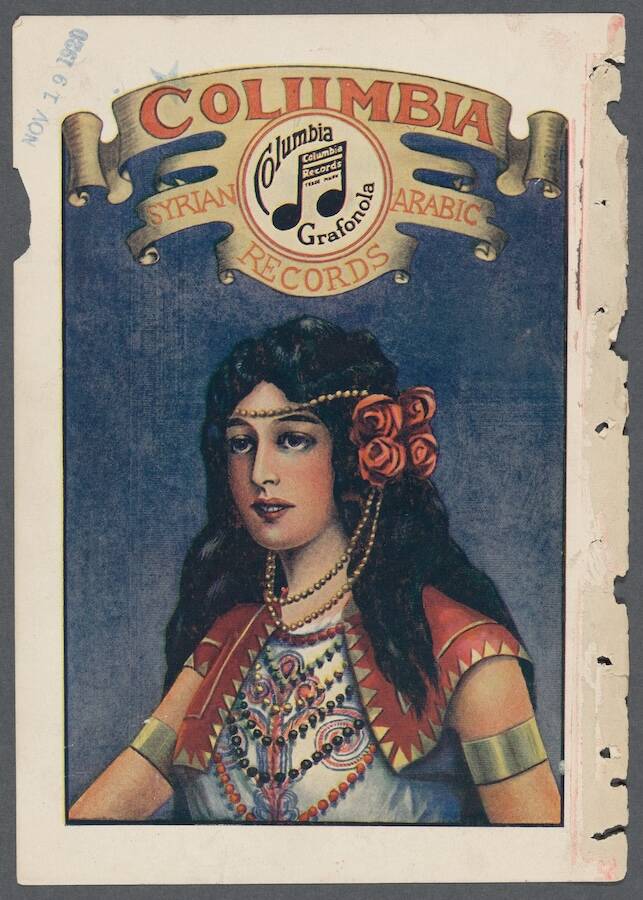
A poster from 1920 promoting Columbia Syrian Arabic Records — Columbia was one of the major American record labels to recognize the commercial potential of ethnic music markets in the US. (Courtesy of The New York Public Library)
Annual event at King Faisal Center spotlights heritage, intellectual legacy
The official celebration of the 13th Arab Manuscript Day was inaugurated on Sunday by Prince Turki Al-Faisal, chairman of the board of directors at the King Faisal Center for Research and Islamic Studies.
Held under the theme “The Arab Manuscript: Life of a Nation and Pioneer of Civilization,” the event was organized in collaboration with the Institute of Arabic Manuscripts at the center’s headquarters in Riyadh.
Prince Turki said: “This day calls upon the memory of thought and allows the soul to listen to the echoes of centuries past.”
He added that Arab Manuscript Day went beyond celebrating paper and ink and honored the consciousness and intellectual legacy that shaped Arab and Islamic civilizations.
He recalled that the late King Faisal bin Abdulaziz received a delegation from the Institute of Arabic Manuscripts in Riyadh more than 50 years ago, near the site of the current center.
The meeting, he said, was a moment of “intellectual enlightenment,” during which King Faisal described heritage as a vital part of identity, comparing it to “a rich fountain of culture that never stops flowing.”
Abdulrahman Al-Khunaifer, adviser at the center, said that the day symbolized the convergence of time and place, at which “Damascus, Cairo, Baghdad, and Cordoba meet Riyadh and Diriyah” to celebrate the enduring legacy of the handwritten book.
He added that the center had produced thousands of titles and research projects that had kept the Arab manuscript “alive and beating” throughout history, and that the hosting of this year’s celebration represented the culmination of those efforts.
Three awards were presented during the ceremony: Yahya Mahmoud bin Junaid, a Saudi professor, was named the Heritage Research Personality of the Year in the Arab World.
In his acceptance speech he described heritage as a living tool for understanding modern society and the evolution of intellect, calling for the creation of a comprehensive digital index of heritage books to support researchers.
The award for Heritage Institution of the Year in the Arab World went to the National Laboratory for the Conservation and Restoration of Parchment and Manuscripts in Kairouan, Tunisia. Its director, Manal Rimah, said the recognition was a tribute to Tunisia’s cultural institutions.
The Heritage Book of the Year went to “The Collection of the Gems of Navigation in the Compendiums of the Benefits of Agriculture,” edited by Ihsan Thannoon Al-Thamiri, a professor from Iraq.
He described the work as an encyclopedic documentation of Arab agricultural knowledge, the result of a long period of dedication.
Since its founding in 1983, the center has become one of the leading global institutions in manuscript care. Its collection includes around 30,000 manuscript titles and 150,000 digitized manuscripts, reproduced in collaboration with major libraries and museums worldwide.
The center has also cleaned and restored about 330,000 books, manuscripts, and documents, reinforcing its position as a key scientific and cultural platform for future generations.
“What King Faisal began five decades ago with the Institute of Arabic Manuscripts is now being continued by his sons and grandsons with modern awareness and cultural dedication,” Prince Turki said as he reflected on the Kingdom’s vision of knowledge and culture as pillars of progress.
source/content: arabnews.com (headline edited)
______________
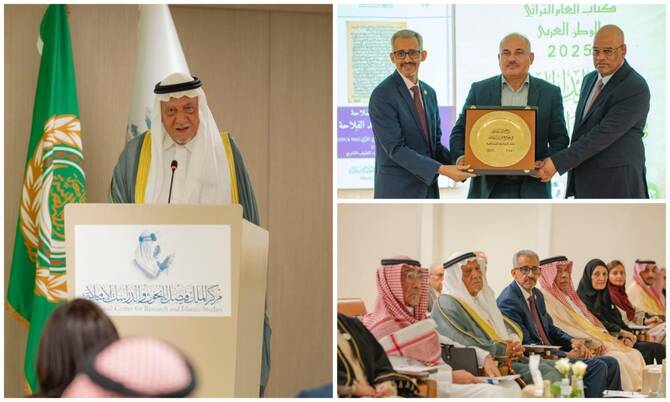
Left: Prince Turki Al-Faisal gives his opening remarks on the occasion of the 13th Arab Manuscript Day at the King Faisal Center for Research and Islamic Studies; Since its founding in 1983, the center has become one of the world’s leading references in the field of manuscript care. It holds around 30,000 manuscript titles and 150,000 digitized manuscripts. (Supplied)
‘From Ocean to Gulf: Heritage Music of the Arab World’ is a series by Ahram Online, in partnership with the AMAR Foundation (Foundation for Arab Music Archiving and Research). In this article, we present the music of the city of Tunis from the dawn of the 20th century till the years of independence.
Many Tunisians rightly endorse this multi-cultural identity. Its variations are reflected across Tunisia’s different regions, echoing the visionary observations of the great Arab historian Ibn Khaldoun (1332–1406), himself born in the country centuries ago.
This multilayered landscape of cultural expressions is associated with social and religious practices and at different instances combines music, dances and classical and colloquial poetry.
Furthermore, it is geographically configured by the plains, the Atlas mountains, and the Mediterranean sea, and forms a continuity beyond political borders with Libya to the southeast, Algeria to the west, and sub-Saharan Africa to the south.
‘A living mosaic’
To Tunisian singer Ghalia Ben Ali, Tunisian music is a living mosaic shaped by centuries of cultural blending and conquests, yet always anchored in the people’s voices.
“I was inspired by the Amazigh music of South Tunisia, for it’s alive. When I was young, helping my mother do house chores, we used to sing. Young girls would create new wedding songs or songs about our daily lives; there were no newspapers or films to talk about this, “she said.
Moufadhel Adhoum, a Tunisian composer and oud player, showcases the diverse music of Tunis City, as well as the North, Mid, and South of Tunisia:
Ma’luf music is of Andalusian origins. As for Mezwed music, itincorporates a bagpipe-type instrument that shares the same name as the genre, accompanied by a darbuka or similar percussion instruments. However, El Kef Governorate, in northwestern Tunisia, bordering Algeria, has its own repertoire of songs inspired by the region’s customs and traditions, as well as the slopes of the Atlas range.
In the South, El Forja music consists of songs associated with weddings and occasions, whereas Stambeli represents an African dimension of Tunisian spiritual music. As for the Sufi practices, they include El-Ziyara music, chants that accompany visits to Shrines.
However, Shaabi music is a blend of Berber (Amazigh), Arabic, and African, influenced by the region’s natural setting, the desert and camel rhythms. It expresses sentiments about love and historic events. Instrumental genres are also present in Tunisia and feature instruments such as oud, rababa, and nai.
Crossroads
Tunisia has consistently been positioned at the “crossroads of the Islamic and European worlds” throughout various historical periods, as noted by historian Kenneth J. Perkins.
In the latter part of the 19th century, these dynamics paved the way for the interaction of the dominant political, economic and military forces at that time, namely Ottoman rule and European powers.
Under the leadership of the Husainid dynasty (1705-1957), Western-inspired reforms based on the Ottoman Tanzimat were introduced during the Ottoman administration.
Additionally, cultural connections were enhanced with countries such as France, Great Britain, and Italy, alongside other Ottoman states and the Maghreb on a different level.
Colonial cultural dominance
In 1837, a military music academy was founded in Bardo, west of Tunis city, which was succeeded by a symphonic orchestra in 1872.
Communities from these nations living in Tunisia introduced their cultures.
They initiated a significant cultural shift in local music practices, shaped by these nations’ various traditions, which later gained another layer with the establishment of a French protectorate over Tunisia in 1881.
New legislation was implemented to restrict traditional musical traditions among Tunisians, favouring and prioritising the European communities in Tunisia, according to researcher Alla El Kahla.
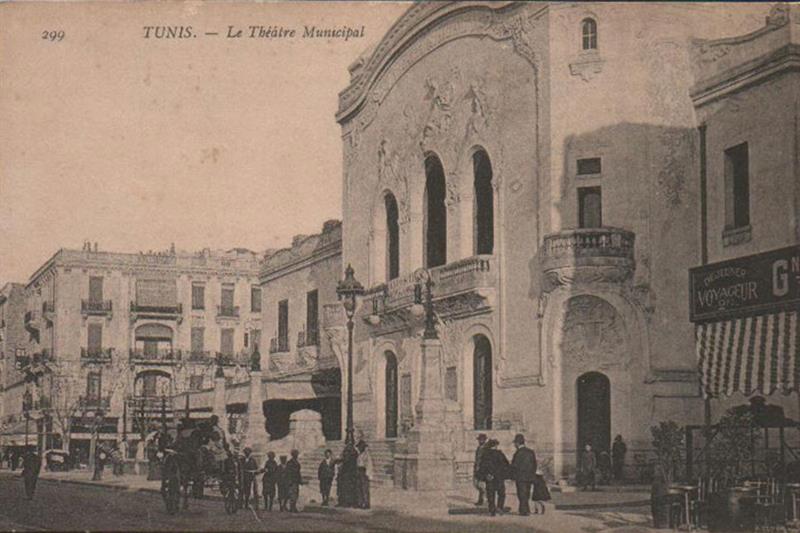
Francophone culture became a defining force in Tunisian society, with the capital developing into a cosmopolitan centre that saw the establishment of key institutions, including the National Archives (1874), the National Library (1885), and a network of museums across the country.
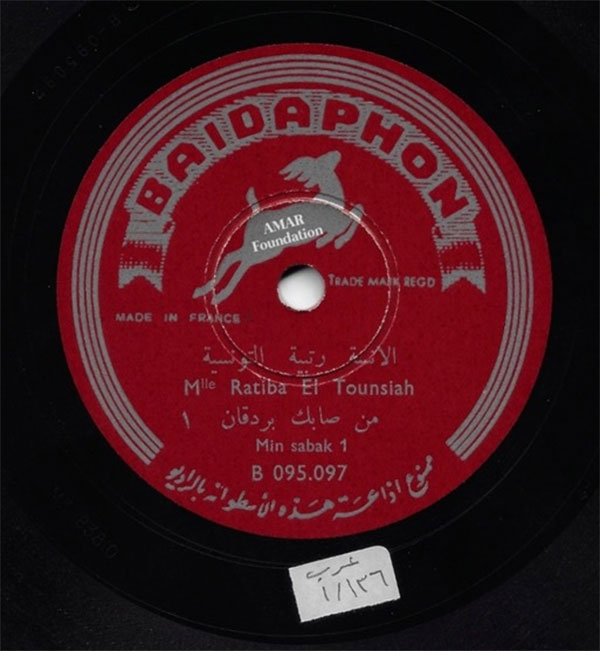
Simultaneously, traditional regional arts faced scrutiny regarding their worth, societal standing, and performance settings, as noted by the researcher Ruth Davis. Meanwhile, commercial recording began in Tunisia in 1904, coinciding with its development in Europe, where European brands dominated the market ahead of local or Arab brand names such as Baidaphon.
The foreign brands consisted of Pathé (France), Gramophone (England) through its French brand Zonophone, and Odéon’s French subsidiary (Germany). More about these record companies is available through AMAR’s podcasts and Bernard Moussali’s book, Le Congrès du Caire de 1932 (edited by J. Lambert: chap IV). Local record labels followed in 1930, such as Bembarophone.
A music school rooted in European traditions was founded in 1897, which subsequently became the Conservatoire National de Tunis after the nation gained independence in 1956. The musical life witnessed the emergence of orchestras and venues such as café halls and theatres that hosted European musicians, dancers, and actors performing mainly for foreign audiences. These performances eventually attracted Tunisian artists and audiences to music and theatre.
The Egyptian influence
The emergence of theatre groups from Egypt, including the Egyptian Comedy (Al-Comedia Al-Masryia), the Egyptian Troupe (Al-JawqAl-Maṣri) directed by Suleiman El-Qardahi, and Ibrahim Higazi’s troupe (1908 and 1909), came a few years later. Additionally, the Salama Higazi troupe introduced musical theatre to the Tunisian theatre scene in 1913.
These initial encounters sparked the foundational growth of Tunisian theatre. They brought the Arabic language and themes drawn from Arab history and heritage to established spaces that European traditions of music, opera, and theatre had previously dominated. Cultural exchanges from Egypt to Tunisia included screenings of early Egyptian cinema and visits by rising stars such as the Naguib Rihani Troupe (1933), followed two years later by a solo tour from his collaborator Badia Masabni with leading vocalist Nadra.
Other prominent figures, including George Abiad, Zaki Talimat, and Youssef Wehbe, also performed in Tunisia, as documented by Dr. Sayyid Ali Ismael in his study of Tunisian-Egyptian theatrical ties (1889–1962).
The author of the study traces these encounters back to the 1889 Paris Expo, when troupes from Egypt, Tunisia, Algeria, and Morocco shared the stage within the curated “Cairo Street” venue and presented their folk arts. The credit goes to these international expos for the oldest recordings of Tunisian music, notably the 1900 Paris Expo.
It was not long before a Tunisian-Egyptian troupe (Sodq Al-Ekhaa) was created in 1909, subsequently substituted by two Tunisian troupes, Literary Pride (Al-Shahama Al-Adabiyya) and Literary Arts (Al-Adāb), respectively in 1910 and 1911.
Other troupes followed their track across the country. While Al-Adāb expressed opposition to France, Al-Shahama Al-Adabiyya put forth no political agenda. One of the pioneering female names in theatre and music was Habiba Msika (1903-1930), who rapidly rose to stardom in theatres and café halls. Musicians integrated Western and Egyptian elements and practices, with the socio-cultural and political centrality of Egypt at that time.
Egyptian reference points sustained until different perceptions of authenticity grew in succeeding decades, as indicated by the researcher Salvatore Morra, who worked closely on the concepts of authenticity and modernisation in Tunisia.
Revival initiatives looked critically at possible local and regional relevant contexts of Tunisian heritage and identity beyond Egyptian aesthetic idioms and Western influences. Furthermore, the scholar Anas Ghrab points out three mechanisms that significantly transformed the musical aesthetics of traditional Tunisian art music. These include a rise in the number of musicians, the implementation of notation, and the incorporation of new instruments.
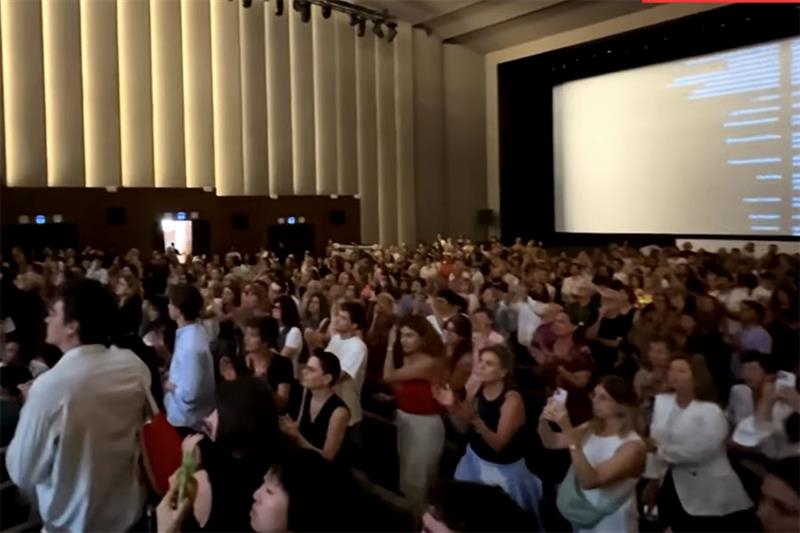
Following its screening, Kaouther Ben Hania’s film The Voice of Hind Rajab (2025) received a 22-minute-long standing ovation — the longest in the Venice Film Festival’s history – culminating in theatre-wide chants to “Free Palestine.”
The film had its world premiere at the 82nd edition of the renowned Venice Film Festival, which runs until 6 September.
The film is also Tunisia’s official submission to the 98th Academy Awards.
The first screening of the film was completely sold out hours before its showing.
Several artists from the film’s cast and crew attended the screening, including lead actor Motaz Malhees, who held a photo of Hind Rajab on the red carpet and raised the Palestinian flag on the stage of the theatre after the film’s conclusion.
The film’s unprecedented success was reflected in the longest standing ovation in the festival’s history, with chants of “Free Palestine” resonating across the hall.
The Tunisian-French co-production also stars Amer Hlehel, Clara Khoury, and Saja Kilani.
“Film anchored in truth”
In a post-screening press conference, Kilani declared that “the Voice of Hind Rajab does not need our defence. This film is not an opinion or a fantasy; it is anchored in truth. Hind’s story carries the weight of an entire people.”
Film director Ben Hania also commented on Trump’s plans to turn Gaza’s coastline into a “Riviera,” saying, “When I think about Hind playing on the beach, and I think about this project, [I find myself asking] in what world do we live in?”
Hind Rajab
The film recounts the events of 29 January 2024, when Red Crescent volunteers received an emergency call. A six-year-old girl named Hind Rajab was trapped in a car under fire in Gaza, pleading for rescue.
While trying to keep her on the line, they do everything they can to get an ambulance to her.
The film uses real-life voice recordings between Hind and the Red Crescent correspondents, who attempted to rescue her from the unrelenting Israeli attack.
Explaining her vision for the film, Ben Hania said, “What I wanted was to focus on the invisible: The waiting, the fear, the unbearable sound of silence when help doesn’t come. Sometimes, what you don’t see is more devastating than what you do. At the heart of it is something very simple, and very hard to live with. I cannot accept a world where a child calls for help and no one comes. That pain, that failure, belongs to all of us.”
Kaouther Ben Hania
Kaouther Ben Hania is one of the most acclaimed filmmakers of the Arab World, known for her bold storytelling and cinematic innovation.
Her 2023 film, Four Daughters, won the L’Oeil d’Or at Cannes and was nominated for Best Documentary at the 2024 Academy Awards.
Her 2020 feature, The Man Who Sold His Skin, was nominated for Best International Feature and won Best Actor at Venice’s Horizons Section.
Earlier works like Beauty and the Dogs (2017), Zaineb Hates the Snow (2026), and Le Challat de Tunis (2012) also earned international acclaim.
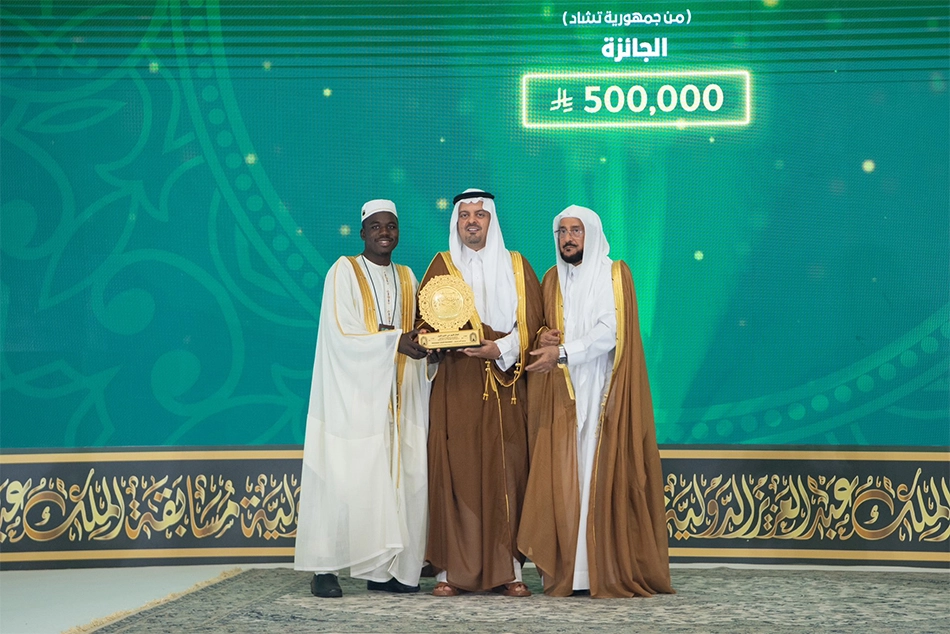
Chaad National, Mohammad Adam Mohamed has won the top prize at the 45th Edition of the King Abdulaziz International Holy Quran Competition or 2025 Makkah Quran Contest for Memorization, Recital and Explanation held at the Grand Mosque.
Makkah Quran Contest 2025: Chaad National, Mohammad Adam Mohamed has won the top prize at the 45th Edition of the King Abdulaziz International Holy Quran Competition or 2025 Makkah Quran Contest for Memorization, Recital and Explanation held at the Grand Mosque.
At a glittering ceremony held at Makkah Grand Mosque after Isha prayers Wednesday August 20, 2025, the Chaad national was awarded a cash prize of 500,000 Saudi Riyals or SAR 0.5 million prize.
The prize distribution ceremony was attended by all Imams of Masjid al Haram Makkah along with Deputy Governor of the Makkah Region Prince Saud bin Mishal bin Abdulaziz.
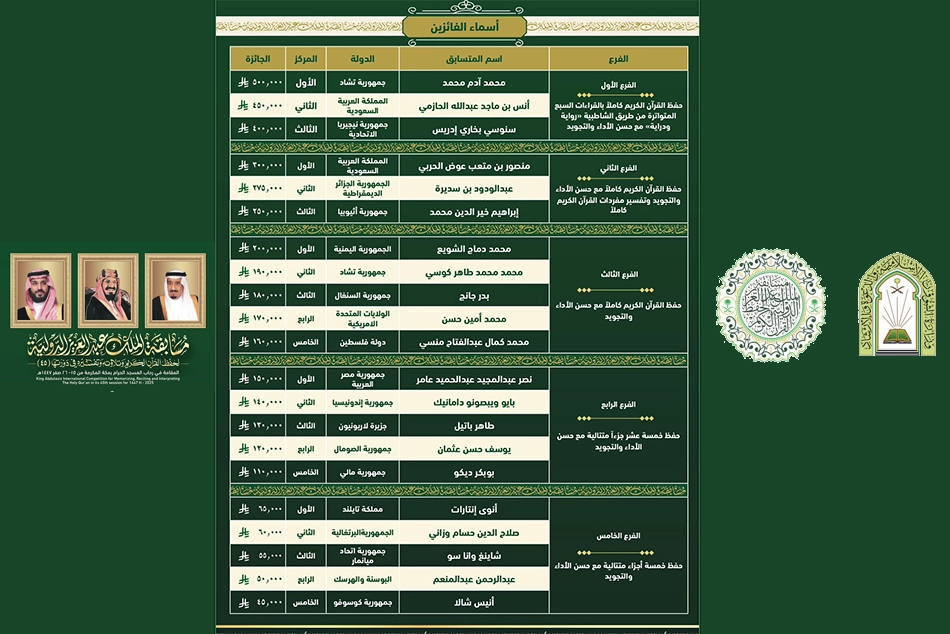
45th King Abdulaziz International Holy Quran Competition – List of Winners
The Makkah Quran contest 2025 was held in five categories. The winners of the first and most coveted category are as follows,
Mohammed Adam Muhamed (Chaad): Prize Money SAR 500,000
Anas bin Majid Abdulla Al Hazmi (Saudi Arabia): Prize Money SAR 450,000
Sanusi Bukhari Idrees (Nigeria): Prize Money SAR 400,000
5 categories
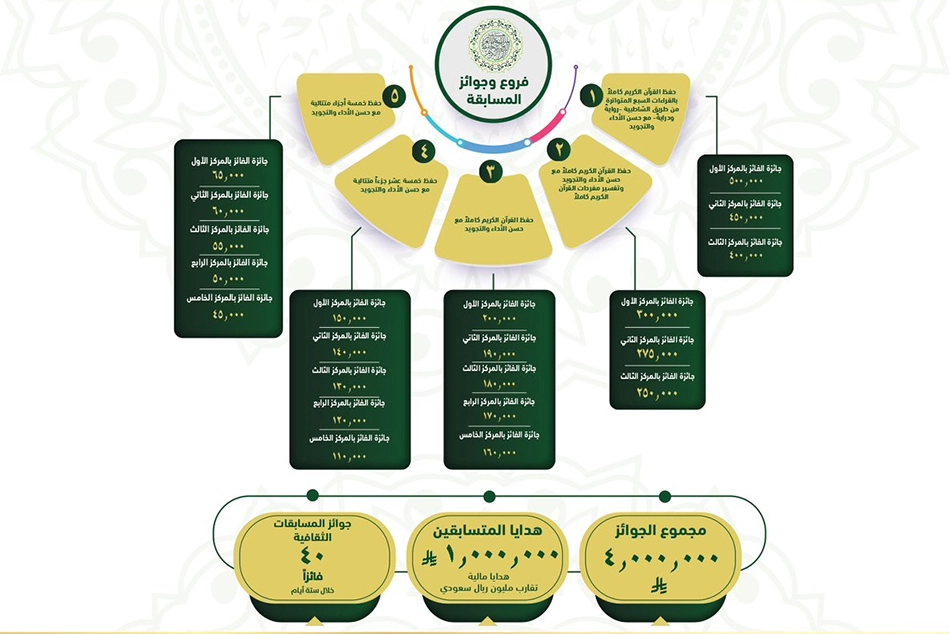
The competition was divided into five categories:
Memorization of the entire Holy Qur’an, with accurate recitation and intonation following the seven rules of recitation
Memorization of the Qur’an along with interpretation of its terms
Memorization of 15 juz (parts) of the Qur’an with proper recitation and intonation
Memorization of five juz with correct recitation and intonation
A category for shorter lengths of memorization with corresponding recitation and intonation requirements.
Other winners
The total value of the competition’s prizes is around SR4 million ($1.07 million), in addition to SR1 million that will be apportioned out to all participants.
Mansoor bin Mutab Awad Al Harbi of Saudi Arabia won the top prize of SAR 300,000 in the second category. Mohamed Damaj Al Shuway’i of Yemen won the top prize of SAR 200,000 in the 3rd category.
Eyptian Nasr Abdel Majeed Abdul Hameed Amir won the top prize of SAR 150,000 in the 4th category. The top prize money SAR65,000 for the 5th category was conferred on Anwa Intarat of Thailand.
The 2025 Quran Competition brought together 179 contestants from 128 countries, the largest number since its inception. In 2024, a total of 174 contenders representing 123 countries participated in the 44th edition of the contest held in 5 categories.
Makkah Qurant Contest 2025 Final Round
The final rounds of the 2025 King Abdulaziz International Competition for Memorizing, Reciting, and Interpreting Holy Quran began last Saturday August 09th, 2025
The final round of the Quran contest continued till Thursday August 14, 2025 when a total of 27 contestants recited Quran as per the contest competition guidelines.
The 27 contestants were from Mauritania, the Philippines, Japan, Guinea-Bissau, France, the United States of America, New Zealand, South Africa, Barbados, Ivory Coast, Cameroon, Guinea, Germany, Zambia, Guyana, Comoros, Uzbekistan, Kyrgyzstan, Finland, Rwanda, Bangladesh, and Myanmar.
As part of the competition package, the participants visited different historical places of religeous and architectural importance. The participants on Saturday August 16 left for visit to The Prophet (PBUH) Mosque in Madinah.
Electronic Judging System
The highlight of the 2025 Quran Contest which ran through six days was electronic judging system. Since its introduction in 2019, the electronic platform has replaced traditional paper-based methods, increasing accuracy and transparency.
The Ministry of Islamic Affairs, Dawah and Guidance said it enhanced and upgraded the electronic judging system for the 45th King Abdulaziz International Competition for Memorizing, Reciting, and Interpreting the Holy Quran held this year.
The enhanced system is designed to improve the efficiency and fairness of the final rounds, bolster transparency, and support the ministry’s digital transformation efforts in line with Saudi Vision 2030.
Watch: Winners Reaction
source: youtube.com
The latest improvements to the system include faster and more accurate scoring, with results calculated more precisely and linked to a real-time electronic control panel for instant monitoring by the judging committee.
An electronic question bank is now used to draw questions from a comprehensive digital repository covering all five branches of the competition, ensuring diversity and fairness. The system also features automated processes that track verse sequences, sort and rank contestants, and issue results instantly, while documenting and analyzing competition data in real time.
The 44th edition of the King Abdulaziz International Competition for Memorization, Recitation, and Interpretation of Holy Quran was also held with the same schedule. Saudi National, Saad bin Ibrahim bin Hamd had won the top prize of the 2024 Makkah Quran Contest.