Arabs & Arabian Records Aggregator. Chronicler. Milestones of the 25 Countries of the Arabic Speaking World (official / co-official). AGCC. MENA. Global. Ist's to Top 10's. Records. Read & Enjoy./ www.arabianrecords.org
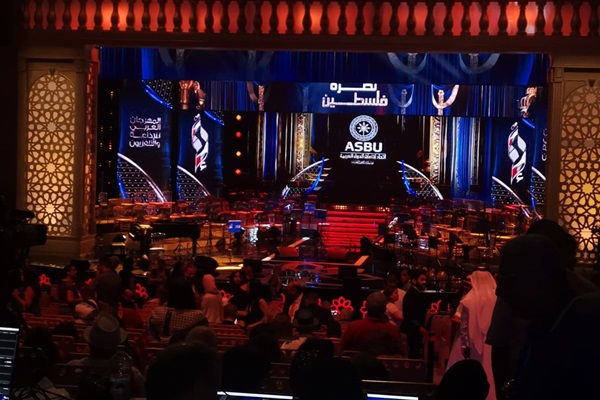
The opening ceremony concluded with a musical performance by Lebanese artist Ragheb Alama, with proceeds dedicated to supporting the people of Palestine.
Abdelrahim Suleiman, Director General of the Arab States Broadcasting Union (ASBU) and Mohammed bin Fahd Al-Harthi, President of ASBU and CEO of Saudi Broadcasting Authority (SBA), presented the awards to the winners of the 24th Arab Radio and Television Festival that was held in Tunis from June 26 to 29.
Part of the Text is Missing, a Kuwaiti TV show won the award for Best Arab TV Programme at the festival.
Saudi Broadcasting Authority (SBA) secured four radio and TV awards, including the second prize in the health programmes category for “Mental Health: Violence in Schools.” In the TV category, Saudi Arabia won three awards, including the second prize in the news category for talk shows, honouring the Saudi street programme on its episode about Vision 2030. Heritage in the Maqam of Hijaz took first prize in the general documentary films and programmes category, while the Saudi social drama series Al-Arbaji 2 secured second place in the social series category.
Additionally, the SBA received the second prize in the 2024 news exchange competition and also, the second prize in the 2024 programme exchange competition. The festival also honoured the judging panels for its radio and television competitions and distributed the exchange awards.
Qatar Media Corporation won three awards. Qatar TV took first prize for the documentary film Museums in Qatar, showcasing the distinctive museums of the country, and secured the second prize for Programme Exchanges of 2023 within the festival’s Arab Radio and Television competition in Tunisia. Qatar Radio won second prize in the “Notable Arab Figures” category.
The Ministry of Information, represented by the Sultanate of Oman Radio and the Sultanate of Oman Television, along with the private media institution Al Wisal, bagged 10 awards. Sultanate of Oman TV won four awards, including the Arab Joint Television Production Award for the documentary Holding Breaths, produced by the Ministry of Information and directed by Issa al Subhi.
Meanwhile, the Palestine Public Broadcasting Corporation (PBC) secured six awards. The radio programme Psychological Counseling in Times of War claimed first prize, while Radio Flash on school violence also earned top honours. Additionally, PBC received first prizes for radio news exchanges and a television report dedicated to the late journalist Mohammad Abu Hattab, a correspondent for Palestine TV killed by Israeli troops in Gaza. Furthermore, PBC was awarded second prize for the cultural programme Sadanat al-Riwaya and another award for the film Noura, produced by Palestine TV.
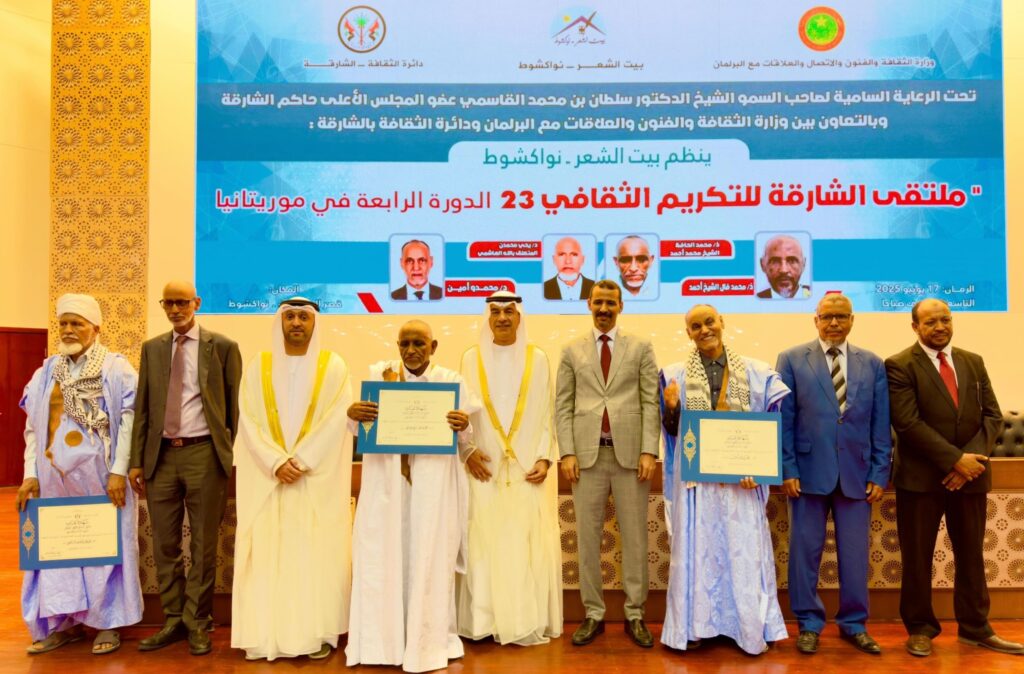
Under the patronage of His Highness Dr Sheikh Dr Sultan Bin Mohammed Al Qasimi, Supreme Council Member and Ruler of Sharjah, the Mauritanian capital, Nouakchott, witnessed a formal and cultural celebration that reinforced the values of loyalty to creative figures and affirmed their status.
The event was held as part of the 23rd edition of the Sharjah Cultural Honouring Forum, organised by the Sharjah Department of Culture in cooperation with the Mauritanian Ministry of Culture, Arts, Communication and Relations with Parliament.
Four prominent figures of Mauritanian literature were honoured in recognition of their contributions to enriching cultural life: poet Mohamed Fall Abdel Latif, linguistics academic Dr Yahya Al Hashemi, language researcher Dr Mohamedou Ameen, and poet Mohamed Al Hafiz Ould Ahmedou.
The forum reflects the directives of the Ruler of Sharjah to honour literary figures who have contributed to contemporary Arab culture. This marks the fourth time the forum is held in Mauritania, where it has previously recognised 12 Mauritanian creatives over past editions.
The award ceremony took place at the Conference Hall in Nouakchott, in the presence of Abdullah bin Mohammed Al Owais, Chairman of the Sharjah Department of Culture; El Houssein Ould Meddou, Minister of Culture, Arts, Communication and Relations with Parliament in Mauritania; Mohammed Ibrahim Al Qaseer, Director of Cultural Affairs at the department; the Governor of Nouakchott-West on behalf of the Mayor of Tevragh-Zeina Municipality; as well as a large audience of Mauritanian intellectuals, academics, writers, and the honourees’ families.
In his speech, Abdullah Al Owais highlighted the significance of the sustained cultural collaboration between Sharjah and Mauritania, saying, “We are pleased to meet today at this distinguished cultural event, which continues the journey of cooperation between the Sharjah Department of Culture and the Ministry of Culture, Arts, Communication and Relations with Parliament. This partnership has led to numerous cultural activities that support Arab culture and reinforce the role of thought and creativity in our Arab societies.”
El Houssein Ould Meddou welcomed the attendees and expressed his sincere thanks and deep gratitude to His Highness the Ruler of Sharjah, saying, “I am honoured to be with you today at this distinguished cultural gathering, celebrating this radiant forum and noble initiative. At the outset, I am pleased to extend my heartfelt thanks and appreciation to His Highness Sheikh Dr Sultan bin Mohammed Al Qasimi, Supreme Council Member and Ruler of Sharjah – this cultured leader who has dedicated his efforts, intellect, and time to serving the Arabic language and its literature, and to supporting the cause of culture and intellectuals throughout our Arab world.”
The honourees expressed their deep gratitude for the recognition, which they considered a badge of pride and an acknowledgment of their cultural and creative journeys. They noted that the Sharjah Cultural Honouring Forum represents a civilised model for celebrating Arab intellectuals and affirms the Emirate’s unwavering commitment to supporting thought and creativity across the Arab world.
They praised the vision of the Ruler of Sharjah in establishing culture as a pillar of development and identity. They emphasised that this recognition is not merely a personal honour, but a celebration of Arab culture and its creative figures across various fields. WAM
19 June marks 7th death anniversary of Amal Farid (1938-2018), an iconic Egyptian actress who captured hearts with her elegance and innocence.
Amal Farid was born on 12 February 1938 in Cairo’s Abbassiya district.
Farid’s career was launched at the hands of Baba Sharo (Mohamed Mahmoud Shaaban) in the early 1950s, when she was hired to work on his children’s radio show.
She was recommended by writers Mostafa Amin and Anis Mansour to appear in her first movie Mawed Maa El-Saada (A Date with Happiness), with mega star Faten Hamama in 1954.
This was soon followed by roles alongside the greatest stars of her time—most notably Abdel Halim Hafez, with whom she shared the screen in the classic film Layali El-Hob (Nights of Love, 1955), marking beginning of a connection that stirred rumors of a relationship between the two.
The starlets for whom Abdel-Halim sang in movies were very few. Amal Farid was among them, however, and she was envied by almost every girl in the Arab world for decades after Abdel-Halim sang Kefaya Norak Alaya in the film, where he and Farid danced in an iconic romantic scene.
Farid said in interviews that it was Abdel-Halim who asked for her by name to star alongside him in the movie.
Farid, who was known for her elegant and convincing acting style, worked most frequently alongside Ahmed Ramzy and the famous comedian Ismail Yassin.
She was fortunate to find directors who were able to utilise her talent in various roles. Such directors include Fateen Abdel-Wahab, Salah Abou Seif, Kamal El-Sheikh and Hussein Helmy El-Mohandes.
Farid was not always the main starlet in movies, but her presence was always felt, and she always made her mark with her convincing performance.
Director Henry Barakat brought Farid out of the pure girl role in Banat El-Yom (1957), where she embodied the personality of a spoiled, selfish girl. In the film, she provokes the hatred of the audience when she tries to spoil her sister’s love affair a nobleman played by Abdel-Halim, whom she accuses of trying to rape her out of jealousy.
The role was a surprise when the movie came out in 1957, but critics appreciated her performance and recognised the talented, capable and credible actress.
Farid’s filmography includes Banat El-Yom (1957), Seraa Maal Hayat (1957), Min Agl Emraa (1959), Ismail Yassin Fil Tayaran (1959), Banat Bahri (1961), Zekrayat El-Talmaza (1965), and Geziret El-Oshak (1968).
Farid gave up on her acting career in the late 1960s and moved to live with her husband in Moscow. She returned to Egypt a decade later and received a number of smaller roles, but her film career never picked up with the same strength.
Farid spent her final years in a home for the elderly in Cairo, and went through surgery months before her passing on 19 June 2018 at the age of 80.
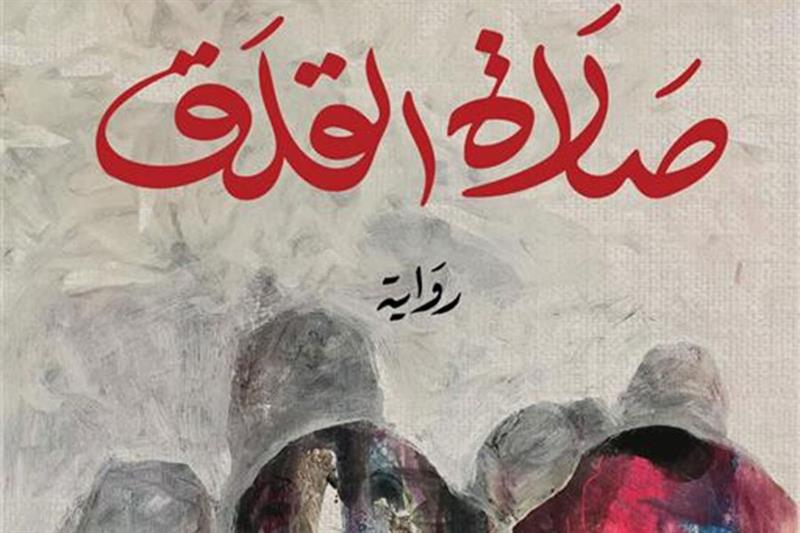
On 25 April, Egyptian author Mohamed Samir Nada was awarded the 2025 International Prize for Arabic Fiction (IPAF) for his novel The Prayer of Anxiety, a darkly allegorical tale set in a secluded village in Upper Egypt.
This marks the third time an Egyptian writer has won the prestigious literary award, following Youssef Zidan’s Azazel in 2009 and Bahaa Taher’s Sunset Oasis in 2008.
Nada’s novel, published by the Tunisian press Masciliana, was chosen from a six-title shortlist.
In a televised interview earlier this year, Nada revealed that he had turned to Masciliana after three Egyptian publishers declined to print the manuscript.
Set in the fictional hamlet of Nag’ Al-Manassi — literally “the village of forgetfulness” — the novel unfolds in a reality suspended in misinformation and fear.
Its inhabitants believe a minefield surrounds them and are still at war with Israel decades after the 1967 conflict.
Their only contact with the outside world is Khalil Al-Khoja, a local authority figure who produces the village newspaper, controls access to goods and maintains the illusion of unending war.
When a mysterious object falls from the sky, triggering an illness among villagers, the local sheikh responds by creating a new ritual prayer—The Prayer of Anxiety.
The plot evolves against the backdrop of national icons, culminating in the 1977 death of Abdel-Halim Hafez, a singer synonymous with the era of Gamal Abdel-Nasser.
Told through eight character “sessions,” each beginning with a nightmare and dreamlike awakening, the novel functions as both a dystopian fable and a meditation on collective delusion.
Nada’s characters offer confessional narratives haunted by guilt and helplessness. The result is a richly layered text that explores how fear and propaganda can distort memory and shape reality.
Mona Baker, chair of this year’s IPAF judging panel, praised the novel for “transforming anxiety into an aesthetic and intellectual experience that resonates with the reader and awakens them to pressing existential questions.”
Yasser Suleiman, Chair of the IPAF Board of Trustees, highlighted the novel’s “gripping poetic language” and its “clever use of symbolism,” calling it a powerful reflection on life under tyranny and the mechanisms that uphold it.
Yet the novel’s success has not gone without controversy.
Some critics have criticized its handling of Egypt’s modern history, especially its allusions to Abdel-Nasser’s legacy.
Literary critic Reda Attiya publicly dismissed The Prayer of Anxiety as “poorly structured” and accused the prize committee of rewarding a novel that “takes aim at Nasser,” calling it a “conspiracy against Egypt.”
Others pushed back. Novelist Mohamed Mawafai likened such attacks to the 1994 stabbing of Nobel laureate Naguib Mahfouz by a young man who admitted to never reading his work.
“Both are acts of incitement,” Mawafai said. “There is no difference between one and the other.”
Nada’s novel joins a growing wave of dystopian fiction in the Arab world.
In a recent study of the genre, Syrian novelist and critic Shahla Al-Ogaily argued that dystopian literature has gained traction in post-2011 Arab societies to confront painful political and social realities.
“This genre represents the inability to forgive,” she wrote, “and a confrontation with the hallucinations and phobic fears that emerged after the revolutions failed to deliver on their promises.”
Al-Ogaily traced the rise of Arabic dystopian writing to the translation of authors like Franz Kafka and George Orwell, whose works explored the horrors of surveillance, repression, and modernity.
The influence is evident in Nada’s novel — from Kafka’s The Metamorphosis, echoed when a village sheikh wakes up to find his head missing, to Orwell’s 1984, in the depiction of total narrative control and a fearful, manipulated public.
At its heart, The Prayer of Anxiety critiques political, religious, and media-driven systems that manufacture obedience and stifle thought.
Through poetic language and surreal events, Nada lays bare the quiet complicity that enables authoritarianism.
One of the novel’s characters voices the core dilemma:
“How many shooting stars must fall before we gain a new memory? How many men must die in war for old women to tell a different story?”
Despite occasional tonal inconsistencies—particularly between the elevated language and the characters’ rural backgrounds—the novel’s literary ambition, conceptual depth, and striking imagery have resonated widely.
The IPAF, launched in 2007 with support from the Emirates Foundation, awards $50,000 to the winner and $10,000 to each shortlisted author. This year’s judges included Said Bengrad, Maryam Al Hashimi, Bilal Orfali, Sampsa Peltonen, and chair Mona Baker.
With The Prayer of Anxiety, Nada has delivered a novel that provokes, unsettles, and — crucially — invites deeper engagement with the structures of power that shape the Arab world’s past and present.
In the holy city of Makkah, pilgrims visit Jabal Al-Nour, whose name means “Mountain of Light”.
As pilgrims complete the sacred rites of Hajj, many embark on a deeper spiritual journey by exploring historic Islamic sites across Saudi Arabia to connect with the roots of their faith.
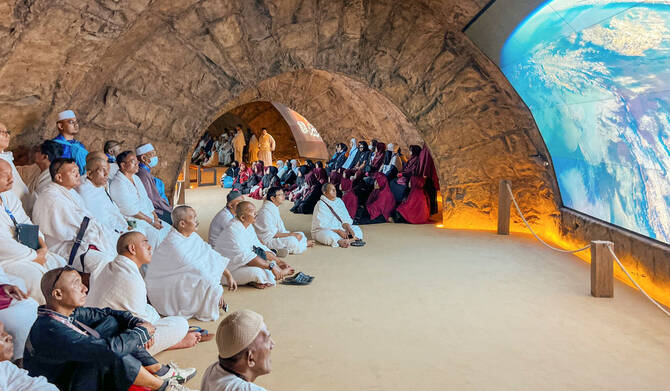
In the holy city of Makkah, pilgrims visit Jabal Al-Nour, whose name means “Mountain of Light.” At its peak lies the Cave of Hira, where the first verses of the Qur’an were revealed through the Angel Jibreel.
The mountain’s distinctive camel-hump shape makes it a striking landmark, especially with the nearby Hira Cultural District, where the Revelation Gallery offers pilgrims to learn the story of divine revelation and history.
Ahmed Khan, a private tour guide said: “There’s something unexplainable about standing where it all began. When I take pilgrims to Jabal al-Nour, many of them are moved to tears it’s not just a climb, but it’s a spiritual awakening.”
To the south lies Jabal Thawr, the mountain that cradled the Prophet and his companion Abu Bakr as-Siddiq in its cave during their migration to Madinah. The story of divine protection, where a spider’s web and a dove’s nest concealed their presence from their pursuers, resonates deeply with pilgrims.
Another frequently visited site is Jabal Abu Qubays, believed in some traditions to be the first mountain placed on Earth. As the closest peak to the Grand Mosque, it resonates with the early public da’wah and the great spiritual responsibility.
FAST FACTS
• Al-Qiblatain Mosque, where revelation changed the direction of prayer from Jerusalem to Makkah, remains a must-visit site for pilgrims.
• Programs like ‘Hala,’ launched by Al-Bait Guests Co., are curating journeys for pilgrims to explore with knowledgeable guides.
Nearby, the modest yet historically significant Al-Bay’ah Mosque marks the location of the Pledge of Aqabah, where the Ansar of Madinah pledged allegiance to the Prophet Muhammad.
Built during the Abbasid era, it symbolizes early Muslim unity and commitment to the new faith. A short distance away in Al-Hajun district is Jabal Al-Sayyidah, at the base of which lies the revered Al-Ma’la Cemetery, resting place of Khadijah, the Prophet’s beloved wife. Her grave remains a focal point of deep reverence.
“Pilgrims love visiting these places and it helps them to understand the sacrifices of the people who shaped Islam,” Khan added.
Madinah has its own timeless legacy. Al-Qiblatain Mosque, where revelation changed the direction of prayer from Jerusalem to Makkah and marked a defining shift in Muslim identity and remains a must-visit site for pilgrims.
Hussain Rauff, regional director of Madinah Hotels at Elaf Al-Taqwa, said: “We’re planning to organize guided tours across Madinah to help pilgrims explore the city’s rich Islamic heritage. It’s a meaningful way to extend their spiritual journey beyond the rituals of Hajj.”
Further west of the Prophet’s Mosque lies the cluster known as the Seven Mosques, each linked to events from the Battle of the Trench. Among them are Al-Fath Mosque and those named after figures such as Fatimah, Ali ibn Abi Talib, and Salman Al-Farsi. These mosques are rich in historical memory and serve as reminders of hardship during one of Islam’s critical battles.
Mount Uhud rises just north of Madinah city, its slopes reminds of the Battle of Uhud and the place where the Prophet’s uncle, Hamza ibn Abdul Muttalib, and 70 companions were martyred. Today, pilgrims pause at the Uhud Martyrs Cemetery indicating the modesty found in victory and the strength drawn from loss.
Equally powerful is a visit to Baqi’ Al-Gharqad Cemetery, the resting place of many of the Prophet’s family members and companions. Located near the Prophet’s Mosque, the cemetery has long served as a site for prayer and remembrance, offering pilgrims a moment of intimate connection with those who stood beside the Prophet during Islam’s formative years.
Beyond the holy cities, other destinations continue to attract pilgrims in search of spiritual enrichment. Northwest of Madinah lies Khaybar, the site of a pivotal military campaign that showcases both the strategic and ethical dimensions of the Prophet’s leadership. Its volcanic terrain and ancient fortifications tell stories etched in stone.
Fatima Al-Mutairi, a pilgrim from Kuwait: “I am planning to visit these places in Jeddah and Taif after my Hajj. I am planning to visit the Tomb of Hawa in Jeddah and in Taif, I look forward to visiting Masjid Abdullah ibn Abbas, to pay tribute to one of the great scholars whose work in Qur’anic interpretation and Hadith continues to inspire many seekers of knowledge.”
Recognizing the growing desire for such experiences, programs like “Hala,” launched by Al-Bait Guests Co., are curating immersive journeys for pilgrims to explore these sacred sites with knowledgeable guides and spiritual context.
Mohammed Al-Shahrani, experience officer in Hajj and Umrah sector said: “Our aim is to enrich the post-Hajj experience. We want pilgrims to understand that the journey of faith continues, and Saudi Arabia is opening its heritage for those who wish to walk in the footsteps of the Prophet.”
source/content: arabnews.com (headline edited)
______________
Beyond the holy cities, other sacred destinations continue to attract pilgrims in search of spiritual enrichment. (Supplied/File photo)
Mrini was widely respected for his deep knowledge and commitment to cultural preservation.
Morocco is mourning the death of Abdelhak El Mrini, the country’s official royal historian and former spokesperson for the Royal Palace. He passed away on Monday evening at the age of 91, after a long career serving Moroccan history and culture.
El Mrini was born in Rabat in 1934. He memorized the entire Quran at a young age and even copied 60 parts of it by hand. Over the years, he became one of Morocco’s most respected literary and cultural figures.
He held several important roles during his life, including Director of Royal Protocol and Decorations. But he was best known for his role as the kingdom’s official historian, as well as his work in preserving Moroccan heritage.
El Mrini had an impressive academic journey. He received a diploma from the Institute of Higher Moroccan Studies in 1960, followed by a degree in literature from the Faculty of Arts in Rabat in 1962.
He later studied in France, where he earned an advanced diploma and a PhD from the Institute of Arab and Islamic Studies at the University of Strasbourg in 1973. He also obtained a State Doctorate in Literature from Sidi Mohamed Ben Abdellah University in Fez in 1989.
El Mrini was also a prolific author who left behind an important literary and historical legacy. Among his most well-known works is “The Moroccan Army Throughout History”, first published in 1968. The book went through several revised editions, with the sixth edition released in 2011 and translated into French in 2000.
He also wrote “Guide for Moroccan Women” in two parts (1993 and 2000), and “An Introduction to Modern Moroccan History” (1996), which covers the period from Sultan Hassan I to King Hassan II.
Other notable titles include “Tea in Moroccan Literature” (1999), “Mohammed V: Studies and Testimonies” (1988), and “The Hassaniyats” (three volumes published between 1975 and 1983), a collection of poems in praise of the late King Hassan II.
Throughout his life, El Mrini made significant contributions to the study and promotion of Moroccan history, and he was widely respected for his deep knowledge and commitment to cultural preservation.
‘From Ocean to Gulf: Heritage Music of the Arab World’ is a series by Ahram Online, in partnership with the AMAR Foundation (Foundation for Arab Music Archiving and Research). In this article, we explore the rich music legacy of Yemen.
‘From Ocean to Gulf: Heritage Music of the Arab World’ is a series by Ahram Online, in partnership with the AMAR Foundation (Foundation for Arab Music Archiving and Research).
In this article, we explore Yemen’s rich music legacy.
Music is a powerful force for healing and reconnecting us with our roots and shared humanity in a world of numerous challenges.
‘From Ocean to Gulf: Heritage Music of the Arab World’ is a new series by Ahram Online, in partnership with the AMAR Foundation (Foundation for Arab Music Archiving and Research). Focusing on the early years of recording in our region, which reflected a modern cosmopolitan repertoire and coincided with the Renaissance era that flourished in Egypt between the mid-19th Century and the 30s of the twentieth Century, this initiative aims to introduce our audience to the iconic figures of Arab music whose contributions have enriched our intangible cultural heritage and inspired generations worldwide.
Yemen, a country on the Arabian Peninsula, is one of the world’s most beautiful and historically rich nations.
Often referred to as Al-Yaman al-Sa‘īd (Happy Yemen), it has long served as a centre of discovery for travellers and a research subject for historians, social scientists, natural scientists, and others.
In the second episode on Yemen, we highlight the music scene from the beginning of the 20th Century to the present.
Music in 20th Century Yemen
The beginning of the 20th Century was difficult in Yemen because of the wars between the Zaydī imams and the Ottoman occupiers. During these wars, the artists swung between the Ottoman authority, which encouraged music, and the Zaydīn, who did not.
Thus, their social, religious, and political position was difficult, as described in the biography of Sa‘d ‘Abd al-Lāh, who, as an artist, was accused by Aden’s jurists and fundamentalists of contravening the religious system of drinking alcohol.
His ‘ūd playing was also subject to accusation. A beautiful legend tells how he faced these accusations and how, thanks to his art and his mastery of religious qaṣīda, he regained the respect of the imam by performing religious qaṣīda and even some religious prayers accompanied by the ‘ūd.
This allowed him to resume his art under the rule of Imam YaḥyaḤamīd al-Dīn. Yet his position remained complicated, and fundamentalists probably killed him in the early 20th Century. We do not have any recordings of him, but some of his numerous students do. Some remained in Sanaa and practised the art of singing.
Music scene in Aden
In contrast, others travelled to Aden, which was under English rule, including famous ‘Alī al-‘Aṭṭāb and MuḥammadẒāfir, who fled from the fundamentalist Zaydī rule and moved to Aden in their early 20s.
In the southern provinces, a vibrant group of artists emerged during the British occupation of Aden (1839 – 1967), with singing and music becoming widespread among Yemeni artists. Professor Muhammad Murshid Naji noted that Lahji singing before the era of Ahmed Fadhl al-Qumindan was influenced by the Sana’ani style. Lahji singers would perform Sana’ani songs, and the singer Hadi Sabit al-Nubi developed his oud-playing by drawing on the techniques of a northern artist whose name remains unrecorded.
Naji attributes the emergence of the first Lahji melody to the poet, composer, and singer Fadhl Mater, who was credited with inventing the initial melody set to the Lahji rhythm. This innovation led Hadi Sabit to sing in the Sana’ani style over one of Al-Qumandan’s poems. It is worth noting that instrumental music is not widespread in Yemen, where it exists under one form whose origin is said to be Turkish, called firtāsh: it is a muwaqqa section, yet it allows variation and improvisation by the artist.
Sanaa singing was divided into two parts: a part in Aden and a part in Sanaa, and the Aden part is the one we have recordings of. Their recordings date back to the late 30s, while those made in Sanaa started later than the 50s. The first recording made in Sanaa in Historical Yemen was made by German orientalist and music expert Hans Helfritz who visited Yemen in the late 1920s and early 1930s to study Yemeni Music in this fundamentalist religious atmosphere, which aroused the suspicion and caution of the pious and religious in particular, and he was accused of being a spy.
Upon the First World War outbreak, the German Odeon Records company had to stop its commercial and recording activities as Yemen was under English occupation. Local record companies started right away, including the major “Aden Crown Company” that took over from Odeon and resumed recording Sheikh ‘AlīAbū Bakr Bāsharāḥīl, as well as Sheikh Ṣalāḥ ‘Abd al-lāh al-‘Antarī and Sheikh Muḥammad al-Mās, who died in the 1950s. They had recorded with the Aden Crown Company in the 1940s.
In the 1920s and 1930s, Indian musical influences became prominent as numerous musical and theatre groups and films were introduced in Aden and Hadhramaut, which had long been under the administration of the British Viceroy of India. By the 1940s and 1950s, Yemeni musicians had adapted these influences to create an “Arabized” Indian style, in which tunes from Indian films were reinterpreted with texts set in classical Arabic rather than colloquial language.
The acclaimed artist Muhammad Juma Khan, known for his mastery of the Hadhrami style, became one of the foremost practitioners of this hybrid form. The distinctive features of Adeni singing developed during the twentieth Century due to the convergence of multiple Yemeni and foreign musical elements, especially from India. Though a large portion of Aden’s pre-independence population was of Indian origin, the evolution of Adeni song was notably influenced by Egyptian melodies, and some musicians even incorporated Western rhythms such as the waltz.
Yemen Radio
Imam YaḥyaḤamīd al-Dīn, who feared openness and foreign interference, forced the Turkish Ottomans out and defended the independence of Yemen, yet within conservative and fundamentalist restrictions. As a consequence, the Yemeni Radio was only launched in 1955. It was a reaction to the launching of the Ṣawt al-‘Arab Radio, which had started broadcasting from Cairo, notably liberalist political ideas. Imam Aḥmad, the son of Imam YaḥyaḤamīd al-Dīn, who took his reign in 1948, consulted with theologians who refused the launching of the Radio. Still, the Radio was launched, and only news was broadcast at first.
They also recorded Qāsim al-Akhṭash, a Yemeni artist in Sanaa. He recorded using reels that existed then, allowing a longer recording duration. Yet recordings were made in Aden before Sanaa Radio’s recordings. They were commercial recordings of Sheikh ‘AlīAbū Bakr Bāsharāḥīl made in the late 1930s, in 1939, by the Odeon.
Singing post 1962 Revolution
After the 1962 revolution, Sanaa singing prospered, yet without the qanbūs or ṭarab, but with the kabanj’ūd played by talented artists such as MuḥammadḤamūd al-Ḥārithī, Aḥmad al-Snaydār, and ‘Alī al-Ānisi among others who became famous and served the Sanaa song with the big ‘ūd and a style inspired a little from Egypt and Syria, while preserving the main form or style.
On the other hand, some other artists did not become famous in the 70s, 80s, and 90s. They are: Ḥasan al-‘Ajamī, Yaḥya al-Nūnū, ṣaḥn player Muḥammad al-Khamīsī, as well as Muḥammad ‘Ushaysh, and they all preserved the old style and preserved the ṭarab as well and revived the old style and methods, considering that many elements, such as the firtāsh and the muṭawwal, had been neglected by the other artists. They continued to play the ṭarab and the ṣaḥn.
Women singers in the public domain
This period also witnessed the rise of women singers. Traditionally, singing was by men, and emerging women performers challenged dominant societal norms. Among these names is Nabat Ahmed (b. 1955), who has appeared in the Yemeni music scene since the early 1970s. Other names presented in the recently published book entitled “Women’s Lyrical Voices in Yemen 1950-2000” by researcher Yahya Qassem Sahel include: Raja’ Basudan, Nabiha Azim, Mona Ali, Taqiya Al Taweelah, Fatima Bahdela and Fatima Mansour Al-Shatri (Habbaniyah).
The rise of the tape cassette
The tape cassette became a dominant and accessible music dissemination format in the 1970s. It also helped a wider circulation of songs within and outside Yemen—the evolution of music in Yemen in the 20th Century and the advent of recording somewhat settled things. Today, we know that, for example, a certain qaṣīda was sung to a particular melody by a specific artist in 1940, recorded by Odeon on a specific date. Still, we do not know how it was before the recording era. This is an essential characteristic of the oral heritage: it is not fixed and settled when transmitted from generation to generation. The sea flows from generation to generation with all its forms, types and variations.
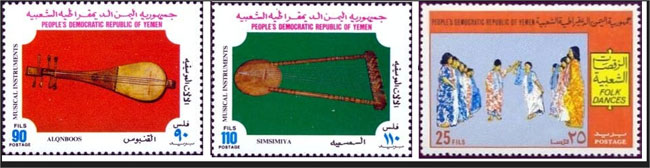
ūdvs Qumbus
The ‘ūd was not used in Yemen before Islam, yet there are indications of its existence there after Islam. Additionally, vocal forms such as the Sanaa singing, including ḥumaynī poetry, are a form of classical poetry influenced by the local colloquial language. It has existed in Yemen since the Medieval period (Middle Ages), i.e. at least since the 12th Century or the 13th Century during or after the Ayyubid dynasty.
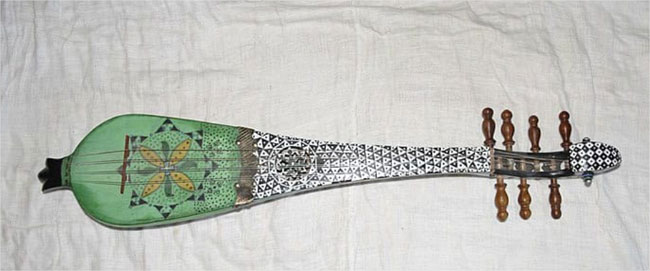
The ‘ūd used in Yemen until the beginning of the 20th Century was strangely not the ‘ūdkumaythrī known in the Arab culture since the drawings of Al-Ḥarīrī’s maqāmāt, or even the drawings of the Alhambra showing the ‘ūd with wooden cover. Instead, the Yemeni ‘ūd called ṭarab in Sanaa has a unique pre-Abbasid body covered with goatskin or sheepskin that produces a distinctive sound, maybe softer, that is difficult to describe, yet undeniably distinctive. It is thinner and smaller, and thus can be played standing up, which is very practical to accompany dancing.
Abū al-Ḥasan al-Ṭaḥḥān describes the ‘ūd in “Ḥāwī al-funūnwa-salwat al-maḥzūn” that dates back probably to the first half of the eleventh Century and is considered one of the most important and oldest references about ‘ūd making. He mentioned the ‘ūd that existed before his era, described it as having an animal skin cover, and detailed the contemporary ‘ūd with a wooden cover. Before that, he talked about the ‘ūd with the animal skin cover and called this ‘ūd “barbaṭ”. The name barbaṭ is derived from Persian and Arabic: “bar” means chest in Persian, and “baṭt” means duck in Arabic. Indeed, the shape of this ‘ūd from head to body resembles the shape of a duck’s chest.
Thus, the ‘ūd that reached the Arabian Peninsula and the Ḥijāz coming from Persia during the early Islamic era and the Umayyad era is the same that reached Yemen, settled there, and kept its shape with all the changes that affected the ‘ūd later on in the Arab Levant.
We do not know when it reached Yemen, yet there are indications that it existed there in the 13th Century along with the ‘ūdkumaythrī. So, both co-existed in the same place during the same periods, in Yemen but also in other regions of the Arab World, such as Andalusia and Morocco, where it still exists under a different shape, the rabāba played with a bow, whose shape is very similar to the ṭarab instrument, also called qanbūs in Yemen, a name probably derived from Turkish, since in the History of Turkish Music there is an instrument called kūbūz that probably was Arabized into qabūs then qanbūs.
Most theories in books on Arab music and the Arabic musical system until a late period presented the ‘ūd as the instrument onto which the theory could be applied. This also applies to Yemen. The Yemeni ‘ūd, i.e. the ṭarab or qanbūs, has four strings, unlike the oriental ‘ūd, which was known in the 20th Century and has five strings.
The four strings are similar to those of the oriental ‘ūd except for the fifth string, i.e. the first, the second, and the third strings are Do, Sol, Re, which is from the jawāb to the qarār. The qarār is the fourth string, but it is tuned to Do, not to La like the big ‘ūd. It is the jawāb of the first string. The three strings are double strings, and the upper is single. Considering these four strings, the Do can be a qarār to the rāstmaqām, and the third string can be a qarār to the bayyātīmaqām, and the third one, plucked, would be a Mi / sikāh.
The strings of the Yemeni ‘ūd have names: the first one is the ḥādhiq (energetic); the second one is the awsaṭ (as it is approximately in the middle), and the rakhīm. The beautiful name rakhīm came from some qaṣīda that tells about the ṣawtrakhīm (melodious voice) of the birds or the ‘ūd. The fourth string is called jarr or yatīm (orphan). The yatīm may be because it is a single string.
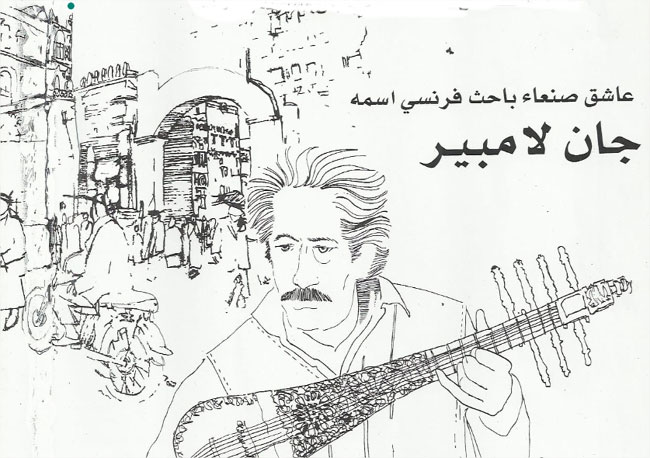
Jean Lambert – pioneer ethnomusicologist
Jean Lambert is a research professor in anthropology and musicology who has dedicated his life to the study, preservation, and dissemination of Yemeni music. He has been associated with the Musée de l’Homme in Paris since 1991 and is the director of the French Centre for Archaeology and Social Sciences in Sanaa (Yemen). Lambert was also the Director of the Centre for Research in Ethnomusicology (CREM-LESC, UMR 7186), CNRS, Université de Paris Ouest Nanterre.
Focusing on the Arab world, particularly in Yemen, the Arabian Peninsula and Lebanon, Jean Lambert’s works explore the relationships between local musical practices and global meanings of Arab-Islamic culture: performance context, ritual practices, mythological representations, and the formation of contemporary identities. His current research focuses on zajal in Lebanon and the 1932 Music Conference in Cairo. Dr Lambert has published several books, more than forty scientific articles, and thirty CDs of traditional music from Yemen, Saudi Arabia, Lebanon, Egypt, Iraq and North Africa. He is also a consulting and management board member of AMAR.
Lambert published his book “Ṭubb al-nufūsfī al-ghinā’ al-Ṣan‘ānīfī al-mujtama‘ al-Yamanī” (“The Medicine of the Soul: Music and Musicians among Urban Dwellers in Sanaa (Republic of Yemen)”) in 1997. He invited several artists to France to record CDs at the Institut du Monde Arabe and French Radio, among others. In his lifelong mission to archive/document the endangered Yemeni heritage, he collaborated with UNESCO in 2000 to inscribe the Sanaa heritage on the List of Intangible Cultural Heritage. He worked on supporting this art through a project that lasted from 2006 to 2009.
For More on Yemeni music, tune in to AMAR Podcasts:
Technology Innovation Institute says model is ‘one of the most advanced Arabic’ offerings.
Concerns that Arabic might be left behind in the fast-developing AI sector are starting to evaporate with the introduction of the Falcon Arabic language model, created in Abu Dhabi.
The model was unveiled on Wednesday by the Technology Innovation Institute (TII) , an Abu Dhabi government-backed research centre which first introduced its Falcon large language model back in 2023.
Faisal Al Bannai, adviser to the UAE President for Strategic Research and Advanced Technology Affairs, spoke about the development as a leap forward for Arabic at the UAE’s Make it in the Emirates event.
“We’re proud to finally bring Arabic to Falcon, and prouder still that the best-performing large language model in the Arab world was built in the UAE,” he said.
According to TII, Falcon Arabic is trained on a native (non-translated) Arabic data set that covers both Modern Standard Arabic and regional dialects.
“It captures the full linguistic diversity of the Arab world,” said TII.
The research centre also said that so far the model outperforms other Arabic language models.
Large language models are complex systems designed to be trained on large amounts of text and data that help AI implementations identify patterns, come to conclusions and even understand nuances. In short, the models can make or break the user experience with AI.
Although Arabic is spoken by about 400 million people worldwide, it was not initially a focus during the initial growth of AI and large language models, with English the most prevalent.
The complexity and diversified Arabic dialects, coupled with various language nuances, posed a challenge for engineers and programmers trying to perfect machine learning technologies.
In recent years, the UAE has sought to bolster Arabic’s presence in the AI race.
In 2023, Jais, an open-source bilingual Arabic-English model, was introduced by G42, Mohammed bin Zayed University of Artificial Intelligence and Silicon Valley-based Cerebras Systems.
Later that year, Jais Climate , the world’s first bilingual large language model dedicated to climate intelligence was also announced.
In addition to Falcon Arabic, TII also announced on Wednesday the release of its Falcon H1 model, which it says “outperforms comparable offerings from Meta’s LLaMA and Alibaba’s Qwen, enabling real-world AI on everyday devices and in resource-limited settings”.
The research centre explained that efficiency was at the core of Falcon H1 development.
“This fundamentally shifts what’s possible at the smallest scale, enabling powerful AI on edge devices where privacy, efficiency, and low latency are critical,” said Hakim Hacid, chief researcher at the TII AI and digital science research centre.
“It demonstrates how new architectures can unlock new opportunities in AI training while showcasing the potential of ultra-compact models.”
Egypt’s presence at Cannes Film Market wins top honour for design, programming, and industry engagement.
The Egyptian pavilion at Cannes Film Market, headed by a joint cooperation between El Gouna Film Festival, Cairo International Film Festival and the Egyptian Film Commission, has won the award for Best Pavilion Design Award during the 78th Cannes Film Festival.
Designed by cinematic set designer Shereen Farghal, and recognised over competing pavilions from 150 nations, the Egyptian pavilion was awarded for its design, curated programming, and strategic networking opportunities offered to Arab and international filmmakers.
“This award is a global recognition of the position Egyptian cinema occupies today, and of the continuous efforts we make to represent it in international contexts,” Hussein Fahmy, President of Cairo International Film Festival, said. “We made sure that the pavilion reflects the spirit of cooperation and openness to the world through a program full of dialogue, and cultural and artistic interaction, and represents a new step for Egypt’s presence in the global film industry.”
Held annually in parallel with the Cannes Film Festival, Marché du Film is a key space for co-productions, distribution deals, and film financing.
The Moroccan Poets Festival concluded its sixth edition after three days of illustrious writing and celebrating the word.
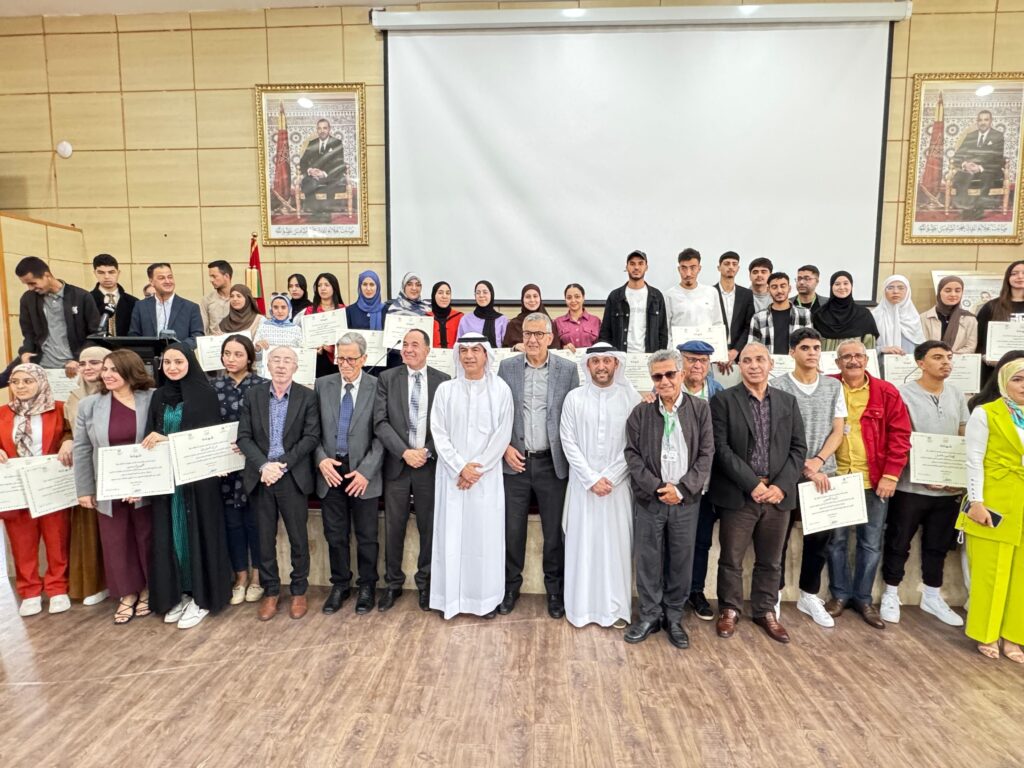
The closing ceremony was held at the National School of Crafts and Arts in Tetouan, in the presence of Abdullah bin Mohammed Al Owais, Chairman of Sharjah Department of Culture; Professor Mohammed Ibrahim Al Qaseer, Director of the Cultural Affairs Department at the Department; Rachid Al Mustafa, Head of the Cooperation Department in the Culture Sector at the Moroccan Ministry of Youth, Culture, and Communication; Dr. Youssef Al Fahri, President of the Higher School of Teachers in Martil; Mukhlis Al Sagheer, Director of the House of Poetry in Tetouan; and a large number of writers, intellectuals, and university students.
Al Sagheer pointed out that the Moroccan Poets Festival strives to innovate with each new edition, and to grow in poetry and cultural resonance in the Arab world. He highlighted that the sixth edition enjoyed a prominent official presence, alongside a public audience with a passion for poetry and art.
He explained that the House of Poetry in Tetouan, founded in 2016, affirms its tireless efforts to organise a distinguished seventh edition next year, to celebrate its tenth anniversary.
Participants in the Moroccan Poets Festival agreed that Sharjah has become a pioneering model in supporting Arab culture and actively contributing to shaping a new generation of Arab intellectuals. They emphasised that Sharjah’s cultural, intellectual, and cultural achievements over the past decades were not a coincidence, but rather the result of the broad cultural vision of His Highness Sheikh Dr. Sultan bin Mohammed Al Qasimi, Supreme Council Member and Ruler of Sharjah. His Highness believes that culture is the cornerstone of human and societal development.
Participants believe that Sharjah’s experience represents a model to be emulated, as it has not only supported cultural production but has also strived to create an integrated knowledge environment that attracts new generations and instils in them a love of reading, thinking, and criticism. They explained that many young Arabs who have benefited from Sharjah’s cultural experiences have now become prominent voices in the fields of literature, thought, and the arts.
The second day of the festival featured a critical symposium titled “Poetry and the Performing Arts”. The speakers emphasised that when poetry is recited on stage, or combined with movement or music, it transforms into a performance art. This is where what is known as “the poetics of performance” emerges, where poetry emerges from the page and is embodied through the body, voice, gaze, and silence. They noted that at this moment, literature intersects with the live arts, providing the recipient with a multi-sensory artistic experience.
Speakers emphasised the intersection of poetry and performance, where word meets movement, voice meets silence. This is when a magic called the poetics of the performing arts is born; where the poem becomes a vibrant body, and the scene becomes a visual poem that is read by the eye and felt by the heart.
The Moroccan Poets Festival has an exceptional section, bringing the audience together with visually impaired poets at the Taha Hussein Institute in Tetouan, in a poetic and humane moment where poetry met with a number of visually impaired creatives who drew inspiration from life’s features and, from its details, wove their vast worlds.
The festival saw the participation of more than 40 poets, poetesses, intellectuals, and artists amidst a festive atmosphere of poetry and its creators. It honoured 83 students in a poetry writing workshop organised by the House of Poetry in Tetouan, in collaboration with the Faculty of Arabic Language at the Higher Teachers’ School in Martil.
Eighteen students were also honoured in the regional competition for Arabic Language Pioneers, organised by the House of Poetry in collaboration with more than 37 secondary and middle school educational institutions.