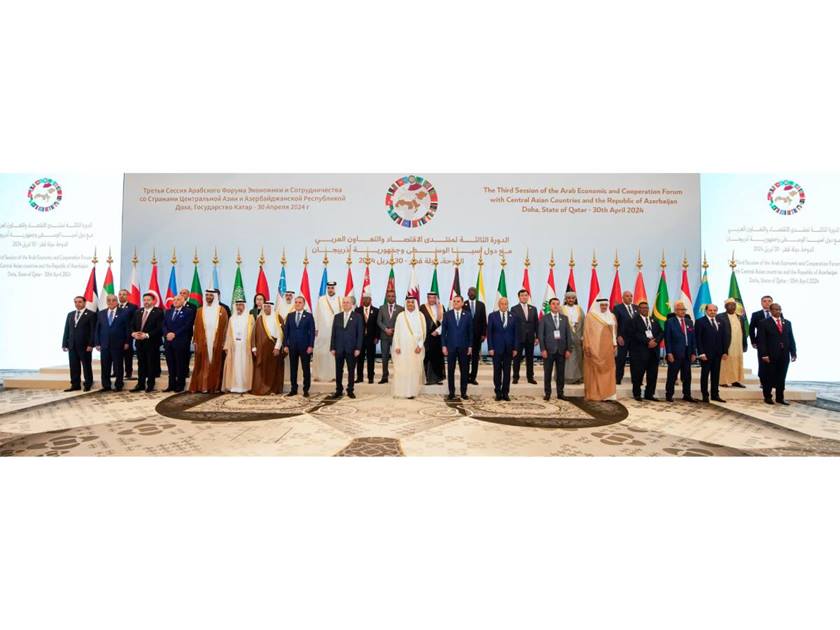
The 3rd session of the Arab Economic and Cooperation Forum with countries of Central Asia and the Republic of Azerbaijan concluded its proceedings today in Doha, with the issuance of the Doha Declaration emphasizing the importance of historical, religious, and cultural relations and ties between Arab countries, Central Asian countries, and Azerbaijan.
The Doha Declaration, released at the conclusion of the forum, stressed the necessity of enhancing economic cooperation prospects and potential between Arab countries, Central Asian countries, and Azerbaijan, including vast natural resources and promising investment opportunities in energy, mining, petrochemical industries, tourism, and more.
Participants in the forum highlighted the importance of encouraging the completion and enhancement of bilateral and multilateral cooperation between the two sides, leveraging vast potential in various economic sectors, and supporting the development of a comprehensive strategic program as a roadmap for the coming decade regarding practical implementation and resource mobilization for the Islamic Infrastructure Initiative.
Ministers of Foreign Affairs, Finance, Commerce, and Economy, as well as delegation heads from participating countries and governments at the forum, recalled the outcomes of the second session of the forum held in Tajikistan in 2017, emphasizing the importance of developing cooperative mechanisms within the forum across all fields to serve the common interests between Arab countries, Central Asian countries, and Azerbaijan.
They called for a focus on cooperation between the Arab League, Central Asian countries, and Azerbaijan without duplication of efforts in various forms of cooperation, emphasizing the need to support political consensus solutions to crises facing some countries in the Arab region through encouraging comprehensive dialogue and national reconciliation, rejecting any interference in the internal affairs of states, and committing to respecting their sovereignty, independence, unity, and territorial integrity in accordance with the charter and principles of the United Nations and international law.
The Doha Declaration condemned ongoing Israeli aggression against the Palestinian people, resulting in more than 100,000 martyrs and wounded, mostly women and children, decrying the subjection of the Palestinian people to famine, deadly siege, obstruction of relief aid flow, and the severing of all means of life in Gaza. It also condemned the systematic destruction of residential neighborhoods, hospitals, schools, universities, mosques, churches, and infrastructure in the sector, as well as the detention and torture of thousands of Palestinian prisoners, underlining the hate speech, racism, and incitement adopted by the Israeli occupation government.
Furthermore, the Doha Declaration warned against Israel’s continued implementation of plans for the forcible displacement of the Palestinian people from their land, which would lead to the collapse of peace prospects in the Middle East and exacerbate conflict in the region, urging the Security Council to adopt a binding resolution to halt Israeli aggression and prevent the forced displacement of Palestinians, ensure the flow of relief aid to the entire Gaza Strip, implement provisional measures outlined in the International Court of Justice ruling, and restore life to its normal state in the sector.
The forum participants also condemned the systematic Israeli occupation campaigns against the United Nations Relief and Works Agency for Palestine Refugees (UNRWA), calling on all countries to support the agency’s efforts. They also condemned the occupation government’s continued settlement plans aimed at changing the historical and legal status quo in the occupied Palestinian territories and the occupied Syrian Golan Heights, the latest being the occupation government’s approval of building approximately 3,500 new settlement units in the West Bank.
The Doha Declaration affirmed support for joint efforts by Qatar and the Arab Republic of Egypt aimed at achieving a permanent ceasefire and restoring life to normal in the Gaza Strip, as well as supporting Algerian and Egyptian efforts to achieve the desired reconciliation among Palestinian factions, commending in this regard Algeria’s role as an Arab member of the United Nations Security Council in supporting the Palestinian cause.
At the conclusion of the third session of the Arab Economic and Cooperation Forum with Central Asian Countries and the Republic of Azerbaijan, the Doha Declaration underscored the full solidarity with Lebanon amid the most severe political, economic and social crisis the country has been grappling with in decades, affirming support for the constitutional institutions to safeguard the Lebanese national unity, as well as the security, stability and the territorial integrity of Lebanon.
The declaration condemned the unceasing Israeli offensive on south Lebanon that resulted in the martyrdom of civilians from children, women, elderly, journalists, and paramedics, in addition to targeting the centers of the Lebanese Army and spilling over into the depth of the Lebanese territories, including agricultural lands, during which the internationally banned white phosphorus has been used.
The declaration called for the importance of ramping up international pressure to prevent the declared Israeli plans to launch a large-scale war on Lebanon, force the Israeli entity to end its occupation of Lebanese lands and stop its land, sea, and air violations of the sovereignty of Lebanese lands.
In addition, the declaration called for adherence to the preservation of Syria’s sovereignty, unity and stability and rejecting foreign interference and any illegal military presence on its territory, condemning the attacks unleashed by the Israeli occupation on its territory, stressing the importance of the Arab role in supporting the efforts made to resolve the Syrian crisis.
As to the Libyan issue, the participants affirmed their commitment to the unity and sovereignty of the State of Libya and the integrity of its territories and supporting the path of comprehensive national reconciliation.
Regarding the situation in Yemen, they called for the resumption of political consultations to reach a comprehensive political solution, in accordance with the three terms of reference represented by the Gulf Initiative and its executive mechanisms, the outcomes of the comprehensive National Dialogue Conference, and the relevant UN Security Council resolutions.
The declaration stressed the sovereignty, unity and independence of Sudan and the importance of preserving its national institutions, primarily the Sudanese Armed Forces, underscoring the importance of intensifying the international efforts aimed at achieving peace and stopping the ongoing war that has caused humanitarian catastrophe and forced displacement of millions of residents from their cities and villages.
It also emphasized the importance of cooperation between the League of Arab States, the African Union (AU) and the United Nations so as to build a comprehensive peace process, and to support the initiatives of the co-facilitators of the Jeddah talks and the Sudanese neighboring countries initiative, which aim to achieve a comprehensive ceasefire. Also, the declaration affirmed support for the security, stability, unity, sovereignty and territorial integrity of Somalia and the Somali government in its efforts dedicated to safeguarding its sovereignty on land, sea, and air, noting its right to legitimate defense of its lands.
Regarding the three UAE islands of Abu Musa, the Greater and Lesser Tunbs, the Doha Declaration affirmed support for all peaceful efforts, including the initiative and endeavors of the UAE to reach a peaceful solution, in accordance with the principles of international law and the United Nations charter, either through Bilateral negotiations or resorting to the International Court of Justice (ICJ), stressing the need for cooperative relationships between Arab countries and the Islamic Republic of Iran to be based on the principle of good neighborliness and non-interference in internal affairs, respect for the principle of independence, sovereignty and territorial integrity of states, and resolve disputes by peaceful means, as per principles of the United Nations Charter. international law and refraining from the use or threat of force.
In regard to the relations between Azerbaijan and Armenia, the declaration emphasized the support for the normalization of relations between the two countries on the basis of mutual recognition and respect and preservation of the sovereignty, territorial integrity and inviolability of each other’s borders, noting that accelerating the establishment of relations between the two countries will achieve regional stability and security, paving the way for realizing the full potential of cooperation in the region.
The participants condemned terrorism in its all manifestations and motives, underscoring the importance of counter-terrorism operations, uprooting its roots, and drying up its sources, and rejected linking terrorism to any race, religion, nationality, or civilization. They also emphasized the importance of respecting the rules and principles of international law governing the exploitation of transboundary rivers, so as to not cause profound harm and the principle of prior notification. Also, they affirmed their full support for Egyptian and Sudanese water security, calling on Ethiopia to refrain from any unilateral measures that would potentially cause harm to the interests and rights of 160 million people of the countries downstream of the Nile River.
The Doha Declaration praised the UAE’s membership in the UN Security Council for the period 2022-2023. It also welcomed the election of Algeria as a non-permanent member of the Security Council for the period 2024-2025 and expressed its support for naming Bahrain as a non-permanent member in the Security Council for the period 2026-2027, and the Kyrgyzstan as a non-permanent member. Also, they supported the nomination of Tajikistan as a non-permanent member of the Security Council for the period 2028-2029, calling for coordination between the Arab members of the Security Council, the countries of Central Asia, and the Republic of Azerbaijan to serve the common interests, in accordance with the Arab League and United Nations charters.
The declaration welcomed Azerbaijan’s presidency of the Conference on Interaction and Confidence Building Measures in Asia (CICA) for the period from 2024 to 2026, expressing its support for strengthening cooperation between the CICA and the Arab League through implementing joint projects and engaging in relevant events organized by each of them.
The Doha Declaration renewed emphasis on supporting all efforts aimed at nuclear disarmament and preventing the spread of nuclear weapons, without prejudice to the inalienable right of states parties to the Treaty on the Non-Proliferation of Nuclear Weapons (NPT) to the peaceful use of nuclear energy, calling on all countries who are not signatories to the treaty to quickly join it.
In this regard, the declaration condemned the Israeli entity’s recent blatant and unprecedented threats to annihilate the Palestinian people using nuclear weapons, stressing the need for the Israeli entity to join the NPT and subject all its facilities to Comprehensive Safeguards Agreements. It also affirmed the need for the establishment of a Middle East Zone free of nuclear weapons and other weapons of mass destruction.
The declaration welcomed the Marrakesh Declaration on the Proliferation Security Initiative (PSI) issued last January, which urged the need to intensify regional efforts to combat weapons of mass destruction by enhancing the exchange of expertise and best practices among the countries under this initiative.
It also welcomed the initiatives by Central Asia countries within the framework of the Central Asian Nuclear-Weapon-Free Zone (CANWFZ) treaty, calling on the nuclear-weapon states that have not ratified the Protocol to the CANWFZ Treaty to expedite ratification to bring the Protocol into force as soon as possible.
Meanwhile, the attendees expressed their desire to enhance cooperation in the field of health care and combat various risks threatening humanity. They renewed their support for Afghanistan to achieve peace and stability, stressing the need to address the challenges facing the Afghan people. They also expressed their deep concern about the indiscriminate use of landmines, explosive remnants of war and improvised explosive devices that threaten peace, security and stability and hinder development efforts.
The declaration stressed the importance of cooperation between Arab League member states, the countries of Central Asia, and Azerbaijan to enhance cybersecurity, including cooperation to prevent the use of infrastructure in countries by groups or individuals against other countries. It welcomed cooperation in implementing programs related to cybersecurity, which contributes to protecting data and praised Saudi Arabia’s launch of the Global Cybersecurity Forum, with the aim of contributing to enhancing cybersecurity at the international level.
The declaration noted the increasing economic cooperation between the Arab League member states, the countries of Central Asia and Azerbaijan, calling for benefiting from the enormous potential of the two sides in various economic fields, stressing the importance of developing cooperation to achieve sustainable development goals and objectives related to water resources and the re-use of water in industrial and oil sectors to reduce the demand for fresh water. It also called for enhancing cooperation in the food security and agriculture sectors and benefit from countries’ experiences in using modern agricultural technologies and smart irrigation programs.
The Doha Declaration called for the importance of confronting the challenge of water scarcity, especially in arid countries, which has increased over recent decades with continued population growth, becoming a global challenge exacerbated by climate change. In this regard, it stressed the importance of cross-border water cooperation based on respect for the rules and principles of international law governing the exploitation of cross-border rivers.
Highlighting the links between water and climate, the Declaration expressed concerns about the accelerating melting of glaciers in the Central Asian region and welcomed the establishment of a trust fund to support activities aimed at preserving glaciers, as well as Tajikistan’s offer to hold an international conference dedicated to glacier conservation next year.
The declaration also called for work to strengthen and develop the land, sea, air and railway transport sectors between the member states of the Arab League, the countries of Central Asia and Azerbaijan with the aim of increasing ties and facilitating access to each other’s markets, stressing the importance of cooperation within the scope of regional projects that aim to advance regional cooperation and increase interconnection in the field of transportation. It also called for robust cooperation between Arab countries, the countries of Central Asia and Azerbaijan in the fields of tourism, housing, reconstruction and sustainable urban development.
The participants congratulated the UAE on its success in hosting the United Nations Climate Change Conference (COP28) last year, welcoming the election of the Republic of Azerbaijan to host the COP29 during the period from Nov. 11 to 22.
They stressed the importance of implementing the triennial Resolution on Sustainable Mountain Development adopted at the 77th session of the United Nations General Assembly, which aims to strengthen international cooperation to support sustainable mountain development. In this regard, the attendees welcomed Kyrgyzstan’s intention to host the Second Global Mountain Summit in 2027.
They also emphasized the importance of Arab cooperation with the countries of Central Asia and Azerbaijan in strengthening efforts to stop land degradation, restore degraded lands, increase the ability of the ecosystem and local communities to confront drought, and exchange experiences, research and studies to reduce its negative effects on human life and development.
The Doha Declaration called for facilitating private sector participation in investment and trade activities between Arab countries, Central Asian countries, and Azerbaijan, and to remove obstacles hindering their operations.
The declaration urged investment promotion institutions, chambers of commerce, business associations, and organizations representing entrepreneurs in those countries to promote all investment activities between the two sides, and to work on developing mechanisms for settling trade and cash transactions between them using national currencies.
Forum participants welcomed the upcoming investment forum between GCC and Central Asian countries in Kyrgyzstan at the end of July, as well as Kazakhstan’s proposal to hold a discussion session on investment and economic cooperation between Central Asia and GCC countries within the framework of the next Astana International Forum.
The declaration encouraged Arab countries, Central Asian countries, and Azerbaijan to coordinate positions in international and trade forums and cooperate with other international parties to contribute to decision-making at the international economic level, in a way that serves common interests, enhances trade exchange, promotes investment, and establishes strong and effective partnerships between the two sides.
It emphasized the importance of enhancing cooperation in environmental preservation and climate change issues, especially within the framework of the green economy, utilizing all types of energy sources, technologies, and solutions, including hydrocarbon emission management technologies, and cooperation in green hydrogen production, which remains an important option for achieving environmental sustainability goals, reducing emissions, and ensuring a greener and safer world for all.
The declaration welcomed cooperation on various topics such as artificial intelligence applications, technological infrastructure development, digital transformation, and their impact on digital economy growth, as well as developing internet networks and interconnections at national and regional levels to reduce the digital divide.
Participants in the forum reiterated the importance of reforming the World Trade Organization (WTO) through a transparent and comprehensive process led by its members, aimed at strengthening the multilateral trading system and consolidating the fundamental principles upon which the organization is based, as the international forum responsible for developing and enforcing multilateral trade rules. They also highlighted the Rabat Declaration issued by the high-level ministerial conference on middle-income countries held in February, calling for a qualitative leap in international cooperation on development for the benefit of middle-income countries.
They called for adopting activities that reflect the role of Arab countries, Central Asian countries, and Azerbaijan in promoting a culture of tolerance and coexistence, rejecting terrorism and extremism, addressing the root causes thereof, promoting dialogue between civilizations, and committing to the values of justice, peace, human rights. In this regard, they condemned all forms of hate speech and attacks on the beliefs and religious rituals of nations and peoples.
The Doha Declaration, issued at the conclusion of the third session of the Arab-Central Asia and Azerbaijan Economic Cooperation Forum, acknowledged Qatar’s efforts in organizing the forum and the hospitality extended to the participating delegations, which contributed to the success of this session. (QNA)
source/content: qna.org.qa / QNA (headline edited)
___________
________________
ARAB / QATAR