Arabs & Arabian Records Aggregator. Chronicler. Milestones of the 25 Countries of the Arabic Speaking World (official / co-official). AGCC. MENA. Global. Ist's to Top 10's. Records. Read & Enjoy./ www.arabianrecords.org
Mohamed Al-Fayed had waged a war of words with the British royal family after his son was killed in a car accident alongside Diana, Princess of Wales.
Mohamed Al-Fayed was an outspoken and successful Egyptian business tycoon. His death comes almost 26 years to the day after the car crash in Paris that killed his eldest son, Dodi, and Diana, Princess of Wales, on August 31, 1997.
Here are five points on the self-made billionaire:
1.Far from being the scion of a dynasty of cotton and shipping barons he made himself out to be, Fayed was the son of a poor Alexandrian schoolteacher who, after an early venture flogging lemonade, set out in business selling sewing machines.
2.He later had the good fortune to start working for the arms dealer Adnan Khashoggi, who recognised his business abilities and employed him in his furniture export business in Saudi Arabia. He became an advisor to the Sultan of Brunei in the mid-1960s and moved to Britain in the 1970s.
3.Fayed lived most of his life in Britain, where for decades he was never far from the headlines. But to his frustration, he was never granted UK citizenship or admitted into the upper echelons of British society.
4.The defining tragedy of Fayed’s life came in August 1997, when Dodi and Princess Diana died when a car driven by one of Fayed’s employees, chauffeur Henri Paul, crashed in a Paris road tunnel. For years afterwards, Fayed refused to accept that the deaths were the result of speeding and intoxication by Paul, who also died. The distraught Fayed accused the royal family of being behind the deaths and commissioned two memorials to the couple at Harrods.
5.According to Forbes list of the world’s billionaires, Fayed was worth $1.9 billion in November 2022. With a business empire encompassing shipping, property, banking, oil, retail, and construction, Fayed was also a philanthropist whose foundation helped children in the UK, Thailand, and Mongolia.
source/content: ndtv.com (headline edited)
_______________
Mohamed Al-Fayed was born in Alexandria and was the son of a schoolteacher.
Dubai Electricity and Water Authority (DEWA)’s Research and Development (R&D) Centre has filed a new patent for an innovative method for improving the performance of electrodes in lithium-ion (Li-ion) batteries, sodium–sulfur batteries, and electrolyte distribution batteries.
This is achieved by treating the electrodes chemically using a polymer to increase the number of active groups on the surface of the electrodes, which leads to improving their performance. The low-cost, environmentally friendly method requires low temperatures and ensures stable battery performance. This is part of the centre’s efforts to promote the technologies of energy production and storage.
The patent supports the pilot project for energy storage that DEWA has inaugurated at the Mohammed bin Rashid Al Maktoum Solar Park using Tesla’s lithium-ion battery solution. The project has a power capacity of 1.21 MW and an energy capacity of 8.61 MWh with a life span of up to 10 years. This pilot project is the second battery energy storage pilot project by DEWA at the solar park. The first project was implemented in collaboration with AMPLEX–NGK to install and test a sodium sulphur (NaS) energy solution with a power capacity of 1.2 MW and an energy capacity of 7.5 MWh. This was the first utility-scale energy storage pilot project in the region.
Saeed Mohammed Al Tayer, MD & CEO of DEWA, said, “Our strategies and plans are inspired by the vision and directives of His Highness Sheikh Mohammed bin Rashid Al Maktoum, Vice President, Prime Minister and Ruler of Dubai, to ensure energy security and sustainability, as well as improve energy efficiency. DEWA relies on research and innovation to support the development of energy storage technologies and increase the share of clean and renewable energy. This supports the Dubai Clean Energy Strategy 2050 and the Dubai Net Zero Carbon Emissions Strategy 2050 to provide 100 percent of Dubai’s total power production capacity from clean energy sources by 2050. DEWA is working on other energy storage projects, including using Concentrated Solar Power (CSP) at the 4th phase of the Mohammed bin Rashid Al Maktoum Solar Park, the 250MW hydroelectric power plant in Hatta with a storage capacity of 1,500 megawatt-hours, and the Green Hydrogen project to produce and store hydrogen using solar power.”
“DEWA’s R&D Centre is a global platform that provides innovative solutions and technologies for the operations and services of the utility sector worldwide. This maintains DEWA’s worldwide leadership and enhances Dubai’s position as a global hub for research and development in solar power, smart grids, water, energy efficiency, and capacity building in these sectors. The R&D Centre improves the services provided by DEWA to customers by developing the latest technologies and sustainable solutions for energy and water and conducting applied research,” Al Tayer continued.
“The R&D Centre at the Mohammed bin Rashid Al Maktoum Solar Park enriches the scientific community in the UAE and the world. This is through disseminating knowledge and nurturing the talent of Emirati researchers,” Waleed bin Salman, Executive Vice President of Business Development and Excellence at DEWA, added.
Acquisition marks company’s first foray into UK market.
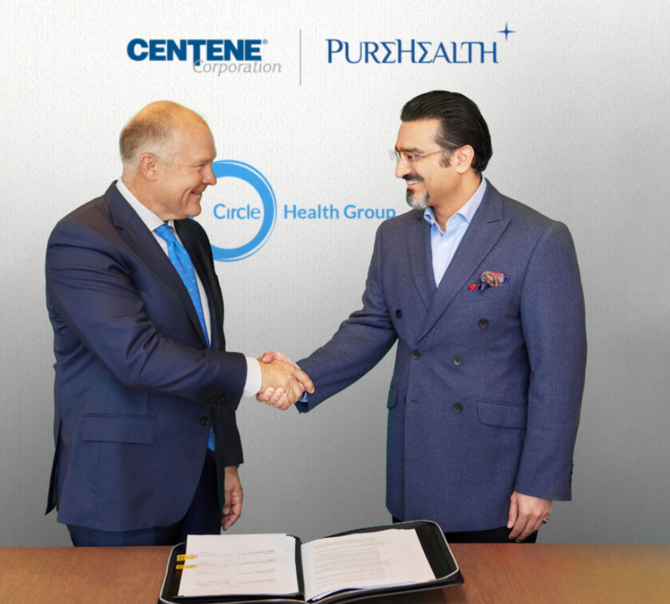
Abu Dhabi-based PureHealth has signed an agreement to buy British hospital operator Circle Health Group for 4.41 billion UAE dirhams ($1.2 billion), Emirates News Agency reported.
PureHealth is the UAE’s largest healthcare provider and the acquisition marks its first foray into the UK market.
According to the report, Circle Health Group has the UK’s largest network of private hospitals and was the first European healthcare provider to enter the Chinese market.
Under the agreement, PureHealth will acquire 100 percent of the group’s portfolio, which includes orthopedics, oncology, cardiothoracic surgery, ophthalmology, neurosurgery and general surgery, as well as the UK’s first purpose-built rehabilitation hospital.
“This acquisition marks an important milestone in our journey toward creating a global healthcare network which revolutionizes patient care,” PureHealth Group CEO Farhan Malik said.
“Our mission at PureHealth is to drive scientific innovation to unlock longevity and greater quality of life for humankind. Through integrating the expertise of both organizations, we positively impact the lives of patients globally.”
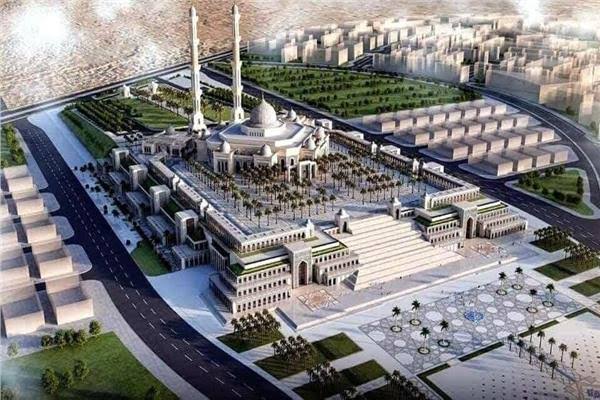
Egypt’s Grand Mosque in the New Administrative Capital
According to the explanation, Egypt’s Grand Mosque obtained three international certificates from the Guinness World Records.
The first was for the largest pulpit in the world with a height of 16.6 meters, handcrafted from the finest types of wood.
The second and third were for the main chandelier of the mosque, being the heaviest chandelier in the world of 50 tons, and it being the largest chandelier with a diameter of 22 meters and four levels.
Egypt’s Islamic Cultural Center in the New Administrative Capital
Egypt’s Islamic Cultural Center in the New Administrative Capital is a great achievement and one of the most important projects established in the New Administrative Capital.
The Islamic Cultural Center was established in the new capital on an area of 15,000 square meters. It has a large place for services, as well as a group of spacious and multi-storey garages, with a capacity of about 4,000 cars.
Saudi Arabia has stepped up measures to increase the scope of halal foods following the partnership of Saudi Standards, Metrology and Quality Organization, also known as SASO, with several entities, the agency said.
“More than 60 accredited entities from around the world work with us in the halal sector,” Nawaf Al-Shahri, head of the conformity assessment body acceptance department at SASO, told Arab News.
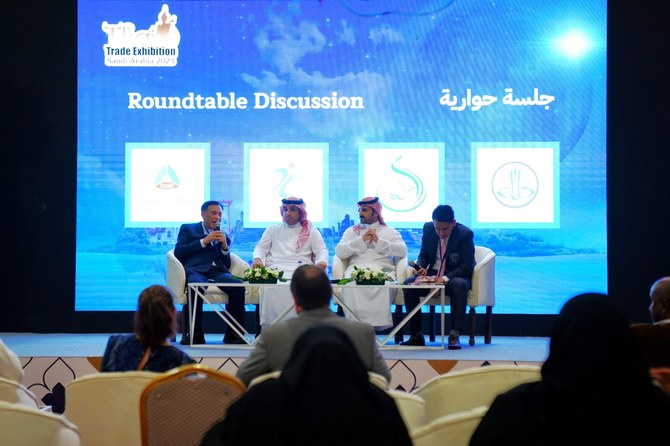
This information was revealed on the sidelines of the Thai Trade Exhibition Riyadh 2023, a four-day event that began on Aug. 27 at the Riyadh International Convention & Exhibition Center.
Al-Shahri further elaborated that SASO’s primary role in this sector involves accrediting entities responsible for issuing certificates for halal products beyond the Kingdom’s borders.
This responsibility complements the Food and Drug Authority’s task of certifying imported products in Saudi Arabia.
The authority is currently assessing the competence of these entities and will subsequently grant them a certificate of acceptance based on their qualifications. The Halal Center will then oversee their operations, both within their offices and in practical settings.
Winai Dahlan, founding director of the Halal Science Center, Chulalongkorn University, highlighted that there has been a noticeable increase in interest in halal meat among Thais in recent decades.
In 2003, the establishment of the cabinet marked a significant milestone in the evolution of halal products in Thailand.
He indicated that the growing interest in halal meat among Thais is fundamentally rooted in religious considerations.
In 1995, he founded the Halal Science Center at Chulalongkorn University to create a hub for the advancement of halal science in Thailand.
The principal duties of the center encompass the research and development of halal science and technology aimed at supporting the expansion of the industry while ensuring the quality and safety of the specialized products.
The halal products sector stands as one of the world’s fastest-growing industries, with a projected 6.1 percent increase in spending on food and beverages, anticipated to reach $1.9 trillion by 2023.
Islamic spending on halal pharmaceuticals was $87 billion in 2017 and is expected to reach $131 billion by 2023. Meanwhile, spending on cosmetics was $61 billion in 2017 and is projected to reach $90 billion by 2023.
Dr. Yousuf Al-Harbi, director of the Halal Center, affirmed that halal meat is a societal norm in Saudi Arabia.
He pointed out that the center aims to meet halal food requirements, adding that they are continually confident that “any local product we guarantee is 100 percent halal.”
“We have several initiatives, especially regarding the reliability of Halal food, from farm to consumer table, confirming that their experience in this area is thriving,” said Al-Harbi.
He said they are committed to ensuring that meats and poultry are slaughtered and stored according to Islamic law.
source/content: arabnews.com (headline edited)
___________
This discussion was held at the Thai Trade Exhibition Riyadh 2023, a four-day event that began on Aug. 27 at the Riyadh International Convention & Exhibition Center. (Huda Bashatah
Ahmed Hussen came to Canada from Somalia as a refugee. Now he’s the new minister of immigration.
Along with thousands of compatriots, Ahmed Hussen fled war-ravaged Somalia for a better life in Canada.
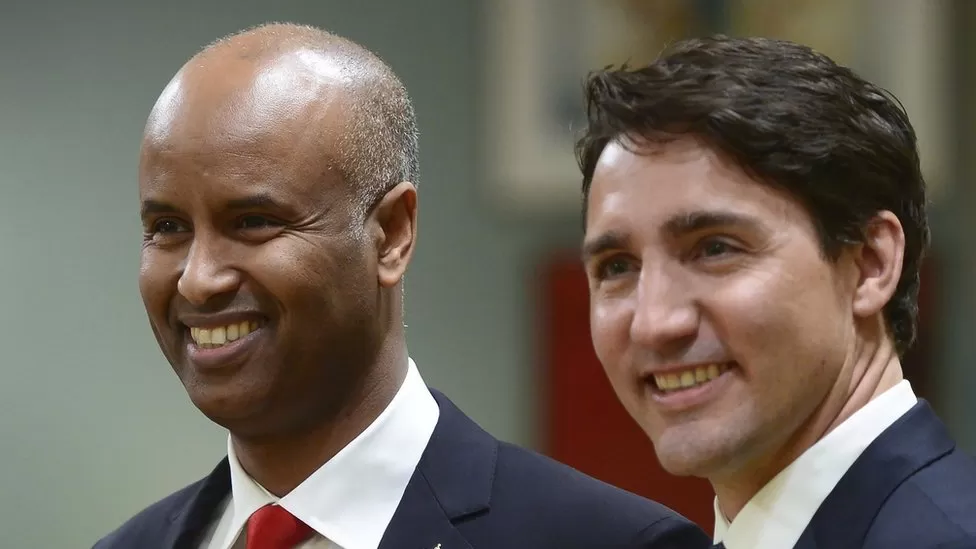
Hussen’s journey took him from Mogadishu to Toronto and then on to Ottawa’s Parliament Hill, where the former Somali refugee was named this week as the country’s newest minister of immigration in a reshuffle of Prime Minister Justin Trudeau’s Cabinet.
It was a fast political rise for the rookie politician, and will put Hussen, who arrived in Canada in 1993 as a 16-year-old, in charge of the complex portfolio that oversees who is welcomed into the country.
Friends say the lawyer and social activist will be able to draw from personal experience in his new role.
Mahamad Accord, who has known Hussen for years through his work with the Canadian Somali Congress, says his friend has not forgotten his modest roots despite walking Canada’s corridors of power.
“He didn’t change,” he says. “The people around him changed.”
Accord recalls Hussen offering him help a few years back. The Somali community in the provinces of Ontario and Alberta were struggling to tackle the deaths of dozens of young Somali men due to drug and gun violence.
He says Hussen did not shy away from speaking openly about the problems plaguing the Somali community in Canada, from high rates of poverty and unemployment to gang involvement.
But Hussen was also aware of how the community could be stigmatised, and was always careful in how he spoke and presented himself. Accord says his friend would tell him “we need to change people’s perception of us”.
“He expects high standards,” he says.
Accord admits he was sometimes jealous of the lawyer and social activist’s ability to get across a difficult message diplomatically.
It was that ability that struck former Ontario politician George Smitherman when he first met Hussen in 1999. Hussen was then fighting for the interest of Regent Park, a multi-ethnic neighbourhood in downtown Toronto where he had settled with one of his brothers upon his arrival in Canada.
In 2015, he told the Toronto Star that a backlog in refugee applications for permanent residency at the time meant he could not qualify for a student loan. Living in the public housing allowed him to save enough to go to university.
Hussen lobbied to help secure funds to revitalise the crime-ridden housing project, co-founding the Regent Park Community Council.
Some long-time residents had to move out of their homes during the redevelopment and were fearful they would not be able to return; Hussen worked to ensure their interests were protected.
“There was an extraordinary tension because there was distrust and concerns among tenants,” recalls Smitherman. “Ahmed had to very carefully but forcefully represent their interests.”
Smitherman, who calls the 40-year-old Mr Hussen an “old soul”, later helped him land a job working with former Ontario premier Dalton McGuinty.
“He was someone who spoke with a calmness and an informed knowledge and a maturity that defied his circumstances, both as someone who was young and someone who had taken this awesomely courageous step of leaving Africa for Canada.”
Mr Hussen swept his Toronto riding in November 2015, though he drew criticism for not living in the disadvantaged riding he was elected to represent.
Speaking last April in the House of Commons, he raised concerns about the recent drowning death of hundreds of migrants from Somalia and the Horn of Africa, saying: “Asylum seekers are not criminals. They are human beings in need of protection and assistance and deserving of our respect”.
Smitherman sees Hussen’s background as both an asset and a possible disadvantage in the challenging portfolio.
“It sets up for tensions also as expectations are increased,” he says.
Following his swearing-in, Mr Hussen, the father of three boys, told media he was “extremely proud of our country’s history as a place of asylum, a place that opens its doors and hearts to new immigrants and refugees”.
Hussen has always referred to himself as a Canadian first and Somali second, says Accord. In 2015 Mr Hussen told the Canadian Broadcasting Corporation that he does not want to be labelled a “Somali MP”.
“I’m a Canadian. Somali is my heritage and I’m proud of my heritage but I have a lot to contribute to Canada. And I’m a mainstream guy. I’m not limited by my community,” he said.
Hussen replaces John McCallum, a veteran politician who is going to become Canada’s envoy to China after managing Trudeau government efforts to bring in over 39,000 Syrian refugees in the last 13 months.
“The real message of the new appointment is that the government wishes to profile refuges as a more salient part of our immigration program,’ says Jeffrey Reitz, a University of Toronto sociology professor.
“But it does raise the question of the mainstream immigration programme,” he says.
The rookie minister will face challenges in the key, and rarely uncontroversial, portfolio.
McCallum recently introduced contentious changes to Canada’s popular family reunification programme, replacing a first-come, first-serve process with a lottery system to randomly choose 10,000 people who filled out initial applications to express interest. Critics say that reuniting families should not depend on luck of the draw.
Another recent decision to scrap a rule limiting how long foreign workers can stay in Canada is being targeted by the opposition as potentially harmful to the country’s work force in the long run. Immigrant rights groups have been critical of the programme, arguing the workers under the program are vulnerable to abuse by employers.
He will also have to defend a recent Liberal decision to significantly reduce the number of private sponsorship applications for Syrian and Iraqi refugees because of a current backlog.
Canada plans to bring in 300,000 immigrants in 2017, the majority of them economic immigrants.
source/content: bbc.com (headline edited)
_____________
Ahmed Hussen is Canada’s new minister of immigration in Justin Trudeau’s government / pix: AP
Last week’s Arabian Flavour Festival in the Dutch capital celebrated Arab culture, cuisine, crafts
‘It’s all about sharing love, identity and culture,’ organizer tells Arab News
The first edition of the Arabian Flavour Festival took place in Amsterdam last Saturday.
In an intimate outdoor setting, the festival celebrated the diversity and richness of Arab culture, cuisine and crafts.
Organizer Shadow, originally from Syria, said his aim is to create a platform for promoting both international and Middle Eastern artists, for people to mingle and to share their cultures through storytelling and arts.
Set in the idyllic Tolhuis garden, a cultural and culinary meeting place in Amsterdam, the one-day event welcomed over 1,000 visitors from different backgrounds.
Organized by The Shadow Projects, the festival featured two stages with performances by dancers, singers and poets, along with a dabke workshop, pop-up food and merchandise, all within an Arabian atmosphere.
“It’s called Arabian Flavour because there’s a flavor of Arabic culture, but at the same time it’s an opportunity for people to integrate,” Shadow told Arab News.
“There’s always a performance other than Arabic to let people understand that this isn’t an Arabic party (but) just an Arabian Flavour.”
The idea started after Shadow starred in the documentary “The Story Won’t Die” about Syrian artists in Europe and America, from award-winning filmmaker David Henry Gerso.
In 2021, because of Shadow’s efforts, the documentary was showcased at the International Documentary Film Festival Amsterdam, whereafter the concept gained more and more traction.
Initially, it began as a gathering showcasing talents at home, but expanded to various stages throughout Amsterdam, and now the Arabian Flavour Festival is the biggest such festival in Europe, according to Shadow.
The organization places significant emphasis on diversity and inclusion. “If you’re an Arabic singer who isn’t well known, you don’t have work anymore if you move to Europe,” he said, adding that Bottom of Form the festival is open to whoever wants to perform.
The organizers state: “It is magical to see people who share their passion, and it is most important that they express themselves authentically.”
Among the performers was DJ Maherrie, a Syrian DJ who amazed the audience with a fusion of Middle Eastern melodies and modern European rhythms to raise awareness of his heritage.
Dutch singer-songwriter Maxine Zain shared her hopes of inspiring people with her heartfelt songs, and specifically highlighted her enjoyment in seeing traditional Arabic music connecting well with the artistry of Dutch artists like herself.
Pauline Koning, a passionate self-taught Dutch musician and belly dancer, made an impact with her performance of her own song “Kefaya Ghyab.”
In her music, she blends Arabic, Western, and Yemeni musical elements, drawing inspiration from her nostalgic love for Umm Kulthum, and praises the language’s poetic nature and rich emotional vocabulary.
The Arab tradition of belly dancing, Koning said, “represents a powerful symbol of empowerment for all women, not only embodying archetypes but also having the power to transfer certain emotions.”
Shadow earned his name for his ability to bring subcultures from the shadow into the light, and the event lived up to this name as confirmed by visitors’ reviews. “I’m very curious about Arab culture. It’s a refreshing perspective opposite Dutch traditions,” said one visitor.
Another visitor attended the festival as an opportunity to connect with language partners and practice Arabic.
Three friends from Yemen were interested to meet Dutch people and exchange stories about their respective cultures.
Aside from the Arabian Flavour Festival, they also host monthly Arabian Flavour Nights. “The dream is to, in the next year or so, organize a three-day festival,” but in the end “it’s all about sharing love, identity and culture,” Shadow said.
All the projects are funded by the Amsterdam Fund for the Arts.
source/content: arabnews.com (headline edited)
_____________
The first edition of the Arabian Flavour Festival took place in Amsterdam last Saturday. (Instagram/@theshadow.amsterdam)
Three entrepreneurs share their stories as well as tips to succeed, regardless of background
Steve Jobs, Tony Fadell of iPod and Nest thermostat fame, and Taher Elgamal, the father of SSL technology, may be some of the most successful Arab Americans the global tech world has seen – but bit by bit, that picture is starting to change.
An emerging group of Arab-American women is increasingly taking up the tech mantle in a host of diverse fields.
A year spent in Kansas as a cultural exchange student at the age of 17 led to Morocco native Yasmine El Baggari feeling a profound need to help people connect.
“Most people [in Kansas] had never met someone from Morocco before. It felt like I was a cultural ambassador for Morocco at every opportunity,” she says.
The experience morphed into something more: a road trip to all 50 US states, during which she stayed with families and taught French and Arabic to get by, and later, a career that has seen her visit more than 45 countries – while securing a degree from Harvard University along the way.
All this led Ms El Baggari to found Voyaj, an online platform that fosters connections between people from diverse backgrounds in all corners of the globe.
“Once you build a human connection with someone, they’re more open to considering different perspectives … which is the basis of the work I continue to do: building and facilitating connections with people around the world,” she says.
Voyaj has collaborated with organisations to bring dozens of students from Africa to California for cultural exchange trips.
In March, Ms El Baggari raised more than $50,000 through a crowdfunding campaign involving more than 260 people from 40 countries to help fund the app.
Recently, Voyaj started working with non-profit Alight to help connect Afghan refugees recently arrived in Minnesota with local residents.
With the number of immigrants from the Middle East and North Africa in the US doubling over the past 20 years to 1.2 million, Arab-American women are set to play an increasing role in the tech and entrepreneurial landscape.
But getting to the top is not easy – just ask serial achiever Sherien Youssef.
Born and raised in Cairo, she emigrated to the US aged 11.
“My parents gave up a lot in Egypt to come here. They were comfortable there, but wanted a better life for their children,” she says.
Now living in a suburb of Washington, Ms Youssef is a senior executive and vice president at CGI, a major IT and consulting multinational that employs more than 90,000 people in about 40 countries.
It has taken serious determination to get to where she is.
“Growing up, being Arab American and being a Muslim, it wasn’t easy to find a person that looked like me [in this industry],” she says.
“It wasn’t very prevalent in my field. When you come as an immigrant, you have a desire to be constantly working harder and proving yourself over and over again.”
Today, her professional life consists of speaking at conferences, working closely with chief executives at partner companies and mentoring staff.
Having raised a family, grown her career and secured an MBA, she says there is still room for change.
“This is still a male-dominated field. We don’t see as many women in the C suites in the IT field,” she says.
Health and wellness is another area Arab-American women are making inroads.
For 12 years, Megan Moslimani was a dedicated public servant, working as a lawyer for the city of Detroit and serving as a board member of the Detroit Bar Association.
But a trip to Los Angeles in 2016 made her realise health care and wellness were industries on the up, and that IV drip therapy could be a game-changer.
“We visited different medical spas for fun and to enjoy the luxury experience. I was impressed with the way you could feel instantly better and hydrated [from using the drips],” she says.
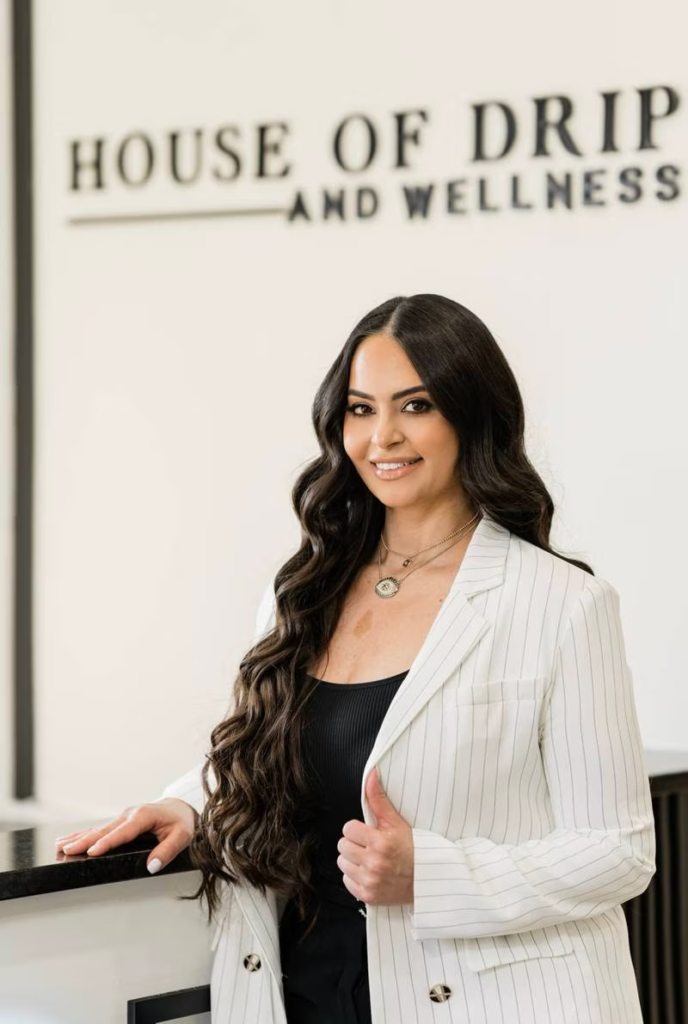
Last spring, Ms Moslimani, whose family arrived in the US from Lebanon in the early 19th century, and her colleague, Biane Bazzy, dove headfirst into their passion, opening the House of Drip & Wellness in Dearborn, Michigan.
American designer brings hijabs to the high street
Made popular by celebrities such as the Kardashians and Hailey Bieber, and appearing in popular TV shows such as Billions, restorative IV drip therapy is a way to get vitamins, electrolytes and other nutrients into the bloodstream quickly.
It is believed to help people recover more quickly from illnesses, jet lag, fatigue and other ailments.
“Clients feel results instantaneously as the drip directly enters the bloodstream, bypassing the digestive tract,” she says.
“People love instant gratification, and I knew all could benefit – athletes, tired mums, overworked professionals.”
Restorative IV drip therapy spas or “drip bars” are springing up in strip malls and neighbourhoods across the US. With the global wellness industry estimated to be worth about $1.5 trillion and expected to grow by 5 per cent to 10 per cent per year, IV drip therapy is set to become an important health recovery tool.
For Arab-American women thinking about starting out in the tech and entrepreneurial worlds, the trio have tips to share.
Ms Moslimani says it is important to be prepared to spend money on the right things to grow your business.
“Look for attorneys offering pro bono hours and get real business law advice,” she says.
Ms El Baggari says getting past the stigma of asking for help is essential to succeeding as an entrepreneur.
“Don’t be afraid to ask for what you need – if people say no, that’s OK,” she says. “You want a clear sense of mission. Understand your ‘why?’”
For Ms Youssef, investing in yourself is key, “whether it’s in degrees and certificates, or in networks”.
“Oftentimes it’s the relationships and connections that you make will be the reason that you get to the next step in your career,” she says.
Last spring, Megan Moslimani and a colleague launched the House of Drip & Wellness in Dearborn, Michigan. Photo: Megan Moslimani
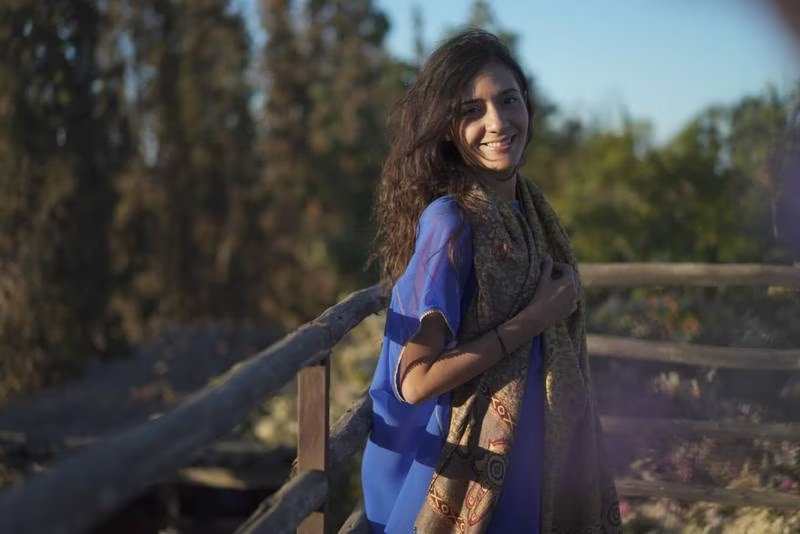
Yasmine El Baggari is the founder of Voyaj, an online platform that fosters connections between people from diverse backgrounds. Photo: Yasmine El Baggari
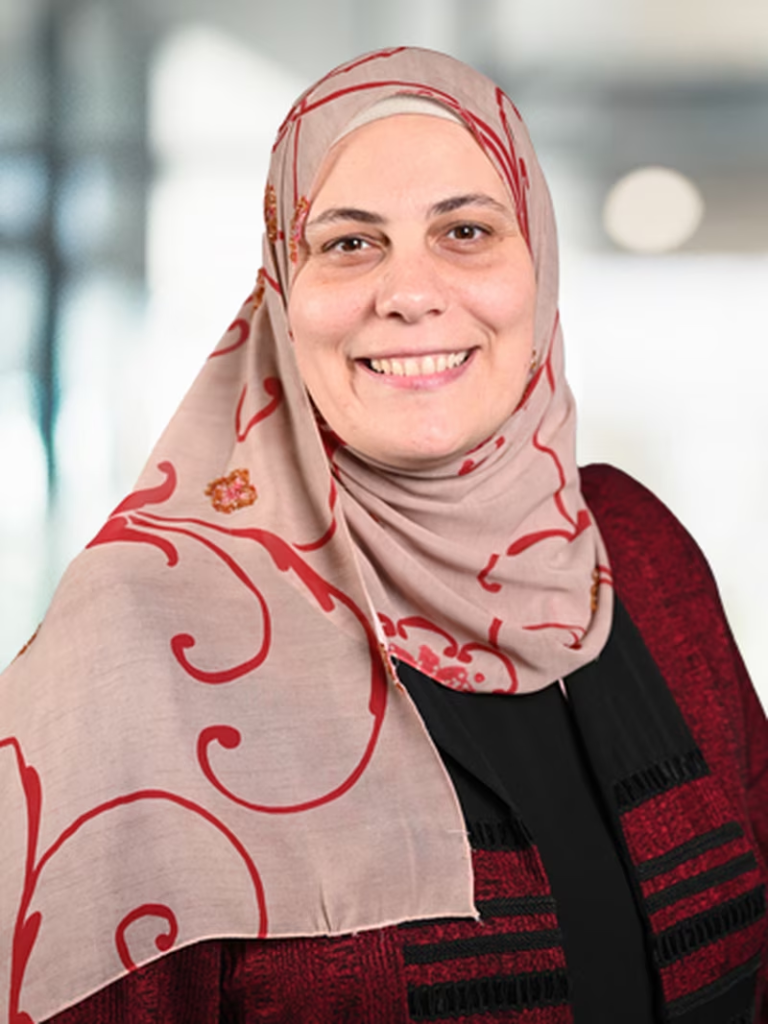
For Sherien Youssef, investing in yourself is key, ‘whether it’s in degrees and certificates, or in networks’. Photo: Sherien Youssef
.When you hear of Al-Andalus, you might think of Andalusia. And yet, from 711 to 1492, until the famous Fall of Granada, the Future Andalusia was only a small part of this vast Arab territory, whose influence can be seen everywhere in Spain. Let us take a tour.
Al-Andalus, a long series of powerful people
In the early 8th century, the Iberian Peninsula belonged to the Visigoth Empire, when the commanders of the Umayyad Caliphate (with a territory extending from the Arabian Peninsula to the Maghreb) set out to conquer the lands on the other side of the Mediterranean.
The Umayyad dynasty ruled in Al-Andalus (what would become Spain) for more than 300 years. It was suceeded by Taifas (independent kingdoms). The Abbasids, then the Almoravids, rose to power. In 1147, it was the Almohads who took over the empire. This proved to be a prosperous period, with great scholars, such as Averroes, a doctor, lawyer, and advisor to the Caliph. These scholars helped to make Al-Andalus a grand dominion. But the Christian reconquest gained ground. From 1238 to 1492, the Reconquista blazed on, and soon only the Emirate of Granada remained in southern Spain, the last vestige of the great Muslim empire.
From the north to the south of Spain, the Arab-Andalusian influence can be seen everywhere
One after the other, Cordoba, Seville and Granada became the capitals of the kingdom of Al-Andalus during the Middle Ages. Arab culture has permeated everything from traditional Andalusian music to the names of localities, and the Spanish language. But the most visible influence can of course be seen directly in the architecture of buildings and streets. Numerous vestiges, sometimes intact, sometimes remodelled, remain in the cities’ maze of streets, and this period of Spanish history has left prodigious monuments of Arab origin and fabulous examples of Islamic art. Many of these monuments bear a unique blend of cultural influences as they were renovated or repurposed over the centuries.
The most beautiful Arab monuments in Spain
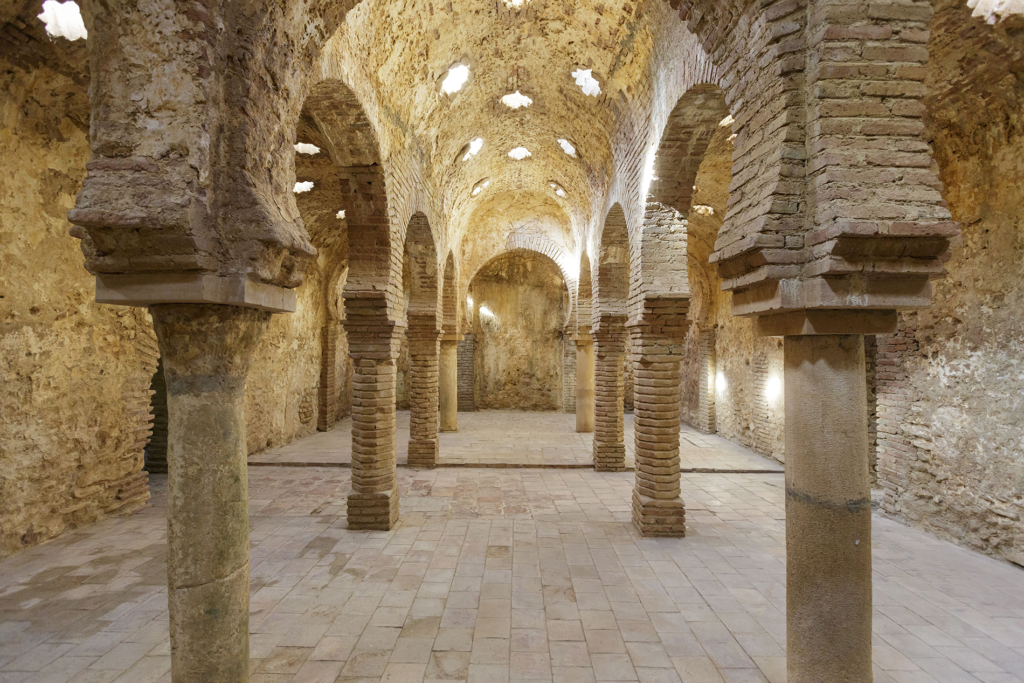
The Arab Baths of Ronda, a magnificent ruin site
The hammam tradition was a cornerstone of Arab culture for centuries. From the 13th to the 15th century, several such baths were built in Spain. The baths of Ronda, in Andalusia, are one of the best examples, with their three magnificent barrel-vaulted rooms and visible heating and water circulation systems. The Guadalevín river, which often floods, has prevented these baths from being used, but excavations have been carried out, and now you can visit and admire some of the best-preserved Arab bathhouses in the country.
pix: P. Escudero / hemis.fr
Baños Árabes C. Molino de Alarcón 29400 Ronda Málaga +34 951 15 42 97 turismoderonda.es
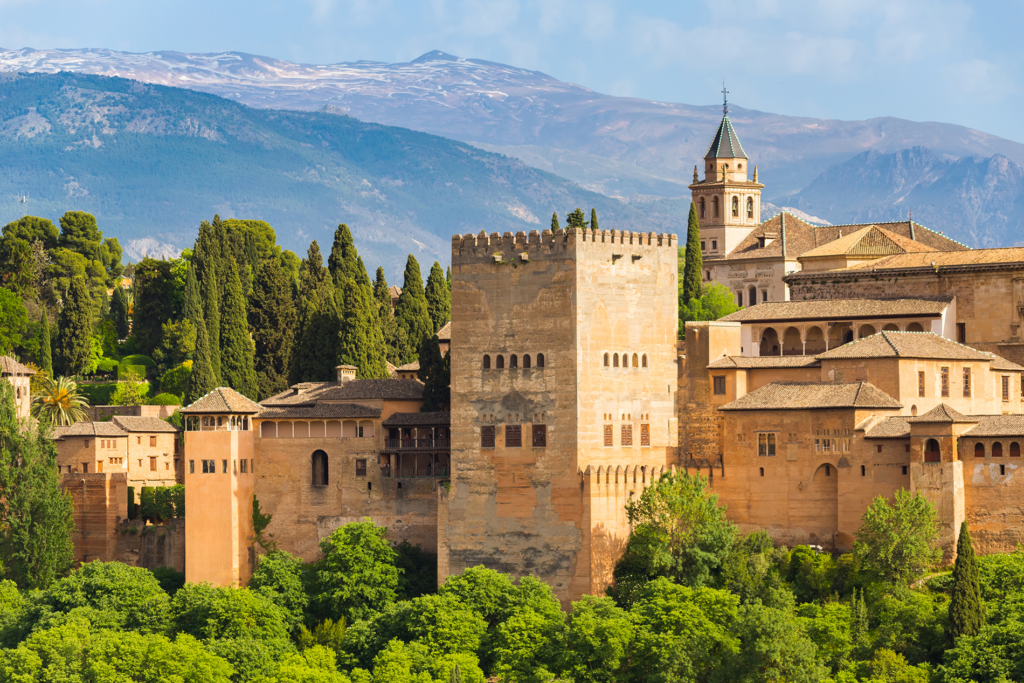
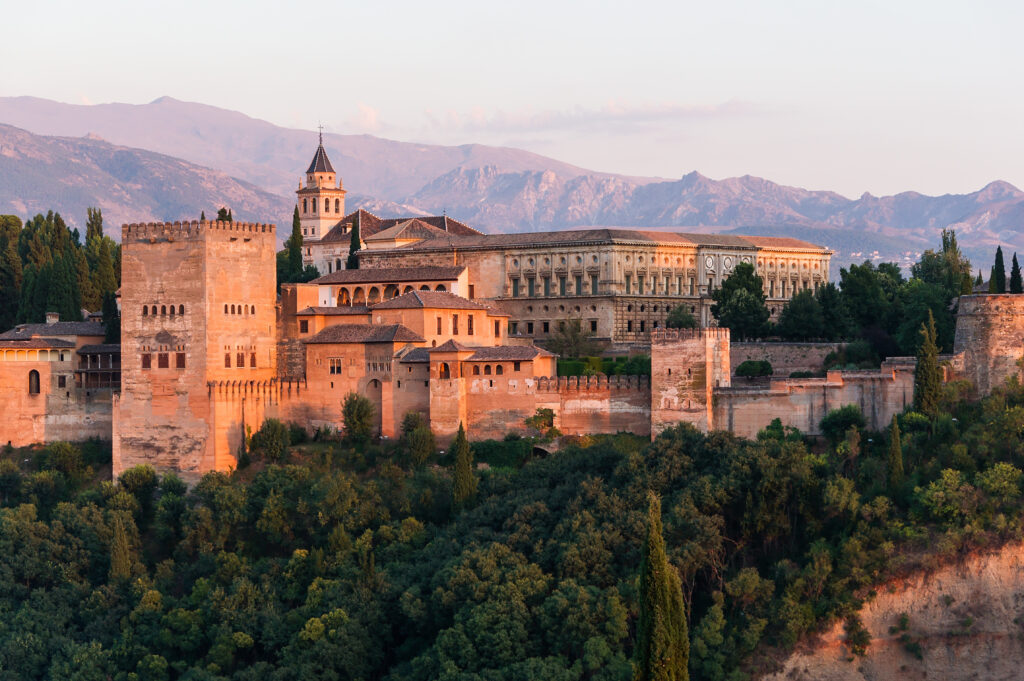
The Alhambra of Granada, an extraordinary castle
On the Sabika hill, opposite the Albaicín district, stands the Alhambra of Granada, a majestic conglomeration of several buildings built in the early 12th century. The grandeur of the last Nasrid rulers is at its peak. Not to mention the sublime, breathtaking view over the plain of Granada!
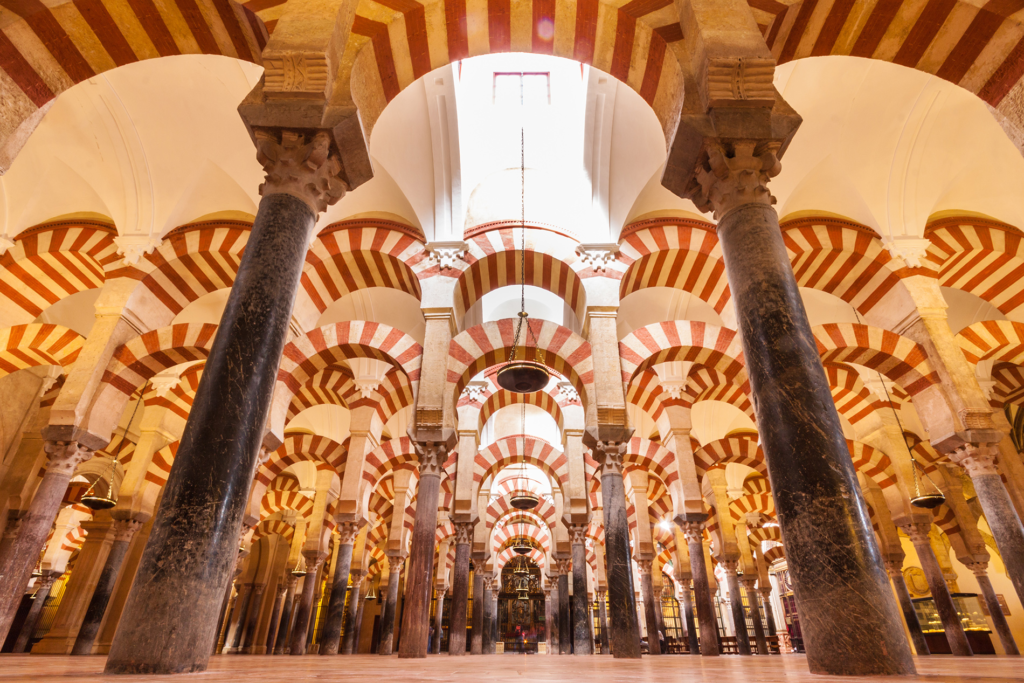
The Mosque-Cathedral of Cordoba, from Islam to Christianity
Another Muslim building, the Cordoba mosque is a symbol of Arab influence at its most grandiose. From the 8th century to 29 June 1236, the building served as a mosque, before becoming a church again following the Reconquista. Representative of the art of the Umayyads of Cordoba, it is a monumental structure, and it covers over 1.5 hectares. The building is a splendid example of Islamic architecture: the “forest of columns” in the main hall – 1,300 marble, jasper and granite columns – highlights the gargantuan size of the place.
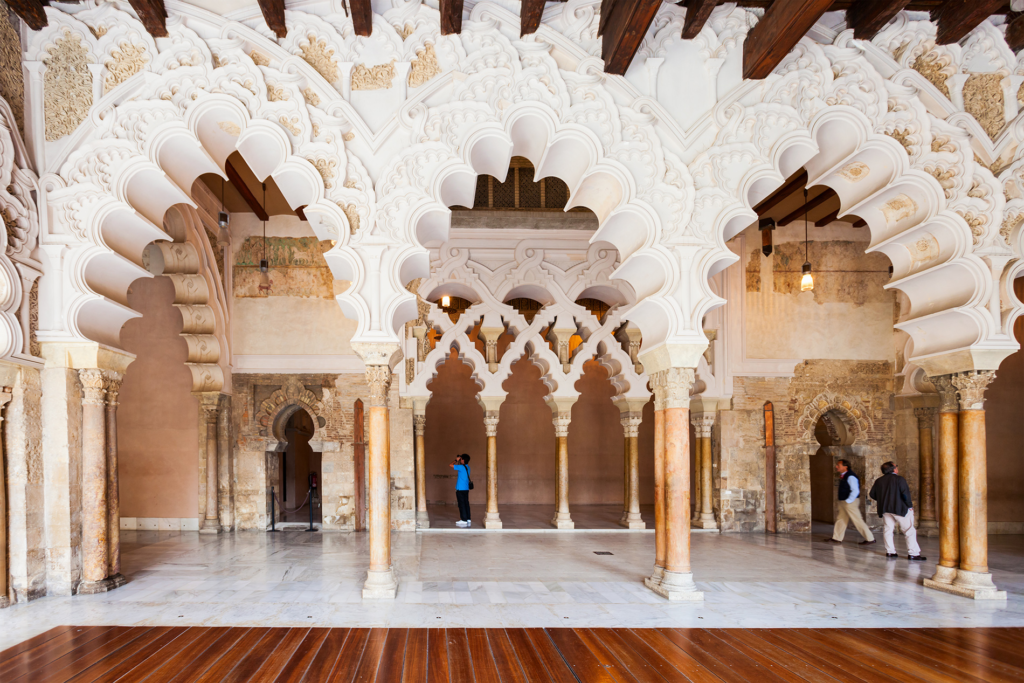
The Mudejar art of Aragon, in the north of Spain, has been declared part of UNESCO’s World Heritage, and the Aljaferia in Zaragoza is one of its most flamboyant masterpieces. When it was built in the second half of the 11th century, this palace clearly displayed the magnificence of the Taifa of Zaragoza. It served as a residence, a fortified enclosure and a barracks. It currently houses the Parliament of Aragon. The palace’s interior decoration is gorgeous, with a series of delicate, refined arches.
pix: kasto80 / Getty Images Plus
Palacio de la Aljafería Calle de los Diputados 50003 Zaragoza +34 976 28 96 83 www.turismodearagon.com
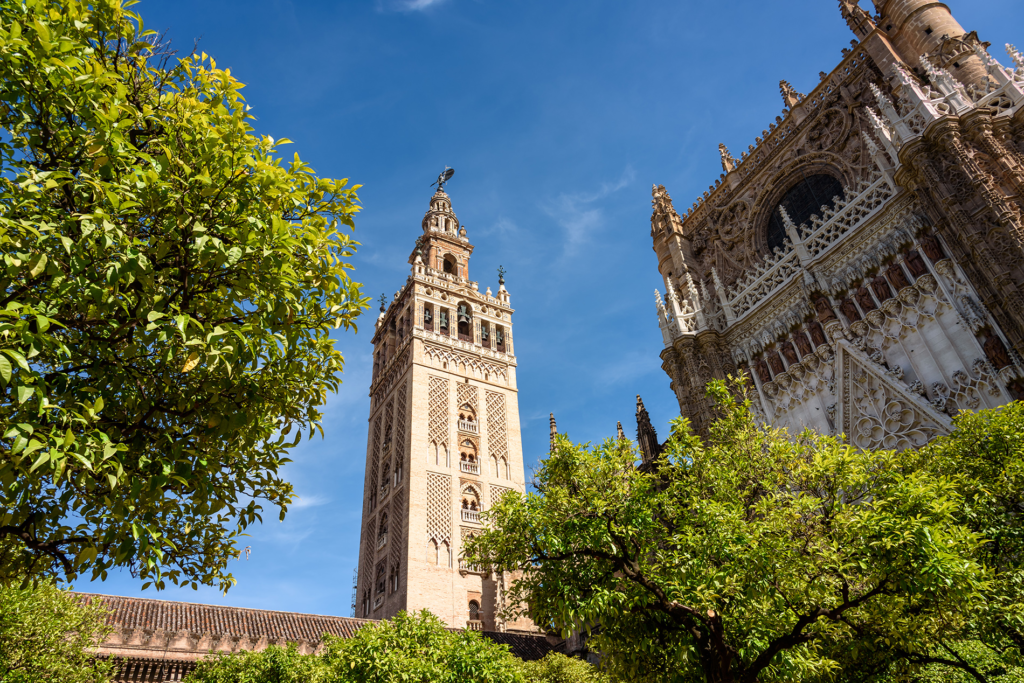
The Seville Giralda, a perfect example of mixed construction
The architectural marriage of the Giralda, the bell tower of the Cathedral of Our Lady of the See in Seville, is immediately evident. The lower parts were built in the 12th century, when the city was the capital of the Arab-Andalusian empire, under the rule of the Almohads. Four centuries later the upper floor was added, and the mosque’s minaret became a bell tower. It is now an unspoken rule that no building should be higher than this symbol of Seville.
pix: marinzolich / Getty Images Plus
Catedral de Santa María de la Sede de Sevilla – Giralda Av. de la Constitución 41004 Sevilla +34 902 09 96 92 www.catedraldesevilla.es
How do you use tech/data to tackle important issues? Tell us about your work.
Data, specifically qualitative research methods, is important to apply a systems lens of work as a means to connect the dots between the various solutions I’ve been mapping. Looking at a portfolio of solutions rather than stand-alone silver bullets creates evidence to better understand complex problems that are in nature wicked and interlinked. This method of starting with the solution and portfolio of solutions becomes a proxy indicator of a need and blind spot in a system or system of systems and/or a signal of change taking place.
I work with ordinary people who create extraordinary things to adapt to change quickly. My work is then to analyse that to share with the UNDP network and government counterparts for better decision making.
Solutions mapping is like pointillism. A series of dots may not make much sense but when it begins to connect and harmonise, you step back and see a picture. An example of that was during Covid-19 and how micro enterprises were forced to figure out ways to continue work under limitations of social and safe distancing. Observing a pattern of cashless solutions and connecting these with similar solutions both in Sudan, regionally and across the globe underlined the need but also an accelerated shift to a cashless economy as result of this new normal.
What was the most impactful project you worked on in the past year?
One of the ways to support a thriving local innovation ecosystem is one that facilitates this very ecosystem to see itself and its diverse and often unusual stakeholders.
If I were to liken the current ecosystem in Sudan, I would describe it as a map of islands with few bridges in between. When you start to ‘see’ solutions, as a mapper, you can see in all the ways they connect, align and interlink in this bigger and collective effort to create impact.
Everywhere I go, I cannot stop emphasising the ripple effect of the Solutions Fair held in early 2020. Whereby for the first time, stakeholders from different groups spanning academia, private and public sectors where in the same giant hall as Giulio Quaggiotto, Head the UNDP Strategic Innovations Unit has coined, the development mutants. A social experiment of sorts, of what takes place when the traditional development actors meet the unusual and unexpected.
The organic connections, knowledge sharing and diffusion that begin to form from which a community of solution holders emerged. With the first Covid-19 case reported in March and subsequent lockdown, it was this very community network that I was able to tap into to understand how they were responding, pivoting with Covid-19. The socio-economic impact but also the incredible resilience to reconfigure and do things differently under this immense and limiting challenge. How this network was connecting, working and collaborating with other networks. From university labs shifting to production of hand-sanitizers for students to distribute for free in the urban centres, to a social enterprise supporting highly affected street tailors into an organised collective to mass produce re-usable masks. The power of connections and compound impact that bridge the usual with the unusual.
What are some innovations from the pandemic that have caught your eye?
Indigenous Sound Bites. This completely grassroot effort was carried out by Dr. Hiba Abdelrahim of Sudan Unity Networking who first noticed the glaring gap in inclusive Covid-19 communication available in local and indigenous languages. She started to reach out to a network of Sudanese polyglots on Facebook to record sound bites of Covid-19 WHO guidelines and safety precautions. Through networks and network of networks on social media from Telegram, Whatsapp, Youtube, a collective distribution approach was used to share and reshare these sound bites to ensure this reaches volunteers on the ground in rural and hard to reach areas to share this vital and critical health information.
What is one unexpected learning from 2020?
2020 was a year of personal growth and learning forced by being cut off from the usual pace and external stimuli of everyday life and way of work. Facing a collective and shared challenge caused by the Covid-19 pandemic, the uncertainty of this new reality and what that means at a personal and professional level created a space to pause for much needed reflection on what really matters. Family and well-being, particularly mental well-being, and health have always been important. But what was unexpected was how much that really is a priority at the core of the choices I make and should and ought to be making.
In a way, the great re-set of this year was a wider ripple effect for social solidarity which emphasised the need for better support for care work and care economies. An integral support system that was consistently undervalued but came to the forefront with the pandemic in the welfare of, for and by communities.
What are your priorities for 2021?
Balance. Solutions mapping, and I am biased for obvious reasons, is an important protocol that introduces mixed research methods and approaches to development practice. The importance of constant and consistent engagement with the systems outside the work of UNDP, and connecting to those closest to the problem in the context of development challenges, allows solutions mappers to be a bridge to share, diffuse and shine light on context responsive knowledge with decision makers at UNDP and government counterparts that may influence programming, policy or inform better partnerships and possibly open unexpected pipelines in the market.
All the while, it is imperative to embed the practice and protocols of solutions mapping within UNDP thereby creating movements and networks of UNDP mappers in the country office to re-learn to see, observe and engage with ecosystems through this new lens. This is akin to having one foot out with one foot in, a balancing act to ensure that I am not leaning heavily on one foot at the expense of the other.
What tool or technique particularly interests you for 2021?
Ethnographic cartography (EC) is a method I am particularly keen to explore its possible applications in the context of Indigenous Knowledge Systems (IKS) in Sudan. EC inspired by Everyday Geographies and Personal Geographies, is a multi-sensory approach combining two activities.
The first, MyWalks is an activity that is intended to reawaken the senses to look for the unexpected. A simple premise of walking through a familiar route, re-walked or a new route walked for the first time. The experience of the journey starting at A is more important by engaging the senses and observing rather than reaching the destination at B.
The second, MessyMaps is the technique to record this multi-sensory experience through images, sound and notes. The outcome of this supports better understanding and engagement of the ecosystem in which I am mapping solutions and how these solutions exist, interlink and engage with the environment it operates out of and with.
I first came across an application of this method through the amazing work “Other Maps” undertaken by a fellow Solution Mapper, Paulina Jimenez at UNDP Ecuador. In academia, this emerging method was used to produce qualitative GIS representations of resilience. In this use case, Dr Faith Evans incorporated emotion, social connections and experience to present an experimental map visualisation of informal settlements in Kenya.
Which other countries inspire you and why?
India. As I onboarded to the Accelerator Lab, the cohort of AccLab mappers had the unique opportunity to get first-hand knowledge and support from the Accelerator Lab Network knowledge partner, the Honey Bee Network and GIAN. Virtual classes led by Prof Anil Gupta and Dr Animika Dey on mapping inclusive grassroots innovation was an eye opener to the work led by India over the last two decades to recognise, incorporate and support grassroots innovations in the National Innovation Policy. As one publication describes it, propositioning grassroots innovations in the S&T policies of India created a space for “the innovation agenda [to] shift from presenting grassroots innovation as a divider of the national innovation wealth to a provider of it”. (1)
The kind of effort India has spearheaded is one I would hope can be galvanised for Sudan to learn from and emulate.
Who do you admire? Who is your hero?
My grandfather. A food scientist, teacher, researcher, former FAO and fierce advocate for R&D turned entrepreneur and thought leader in the F&B industry of Sudan.
I remember once asking him why he did not invest in better advertising for his products or fancier packaging. His response was that his responsibility and priority is to ensure accessibility for the everyday Sudanese informed by the forefront of sustainable food production research. In which the everyday consumer not only benefits from the product itself but is able to re-use and repurpose the packaging for domestic needs.
The value system he has abided by until his retirement almost a decade ago is one I admire and have grown to appreciate even more as a development practitioner. The principles he went by still ring true and relevant in industrial innovation and sustainable consumption and production today.
(1) Jain, A., & Verloop, J. (2012). Repositioning grassroots innovation in India’s S&T policy: From divider to provider. Current Science, 103(3), 282-285. Retrieved March 16, 2021, from http://www.jstor.org/stable/24085031