Arabs & Arabian Records Aggregator. Chronicler. Milestones of the 25 Countries of the Arabic Speaking World (official / co-official). AGCC. MENA. Global. Ist's to Top 10's. Records. Read & Enjoy./ www.arabianrecords.org
Category: Inventions, Innovations (wef. Feb 01sy, 2022
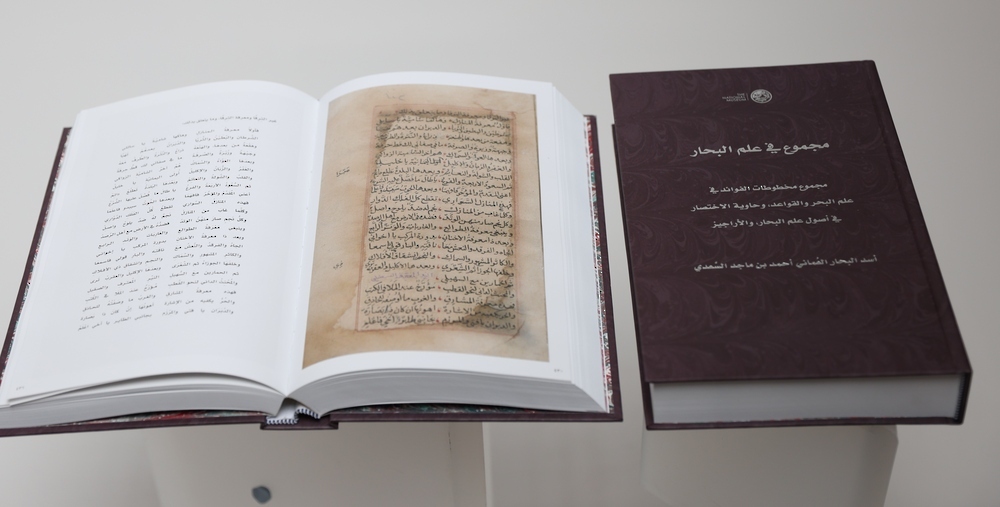
The National Museum has issued a special edition titled ‘Collection in Marine Science.’
The issue documents the greatness of Omani navigator Ahmed bin Majid Al Saadi, reviving his marine prowess and navigational creativity.
The collection documents the origin of the manuscript titled “Kitab al-Fawa’id fi ‘Ilm al-Bahr wa al-Qawa’id” (Collection of Manuscripts of Benefits in the Science of the Sea and Rules, as well as the abbreviation container in the origins of marine science and Arajiz), which has been on loan from Al Assad National Library in the Syrian Arab Republic to the National Museum since 2019.
In the opening speech of the publication, Jamal Hassan al Moosawi, Secretary General of the National Museum, said, “The display of the original manuscript ‘Collection in the Science of the Seas’ by the author Ahmed bin Majid al Saadi at the National Museum is an affirmation of the Omani identity of this unique scientific and historical personality.
This display comes in the context of the existing cooperation between the National Museum and the Ministry of Culture of the Syrian Arab Republic as part of the cultural diplomacy pursued by the National Museum.”
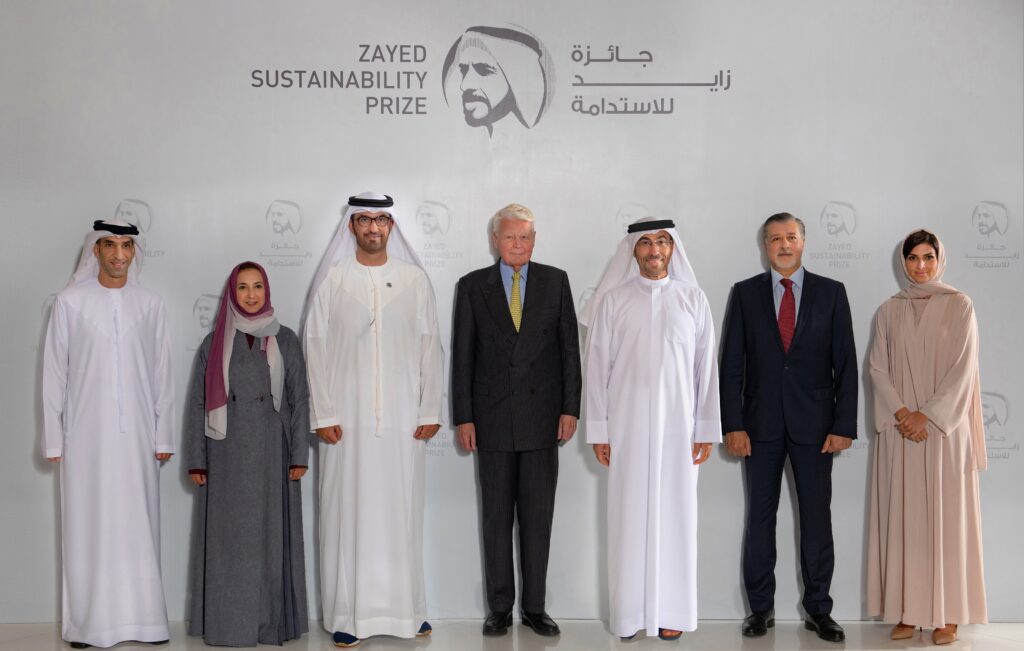
The Zayed Sustainability Prize, the UAE’s pioneering global sustainability and humanitarian award, has announced this year’s finalists following a deliberation by its esteemed Jury.
The winners will be announced at the Zayed Sustainability Prize Awards Ceremony on 1st December during the 28th Conference of the Parties (COP28) of the UN Framework Convention on Climate Change, to be held from 30th November to 12th December.
The Zayed Sustainability Prize’s Jury elected the 33 finalists from 5,213 entries received across six categories: Health, Food, Energy, Water, Climate Action and Global High Schools – a 15 percent increase in submissions compared to last year. The new Climate Action category, introduced to mark the UAE’s Year of Sustainability and hosting of COP28 UAE, received 3,178 nominations.
From Brazil, Indonesia, Rwanda and 27 other countries, the finalists represent small and medium sized businesses, nonprofit organisations and high schools, and reflect the Prize’s growing mandate to reward innovations that transcend borders and tackle pressing global challenges.
Dr. Sultan bin Ahmed Al Jaber, Minister of Industry and Advanced Technology, COP28 President-Designate and Director-General of the Zayed Sustainability Prize, said the finalists exemplify the remarkable ingenuity and unwavering commitment to shaping a more sustainable and resilient future for our planet.
Dr. Al Jaber added, “The Zayed Sustainability Prize carries forward the enduring legacy of UAE’s visionary leader, Sheikh Zayed, whose commitment to sustainability and humanitarianism continues to inspire us. This legacy remains the guiding light of our nation’s aspirations, propelling us forward in our mission to uplift communities around the globe. Over the past 15 years, the Prize has been a powerful force for positive change, transforming the lives of over 378 million people across 151 countries. We have incentivised solutions that are driving climate and economic progress in some of the world’s most vulnerable regions.
“This cycle, we received a record-breaking number of submissions from every continent. The innovations put forth by the finalists reflect a profound dedication to inclusivity and an unyielding resolve to bridge critical gaps. These solutions directly align with the four pillars of the COP28 UAE agenda: fast-tracking a just and equitable energy transition, fixing climate finance, focusing on people, lives and livelihoods and underpinning everything with full inclusivity. The work of these sustainability pioneers will contribute practical solutions for climate progress that protect the planet, improve livelihoods, and save lives.”
Through the Prize’s 106 winners to date, 11 million people have gained access to safe drinking water, 54 million homes have gained access to reliable energy, 3.5 million people have gained access to more nutritious food, and over 728,000 people have gained access to affordable healthcare.
Ólafur Ragnar Grímsson, Chair of the Prize Jury, said, “As global challenges continue to mount, our newest group of Prize finalists reveal the extraordinary efforts being made worldwide to meet the needs of the moment with purpose and innovation – inspiring hope for a brighter future. Whether it’s restoring the ocean wilderness, using technology to ensure better, more sustainable farm yields, or driving change for individuals without access to affordable healthcare, these innovators are transforming our world.”
The Health finalists are: • Alkion BioInnovations is an SME from France that specialises in supplying cost effective and sustainable active ingredients for large-scale pharmaceuticals and vaccines. • ChildLife Foundation is an NPO from Pakistan that employs an innovative Hub & Spoke healthcare model, linking Emergency Rooms as hubs to telemedicine satellite centres. • doctorSHARE is an NPO from Indonesia dedicated to expanding healthcare access in remote and inaccessible regions using barge-mounted floating hospitals.
The Food finalists are: • Gaza Urban & Peri-urban Agricultural Platform is an NPO from Palestine that empowers female agripreneurs in Gaza to achieve food security in their communities. • Regen Organics is an SME from Kenya that specialises in a municipal-scale manufacturing process that produces insect-based protein for livestock feed and organic fertiliser for horticultural production. • Semilla Nueva is an NPO from Guatemala that specialises in the development of biofortified maize seeds.
The Energy finalists are: • Husk Power Systems is an SME from the United States of America that deploys AI-enabled minigrids that provide 24/7 renewable energy to homes, micro enterprises, health clinics, and schools. • Ignite Power is an SME from Rwanda that specialises in delivering solar powered pay-as-you-go solutions to electrify last mile communities. • Koolboks is an SME from France that provides off-grid solar refrigeration solutions with integrated Internet of Things (IoT) monitoring for last mile communities, through a lease-to-own sales model.
The Water finalists are: • ADADK is an SME from Jordan that employs wireless smart sensors that use machine learning and augmented reality for the detection of both visible and hidden water leaks. • Eau et Vie is an NPO from France that offers individual taps to the homes of impoverished urban residents, ensuring access to clean water in slum areas. • TransForm is an NPO from Denmark that employs innovative soil filter technology for the cost-effective treatment of wastewater, sewage, and sludge without relying on energy or chemicals.
The Climate Action finalists are: • CarbonCure is an SME from Canada that specialises in carbon removal technology. They inject CO₂ into fresh concrete, effectively reducing its carbon footprint while maintaining performance standards. • Foundation for Amazon Sustainability is an NPO from Brazil that is dedicated to implementing projects and programmes that advance environmental conservation and empower indigenous communities to protect their rights. • Kelp Blue is an SME from Namibia that contributes to the restoration of natural ocean wilderness and the mitigation of excess CO₂ by establishing large-scale giant kelp forests in deep waters.
The Global High Schools’ finalists presented project-based, student-led sustainability solutions, with finalists divided into 6 regions. The regional finalistsinclude:
The Americas: Colegio De Alto Rendimiento La Libertad (Peru); Liceo Baldomero Lillo Figueroa (Chile); and New Horizons School (Argentina). Europe and Central Asia: Northfleet Technology College (United Kingdom); Presidential School in Tashkent (Uzbekistan); and Split International School (Croatia). Middle East & North Africa: International School (Morocco); JSS International School (United Arab Emirates); and Obour STEM School (Egypt). Sub-Saharan Africa: Gwani Ibrahim Dan Hajja Academy (Nigeria); Lighthouse Primary and Secondary School (Mauritius); and USAP Community School (Zimbabwe). South Asia: India International Public School (India); KORT Education Complex (Pakistan); and Obhizatrik School (Bangladesh). East Asia and the Pacific: Beijing No. 35 High School (China); Swami Vivekananda College (Fiji); and South Hill School, Inc. (The Philippines).
In the Health, Food, Energy, Water and Climate Action categories, each winner receives US$600,000. Each of the six winning Global High Schools receives up to US$100,000.
source/content: wam.ae (headline edited0
_____________
أبوظبي في 12 سبتمبر /وام/ أعلنت جائزة زايد للاستدامة، الجائزة العالمية الرائدة التي أطلقتها دولة الإمارات لتكريم حلول الاستدامة المبتكرة، عن المرشحين النهائيين لدورتها لهذا العام بعد مداولات أعضاء لجنة التحكيم.
وسيتم الإعلان عن الفائزين في حفل توزيع الجوائز الذي تعقده الجائزة يوم الأول من ديسمبر القادم خلال مؤتمر الدول الأطراف في اتفاقية الأمم المتحدة الإطارية بشأن تغير المناخ “COP28” الذي تستضيفه دولة الإمارات في الفترة الممتدة من 30 نوفمبر إلى 12 ديسمبر المقبلين.
واختارت اللجنة 30 مرشحاً ضمن ست فئات تشمل الصحة والغذاء والطاقة والمياه والعمل المناخي والمدارس الثانوية العالمية.
كانت الجائزة قد تلقت هذا العام 5,213 طلب مشاركة، محققةً بذلك زيادة بنسبة 15 في المائة مقارنة بالدورة الماضية.. واستقطبت فئة العمل المناخي وحدها والتي تم استحداثها مؤخراً تزامناً مع عام الاستدامة في دولة الإمارات والاستعدادات لاستضافة مؤتمر(cop28) حوالي( 3,178) مشاركة.
تضم قائمة المرشحين النهائيين مؤسسات صغيرة ومتوسطة ومنظمات غير ربحية ومدارس ثانوية من البرازيل وإندونيسيا ورواندا و27 دولة أخرى، ما يعكس الانتشار العالمي المتنامي للجائزة وسعيها المستمر لتكريم الابتكارات التي تواجه التحديات العالمية الملحة في مختلف بقاع الأرض.
وبهذه المناسبة، قال معالي الدكتور سلطان بن أحمد الجابر، وزير الصناعة والتكنولوجيا المتقدمة، الرئيس المعيّن لمؤتمر الأطراف (COP28)، مدير عام جائزة زايد للاستدامة: “تواصل الجائزة إحداث تأثير إيجابي ملموس والارتقاء بالمجتمعات حول العالم تماشياً مع رؤية القيادة الرشيدة واستلهاماً لإرث الوالد المؤسس الشيخ زايد بن سلطان آل نهيان، طيب الله ثراه، في مجالات الاستدامة والعمل الإنساني.. وعلى مدار السنوات الخمس عشرة الماضية، أسهمت الجائزة في تحسين حياة أكثر من 378 مليون شخص في 151 دولة، وذلك من خلال تكريم ودعم الحلول المبتكرة القادرة على دفع التنمية الاقتصادية ومواجهة أزمة المناخ، لا سيما في المجتمعات الأكثر تأثراً بتداعيات تغير المناخ”.
وأضاف: “تلقت جائزة زايد للاستدامة في هذه الدورة عدداً قياسياً من المشاركات من كل القارات، وتقدم الابتكارات المقترحة من قبل المرشحين النهائيين حلولاً فعالة لمجموعة من التداعيات الملحة الناجمة عن تغير المناخ، ما يعكس الالتزام الراسخ للجائزة بإحداث تغيير واسع النطاق لبناء مستقبل أكثر استدامة ومرونة لكوكبنا.. وتنسجم الحلول المتأهلة مع الركائز الأربع للأجندة المناخية التي تسعى دولة الإمارات لتحقيقها خلال استضافتها لمؤتمر الأطراف (COP28) والهادفة إلى تسريع تحقيق انتقال منظم ومسؤول وعادل في قطاع الطاقة، وتطوير أداء التمويل المناخي، والحفاظ على البشر وتحسين الحياة وسُبل العيش، وضمان احتواء الجميع بشكل تام”.
وأسهمت الجائزة من خلال الفائزين بدوراتها السابقة، والبالغ عددهم 106 فائزين، في تمكين 11 مليون شخص من الوصول إلى مياه الشرب المأمونة، وإيصال إمدادت الطاقة النظيفة إلى 54 مليون منزل، وحصول 3.5 مليون شخص على الأطعمة المغذية، وتوفير الرعاية الصحية ميسورة التكلفة لأكثر من 728 ألف شخص.
من جانبه، قال فخامة أولافور راغنار غريمسون، رئيس لجنة تحكيم الجائزة: “تعكس الحلول المقدمة من المرشحين النهائيين لهذا العام الجهود الاستثنائية التي يتم بذلها في جميع أنحاء العالم لتسخير الابتكار بهدف تلبية الاحتياجات الراهنة الملحة في ظل تنامي التحديات المناخية، ما يبرهن على الدور المستمر للجائزة في تغيير العالم نحو الأفضل من خلال توفير منصة داعمة لرواد الاستدامة.. وتميزت الحلول بالابتكار والتنوع وشملت مجموعة مختلفة من التحديات بما في ذلك استعادة الحياة البرية في المحيطات، واستخدام التكنولوجيا لزيادة وتعزيز استدامة إنتاجية المحاصيل الزراعية، وتحسين الوصول إلى خدمات الرعاية الصحية ميسورة التكلفة في المجتمعات الأشد حاجة لها”.
وشملت قائمة المرشحين النهائيين عن فئة الصحة كلاً :.
– من “ألكيون بيو إنوفيشنز”، وهي من فئة المؤسسات الصغيرة والمتوسطة في فرنسا متخصصة في إنتاج مكونات نشطة مستدامة وفعالة من حيث التكلفة للأدوية واللقاحات المستخدمة على نطاق واسع.
– “تشايلد لايف فاونديشن”، وهي منظمة غير ربحية في باكستان تستخدم نموذج الرعاية الصحية المبتكر (Hub and Spoke) لربط غرف الطوارئ مع بعضها البعض وبالمراكز التي تقدم خدمات التطبيب عن بعد عبر الأقمار الصناعية.
– مؤسسة الأطباء للرعاية “doctorSHARE”، وهي منظمة غير ربحية في إندونيسيا تعمل على توسيع نطاق خدمات الرعاية الصحية لتصل إلى المناطق النائية باستخدام المستشفيات العائمة المحمولة على السفن.
وشملت قائمة المرشحين النهائيين عن فئة الغذاء كلاً من:.
– منتدى غزة للزراعة الحضرية، وهو منظمة غير ربحية في فلسطين تهدف إلى تمكين رائدات الأعمال في القطاع الزراعي في غزة لتعزيز الأمن الغذائي في مجتمعاتهن.
– “ريجين أورجانيكس”، وهي من فئة المؤسسات الصغيرة والمتوسطة في كينيا وتعمل على إنتاج البروتين المشتق من الحشرات لتغذية الماشية، والأسمدة العضوية لإنتاج المحاصيل البستانية.
– “سيميلا نويفا”، وهي منظمة غير ربحية في غواتيمالا متخصصة في إنتاج بذور الذرة المدعّمة.
شملت قائمة المرشحين النهائيين عن فئة الطاقة كلاً من:.
– “هاسك باور سيستم”، وهي من فئة المؤسسات الصغيرة والمتوسطة في الولايات المتحدة الأمريكية، وتعمل على نشر شبكات صغيرة مدعمة بالذكاء الاصطناعي لتوفير الطاقة المتجددة على مدار الساعة للمنازل والمؤسسات الصغيرة والعيادات الصحية والمدارس.
– “إغنايت باور”، وهي من فئة المؤسسات الصغيرة والمتوسطة في رواندا، وتقدم حلول الشراء بنموذج الدفعات الدورية (go-you-as-pay) بالاعتماد على الطاقة الشمسية لإمداد المجتمعات بطاقة الكهرباء.
– “كولبوكس”، وهي من فئة المؤسسات الصغيرة والمتوسطة في فرنسا، وتوفر من خلال نموذج التأجير المنتهي بالتمليك حلول التبريد بالطاقة الشمسية والمدعومة بنظام مراقبة قائم على تقنية إنترنت الأشياء (IoT) في المجتمعات غير المتصلة بشبكة الكهرباء.
وشملت قائمة المرشحين النهائيين عن فئة المياه كلاً من:.
– “عدادك”، وهي من فئة المؤسسات الصغيرة والمتوسطة في الأردن، وتستخدم أجهزة استشعار ذكية لاسلكية مدعومة بتقنيات “تعلّم الآلة” والواقع المعزز للكشف عن تسربات المياه المرئية والمخفية.
– “الماء والحياة” (Eau et Vie) هي منظمة غير ربحية في فرنسا، توفر صنابير مياه لمنازل الأسر الفقيرة في المناطق الحضرية، لتضمن بذلك إمكانية الوصول إلى المياه النظيفة في الأحياء العشوائية الفقيرة.
– “ترانسفورم” هي منظمة غير ربحية في الدنمارك، تستخدم تقنية ترشيح مبتكرة للتربة لمعالجة مياه الصرف الصحي والمجاري والرواسب الصلبة دون الاعتماد على الطاقة أو المواد الكيميائية.
و شملت قائمة المرشحين النهائيين عن فئة العمل المناخي كلاً من:.
– “كاربون كيور”، وهي من فئة المؤسسات الصغيرة والمتوسطة في كندا، والمتخصصة بتقديم حلول إزالة الكربون.. ويتضمن حلّها حقن ثاني أكسيد الكربون في الخرسانة أثناء مرحلة الإنتاج مما يقلل من حجم الانبعاثات بصورة فعالة دون التأثير على معايير الكفاءة والأداء.
– “مؤسسة استدامة الأمازون” هي منظمة غير ربحية في البرازيل، وتنشط في تنفيذ المشاريع والبرامج التي تسهم في الحفاظ على البيئة وتمكين الأفراد من حماية حقوقهم.
– “كيلب بلو”، وهي من فئة المؤسسات الصغيرة والمتوسطة في ناميبيا، والتي تسهم في استعادة الموائل الطبيعية في المحيطات والحد من فائض ثاني أكسيد الكربون في الغلاف الجوي.
أما المرشحون النهائيون عن فئة المدارس الثانوية العالمية فقد قدموا حلولاً مستدامة قائمة على مشاريع يقودها الطلاب وتم تقسيم المتأهلين إلى 6 مناطق جغرافية.. وشملت قائمة المرشحين النهائيين عن هذه الفئة كلاً من:.
– منطقة الأمريكيتان: مدرسة الحرية للأداء العالي “Colegio De Alto Rendimiento De La Libertad” (بيرو)، مدرسة “ليثيو بالدوميرو ليلو فيغيروا” (تشيلي)، “مؤسسة أوزوريس – مدرسة نيو هورايزنز” (الأرجنتين).
– منطقة أوروبا وآسيا الوسطى: “معهد نورث فليت تكنولوجي” (المملكة المتحدة)، المدرسة الرئاسية في طشقند (أوزبكستان)، مدرسة سبليت الدولية (كرواتيا).
– منطقة الشرق الأوسط وشمال أفريقيا: المدرسة الدولية (المغرب)، “جيه إس إس الدولية” (الإمارات)، مدرسة المتفوقين للعلوم والتكنولوجيا بالعبور (مصر).
– منطقة إفريقيا جنوب الصحراء الكبرى: “أكاديمية جواني ابراهيم دان هاجا” (نيجيريا)، مدرسة “لايت هاوس الابتدائية والثانوية” (موريشيوس)، “مدرسة يوساب المجتمعية” (زيمبابوي).
– منطقة جنوب آسيا: مدرسة الهند الدولية العامة (الهند)، مجمع كورت التعليمي (باكستان)، مدرسة أوبهيزاتريك (بنغلاديش).
– منطقة شرق آسيا والمحيط الهادئ: “مدرسة بكين 35 الثانوية” (الصين)، “كلية سوامي فيفيكاناندا” (فيجي)، “ساوث هيل” (الفلبين).
ويحصل كل فائز ضمن فئات الصحة والغذاء والطاقة والمياه والعمل المناخي على 600 ألف دولار، فيما تحصل كل مدرسة من المدارس الثانوية العالمية الست الفائزة على ما يصل إلى 100 ألف دولار.
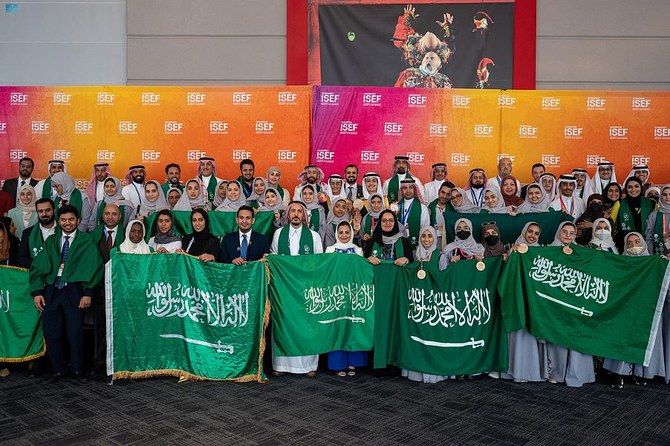
Saudi Arabia, represented by King Abdulaziz and His Companions Foundation for Giftedness and Creativity, or Mawhiba, and the ministry of education, has won 27 prizes — including 23 major and four special prizes — at the Regeneron International Science and Engineering Fair.
More than 1,800 gifted individuals from more than 70 countries participated in the ISEF event, which was held from May 13-19 in the US.
In the major awards, the Saudi team won two first-place prizes, seven second-place prizes, seven third-place prizes and seven fourth-place prizes.
Student Faisal Al-Muhaish won first-place in chemistry for his project titled “Metal-organic framework-based electrocatalyst for a highly efficient and low-cost seawater hydrogen production,” while student Mohammed Al-Arfaj won first prize in environmental engineering for his project titled “Using a contact liquid to capture CO2 found in fuel and air through a highly efficient and low-cost freezing method.”
Second-place prizes went to Taif Al-Hamdi in the field of energy, Latifa Al-Ghannam in energy, Lynn Al-Melhem in energy, Zahra Al-Shabr in biomedicine and health sciences, Fatima Al-Arfaj in chemistry, Wissam Al-Qurshi in biomedical engineering and Dima Marwahi in earth and environmental sciences.
Third-place prizes went to Ritaj Al-Sulami in energy, Fajr Al-Khulaifi in energy, Fares Al-Yami in transitional medicine, Lian Norolli in environmental engineering, Abeer Al-Youssef in materials science, as well as Lian Al-Maliki and Nour Al-Hamad in plant sciences.
Fourth-place prizes went to Maria Al-Qumsani in engineering technologies, Bandar Al-Barahim in robots and smart devices, Hanadi Arif in social and behavioral sciences, Maria Al-Ghamdi in environmental sciences, Tahani Ahmad in materials sciences, Dee Shujaa in earth and environmental sciences and Yazan Al-Fulaih in plant sciences.
This year’s achievements have increased the total number of prizes won by the Kingdom at ISEF to 133 — 92 major and 41 special prizes — since it began participating in 2007.
Amal bint Abdullah Al-Hazaa, secretary general of Mawhiba, congratulated King Salman and Crown Prince Mohammed bin Salman for this new national achievement, which was supported by the leadership. She also congratulated the ministry of education and the students, along with their families, schools and teachers.
Al-Hazaa commended the joint efforts by Mawhiba and the ministry of education, as well as their strategic partners, to continue achieving the objectives and initiatives of the Kingdom’s Vision 2030 by improving students’ capabilities in accordance with the latest scientific methods used for gifted individuals.
Al-Hazaa said that “the complementary partnership between Mawhiba and the ministry of education has contributed to the development of a creative environment, space and system for talented individuals and produced Saudi human capital models that are competent and able to innovate solutions to sustainable development-related problems, contributing to the prosperity of all of humanity.”
The Kingdom, represented by Mawhiba, also took part in ISEF 2023 as an official sponsor and presented 18 special prizes to the best projects participating in the energy category.
ISEF is considered the largest pre-university scientific research and innovation competition fair.
source/content: arabnews.com (headline edited)
___________
This year’s achievements have increased the total number of prizes won by the Kingdom at ISEF to 133 — 92 major and 41 special prizes — since it began participating in 2007.(SPA)
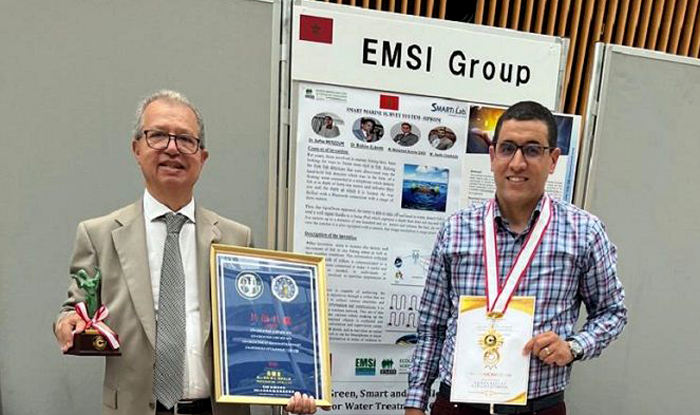
Moroccan Engineering Lab won two prestigious awards at the International Innovation Salon in Toronto, Canada.
Smarti Lab, a research laboratory affiliated with the Moroccan School of Engineering Sciences (EMSI), claimed two gold medals and two prestigious awards at the iCAN 2023 International Innovation Exhibition held in Toronto, Canada.
The lab’s winning invention is called the “Smart Wastewater Treatment Station” (SGWT), which is a “green, and mobile” wastewater treatment station.
According to a statement from EMSI, the innovation addresses a critical global issue and represents a “significant leap forward” in sustainable water management.
The smart wastewater treatment station was in response to the current global water crisis, EMSI said in the statement.
The second medal went to the “Meat Quality Verification System” (SMT), a system that offers a “simple and rapid solution for assessing the quality of various types of meat.”
The solution relies on mechanisms that analyze meat quality using specialized integrated units. The system addresses critical health and safety concerns related to meat consumption, the statement explains.
Over the years, EMSI secured a number of awards for innovation. The engineering school has won a total of 85 awards and medals on both national and international fronts.
Engineers from the school previously participated in international innovation competitions such as ICAN in Canada, Silicon Valley in the United States, the International Innovation Exhibition in China, ISIF in Turkey, Intarg in Poland, and EuroInvent in Romania, among others.
The Canada exhibition was held from August 23 to 26, and it featured participants from 50 countries with over 800 inventions.
Dubai Electricity and Water Authority (DEWA)’s Research and Development (R&D) Centre has filed a new patent for an innovative method for improving the performance of electrodes in lithium-ion (Li-ion) batteries, sodium–sulfur batteries, and electrolyte distribution batteries.
This is achieved by treating the electrodes chemically using a polymer to increase the number of active groups on the surface of the electrodes, which leads to improving their performance. The low-cost, environmentally friendly method requires low temperatures and ensures stable battery performance. This is part of the centre’s efforts to promote the technologies of energy production and storage.
The patent supports the pilot project for energy storage that DEWA has inaugurated at the Mohammed bin Rashid Al Maktoum Solar Park using Tesla’s lithium-ion battery solution. The project has a power capacity of 1.21 MW and an energy capacity of 8.61 MWh with a life span of up to 10 years. This pilot project is the second battery energy storage pilot project by DEWA at the solar park. The first project was implemented in collaboration with AMPLEX–NGK to install and test a sodium sulphur (NaS) energy solution with a power capacity of 1.2 MW and an energy capacity of 7.5 MWh. This was the first utility-scale energy storage pilot project in the region.
Saeed Mohammed Al Tayer, MD & CEO of DEWA, said, “Our strategies and plans are inspired by the vision and directives of His Highness Sheikh Mohammed bin Rashid Al Maktoum, Vice President, Prime Minister and Ruler of Dubai, to ensure energy security and sustainability, as well as improve energy efficiency. DEWA relies on research and innovation to support the development of energy storage technologies and increase the share of clean and renewable energy. This supports the Dubai Clean Energy Strategy 2050 and the Dubai Net Zero Carbon Emissions Strategy 2050 to provide 100 percent of Dubai’s total power production capacity from clean energy sources by 2050. DEWA is working on other energy storage projects, including using Concentrated Solar Power (CSP) at the 4th phase of the Mohammed bin Rashid Al Maktoum Solar Park, the 250MW hydroelectric power plant in Hatta with a storage capacity of 1,500 megawatt-hours, and the Green Hydrogen project to produce and store hydrogen using solar power.”
“DEWA’s R&D Centre is a global platform that provides innovative solutions and technologies for the operations and services of the utility sector worldwide. This maintains DEWA’s worldwide leadership and enhances Dubai’s position as a global hub for research and development in solar power, smart grids, water, energy efficiency, and capacity building in these sectors. The R&D Centre improves the services provided by DEWA to customers by developing the latest technologies and sustainable solutions for energy and water and conducting applied research,” Al Tayer continued.
“The R&D Centre at the Mohammed bin Rashid Al Maktoum Solar Park enriches the scientific community in the UAE and the world. This is through disseminating knowledge and nurturing the talent of Emirati researchers,” Waleed bin Salman, Executive Vice President of Business Development and Excellence at DEWA, added.
.When you hear of Al-Andalus, you might think of Andalusia. And yet, from 711 to 1492, until the famous Fall of Granada, the Future Andalusia was only a small part of this vast Arab territory, whose influence can be seen everywhere in Spain. Let us take a tour.
Al-Andalus, a long series of powerful people
In the early 8th century, the Iberian Peninsula belonged to the Visigoth Empire, when the commanders of the Umayyad Caliphate (with a territory extending from the Arabian Peninsula to the Maghreb) set out to conquer the lands on the other side of the Mediterranean.
The Umayyad dynasty ruled in Al-Andalus (what would become Spain) for more than 300 years. It was suceeded by Taifas (independent kingdoms). The Abbasids, then the Almoravids, rose to power. In 1147, it was the Almohads who took over the empire. This proved to be a prosperous period, with great scholars, such as Averroes, a doctor, lawyer, and advisor to the Caliph. These scholars helped to make Al-Andalus a grand dominion. But the Christian reconquest gained ground. From 1238 to 1492, the Reconquista blazed on, and soon only the Emirate of Granada remained in southern Spain, the last vestige of the great Muslim empire.
From the north to the south of Spain, the Arab-Andalusian influence can be seen everywhere
One after the other, Cordoba, Seville and Granada became the capitals of the kingdom of Al-Andalus during the Middle Ages. Arab culture has permeated everything from traditional Andalusian music to the names of localities, and the Spanish language. But the most visible influence can of course be seen directly in the architecture of buildings and streets. Numerous vestiges, sometimes intact, sometimes remodelled, remain in the cities’ maze of streets, and this period of Spanish history has left prodigious monuments of Arab origin and fabulous examples of Islamic art. Many of these monuments bear a unique blend of cultural influences as they were renovated or repurposed over the centuries.
The most beautiful Arab monuments in Spain
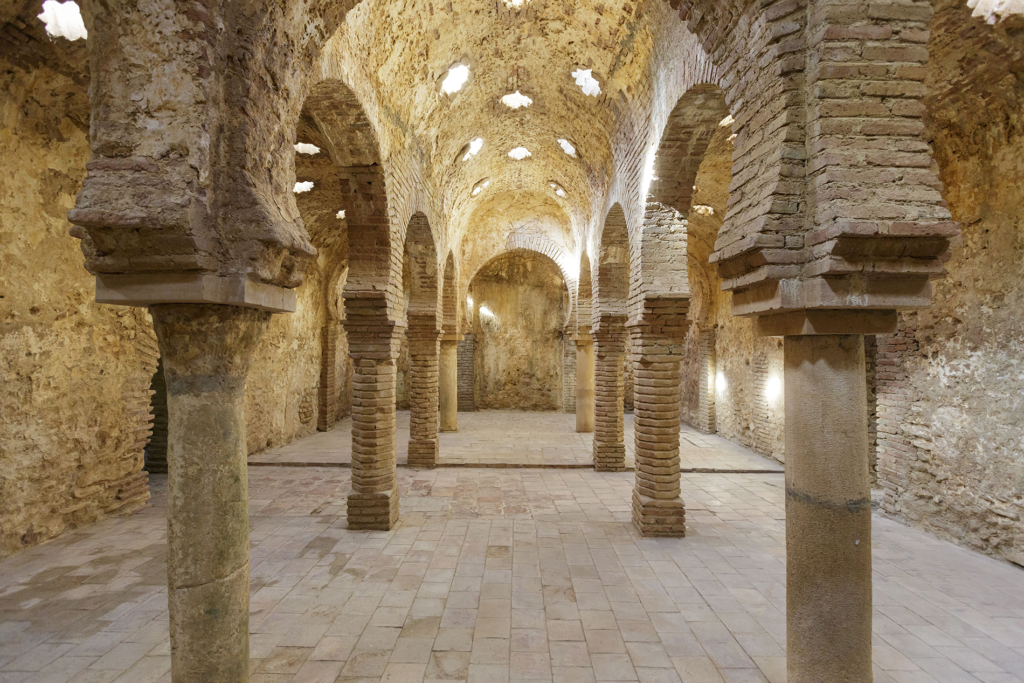
The Arab Baths of Ronda, a magnificent ruin site
The hammam tradition was a cornerstone of Arab culture for centuries. From the 13th to the 15th century, several such baths were built in Spain. The baths of Ronda, in Andalusia, are one of the best examples, with their three magnificent barrel-vaulted rooms and visible heating and water circulation systems. The Guadalevín river, which often floods, has prevented these baths from being used, but excavations have been carried out, and now you can visit and admire some of the best-preserved Arab bathhouses in the country.
pix: P. Escudero / hemis.fr
Baños Árabes C. Molino de Alarcón 29400 Ronda Málaga +34 951 15 42 97 turismoderonda.es
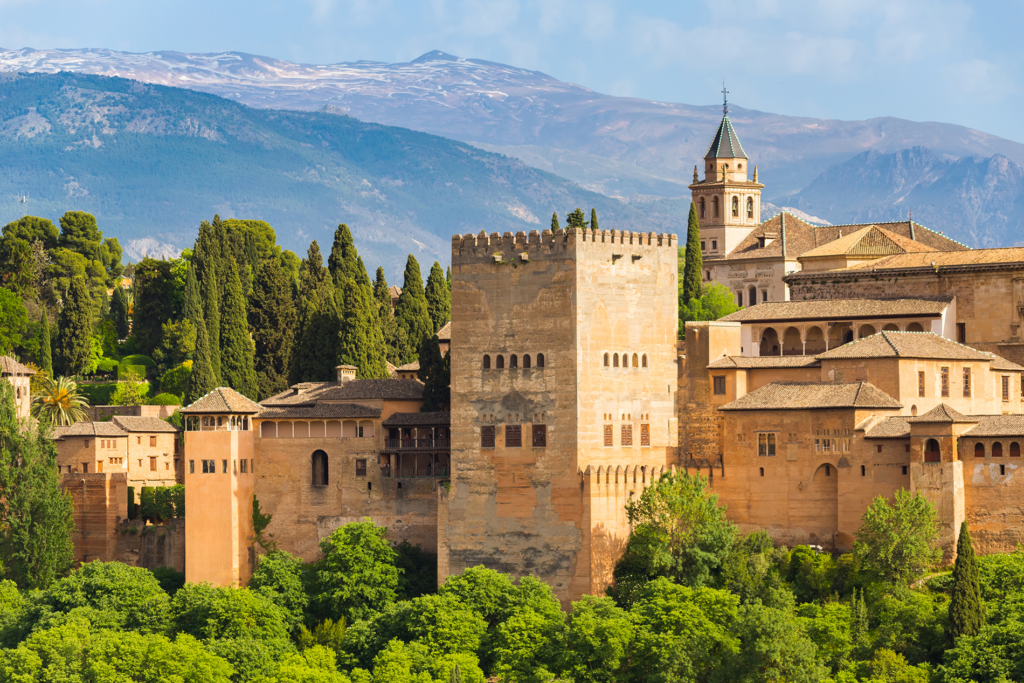
The Alhambra of Granada, an extraordinary castle
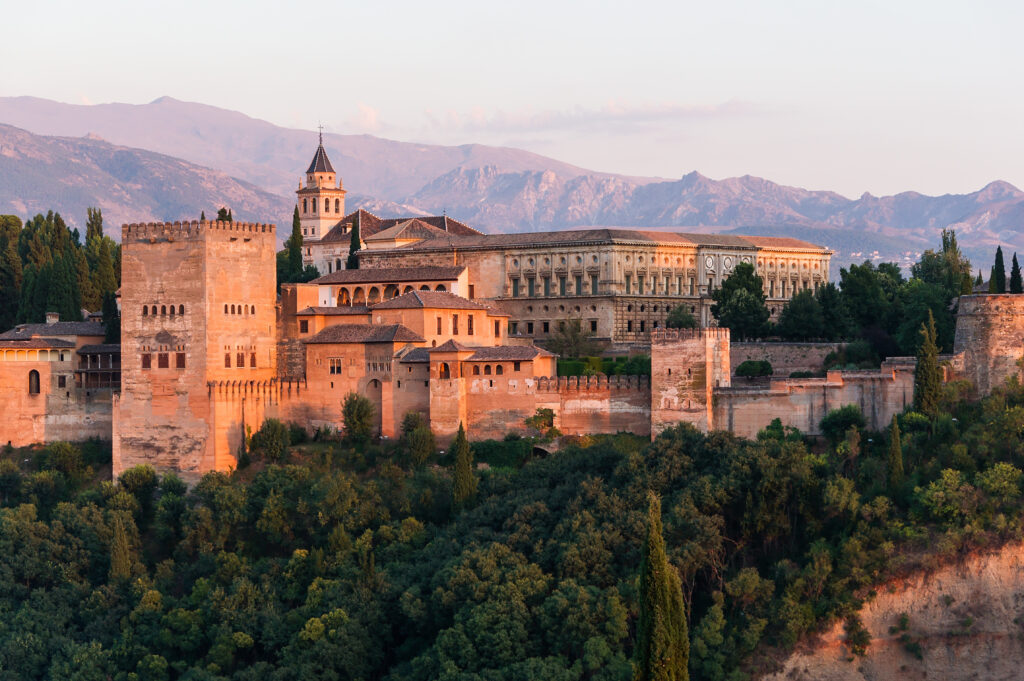
On the Sabika hill, opposite the Albaicín district, stands the Alhambra of Granada, a majestic conglomeration of several buildings built in the early 12th century. The grandeur of the last Nasrid rulers is at its peak. Not to mention the sublime, breathtaking view over the plain of Granada!
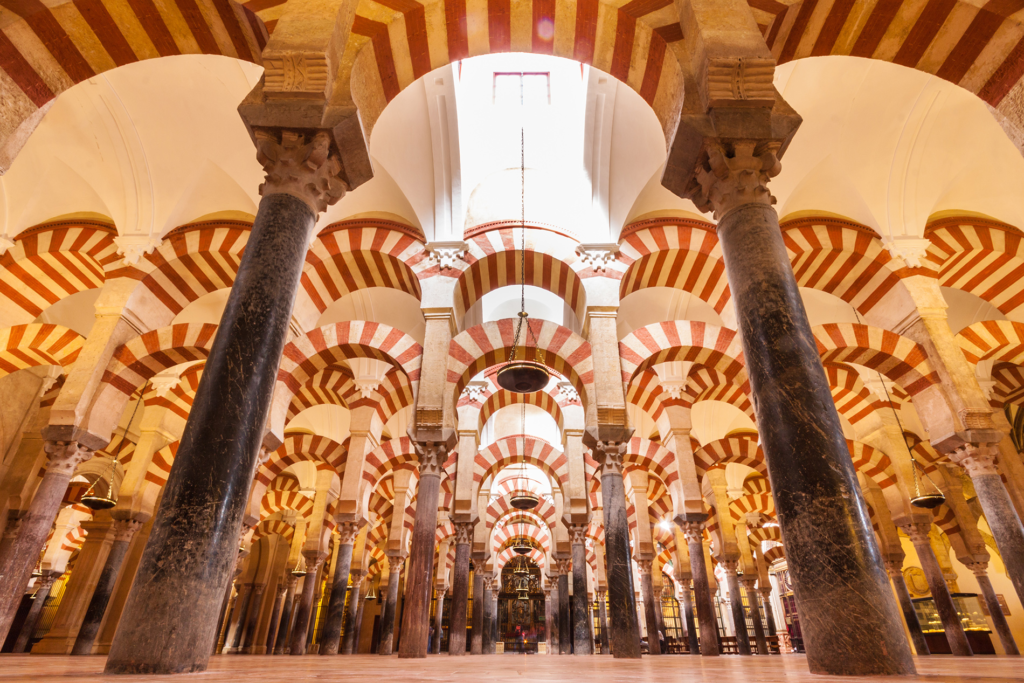
The Mosque-Cathedral of Cordoba, from Islam to Christianity
Another Muslim building, the Cordoba mosque is a symbol of Arab influence at its most grandiose. From the 8th century to 29 June 1236, the building served as a mosque, before becoming a church again following the Reconquista. Representative of the art of the Umayyads of Cordoba, it is a monumental structure, and it covers over 1.5 hectares. The building is a splendid example of Islamic architecture: the “forest of columns” in the main hall – 1,300 marble, jasper and granite columns – highlights the gargantuan size of the place.
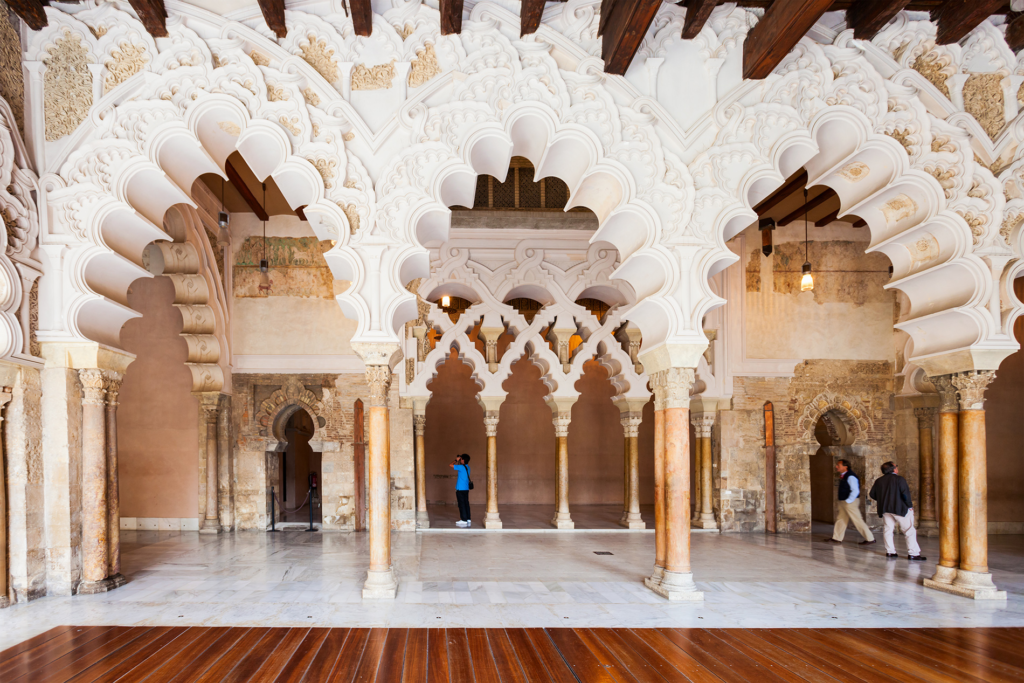
The Mudejar art of Aragon, in the north of Spain, has been declared part of UNESCO’s World Heritage, and the Aljaferia in Zaragoza is one of its most flamboyant masterpieces. When it was built in the second half of the 11th century, this palace clearly displayed the magnificence of the Taifa of Zaragoza. It served as a residence, a fortified enclosure and a barracks. It currently houses the Parliament of Aragon. The palace’s interior decoration is gorgeous, with a series of delicate, refined arches.
pix: kasto80 / Getty Images Plus
Palacio de la Aljafería Calle de los Diputados 50003 Zaragoza +34 976 28 96 83 www.turismodearagon.com
The Seville Giralda, a perfect example of mixed construction
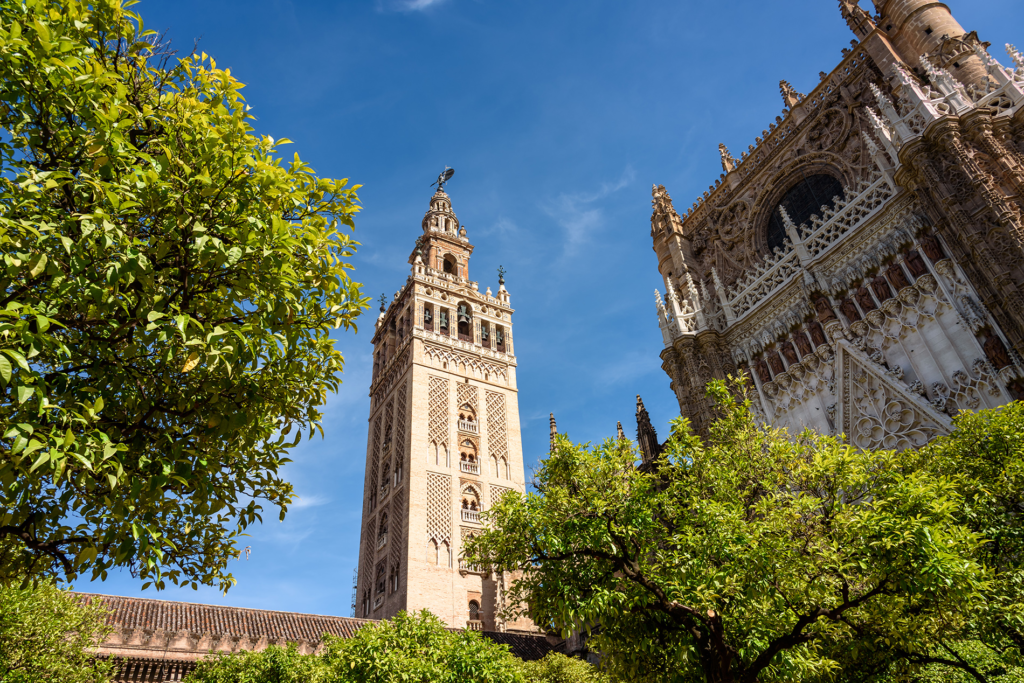
The architectural marriage of the Giralda, the bell tower of the Cathedral of Our Lady of the See in Seville, is immediately evident. The lower parts were built in the 12th century, when the city was the capital of the Arab-Andalusian empire, under the rule of the Almohads. Four centuries later the upper floor was added, and the mosque’s minaret became a bell tower. It is now an unspoken rule that no building should be higher than this symbol of Seville.
pix: marinzolich / Getty Images Plus
Catedral de Santa María de la Sede de Sevilla – Giralda Av. de la Constitución 41004 Sevilla +34 902 09 96 92 www.catedraldesevilla.es
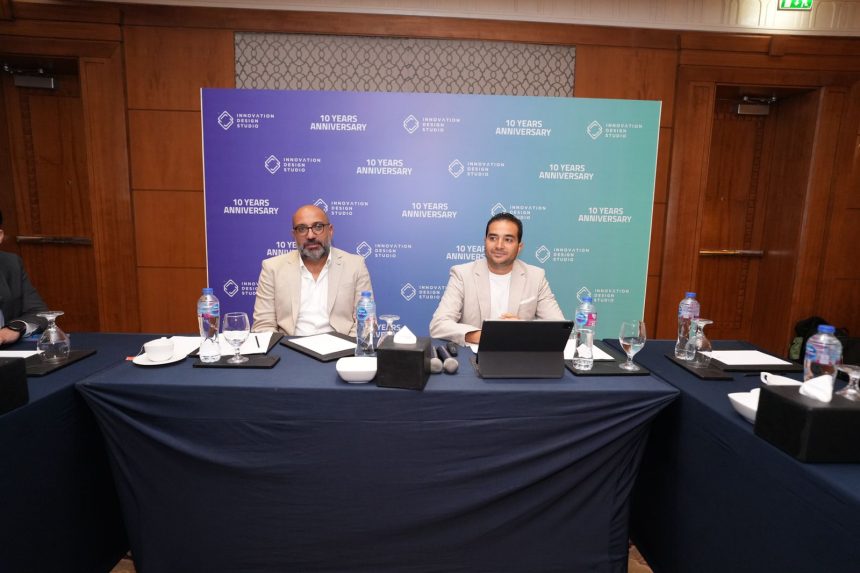
Innovation Design Studio, an award-winning architecture and design firm, has designed more than 400 projects in Egypt, Saudi Arabia, and Oman over the past 10 years. The company was recently awarded the A’ Design Golden Award for its design of a business district in Egypt.
Mahmoud Farouk, chief of design and co-founder of Innovation Design Studio, said the company started in 2014 with one project worth $4m. In 2023, the company is working on a project worth $400m.
Farouk added, “Our work encompasses the local market to include key regional projects in Oman and Saudi Arabia with an envisioned global expansion plan.”
Alaa Abdel Hameed, CEO and co-founder of Innovation Design Studio said the company is committed to using local materials and products.
“We believe that designers play a crucial role in directing developers’ projects towards more reliance on materials localization,” Abdel Hameed said. “This is in line with the Egyptian government’s direction of limiting importation and preserving foreign currency.”
Abdel Hameed also praised the efforts of Egyptian manufacturers in developing solutions and products that meet international standards.
“The local producers are becoming the preferred option and partner for developers and designers,” he said.
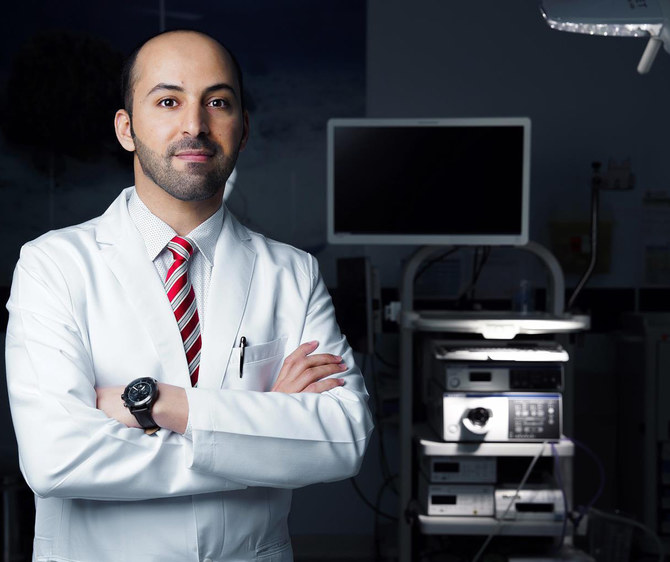
Dr. Abdullah Al-Thiabi claims to have developed a way of controlling the condition, known as gastroesophageal reflux disease.
A Saudi consultant specializing in the digestive system has invented a device that could provide relief for millions of people suffering with acid reflux, the Saudi Press Agency reported on Sunday.
Dr. Abdullah Al-Thiabi claims to have developed a way of controlling the condition, known as gastroesophageal reflux disease.
GERD is a temporary disorder that occurs when stomach acid repeatedly flows back into the tube (esophagus) connecting the mouth and stomach. This backwash, often referred to as acid reflux, can irritate the lining of the esophagus. If left untreated it can develop into a chronic condition with severe and life-threatening implications.
Also an expert in liver conditions and endoscopy, Al-Thiabi’s procedure involves placing a specialized device underneath the esophagus — using upper gastrointestinal endoscopy — which acts as a valve, preventing the backflow of stomach fluids and acids.
The device regulates medication levels and prevents side effects, while also monitoring esophageal tissue to lower the risk of cancer of the esophagus. In addition, it allows for easy sample collection and initial evaluation before laboratory analysis.
Installation time can be as quick as 15 minutes, and the technology reduces reliance on acidity drugs, surgical procedures, and healthcare costs for both institutions and patients.
After four years of rigorous scientific work following approved standards and methodology, the King Abdullah International Medical Research Center at the Ministry of National Guard has officially registered the device with the relevant authorities.
The next step will be to obtain rights and a local patent certificate from the Saudi Authority for Intellectual Property, and globally from the US Office of Innovation and Intellectual Property.
To then bring the product to market, funding from the public and private sectors will be required to support largescale commercial production, manufacturing, storage, shipping, sales, promotion, and marketing.
source/content: arabnews.com (headline edited)
_____________
Dr. Abdullah Al-Thiabi claims to have developed a way of controlling acid reflux, known as gastroesophageal reflux disease. (SPA)
Kalantan has become the first female director, the first non-European to win a BAFTA award in the Gamers category.
Rafif Kalantan has become the first student from Saudi Arabia to win a 2023 Yugo BAFTA Award, picking up the accolade in the Games Category for her submission ‘Eros Xavier’s Love Solutions’.
The Yugo BAFTA Student Awards is an annual event celebrating the works of the next generation of highly skilled and creative storytellers from around the world.
Kalantan, the first female director and the first non-European to win a BAFTA award in this category, was one of the students supported by Neom to attend the National Film and Television School (NFTS), one of the top-ranking schools to join its Master’s programme in Games Design and Development.
Kalantan’s entry ‘Eros Xavier’s Love Solutions’ is the culmination of an intensive two-year Master’s programme of training that provides students with the skills and creative knowledge to design, devise and build games, from inception to delivery.
‘Eros Xavier’s Love Solutions’ is a narrative-driven puzzle-like game. The game follows Eros Xavier, a retired cupid who is cynical about love and has decided to open a private business for hire as a match-breaker.
This year’s Yugo BAFTA Student Awards welcomed 754 submissions from 103 schools across 30 countries, including, Argentina, Belgium, the Czech Republic, Denmark, Hong Kong, India, Mexico, South Africa, and the United Arab Emirates.
Speaking about the award, Rafif Kalantan said: “I am honoured to have been selected as the winner of such a globally renowned award, especially being the first female director and first non-European to win this category. This wonderful achievement also showcases the capabilities of the developers from the Kingdom and the Middle East as a whole, and how the game industry in the region has a lot of potential. I am also grateful for the continued support and investment of Neom, which was an integral part of this achievement. Their continued support for us in the gaming field shows how much Neom believes in growing local talents and allowing them to thrive!”
Jon Wardle, Director of the National Film and Television School, commented: “The School is incredibly proud to be celebrating this achievement with Rafif as we celebrate the 10th anniversary of our Games Design MA. We’re also very grateful to Neom for continuing to help make our courses accessible with life-changing funding opportunities.”
Wayne Borg, Managing Director of Media Industries, Entertainment, and Culture at Neom, added: “On behalf of the entire Neom team, we extend our congratulations to Rafif for the well-deserved honour of receiving this prestigious award from BAFTA. This remarkable accomplishment is a testament to her exceptional talents and marks a momentous beginning for Rafif’s journey, and I’m sure she will achieve great things in the gaming world. We will continue to work closely with the National Film and Television School to nurture and empower more talented individuals as we develop our partnership and offer a unique blend of professional development, mentorship, and growth opportunities for emerging talent in the creative industries.”
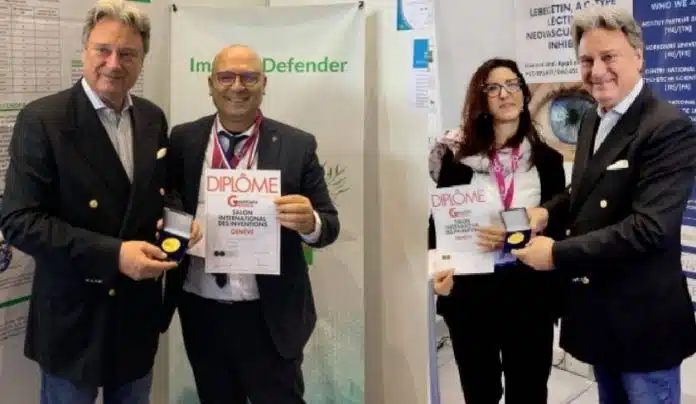
This is a new consecration for Tunisia on an international scale. This is the International Exhibition of Inventions Geneva 2023, one of the largest events dedicated to invention organized by the World Intellectual Property Organization and the Swiss government. Two gold medals were awarded to Erij Messadi, researcher, and Mounir Bezzarga, professor, for their inventions.
Tunisia causes a stir with two revolutionary inventions
The two Tunisian winners were distinguished among a total of 1,000 other inventions from 50 different countries, thanks to the gigantic potential of their projects.
Dr. Erij Messadi, representative of the Institut de Pasteur, presented a one-of-a-kind project at this prestigious event. Baptized “Lebecetine, Lectin type C, as an inhibitor of neovascularization”, it was able to capture the attention of the public and was able to win the gold medal with congratulations from the jury. His innovative invention aims to demonstrate the crucial role of Lebecetine in blocking the formation of new blood vessels, which could slow the progression of several diseases such as cancer.
The ImmunoDefender project won in the Q category. Designed and produced by Dr. Mounir Bezzarga to fight against COVID-19, this winning invention continues to receive awards and shine on an international scale. After winning a prize at TICAD and another at the Euro-Mediterranean Intellectual Property Conference, this plant-based project was on the way to winning the gold medal with congratulations from the jury at the Geneva fair.
Beyond the obstacles, Tunisia continues to shine
Despite the turbulent political scene and the difficult economic situation, Tunisia continues to shine thanks to the exploits of its talents. Indeed, the country is always represented on the podium of international events, especially those dedicated to technologies and inventions. Tunisian inventors like Erij Messadi and Mounir Bezzarga are often awarded for their inventions covering several fields. All this bears witness to remarkable innovation and dynamism on the Tunisian scene.
This immense potential can only be an incomparable asset for our Tunisia. The future therefore looks promising in this area.