Arabs & Arabian Records Aggregator. Chronicler. Milestones of the 25 Countries of the Arabic Speaking World (official / co-official). AGCC. MENA. Global. Ist's to Top 10's. Records. Read & Enjoy./ www.arabianrecords.org
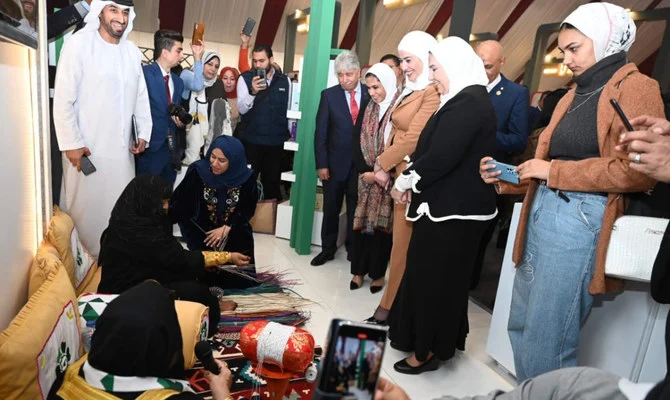
The first Arab exhibition for productive families, Bayt Al-Arab (House of the Arabs) opened in Cairo in the presence of Ahmed Aboul Gheit, the Arab League secretary-general, and several Egyptian and Arab officials, including a high-ranking Saudi delegation.
The products at the exhibition reflect the identity of the 12 participating Arab countries.
It offers an important opportunity to learn about the richness of the cultures of these countries in craftwork and handicrafts in order to protect these industries from extinction.
The number of participants featuring at the exhibition is about 150, of which 70 are Egyptian and 80 from other Arab countries.
The exhibition, which continues until Jan. 11, opens areas for the exchange of expertise between craftsmen, producers and exhibitors.
Saeed Al-Zahrani, head of the Saudi delegation, shared with the audience at the opening ceremony a number of success stories, and said the participation of the Social Development Bank aimed at supporting and empowering micro-enterprises for family businesses, which are considered a fundamental pillar of the Kingdom’s Vision 2030.
At the Saudi pavilion, visitors were drawn to the heritage products of various regions of the Kingdom, such as Al-Sadu weaving, Al-Qat Al-Asiri, and the manufacture of Al-Masleh, in addition to the products of many Saudi family businesses displayed within the Tagseed (incarnation) initiative, which is marketed for home projects in all international and local exhibitions.
Nevin Al-Kilani, Egypt’s culture minister, said that the participation of dozens of families from Egypt and the Arab world was “the best evidence of Egypt’s keenness to support heritage both locally and regionally.”
Raef Al-Khouli, an official involved in the organization of the exhibition, told Arab News: “The Arab House exhibition in the Dome Palace is a wonderful opportunity to visit because there are many handicrafts from all Arab countries, which are sold at very reasonable prices, because all who are present are the owners of the profession or craft, and are not merchants.”
At the entrance, Al-Khouli said, visitors can register their names and phone numbers, and will receive entry for free, taking a dedicated bus to the exhibition venue.
Al-Khouli added: “At the Saudi pavilion there is a wonderful medal that the visitors can buy. It is a commemorative medal for the door of the Kaaba and the door of the Prophet’s Mosque.
“On the sidelines, there is a large theater and artistic performances are held in it throughout the day,” Al-Khouli said, adding that visiting families could bring children as well, because there is a play area and many drawing and coloring activities.
source/content: arabnews.com (headline edited)
___________
The first Arab exhibition for productive families, which continues in Egyptian capital Cairo until Jan. 11, opens areas for the exchange of expertise between craftsmen, producers and exhibitors. (Supplied)
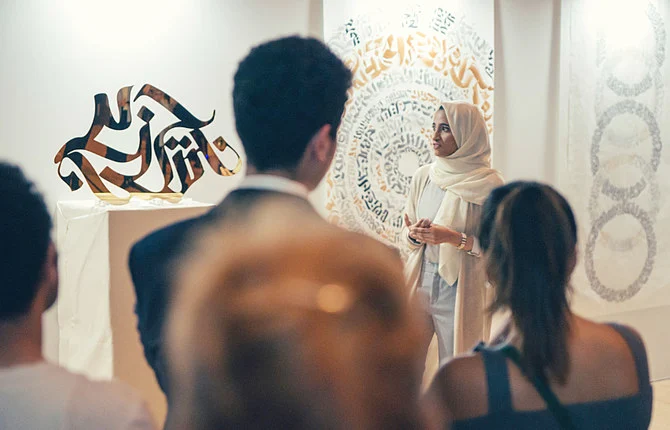
Mawadah Muhtasib, an emerging Saudi artist who reversed the typeface of the Arabic language, is well on her way to becoming a prominent name in the global art scene.
From learning her mother’s technique of writing backward at age 13 to exhibiting in London and New York City, Muhtasib has generated international intrigue in the art of Arabic by creating the first reversed Arabic calligraphy, or calligraffiti, typeface.
Her messages are not only meant to be read, but are also designed to be deciphered. Engaging her audience with the challenge of decoding letters is a large part of experiencing the artwork itself.
“It’s about expanding your human capabilities into creating the impossible. And this is exactly what I have been trying to do,” she told Arab News in an exclusive interview.
FASTFACT
The Arabic language is one of the richest art forms, the artist says, but in modernity, it is difficult to appreciate the depths of something that has become so ordinary.
Born out of a quest to layer the heritage of Arabic letters with innovative graffiti art methods, her work dares to be the first of its kind, granting her Dubai’s Art Bus competition award and a chance to show her work at exclusive showcases.
As graffiti art surged in popularity in 2013, Muhtasib experimented with mural painting alongside a novel group, hoping to develop a boundaryless form of art.
With a vision to modernize the traditional, she created a decorative typeface that mixed Arabic and Latin, written from left to right.
It’s about expanding your human capabilities into creating the impossible.
Mawadah Muhtasib
Muhtasib said: “We are so used to Arabic calligraphy when it comes to Thuluth calligraphy, Al-Kufi, Al-Naskh, and so on, and we just read that way and pass it on.
“When I’m doing my Arabic calligraphy, people sit and stare at my work for hours trying to figure out what these letters are, and the moment they realize it’s Arabic, they start to analyze and see all these letters in a different form that we as Arabic speakers are not used to.”
The Arabic language is one of the richest art forms, the artist says, but in modernity, it is difficult to appreciate the depths of something that has become so ordinary.
The goal is not only to get the viewer to read but to actively reflect on the beauty and form of each stroke and letter within the alphabet.
Muhtasib now passes on her craft through community workshops exclusively for women, most recently at Saudi’s largest light-based festival, Noor Riyadh.
“In my workshops, I do not teach people to write in reverse … I’m basically giving you the key of how to use the tools of starting to practice in the form of Latin calligraphy,” she said.
As soon as students understand the anatomy of the font family, Muhtasib introduces slanted brushes, layering techniques and stroke pressure. From the first session, students are sent home with a new creative form of expression. “The soul of a person is laid out on a page,” she said.
Writing in reverse is not new; the artist’s mother passed down the habit after having to write backward to maintain privacy at work. Alongside that, she passed down her passion for creative innovation.
While most calligraphers in the Kingdom were mimicking Western methods, Muhtasib, at 16 years old, was inspired and encouraged by Tunisian artist eL Seed and Saudi Moroccan artist Shaker Kashgari.
“I took that trick that my mom taught me years ago on how to write and then I changed it into a decorative typeface,” she said.
The concept was designed to preserve the rich heritage of the Arabic language. For foreigners, it offers a chance to engage in the language and learn its history.
“This is Arabic calligraphy in reverse that I took, improved, adjusted and made into a different form. But viewers will also wonder how it actually looked like (originally) and this will make a lot of people go in-depth and learn more about Arabic calligraphy,” Muhtasib said.
The philosophy behind the Typeform has gained interest from international luxury brands such as Louis Vuitton, Carolina Herrera, Montblanc, Sephora and more, resulting in several collaborations.
Muhtasib urges creators to push the boundaries of art and culture.
With calligraphy, “your sky’s the limit,” she said.
source/content: arabnews.com (headline edited)
____________
Mawadah Muhtasib now passes on her craft through community workshops exclusively for women. (Supplied)
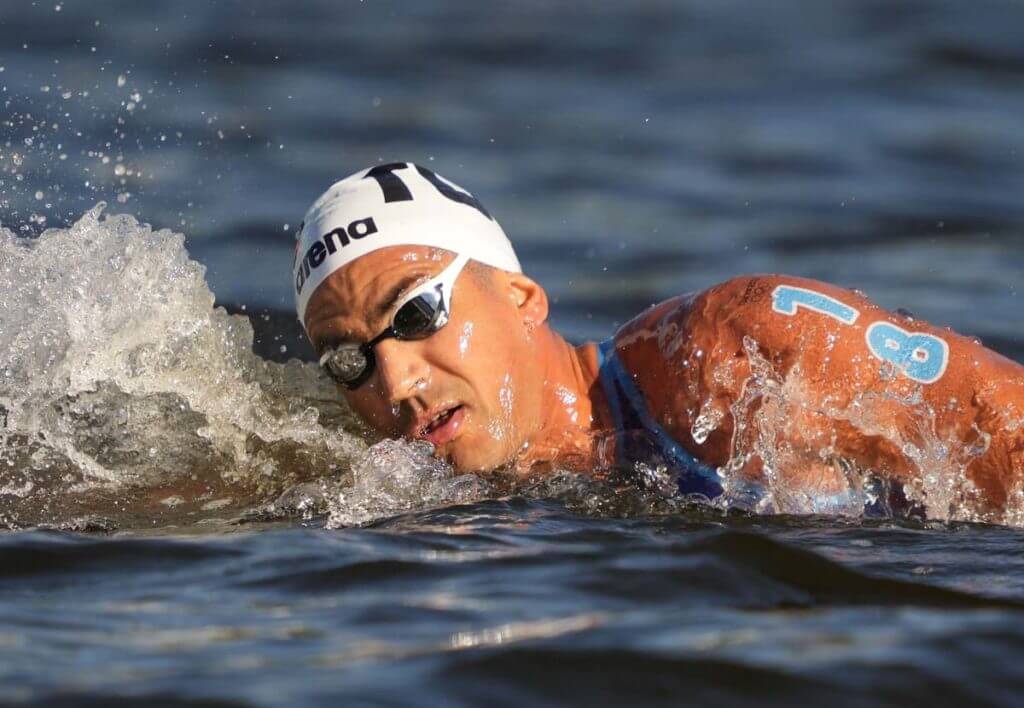
Oussama Mellouli became only the fourth swimmer to compete at six Olympic Games when he dived off the pontoon at Odaiba Marine Park on Thursday and then set his sights on Paris 2024 when he will be 40.
The Tunisian made his Olympic debut at Sydney 2000 and has now competed at five subsequent editions to join Therese Alshammar and Lars Frolander – both of Sweden – and Derya Buyukuncu of Turkey in an exclusive club.
The 37-year-old won gold in the 1500 free at Beijing 2008 followed four years later by bronze in the longest event in the pool as well as the open water title at London 2012.
He was 20th at Odaiba Marine Park on Thursday almost eight minutes behind winner Florian Wellbrock who delivered a masterclass in open water swimming.
Mellouli almost didn’t make it to Tokyo at all because of an ongoing dispute with the Tunisian Swimming Federation which saw him announce his retirement last month.
Days later, however, he confirmed he would race in Japan after Tunisian Olympic Committee president Mehrez Boussainpledged to mediate between Mellouli and the federation.
Mellouli though said the dispute had affected his training and subsequent performance, saying:
“I think I could have done a better job. Considering the last five weeks since Setubal (the FINA qualifying race), I’m a bit disappointed about (not being) a bit more in the fight.
“I think I wasn’t in the race for the first three loops and then I was below average in the last four loops.
“I think the poor situation that I’ve been in after my qualifier, I think a lot of extra stuff that’s been happening in my preparation didn’t get me in top form and top condition.
“After the qualifier I was hoping the situation could have been better so I could be in a better condition.”
It seems that Mellouli doesn’t want to end his career on such a note and when asked if he intended to compete in France, Mellouli said:
“I honestly hope so. I think I have more to prove.”
Should he do so, the eight-time world medallist would become the first swimmer to compete in seven Olympics after Alshammar attempted to qualify for the Sweden team in the women’s 4×100 free this year although her bid came to an end at the Sette Colli meet in June.
Thursday’s race saw Wellbrock win by more than 25 seconds ahead of Kristof Rasovszky and European champion Gregorio Paltrinieri and add to his bronze in the 1500m freestyle.
The German now holds the Olympic and world titles and Mellouli said:
“He did an amazing job, congratulations to the German team.
“Florian is a superstar. He has shown tremendous skills in the pool and today dominated the 10k so congrats.”
The first morning of swimming finals at the Tokyo Aquatics Centre featured Mellouli’s fellow Tunisian Ahmed Hafnaoui who won the 400 free from lane eight, prompting an outburst of emotion and unconfined joy.
Hafnaoui described Mellouli as a “legend” and said he aspired to be like him, a legacy of the older man’s success in the pool since he claimed his first global medal with 400IM bronze at the 2013 World Championships in Barcelona.
“I hope so,” said Mellouli.
“I’m very proud of him, words can’t describe how proud I am of him. I know the 400 freestyle is a very tough event, I think my best finish was fifth.
“He is a mature athlete at a young age.”
He added:
“That was great for Tunisian swimming, for Arab swimming, for north African swimming.
“I’m very proud of the kid. He shook the world and did an amazing job, an inspirational job.”
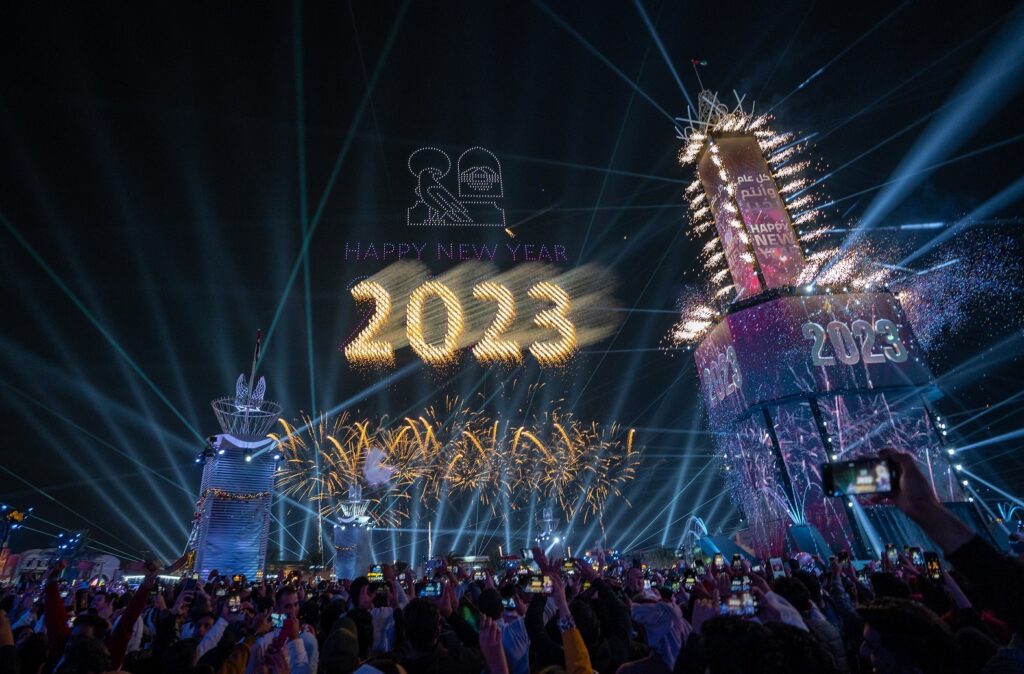
The Sheikh Zayed Festival witnessed an intense public turnout that exceeded the barrier of one million visitors, followers and viewers of the festival, who gathered in the Al Wathba area, coming from inside and outside the country, to celebrate the welcome of the New Year 2023.
The various events attracted visitors, especially the huge fireworks and drone shows, where 4 records were broken in the Guinness Book of Records.
The festival squares were crowded with crowds, and the Al Wathba area was filled with followers and viewers of the drone shows and fireworks, which lasted for about 60 minutes for the first time, for the Guinness Book of Records to record this great achievement.
Amid feelings of happiness and joy, the largest fireworks display and the largest drone show lit up the sky of Al Wathba. The largest fireworks display, which lasted for more than 40 continuous minutes and broke three records in the Guinness Book of Records in terms of quantity, time and shape, won the admiration of visitors. In addition to the largest display of “Drones”, using more than 3,000 drones, a message was drawn in the sky of Al Wathba, welcoming the New Year at the end of its interesting show.
Al-Waleed Othman, an arbitrator of the Guinness Book of Records, confirmed that the Sheikh Zayed Festival was able to break 4 records at the same time, 3 of which are related to fireworks and a new record related to “Drones”, explaining that the most number of helicopter fireworks thrown in 30 seconds or more was recorded. The number of fireworks launched in 30 seconds (wheels), the most repeated fireworks in 30 seconds, in addition to the largest formation of a quick response code by drones.
Othman said: We are pleased to be present at the Sheikh Zayed Festival in the New Year’s celebrations, and we extend our congratulations to the organizers of the festival, who used to break records annually in order to please the audience.
The festival’s audience was keen to document the wonderful moments of the various shows on their mobile phones and share them on social media. The impressive performances were also broadcasted on the festival’s social media.
The Emirates Fountain and laser performances won the admiration of the festival-goers, young and old, with their dazzling musical and laser shows.
The Pavilions of World Civilizations also allocated a lot of international artistic and folklore shows, turning the festival into a global artistic carnival in celebration of New Year’s Eve, whether by holding concerts on the stages of the Pavilions of Civilizations or by participating in the march of world civilizations that roamed all parts of the festival, presenting popular performances in traditional clothes of countries. participation.
Visitors to the Sheikh Zayed Festival expressed their happiness with the international and diverse folklore and artistic events and performances, including the activities of the Heritage Village, the city of recreational games, the children’s city, the arts area, go-karting competitions, Crazy Cars, the Garden of Lights and Flowers, in addition to the Selfie Street area, the Museum of Sweets and many others.
William Mullally picks the best movies by Arab filmmakers over the past year.
‘Perfect Strangers’
Director: Wissam Smayra
Starring: Mona Zaki, Nadine Labaki, Georges Khabbaz
The original Italian version of “Perfect Strangers” had already been remade across the world before its Arabic-language iteration was released on Netflix. But nowhere else has it caused the stir that it did in the Middle East. The conceit is simple: Seven friends at a dinner party decide to play a game, placing their phones in the center of the table to make their calls and messages known to all. As the night goes on, their secrets are revealed, upending everything they thought they knew about each other. Not only was this the best version of the film so far, with pitch-perfect casting and memorable performances, it was also the bravest: each of its stars pushed themselves in ways they had never been able to in regional film previously, shattering taboos, capturing the world’s attention and changing Arab cinema forever.
The highest grossing film in the history of Egyptian cinema, “Kira & El Gin” is Marwan Hamed at his best. This is a crowd-pleasing historical epic that not only captures the spirit of Egypt past and present, but sets a course for a new future for the country’s film industry. Following two men fighting the British occupation in Egypt during the 1919 revolution, Hamed’s film rarely sags despite its nearly three-hour run time and sprawling cast, structured more as a suspense thriller than a social studies lecture. As Hamed jumps from genre to genre across his films, proving equally adept at each, one wonders how he will top this, should he try. But it would be foolish to bet against him as he continues to notch up career high after career high.
‘Boy From Heaven’
Director: Tarik Saleh
Starring: Fares Fares, Tawfeek Barhom, Mohammad Bakri
Egyptian-Swedish filmmaker Tarik Saleh has a bone to pick. Growing up in Europe, he was always labeled as ‘other’ — an idea reinforced in the books in his school library describing Arabs as “stupid” and “uncivilized.” Now firmly entrenched as a filmmaker, Saleh refuses to make films tailored to the Western gaze, turning his camera deep into the inner workings of Egyptian society and forcing international viewers to accept that they are seeing things through eyes that are not their own. In “Boy from Heaven,” Saleh goes deep into a corruption scandal at the influential Al-Azhar Mosque, following a hero whose strong Muslim faith is unrattled as he uncovers the evils hiding from plain sight, with scenes and images you won’t soon forget.
‘The Alleys’
Director: Bassel Ghandour
Starring: Maisa Abd Elhadi, Nadia Omran, Munther Rayahna
In 2014’s “Theeb,” Jordanian writer Bassel Ghandour crafted perhaps the greatest example of the Bedouin Western in cinema history. With “The Alleys,” Ghandour steps into the director’s chair for the first time and turns the streets of Amman into the setting for a modern noir, in which the darkness hiding in the city’s back streets slowly boils to the surface. The film’s sprawling nature is both benefit and detriment, but it’s a stirring snapshot nonetheless, elevated by star-making performances from Maisa Abd Elhadi and Nadia Omran.
‘You Resemble Me’
Director: Dina Amer
Starring: Dina Amer, Mouna Soualem, Lorenza Grimaudo
Filmmaker Dina Amer is most familiar to global audiences for her fearless journalism in 2013’s “The Square” and various Vice News stories she produced as their foreign correspondent from the front lines of regional conflicts. “You Resemble Me” cements her as a filmmaker to watch, as her harrowing experimental recounting of the life of Hasna Ait Boulahcen, the woman miscredited as Europe’s first suicide bomber, is a deeply affecting dissection of the roots of terrorism and the racism that Arab women face in Europe. One of the most original films released this year.
The story of Yusra and Sara Mardini, two sisters from Syria who risked their lives to escape conflict for a better future only for one of them to become an Olympian, is so powerful that a film capturing their story could not help but be inspirational. El-Hosaini, the Welsh-Egyptian filmmaker behind 2012’s excellent “My Brother the Devil,” made it into something more — a thought-provoking reframing of the refugee experience at a time when Syrians and many others still suffer from that stigma, as well as a chronicle of women’s empowerment as the structures that held them back crumble, all told with a light touch that never alienates the huge global viewership the Netflix film has enjoyed.
‘Mediterranean Fever’
Director: Maha Haj
Starring: Amer Hlehel, Ashraf Farha, Anat Hadid
Palestinian cinema is often, understandably, a no-holds-barred dissection of the plight of its people. But that is by no means its only manifestation, as Maha Haj, a previous collaborator with renowned satirist Elia Suleiman, proves with her latest feature, “Mediterranean Fever,” the follow up to her acclaimed 2016 feature “Personal Affairs.” Haj focuses here on smaller human problems, following an aspiring writer who suffers from depression and befriends a small-time crook living next door. At times comedic, the film drifts into dark territory while always keeping its audience guessing. After winning best screenplay at Cannes in 2022, Haj has confirmed herself as one of the region’s most singular voices.
There is no more versatile actor working in Arab cinema today than Palestinian actor Saleh Bakri, who, with Touzani’s “The Blue Caftan,” has capped off a tremendous run of eight films in the last two years, including Farah Nabulsi’s Oscar-nominated “The Present” and Mohammed Diab’s “Amira.” This is perhaps his best performance yet. He plays Halim, a struggling master tailor in Morocco whose life is turned upside down when he and his wife take in a young apprentice. Stealing the strikingly-filmed show, however, is his co-star Lubna Azabal as his wife Mina, who is quietly enduring her own private battle with breast cancer as she and her husband struggle to communicate. With this and 2019’s “Adam,” Touzani is already one of Morocco’s great chroniclers.
‘Raven Song’
Director: Mohamed Al-Salman
Starring: Asem Alawad, Ibrahim Alkhairallah, Abdullah Aljafal
The singular contemporary Gulf filmmaker Mohamed Al-Salman is not making films so that the world may understand Saudi Arabia — he’s making them so that Saudi Arabia may understand itself. “Raven Song,” his debut feature after years of acclaimed shorts, is a stylish jump back to 2002 in the Kingdom, a formative time for both the filmmaker and his country, in which the fight between traditionalism and modernity was so heated that it manifested prominently even in the world of poetry. At times dream-like, “Raven Song” is a film that defies definition, with interpretations likely to roll in for years to come.
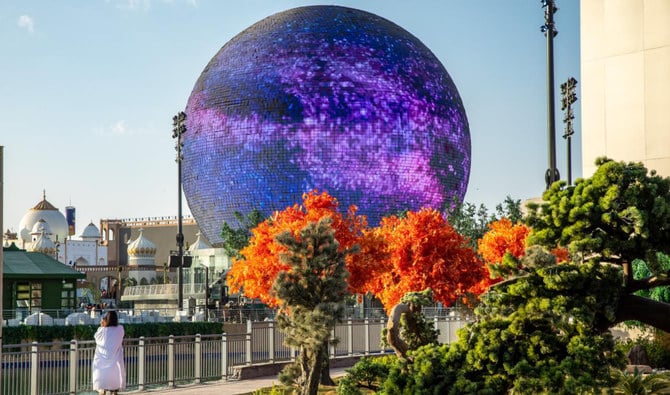
A new modern landmark in the capital of the Kingdom, the Light Ball, has been named by Guinness World Records as the largest illuminated LED ball in the world, with an estimated height of 35 meters.
Located at Boulevard World, the exterior of the ball emanates bright lighting that flickers in different patterns, while the interior boasts a 220-seat theater equipped with state-of-the-art features.
Guests can recline in their seats facing a 360-degree circular screen. The short films presented in the theater are five minutes long, with varying genres suitable for families to enjoy. The shows run every 30 minutes daily from 3:30 p.m. to 10:30 p.m.
In addition to cultural experiences, Boulevard World includes the largest artificial lake in the world. Visitors can take part in boat and submarine rides in the lake — a first for Riyadh Season.
There are also distinctive entertainment options, such as Combat Village, Super Hero, the largest sphere in the world and cable car trips between Boulevard World and its neighboring zone, Boulevard Riyadh City.
The zone offers visitors other entertainment experiences as well, such as Boulevard Pier, Discovery, Realistic Monopoly, The Mountain, Area 15, Ninja Warriors and Fun Zone for children.
source/contents: arabnews.com (headline edited)
___________
Located at Boulevard World, the exterior of the ball emanates bright lighting that flickers in different patterns, while the interior boasts a 220-seat theater equipped with state-of-the-art features. (Supplied)
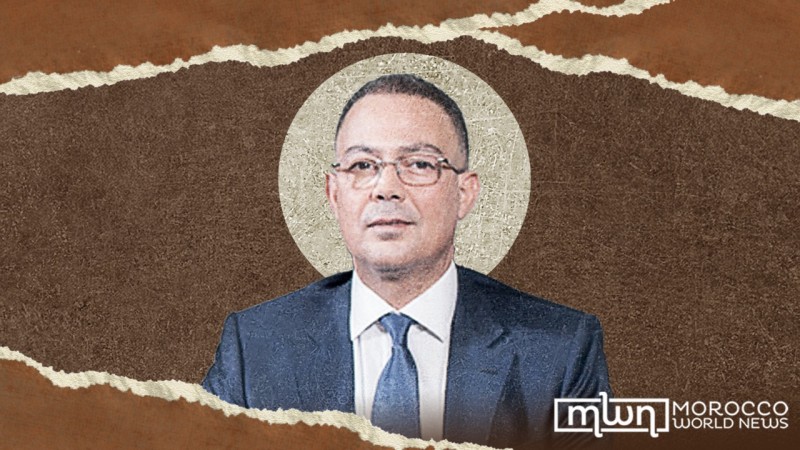
Lekjaa was instrumental in Morocco’s 2022 footballing triumphs, but he continues to look to the future.
When Morocco’s football team defied all odds by topping their group at the Qatar World Cup and qualifying to the round of 16, the president of the Royal Moroccan Football Federation (FRMF) appeared simultaneously happy and unsatisfied.
As most football watchers — and even Moroccan fans and analysts — seemed to say that the Moroccan team’s group performance was a welcome surprise, Fouzi Lekjaa begged to slightly differ.
Yes, the performance was welcome, but there was nothing surprising or shocking about it, the FRMF chief suggested. Others believed — or hoped — that Morocco could do well in the knockout stage, but Lekjaa knew the team could and should do much better. With many pundits favoring Spain to beat Morocco in the round of 16, Lekjaa beamed in an interview that the Atlas Lions have “the potential to compete with anyone.”
Over the team’s next few games, Lekjaa’s words would prove true. The team defeated Spain on penalty kicks after a 120-minute grueling and edgy match, progressing to the quarter-finals for the first time in its history. With a star-suffused Portuguese team waiting in the quarter-finals, the FRMF remained adamant that Morocco could stun their European opponents. And that, ultimately, this being Morocco’s moment to lift Africa’s quarter-final curse, he was confident Morocco would seize it.
And while Morocco’s campaign may have been ended by France in the semi-finals, and while the Atlas Lions may have failed to snatch the bronze medal during their third-place game with Croatia, they have largely achieved what has long been Lekjaa’s goal: put Moroccan football in the global spotlight and earn African football the world’s respect.
Of course, credit for the Atlas Lions’ triumphs cannot be given to one person. Head coach Walid Regragui, players like Yassine Bounou and Sofyan Amrabat, and the team’s technical and medical staff all helped throughout the historic run.
But Lekjaa, who has also been member of FIFA’s executive council since 2021, has been duly celebrated as the orchestrator of the advancement of Moroccan football and the plaudits and respect it has earned of late. While talents on the pitch and the coaching staff’s vision and tactical nous were instrumental in Morocco’s exploits, many have argued, the Atlas Lions’ success story would not have been possible without the reforms the Moroccan federation has witnessed under Lekjaa.
With his team’s sustained quest for Moroccan talents in the diaspora, the recent colossal investments in the national football league and in sporting infrastructure such world-class stadiums and a well-respected football academy, Lekjaa’s leadership has made Moroccan football a leader in Africa and a force to reckon with on the world stage.
It is thus in recognition of his revolutionary leadership at the helm of the FRMF, especially the last-minute, well-timed decision to appoint an inspired coach ahead of the World Cup, that Morocco World News is choosing Lekjaa as one of this year’s most important personalities.
Education and career
Lekjaa was born in Berkane in 1970, where he finished his education before leaving for Rabat to join the Hassan II Agronomic and Veterinary Institute, where he obtained a degree as an agricultural engineer.
He then studied at the National School of Administration in Casablanca and worked at the Ministry of Finance as well as the Ministry of Agriculture. He has been described as the youngest to ever hold the position of budget director in the Finance ministry’s history.
In October 2021, Lekjaa was named as Minister Delegate to the Minister of Finance, responsible for the Budget, as part of Aziz Akhannouch’s government, currently in power.
Career in football
While he has occupied numerous high-profile posts in Morocco’s government, Lekjaa is perhaps best known for his transformative contributions to the country’s football scene.
Having grown up a supporter of his local club, Renaissance Sportive de Berkane (RSB), Lekjaa was appointed president of the club in 2009, while he held another job as a civil servant.
In 2012, RS Berkane rejoined the Moroccan top-flight league for the first time since the 80s, and reached the Throne Cup’s final in 2014, for the first time since 1986.
Since then, the club has been crowned champions of the Throne Cup two times, in 2018 and 2022.
They have also achieved unprecedented continental success, reaching the final of the CAF Confederation Cup three times, winning the title in 2020 and 2022. They also won the most recent CAF Super Cup in 2022, after defeating their fellow Moroccans in Wydad Casablanca.
In 2014, Lekjaa succeeded Ali Fassi Fihri as President of the FRMF, the position he continues to hold today. During his time, Moroccan clubs have achieved success on the continental stage, winning three CAF Super Cup titles, two Champions’ League titles, and reaching five finals.
In 2022, the Super Cup title was contested by two Moroccan teams — with Wydad AC winning the continent’s Champions League while RS Berkane took home the Confederations Cup.
Morocco’s national football team also qualified for the 2018 Russia World Cup under Lekjaa’s presidency, although they could not make it past the group stage despite strong performances against Spain and Portugal.
In 2022, following trouble with players and disapproval from Morocco’s football fans, Bosnian manager Vahid Halilodzic was dismissed by FRMF only a few months before Morocco was set to participate in the World Cup finals.
In his place came Moroccan coach Walid Regragui, who went on to lead Morocco’s squad through a historic run that saw them reach the World Cup’s semi-finals. The decision to hire Regragui has been hailed by many as a step in the right direction of putting more trust in local talents.
Looking to the future
Morocco’s 2022 World Cup triumphs have been declared as just the beginning by some, and it certainly seems that Lekjaa is looking to the future as well.
Despite its World Cup bids being rejected before, Morocco will most likely bid again to host the 2030 World Cup. With Lekjaa joining FIFA’s Executive Council last year, this bid could see a better fate than the past ones.
If successful, Morocco would be the second African and Arab country to host the global competition. Lekjaa told the Associated Press earlier this month that Morocco is considering a joint bid with Spain and Portugal to show the world that the relationship between Morocco and its European neighbors is one “in which civilizations can meet and cultures meet.”
The Moroccan team’s performances at the 2022 tournament have only strengthened Morocco’s international reputation as a footballing nation with a history and passion for the sport, which should also serve well to strengthen its bid.
Many of the stars that led Morocco to the semi-finals in 2022 should still be playing in four years when the US, Canada, and Mexico host the competition, leading to hopes that they can maintain the same level or improve upon it in the future.
Regragui has already made it clear his aspirations are for the next World Cup, asserting that because the Atlas Lions have shown they can compete with the world’s best, Morocco lifting the trophy in 2026 is not a quixotic goal.
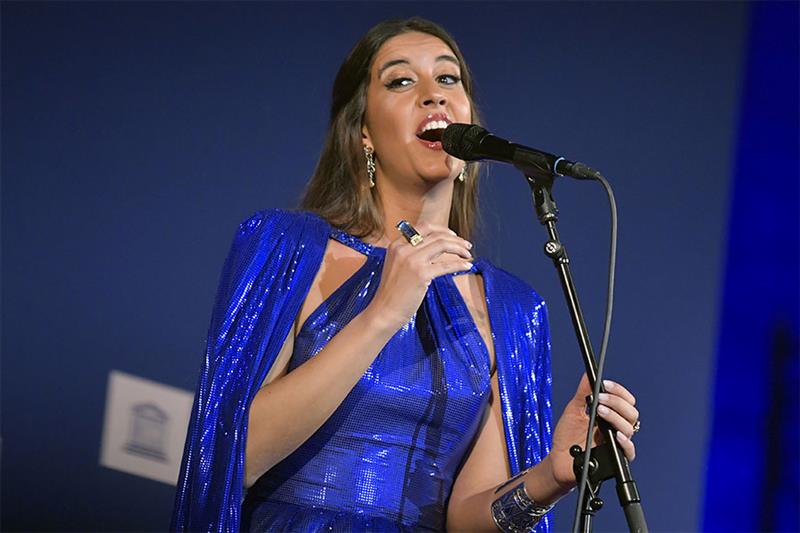
Egyptian mezzo soprano Farrah El-Dibany has performed La Marseillaise the French national anthem, in the beginning of the final FIFA World Cup match against Argentine in Doha, Qatar on Sunday.
Farrah El-Dibany has sang during the re-election of Emmanuel Macron on April 24.
She was awarded France’s Ordre des Arts et des Lettres in the grade of Chevalier (Knight) by France’s Ambassador to Cairo Marc Baréty during an official ceremony in April.
Born in Alexandria in 1989, El-Dibany is one of the well-known Egyptian singers of her generation, establishing herself on an international scale in a short time.
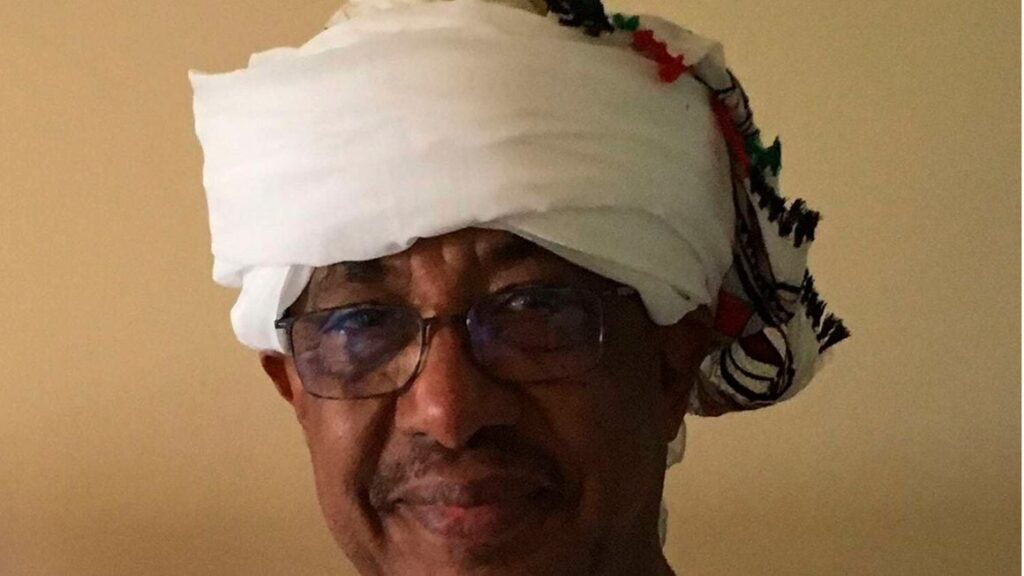
Rashid Diab was the first in a stream of brilliant Sudanese artists who came flooding into Kenya in the early 1990s.
He has been a way-shower ever since. Experimenting with technical skills that he’s acquired and mastered over the years, his awesome etchings have come to Nairobi’s Red Hill Gallery in an exhibition entitled A Trajectory of Etchings – 1980-2000.
A trip up to Hellmuth and Erica Rossler-Musch’s ever-green gallery is well worth the trek, if for no other reason than to meet two of the most hospitable art lovers around.
But then, to see the Gallery’s pearly white walls covered in a rich array of Rashid’s colourful etchings is all the more reason to come and see.
They are mainly abstract works, but one can see so many influences surfacing through his swirls of colours, two-dimensional lines, and calligraphic curves that disclose his Sufi upbringing.
There are more than 50 etchings, all of which are beautifully framed and displayed in geometric clusters of both miniature gems of genius dressed in sepia and ochre ink as well as larger works suggesting symbolic forms such as are found in northern Sudan, in the ancient murals of Meroetic and Kush civilisations.
The venerable Sudanese artist flew in from Khartoum, especially for his exhibition opening last Sunday, November 20, having been preceded by his son Yafil, who prepared the way for Nairobi to see facets of his father’s art other than the style of painting that he is currently passionate about and which we have seen in recent exhibitions of his work in places like Tribal Gallery, One Off, and Gravitart.
“We met Yafil more than a year ago when he came and suggested that we have an exhibition of his father’s etchings,” Hellmuth told BDLife shortly before the exhibition opened.
“We were impressed with the etchings, especially as they cover a span of 20 years, but we couldn’t hold the exhibition until now.”
There had been many steps involved in bringing Yalif’s idea to fruition, especially as he had to return to Khartoum and the process of curating the show had to proceed online.
The fact that none of the etchings had ever been seen before in Kenya made the preparation process all the more exciting for Hellmuth who relished the challenge.
But once he’d selected his favourites from the hundreds that Yalif had shared, Hellmuth insisted on framing all but ten of them to show them in their best light.
“My father was impressed to see the exhibition as he had never seen so many of the works shown so well in one space,” Yalif said.
Rashid himself hadn’t discovered his passion for printmaking, specifically for etching until he was introduced to the technique in Spain, at the Complutense University of Madrid where he had been awarded a fellowship to attend.
That discovery led to his getting advanced degrees in painting and etchings, including a PhD.
But after years of working as a scholar and professor of fine art, he felt compelled to return to his homeland where he has been sharing his knowledge, skills, wisdom and experience with his fellow Sudanese ever since.
In 2000 when he returned to Khartoum, he established the Dara Art Gallery. And several years after that, the Rashid Diab Art Centre was born.
“As we don’t have a national art gallery in Sudan, the Centre has played an important role,” Yalif said. It has also given Rashid the visibility required for the world to recognise his talent and leadership role in the arts of Sudan.
For instance, he won the King Juan Carlos of Spain award for Excellence in Service. He has also won ambassadorial status from the Japanese and British governments for his concern for peace and the environment.
He’s also exhibited his art all over the Middle East and Europe.
So, while he hasn’t lost his passion for printmaking, he had to put it on hold while shifting artistically as well as socially and culturally from his Spanish to his Sudanese circumstance.
“I’m concerned about the role of women in our society, which is why they appear so frequently in my art,” Rashid told BDLife at the opening of his first solo exhibition at Red Hill.
But it is thanks to his son, who discovered hundreds of his etchings while archiving his father’s art that we have the opportunity to see this treasure trove of an earlier phase of Rashid’s artistic ‘trajectory.’
Following up a highly eventful year, the diverse artist delivers an electrifying track for the official soundtrack of the 2022 World Cup which he will perform at the final match.
Ahead of his performance at the FIFA 2022 World Cup finals taking place in Qatar on Sunday the 18th of December, Wegz releases ‘Ezz El Arab’ as part of the tournament’s official soundtrack.
Internationally acclaimed Egyptian artist Wegz has been continuously growing throughout his career. In only a few years, the Alexandrian rapper and singer has managed to permeate the cultural zeitgeist, becoming an ever-present figure in contemporary Arabic music.
This year, Wegz has achieved major accomplishments, such as his track ‘Al Bakht’ amassing over 150 million views on YouTube and topping the charts on Spotify’s most played artist in the MENA region.
If there is one thing that Wegz has demonstrated throughout his career, it’s that he is always moving forward, continuously trying to evolve his sound and expand his reach.
In pursuit of these ventures, the beloved Egyptian rap icon has just released an official track for the 2022 FIFA World Cup in Qatar, looking to afro-beats, electronic music, and his signature singing style to deliver an energising track that explores themes of unity and pride.
The music video for the track was directed by Ali El Arabi, who also directed Wegz’s, ‘B3oda Ya Belady’ from the highly acclaimed documentary ‘Captains of Zaatari’. The video features Wegz in a variety of shots around Qatar, DJing to an adoring crowd of football fans, and performing to camera in a cinematic portrayal of the tournament’s festivities.
This year’s World Cup has been more than just a sporting event for people of the MENA region. The tournament has always been a time for gathering and community, even if many Arab national teams have not reached their full potential in previous iterations of the World Cup. But this year’s tournament, hosted in Qatar, has seen incredible performances from teams such as Saudi Arabia, and of course, the Moroccan national team, who have instilled a sense of pride in Arab fans around the region and beyond. Watch the full music video here