Arabs & Arabian Records Aggregator. Chronicler. Milestones of the 25 Countries of the Arabic Speaking World (official / co-official). AGCC. MENA. Global. Ist's to Top 10's. Records. Read & Enjoy./ www.arabianrecords.org
The trailblazing artist, son of legendary Fairuz and composer Assi Rahbani, was also a playwright, pianist and political provocateur.
Lebanese musician and composer Ziad Rahbani, son of the iconic singer Fairuz and a pioneer of fusion jazz, has died at the age of 69 of a heart attack.
“On Saturday at 9:00am, the heart of the great artist and creator Ziad Rahbani stopped beating,” said a statement from the hospital where he was being treated in the capital, Beirut, on Saturday.
Rahbani influenced generations of Lebanese people with his songs and especially his plays, whose lines are known by heart by both young and old.
He was the son of Fairuz, the last living legend of Arabic song – and one of the most famous Arab women worldwide – and composer Assi Rahbani, who, along with his brother Mansour, modernised Arabic song by blending classical Western, Russian, and Latin American pieces with Middle Eastern rhythms.
“I admire the music of composers like Charlie Parker, Stan Getz and Dizzy Gillespie,” Rahbani once said. “But my music is not Western, it’s Lebanese, with a different way of expression.”
Fairouz also became an icon for young people when Rahbani composed songs for her influenced by jazz rhythms – he called it “oriental jazz”.
Lebanon’s leaders paid a heartfelt tribute to the Lebanese composer, who was also a playwright, pianist and political provocateur.
President Joseph Aoun called Rahbani “a living conscience, a voice that rebelled against injustice, and a sincere mirror of the oppressed and marginalised”.
“Lebanon has lost an exceptional and creative artist, a free voice that remained faithful to the values of justice and dignity” and who said “what many did not dare to say”, said Prime Minister Nawaf Salam.
Rahbani’s works reflected the hybrid heritage of Lebanon, which, until the civil war erupted in 1975, was a cultural melting pot. It also reflected the ensuing sectarian strife, which involved bloody street battles between rival militias and three years of violent Israeli occupation after the 1982 invasion.
While Fairuz transcended the powerful sectarian divides in the country, her son chose to be resolutely left-wing and secular, denouncing Lebanon’s longstanding divisions. His breakout play, Nazl el-Sourour (Happiness Hotel), premiered in 1974 when he was only 17, portrayed a society disfigured by class inequality and repression.
The play follows a group of workers who take over a restaurant to demand their rights, only to be dismissed by the political elite.
In another play, Bennesbeh Labokra Chou? (What About Tomorrow?), he plays a jaded bar pianist in post-civil war Beirut. The work features some of Rahbani’s most poignant music and biting commentary, including the famous line, “They say tomorrow will be better, but what about today?”
Rahbani was also a composer of staggering range. He infused traditional Arabic melodies with jazz, funk and classical influences, creating a hybrid sound that became instantly recognisable. His live performances were legendary, when he often played piano in smoky clubs in Hamra, one of Beirut’s major commercial districts.
In recent years, Rahbani appeared less in the public eye, but younger generations rediscovered his plays online and sampled his music in protest movements. He continued to compose and write, speaking often of his frustration with Lebanon’s political stagnation and decaying public life.
“I feel like everything is over, I feel like Lebanon has become empty,” wrote Lebanese actress Carmen Lebbos, his former partner, on X.
Rahbani is survived by his mother, now 90, his sister Reema and brother Hali.
Source: News Agencies
source/content: aljazeera.com (headline edited)
______________
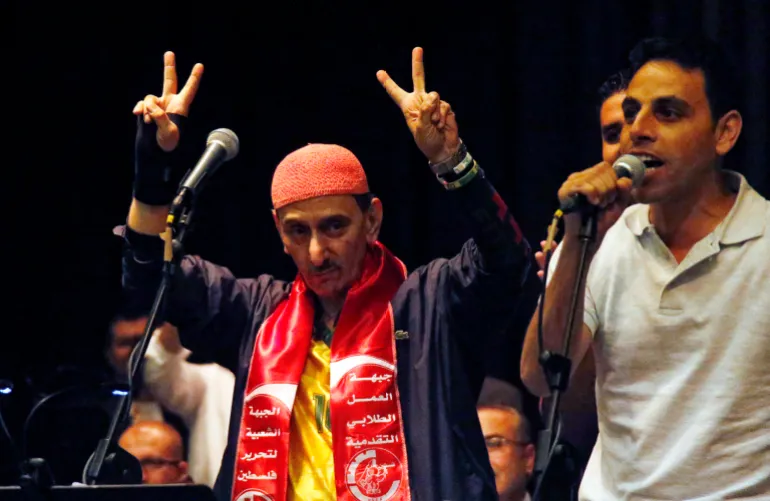
Ziad Rahbani gestures while wearing a scarf of the left-wing Popular Front for the Liberation of Palestine group, during a concert in Sidon, southern Lebanon, October 9, 2014 [File: Ali Hashisho/Reuters]
From Cairo’s backstreets to the Olympics in Athens, Mohamed Reda opens up about discipline, family, and the academy where he now trains a new generation to dream with grit.
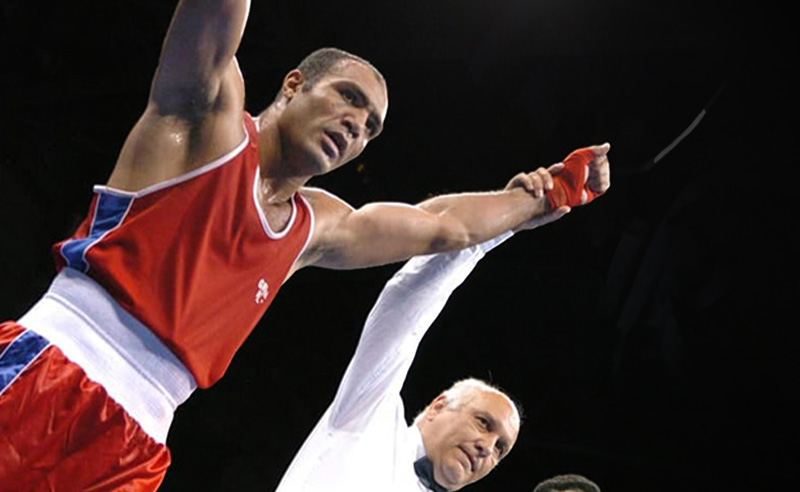
Here is a conversation with Olympic boxer Mohamed Reda, written by someone whose dad has been telling this story for years… Growing up, my dad never ran out of stories about school pranks, scraped report cards, and friends who became family. But one story always stood out. He had a friend, a real friend, who went on to become an Olympic silver medallist in boxing. The guy’s name was Mohamed Reda.
For years, I thought the story might be exaggerated, until I looked him up and found out he’s real, he’s famous, and he runs a professional boxing academy in Cairo. And eventually, I got the chance to sit with him for an interview. My dad was probably more excited than Reda himself when I told him.
Reda welcomed me with the same calm energy that has shaped his whole career. “I’m a son of El-Gamaliya, Haret El-Maghrabaleen, to be specific,” he said. “That neighbourhood taught me that being a man doesn’t come from how you look. It’s how you carry yourself. People there helped each other just because it was the right thing to do. That’s what I grew up around. That’s what shaped me.” He grinned. “Also, I still remember that foul cart on the corner. Mornings with foul and chilli oil… nothing like it.”
His entry into boxing wasn’t really planned. “It looked like a coincidence. My coach lived in our neighbourhood and wanted to do my dad a favour. But the moment I put those gloves on, something clicked. I felt like I’d found something I didn’t know I was looking for.” Reda still remembers the first real match. The nerves, the smell of sweat, the shouting coach, the shaky legs. “It was at Darb Al-Ahmar Club, my first championship. Everything about that day stayed with me. That was the first time I felt like I’d started writing my name in the sport.”
He’s worn gloves with the Egyptian flag stitched into them. When I asked what that meant, his answer was simple. “Every time I put them on, I felt the weight of the country. You carry more than your own goals. It’s an honour. A responsibility.”
In 2004, he won silver for Egypt in the Athens Olympics. We chatted a lot about it, but what really stood out to me was him saying, “People see the medal. What they don’t see is the years of training, the injuries, the days I went to bed hungry, the nights I was in pain. They don’t see what you give up. You miss moments with people you love because you believe in something no one else can see yet.” After Athens, everything changed – and didn’t.
“People started calling me a star,” he said. “But I stayed Mohamed from El-Gamaliya. What changed was the responsibility. What didn’t change was my faith in God, my respect for my parents… and my love for foul with chilli oil.” Despite offers to go pro in Europe and the US, Reda chose to stay. “I had an eye issue. And more than that, I wanted to set an example. I wanted to build something here. Not everything is about the money.” Instead, he built a boxing academy, which was the next step in a lifelong goal.
“I wanted to train my son differently from how I was trained. I stopped competing, but I didn’t stop dreaming. The academy became that dream, a place to shape people as much as athletes.” The lessons go beyond the ring. “Victory’s great,” he said. “But what really matters is consistency. Show up when you’re tired. Respect your opponent. Respect yourself.” He sees parts of himself in the new generation. What surprises him most is how quickly they grow. “This generation? They’ve got energy. They’ve got guts. All they need is someone to steer them.”
Over the last few years, more women have joined the sport. For Reda, this was an opportunity to evolve his training. “I started listening more. Every girl has her own story. Boxing, for some, carries the weight of protection, the spark of confidence, and the breath of freedom beyond the sport alone. We adjusted our training to focus on skill, self-defence and respect.”
The academy now offers sessions exclusively for women. The experience has changed him as much as it’s changed them. “Give a girl a safe environment, and she’ll surprise you. That’s what I’ve seen. Greatness comes from will; gender has nothing to do with it. Every time one of them pushes through fear, she teaches me something new.”
When I asked about a moment from his career that stayed with him – even though it never made the headlines – he didn’t hesitate. “After losing a championship, I came home feeling like I wasn’t cut out for it any more. I told myself I was done. But when I walked in and saw my wife’s eyes, she didn’t say a word, but the belief she had in me… that’s what brought me back. No one wrote about that. But that moment made me a champion.”When I asked Reda about his definition of strength or power, he answered, “Strength is getting back up when you fall. It’s staying calm when someone tries to get under your skin. It’s holding onto your humanity when things get tough. The real strength? It’s in your heart and your head, not in your gloves.”
Before I left, I asked what he hoped kids would take from his story. “I hope they see that champions rise through what they build, step by step. Built from every tough moment, every ‘I can’t’ that turns into ‘I did.’ Boxing is a big school. It teaches you to face yourself. And if you’ve got a dream – any dream – you’ve got to believe it can happen. There’s always room for another Mohamed Reda.” After the interview, I called my dad to tell him how it went. He said, “I told you he was the real deal.” And honestly? He really is.
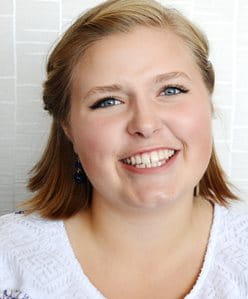
Until last year, 17-year-old Victoria Miller admits she would have had to search online to learn where Algeria is , let alone describe the exploits of one of its most famous heroes.
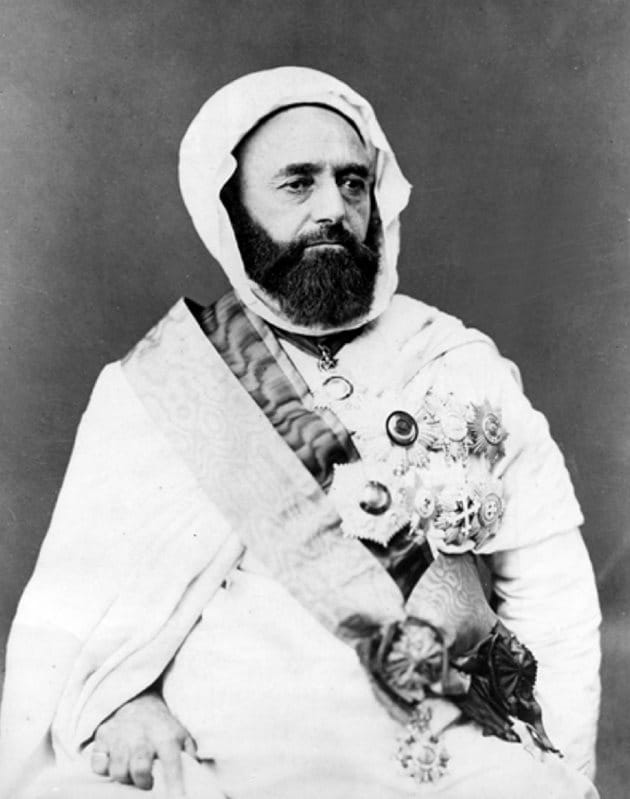
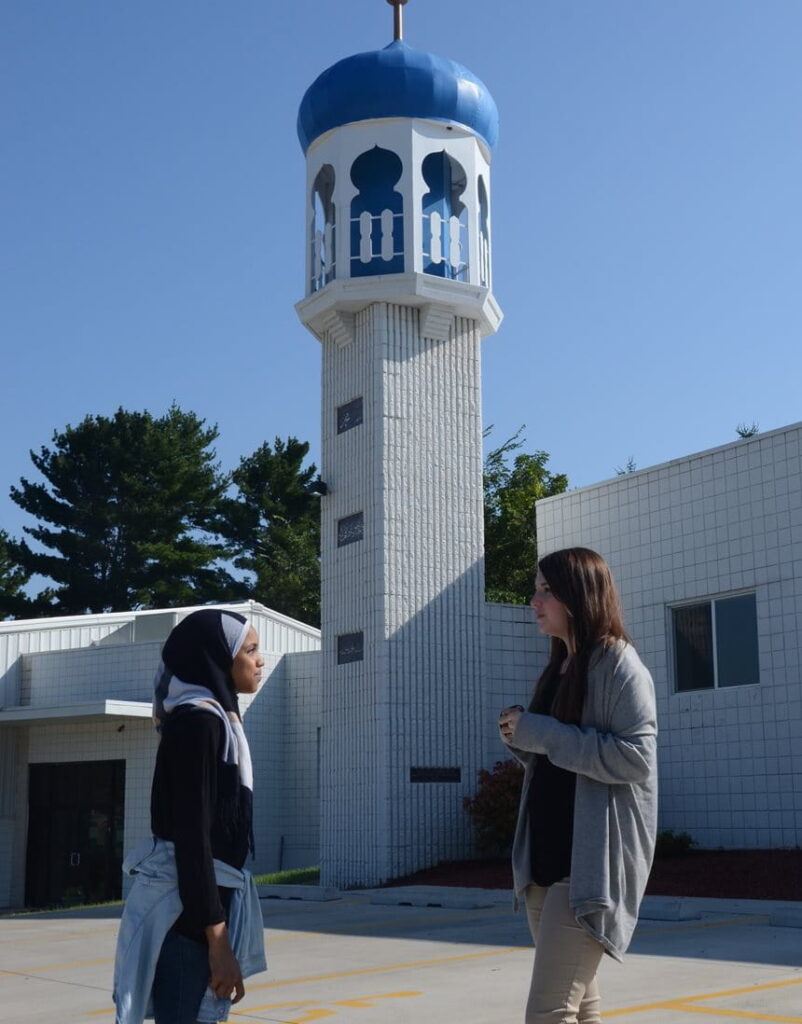
Pictorial Press / ALAMY / Abd el-Kader’s name lives on in Elkader, Iowa, pop. 1,300, the only US town named after an Arab.
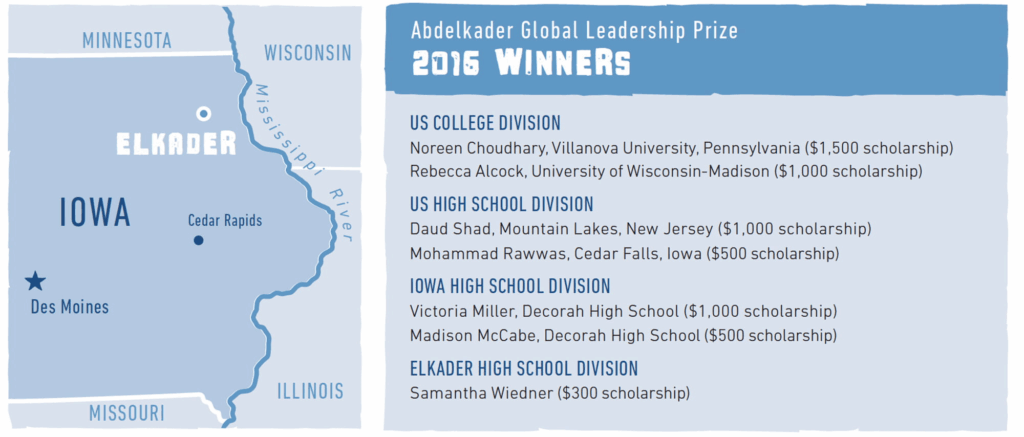
.“I was really taken by Amir Abd el-Kader’s character and how he handled the multiple challenges he faced, including when some of his own people didn’t believe in him,” says Miller, who lives in the northeastern Iowa town of Decorah. On September 19 she was recognized as one of seven winning essayists in the 2016 Abdelkader Global Leadership Prize.
After reading diplomat John W. Kiser’s biography, Commander of the Faithful: The Life and Times of Emir Abd el-Kader (Monkfish, 2008), for a class in human geography at Decorah High School, Miller now says she regards him as an international role model. Her new understandings, she adds, help her feel more comfortable talking to Muslims.
“Abd el-Kader’s legacy deserves to be remembered along with Nelson Mandela, Gandhi and Dr. Martin Luther King Jr.’s,” Miller enthuses, “because they were all pursuing the same dream: to reach peace.”
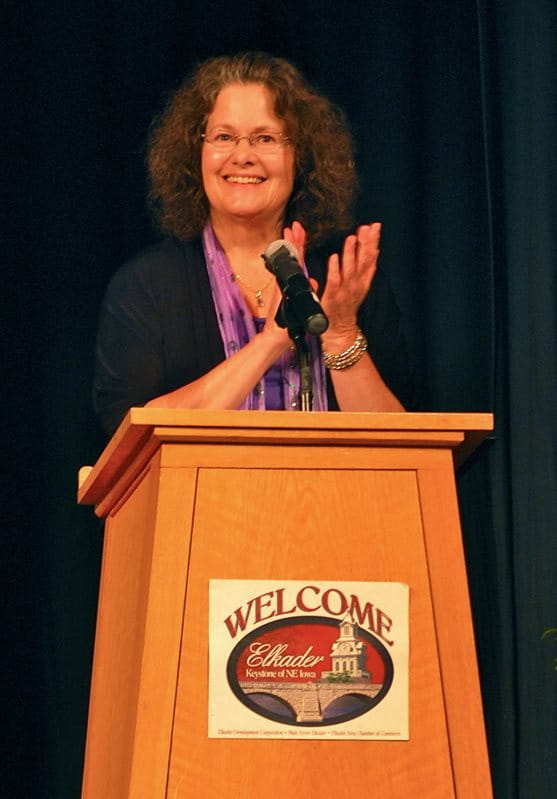
ABDELKADER EDUCATION PROJECT / Abdelkader Education Project co-founder and executive director Kathy Garms opened the group’s seventh annual forum on September 19 in Cedar Rapids. Students competed for scholar-ships in the Abdelkader Global Leadership Prize, and educators explored the legacy of Algerian freedom fighter and peacemaker Amir (Prince) Abd el-Kader.
Indeed, the Algerian prince (amir or emir in Arabic) united tribes in North Africa and fought for independence; later, during the 1860 Mount Lebanon civil war, he helped save thousands of Maronite Christians from massacre—an act for which President Abraham Lincoln lauded him. When the amir passed away in 1883, The New York Times eulogized him as “one of the few great men of the century. The nobility of his character won him the admiration of the world.”
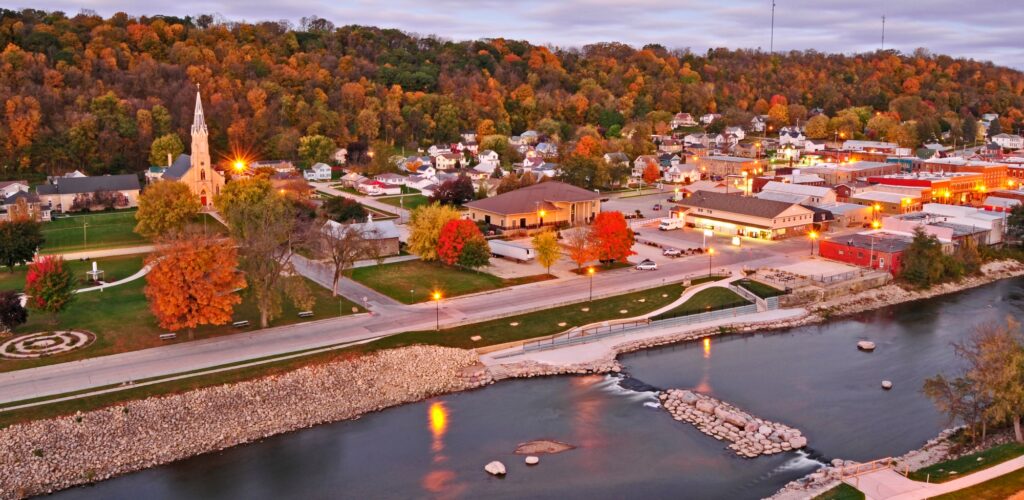
Even decades earlier, in 1846, so widely admired was he that Iowa farmers named their new town after him, and today Elkader, Iowa, is the only us town named for an Arab. Since 2008 it has been reviving his legacy, thanks largely to the eight-year-old nonprofit Abdelkader Education Project (aep).
Kathy Garms, executive director and cofounder with Kiser of the Elkader-based aep, furthers Miller’s sentiment, explaining that the story of the amir “inspires civility, tolerance and understanding” and offers “models of ethical leadership, moral courage and humanitarian conduct.” The aep, Garms continues, works to “shape the minds, hearts, values of the next generation.” And this is where aep’s Abdelkader Global Leadership Prize essay competition comes in.
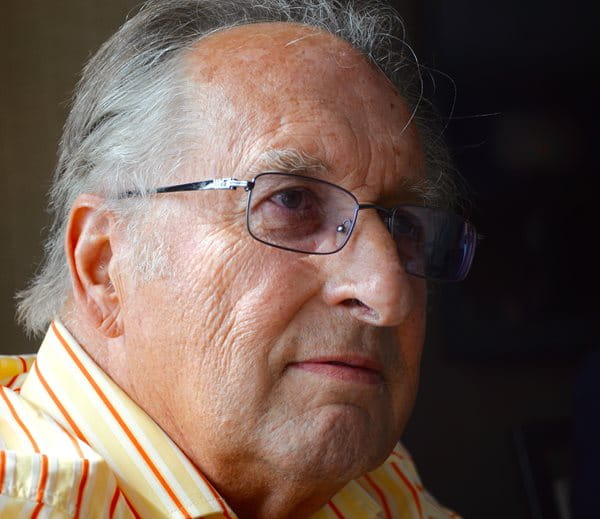
John W. Kiser, author of Commander of the Faithful: The Life and Times of Emir Abd el-Kader, and forum participant said the students stereotypes have been challenged.
Its award ceremony was held this year about 130 kilometers south of Elkader in Cedar Rapids, where it was nearly cancelled due to rising floodwaters on the Cedar River. But the student writers and their families braved the threats of high water to meet Kiser as well as teachers and leaders of civil-society groups from around the country.
Kiser says he is pleased with the results so far.
“The students’ stereotypes about Muslims and Arabs have been challenged, and their minds opened to the diversity of the Muslim world,” he observes. As a role model, he says, Abd el-Kader “is a unifier … [whose] probing intellect, ethical courage, compassion, depth of knowledge … impress all who learn about him.”
And his advice to the winners was simple: “Treat others as they would want to be treated … and resist stereotyping.”
Garms affirms the broadening of students’ horizons. “We started this with an essay contest for students, but we’d like to expand our programs and create additional tools to reach a wider audience of police, military and businesses to promote better intercultural understanding,” she says.
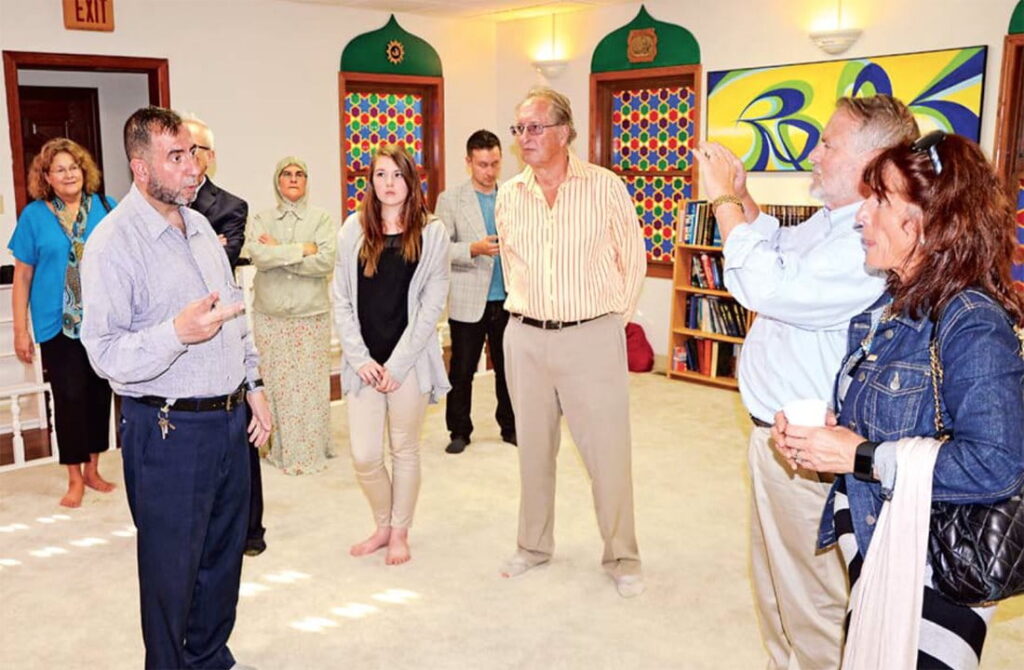
After the awards program, the winners and family members toured the Cedar Rapids Islamic Center and visited one of the city’s historic sites: the oldest standing mosque in the United States, built in 1934.
“Abd El-Kader’s legacy deserves to be remembered along with Nelson Mandela, Gandhi and Dr. Martin Luther King Jr’s because they were all pursuing the same dream : To Reach Peace
‘ – Victoria Miller, Iowa High School Division Winner’
Elkader Mayor Josh Pope hopes the aep inspires young people “to carry on the values of the amir.” In addition to hosting the aep, Elkader is a sister city to Mascara, in northwestern Algeria, where Abd el-Kader was born in 1808. Today Mascara’s population of 150,000 dwarfs Elkader’s 1,300 residents. “Abd el-Kader serves as a great example about how people of different cultures can live together in peace and understanding,” he says
In early September Pope traveled at the invitation of the Algerian government to speak at its own Emir Abd el-Kader Award ceremony, which recognized organizations in the Mediterranean region for work in economic cooperation and interfaith relations.
The interfaith aspect of Abd el-Kader’s life impresses Miller deeply.
“I’m a Christian, and I’ve had my own difficulties—though certainly on a different level—but I know it’s important to stay positive and hopeful,” she says.
Now, she wants to add study of comparative religions and “the psychology of how we learn and react to stereotypes” to her aspirations for a career in medicine.
“Victoria grew a lot in the process of reading about el-Kader and writing her essay,” says Miller’s mother, Yvette Powers, noting diplomatically that her daughter was not always supported by some members of her extended family.
“I believe people need to accept all races and creeds,” she declares. “I hope she was able to open some eyes.”
Brian Miller, Victoria’s father, says he and his daughter talked about the life of Abd el-Kader when she was writing her essay.
“It opened up quite a discussion,” he says. “I believe there are good Muslims and bad Muslims, just like all people.”
Forum attendees received a tour of the “Mother Mosque of America,” built in 1934 in Cedar Rapids, Iowa, by immigrants from what is now Syria and Lebanon. Although not the first mosque built in the US, it is the oldest standing mosque; its proximity to Elkader, 130 kilometers away, is coincidental.
Abd el-Kader, he says, “was a good guy,” adding that he hadn’t ever really thought much before about why the town was called “Elkader.”
National high school division winner Daud Shad lives far from Iowa, more than 1,600 kilometers east, in New Jersey. He says his elder brother encouraged him to read Kiser’s biography and enter the contest.
“I’d never heard of el-Kader, ‘the George Washington of Algeria,’” says the 17-year-old, whose parents were born in Pakistan. “There need to be more leaders on all sides like el-Kader because he embodied the best of religion and humanity.”
Samantha Wiedner, 18, grew up in Elkader, and she won the high school competition for her town.
“I knew Elkader was named after the emir, and I knew where Algeria was, but that was about it,” says Wiedner, now a freshman studying Russian and international relations at the University of Iowa.
University of Iowa freshman and winner in the contest’s Elkader High School Division, Samantha Wiedner, right, talks with Jefferson High School tenth grader Lena Osman outside of the Islamic Center of Cedar Rapids. “Being intolerant to other cultures and religions isn’t going to get us anywhere,” Wiedner says. “Despite all our differences, we should be able to co-exist.”
She says she learned that “being intolerant to other cultures and religions isn’t going to get us anywhere. Despite all our differences, we should be able to coexist.”
Noureen Choudhary, 20 and a student at Villanova University, learned about the essay contest from her mother, who was born in Algeria.
“I first heard the name Abd el-Kader in a song popularized by Algerian musicians Khaled, Faudel and Rachid Taha,” says Choudhary, who was born and raised in Philadelphia. Though she was only four, she says the memorable tune and appealing lyrics made her wonder who it was about.
“My mother told me he was an Algerian hero,” she continues. “I now realize he is a figure widely heralded as an ideal Muslim, humanitarian, warrior, leader and source of Algerian national pride of the 19th century.”
Choudhary initially thought Abd el-Kader was “too obscure for Westerners to know about.” She was stunned to learn that a small town in Iowa was named for him, and that there is a group devoted to the study and promotion of his life and work.
“Not many people achieve great things like he did,” she says. “He practiced his faith in an exemplary manner.”
source/content: aramcoworld.com (headline edited) / Brian E. Clark
Groundbreaking procedure opens new horizons in circulatory support techniques for patients with complex cardiac conditions
Cardiac surgery team, led by Prof. Feras Khaliel, performed the operation through small incisions using remotely controlled high-precision robotic arms
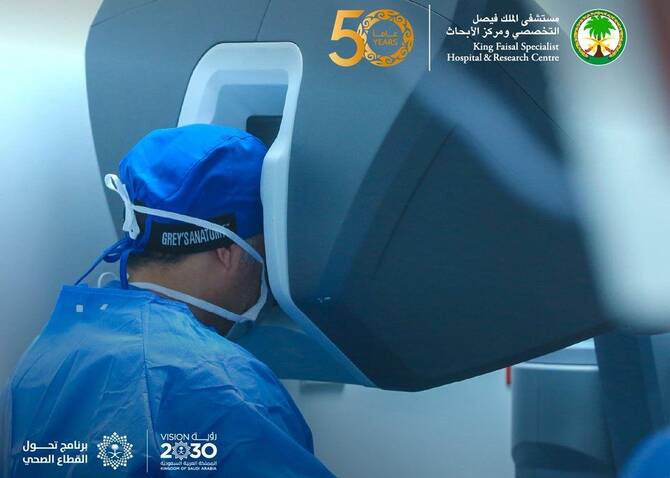
King Faisal Specialist Hospital and Research Centre in Riyadh has performed the world’s first implantation of two artificial pumps for biventricular support using robotic technology on a patient with advanced heart failure.
The groundbreaking procedure opens new horizons in circulatory support techniques for patients with complex cardiac conditions and marks a medical achievement that culminated in the patient’s recovery within a short period following the surgery.
The procedure represents a major advance in the treatment of bilateral heart failure, which was traditionally performed through full sternotomy, an approach associated with higher surgical risks and prolonged recovery.
However, the cardiac surgery team, led by Prof. Feras Khaliel, performed the operation through small incisions using remotely controlled high-precision robotic arms, resulting in reduced blood loss, lower risk of infection, and faster patient recovery.
The milestone reflects the integration of expertise across multiple departments at the hospital, including cardiac surgery, cardiology, anesthesia, critical care, biomedical engineering, and advanced life support.
The procedure was meticulously planned and benefited from 3D imaging technologies, real-time surgical navigation, and innovative solutions.
source/content: arabnews.com (headline edited)
_____________
KFSHRC has performed the world’s first implantation of two artificial pumps for biventricular support using robotic technology. (X/@KFSHRC)
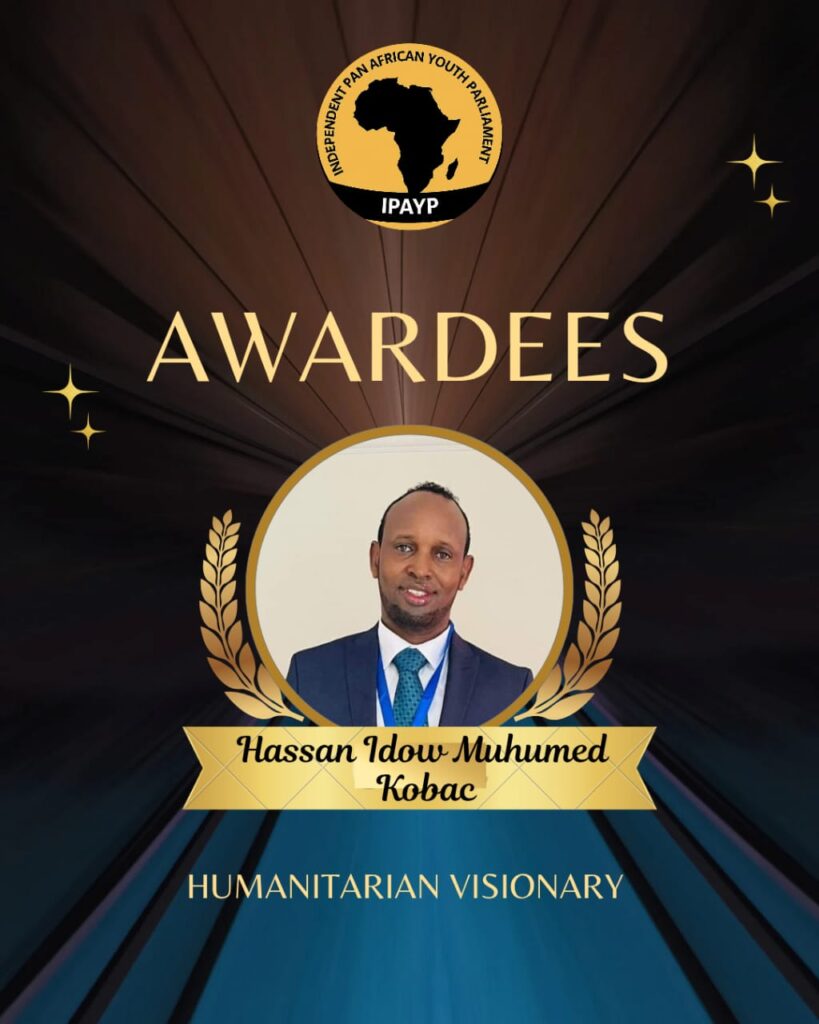
Independent Pan African Youth Parliament awarded Humanitarian Visionary Award to Hassan Idow Muhumed Kobac – a Senator, a business elite and humanitarian worker among other awardees at the Kenyan capital Nairobi.
The three-day summit gathered over 50 youth leaders, policymakers, academics, and civil society voices from across the continent focusing youth-driven solutions for key challenges including education, employment, leadership, democracy, climate change, and digital innovation.
“I am honoured to receive this important award which is the recognition of the humanitarian work I have been doing in Somalia for more than a decade and all other humanitarian workers” Hassan Idow Muhumed Kobac said, “The Award not only encourages the humanitarian workers, but also boosts the morale of other humanitarian workers.”
“My goal is to create a better life for the Somali people and restore their dignity.” Hassan Kobac who is a true example of honest leadership that stands for progress and compassion said.
Mr. Kobac has dedicated his life to the development of vulnerable communities. Through the Hassan Kobac Foundation (HKF), a foundation he founded himself, has become a source of hope for many people affected by drought, displacement, and poverty.
In the face of one of the most severe droughts in recent history, the Hassan Kobac Foundation (HKF) has emerged as a beacon of hope, delivering emergency water trucking assistance and food rations to thousands of families in the Hiiraan region of central Somalia.
In February this year, Hiiraan Youth Association honored and celebrated the achievements of Senator Hassan Kobac in a grand event held in Beledweyne. The ceremony, attended by various societal groups, intellectuals, and youth, honored Senator Kobac’s four-year tenure in the upper house of the Federal Parliament of Somalia
Hassan Kobac has been described as the true voice of the people of Hirshabelle, continuously working to defend their rights and improve their well-being. His dedication to youth empowerment and community development has earned him the admiration of and respect of many.
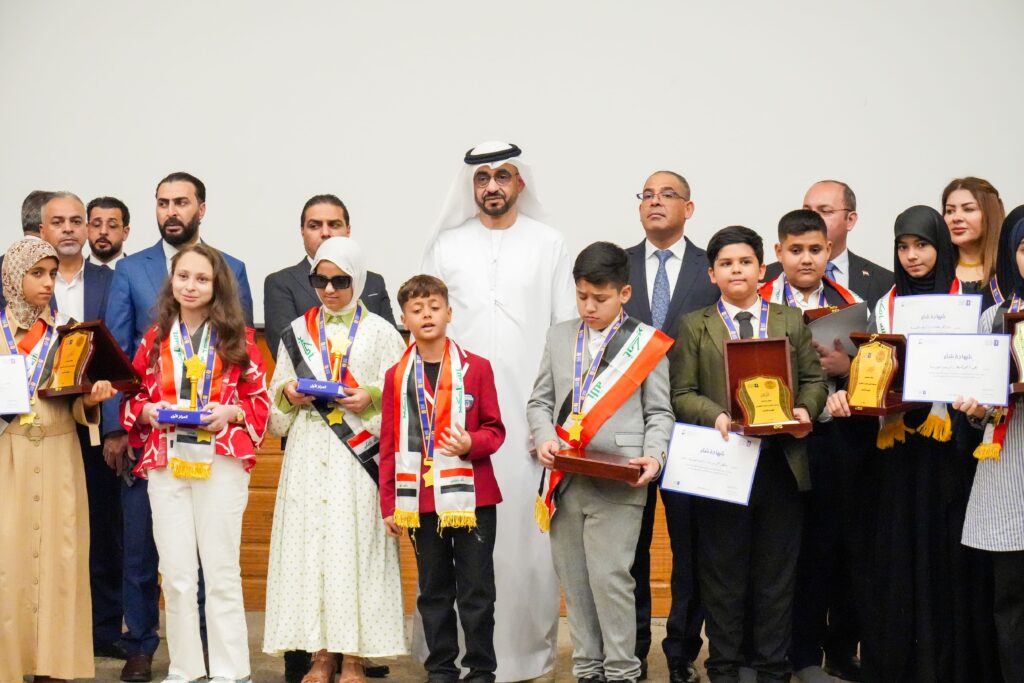
Student Aisha Nizar Nazim won the title of champion of the ninth edition of the Arab Reading Challenge in Iraq, after qualifiers in which 1,339,270 students from 38,100 schools participated, under the supervision of 16,310 supervisors, who contributed to the success of the ninth edition of the largest reading event of its kind in the Arabic language in the world, organized by the Mohammed bin Rashid Al Maktoum Global Initiatives Foundation since its launch in 2015.
Student Aisha Nizar Nazim, a seventh-grade student at Zaha Hadid School for Excellence in Nineveh, was announced as the winner during the closing ceremony of the ninth edition of the Arab Reading Challenge, which was held in the Iraqi capital, Baghdad, in the presence of His Excellency Dr. Ibrahim Namis Al-Jabouri, Minister of Education; Dr. Adnan Al-Sarraj, Advisor to the Prime Minister for Education Affairs; Mohammed Dayea Al-Azzawi, Undersecretary of the Ministry of Education for Administrative Affairs and Chairman of the Higher Committee; and Mr. Mohammed Saleh Al-Taniji, Acting Charge d’Affaires.
At the UAE Embassy in Baghdad, Dr. Fawzan Al Khalidi, Director of Programs and Initiatives at the Mohammed bin Rashid Al Maktoum Global Initiatives Foundation, participated, along with a number of officials and educators in charge of the Arab Reading Challenge initiative, and a large crowd of parents of the participating students.
The closing ceremony also witnessed the announcement of Maria Hassan Ajeel, a fifth-grade student at Al Fara’a Girls School in the Salah al-Din district, as the winner of first place in the People of Determination category, out of 450 students who participated in the qualifiers
The list of the top ten finalists from which the judging committees selected student Aisha Nizar Nazim as the champion of the ninth Arab Reading Challenge at the level of the Republic of Iraq, included: Muntadhar Ahmed Mardan from the fifth grade at Al-Insaf School in the Karbala region, Akram Khalil Abdullah from the tenth grade at Al-Dhakirin Intermediate School (Kirkuk), Fatima Muhammad Abdul-Amir from the eleventh grade at Shams Al-Hurriyah Preparatory School (Najaf), Yusr Hamza Farhan from the eleventh grade at Al-Nabaa Al-Azim Secondary School (Qadisiyah), Rawan Muntadhar Mansour from the tenth grade at Haifa Intermediate School for Girls (Babylon), Hadi Hassan Hadi from the eleventh grade at Al-Nahrawan School for Boys (Rusafa 3), Aya Ziad Subhi from the eleventh grade at Al-Rafidain School (Kirkuk), Hussein Ali Ahmed from the tenth grade at Al-Dhakirin School (Kirkuk), and Haider Ali Abdul-Aziz from the seventh grade at Al-Muhwebin School (Najaf).
The ninth edition of the Arab Reading Challenge initiative achieved a record participation of 32 million and 231 thousand students from 50 countries representing 132,112 schools, under the supervision of 161,004 supervisors. His Excellency Professor Ibrahim Namis Al-Jabouri, Minister of Education of the Republic of Iraq, praised the vital role played by the Mohammed bin Rashid Al Maktoum Global Initiatives Foundation in empowering new Arab generations to acquire the knowledge, sciences, and skills necessary to build the future. He pointed to the successive successes achieved by the Arab Reading Challenge initiative in this context, and its tangible impact in spreading the culture of reading and developing the potential of Arab students.
He said: “We are proud of this new participation in the Arab Reading Challenge initiative. 133,920 students, through their interaction with this knowledge competition and their outstanding performance, have proven the development of the educational and cultural landscape in Iraq and the effectiveness of the plans put in place by the Ministry of Education to advance students’ levels and enhance the status of the Arabic language, in line with our rich cultural heritage and the creativity of the people of Iraq in various fields, thus strengthening our confidence in a brighter tomorrow for our country and the Arab nation.
Dr. Ibrahim Al-Jubouri extended his congratulations to student Aisha Nizar Nazim, all the winners, participating students and their families, as well as to the schools and educational staff across Iraq. He extended his thanks to the Mohammed bin Rashid Al Maktoum Global Initiatives Foundation and everyone who contributed to the success of the ninth round’s qualifiers.
Dr. Fawzan Al Khalidi affirmed that the Arab Reading Challenge initiative continues to fulfill its mission of spreading the culture of knowledge, providing the means for rising Arab generations to enhance their capabilities, hone their talents, and strengthen their connection to the Arabic language, thus providing them with the visions and tools necessary to revive Arab civilization and contribute effectively to the development of Arab societies.
The Director of Programs and Initiatives at the Mohammed bin Rashid Al Maktoum Global Initiatives Foundation praised the wide Iraqi participation in the qualifying rounds of the ninth edition of the Arab Reading Challenge, saying: “We greatly appreciate the participation of more than 1.3 million students in the ninth edition, which reflects the great efforts made by the Ministry of Education in the sisterly Republic of Iraq, and those concerned with cultural affairs and Iraqi society to motivate students to read. These efforts represented a significant contribution to the achievement of the ninth edition, in which more than 32.2 million students from 50 countries around the world participated.”
On behalf of the Mohammed bin Rashid Al Maktoum Global Initiatives Foundation and the Arab Reading Challenge, Dr. Fawzan Al Khalidi congratulated the ninth edition’s champions in Iraq and all the participants. He also thanked the Iraqi Ministry of Education and everyone who helped the students advance to the ninth edition’s qualifying rounds.
The Arab Reading Challenge, launched in the 2015-2016 academic year under the directives of His Highness Sheikh Mohammed bin Rashid Al Maktoum, Vice President and Prime Minister of the UAE and Ruler of Dubai, aims to foster a comprehensive reading and knowledge movement, instill a culture of reading in Arabic as a language capable of keeping pace with all forms of literature, science, and knowledge, and encourage young generations to use Arabic in their daily interactions. It also aims to develop mechanisms for understanding and self-expression in fluent Arabic, and foster creative thinking skills.
The challenge seeks to enhance the importance of cognitive reading in building self-learning skills and fostering a value system for young people by exposing them to the values, customs, and beliefs of other cultures. This instills the principles of tolerance, coexistence, and acceptance of others, and encourages dialogue and cultural and human openness.
Elevated above ground and connected to Riyadh’s metro, the skywalks help workers, visitors, and residents move easily.
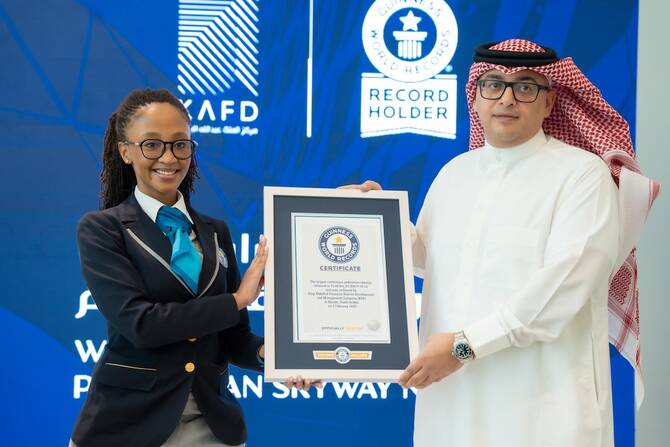
The King Abdullah Financial District in Riyadh was awarded a Guinness World Record on Sunday for the world’s largest continuous pedestrian skyway network.
The network spans 15.46 km, linking 95 buildings through 42 climate-controlled skywalks, allowing year-round pedestrian access.
Elevated above ground and connected to Riyadh’s metro, the skywalks help workers, visitors, and residents move easily through the district while avoiding traffic and weather.
Built with 30,000 sq. meters of glass and more than 3,000 tonnes of steel, the project required more than 5 million safe work hours from 1,200 personnel.
The skywalks connect offices, homes, shops, restaurants, and entertainment venues, making it easier to walk between work, home, and leisure.
“This recognition by Guinness World Records affirms KAFD as a platform for urban development,” said Faddy AlAql, chief asset delivery officer at KAFD Development and Management Co.
“The skywalk network reflects a mobility strategy that connects assets, enhances walkability, and supports our goal of delivering a smart city experience.”
Mbali Nkosi, official adjudicator for Guinness World Records, said: “First set in Minneapolis in 2016, this record has now been redefined by KAFD. In an era where sustainability drives innovation, KAFD’s skyway network sets a new benchmark for walkable urban design.”
The district hosts more than 90 international and local companies and 19 regional headquarters, including Goldman Sachs, Bain & Company, and PepsiCo.
source/content: arabnews.com (headline edited)
__________
Mbali Nkosi, official adjudicator for Guinness World Records, presents the award to Faddy AlAql, chief asset delivery officer at KAFD Development and Management Co. (SPA)
Unveiled during a ceremony in Damascus on Thursday
New emblem reimagines iconic Syrian golden eagle with symbolic elements representing country’s history, geography and post-conflict aspirations
The Syrian Arab Republic has launched a new national visual identity featuring a redesigned golden eagle emblem, in what officials described as a break from the legacy of authoritarianism and a step toward a state defined by service, unity and popular legitimacy.
Unveiled during a ceremony in Damascus on Thursday, the new emblem reimagines the iconic Syrian golden eagle with symbolic elements representing the country’s history, geography and post-conflict aspirations, the Syrian Arab News Agency reported.
The redesign forms the centerpiece of a wider national branding effort aimed at redefining Syria’s image at home and abroad.
The eagle has long held significance in Syrian history, appearing in early Islamic military symbolism, notably in the 7th-century Battle of Thaniyat Al-Uqab, and later as part of the 1945 emblem of Syria.
The new design retains this historic continuity but shifts its meaning, and the combative shield clutched by previous iterations of the eagle has been removed.
Instead, the emblem now features the eagle topped by three stars representing the people symbolically placed above the state.
The redesigned wings are outstretched, balanced rather than aggressive, with seven feathers each to represent Syria’s 14 governorates.
The tail carries five feathers symbolizing the country’s major geographical regions: north, south, east, west, and central Syria — a nod to national unity and inclusivity, SANA reported.
Officials described the design as a “visual political covenant,” aimed at linking the unity of land with the unity of national decision-making.
“The people, whose ambitions embrace the stars of the sky, are now guarded by a state that protects and enables them,” said a statement accompanying the launch. “In return, their survival and participation ensure the renaissance of the state.”
The emblem is designed to signal historical continuity with the original post-independence design of 1945, while also representing the vision of a modern Syrian state born from the will of its people, SANA said.
Officials said the elevation of the stars above the eagle was intended to reflect the empowerment and liberation of the people, and the transition from a combative state to a more civic-minded one.
The symbolism also reinforces Syria’s territorial integrity, with all regions and governorates represented equally. The design, they said, reflects a new national pact, one that defines the relationship between the state and its citizens based on mutual responsibility and shared aspirations.
The new emblem is also intended as a symbolic end to Syria’s past as a security-driven state, replacing a legacy of repression with one of reconstruction and citizen empowerment.
President Ahmad Al-Sharaa, who has positioned his administration as one of reform and renewal, described the change as emblematic of “a government emanating from the people and serving them.”
The visual identity was developed entirely by Syrian artists and designers, including visual artist Khaled Al-Asali, in a deliberate effort to ground the new identity in local heritage and creativity.
Officials said that the process was intended not only as a rebranding exercise but as a reflection of Syria’s cultural and civilizational legacy — and its future potential.
Foreign Minister Asaad Al-Shaibani, speaking at the event, framed the launch as part of a broader transformation in Syrian governance and diplomacy.
“In every encounter, we carried a new face of Syria,” he said. “Our efforts brought Syria back to the international stage — not as a delayed hope, but as a present reality.”
He said the country was now rejecting the “deteriorated reality” inherited from decades of authoritarian rule, and described the new emblem as a symbol of Syria’s emergence as a state that “guards” and empowers its people, rather than controlling them.
Al-Shaibani concluded his remarks by calling the moment “a cultural death” for the former regime’s narrative.
“What we need today is a national spirit that reclaims the scattered pieces of our Syrian identity, that is the starting point for building the future.”
source/content: arabnews.com (headline edited)
____________
The Syrian Arab Republic has launched a new national visual identity featuring a redesigned golden eagle emblem, in what officials described as a break from the legacy of authoritarianism and a step toward a state defined by service, unity and popular legitimacy. (SANA)
The UAE leads the global market in mobile shopping, according to the results of the Global Digital Shopping Index 2025, a joint study by PYMNTS Intelligence and commissioned by Visa Acceptance Solutions.
The study, which surveyed 1,679 consumers and 329 merchants in the country, showed that 67% of UAE consumers used their smartphones for their most recent purchase, a 23% increase compared to 2022.
The UAE also recorded the highest rate of mobile shopping at 37%, ahead of Singapore, the UK, and Brazil.
The country also recorded an advanced global rate of biometric authentication use (32%) when making online purchases, surpassing the global average of 17%. Fifty-three percent of consumers expressed a desire to shop across multiple channels, while 75% preferred rewards programs, 73% preferred free shipping, and 70% preferred price matching.
The report also indicated that 38% of shoppers in the UAE made their recent purchases using a mobile phone or computer, with the option of home delivery.
The results confirmed that consumers in the UAE are increasingly adopting a “mobile first” lifestyle, particularly among millennials, with a usage rate of 73%.
Commenting on the study results, Salima Joteva, Vice President and General Manager, Visa UAE, said, “The UAE’s approach reflects the great potential that can be achieved by uniting efforts to build the future of commerce. At Visa, we are working in partnership with the government and private sectors to offer innovative solutions such as Click to Pay to provide secure and seamless digital payment experiences.
These indicators reflect the country’s advanced regulatory environment and its continued support for the digital business ecosystem, enabling retailers to enhance customer experiences and achieve sales growth by offering flexible and secure payment options.
The Global Digital Shopping Index is based on a survey of 18,468 consumers and 3,464 merchants across eight countries, including the UAE, Saudi Arabia, the United States, the United Kingdom, Singapore, Australia, Mexico, and Brazil, during the period from October to December 2024.
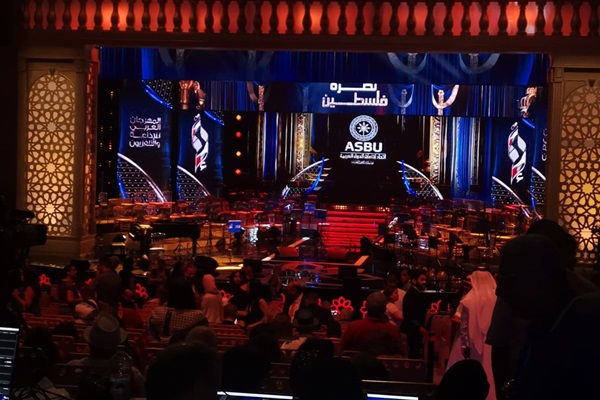
The opening ceremony concluded with a musical performance by Lebanese artist Ragheb Alama, with proceeds dedicated to supporting the people of Palestine.
Abdelrahim Suleiman, Director General of the Arab States Broadcasting Union (ASBU) and Mohammed bin Fahd Al-Harthi, President of ASBU and CEO of Saudi Broadcasting Authority (SBA), presented the awards to the winners of the 24th Arab Radio and Television Festival that was held in Tunis from June 26 to 29.
Part of the Text is Missing, a Kuwaiti TV show won the award for Best Arab TV Programme at the festival.
Saudi Broadcasting Authority (SBA) secured four radio and TV awards, including the second prize in the health programmes category for “Mental Health: Violence in Schools.” In the TV category, Saudi Arabia won three awards, including the second prize in the news category for talk shows, honouring the Saudi street programme on its episode about Vision 2030. Heritage in the Maqam of Hijaz took first prize in the general documentary films and programmes category, while the Saudi social drama series Al-Arbaji 2 secured second place in the social series category.
Additionally, the SBA received the second prize in the 2024 news exchange competition and also, the second prize in the 2024 programme exchange competition. The festival also honoured the judging panels for its radio and television competitions and distributed the exchange awards.
Qatar Media Corporation won three awards. Qatar TV took first prize for the documentary film Museums in Qatar, showcasing the distinctive museums of the country, and secured the second prize for Programme Exchanges of 2023 within the festival’s Arab Radio and Television competition in Tunisia. Qatar Radio won second prize in the “Notable Arab Figures” category.
The Ministry of Information, represented by the Sultanate of Oman Radio and the Sultanate of Oman Television, along with the private media institution Al Wisal, bagged 10 awards. Sultanate of Oman TV won four awards, including the Arab Joint Television Production Award for the documentary Holding Breaths, produced by the Ministry of Information and directed by Issa al Subhi.
Meanwhile, the Palestine Public Broadcasting Corporation (PBC) secured six awards. The radio programme Psychological Counseling in Times of War claimed first prize, while Radio Flash on school violence also earned top honours. Additionally, PBC received first prizes for radio news exchanges and a television report dedicated to the late journalist Mohammad Abu Hattab, a correspondent for Palestine TV killed by Israeli troops in Gaza. Furthermore, PBC was awarded second prize for the cultural programme Sadanat al-Riwaya and another award for the film Noura, produced by Palestine TV.