Arabs & Arabian Records Aggregator. Chronicler. Milestones of the 25 Countries of the Arabic Speaking World (official / co-official). AGCC. MENA. Global. Ist's to Top 10's. Records. Read & Enjoy./ www.arabianrecords.org
The World Bank has opened a new regional hub in Riyadh to serve the Middle East, North Africa, Afghanistan, and Pakistan, as the Washington-based lender continues to boost its presence in the region.
According to a press statement, the new Riyadh hub will be co-located with the World Bank Group’s Gulf Cooperation Council regional office, bringing its leadership closer to country teams, clients, and regional partners.
The opening of the new regional hub signals the deepening ties between the World Bank and Saudi Arabia, as in December, the lender signed a strategic agreement to launch a new global knowledge hub in Riyadh to facilitate regional and global knowledge exchange, joint research, and capacity-building initiatives aimed at advancing global development impact.
Commenting on the opening of the new regional hub, Ousmane Dione, vice president of the World Bank for the MENAAP region, said: “Riyadh is not only a gateway to the region’s transformation, but also a powerful platform for global knowledge exchange and policy innovation.”
He added: “It is especially meaningful to mark this relocation on Saudi National Day, a moment that celebrates the Kingdom’s transformation and its growing role as a global convener of development knowledge.”
In the press statement, the lender added that the opening of the new regional hub aligns with the 50th anniversary of technical cooperation between the World Bank and Saudi Arabia.
In recent months, the institution has awarded a $650 million disaster management loan for Turkiye, a $146 million grant to Syria to help restore reliable, affordable electricity, and $930 million in financing to help improve Iraq’s railway performance, boost domestic trade, and diversify the country’s economy away from oil.
The regional hub development aligns with Saudi Arabia’s government-backed regional headquarters program, launched in 2021, which offers incentives such as a 30-year corporate income tax exemption and withholding tax relief, alongside regulatory support for multinationals operating in the Kingdom.
A Saudi Press Agency report in March said that over 600 international companies, including Northern Trust, IHG Hotels & Resorts, and Deloitte, have already established their regional bases in Saudi Arabia.
source/content: arabnews.com (headline edited)
_____________
The new Riyadh hub will be co-located with the World Bank Group’s Gulf Cooperation Council regional office, bringing its leadership closer to country teams, clients, and regional partners. Shutterstock
Dubai has reinforced its status as a leading global maritime hub, earning the title of “the crown jewel of the Middle East’s maritime sector,” according to the 2025 International Shipping Centre Development Index report, issued by Xinhua News Agency in collaboration with the Baltic Exchange. The report ranks Dubai among the top five global shipping centres and first in the Arab region.
Sheikh Dr. Saeed bin Ahmed bin Khalifa Al Maktoum, CEO of the Dubai Maritime Authority, part of the Ports, Customs, and Free Zone Corporation, hailed the achievement stating: “Dubai’s ranking as fifth globally and first in the Arab world in the 2025 International Shipping Centre Development Index reflects the vision of our leadership, as well as the effective coordination between strategic partners and maritime sector companies in the emirate.
We remain committed to continuous development, delivering world-class services, adopting global maritime best practices, implementing innovative solutions, updating regulations, and fostering a thriving maritime business environment to position Dubai as an innovative and sustainable global centre for shipping and logistics.”
The report highlights Dubai’s comprehensive maritime ecosystem, offering navigation services, shipbuilding and repair, and capacity to handle the increasing number of vessels. It also emphasised the Dubai Maritime Transport Plan 2030, aligned with the Dubai Economic Agenda D33, which aims to expand maritime transport usage, enhance the network of marine transportation, and develop Dubai Maritime City.
The report specifically praised Jebel Ali Port for its strategic role as a regional shipping hub, underpinned by continuous investment in infrastructure and services. In 2024, the port handled 15.5 million twenty-foot equivalent units (TEUs), the highest since 2015, accounting for 18% of the total 88.3 million TEUs managed by DP World, the port operator.
On sustainability, the report highlighted Jebel Ali Port’s initiatives to reduce emissions, including the provision of biofuel for ships, installation of 50,000 m² of solar panels for renewable energy, and the use of electric vehicles for container handling—contributing to an annual reduction of 2,000 tons of CO₂ emissions.
Captain Ibrahim Al Blooshi, Executive Director of Dubai Ports Authority, commented: “We take pride in this achievement, which underscores Dubai’s strong position as a global maritime hub. Jebel Ali Port, operated by DP World under the Ports, Customs, and Free Zone Corporation, continues to excel at both regional and international levels.
Dubai Ports Authority is committed to proactive measures to enhance the maritime sector’s contribution to the strategic objectives of the Dubai Economic Agenda D33, through its three ports—Jebel Ali, Port Rashid, and Hamriyah—despite global economic challenges and market fluctuations. We are dedicated to preserving the emirate’s marine environment and ensuring the highest operational safety standards in the maritime sector.”
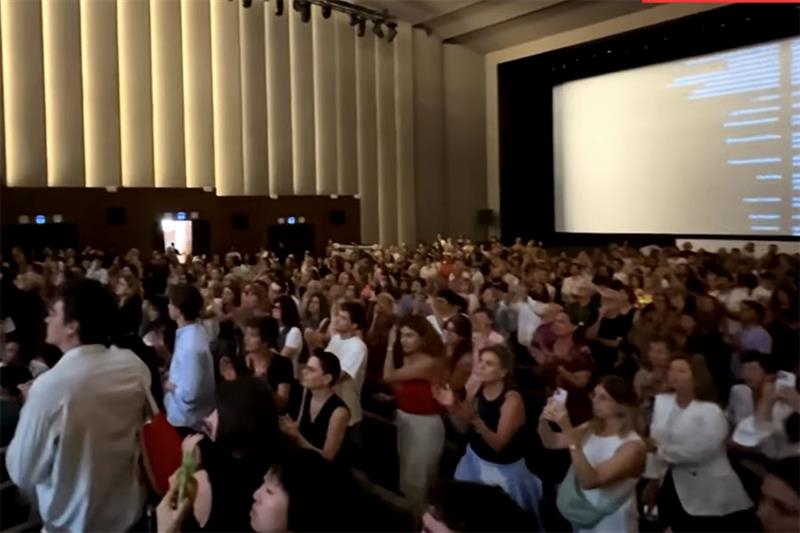
Following its screening, Kaouther Ben Hania’s film The Voice of Hind Rajab (2025) received a 22-minute-long standing ovation — the longest in the Venice Film Festival’s history – culminating in theatre-wide chants to “Free Palestine.”
The film had its world premiere at the 82nd edition of the renowned Venice Film Festival, which runs until 6 September.
The film is also Tunisia’s official submission to the 98th Academy Awards.
The first screening of the film was completely sold out hours before its showing.
Several artists from the film’s cast and crew attended the screening, including lead actor Motaz Malhees, who held a photo of Hind Rajab on the red carpet and raised the Palestinian flag on the stage of the theatre after the film’s conclusion.
The film’s unprecedented success was reflected in the longest standing ovation in the festival’s history, with chants of “Free Palestine” resonating across the hall.
The Tunisian-French co-production also stars Amer Hlehel, Clara Khoury, and Saja Kilani.
“Film anchored in truth”
In a post-screening press conference, Kilani declared that “the Voice of Hind Rajab does not need our defence. This film is not an opinion or a fantasy; it is anchored in truth. Hind’s story carries the weight of an entire people.”
Film director Ben Hania also commented on Trump’s plans to turn Gaza’s coastline into a “Riviera,” saying, “When I think about Hind playing on the beach, and I think about this project, [I find myself asking] in what world do we live in?”
Hind Rajab
The film recounts the events of 29 January 2024, when Red Crescent volunteers received an emergency call. A six-year-old girl named Hind Rajab was trapped in a car under fire in Gaza, pleading for rescue.
While trying to keep her on the line, they do everything they can to get an ambulance to her.
The film uses real-life voice recordings between Hind and the Red Crescent correspondents, who attempted to rescue her from the unrelenting Israeli attack.
Explaining her vision for the film, Ben Hania said, “What I wanted was to focus on the invisible: The waiting, the fear, the unbearable sound of silence when help doesn’t come. Sometimes, what you don’t see is more devastating than what you do. At the heart of it is something very simple, and very hard to live with. I cannot accept a world where a child calls for help and no one comes. That pain, that failure, belongs to all of us.”
Kaouther Ben Hania
Kaouther Ben Hania is one of the most acclaimed filmmakers of the Arab World, known for her bold storytelling and cinematic innovation.
Her 2023 film, Four Daughters, won the L’Oeil d’Or at Cannes and was nominated for Best Documentary at the 2024 Academy Awards.
Her 2020 feature, The Man Who Sold His Skin, was nominated for Best International Feature and won Best Actor at Venice’s Horizons Section.
Earlier works like Beauty and the Dogs (2017), Zaineb Hates the Snow (2026), and Le Challat de Tunis (2012) also earned international acclaim.
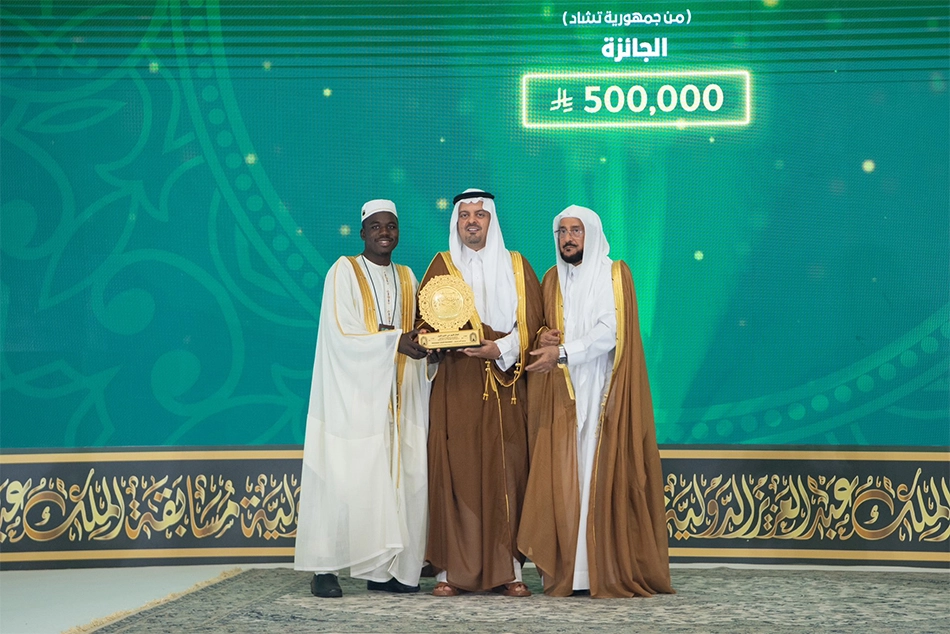
Chaad National, Mohammad Adam Mohamed has won the top prize at the 45th Edition of the King Abdulaziz International Holy Quran Competition or 2025 Makkah Quran Contest for Memorization, Recital and Explanation held at the Grand Mosque.
Makkah Quran Contest 2025: Chaad National, Mohammad Adam Mohamed has won the top prize at the 45th Edition of the King Abdulaziz International Holy Quran Competition or 2025 Makkah Quran Contest for Memorization, Recital and Explanation held at the Grand Mosque.
At a glittering ceremony held at Makkah Grand Mosque after Isha prayers Wednesday August 20, 2025, the Chaad national was awarded a cash prize of 500,000 Saudi Riyals or SAR 0.5 million prize.
The prize distribution ceremony was attended by all Imams of Masjid al Haram Makkah along with Deputy Governor of the Makkah Region Prince Saud bin Mishal bin Abdulaziz.
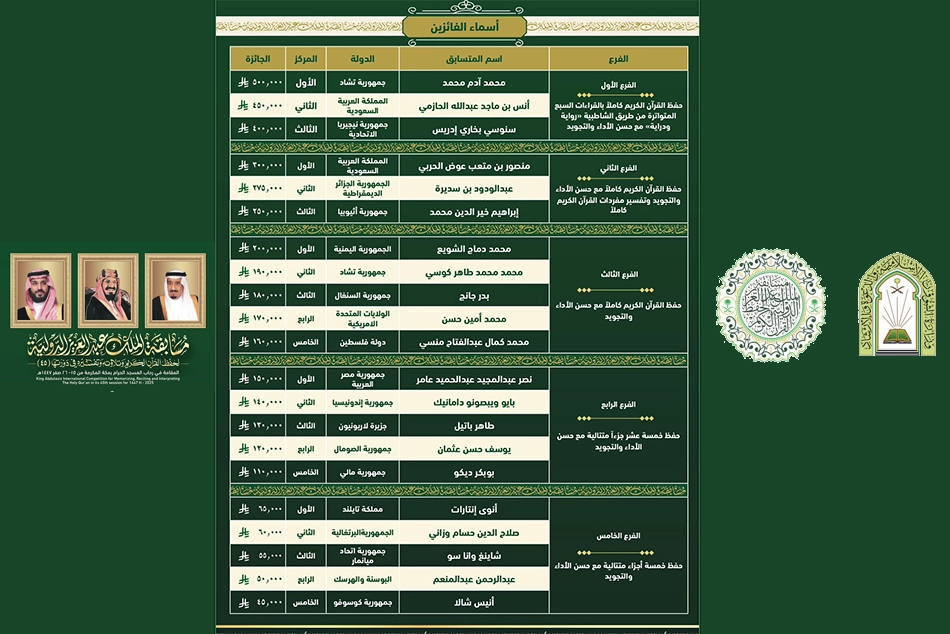
45th King Abdulaziz International Holy Quran Competition – List of Winners
The Makkah Quran contest 2025 was held in five categories. The winners of the first and most coveted category are as follows,
Mohammed Adam Muhamed (Chaad): Prize Money SAR 500,000
Anas bin Majid Abdulla Al Hazmi (Saudi Arabia): Prize Money SAR 450,000
Sanusi Bukhari Idrees (Nigeria): Prize Money SAR 400,000
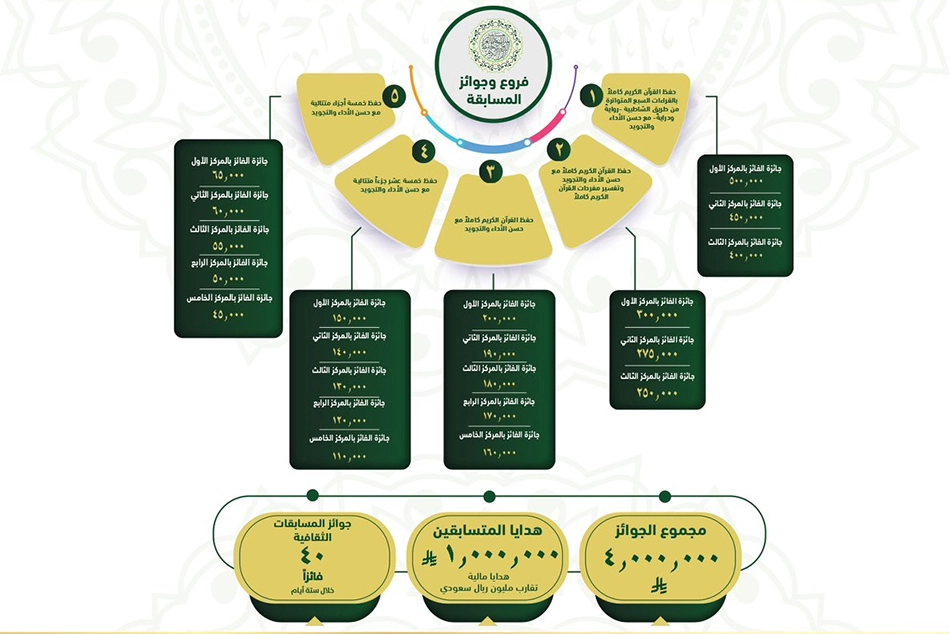
5 categories
The competition was divided into five categories:
Memorization of the entire Holy Qur’an, with accurate recitation and intonation following the seven rules of recitation
Memorization of the Qur’an along with interpretation of its terms
Memorization of 15 juz (parts) of the Qur’an with proper recitation and intonation
Memorization of five juz with correct recitation and intonation
A category for shorter lengths of memorization with corresponding recitation and intonation requirements.
Other winners
The total value of the competition’s prizes is around SR4 million ($1.07 million), in addition to SR1 million that will be apportioned out to all participants.
Mansoor bin Mutab Awad Al Harbi of Saudi Arabia won the top prize of SAR 300,000 in the second category. Mohamed Damaj Al Shuway’i of Yemen won the top prize of SAR 200,000 in the 3rd category.
Eyptian Nasr Abdel Majeed Abdul Hameed Amir won the top prize of SAR 150,000 in the 4th category. The top prize money SAR65,000 for the 5th category was conferred on Anwa Intarat of Thailand.
The 2025 Quran Competition brought together 179 contestants from 128 countries, the largest number since its inception. In 2024, a total of 174 contenders representing 123 countries participated in the 44th edition of the contest held in 5 categories.
Makkah Qurant Contest 2025 Final Round
The final rounds of the 2025 King Abdulaziz International Competition for Memorizing, Reciting, and Interpreting Holy Quran began last Saturday August 09th, 2025
The final round of the Quran contest continued till Thursday August 14, 2025 when a total of 27 contestants recited Quran as per the contest competition guidelines.
The 27 contestants were from Mauritania, the Philippines, Japan, Guinea-Bissau, France, the United States of America, New Zealand, South Africa, Barbados, Ivory Coast, Cameroon, Guinea, Germany, Zambia, Guyana, Comoros, Uzbekistan, Kyrgyzstan, Finland, Rwanda, Bangladesh, and Myanmar.
As part of the competition package, the participants visited different historical places of religeous and architectural importance. The participants on Saturday August 16 left for visit to The Prophet (PBUH) Mosque in Madinah.
Electronic Judging System
The highlight of the 2025 Quran Contest which ran through six days was electronic judging system. Since its introduction in 2019, the electronic platform has replaced traditional paper-based methods, increasing accuracy and transparency.
The Ministry of Islamic Affairs, Dawah and Guidance said it enhanced and upgraded the electronic judging system for the 45th King Abdulaziz International Competition for Memorizing, Reciting, and Interpreting the Holy Quran held this year.
The enhanced system is designed to improve the efficiency and fairness of the final rounds, bolster transparency, and support the ministry’s digital transformation efforts in line with Saudi Vision 2030.
Watch: Winners Reaction
source: youtube.com
The latest improvements to the system include faster and more accurate scoring, with results calculated more precisely and linked to a real-time electronic control panel for instant monitoring by the judging committee.
An electronic question bank is now used to draw questions from a comprehensive digital repository covering all five branches of the competition, ensuring diversity and fairness. The system also features automated processes that track verse sequences, sort and rank contestants, and issue results instantly, while documenting and analyzing competition data in real time.
The 44th edition of the King Abdulaziz International Competition for Memorization, Recitation, and Interpretation of Holy Quran was also held with the same schedule. Saudi National, Saad bin Ibrahim bin Hamd had won the top prize of the 2024 Makkah Quran Contest.
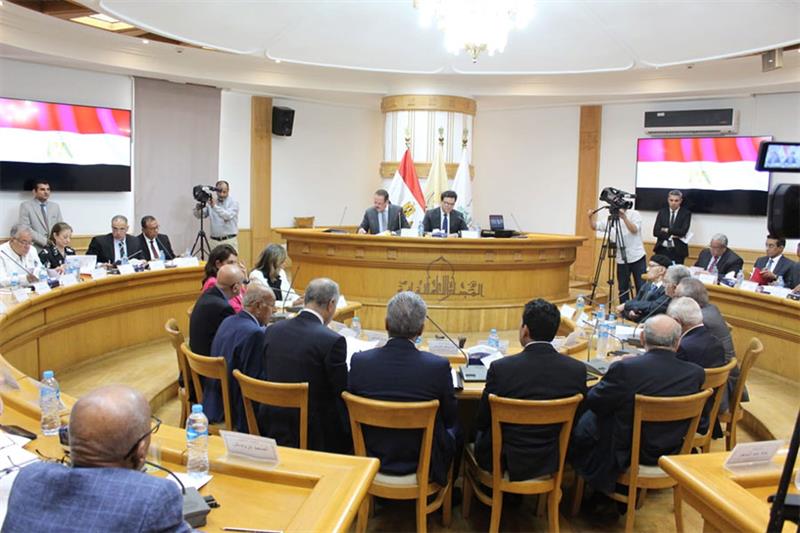
The Supreme Council of Culture (SCC), headed by Minister of Culture Ahmed Fouad Hano, has officially revealed the recipients of the 2025 State Awards.
The announcement, made via an official statement on the Ministry of Culture’s Facebook page on Tuesday, follows a comprehensive voting process that recognised individuals for their profound impact on Egypt’s cultural and intellectual spheres.
The distinguished awards include the Nile Award, the State Appreciation Award, the Excellence Award, and the Encouragement Award.
The selection process involved a meeting attended by leading intellectuals, academics, heads of cultural institutions, and representatives from professional unions.
Nile Award
The prestigious Nile Awards were granted to:
Arts category: Architect Dr. Saleh Lamai
Literature category: Dr. Ahmed Darwish
Social Sciences category: Dr. Ahmed Zayed
Nile Award for Arab Creators: Palestinian artist Suleiman Anis Mansour
Appreciation Award
The State Appreciation Awards were granted to:
Arts category: Theatre director Shaker Abdel Latif, visual artist Abdel Wahab Abdel Mohsen, and cinematographer Samir Farag.
Literature category: Poet Ahmed El-Shahawi, critic and writer Dr. Khayri Douma, and writer Fatma El-Maadoul.
Social Sciences category: University professors Dr. Anas Gaafar, Dr. Mohamed Sameh Amr, Dr. Mona Haggag, and Dr. Nevine Massad.
Literature category: Poet Masoud Shoman and Dr. Khaled Abou El-Leil.
Social Sciences category: Dr. Samah Fawzy, Dr. Atiya El-Tantawy, and Dr. Nahla Imam.
Encouragement Award
When it comes to the 2025 Encouragement Awards, 32 creatives were honoured across arts, literature, social sciences, and legal/economic studies.
Arts Category (8 prizes; 6 awarded, 2 withheld)
Piano Performance: Naghamaya Safwat for her rendition of Shostakovich’s Piano Concerto No. 2 with the Cairo Symphony Orchestra.
Film Script: Mahmoud Zein for Wala Azaa’ Lil Sayedat.
Children’s Book Illustration: Heidi Fawzy for Ta’aqqal… Ya Marah.
Theatrical Scenography: Nehad El-Sayed for Shatat.
Digital Media & Architecture: Mostafa Salem for an awareness series on heritage preservation.
Painting: Dr. Islam El-Reihany for The Music of the Body.
Withheld: Prizes for “E-marketing for handicrafts” and “Fiber Art”.
Literature (8 prizes)
Historical Novel: Doaa Gamal El-Bady for Crows That Don’t Eat the Dead.
Short Story Collection: Ahmed Yasser Fathy for A Very Lonely City.
Classical Poetry: Mohamed Refai for The Cry of a Coin.
Colloquial Poetry: Ibrahim Abou Samra for Balta Shi’r.
Computational Linguistics: Marwa Mostafa Amin for Functions of the Electronic Dictionary.
Narrative Criticism: Aly Kotb for Singing and Music in the Literature of Naguib Mahfouz.
Translation (Turkish-Arabic): Sousana Sayed Mohamed for A Strange Woman by Leyla Erbil.
Translation (Arabic to Asian/African languages): Shared by Dina Mohamed Bayoumi (Suspense and Horror Between China and Egypt) and Mohamed Abdelrahman Farag (Al-Mukhtasar Al-Shafi fi Al-Iman Al-Kafi).
Social Sciences
History, Archaeology & Heritage (shared):
Dr. Ahmed Ma’arouf for Walls with Gates: Political Borders in Islamic Historical Heritage.
Dr. Sherif Imam for Saad Zaghloul in Gramsci’s Mirror.
Geography & Environment: Dr. Shaimaa Mohamed Wehba for research on water pollution and income inequality in Egypt.
Philosophy & Anthropology: Irene Samir Hakim for The Many Faces of Female Genital Mutilation.
Educational Sciences: Dr. Mohamed Abdel Khaleq for Dimensions of Global Education in Stoic Philosophy.
Media: Student team (Ramaj Osman, Gharib Reda, Farah Abdelkarim, etc.) for the film Hayy Falasteen, directed by Martina Wagdy.
Administrative Sciences: Dr. Islam Abdel Bari for Decoding Buy Now, Pay Later in Egypt.
Documentation & Publishing: Dr. Alaa Jaafar Al-Sadiq for research on local journal indexing.
Digital Culture: Dr. Ahmed Magdy for How AI Has Changed the Film Industry.
Legal and Economic Sciences (6 prizes awarded, 2 withheld)
Inflation in the Egyptian Economy: Dr. Gehan Abdel Salam Mahmoud for Tackling Inflation amid Global Crises.
Climate Change: Dr. Ahmed Mohamed Okasha for Climate Change and Economic Sustainability.
Russian–Ukrainian War & International Relations: Shared by Dr. Raghda El-Beheiry, Dr. Adnan Moussa, and Mr. Mahmoud Kassem.
Geopolitical Shifts: Ahmed Abdel Fattah Askar for Strategic Transformations in the Horn of Africa (2020–2024).
Right to Privacy: Dr. Mohamed Mesbah El-Naghy for Constitutional Guarantees for Genetic Privacy.
Cultural Diversity Management: Dr. Mahmoud Hussein Abou Seif for The Principle of Non-Refoulement in European Human Rights Law.
Withheld: Prizes for “Personal Data Protection under Cyber Law” and “Citizenship Through Investment”.
Minister Hano emphasised that these awards represent one of the highest forms of recognition granted by the Egyptian state, describing them as the culmination of long and distinguished careers marked by creativity and dedication.
Hano reaffirmed the state’s continued commitment to supporting intellectuals and creators who contribute to strengthening Egypt’s cultural identity and promoting values of diversity, openness, and awareness, the statement pointed out.
He played the Devil, challenged shame, and made Arab cinema speak. On his birthday, we revisit Youssef Wahbi – the man who dared to redefine the rules of the screen and stage.
Youssef Wahbi broke every mould – actor, director, and pioneer of Arabic cinema. On his birthday, we honour a legend who shaped generations of stage and screen.
Wahbi’s love for acting started when he first watched the Lebanese artist Salim Al-Qardahi’s troupe in Sohag. Since then, he started delivering monologues and performing theatrical acts at Al Ahly Club and at school. But at the time, acting was seen as shameful, and his father disapproved. Refusing to bend, Wahby fled to Italy and studied acting under the Italian actor Cantoni. He didn’t come back until after his father’s death in 1921 and used all his inheritance to establish a theatrical troupe named Ramses, which was also the name given to him during his stay in Europe.
In 1923, the troupe premiered with a successful play called ‘Al Magnoun’. But Wahby wasn’t done breaking ground. Later, in 1930, he established his film production company, Ramses Film, which produced the very first speaking film in the history of Arabic cinema, ‘Awlad El Zawat’. The movie was adapted from one of his successful plays, as he wrote the script and starred in the film.
Throughout his prolific career, Youssef Wahbi wrote, directed, or starred in over 300 theatrical plays and contributed to more than 60 films. Among this vast body of work, a few standout titles have become milestones in the history of Arabic drama and cinema…
Awlad El Zawat (1932)
‘Awlad El Zawat’ tells the story of Hamdi, who marries a French woman only to discover she’s cheating on him. In a powerful scene, he confronts her with the line: “You woman of all men… you garbage of history.” In a rare interview, Youssef Wahbi revealed that he insisted on making ‘Awlad El Zawat’ as the first Arabic-speaking film to defend the image of the East, after Western narratives described the region as barbaric and trivial, particularly during the trial of a woman who had murdered an Egyptian young man.
Safir Gohannam (1945)
‘Safir Gohannam’ follows Abd Elkhallak, a humble professor worn down by life’s hardships and became a bitter and resentful man. His shaky faith opens the door for the Devil (played by Youssef Wahbi) to lead him astray, tempting him with a false paradise to ruin his life, destroy his children, and tear his family apart. The film marks the first-ever portrayal of the Devil in Egyptian cinema.
Bayoumi Effendi (1949)
‘Bayoumi Effendi’ is considered one of Wahbi’s most powerful socially driven films, tackling the issue of children born out of wedlock. The film calls for compassion toward these individuals, emphasising that they should not be treated as criminals for a sin they did not commit.
Hayah Aw Mout (1954)
‘Hayah Aw Mout’ – one of the most famous films in Egyptian cinema – follows the story of a man who suffers a heart attack and sends his daughter to fetch his medicine, only for the pharmacist to realise he accidentally gave her poison. As the police, led by Wahbi’s character, race to save him, a dramatic city-wide radio broadcast becomes his only hope. This is the film that gave us the famous line: “لا تشرب الدواء الذي أرسلت بنتك لشرائه…الدواء فيه سم قاتل.” (“Do not drink the medicine your daughter was sent to fetch; the medicine contains deadly poison.”)
Esha’et Hob (1960)
‘Esha’et Hob’ is one of the most memorable comedy films in Egyptian cinema. Starring Omar El Sherif, Soad Hossny and Youssef Wahbi, it follows the story of Hussein, a shy young man in love with his cousin Samia, who prefers her charming cousin Lucy ‘Ibn Tante Fakeeha’. To help him win her heart, Hussein’s uncle Abdel Qader comes up with a clever plan: spread a rumour about a love story between Hussein and the famous actress Hind Rostom.
The trailblazing artist, son of legendary Fairuz and composer Assi Rahbani, was also a playwright, pianist and political provocateur.
Lebanese musician and composer Ziad Rahbani, son of the iconic singer Fairuz and a pioneer of fusion jazz, has died at the age of 69 of a heart attack.
“On Saturday at 9:00am, the heart of the great artist and creator Ziad Rahbani stopped beating,” said a statement from the hospital where he was being treated in the capital, Beirut, on Saturday.
Rahbani influenced generations of Lebanese people with his songs and especially his plays, whose lines are known by heart by both young and old.
He was the son of Fairuz, the last living legend of Arabic song – and one of the most famous Arab women worldwide – and composer Assi Rahbani, who, along with his brother Mansour, modernised Arabic song by blending classical Western, Russian, and Latin American pieces with Middle Eastern rhythms.
“I admire the music of composers like Charlie Parker, Stan Getz and Dizzy Gillespie,” Rahbani once said. “But my music is not Western, it’s Lebanese, with a different way of expression.”
Fairouz also became an icon for young people when Rahbani composed songs for her influenced by jazz rhythms – he called it “oriental jazz”.
Lebanon’s leaders paid a heartfelt tribute to the Lebanese composer, who was also a playwright, pianist and political provocateur.
President Joseph Aoun called Rahbani “a living conscience, a voice that rebelled against injustice, and a sincere mirror of the oppressed and marginalised”.
“Lebanon has lost an exceptional and creative artist, a free voice that remained faithful to the values of justice and dignity” and who said “what many did not dare to say”, said Prime Minister Nawaf Salam.
Rahbani’s works reflected the hybrid heritage of Lebanon, which, until the civil war erupted in 1975, was a cultural melting pot. It also reflected the ensuing sectarian strife, which involved bloody street battles between rival militias and three years of violent Israeli occupation after the 1982 invasion.
While Fairuz transcended the powerful sectarian divides in the country, her son chose to be resolutely left-wing and secular, denouncing Lebanon’s longstanding divisions. His breakout play, Nazl el-Sourour (Happiness Hotel), premiered in 1974 when he was only 17, portrayed a society disfigured by class inequality and repression.
The play follows a group of workers who take over a restaurant to demand their rights, only to be dismissed by the political elite.
In another play, Bennesbeh Labokra Chou? (What About Tomorrow?), he plays a jaded bar pianist in post-civil war Beirut. The work features some of Rahbani’s most poignant music and biting commentary, including the famous line, “They say tomorrow will be better, but what about today?”
Rahbani was also a composer of staggering range. He infused traditional Arabic melodies with jazz, funk and classical influences, creating a hybrid sound that became instantly recognisable. His live performances were legendary, when he often played piano in smoky clubs in Hamra, one of Beirut’s major commercial districts.
In recent years, Rahbani appeared less in the public eye, but younger generations rediscovered his plays online and sampled his music in protest movements. He continued to compose and write, speaking often of his frustration with Lebanon’s political stagnation and decaying public life.
“I feel like everything is over, I feel like Lebanon has become empty,” wrote Lebanese actress Carmen Lebbos, his former partner, on X.
Rahbani is survived by his mother, now 90, his sister Reema and brother Hali.
Source: News Agencies
source/content: aljazeera.com (headline edited)
______________
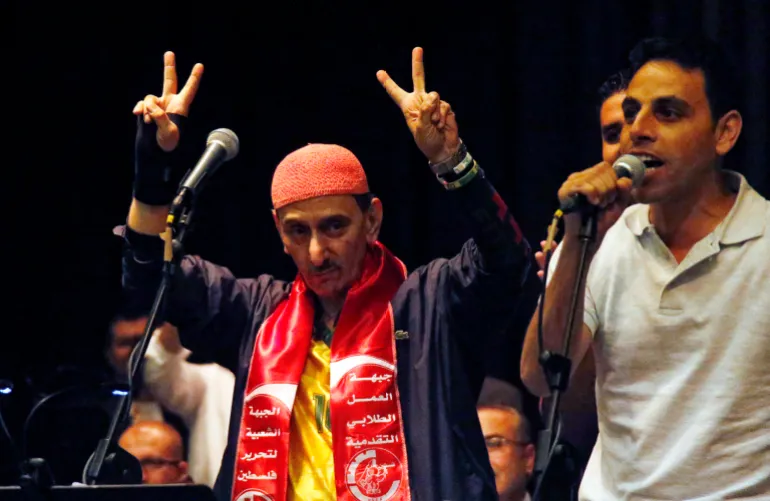
Ziad Rahbani gestures while wearing a scarf of the left-wing Popular Front for the Liberation of Palestine group, during a concert in Sidon, southern Lebanon, October 9, 2014 [File: Ali Hashisho/Reuters]
From Cairo’s backstreets to the Olympics in Athens, Mohamed Reda opens up about discipline, family, and the academy where he now trains a new generation to dream with grit.
Here is a conversation with Olympic boxer Mohamed Reda, written by someone whose dad has been telling this story for years… Growing up, my dad never ran out of stories about school pranks, scraped report cards, and friends who became family. But one story always stood out. He had a friend, a real friend, who went on to become an Olympic silver medallist in boxing. The guy’s name was Mohamed Reda.
For years, I thought the story might be exaggerated, until I looked him up and found out he’s real, he’s famous, and he runs a professional boxing academy in Cairo. And eventually, I got the chance to sit with him for an interview. My dad was probably more excited than Reda himself when I told him.
Reda welcomed me with the same calm energy that has shaped his whole career. “I’m a son of El-Gamaliya, Haret El-Maghrabaleen, to be specific,” he said. “That neighbourhood taught me that being a man doesn’t come from how you look. It’s how you carry yourself. People there helped each other just because it was the right thing to do. That’s what I grew up around. That’s what shaped me.” He grinned. “Also, I still remember that foul cart on the corner. Mornings with foul and chilli oil… nothing like it.”
His entry into boxing wasn’t really planned. “It looked like a coincidence. My coach lived in our neighbourhood and wanted to do my dad a favour. But the moment I put those gloves on, something clicked. I felt like I’d found something I didn’t know I was looking for.” Reda still remembers the first real match. The nerves, the smell of sweat, the shouting coach, the shaky legs. “It was at Darb Al-Ahmar Club, my first championship. Everything about that day stayed with me. That was the first time I felt like I’d started writing my name in the sport.”
He’s worn gloves with the Egyptian flag stitched into them. When I asked what that meant, his answer was simple. “Every time I put them on, I felt the weight of the country. You carry more than your own goals. It’s an honour. A responsibility.”
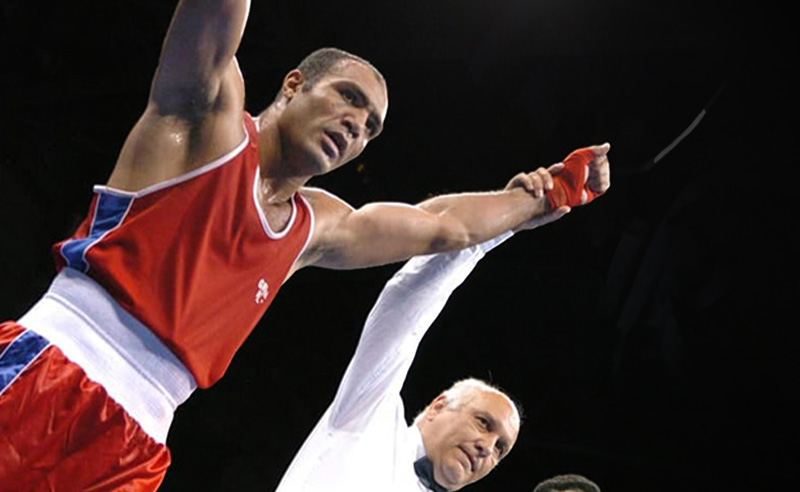
In 2004, he won silver for Egypt in the Athens Olympics. We chatted a lot about it, but what really stood out to me was him saying, “People see the medal. What they don’t see is the years of training, the injuries, the days I went to bed hungry, the nights I was in pain. They don’t see what you give up. You miss moments with people you love because you believe in something no one else can see yet.” After Athens, everything changed – and didn’t.
“People started calling me a star,” he said. “But I stayed Mohamed from El-Gamaliya. What changed was the responsibility. What didn’t change was my faith in God, my respect for my parents… and my love for foul with chilli oil.” Despite offers to go pro in Europe and the US, Reda chose to stay. “I had an eye issue. And more than that, I wanted to set an example. I wanted to build something here. Not everything is about the money.” Instead, he built a boxing academy, which was the next step in a lifelong goal.
“I wanted to train my son differently from how I was trained. I stopped competing, but I didn’t stop dreaming. The academy became that dream, a place to shape people as much as athletes.” The lessons go beyond the ring. “Victory’s great,” he said. “But what really matters is consistency. Show up when you’re tired. Respect your opponent. Respect yourself.” He sees parts of himself in the new generation. What surprises him most is how quickly they grow. “This generation? They’ve got energy. They’ve got guts. All they need is someone to steer them.”
Over the last few years, more women have joined the sport. For Reda, this was an opportunity to evolve his training. “I started listening more. Every girl has her own story. Boxing, for some, carries the weight of protection, the spark of confidence, and the breath of freedom beyond the sport alone. We adjusted our training to focus on skill, self-defence and respect.”
The academy now offers sessions exclusively for women. The experience has changed him as much as it’s changed them. “Give a girl a safe environment, and she’ll surprise you. That’s what I’ve seen. Greatness comes from will; gender has nothing to do with it. Every time one of them pushes through fear, she teaches me something new.”
When I asked about a moment from his career that stayed with him – even though it never made the headlines – he didn’t hesitate. “After losing a championship, I came home feeling like I wasn’t cut out for it any more. I told myself I was done. But when I walked in and saw my wife’s eyes, she didn’t say a word, but the belief she had in me… that’s what brought me back. No one wrote about that. But that moment made me a champion.”When I asked Reda about his definition of strength or power, he answered, “Strength is getting back up when you fall. It’s staying calm when someone tries to get under your skin. It’s holding onto your humanity when things get tough. The real strength? It’s in your heart and your head, not in your gloves.”
Before I left, I asked what he hoped kids would take from his story. “I hope they see that champions rise through what they build, step by step. Built from every tough moment, every ‘I can’t’ that turns into ‘I did.’ Boxing is a big school. It teaches you to face yourself. And if you’ve got a dream – any dream – you’ve got to believe it can happen. There’s always room for another Mohamed Reda.” After the interview, I called my dad to tell him how it went. He said, “I told you he was the real deal.” And honestly? He really is.
Groundbreaking procedure opens new horizons in circulatory support techniques for patients with complex cardiac conditions
Cardiac surgery team, led by Prof. Feras Khaliel, performed the operation through small incisions using remotely controlled high-precision robotic arms
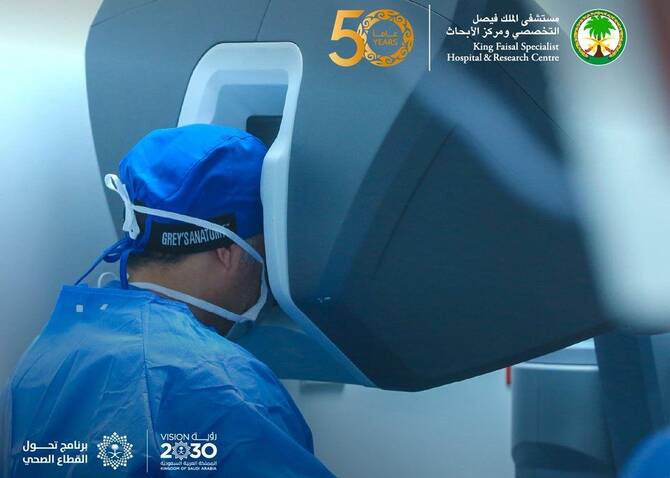
King Faisal Specialist Hospital and Research Centre in Riyadh has performed the world’s first implantation of two artificial pumps for biventricular support using robotic technology on a patient with advanced heart failure.
The groundbreaking procedure opens new horizons in circulatory support techniques for patients with complex cardiac conditions and marks a medical achievement that culminated in the patient’s recovery within a short period following the surgery.
The procedure represents a major advance in the treatment of bilateral heart failure, which was traditionally performed through full sternotomy, an approach associated with higher surgical risks and prolonged recovery.
However, the cardiac surgery team, led by Prof. Feras Khaliel, performed the operation through small incisions using remotely controlled high-precision robotic arms, resulting in reduced blood loss, lower risk of infection, and faster patient recovery.
The milestone reflects the integration of expertise across multiple departments at the hospital, including cardiac surgery, cardiology, anesthesia, critical care, biomedical engineering, and advanced life support.
The procedure was meticulously planned and benefited from 3D imaging technologies, real-time surgical navigation, and innovative solutions.
source/content: arabnews.com (headline edited)
_____________
KFSHRC has performed the world’s first implantation of two artificial pumps for biventricular support using robotic technology. (X/@KFSHRC)
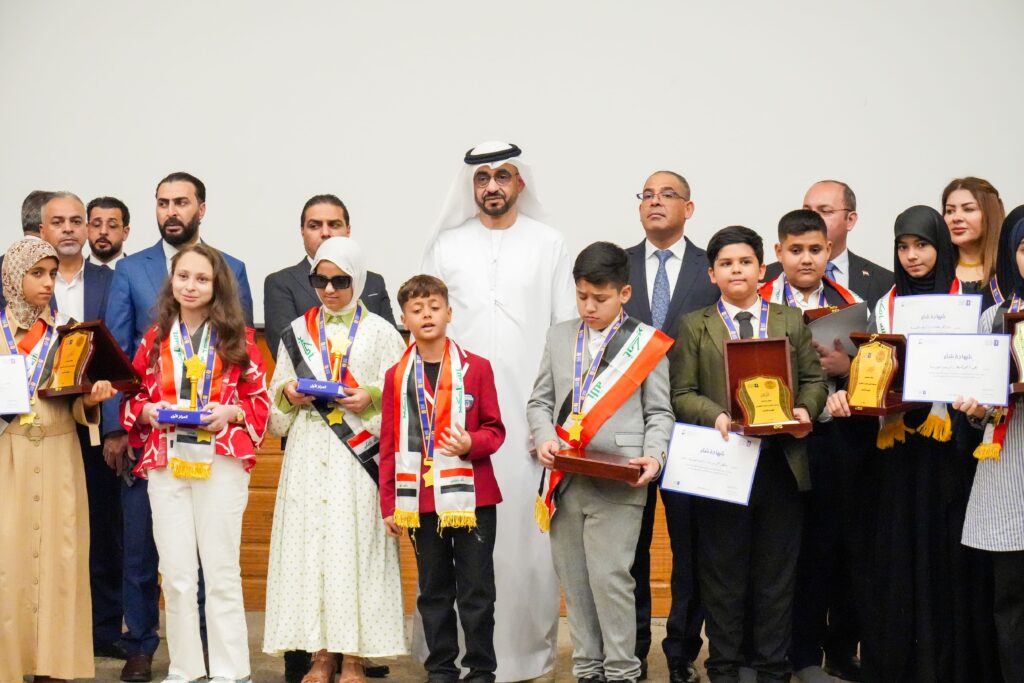
Student Aisha Nizar Nazim won the title of champion of the ninth edition of the Arab Reading Challenge in Iraq, after qualifiers in which 1,339,270 students from 38,100 schools participated, under the supervision of 16,310 supervisors, who contributed to the success of the ninth edition of the largest reading event of its kind in the Arabic language in the world, organized by the Mohammed bin Rashid Al Maktoum Global Initiatives Foundation since its launch in 2015.
Student Aisha Nizar Nazim, a seventh-grade student at Zaha Hadid School for Excellence in Nineveh, was announced as the winner during the closing ceremony of the ninth edition of the Arab Reading Challenge, which was held in the Iraqi capital, Baghdad, in the presence of His Excellency Dr. Ibrahim Namis Al-Jabouri, Minister of Education; Dr. Adnan Al-Sarraj, Advisor to the Prime Minister for Education Affairs; Mohammed Dayea Al-Azzawi, Undersecretary of the Ministry of Education for Administrative Affairs and Chairman of the Higher Committee; and Mr. Mohammed Saleh Al-Taniji, Acting Charge d’Affaires.
At the UAE Embassy in Baghdad, Dr. Fawzan Al Khalidi, Director of Programs and Initiatives at the Mohammed bin Rashid Al Maktoum Global Initiatives Foundation, participated, along with a number of officials and educators in charge of the Arab Reading Challenge initiative, and a large crowd of parents of the participating students.
The closing ceremony also witnessed the announcement of Maria Hassan Ajeel, a fifth-grade student at Al Fara’a Girls School in the Salah al-Din district, as the winner of first place in the People of Determination category, out of 450 students who participated in the qualifiers
The list of the top ten finalists from which the judging committees selected student Aisha Nizar Nazim as the champion of the ninth Arab Reading Challenge at the level of the Republic of Iraq, included: Muntadhar Ahmed Mardan from the fifth grade at Al-Insaf School in the Karbala region, Akram Khalil Abdullah from the tenth grade at Al-Dhakirin Intermediate School (Kirkuk), Fatima Muhammad Abdul-Amir from the eleventh grade at Shams Al-Hurriyah Preparatory School (Najaf), Yusr Hamza Farhan from the eleventh grade at Al-Nabaa Al-Azim Secondary School (Qadisiyah), Rawan Muntadhar Mansour from the tenth grade at Haifa Intermediate School for Girls (Babylon), Hadi Hassan Hadi from the eleventh grade at Al-Nahrawan School for Boys (Rusafa 3), Aya Ziad Subhi from the eleventh grade at Al-Rafidain School (Kirkuk), Hussein Ali Ahmed from the tenth grade at Al-Dhakirin School (Kirkuk), and Haider Ali Abdul-Aziz from the seventh grade at Al-Muhwebin School (Najaf).
The ninth edition of the Arab Reading Challenge initiative achieved a record participation of 32 million and 231 thousand students from 50 countries representing 132,112 schools, under the supervision of 161,004 supervisors. His Excellency Professor Ibrahim Namis Al-Jabouri, Minister of Education of the Republic of Iraq, praised the vital role played by the Mohammed bin Rashid Al Maktoum Global Initiatives Foundation in empowering new Arab generations to acquire the knowledge, sciences, and skills necessary to build the future. He pointed to the successive successes achieved by the Arab Reading Challenge initiative in this context, and its tangible impact in spreading the culture of reading and developing the potential of Arab students.
He said: “We are proud of this new participation in the Arab Reading Challenge initiative. 133,920 students, through their interaction with this knowledge competition and their outstanding performance, have proven the development of the educational and cultural landscape in Iraq and the effectiveness of the plans put in place by the Ministry of Education to advance students’ levels and enhance the status of the Arabic language, in line with our rich cultural heritage and the creativity of the people of Iraq in various fields, thus strengthening our confidence in a brighter tomorrow for our country and the Arab nation.
Dr. Ibrahim Al-Jubouri extended his congratulations to student Aisha Nizar Nazim, all the winners, participating students and their families, as well as to the schools and educational staff across Iraq. He extended his thanks to the Mohammed bin Rashid Al Maktoum Global Initiatives Foundation and everyone who contributed to the success of the ninth round’s qualifiers.
Dr. Fawzan Al Khalidi affirmed that the Arab Reading Challenge initiative continues to fulfill its mission of spreading the culture of knowledge, providing the means for rising Arab generations to enhance their capabilities, hone their talents, and strengthen their connection to the Arabic language, thus providing them with the visions and tools necessary to revive Arab civilization and contribute effectively to the development of Arab societies.
The Director of Programs and Initiatives at the Mohammed bin Rashid Al Maktoum Global Initiatives Foundation praised the wide Iraqi participation in the qualifying rounds of the ninth edition of the Arab Reading Challenge, saying: “We greatly appreciate the participation of more than 1.3 million students in the ninth edition, which reflects the great efforts made by the Ministry of Education in the sisterly Republic of Iraq, and those concerned with cultural affairs and Iraqi society to motivate students to read. These efforts represented a significant contribution to the achievement of the ninth edition, in which more than 32.2 million students from 50 countries around the world participated.”
On behalf of the Mohammed bin Rashid Al Maktoum Global Initiatives Foundation and the Arab Reading Challenge, Dr. Fawzan Al Khalidi congratulated the ninth edition’s champions in Iraq and all the participants. He also thanked the Iraqi Ministry of Education and everyone who helped the students advance to the ninth edition’s qualifying rounds.
The Arab Reading Challenge, launched in the 2015-2016 academic year under the directives of His Highness Sheikh Mohammed bin Rashid Al Maktoum, Vice President and Prime Minister of the UAE and Ruler of Dubai, aims to foster a comprehensive reading and knowledge movement, instill a culture of reading in Arabic as a language capable of keeping pace with all forms of literature, science, and knowledge, and encourage young generations to use Arabic in their daily interactions. It also aims to develop mechanisms for understanding and self-expression in fluent Arabic, and foster creative thinking skills.
The challenge seeks to enhance the importance of cognitive reading in building self-learning skills and fostering a value system for young people by exposing them to the values, customs, and beliefs of other cultures. This instills the principles of tolerance, coexistence, and acceptance of others, and encourages dialogue and cultural and human openness.