Arabs & Arabian Records Aggregator. Chronicler. Milestones of the 25 Countries of the Arabic Speaking World (official / co-official). AGCC. MENA. Global. Ist's to Top 10's. Records. Read & Enjoy./ www.arabianrecords.org
We were scouting impressive Arab female scientists and we realised that these visionaries need more spotlight.
Earlier this year, The L’Oréal-UNESCO For Women in Science Middle East Regional Young Talents Program, now in its ninth year, recognized and supported five trailblazing women from the GCC region for their ground-breaking work in the fields of life sciences, physical sciences, mathematics, and computer science.
The regional program is part of the L’Oréal-UNESCO’s global For Women in Science initiative, in partnership with Khalifa University of Science and Technology. The outstanding researchers were awarded funds totaling EUR 76,000 to advance their creative work in the fields of science, technology, engineering, and mathematics (STEM).
Fostering and empowering upcoming female scientists and their ground-breaking research, particularly in the GCC region, where women scientists’ contributions are crucial to finding answers for pressing global issues including climate change, food shortages, pandemics, future technology, and cybersecurity.
The award winners stand for the most driven and ambitious women in the region who are unafraid to overcome obstacles in their quest to develop creative solutions to issues that have a social impact. They also serve as role models for young girls who are just beginning their careers in STEM.
UAE has achieved significant progress in ensuring equality and representation in all spheres, from the educational system to the forefront of important scientific and technical achievements led by women, which has improved its competitiveness on the world stage.
About the Middle East Regional Young Talents:
PhD student Hessa Ebrahim Ali Alfalahi (UAE): For her studies on the early identification and diagnosis of Parkinson’s disease and depression utilizing smartphone data gathered in the outdoors using revolutionary Artificial Intelligence (AI) algorithms.
PhD student Ayesha Abdulla Alkhoori (UAE): For her work on the conversion of carbon dioxide (CO2) into clean fuel to reduce global warming and address the energy problem.
Post-doctorate researcher Dr. Maha Zakariya Yahya Al-Riyami (Oman): for her investigation of somatic mutations in type 1 diabetes, which may open up new research directions in the study of autoimmune diseases.
Post-doctorate researcher Dr. Raefa Abou Khouzam (UAE): For her research on examining innovative treatments to thwart the development and spread of pancreatic cancer.
Post-doctorate researcher Dr. Fatiha M. Benslimane (Qatar): For her work on creating a quick, dependable, and affordable microbiological analysis procedure that would enable real-time diagnosis.
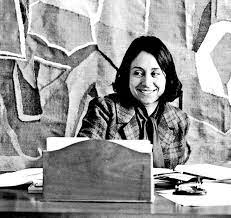
Tunisian artist Safia Farhat was not only a dynamic tapestry creator, but had an impressive resumé including ceramicist, educator, women’s rights activist, and publishing pioneer. She was a woman who accumulated a list of historic firsts in her lifetime.
She contributed to the growth of visual culture in independent Tunisia under the progressive leadership of President Habib Bourguiba. Farhat designed national stamps, had her fiber art displayed in the country’s banks, hotels, and schools, and worked with expert weavers and artisans in her studio.
Farhat was born in the harbor city of Rades in 1924 and raised in a well-to-do family. It was her maternal aunt, who was skilled in knitting and crochet, who cultivated Farhat’s love of art. She went on to study at the Tunis Institute of Fine Arts and was reportedly just the third Tunisian woman to enroll there.
She later became the institute’s first female director in 1966 — remaining in the role for more than a decade. She encouraged female students to take part in the institute’s programming. Farhat also founded Tunisia’s first magazine for women, “Faiza,” delving into feminism and decolonization, among other social issues.
Her colorful, thickly lined tapestries depict animals, plants, and men and women wearing traditional clothing. “When I saw her work, I was really fascinated by its sculptural elements, the color, the various techniques that were embedded in it — and by their stories,” Jessica Gerschultz, a professor of African studies at the University of Kansas, told Arab News.
“She seems to really play on self-referentiality,” she continued. “Her works are referring to her other works, so there are many symbols — lots of triangles and zigzags — integrated into her weavings and other works that she did in ceramics and iron.”
Farhat, who died in 2004, is a name still recognized by some older people in her homeland, but she has been generally overlooked, ironically, by young art students in Tunisia. “At the institute, maybe students know her name, but they’re not very familiar with her,” noted Gerschultz. “Maybe they don’t know her at all.”
International interest in Farhat, however, was boosted last year as a result of her works being showcased at the Venice Biennale. “It’s wonderful to see her contributions now being viewed more widely,” said Gerschultz.
Dubai – Dubai is the also the most record-breaking city not just within the country but also across the Mena region.
The UAE is far ahead in achieving the Guinness World Records regionally as the country boasts 425 GWRs with 34 of them were achieved in 2020 alone.
Dubai is the also the most record-breaking city not just within the country but also across the Middle East and North Africa (Mena) region.
“The UAE is currently home to 425 Guinness World Records titles, making it the biggest record-breaking country in the Mena region… Dubai has the lion share of titles in the country with around 60 per cent of the overall number,” said Danny Hickson, senior events production manager at Guinness World Records Ltd in Dubai.
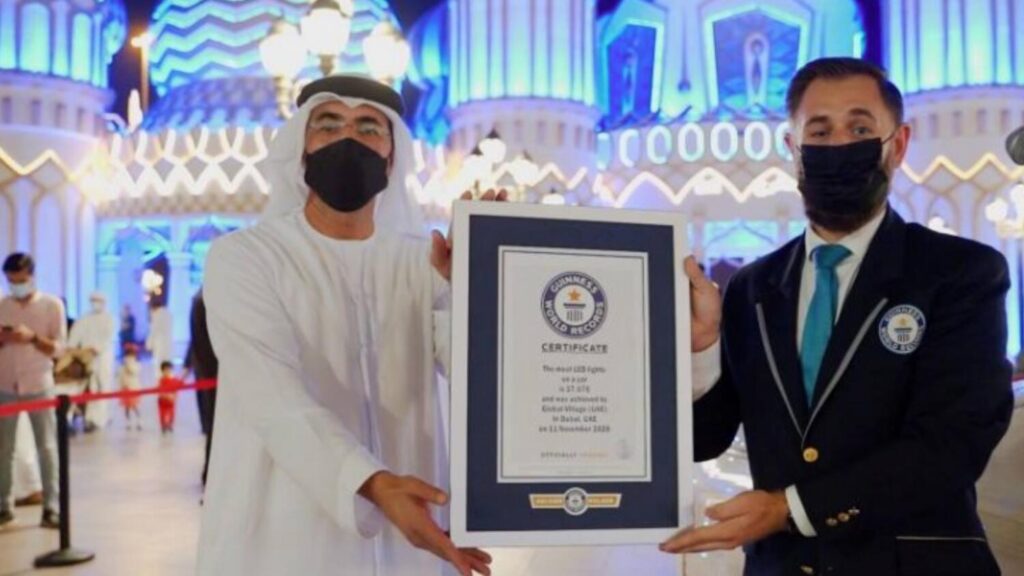
Global Village, a multicultural family entertainment destination, achieved two records in November alone. The first record was set by having the most LED lights ever on a car. The vehicle had 36,676 LED lights. The feat began two weeks ago as the park achieved the record for the most videos in a music medley video following the Rockin’1000 Season 25 opening concert.
Global Village aims to break 25 records this season as part of its Silver Jubilee anniversary celebrations.
Emirati shipbuilder Obaid Jumaa bin Majid Al Falasi also made it into the history by building the world’s largest dhow, a wooden Arabic boat, measuring 91.47-metre long and 20.41-metre wide. That is equal to the length and almost half the width of a standard American football field floating over the Indian Ocean.
Dubai’s Nakheel Mall, too, recently broke the record for the world’s largest fountain, measuring a whole 7,327 m2. The record breaking fountain named The Palm Fountain was designed a with tricks including colour and brightness controls.
The emirate is also home to the world’s tallest hotel – 75-storey Gevora Hotel, measuring 356.33 metres tall from the group level to the top.
Danny Hickson said Saudi Arabia comes second with 96 Guinness World Records titles, while Egypt is not far in the third place with 93 titles.
On September 23, Saudi Arabia achieved the Guinness World Record for the largest fireworks display in multiple cities as the display consisted of 962,168 fireworks.
“What’s brilliant about breaking world records with brands in the UAE is that there is almost a chance to do something different with the heritage. Brands and individuals think it is impossible to be break world records, but we believe everyone is amazing in his own way, and we are here to make their achievement Officially Amazing!,” said Hickson.
“We have seen the tallest house of cards build in 12 hours, sat on top of a washing machine, to demonstrate its reduced vibrations and noise levels; and an iconic car brand celebrated its 80th anniversary by breaking the record for the largest loop the loop in a car! Would we find amazing talents among Khaleej Times readers?,” concluded Hickson.
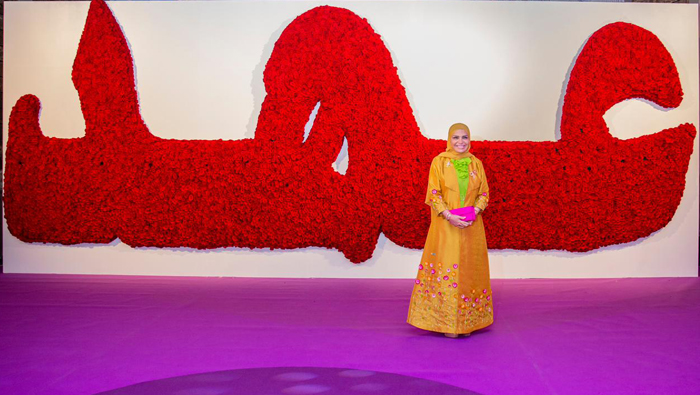
Paying tribute to Her Highness the Honourable Lady Assayida Ahd Abdullah Hamed Al Busaidi, Spouse of the Sultan of Oman, the Infrastructure, Technology, Industrial and Consumer Solutions cluster of Mohsin Haider Darwish LLC (MHD-ITICS), sponsored an event to set a new Guinness World Record for ‘A Word Written with the Largest Number of Flowers’.
The event was hosted by Lujaina Mohsin Darwish, Chairperson, MHD-ITICS. The mammoth task of assembling 12,000 roses, which spelt out the First Lady’s name, ‘Ahad’, began with fabrication work on 25 October and was successfully completed on 26 October.
It was then displayed at a grand event organised near the Snow Zone area, located on level two of the Mall of Oman. Official adjudicators from Guinness World Records were present to supervise, analyse and follow every step of the process. Adhering to all the stringent criteria, the masterpiece, once finished, stood 8.2 metres wide and 3 metres tall and proved to be a true work of art.
Ideated and conceptualised by Ms Naseem Abdullah Al Fadhli, MD, Integrated Benefits Projects and supported by Ms Haifa Balfaqih, Investment Programme Director – Nazdaher and GM, Strategic Planning and Technology, be’ah, the historic event witnessed the presence of some of the highly-esteemed guests including her excellencies, leading businesswomen and attendees from all over the country.
Receiving an overwhelming response from the audience, the new Guinness World Record further cements Oman’s position on the map as a country filled with unique initiatives and also as a nation raising an empowered generation of women.
Lujaina Mohsin Darwish said, “With the key message behind this initiative being especially close to our hearts, we are indeed delighted to set this new world record. It not only celebrates Omani women but is a tribute to Her Highness the Honourable Lady Assayida Ahad Abdullah Hamed Al Busaidi.
Her unwavering faith in the capabilities of the Omani women of today and continuous appreciation of their achievements have served as a constant motivation for all. It has ignited a zeal in every woman to break the glass ceiling and push the frontiers of women leadership.”
“Drawing inspiration from our leaders, MHD-ITICS will continue to act as a catalyst of change, encouraging women’s contribution to the Omani economy as well as participating and leading in their respective areas of influence and expertise. The strong Omani women have displayed courage, creativity, vision and accomplishment and will continue to play an instrumental role in driving transformation,” she added.
A keynote speech was delivered by Lujaina Mohsin Darwish, which was then followed by the much-awaited showcasing of the largest flower word. Another key highlight of the event was the large LED display wall with snippets and pictures of the First Lady of Oman. All attendees were gifted a branded scarf and were entertained with live music, a food and beverage counter and photo opportunities.
MHD-ITICS, under the guidance of Honourable Lujaina Mohsin Darwish, has achieved commendable growth in recent years. Moreover, the Company has been at the forefront of setting new benchmarks in the industry and supporting its women employees to assume various critical roles in the organisation.
British and Egyptian government officials celebrated on Monday seven years of cooperation between the two countries under the Newton-Mosharafa Fund, which supports research and innovation programmes to advance economic development and social welfare, tackle global challenges and develop talent and careers.
Participating in the celebration were the British Embassy in Cairo, the British Council, together with the Egyptian Ministry of Higher Education and Scientific Research’s Science, Technology and Innovation Funding Authority (STDF) and the Central Department of Missions (CDM).
The fund is named after British mathematician and physicist Sir Isaac Newton, one of the most influential scientists in history, and the Egyptian theoretical physicist Doctor Ali Mustafa Mosharafa, who contributed to the development of quantum theory.
It is the largest science and innovation partnership between Egypt and the UK in history.
The ceremony started with speeches by the British Ambassador to Egypt Gareth Bayley, British Council Country Director Elizabeth White, and Deputy Minister of Higher Education and Scientific Research Yasser Refaat
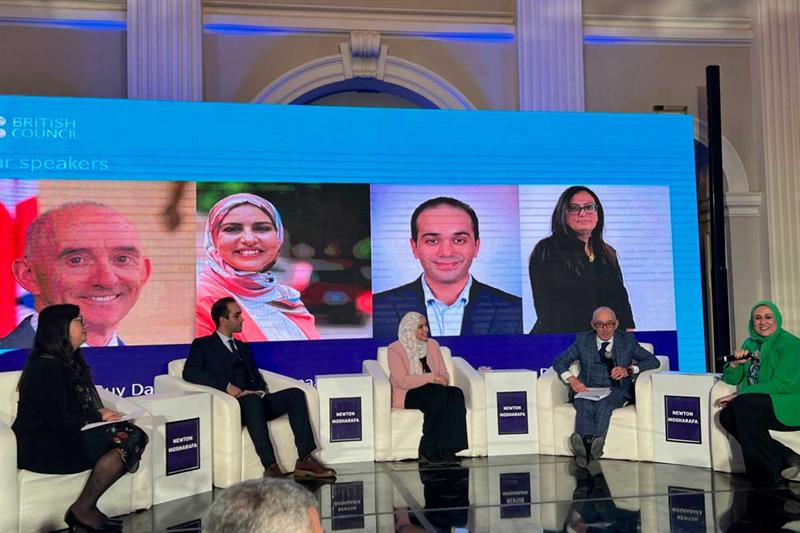
It was followed by a panel discussion on the role of international collaboration in science and research.
The discussion involved professor Guy Daly, provost and senior vice-president of the British University in Egypt; Shaimaa Lazem, international collaboration programme manager at STDF; Dr Marco Zaki, lecturer of biochemistry and cell biology and founder of the NILE CAN research laboratory at Minia University; and Irene Gabriel, director of the Smart Engineering Systems Research Centre at Nile University.
At the ceremony, the British ambassador expressed his pride in celebrating the alumni from the joint British-Egyptian programme.
“These outstanding scientists are the leaders of tomorrow, and today’s event pays tribute to them and to the legacy of the Newton Mosharafa Fund, one of the largest science and innovation partnerships between Egypt and any country,” he said.
He went on to note that the alumni are working to make the world a better place everyday through their research into curing cancer, achieving food and water security and “making the earth a safer, healthier and more sustainable place to live in.”
During her speech, British Council Egypt Director Elizabeth White observed that the fund has supported her country’s long-term approach by “building the next generation of scientists”
“For seven years, we have worked with our partners to enable the exchange of learning and ideas between scientists in the UK and Egypt,” she added.
She concluded by saying that the British Council will remain committed to opening up access to science and research to support UK-Egypt priorities.
Funding Egypt’s long-term sustainable development
The fund is valued at £55 million over seven years; the cost is shared between the UK and Egyptian governments.
It focuses on five main areas identified by the Egyptian government as priorities for their long-term sustainable development: water management, renewable energy, food production, archaeological and cultural heritage and affordable and inclusive healthcare.
These priorities are closely related to Egypt’s Vision 2030 sustainable development strategy, as well as the UN’s Sustainable Development Goals (SDGs).
Since its launch in 2014, the Newton-Mosharafa Fund has provided 282 scholarships to Egyptian researchers to obtain a doctoral degree, in addition to funding 69 research partnerships between Egyptian and UK universities. Research related to health care had a significant share of it, amounting to about 69 percent of doctoral scholarships and about 22 percent of research partnerships.
Notable alumni
Some of the outstanding Newton-Mosharafa alumni who attended the ceremony include: Dr Marco Zaki, winner of the Newton Prize for his research on treating liver cancer, and Dr Irene Gabriel, who is a Newton Mosharafa grant holder. She lead a research team at Nile University together with Nottingham University to turn dried shrimp shells into thin films of biodegradable plastic that can be used to make eco-friendly grocery bags and packaging.
Shaimaa Lazem, who is an associate research professor at the City of Scientific Research and Technology Applications (SRTA-City), was awarded Newton-Mosharafa grants three times. Her work focuses on designing prototypes for technologies that serve the rural communities in Egypt. She is currently working with artificial intelligence (AI) start-ups in Africa as part of a Google Research for Inclusion and Google AI Awards.
Also in attendance was Yasser Shabana, who developed adaptation strategies to mitigate the impacts of climate change on wheat, maize and food production in Egypt.
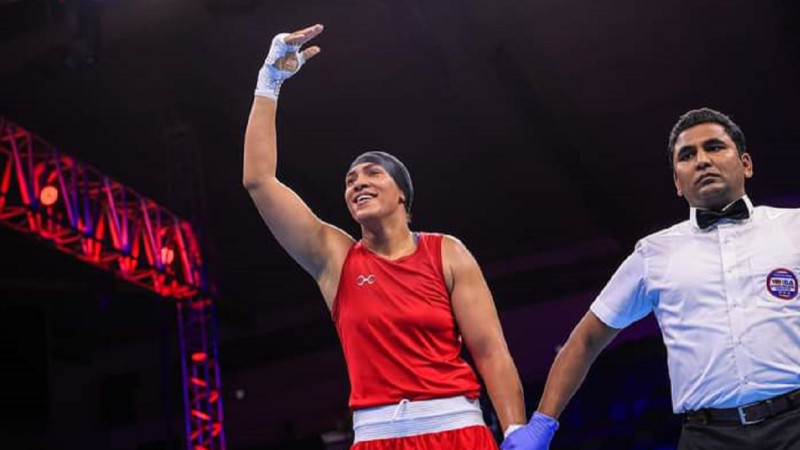
Moroccan boxer Khadija El Mardi won the gold medal on Sunday in New Delhi, India, during the Women’s World Amateur Boxing Championships.
The national champion El Mardi, who competed in the heavyweight division (Over 81kgs), won the women’s world boxing championship by defeating the Kazakh Kungeibayeva Lazzat.
El Mardi has achieved a number of victories over the years, including the title of African champion in 2022, a victory at the African Games in Rabat in 2019, a silver medal at the World Championships in 2022, and this year’s Mohammed VI Trophy gold medal.
Born in Casablanca in 1991, El Mardi’s everlasting commitment and heroic efforts to achieve success have made her name stand out.
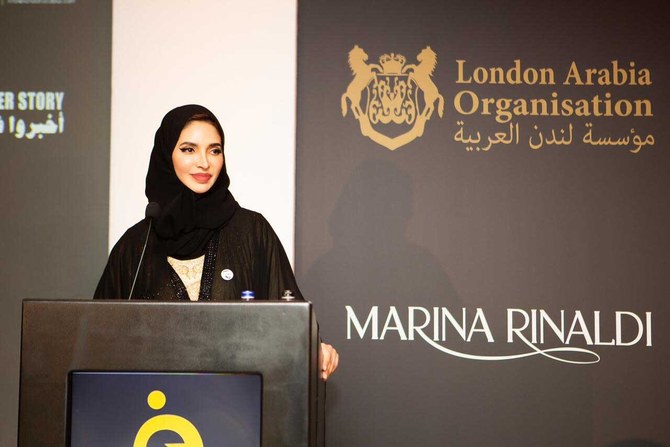
The UAE’s Sheikha Fatima bint Hazza was honored on Tuesday with the Arab Woman Award at a ceremony in London in recognition of her contributions to female empowerment in the region and her philanthropic efforts in various countries, Vogue Arabia reported.
Sheikha Fatima has been a strong supporter of cultural initiatives, particularly those involving the arts and sports.
She has endorsed several programs aimed at boosting the cultural scene in the UAE and the region through her role as chairwoman of the board of directors of the Fatima bint Mubarak Ladies Sports Academy and the Fatima bint Hazza Cultural Foundation.
Her other accomplishments include increasing access to education in Bangladesh, building schools in Kenya, and forming the Fatima bint Hazza Fund for Emirati women to pursue higher education abroad, Vogue Arabia reported.
She is “committed to enhancing the role of women in various ways, as she is a supporter of sports and arts, and we are honored to bestow her with the Achievement Award in Cultural Development,” the Arab London Foundation said.
The philanthropist has also helped broaden young people’s interest in fields such as art, literature, sustainability and community interaction, Vogue Arabia reported.
The Fatima bint Hazza Cultural Foundation recently launched a series of short stories for young people focusing on culture, local identity and sustainability
Upon accepting her award, Sheikha Fatima praised Emirati leaders and their efforts to encourage women to pursue their dreams.
“Effective participation and making progress and positive change are the core values that we have been raised on,” she said.
“I am proud to represent my country, the UAE, where women have not had to struggle to obtain their rights but have always been at the forefront since the establishment of the state.”
source/content: arabnews.com (headline edited)
______________
Sheikha Fatima bint Hazza was honored at the eighth edition of the Arab Women Awards in London. (WAM)
As a child, she took part in the game she loves against a backdrop of civil war. Now, Britain’s first black female Muslim referee fights for the rights of others as a role model for inclusivity.
A cold, cloudy Sunday morning in West London and 22 grown men are on a football pitch playing in one of the capital’s minor leagues. The standard is not particularly good but nonetheless there is something remarkable about the fixture.
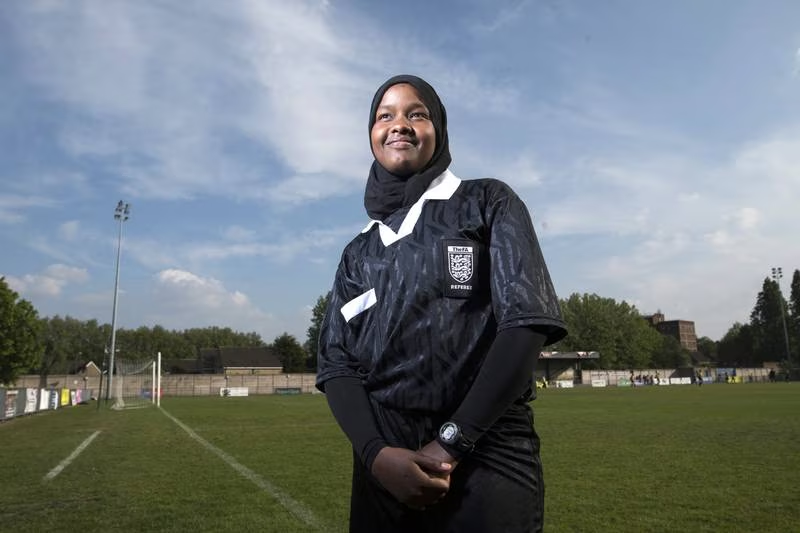
As the tackles fly in, a 1.6-metre-tall figure wearing match officials’ kit and a headscarf brandishes a yellow rectangular piece of plastic.
“My philosophy is that everyone deserves a chance,” Jawahir Roble, Britain’s first black female Muslim referee, tells The National. “But if they keep repeating fouls, I book them.
“I like to control the game first and then I’ll use my cards. The game is not about me. It’s about them having fun and making good memories.”
The contest finishes with a 3-1 home win but, for Roble, 29, the more important result is not the score at the final whistle — it’s that the players amble over to shake her hand and say thank you. Confirmation, she says, of a job well done.
Her extraordinary achievements have been recognised with an MBE in King Charles IIIs first New Year Honours List for services to the Football Association and volunteering work with the education and social inclusion charity Football Beyond Borders.
It is a feat perhaps rivalled only by the journey that has brought her to within tantalising distance of collecting the silver medal at a forthcoming investiture at Buckingham Palace.
Musing on how far she has come, Roble herself once said: “Who would ever think a black, Somali-born immigrant girl with eight siblings could ref a men’s game in England with a hijab on?”
Jawahir Jewels (JJ), as she is commonly known because of the Arabic meaning of her first name, was born in Mogadishu, where she could often be found barefoot in a four-a-side competition with her siblings, kicking scrunched up cloth wrapped in sticky tape around the courtyard of the family home.
Her parents, Mahdi, a grocer, and Safya, sometimes watched the rough and tumble from the sidelines with Jamila, the baby too small to take part, until the moments when the country’s civil war came perilously close. Then, play was suspended as everyone scarpered inside to relative safety.
“You did have to be careful,” Roble recalls. “You could hear gunfire, people screaming sometimes, loud bangs and explosions. I was scared. There were lots of kidnappings and crazy stories.
“But, as a child, it was also very carefree and fun and happy. We still had to get our school and mosque work done. We got told off so many times. But we learnt the system — do our chores and then we could go outside. We had to earn the right to play football.”
After Friday prayer, they would rendezvous with friends to play on a larger patch of muddy ground outside the house, or on the beach at Xeebta Liido by the Somali Sea a half-hour drive away.
The walls of the bedroom shared with her two younger sisters, Amina and Fatima, featured images of David Beckham and, intriguingly given Roble’s future career path, the controversial Italian defender Marco Materazzi, whose aggressive style amassed an inordinate number of bookings.
“With the obsession I have with football, you would think that someone encouraged me or a teacher influenced me. But, no, I just fell in love with it out of nowhere. At heart, I am a complete tomboy.”
As tensions heightened and the war escalated in the early 2000s, the siblings’ outside excursions were curtailed and Mahdi, who had applied for British visas and bought suitcases, put in motion a hitherto secret escape plan.
Ten-year-old JJ, forced to swelter in a coat in anticipation of the colder weather ahead, was taken in a packed eight-seater van to the airport for the 6,400km flight to London.
“We got told: ‘We have to move out.’ No time to tell anyone or sell the shop,” Roble says. “Dad gave it to a relative to look after.
“I remember thinking to myself, ‘We’re not coming back here for a long, long time’.”
Landing at Heathrow nine hours later was a shock. “Oh, my goodness, the place seemed massive. So many different people. Like there’s white people, there’s Chinese people. I’m only used to seeing black people. One of my siblings reached out to touch someone’s bright blonde hair.
“I thought: ‘Wow, this is the real world.’”
First stop was Sudbury in north-west London for a few weeks with a relative, then a temporary hotel stay in Kilburn before they were allocated a council house in the shadow of the largest football stadium in the UK.
“Can you imagine?” she asks with an infectious laugh. “Wembley! We could see the stadium — the home of football — from our house. Just amazing. Something I’ll never forget.”
Roble had thought that only players or special fans were allowed into the hallowed grounds but she has since been twice: on a Chalk Hill Primary School trip (“I couldn’t imagine someone like me could go … It was surreal); and last summer when England’s Lionesses beat Germany 2-1 in the European Championships final (“That was incredible”).
In their new garden, the serious rivalry resumed, one team captained by the oldest Roble sister, the other by the oldest brother, and a lemon or potato for a football.
But, after much pleading, her parents soon handed over £3 ($3.69) for a coveted purchase that enabled JJ, who at that time spoke no English, to overcome the language barrier and fit in more quickly at school.
“Because the kid that has the ball gets the friends,” she explains, smiling. “The first words I learnt I think were, ‘pass, pass’ and ‘shoot!’”
The restrictive uniform of long black skirt, white shirt, school shoes and hijab did little to stop Roble from playing every spare minute, skipping breakfast and lunch to take to the field before lessons, in break times and after the final bell.
“Sometimes kids at primary school teased me. Teachers asked how I could play dressed like that. I was like, ‘This is it, this is what Muslim people wear. You have to be covered up.’
“My religion was not an issue. As long as you’re just a nice person, they would accept you in the group. Being a Muslim is about being a good person, being modest and doing what makes you happy.”
When a supportive PE teacher spotted how well Roble was performing in sports, the first seeds of discord were sowed with her parents who expressed a strong preference for their children to excel instead at maths and English.
“My dad actually sat me down and said: ‘You came all the way from Somalia, all the way from the war just so you can play football? We want you to make use of this country’s opportunities. At least learn to be something that can help other people, like a doctor.’”
But, in Roble’s characteristically headstrong way, fulfilling her father’s ambitions was never a realistic outcome.
At 14, she thought the moment she had dreamt of had arrived. Players from Queens Park Rangers’ women’s team visited the secondary school for a coaching session and to seek out talent for the club’s academy.
Roble put in the work, showing off her pace and left-footed skills in the attacking and defensive duties of a centre midfielder.
“I was one of four or five girls who got a letter inviting me to trial. I was so excited. I’m on the bus and I’m reading this letter over and over again. All that letter needed was a parent’s name and a signature.”
When she arrived home, however, her mother tore up the invitation in an act that even now, 15 years later, causes Roble pain to recount.
Heart-broken at her life’s ambition being thwarted, the resigned teenager eventually left school early to begin a design technology course at college.
While there, she took the level one and two coaching badges with Middlesex Football Association before a referee shortage led to her being asked to step in at the last minute, with no experience, to take charge of an under-sevens girls’ match.
“The parents were very nice to me and the girls said how nice it was to have a female referee. So, from that, I continued volunteering as a referee for a whole year at junior level.”
That prompted the FA to fund her formal referee training. “I said to myself: ‘I have to continue, get braver, do different leagues, different age groups.’ Next thing you know I’m doing men’s and women’s. It happened so fast. Within four years, I was doing adult games.”
After joining the women’s pathway, Roble advanced to National League Level 3 and is now determined to progress to the Women’s Championship and Super League, and who knows where after that?
Along the way, she has garnered a clutch of accolades, including the FA Respect Match Official Award 2017 and being named on the BBC’s 100 Women 2019, as well as that MBE on the same honours list as the England head coach Sarina Wiegman, captain Leah Williamson, and players Lucy Bronze, Beth Mead and Ellen White.
When she’s not teaching at a special needs school in London, Roble dedicates herself to promoting inclusivity, defying stereotypes, demolishing barriers and clearing a path for future generations.
There are, she says, no limits to what can be achieved: “Only I can stop myself, and I’m not going to do that.”
Fitness is a priority, and she has also spent countless hours watching YouTube clips of professional referees such as the former Premier League’s Mark Clattenburg to study their positioning during play and how they control the game.
Further inspiration came last November when an all-female on-field refereeing team led by Stephanie Frappart took charge of a men’s World Cup game for the first time in the match between Germany and Costa Rica.
Even her parents are coming around to their daughter’s deep involvement with football, though Roble sounds as though she is meeting them halfway.
“I understand now that they wanted the best for me and to make sure I was protected and safe. They told me, ‘We don’t want any hatred towards you.’ I’ve told them it’s not like that.
“At the end of the day, I’m spreading positivity. I’m sharing my sports journey with young girls, you know, who like me are interested in football. Maybe if they hear my story, they can use it to inspire them and have a shortcut instead of what I did.”
What she did, ultimately, was find the courage to tackle the norms within the Somali community and succeed on her own terms.
“My faith encourages sports, my faith encourages a healthy lifestyle,” Roble says. “I feel like [the issue] was more to do with cultural concerns. Because our culture says girls should be at home, not getting involved in men’s sports. Girls should be shy, keep on the low, low. I’m sorry but that’s not me.
“I have challenged it. Now, in my Somali community, most of them are: ‘Oh, wow, you’re doing a great job.’ And I’m like, ‘So who was the problem? Do you have anything to say now?’”
It is the same toughness displayed when Roble encounters disbelieving looks from players and coaching staff as she walks to her happy place on the pitch or a decision is criticised.
As with all referees, she has received verbal abuse but says it’s nothing she can’t deal with. Despite her diminutive size, Roble’s big personality, confidence and forthright retorts make for a commanding presence — and there is always the “power” of the red and yellow cards in her pocket.
Her story might have had moments of isolation, sometimes in the family setting and at least initially in an unfamiliar country as a refugee, but she seems undaunted by the “loneliness” of the referee presiding over two teams.
“I have accepted that,” Roble says of the latter. “Once I get on the pitch, I feel like everyone is my team. I feel totally free, like nothing else matters. There is no stress, nothing.
“I wanted to be a footballer so, in a way, I am kind of living that dream. It is where I belong.”
When she’s not teaching at a special needs school in London, Jawahir Roble is dedicated to defying stereotypes, demolishing barriers and clearing a path for future generations. Photo: Shutterstock
The airline promoted Maha Al Balushi who has been with the company since 2010.
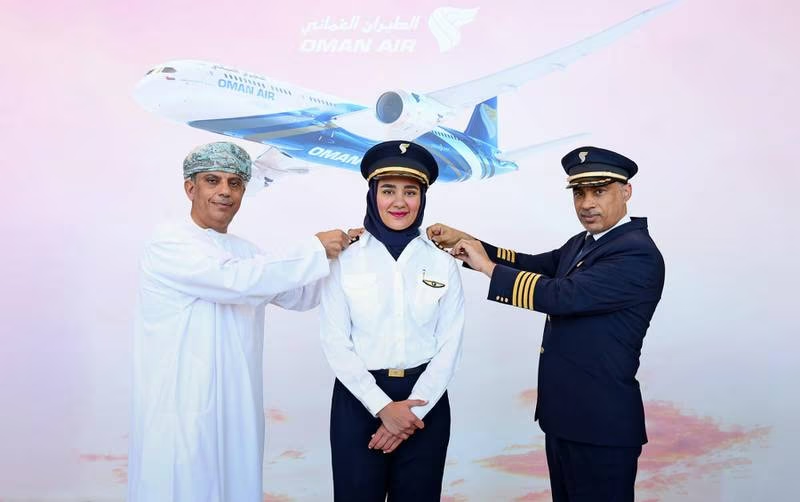
Oman Air, the national airline of the sultanate, has announced pilot Maha Al Balushi as the first female Omani captain.
Ms Al Balushi officially received her new rank during a ceremony held at Oman Air’s headquarters in Muscat.
She has been with the airline since 2010 after graduating from the cadet programme at the Royal Melbourne Institute of Technology, in Australia.
Ms Al Balushi was the only woman enrolled in the programme at the time.
She became the first female Omani to be awarded the rank of first officer in 2013.
“My dream has always been to become a captain. It hasn’t been easy but thanks to the support I have around me, from my family to my training team and the airline,” said Ms Al Balushi in a statement by Oman Air.
“I have accomplished what I set out to do. It is an honour to hold this role and I hope that I will inspire other Omani women to choose such a rewarding career in the skies.”
Oman Air said that 1,230 Omani female employees contribute to the airline’s strength, occupying a range of roles including cabin crew, flight operations, engineering, airport services, marketing, customer services, sales and communications.
The airline has so far achieved an Omanisation rate of 94 per cent — excluding female cabin crew.
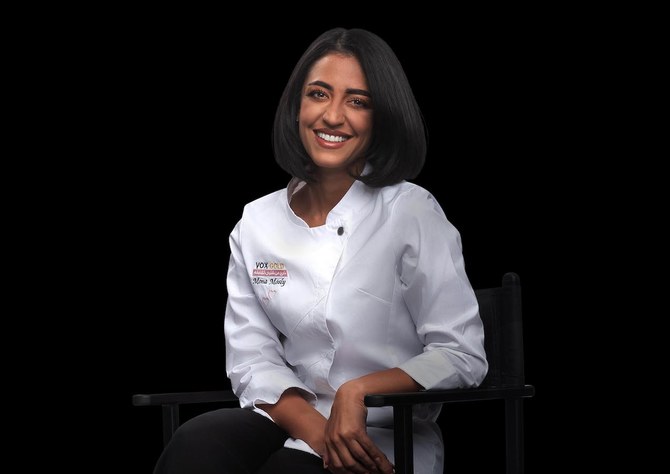
Known for her creative take on classic favorites, Saudi chef Mona Mosly is one of the region’s most recognizable celebrity chefs, renowned for her creative takes on classic favorites.
As well as being a judge on the Arabic-language version of talent show “Top Chef,” Mosly has extensive experience in culinary art, having trained professionally in Switzerland before attending the world-renowned Le Cordon Bleu in London and subsequently honing her craft at restaurants across the Middle East.
In January, Mosly joined forces with VOX Cinemas in Riyadh and Jeddah to curate an expanded menu that features more than 20 dishes, including kibbeh nachos and BBQ chicken bao, Armenian tabbouleh, dukka madani chicken burger, halva cookies with Syrian ice cream, Thai curry salmon and more.
“What I love about this is that (movies) bring people joy,” Mosly tells Arab News. “I believe that I can bring people joy with my food as well. And it’s all about happiness, right? So it’s a beautiful collaboration for me.”
When VOX first reached out, Mosly says, her first thought was to create a menu of cinema food, “with an Arabic or Saudi twist.”
She explains: “I believe that food has to be related to us. It could take us to a beautiful memory. It could remind us of flavors from our childhood and all that.”
One of her favorite dishes on the menu is the kibbeh nachos. “It’s basically kibbeh, but it looks like nachos. Instead of cheddar sauce, I used mohamara sauce, so it gives the same feeling,” she says. “I also love the fish and chips, because it has a very nice story behind it. I like food that can gather different cultures together.”
Here, Mosly takes a trip down memory lane to when she first started her career, and offers advice for amateur chefs.
Q: When you started out as a professional, what was the most-common mistake you made when preparing a dish?
A: When I was working for Leylaty ballroom in Jeddah, I once burned 80 kilos of morels — one of the most expensive mushrooms. But after that, morel became my favorite ingredient. In kitchens — or any job where you work with your hands — if you don’t make mistakes, you’ll never learn.
What’s your top tip for amateur chefs?
Be yourself. Food is all about who you are. You translate what you have within you to people.
What one ingredient can instantly improve any dish?
Garlic. Or onion. They are the essence of food.
When you go out to eat, do you find yourself critiquing the food?
After six years of ‘Top Chef,’ believe me, I don’t want to critique anything. I’m done critiquing. I go out to have fun. I’ve reached a place where I don’t want to critique, I just want to enjoy.
What’s the most-common mistake you find restaurants making?
What annoys me the most is when food doesn’t have a taste because the cook didn’t respect the ingredients. I don’t understand how you can end up cooking a dish that doesn’t taste of anything.
When you go out to eat, what’s your favorite cuisine?
It depends. My cheat meal will always be a burger. But if I want to give myself a treat, I’ll go for sushi — or Japanese cuisine anyway.
What customer behavior or request most annoys you?
When people like something, they don’t try other stuff. I find that sad, rather than annoying. Why did you like the first thing that you tried? Because you tried it. That’s why you have to try other things too.
What’s your favorite dish to cook and why?
I do enjoy things like rolling warak enab (stuffed vine leaves) or stuff that takes time, because I’m a very fast person. I do everything very quickly. So, I like things that calm me down like baking. I like having to wait.
As a head chef, what are you like in the kitchen? Are you laidback? Or a disciplinarian?
I believe that when you are loved, appreciated and respected, you can do wonders. So, that’s what I try to give to the people I work with. Really, I like to dance, I like to sing, I like to enjoy being with my team. But when something goes wrong, something goes wrong. So, sometimes, I do have to shout.