Arabs & Arabian Records Aggregator. Chronicler. Milestones of the 25 Countries of the Arabic Speaking World (official / co-official). AGCC. MENA. Global. Ist's to Top 10's. Records. Read & Enjoy./ www.arabianrecords.org
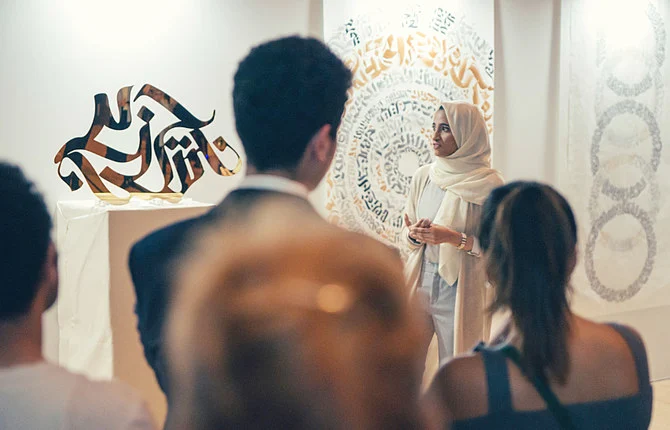
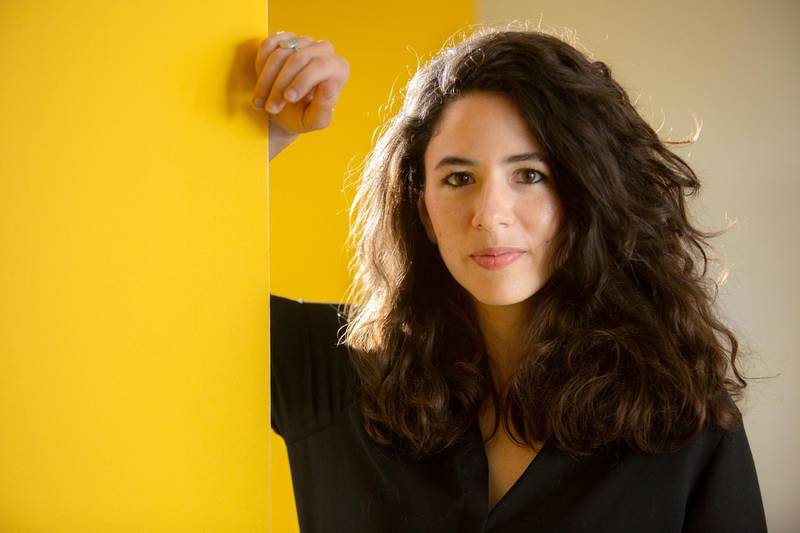
Mawadah Muhtasib, an emerging Saudi artist who reversed the typeface of the Arabic language, is well on her way to becoming a prominent name in the global art scene.
From learning her mother’s technique of writing backward at age 13 to exhibiting in London and New York City, Muhtasib has generated international intrigue in the art of Arabic by creating the first reversed Arabic calligraphy, or calligraffiti, typeface.
Her messages are not only meant to be read, but are also designed to be deciphered. Engaging her audience with the challenge of decoding letters is a large part of experiencing the artwork itself.
“It’s about expanding your human capabilities into creating the impossible. And this is exactly what I have been trying to do,” she told Arab News in an exclusive interview.
FASTFACT
The Arabic language is one of the richest art forms, the artist says, but in modernity, it is difficult to appreciate the depths of something that has become so ordinary.
Born out of a quest to layer the heritage of Arabic letters with innovative graffiti art methods, her work dares to be the first of its kind, granting her Dubai’s Art Bus competition award and a chance to show her work at exclusive showcases.
As graffiti art surged in popularity in 2013, Muhtasib experimented with mural painting alongside a novel group, hoping to develop a boundaryless form of art.
With a vision to modernize the traditional, she created a decorative typeface that mixed Arabic and Latin, written from left to right.
It’s about expanding your human capabilities into creating the impossible.
Mawadah Muhtasib
Muhtasib said: “We are so used to Arabic calligraphy when it comes to Thuluth calligraphy, Al-Kufi, Al-Naskh, and so on, and we just read that way and pass it on.
“When I’m doing my Arabic calligraphy, people sit and stare at my work for hours trying to figure out what these letters are, and the moment they realize it’s Arabic, they start to analyze and see all these letters in a different form that we as Arabic speakers are not used to.”
The Arabic language is one of the richest art forms, the artist says, but in modernity, it is difficult to appreciate the depths of something that has become so ordinary.
The goal is not only to get the viewer to read but to actively reflect on the beauty and form of each stroke and letter within the alphabet.
Muhtasib now passes on her craft through community workshops exclusively for women, most recently at Saudi’s largest light-based festival, Noor Riyadh.
“In my workshops, I do not teach people to write in reverse … I’m basically giving you the key of how to use the tools of starting to practice in the form of Latin calligraphy,” she said.
As soon as students understand the anatomy of the font family, Muhtasib introduces slanted brushes, layering techniques and stroke pressure. From the first session, students are sent home with a new creative form of expression. “The soul of a person is laid out on a page,” she said.
Writing in reverse is not new; the artist’s mother passed down the habit after having to write backward to maintain privacy at work. Alongside that, she passed down her passion for creative innovation.
While most calligraphers in the Kingdom were mimicking Western methods, Muhtasib, at 16 years old, was inspired and encouraged by Tunisian artist eL Seed and Saudi Moroccan artist Shaker Kashgari.
“I took that trick that my mom taught me years ago on how to write and then I changed it into a decorative typeface,” she said.
The concept was designed to preserve the rich heritage of the Arabic language. For foreigners, it offers a chance to engage in the language and learn its history.
“This is Arabic calligraphy in reverse that I took, improved, adjusted and made into a different form. But viewers will also wonder how it actually looked like (originally) and this will make a lot of people go in-depth and learn more about Arabic calligraphy,” Muhtasib said.
The philosophy behind the Typeform has gained interest from international luxury brands such as Louis Vuitton, Carolina Herrera, Montblanc, Sephora and more, resulting in several collaborations.
Muhtasib urges creators to push the boundaries of art and culture.
With calligraphy, “your sky’s the limit,” she said.
source/content: arabnews.com (headline edited)
____________
Mawadah Muhtasib now passes on her craft through community workshops exclusively for women. (Supplied)
William Mullally picks the best movies by Arab filmmakers over the past year.
‘Perfect Strangers’
Director: Wissam Smayra
Starring: Mona Zaki, Nadine Labaki, Georges Khabbaz
The original Italian version of “Perfect Strangers” had already been remade across the world before its Arabic-language iteration was released on Netflix. But nowhere else has it caused the stir that it did in the Middle East. The conceit is simple: Seven friends at a dinner party decide to play a game, placing their phones in the center of the table to make their calls and messages known to all. As the night goes on, their secrets are revealed, upending everything they thought they knew about each other. Not only was this the best version of the film so far, with pitch-perfect casting and memorable performances, it was also the bravest: each of its stars pushed themselves in ways they had never been able to in regional film previously, shattering taboos, capturing the world’s attention and changing Arab cinema forever.
The highest grossing film in the history of Egyptian cinema, “Kira & El Gin” is Marwan Hamed at his best. This is a crowd-pleasing historical epic that not only captures the spirit of Egypt past and present, but sets a course for a new future for the country’s film industry. Following two men fighting the British occupation in Egypt during the 1919 revolution, Hamed’s film rarely sags despite its nearly three-hour run time and sprawling cast, structured more as a suspense thriller than a social studies lecture. As Hamed jumps from genre to genre across his films, proving equally adept at each, one wonders how he will top this, should he try. But it would be foolish to bet against him as he continues to notch up career high after career high.
‘Boy From Heaven’
Director: Tarik Saleh
Starring: Fares Fares, Tawfeek Barhom, Mohammad Bakri
Egyptian-Swedish filmmaker Tarik Saleh has a bone to pick. Growing up in Europe, he was always labeled as ‘other’ — an idea reinforced in the books in his school library describing Arabs as “stupid” and “uncivilized.” Now firmly entrenched as a filmmaker, Saleh refuses to make films tailored to the Western gaze, turning his camera deep into the inner workings of Egyptian society and forcing international viewers to accept that they are seeing things through eyes that are not their own. In “Boy from Heaven,” Saleh goes deep into a corruption scandal at the influential Al-Azhar Mosque, following a hero whose strong Muslim faith is unrattled as he uncovers the evils hiding from plain sight, with scenes and images you won’t soon forget.
‘The Alleys’
Director: Bassel Ghandour
Starring: Maisa Abd Elhadi, Nadia Omran, Munther Rayahna
In 2014’s “Theeb,” Jordanian writer Bassel Ghandour crafted perhaps the greatest example of the Bedouin Western in cinema history. With “The Alleys,” Ghandour steps into the director’s chair for the first time and turns the streets of Amman into the setting for a modern noir, in which the darkness hiding in the city’s back streets slowly boils to the surface. The film’s sprawling nature is both benefit and detriment, but it’s a stirring snapshot nonetheless, elevated by star-making performances from Maisa Abd Elhadi and Nadia Omran.
‘You Resemble Me’
Director: Dina Amer
Starring: Dina Amer, Mouna Soualem, Lorenza Grimaudo
Filmmaker Dina Amer is most familiar to global audiences for her fearless journalism in 2013’s “The Square” and various Vice News stories she produced as their foreign correspondent from the front lines of regional conflicts. “You Resemble Me” cements her as a filmmaker to watch, as her harrowing experimental recounting of the life of Hasna Ait Boulahcen, the woman miscredited as Europe’s first suicide bomber, is a deeply affecting dissection of the roots of terrorism and the racism that Arab women face in Europe. One of the most original films released this year.
The story of Yusra and Sara Mardini, two sisters from Syria who risked their lives to escape conflict for a better future only for one of them to become an Olympian, is so powerful that a film capturing their story could not help but be inspirational. El-Hosaini, the Welsh-Egyptian filmmaker behind 2012’s excellent “My Brother the Devil,” made it into something more — a thought-provoking reframing of the refugee experience at a time when Syrians and many others still suffer from that stigma, as well as a chronicle of women’s empowerment as the structures that held them back crumble, all told with a light touch that never alienates the huge global viewership the Netflix film has enjoyed.
‘Mediterranean Fever’
Director: Maha Haj
Starring: Amer Hlehel, Ashraf Farha, Anat Hadid
Palestinian cinema is often, understandably, a no-holds-barred dissection of the plight of its people. But that is by no means its only manifestation, as Maha Haj, a previous collaborator with renowned satirist Elia Suleiman, proves with her latest feature, “Mediterranean Fever,” the follow up to her acclaimed 2016 feature “Personal Affairs.” Haj focuses here on smaller human problems, following an aspiring writer who suffers from depression and befriends a small-time crook living next door. At times comedic, the film drifts into dark territory while always keeping its audience guessing. After winning best screenplay at Cannes in 2022, Haj has confirmed herself as one of the region’s most singular voices.
There is no more versatile actor working in Arab cinema today than Palestinian actor Saleh Bakri, who, with Touzani’s “The Blue Caftan,” has capped off a tremendous run of eight films in the last two years, including Farah Nabulsi’s Oscar-nominated “The Present” and Mohammed Diab’s “Amira.” This is perhaps his best performance yet. He plays Halim, a struggling master tailor in Morocco whose life is turned upside down when he and his wife take in a young apprentice. Stealing the strikingly-filmed show, however, is his co-star Lubna Azabal as his wife Mina, who is quietly enduring her own private battle with breast cancer as she and her husband struggle to communicate. With this and 2019’s “Adam,” Touzani is already one of Morocco’s great chroniclers.
‘Raven Song’
Director: Mohamed Al-Salman
Starring: Asem Alawad, Ibrahim Alkhairallah, Abdullah Aljafal
The singular contemporary Gulf filmmaker Mohamed Al-Salman is not making films so that the world may understand Saudi Arabia — he’s making them so that Saudi Arabia may understand itself. “Raven Song,” his debut feature after years of acclaimed shorts, is a stylish jump back to 2002 in the Kingdom, a formative time for both the filmmaker and his country, in which the fight between traditionalism and modernity was so heated that it manifested prominently even in the world of poetry. At times dream-like, “Raven Song” is a film that defies definition, with interpretations likely to roll in for years to come.
The Kuwaitis continued to make many distinguished achievements and achieved results in various fields and at the various local, regional and international levels, which were recorded for their work and creativity, reports Al-Rai daily. The following are the most prominent of these achievements during the year 2022.
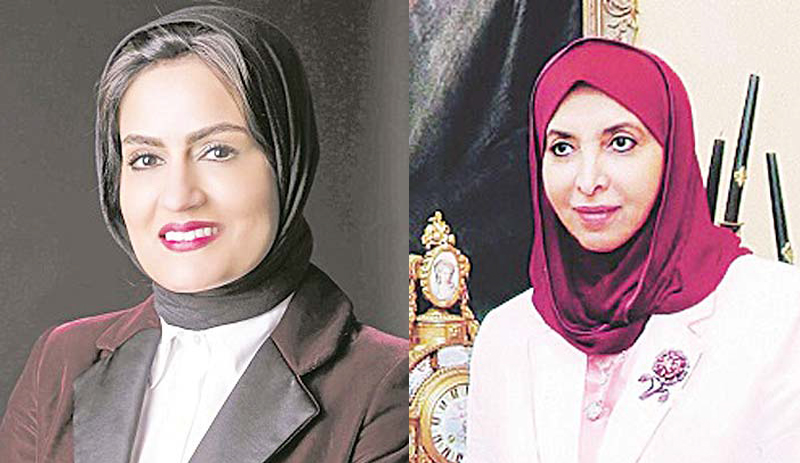
February 10: Dr. Hind Al-Qadri, a researcher at the Dasman Diabetes Institute of the Kuwait Foundation for the Advancement of Sciences, won the 2021 L’Oréal UNESCO Prize for Women in Science within the Middle East Regional Program for Emerging Female Researchers. (see picture below)
February 24: Kuwaiti parachutist Ibrahim Al-Rubaian recorded an unprecedented feat by jumping from a height of 13,000 feet with the biggest fl ag in the sky of Kuwait, with an area of 800 square meters, under the slogan “I raised glory and soared with pride,” coinciding with the national holidays.
February 26: The State of Kuwait entered the Guinness Book of Records by hoisting the country’s largest flag measuring 2,742 square meters and installing it on a mountain peak in the Sultanate of Oman (Jabal Shams), at an altitude of 3,028 meters above sea level, in conjunction with national holidays.
March 21: The Arab Organization for Education, Culture and Science (ALECSO) honored Sheikha Dr. Suad Al-Sabah, in recognition of her brilliant contributions in the literary and cultural fields, at its eighth session of the “Arab Poetry Day” in the Tunisian capital.
April 23: The International Professional Diving Instructors Organization awarded the Kuwait Scientific Club Center for Swimming and Diving a Certificate of Excellence for its contribution to the development of the diving industry inside and outside Kuwait.
June 12: Kuwaiti researchers Dr. Nasser Al-Sayegh and Dr. Ammar Bahman obtained a patent from the US Patent Office, for their invention of a device capable of characterizing the physical state of nanosuspensions dispersed in nanofluids during the dynamic fl ow process.
June 29: Kuwait University announces that Assistant Professor of the Department of Surgical Sciences at the College of Dentistry, Dr. Muhammad Kamal, and the Consultant of Nose and Throat at the Ministry of Health, Dr. Abdul Mohsen Al-Turki, obtained a patent from the United States of America for an alternative medical splint to the nose wicks.
July 2: The International Pharmaceutical Federation selected Dr. Dalal Al-Taweel, Assistant Dean for Student and Academic Affairs at the College of Pharmacy, among 20 rising stars in the field of pharmaceutical research and pharmaceutical education.
August 11: The League of Arab States honors the Kuwaiti youth, Abdullah Al- Shammari, who won the third place for the “Excellence Award for Arab Youth 2022” in the field of “voluntary work” granted by the Council of Arab Ministers of Youth and Sports. The award came about the “Al-Amal Electronic Newspaper” project, which is concerned with the affairs of people with disabilities.
October 2: Plastic artist Munira Al-Qadiri won the prize of the 15th session of the German “Trina Fellbach” exhibition for small sculptures.
October 3: Dr. Badr Al-Enezi, from the Department of Environmental Technology Management at the College of Life Sciences at Kuwait University, obtained a patent on “improving water and solving the problem of environmental pollution in a scientific way” from the United States Patent and Intellectual Property Office.
October 9: Kuwaiti photographer Muhammad Murad won first place in the prestigious international “Mont Photo” competition for photography in the natural world in Spain.
October 12: The European Union of Medical Specialties selected Dr. MuhammadKamal, a Kuwaiti academic, as the first examiner from outside the continent for the Board of Oral, Maxillofacial, and Head and Neck Surgery. The selection was made during the last session held in the Spanish capital, Madrid.
October 12: Lama Fahad Al-Ariman received the “Rising Space Leaders” award presented by the International Astronautical Federation as the representative of the State of Kuwait in this international competition.
October 30: Kuwaiti photographer Muhammad Murad won the top honorary prize in the African “Benjamin Mkapa” competition for developing African wildlife and the American “Nature Best” competition.
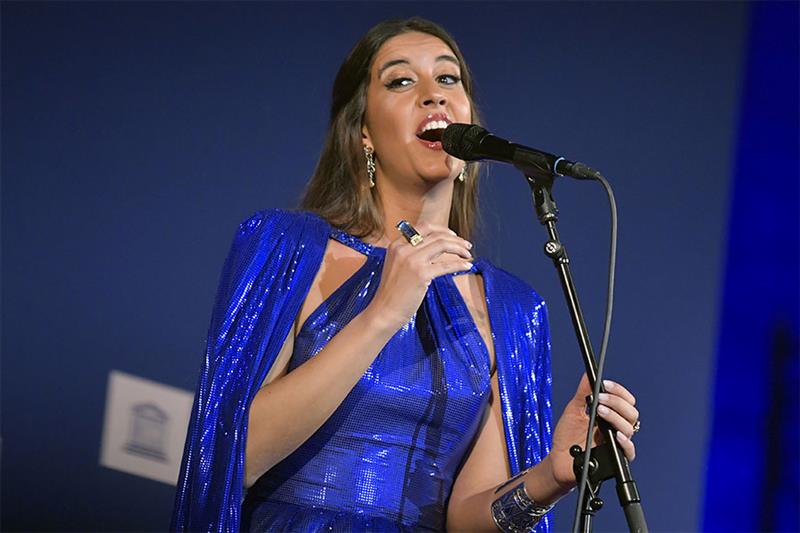
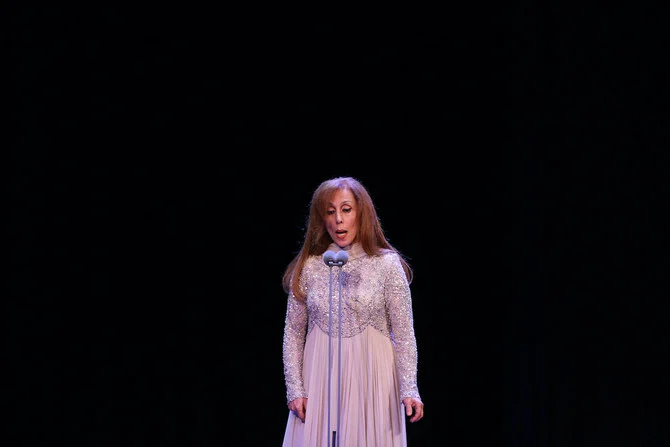
Egyptian mezzo soprano Farrah El-Dibany has performed La Marseillaise the French national anthem, in the beginning of the final FIFA World Cup match against Argentine in Doha, Qatar on Sunday.
Farrah El-Dibany has sang during the re-election of Emmanuel Macron on April 24.
She was awarded France’s Ordre des Arts et des Lettres in the grade of Chevalier (Knight) by France’s Ambassador to Cairo Marc Baréty during an official ceremony in April.
Born in Alexandria in 1989, El-Dibany is one of the well-known Egyptian singers of her generation, establishing herself on an international scale in a short time.
The Syrian-Lebanese economist and activist favours advocacy now over anger in her humanitarian mission to protect refugees.
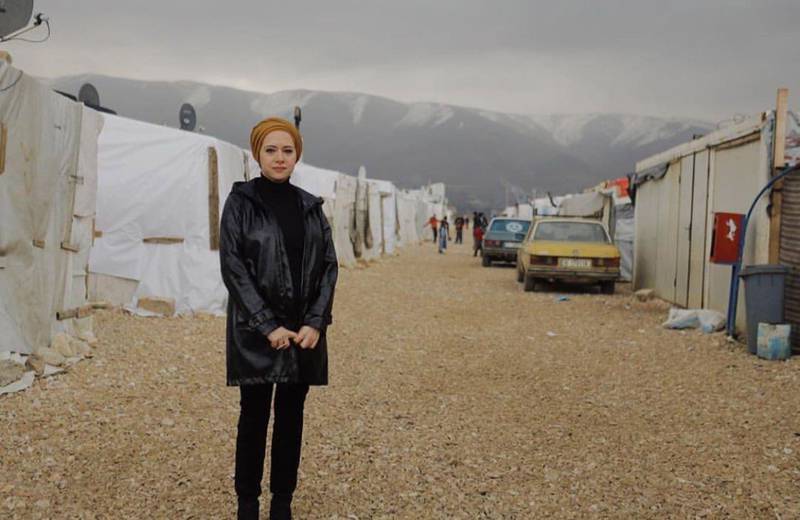
Rouba Mhaissen was on a spring break in Beirut to visit her parents when she heard about the 40 families fleeing lives that had become intolerable over the border in Syria.
It was 2011, when the term “Syrian refugees” did not yet exist, and the arrivals were a harbinger of something inconceivable to Ms Mhaissen back then – the largest displacement crisis of our time.
Little knowing that the families would still be refugees more than a decade on, the 22-year-old student at the London School of Economics raced off to see what they needed.
“I took the family car and drove to meet the families to offer them help,” she tells The National.
“My parents were very worried. At the beginning of my work and until this day, they worry about me because there are risky situations.
“You get threats, and our advocacy work, in particular, can be very controversial. But they believe in the cause and support me.”
Fast forward a decade, and Ms Mhaissen is in London to appear at a charity event run by the Hands Up Foundation as the founder of Sawa for Development and Aid, a grassroots organisation that offers protection, education and relief for Syrian refugees in Lebanon.
Sawa, which means “together” in Arabic, now has about 400 employees, many of whom are from refugee communities, and operates in 130 camps.
In some ways, it is a continuation of work that the young Rouba began as a child in Beirut and Damascus, where she would often volunteer to assist orphans, and refugees from Palestine and, later, those from Iraq.
“I never knew that this would be my career,” Ms Mhaissen says. “I thought I was going to be an academic.
“When the war started in Syria in 2011, I had already applied for my PhD and had no idea I would only end up being a part-time academic.”
Born in Beirut, a “surprise” 10 years after two brothers and a sister, she had been gently steered towards academia by her Lebanese stay-at-home mother and father, a Syrian businessman.
She claims to have been raised as a very spoilt last child yet her parents convinced Ms Mhaissen against studying her heart’s desire, theatre, because it was not what they described as a rigid path.
“I definitely think that, if I was reborn, I would be a dancer because I love to dance and perform,” she says.
It was not to be. Ms Mhaissen grew up going to school in Beirut because the education was deemed better there, and then driving as a family two hours to Damascus for the weekends.
After an undergraduate degree in economics at the American University of Beirut, she embarked on a master’s in development studies at the LSE, followed by a PhD in gender and development at the School of Oriental and African Studies at the University of London.
Somehow, in the middle of all these studies, she found the time to start Sawa, through which Ms Mhaissen unsurprisingly gives priority to education.
Of prime importance to her is that refugees acquire skills to live in dignity, take ownership of their lives and rebuild their communities themselves.
The demands have been many, and, with the spread of coronavirus, she thought that perhaps she might finally learn what it is to relax a little.
“I love, love, love travelling, learning about new cultures, new food and new countries,” Ms Mhaissen says. “But with my son now it’s very hard.”
She shuttles between southern Turkey, Beirut and London with her husband, a one-year-old and another baby on the way.
The pandemic gave rise to a more acute need for aid than ever, although one silver lining is that the whole world has for the first time experienced what it is to be refugees – at least the uncertainty, the inability to plan ahead and lack of communication.
“Camps are one of the hardest environments to sit out Covid as there is nowhere to self-isolate, no internet or devices for home-schooling, and gender-based violence rose dramatically,” Ms Mhaissen says.
“People talk about refugees and their ‘resilience’, a term that is so misused. Conditions for refugees in host countries and their neighbours are constantly terrible and getting worse all the time.
“A Syrian family in Lebanon has to move their tent three times on average in winter when it floods, and then people wonder why they get on boats. It’s because they have no hope.”
Over the years, Ms Mhaissen has received many accolades and honours, including being named on the 2017 Forbes 30Under30 list of most influential people in Policy and Law.
There was also the Vital Voices Global Leadership Award and the Rafto Prize “for defending human rights from the local to the global level for people living as refugees”, both in 2019.
She has been invited to conferences, summits on Syria – at one in Brussels she met her husband, an activist from Aleppo – and this year became the 10th Arab woman to address the UN Security Council.
Late last month, days befor 27 migrants died in the English Channel, she was at the Opera Garnier in Paris being presented with the International Diane von Furstenberg Award alongside businesswoman and philanthropist Melinda Gates, CNN chief international correspondent Clarissa Ward, Burmese human rights advocate Wai Wai Nu, and climate change activist Vanessa Nakate.
She took the opportunity to tell the room full of European policymakers and philanthropists that attempting the crossing is not an illegal act.
“You have the right legally to apply for asylum in whatever country you are in,” Ms Mhaissen says. “We need to live up to our responsibility to these people.”
She also talked about the refugees stuck at the border of Belarus and Poland, and of one in particular, Ahmed, who had grown up in a camp, but was the first of the refugees to be buried officially after he drowned in a river there. His mother joined the funeral on a conference call.
“I reminded those listening that this was a woman who had been pregnant with him, who had celebrated his birthdays, who had brought him up like any mother, and who was now connecting with him on social media, just like [those in the audience] used social media to connect with their loved ones during the pandemic … except this was his funeral.
“Everyone was really moved and many were in tears. I always try to humanise it for the wider public, and I use the word ‘humans’ as often as I can when I talk about refugees.
“‘Refugee’ carries a lot of legal rights with it so while there is certainly fatigue associated with the word, it’s not a redundant word that we should stop using.
“Politicians, on the other hand, want us to call them migrants because it sounds more scary.”
The citation on the DVF award was for Ms Mhaissen’s “dedication and fierceness to support displaced Syrian individuals and families”, which world leaders gathered at the Support for Syria donor conference in London a few years earlier experienced in full force.
She was the first speaker up and was introduced by then UN secretary general Ban Ki-moon, who said: “Rouba Mhaissen, you have the floor. Two minutes.”
But a stern-looking Ma Mhaissen retorted that, as one of the few Syrians at the event speaking in the name of Syria, she wasn’t sure that she would stick to two minutes. She was at the podium for nearly nine.
It was a passionate speech in which she criticised “Fortress Europe”, her “token presence at an ad hoc event for which the priorities have already been pre-determined without our involvement”, and counter-terrorist legislation stopping funds being sent where they were most needed.
“Don’t fight the wrong people, guys,” Ms Mhaissen said.
She said she could see good leaders in the room but hoped for greatness from them along the lines of “the next Martin Luther King, the next Benazir Bhutto, the next Churchill, the next Madeline Albright, the next Mandela of our time …
“Each one of you can be that person,” she told them, “Remember that.”
Ms Mhaissen smiles at the memory.
“I realised that those in power have incredibly thick skin,” she says. “They are inured to what the situation is on the ground.
“I used to be very angry and lead a crazy life where I would come out of the field where kids had to step over their parents’ dead bodies to get to safety, and then you’re invited as the token Syrian to an event in a five-star hotel where people are drinking champagne and eating caviar.”
With a dawning realisation that advocacy, not anger, was the way to go about beating the system, the focus has since been more on changing laws that help refugees and doing the day-to-day work that affects people’s lives.
Her spirituality has been of great support throughout. “Knowing that God has been alongside me all along, and my faith, have helped me along the way,” she says.
Ms Mhaissen’s message to those gathered on Wednesday night in the 17th-century Great Hall of Lambeth Palace at the annual Singing for Syrians carol concert will be comparatively gentler in nature.
The event raises funds for Hands Up Foundation’s humanitarian work in Syria for which Sawa is a partner on educational projects.
This year it will feature the author and illustrator Nadine Kaadan, Citizens of the World Choir, actress and activist Joanna Lumley and actor Tom Hollander.
She will, she says, of course push everyone to donate to the foundation’s Big Give Christmas Challenge as a firm believer in how the deeds of the few can transform the lives of the many.
“I always say that what goes around comes around, and the more we give the more blessed our lives are,” Ms Mhaissen says. “It’s like investing in the best thing ever.”
The memory of an email received from a young Icelandic citizen will also be shared. It arrived in her inbox at the time of a terrible massacre in Syria, with the sender asking what help he could give.
Shocked, Ms Mhaissen recalls staring at the message for a long time, wondering how to answer a person on a Nordic island country in the North Atlantic Ocean.
“I told him, ‘If you want to help Syria today, call your mother. Just call your mother and see how she is doing. We are in a world of small circles and they are all interconnected …
“Sometimes,” she says, “it’s best just to start local.”
She is the Arab world’s greatest living musical icon, but Fayrouz remains an enigma. She retains a sometimes-infuriating aura of mystery, rarely giving interviews and ardently protecting the privacy of her family. On stage she appears devoid of emotion — motionless and expressionless. Those characteristics have themselves become iconic, with Fayrouz’s striking but emotionless features adorning everything from handbags and posters to Beirut’s city walls.
Born Nouhad Haddad in 1934, during the course of her career Fayrouz has recorded hundreds of songs, starred in dozens of musicals and movies, and toured the world. From 1957 onwards, when she first performed at the Baalbeck International Festival, she has become one of the Arab world’s most beloved singers. And in doing so she would unite her often-fractious homeland.
All Lebanese remember the first time they heard Fayrouz. For Tania Saleh, it was during a drive to Syria to escape the beginning of the Lebanese Civil War. She remembers one song in particular — “Roudani Ila Biladi” (Take Me Back To My Homeland).
“That song really marked me,” says Saleh, a singer-songwriter and visual artist. “My mother was crying while she was driving and the song created this really intense emotional moment. And I remember thinking, ‘How can a song affect someone so much? It’s just a song.’ But it affected me, too, in a manner that I didn’t understand back then.”
Fayrouz remained in Lebanon for the entirety of the war and refused to take sides. Although she continued to sing in venues across the world, she did not perform in Lebanon until the conflict was over. This neutrality, and the patriotic nature of many of her songs, meant she was a rare symbol of national unity, with all sides listening to her music throughout the 15 years of civil war. She was, as Saleh says, an “emotional anchor for all Lebanese during the war,” regardless of religion or political beliefs. When she released “Li Beirut“ (arranged and adapted by her son Ziad Rahbani) in 1984, Fayrouz and Beirut became inseparable. More than ever she embodied the very essence of what it meant to be Lebanese.
None of which would have been possible without the music of the Rahbani Brothers. Fayrouz, who was a chorus singer at Radio Lebanon in the early 1950s, met Mansour and Assi Rahbani through the composer Halim El-Roumi in 1951. She went on to marry Assi a few years later and together the trio would revolutionize popular Lebanese music. The Rahbani Brothers fused musical genres, including Levantine folkloric traditions and the music of Latin America, and incorporated both Western and Russian elements into their compositions. It was Fayrouz, however, who gave voice to their musical vision.
Fayrouz sang of an almost mythical Lebanon. She sang of love and desire, but also of an idealized Lebanese mountain village, of olive trees and jasmine, of vineyards and streams. “Lyrically, they created the Lebanon we now love,” says Saleh of the brothers, who followed in the footsteps of writers such as Khalil Gibran and Mikhail Naimy, who helped to forge a romanticized image of Lebanon that many of its citizens still cling to today.
As the Palestinian poet and film director Hind Shoufani notes, Fayrouz represents “the village girl, the stories of love, the fetching of fresh water, the mountain, the resistance, the power of the people; that kind of simple, beautiful daily existence that is in harmony with nature.” As such, her songs have an additional, heartbreaking poignancy, because the Lebanon she sings of bears no resemblance to the Lebanon of today. She sings of a fading dream — one that is shared by much of the Arab world.
That vision was rooted in Lebanon’s golden age, with Fayrouz intimately linked to the formation of a national cultural identity in the years following independence from France. As the acclaimed indie-music producer Zeid Hamdan says, Fayrouz would carry that identity “with elegance and depth like no other singer.”
Fayrouz and the Rahbani Brothers changed popular Arabic music forever. Umm Kulthoum, another icon of the Arab world, sang songs of love that could last for up to an hour and were deeply embedded in the tarab tradition. The songs of Fayrouz and the Rahbani Brothers, however, were far shorter, utilized the Lebanese dialect, and embraced new melodic forms.
“As a musician, I am very inspired by the dialect that Fayrouz sings,” says Hamdan, “arguably best known as one half of the trip-hop duo Soapkills. “It’s not only classical Arabic, it’s often modern Lebanese, and the Rahbanis — from Assi to Ziad — used the Lebanese dialect in a very clever way throughout their repertoire.”
Hamdan was introduced to Fayrouz in the late 1990s by Yasmine Hamdan (no relation), his Soapkills partner. Encouraged by her, he bought a double K7 cassette of Fayrouz’s “Andaloussiyat” and immediately fell in love with three tracks, one of which was “Ya Man Hawa.”
“The lyrics are simply incredible,” he says. “It’s a form of poetry that is several hundred years old called muwashshah and I wish I could do justice to the beauty of the words.” Another was “Yara El Jadayel,” on which, at a certain point, Fayrouz “sings at a very high pitch and very softly, the melody almost whispered on a piano arpeggio”.
It is the wonder and versatility of Fayrouz’s voice that continues to entrance audiences across the world. El-Roumi thought her voice so beautiful that he gave her the nickname Fayrouz (Arabic for turquoise) and went on to become the first person to compose for her.
“Fayrouz has one of the most distinctive voices in the Arab world,” says Egyptian-Belgian singer Natacha Atlas, who has worked with the likes of Peter Gabriel and Nitin Sawhney. “One can always tell that it’s (her) voice. It is as delicate as it is beautiful and strong, and her voice’s ability to (carry) such strong emotions is always extraordinary. She is one of my greatest influences. When I hear her, I often melt in tears at the sheer beauty of her voice and how it also evokes a deep nostalgia in me for the Middle East as it once was, and how everything has changed almost beyond recognition.”
Fayrouz’s fame outside of the Levant can also be traced back to her support of the Palestinian cause. As early as 1957, Fayrouz and the Rahbani Brothers released “Rajioun” (We Will Return), a collection of pro-Palestinian anthems. This was followed in 1967 by the release of “Al-Quds Fil Bal” (Jerusalem In My Heart), and as recently as 2018 she was still dedicating songs to Palestinians killed on Gaza’s border with Israel.
When her husband’s health began to fail in the 1970s, Fayrouz began to collaborate more closely with her son Ziad — the eldest of her four children. One of the albums composed and arranged by him was “Wahdon,” which was released on the Zida record label in 1979 and includes the song “Al Bosta.”
“I cherish and love her experience with Ziad,” says Saleh. “The albums that she did with him took her to jazz and bossa nova and sometimes to funk. This gave Fayrouz another dimension — that of the risk taker. She went out of her comfort zone, and that is very rare.”
This helped to cement her reputation with a younger generation and she continues to evoke a deep sense of nostalgia, not only among the Lebanese, but across the Levant and North Africa. Many Lebanese still start their day listening to Fayrouz’s songs and, despite family disputes over royalties, her controversial performance in Damascus in 2008, and accusations of plagiarism directed at the Rahbani family, her status as a cultural icon endures. When the French President Emmanuel Macron visited Lebanon in 2020, he chose the home of Fayrouz as one of his first ports of call, not those of the country’s political leaders.
“They described this beautiful Lebanon and they made us dream that this is our country, which was actually just a picture they had created,” says Saleh of Fayrouz and the Rahbani Brothers. “We were looking for it: ‘Where is this Lebanon you are talking about guys?’ We were always trying to find it but we never did. But thankfully they did create this image, because the bond that we have with our country is mainly because of them.”
New Shubbak chairwoman Shadia El Dardiry on the privilege of supporting those from all walks of life, whether beleaguered artists or stranded migrants.
Shadia El Dardiry has been on a journey of discovery in London since arriving nearly seven years ago but one scene from her impromptu walking tours stands out from the rest.
The unexpected sight and sound of two boys speaking Arabic in a Syrian dialect as they passed by halted El Dardiry in her tracks as she tried to figure out why she recognised them.
Oblivious to her stopping and staring, they walked on without a glance but it dawned on her that she had helped the younger of the siblings when he was an unaccompanied minor stuck in Calais, after fleeing the war in Syria.
“I remember feeling so uplifted, knowing that the younger brother finally had a home and that they had been reunited,” El Dardiry tells The National, “and just seeing them live something akin to a normal life in London on a Saturday afternoon.
“It was all thanks to the work of a group of amazing lawyers and people who took these cases on at a time when the UK was pretty much refusing to comply with its legal obligations … it filled me with hope to see the fruit of all that hard work before my eyes.”
El Dardiry had signed up as a volunteer while studying to be a lawyer but she is modest about her part “on the margins” of the reunification. All she did, she says, was use her Arabic and English to interview refugees and their family members.
She also practises as a solicitor specialising in employment law. “There’s no hierarchy of problems,” El Dardiry says. “Unfortunately, it would be great if you didn’t need employment lawyers or immigration lawyers or any lawyers really. That would be, I think, everyone’s utopia,” she says, with a self-deprecating smile.
El Dardiry believes that her heritage and nomadic upbringing – “being a bit from everywhere” – make her particularly attuned to migration issues. As an adult, she has lived in Paris, Brussels, Geneva and Copenhagen but she ascribes what she calls her “mixed identities” to being raised in Guinea, Canada and Egypt.
Born in Montreal to an Egyptian father and an Italian mother, El Dardiry moved as a young child with her older sister to West Africa with their parents, an accountant and a doctor, who met while working in Guinea in the 1970s.
She conjures up vivid memories of a tranquil time in the port city of Kamsar, punctuated by daily family lunches and weekends of camping and trips to the beach or local waterfalls.
With just a local fresh goods market and one shop, the simplicity of life created a strong sense of community. But even the young El Dardiry was conscious that the family, as expatriates in one of the world’s most impoverished countries, were “living here but we’re not from here, and we’re very privileged”.
After moving back to Canada for a few years at the age of 7, El Dardiry relocated to Egypt with her father where she completed her schooling. An adolescence spent in one of the most populous and multi-ethnic Arab countries solidified her sense of compassion, as well as how she saw herself.
“I loved it,” she says. “Cairo is great. It’s hectic, it’s chaotic, it’s inconvenient in many ways, but it has a charm to it. I think it definitely shaped me. That’s where I developed my Arab identity and why I started saying, ‘I’m Arab’ and ‘I’m Egyptian’. Before, I used to say I was Canadian. So I think that there was a real shift there.”
It also gave her the opportunity to improve her command of Arabic. El Dardiry concedes, however, that she can never quite pass for a native on her regular trips back to the city that each time is “a little bit different, a bit bigger”.
“I have an accent and people make fun of me,” she says, laughing. “The taxi drivers love it. But I do tell them: ‘Don’t rip me off! I still know the prices.’”
Coming of age in a land that housed the likes of the Nobel-prize laureate Naguib Mahfouz and the public intellectual Edward Said, it is no surprise that El Dardiry grew fond of Arabic literature. The seeds had been sown early by her father who regaled her about the region’s authors and introduced her to the Tales of Goha.
“He’s very much a fixture of Arabic storytelling,” El Dardiry says of the titular satirical folk character whose sidekick is a long-suffering but faithful donkey. “Though I’m pretty sure my Dad eventually also started improvising his own Goha stories for me.”
After a graduate degree in political science at McGill University in Montreal, she studied as an exchange student for two years in Paris for her master’s. While writing her thesis on identity and integration of second-generation North African migrants, she recalls being struck by the extent of discrimination against those communities in the French capital.
“We all know it exists,” El Dardiry says, “but I think I was sheltered in Canada from that. And that’s what really drew me in. I think that was kind of a stepping stone where I thought ‘this is actually a sector that I’m really, really passionate about’, both in terms of refugees and asylum seekers but also populations that settle in countries and how their identities change over time.”
In a natural progression, she entered the world of non-governmental groups in various cities across Europe. She spent four years in Denmark with a human rights organisation working on asylum issues that kept her Middle East roots close and made use of her language skills.
She concedes that there may have been one downside to so enthusiastically soaking up the culture in Copenhagen and learning the local lexicon. “My Arabic suffered as I picked up some Danish, but it was great,” she says.
Her years as a human rights advocate were starting to take their toll, however. She reflects on the difficulties and taxing nature of working on immigration and asylum issues day in, day out.
It gave rise, she says, to a feeling of helplessness, particularly when the Middle East was haemorrhaging people fleeing the conflicts that followed the Arab uprisings.
“You had really strong political opposition to that in Europe, and you still have that,” El Dardiry says. “I think it just felt like a really difficult fight that we were never going to win. It was not getting better and it is only getting worse.”
She decided to qualify as a lawyer in London, and was drawn to Bates Wells. The city law firm is renowned for combining a strong commercial and charity practice with a general emphasis on public interest work.
El Dardiry’s chosen field of employment law allows a bit more distance than is afforded to those whose full-time focus is on migrants. “The lawyers who do are really impressive and have a lot of strength because it’s definitely something I’ve struggled with,” she says.
Among Bates Wells’ large charity clientele are many within the arts, and it wasn’t long before a colleague put her forward as a trustee for Shubbak in 2018.
“This offers me a chance to be more involved in art and culture coming from the Arab world,” she says. “At the same time, I’m realistic that I’m not an artist and I don’t work in that every day. So it just gave me an opportunity to contribute.”
As chairwoman, her role is to provide strategic direction to Shubbak and to assist in the long-term vision of supporting and celebrating the diversity of Arab artists’ creativity and innovation in the UK and the Mena region.
“It is very much there to act as a bridge between those two geographical locations,” she says.
Shubbak, which means window in Arabic, has evolved in the decade since its launch from a festival to bring people together every two years to what El Dardiry explains is a permanent presence with ongoing projects taking place between the biennial programmes.
To the delight of deprived art lovers, this year’s event will go ahead after the last of England’s Covid-19 restrictions lift in June. It’s a welcome hurrah for a sector that has been “hugely shaken” by the pandemic, but El Dardiry is keen to acknowledge the resilience of artists and their ability to create work out of any situation. “It’s really amazing,” she says.
While the festival will be physically held in London, the organisers have adopted a hybrid approach. Some works will be presented digitally which, for the first time ever, will make them available to a global audience. It could well be a pilot for things to come.
“I think there’s going to be even more creative ways of linking the two together,” she says. “It’s another way of presenting and working which will just enrich the organisation.”
As she waits for international travel to open up so that she can see her family in Canada and Egypt again, El Dardiry will revel in Shubbak’s role in the reinvigoration of London.
She is a flaneuse, being a “bit more of a walker” than most, and has both revelled in and been saddened by the unusually deserted streets of London for which she has developed such a deep affection on her regular roams.
When asked if all those pre-Covid hours spent pounding the pavements meant that she had been ready for lockdown restrictions, El Dardiry laughs in agreement that she had been “good to go”.
“If anything, I think the pandemic has made me tired of walking,” she says, half lamenting that everyone’s doing it now.
It is perhaps one of the lesser-known side effects of the coronavirus, but seems unlikely to impede El Dardiry from making great strides one way or another in the future.
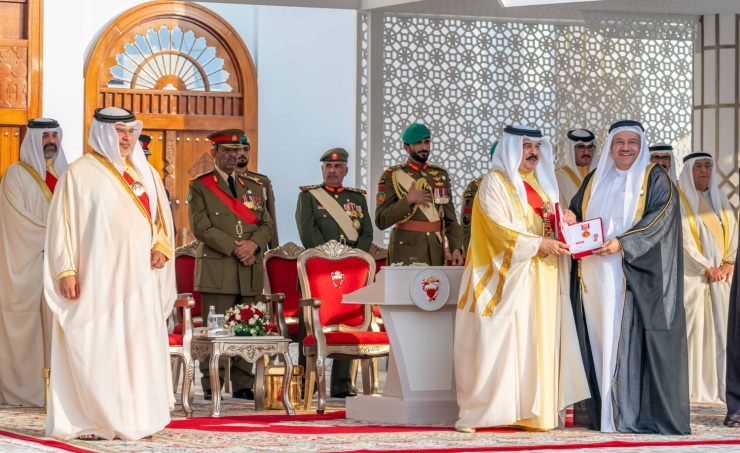
His Majesty King Hamad bin Isa Al Khalifa today patronised, in the presence of His Royal Highness Prince Salman bin Hamad Al Khalifa, the Crown Prince and Prime Minister, the ceremony held at the Al-Sakhir Palace on the occasion of the kingdom’s National Days, in commemoration of the establishment of the modern Bahraini State as an Arab and Muslim state, founded by Ahmed Al Fateh in 1783, the anniversary of its full membership in the United Nations, and the anniversary of His Majesty the King’s Accession to the Throne.
On arrival at the Al-Sakhir Palace, the artillery fired 21 rounds to salute HM the King, who was accompanied by a constellation of cavalry.
The National Anthem was played, and some holy Quran verses were recited.
After that, HM King Hamad delivered the following keynote speech:
“In the name of God, the most Merciful, the most Compassionate,
Praise be to Allah, and prayers and peace be upon Prophet Mohammed and his family and companions,
Your Highnesses, Excellencies, Distinguished Guests,
May the peace, mercy and blessings of God be upon you,
This year’s glorious National Day arrives with its atmosphere full of joy on the return of our lives to their former state, thanks to God. Here, we meet you on this blessed day of our dear homeland, in the essence of its commemoration, which returns to us with good and affection, in the expansive glory of the Kingdom of Bahrain, whose civilisational achievements have, for over two centuries, continued to transcend among nations, through the giving of its people at all times and periods.
In fact, with every new commemoration of this day with its experiences and achievements, the more confidence we feel in our progress in building towards the goal of the advancement and prosperity of our honourable citizens, a matter to which our esteemed Government is committed, and for which it strives with determination and diligence.
In this regard, we must first commend the national endeavours being undertaken to achieve our ultimate goal to achieve good and prosperity for every citizen, and we refer, in this context, to the results of the Economic Recovery Plan, whose positive impact extends to all sectors of development. We are proud of the active role of financial and economic support programmes, particularly in facing the economic and health difficulties, and we direct raising their efficiency and enhancing equitable access to them, by considering their effectiveness and great benefit to living standards.
Here, we express our satisfaction with what has been achieved in meeting the housing needs of the Bahraini family, commending the record government achievement, and emphasising in this regard the need to continue development plans for the housing sector with their innovative solutions and vast investments, in partnership with the private sector, to ensure decent and suitable housing for citizens.
In the context of its priorities, our country continues to preserve and protect human rights under the auspices of its independent legal institutions, and among the results of those efforts is the comprehensive programme of alternative sanctions and measures, which we are keen to realise given its noble objectives of giving its beneficiaries new hope for the stability of their families, and for a promising future of giving and contributing to the building of their society.
Brothers and sisters, on such a special occasion that brings us together with you today, it gives us pleasure to celebrate the pioneers of national action, from the sons and daughters of our dear nation, in honour of their efforts, and in recognition of their outstanding services, which we greatly appreciate, and we will not find a more remarkable day in the life of the country to express to them pride in their leadership and excellence, and to thank them for giving this day its most beautiful meaning.
May God grant you all success, and may the peace, mercy and blessings of God be upon you.”
Then, HM the King conferred medals on national work pioneers.
After that, Kefaya Habib Al-Anzoor, delivered a statement on behalf of the honourees in which she expressed deepest pride in HM the King’s patronage of the auspicious National Days, and honouring of national work pioneers.
She asserted that the annual honouring of the distinguished national work pioneers is an impetus for them to be more dedicated in serving the nation and raising its flags at all international gatherings so that Bahrain always remains at the top across various fields.
She lauded the historic wide-ranging achievements attained by the kingdom during HM King Hamad’s prosperous era, noting that the precious royal honouring is a source of pride, and that it motivates everyone to do their utmost to be more dedicated to serving the homeland.
She affirmed that the kingdom’HM the King’s patronage of the honouring of military and civilian national work pioneers will optimise the kingdom’s accomplishments, noting that thanks to the constant royal support and forward-looking vision, Bahrainis have brought about unprecedented achievements in the scientific, cultural and youth fields, locally and abroad.
She extended deepest thanks, appreciation and gratitude to HM the King for honouring national work pioneers on this cherished national occasion.
She also extended sincere congratulations to HM King Hamad on the glorious National Days, wishing HM the King abundant health, happiness and long life.
The honouree list included:
– Shaikh Mohammed bin Khalifa bin Ahmed Al Khalifa
– Faeqa bint Saeed Al-Saleh
– Ali bin Mohammed Al-Romaihi
– Ayman bin Tawfiq Al-Moayyed
– Shaikh Hesham bin Abdulrahman bin Mohammed Al Khalifa
– Eman Ahmed Al-Dossari
– Osama Saleh Al-Alawi
– Major-General Mohammad Abdulla Al-Noaimi
– Brigadier-General Fahd Mohammed Al-Humaidan Al-Najdi
– Brigadier-General Dr. Hassan Mohammad Noor
– Brigadier-General Mohammed bin Mohammed bin Dinah
– Colonel Tariq Ahmed Ali Al-Buflasa
– Warrant Officer Ahmed Mohammad Ali Mohammad
– Abdulla Jehad Abdulla Al-Zain
– Faisal Mohammed Hassan Al-Mahroos
– Ghassan Ali Muhanna Mohammed Al-Muhanna
– Mark Joseph Thomas
– Mazen Mohammed Ahmad Mattar
– Ahmed Yousif Talib Abdulghani
– Abdulla Ali Al-Binkhalil
– Mustafa Mohammed Ahmed Mustafa
– Nawaf Abdulla Hamza
– Shaikha Mariam bint Abdulwahhab Al Khalifa
– Chancellor Rashid Mohammed Bu Najma
– Abdulla Khalid Ahmed Al-Nassar Al-Dossari
– Mohammed Khalid Al-Fadhala
– Hamad Ali Al-Mannai
– Ambassador Ali Jassim Al-Aradi
– Nada Ahmed Mustafa
– Adnan Abdulwahhab Eshaq
– Kefaya Habib Al-Anzoor
– Akbar Jassim Ashour
– Ziyad Adel Darwish
– Fatima Abdulghani Ismail
– Amna Ali Al-Arrayad
– Huda Mirza Abbas Al-Salman
– Mohammad Yusif Al-Binfalah
– Ramzi Raisan Al-Badran
– Najlaa Mohammed Qassim Al-Shirawi
– Dr. Haitham Ali Jahrami
– Dr. Abdulla Mohammed Al-Khan
– Badriya Jassim Al-Kuwaiti
– Marwan Fuad Salman Kamal
– Alia Ali Al-Aali
– Mustafa Aqeel Al-Shaikh
– Lama Abbas Saeed Al Mahrous
– Abdulhussain Ibrahim Isa
– Beshara Abdo Beshara
– Hanan Ibrahim Al Emadi
– Mohammed Salman Makki Habib
– Ahmed Abdulghani Isa Ahmed Madan
– Nabeel Abdulrahman Ajur
– Hussain Jassim Mohammed Ali Al-Sakran
– Khalifa Yacub Yousif Al-Amer
– Mohammed Jassim Al-Amer.
WHQ
source/content: bna.bh (headline edited)
_____________
HM King patronises Bahrain’s celebrations of its National Days
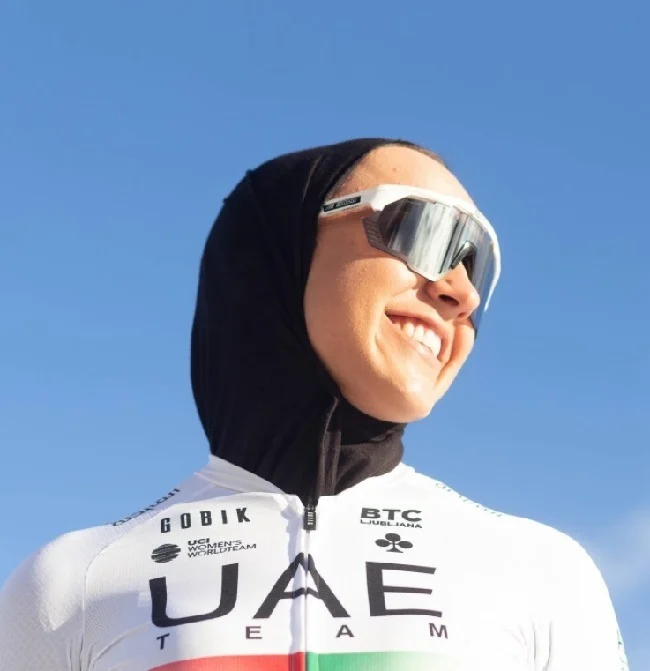
‘I feel like I hold a lot of hope’ says first Emirati rider in Women’s WorldTour.
As the first Emirati rider in the Women’s WorldTour and the sole national representative on UAE Team ADQ, Safiya Al Sayegh is feeling both the pressures and the privileges of her position going into 2022.
20-year-old Al Sayegh is the UAE national road race and time trial champion, and was approached by the team last November after UAE Team Emirates took over Alé BTC Ljubljana’s WorldTeam licence.
This is Al Sayegh’s first professional contract and a significant adjustment from racing for the Dubai Police Cycling Team, but her first experience with the UAE Team ADQhas been positive.
“When I was going to Spain [for training camp] and before I left, it was quite overwhelming to think of how it was going to be and how it’s going to go,” she wondered.
“Will I adjust with the team and how will I get on? But I’m very happy to say that everything went really well. I really enjoyed it, it was a really good start.”
Al Sayegh is the first female rider from the UAE to join a WorldTeam and only the second of any gender, after UAE Team Emirates’ Yousif Mirza, and she acknowledged the pressures that come with being in that position.
“It’s a big honour, and it’s actually a big responsibility on my shoulders,” she said. “I feel like I hold a lot of hope, especially from my country, because lots of people have helped me. And it really makes me want to push harder and strive even higher, with all the support and hope I have from the country – and from the Arab world, actually. It really pushes me to want more, to achieve more and to progress.
The men’s UAE Team Emirates squad, Al Sayegh said, has helped raise the profile of the sport in the UAE among both men and women, and she is looking forward to ‘representing all the local girls’.
Though an experienced racer in the UAE and Asia, Al Sayegh has only raced in Europe once before, the Rás na mBan stage race in Ireland in 2017, and she is conscious of the challenges ahead of her this year.
“Keeping up with the level is one concern I have,” she said.
“But hopefully with hard work, I will try to progress to the level of Europe. And one of my concerns is that pretty much every day in the peloton, crashes are happening. So I just hope to stay safe while racing.”
In the UAE much of Al Sayegh’s riding is done on wide highways or flat, protected bike paths, meaning even the change in terrain is a source of apprehension.
“In Europe, I know some races can be on quite dangerous roads or have quite steep downhills and stuff. So I do look forward to racing but I am quite worried about all the crashes and the dangers.”
Al Sayegh will continue to compete primarily in the UAE for the opening months of the season as she completes her university studies in Dubai, and will join the team in Europe from May.
“I really look forward to all the races my team is going to race, and I’ll be cheering here from the UAE.”
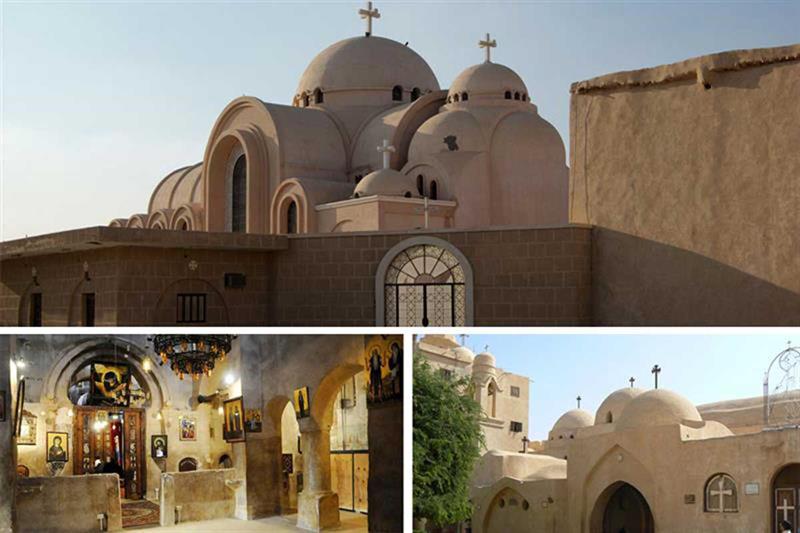
“Festivities and celebrations affiliated with the Journey of the Holy Family in Egypt are now on UNESCO’s Representative List of Intangible Cultural Heritage of Humanity,” professor Nahla Imam, heritage consultant at the Egyptian Ministry of Culture and country representative of Egypt at the 2003 Convention of Safeguarding the Intangible Heritage of UNESCO, told Ahram Online on Wednesday.
Imam credited the move to the efforts of the Egyptian ministries of culture and foreign affairs, adding that Egypt’s efforts were almost unanimously supported by UNESCO’s Inter-Governmental Committee.
This is the seventh intangible cultural heritage element that Egypt enlists in UNESCO. Prior to the Journey of the Holy Family, the Egyptian manual-textile industry in Upper Egypt was put on the UNESCO List of Intangible Cultural Heritage Sites in Need of Urgent Preservation.
Egypt first enlisted El-Sirah El-Helalya (The Epic of Beni Helal) in 2008, Tahteeb(Stick Art) in 2016, the Aragouz Puppet in 2018, and the knowledge and traditions affiliated with palm trees in 2019.
According to the accounts of historians, the Holy Family spent around four years in Egypt.
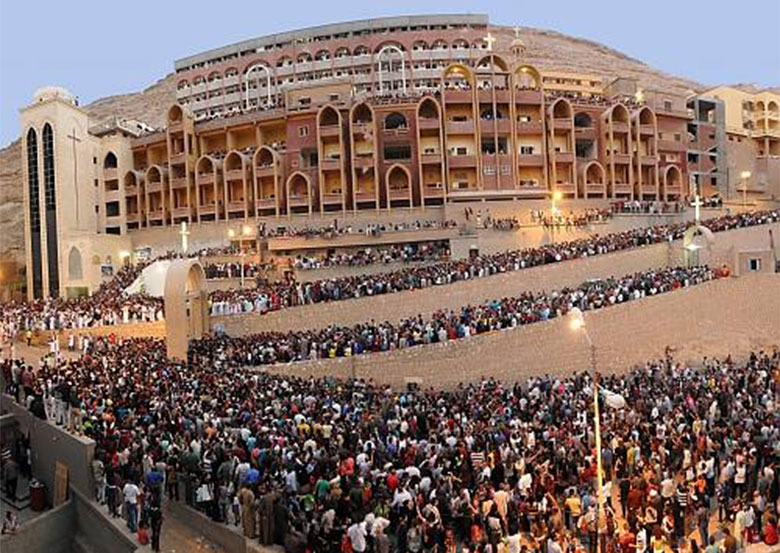
Their trip started in the Sinai at Al-Farma, on the border with Gaza, where they arrived after fleeing Jerusalem. Their trip ended in Durnaka, Assiut, venue of the famous Monastery where the feast of Virgin Mary is celebrated in August each year.