Arabs & Arabian Records Aggregator. Chronicler. Milestones of the 25 Countries of the Arabic Speaking World (official / co-official). AGCC. MENA. Global. Ist's to Top 10's. Records. Read & Enjoy./ www.arabianrecords.org
Mohammad Abdullah Al Gergawi, Minister of Cabinet Affairs, Chairman of the Committee leading Great Arab Minds, and Secretary-General of the Mohammed Bin Rashid Al Maktoum Global Initiatives (MBRGI), highlighted the details of “The Great Arab Minds” initiative.
Launched by His Highness Sheikh Mohammed bin Rashid Al Maktoum, Vice President, Prime Minister and Ruler of Dubai, in January 2022, the initiative is the Arab world’s largest movement designed to search for exceptional talents among Arab scientists, thinkers, and innovators across key fields.
The Great Arab Minds initiative, under the MBRGI, aims to identify, support and acknowledge leading thinkers in the region, amplify their impact and inspire future generations. One of its main purposes is to reduce the emigration of Arab scientists, specialists, intellectuals, doctors, and engineers.
He affirmed that “The Great Arab Minds” initiative reflect His Highness’ vision in reigniting the Arab World’s Civilisation Drive, support great Arab minds and acknowledge their work and achievements, in service of humanity.
Mohammad Al Gergawi pointed out the importance of the Arab Reading Challenge initiative launched by His Highness Sheikh Mohammed bin Rashid Al Maktoum, among many other development projects, serving more than 91 million beneficiaries.
A study conducted by KPMG, showed that ignorance costs the Arab world more than US$2 trillion. The Great Arab Minds initiative aims to change this reality and contribute to shaping a brighter future for Arab generations.
During an event organised in the Museum of the Future to announce the details of the initiative, Mohammad Al Gergawi witnessed the signing of four partnerships between “The Great Arab Minds” initiative and KPMG, LinkedIn, Meta, and Majarra.
The initiative’s mission is to search for exceptional talents among Arab scientists, thinkers, and innovators across key fields, aiming to identify, support and acknowledge leading thinkers in the region, amplify their impact and inspire future generations.
Over a 5-year period, “The Great Arab Minds” will reward scientists, thought leaders, scholars, and innovators across 6 categories: Natural Sciences (Physics and Chemistry), Medicine, Literature and Arts, Economics, Technology and Engineering, and Architecture & Design.
The initiative includes the “Mohammed bin Rashid Medal for Great Arab Minds”, which will be awarded to 6 winners of six categories each year.
The Great Arab Minds initiative aims to facilitate the recognition of Arab thought leaders, scholars, scientists, geniuses, and transforming their ideas to real-life breakthroughs and solutions. It also aims at empowering cluster of Arab scientists and thinkers and building a network of Arab thinkers, scientists, and exceptional talents in various fields to work as one team to drive the Arab world’s intellectual renaissance.
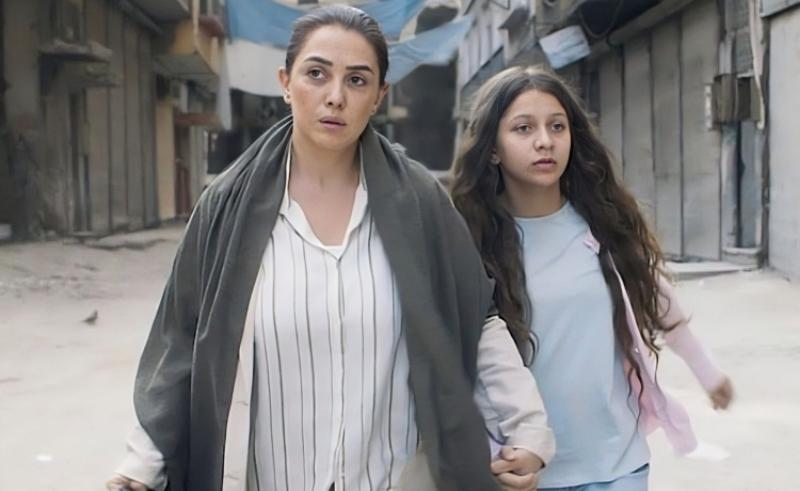
Winner of the Audience Award at Venice Film Festival’s Orizzonti Extra Section, ‘Nezouh’ follows a Syrian family on the verge of becoming refugees.
Syrian film ‘Nezouh’ starring Kinda Alloush and Samer Al Masri, and directed by Syrian filmmaker Soudade Kaadan, won the Audience Award at Venice Film Festival’s Orizzonti Extra Section, supported by Armani Beauty. This is Kaadan’s second win at the festival after ‘The Day I Lost My Shadow’ (2018), her first feature-length film and the winner of Best Debut Film.
The film stars the Cairo-based Syrian actress Alloush, known for her roles in Egyptian and Syrian dramas. She was first introduced to Egyptian audiences in 2009 with her role in ‘Welad El A’am’ and has since starred in multiple films and series including ‘El Maslaha’ (2012), and ‘El Asliyyin (2017). She’s also part of the cast of ‘The Swimmers’ (2022) which debuted at Toronto Film Festival.
‘Nezouh’ is set in war-torn Damascus and tells the story of a Syrian family at a crossroads choosing between fleeing or clinging on to their home. The father, played by Samer Al Masri, refuses to become a refugee while his fourteen-year-old daughter yearns for freedom. The film is inspired by the filmmaker’s personal journey away from Damascus and the effect of the conflict on Syrian women’s social reality.
Saudi engineer Mishaal Ashemimry is the newly elected vice president of the International Astronautical Federation, becoming the first Saudi woman to hold the position after receiving 14 majority votes from international representatives.
Her role as one of the federation’s 12 vice presidents enables her to further the development of the space sector globally and consolidate the direction of the IAF.
As a Saudi woman and the first aerospace engineer in the Gulf Cooperation Council, her position strategically places the Kingdom at the forefront of the industry and highlights the country as a global leader in the field.
Since September 2021, Ashemimry has served as special advisor to the CEO of the Saudi Space Commission Mohammed Al-Tamimi, a position in which she consults on developing a national space strategy, creates and leads space programs, and advises leadership on direction and execution.
Ashemimry was previously a space nuclear technology consultant at the aerospace and defense company Northrop Grumman. She also conducted research funded by the NASA Marshall Space Flight Center during her time as a research assistant at the Florida Institute of Technology
At 26 years old, the engineer was also president and CEO of her own aerospace company, MISHAAL Aerospace, established in 2010.
The company developed space rockets, designed and launched its own line of cost-effective rockets titled the “M-rocket” series, completed static tests for hybrid rocket propulsion systems and provided global consultation.
In 2015, Ashemimry won the Inspirational Woman of the Year Award at the Arab Women Awards and in 2018 was awarded for her scientific achievements by King Salman.
She received her bachelor’s degree in applied mathematics and aerospace engineering in 2006 and her master’s degree in aerospace engineering in 2007, both from the Florida Institute of technology.
She is a certified Nitrox, rescue and open water diver, a commercial pilot and is trained in real space flight conditions of zero-gravity.
Ashemimry is an expert in aerodynamics, missile and rocket stage separation analysis, vehicle design, wind tunnel testing, simulations and analysis, and computational tool development.
At only 14 years old, Egyptian athlete Hana Goda holds the number one rank in the International Table Tennis Federation’s (ITTF) U19 Girls’ Singles list for the first time.
Egyptian table tennis champion Hana Goda has cemented her legacy as the first person to hold the number one rank in the International Table Tennis Federation’s (ITTF) U19 Girls’ Singles list at only 14 years old.
After an exceptional performance at the 2022 ITTFA, the long-standing national champion and Africa Cup senior champion also stands at 43 in the International Table Tennis Federation’s Women’s Singles ranking worldwide.
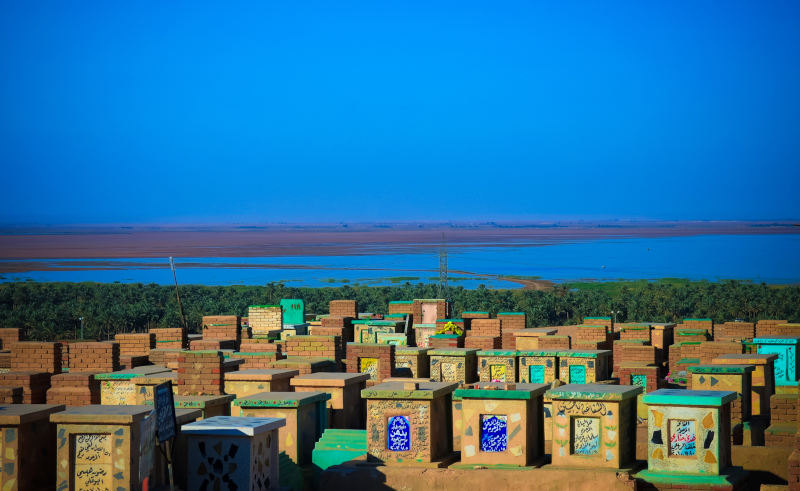
Dating back to the early middle ages, this Iraqi cemetery holds the remains of kings, dignitaries, scholars, and soldiers alike.
Wadi Al-Salam, which means ‘Valley of Peace’ in Arabic, is a necropolis in which every Shiite Muslim hopes to be buried some day, in the belief that it is these burial grounds that will hold eternal peace for them.
Located in the Iraqi city of Najaf, Wadi Al-Salam is a cemetery that dates back to the early middle ages, hosting the remains of kings, dignitaries, scholars, and soldiers alike.
Every year, an estimated 50,000 Shiite Muslims are buried in this hallowed ground. The cemetery stretches across 1500 acres, taking up almost 13% of the city, and allegedly holds over six million bodies. The necropolis, however, isn’t just a morbidly beautiful burial ground. Rather, each tombstone contains a name and an engraving that paints a vivid timeline of Iraq’s (arguably tragic) history, with a hyperfocus on internal disputes, natural disasters, and wars.
In 1981, Rahim Jabr, an Iraqi foot soldier, was martyred in the eight-year war with Iran. 25 years later, his brother, Naeem Jabr, was a casualty of the sectarian civil war that killed hundreds in Baghdad in 2006. The siblings are buried next to each other, united in the necropolis that holds many others whose stories are eternally intertwined with that of the bloody history of this country.
The 2003 invasion of Iraq by the United States and its subsequent conflicts alone led to the graveyard expanding by over 40% (7.5 square kilometres) to contain the bodies of the martyred Shiites.
Wadi Al-Salam has been the responsibility of a single Shiite family for over three centuries, and the Abu Seiba’s stand testament to the cruelty of war, having carried hundreds of thousands of bodies belonging to their brethren into the ground.
Wadi Al-Salam is considered a UNESCO World Heritage site and has been since 2011, as the cemetery stands witness to thousands of years of history, religious tradition and dedication by Shiite Muslims.
Sibaha is the director of the “Atlas Lionesses: Hear Them Roar!” documentary that honored Morocco’s Women’s Football Team.
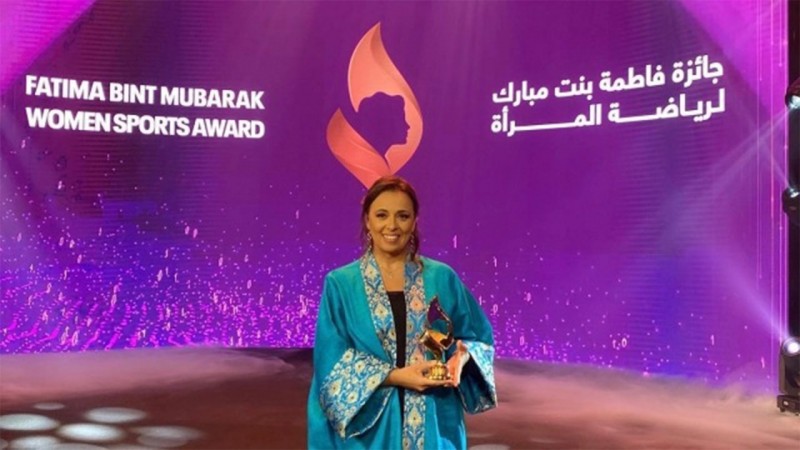
The Moroccan journalist Aziza Nait Sibaha has won the sixth “Fatima Bint Mubarak” Women Sports Award, crowning her as the Arab world’s “best sports journalist.”
Presented on September 17 in Abu Dhabi, the award is the region’s first of its kind aimed at empowering women and celebrating their sports achievements.
The “Fatima Bint Mubarak” Prize was awarded to different winners in several categories, including sports management, training, research, sports sponsorship, and women of determination.
The value of the prizes totaled AED 1,700,000 ($462,824).
Different trophies were awarded to nine competitors, individuals and teams, including Egypt’s Giana Farouk Mahmoud, who was named the “best Arab sportswoman,” and Shamma Yousef Al Kalbani, who won the “best Emirati athlete” award.
Egyptian Ahmed Gouda won the prize for the “best young athlete,” while his compatriot Rehab Ahmed Radwan was awarded the prize for the “best Paralympic athlete.”
The “best coach” award went to Faris Al-Assaf from Jordan, while the Jordanian Women’s Football Association took the award in the “ Youth Development Programs” category.
The Egyptian Weightlifting Federation won the award for “best team,” while the “Emirates International Endurance Village” earned the prize for “best innovative sports initiative.”
The celebrated Tunisian tennis player Ons Jaber won the award for “Sports Personality of the Year in the Arab World.”
In her speech at the award ceremony, the representative of Fatima Bint Mubarak Ladies Sports Academy, Maryam Al-Mansouri, said that all categories of the award have seen strong competitiveness in recent months. This proves the talent, willingness, and ambition of Arab sportswomen, she stressed.
Al-Mansouri concluded: “We hope to see Arab women continue to take the lead in local and international sports events, and this award will contribute to the birth of new achievements in the Arab women’s sports career.”
Nujoud Fahoum Merancy started the Twitter hashtag ‘YallaToTheMoon’ to support latest mission.
A Palestinian-American woman is one of the leaders of the Artemis missions, a programme by Nasa that aims to fly astronauts to the Moon.
Nujoud Fahoum Merancy, 43, is the chief of exploration mission planning at the US space agency and has been working in the space sector for more than two decades.
She started the Twitter hashtag ‘YallaToTheMoon’ to support the Artemis 1 mission, which is scheduled for another launch attempt on Saturday, from Florida’s Kennedy Space Centre. ‘Yalla’ is an Arabic word that translates to ‘let’s go’ or ‘come on’.
Before the historic event, Ms Merancy spoke to The National about her Palestinian roots and her involvement in the Artemis programme.
A stellar career
The Artemis 1 mission is an unmanned flight around the Moon that will test the performance of the Space Launch System rocket and Orion spacecraft.
If successful, it would pave the way for Nasa to launch Artemis 2 and 3, crewed flights around the Moon and the first human lunar landing mission under the programme.
“As a Palestinian-American, I’m very excited to be a part of this programme,” she said.
“And, really, Nasa and Artemis, it is a much more diverse workforce than it was during the Apollo era.
“It’s important to me and to a lot of us that it represents all of humanity and Artemis itself is international because we have international partners.”
Ms Merancy, a mother-of-two, earned her bachelor’s degree in aerospace engineering from the University of Washington in Seattle.
From there, she joined the aerospace company Boeing to work on the International Space Station.
She then started working on the development of Orion, the spacecraft launching on top of Nasa’s mega Moon rocket on Saturday that will fly around the Moon — and one day carry astronauts.
“From that, I’ve transitioned into the mission planning for Artemis, which is designing and integrating the missions across all the programmes for Artemis, and that’s my current role,” she said.
Connecting with her Palestinian roots
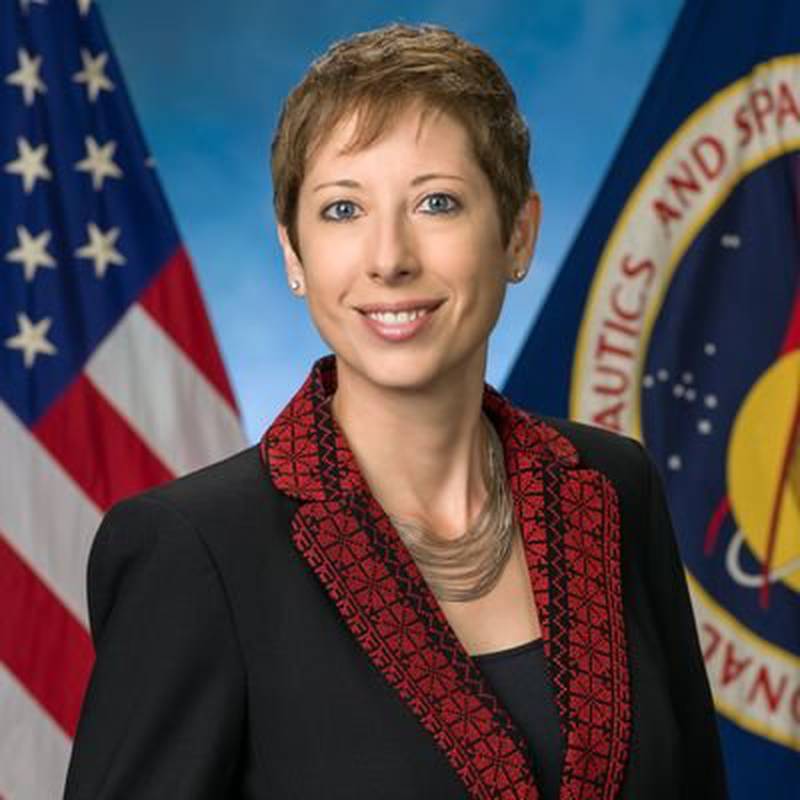
Ms Merancy went viral on the internet in 2019 when she posted her official Nasa photo, in which she wore a blazer embroidered with Palestinian tatreez, a traditional cross-stitch, that she bought during a visit to her father’s home town of Nazareth.
Her father moved to the US more than 40 years ago to go to college.
Although she was born in the US and does not speak fluent Arabic, she said her Palestinian roots were important to her.
“I don’t speak Arabic, unfortunately, it’s one of those regrets that I’ll always have,” she said.
“I know the basics, a few words here and there, and the polite greetings.
“But I do enjoy the food and that is something I grew up on. And then as an adult, I started cooking.
“So, I have a whole bunch of Palestinian cookbooks just to learn other recipes that my family didn’t teach me.
“I do like to cook Palestinian food and that’s probably the biggest connection to the culture that I have.”
Palestinian presence in the space sector
Other Palestinians are involved in the Artemis programme or are making a name for themselves in the US space sector through other projects.
Soha Alqeshawi, born and raised in Gaza city with her seven siblings, currently works for Lockheed Martin as a software engineering associate manager and looks after Orion’s back up-flight software.
And Loay Elbasyouni is a Palestinian-American electrical engineer who helped design Nasa’s Mars rover, Perseverance.
“My parents did their best to provide me and my siblings with a good education and shield us from the effects of the continuous horrific conflict that Gaza has been living under,” Ms Alqeshawi told Portuguese journalist Margarida Santos Lopes in 2015.
“Living under constant fear and despair where everything is uncertain and basic life necessities such as electricity and sometimes water are unavailable for most of the day.
“Although I was the only one in my family who had the opportunity to leave Gaza for the US to study and work, all of my brothers and sisters are college-educated with degrees in science, engineering and business.”
“Going to school was sometimes a dangerous journey that could have death waiting at any step of the way.
“However, that made us more determined to achieve our dreams in receiving an education.’
Nujoud Fahoum Merancy went viral in 2019 when she posted her official Nasa photo, in which she wore a blazer embroidered with Palestinian tatreez, a traditional cross-stitch that she purchased during a visit to her father’s hometown of Nazareth. Photo: @nujoud
The dance troupe’s victory, which earned them the seven-figure prize , offered a sliver of hope to the country and its population, who continue to battle a flurry of crises and bad news.
“We haven’t shed happy tears in so long in this country and Mayyas made it happen,” says Reem Nasra, 24, a recruiter in Beirut.
Mayyas first made international headlines when they received a golden buzzer from judge Sofia Vergara for their performance during the auditions, securing their spot in the semi-finals.
“There are no words to explain to you what we were feeling over here,” Vergara said at the time. “It was the most beautiful, creative dancing I have ever seen.”
Since then, the Lebanese group put on a series of breathtaking routines as they advanced to the final. And, their journey to the top connected with compatriots around the world.
“They are an example of what a synchronised group of Lebanese are able to achieve,” says Eli Lattouf, 26, a postdoctoral researcher at Harvard Medical School in the US. “Such a win delivers a global message.”
Lebanon is currently facing an economic crisis described as one of the worst in 150 years by the World Bank. According to a UN study, the financial collapse has pushed more than 80 per cent of the population into poverty while inflation and living expenses reached record highs.
The country’s plight has made global news, highlighting everything from its fuel crisis to the deadly Beirut port blast in 2020.
To see Lebanon represented in a different light, as a beacon of art and culture, was refreshing, says Lattouf.
“Most people know the Lebanon they see on the news, which might not be totally misleading, unfortunately,” he tells The National. “This time the world sees not one, but a group of Lebanese, full of art, creativity and discipline.”
Lattouf’s sentiment is echoed by many other Lebanese people, who are proud of the group’s outstanding representation on a global platform.
“This is our Lebanon, the real one,” says Rima Hijazi, 26.
Watching from her home in Choueifat, south-east of Beirut, the agricultural engineer fortunately had electricity overnight to stream the final live. Many other households across Lebanon were without power, which prompted private TV station LBCI to campaign for generator owners to keep the lights on ahead of the show.
Lebanon’s electricity crisis is merely one of the many obstacles Mayyas had to overcome while rehearsing.
Despite the many hindrances, the girls put in long hours of work, determined to grab the title.
According to the group’s founder and choreographer Nadim Cherfan, the team were in the studio on a daily basis and would “only leave when the power goes off”.
“When it’s about art, nothing stands in your way,” he previously told The National.
Their hard work and diligence made them all the more deserving of the win, according to many Lebanese. It is also testament to the country’s potential, despite the odds.
“This win means that despite everything we are going through, our will to live and be successful beats all miseries,” says Yara Youssef, 25, a marketing coordinator in Beirut.
Between pride and hope, Mayyas also evoked a solemn feeling for some.
“It’s a bit sad knowing that if you have potential here in Lebanon, you have to leave in order to reach your goals,” Hijazi tells The National. “We’re in the wrong spot to bloom.”
But despite their international achievement, Mayyas are returning to Lebanon, where they will continue to work on their art.
While Cherfan has been asked why he continues to work in Beirut, he is adamant on going back to where they started.
“I’m never leaving my country because my country has never left me,” he says.
Watch the moment Mayyas won on ‘America’s Got Talent’ here (below):
As Egypt promotes the trail of the Holy Family as a major tourist experience, Ahram Online republishes an account of stops and cities where the Virgin Mary, Joseph and Jesus found safety and shelter in the country.
“Now when Jesus was born in Bethlehem of Judaea in the days of Herod the King, behold, there came wise men from the east to Jerusalem, saying, Where is he that is born King of the Jews? For we have seen his star in the east, and are come to worship him.”
(Matthew 2:1-2)
———-
The story of the holy family’s journey from Palestine to Egypt has long been recorded with dedication by historians and authors around the world. Many look upon the journey as a mark in the history of Egypt, not merely a religious event. Egyptians look with fondness and pride on the passage of the holy mother and her child through the land of Egypt, and the fact that they found solace here.
The flight to Egypt
The Virgin Mary gave birth to Jesus in Bethlehem of Judaea in Palestine. Upon his birth, wise men preached to the people of the city, declaring that Jesus was the chosen one, and that, “according to prophecies” they had seen in the stars, he would become the next king of the Jews. Upon hearing the news, King Herod was overcome by terror at the possibility of losing his throne. He decided that killing Jesus was the only way to protect his royal status.
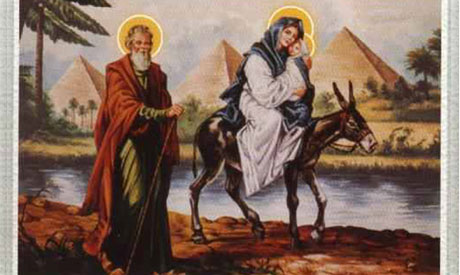
In a dream, Joseph, the carpenter, was ordered by God to escort Jesus and his mother to Egypt, where they would find refuge. Both Western and Eastern traditions agree that the method of transport most likely used by the holy family on their journey to Egypt would have been a donkey. In this situation, the Virgin Mary would have been seated on the donkey, holding the child Jesus in her arms and Joseph would have walked by their side, leading the way.
The holy family in Sinai
Keller writes in his book, The Bible as History (1955): “A day’s journey from Gaza brought the holy family to the ancient township of Jenysos, which is mentioned by Herodotus, the Greek historian.” Today, this village, which is part of the Gaza Strip, is known as Khan Younis. “The next town on the holy family’s route would have been Raphia (Rafah), the frontier town between the Gaza Strip and the province of Egypt.”
Continuing for another 44 kilometres, beyond Raphia, and after almost two days of traveling, the mother and child reach Wadi Al-Arish, a point at which they are safe enough to obtain food and shelter. The holy family passes by other towns in Sinai such as Al-Muhammadia and Al-Farma, located 35 kilometres east of El-Qantara City. Churches from the 5th and 6th century have recently been discovered in Al-Farma.
Route to the Nile Delta
The holy family continued on its trip to the Nile Delta, stopping at the city of Musturod, only 10 kilometres from Cairo. “The Virgin Lady”, a 12th century church, was found in the city.
Keller adds in his book: “The city of Musturod was again visited by the holy family on their return journey to Palestine.” After leaving Musturod and passing by Belbes, the holy family travel west to the Valley of Natroun, crossing the western branch of the Nile (the Rasheed branch).
The holy family in Cairo
The movie Journey of the Holy Family portrays the settlement of the blessed family in Al-Mataraya district near Ein Shams (Old Heliopolis). They find shade under a sycamore tree that came to be known as “Mariam’s Tree,” which has evolved into an engrossing attraction for religious tourists. The holy “Mayron oil,” or the “Chrism,” is nowadays prepared from the oil of the tree.
An ancient church was built in the area by the name of “The Virgin Mary” and is visited by people to this day. Paintings can be found inside the church, including maps of the holy family’s journey, as well as a statue of Jesus and his blessed mother guarded by Joseph the Carpenter.
In his book The Geography of Coptic Egypt (1989), French historian Amelenio narrates some of the stories passed down about the miracles of “Mariam’s Tree.”
One such story tells how “the French army sat by the tree, drank from its well and wrote their names on its stems.” It is believed that some of the wounded soldiers were healed by its oil. Amelenio adds: “Al-Matarya district became the most popular shrine in Egypt; a place where people flooded to for blessings and spiritual remedies.”
The second district visited by the holy family in Cairo was Al-Zeitun, where a church by the name “The Virgin Mary” was constructed in Toman Bey Street. It is said that appearances of the blessed lady were witnessed around the domes of the church up until recent years.
Another spot visited by the holy family was Zowela Avenue on at Been El-Soreen Street in El-Gamaleya district. An ancient church is found there with the same name, “The Virgin Mary”. It is considered one of the largest churches in Egypt and is distinguished by its basaltic style.
The holy family moved on to “Old Egypt” (Al-Fustaat) where they dwelled for a short time in a cave in Abi Serja’s Church, within the walls of the Roman Babylon fortress. “The cave is about 20 feet tall, 15 feet wide and does not have any windows,” as described by Amelenio, who believes the holy family’s stay in the cave did not exceed a week. After leaving Al-Fustaat, they moved to Maadi district and settled at the location where the Virgin Mary Monastery and church were later built by the Nile.
Amelenio explains that during Ottoman rule in Egypt, the church had a marina for boats allocated for the transport of people and soldiers traveling to and from Egypt. Some villages in Upper Egypt were visited by the holy family such as Assiut and Minya. In the book History of the Coptic Nation, author Samy Saleh records that the holy family took the same route on their journey back to Palestine. They first go to Maadi, passing through Old Egypt, then follow the road to Ein Shams, back to the city of Mustorod, and finally El-Arish, and from there to Gaza.
The trail of the blessed
At present, many Egyptian historians and archeologists are calling for a project to track each town or city visited by the holy family, so as to make it easier for tourists to visit the blessed spots, thus reviving the symbolism of the holy journey and its message of peace and goodwill to all men.
The Iraqi scholar Suhad Yasin has waged a long battle against financial and administrative obstacles to continue her work on purifying polluted water.
Her graduate studies started later than most and became a long journey over 13 years of dropping out and restarting, but she persevered. Two years ago, the University of Duhok awarded her a doctorate in polymer chemistry.
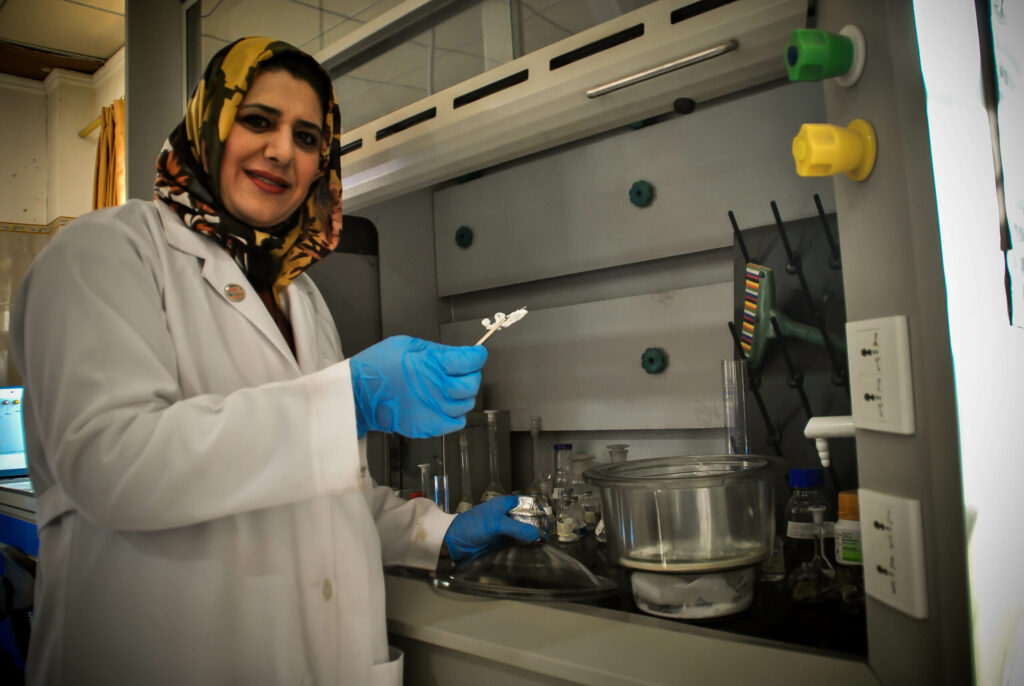
Now Yasin works from an independent laboratory she set up at the University of Duhok, where she and her students use cheap, available materials to treat polluted water.
Iraq, like many Arab countries, suffers from water scarcity and stress. One study predicts the Tigris and Euphrates rivers will dry up completely by 2040.
Apart from the scarcity issue, some Iraqi waterways also face problems with contamination by heavy metals like aluminum, cadmium and chromium, adding urgency to research like Yasin’s.
An Interrupted Academic Journey
In an interview with Al-Fanar Media, Yasin described her career in industry and academe.
After obtaining her bachelor’s degree in chemistry at the University of Mosul in 1993, she joined a laboratory in a local pharmaceutical factory, eventually becoming production manager.
As violence increased in Mosul over the next decade, however, Yasin was forced to return to her family’s home city of Duhok in 2006. She got an administrative job at the Ministry of Industry of the Kurdistan Region of Iraq.
But she did not find administrative work satisfying, Yasin said, so she took a competitive exam to study for a master’s degree at the University of Duhok.
By then a wife and mother, Yasin faced challenges in studying at the University of Duhok, both with learning in English and in overcoming the skepticism of some academics. Her thesis supervisor questioned her ability to complete the work. “He told me, ‘I regret being involved in the supervision of your thesis. It will be difficult for you to complete your studies at your age because of your family responsibilities.’”
But Yasin said his words only increased her motivation. “I needed to prove to my supervisor and myself that I was not a problem, but an energetic researcher who had missed an opportunity,” she said.
Yasin got her master’s degree with excellence in 2009 with a thesis on removing chromium from water using modified pomegranate peel .
Starting from Scratch on a Ph.D.
She then applied to transfer from her job at the ministry to work as an assistant teacher in the chemistry department of the University of Duhok’s Faculty of Science.
She taught at the University of Duhok for six years but was not given an opportunity to pursue a Ph.D. because the university lacked facilities and funds for research in her specialisation. Throughout this time, she continued her research on purifying polluted water.
In 2015, the university offered her an opportunity to pursue a doctorate and she took it. There was considerable opposition to her studying for a Ph.D. at the age of 50, but she managed to convince the head of the department.
Based on the advice of her master’s supervisor, who had changed his mind about her ability, she chose nanofiber technology as the subject of her doctorate. Her new supervisor initially opposed the idea, saying the university could not afford the materials required for research on this topic. But he finally relented when she persisted.
Yasin said she had nothing but the lab walls when she started her doctoral research: no equipment, devices, or “cofactors”, molecular compounds needed in certain chemical reactions. “The resources were almost zero,” she said. “I had to buy everything myself and start from scratch.”
Lining up Support
Yasin contacted professors and scholars from various Arab countries to ask for help. By chance, she heard of a physics professor at the University of Basrah who had designed a device that would help her with her research. “I contacted the professor at the University of Basrah immediately and she agreed to help me,” Yasin said.
Yasin then had to convince her dean at the University of Duhok to manufacture a similar device so she could work. He agreed, but she still needed funding for her research.
She wrote to several international organisations asking for financial support and eventually received a three-year grant of about $207,000 from the National Academy of Sciences in the United States, in 2018. She used the money to establish an independent laboratory at the University of Duhok to conduct her research on using nanomaterials to treat water.
Yasin acknowledges that funding scientific research is a general problem in Arab countries, but she insists that scholars themselves have a duty to find funding for their research.
“We must not stand idly by. I work day and night to get new financial support,” she said. “With each refusal, I realise that I have to work more.”
Suhad Yasin, of the University of Duhok, overcame many obstacles during 13 years of interrupted graduate study to continue her research on purifying polluted water. (Photo courtesy of Suhad Yasin)