JORDAN: Ahmad Alhendawi -Youngest Secretary-General of the World’s Scouting Movement (WOSM).

Scout’s honour: lucky break bounced Ahmad Alhendawi into the line of dut.y

Jordanian who substituted basketball for public service now proudly puts the global scout movement’s 54 million young people first as leader of the packs.

Ahmad Alhendawi found his mission in life on the basketball court. Just not in the way he expected.

As a teenager on the brink of university, the Jordanian had set his heart on a sports scholarship. It all depended on one 90-minute trial but, fortunately, young Alhendawi was good.

Even though he was up against more than 30 contenders for one of just two coveted places, he had little doubt in his ability to prevail.

The decisive moment came as he ran back into a defensive position during a one-on-one exercise with a rival when his knee twisted beneath him.

The tears that followed were for the agony and his thwarted ambition. “I can’t remember much because the pain was just unbearable,” Mr Alhendawi tells The National.

The diagnosis was a cruciate ligament injury – and that was that as far as the basketball scholarship was concerned.

“It was literally the only time I needed basketball in my life, just to get to the school that I really wanted,” he says.

“Most of my friends were there and I already had a kind of picture of how things would play out if I went. So it was game over.”

He had little choice but to revert to plan B, one which he now believes should “always have been my plan A”, to focus on his other passion – volunteering.

The switch to public service has not worked out too badly for the man who, at the age of 32, was named as the youngest head of the world’s scouting movement.

“Volunteering is quite a remarkable thing,” he says. “It’s a magical thing. You actually think you’re giving your time and energy but all the time you are getting much more than you are giving.

“Only with time do you realise how much you have accumulated experiences and insights on things that you would never have explored if it wasn’t for volunteering.”

It is tempting to call it a meteoric rise but Mr Alhendawi’s selection as secretary general of the World Organisation of the Scout Movement followed a pattern of volunteering and championing youth causes that was set early in childhood.

The young Ahmad grew up in Zarqa, Jordan’s second largest city and a magnet for migrants from across the Middle East seeking a better life.

Attending a public school with class sizes of 45 to 50, he mixed with Iraqis, Syrians and Christian Arabs whose families had all made their way to the country’s industrial centre beside the Zarqa River.

As the youngest of 10 children from a military family, he was well versed in making himself heard.

His intellectual curiosity was fed by learning from the conversations of his older siblings and visits to the local public library. He remembers, too, aged six, being captivated by his father’s habit of reading the newspaper every day.

“It was always a surprise to me why there were so many stories in there but we were not in the paper,” Mr Alhendawi says.

“My father explained the whole thing that you have to do something to be in the paper. In a very childish way – but in a profound way when I reflect on it – I felt like I would like to be part of those sorts of things.”

Thinking that the opportunities afforded him through the formal education system would not only be conventional but limited by social class and financial background, he fixed upon the idea of expanding the realm of possibilities via extra-curricular activities.

These days, Mr Alhendawi describes it as “hustling through volunteering”. “It was my ticket to try to make it, and it worked rather well and allowed me to do a lot of things,” he says.

As a teenage scout, he was asked to help as an usher for an event where the charismatic King Hussein of Jordan gave a speech. “It was the only time I saw my father cry, when the king passed away,” Mr Alhendawi says.

He learnt the value of public service from a teacher, who in his spare time ran the school’s scout troop, and his inspirational basketball coach. His own volunteering efforts ran in parallel with his sporting passions until that devastating torn ligament.

The result of the injury was that, instead of staying in his home city and attending the Hashemite University, he went to his second-choice, Al Balqa, in Salt, 50 kilometres away.

Being separated from his family taught him independence, but the course on computer information systems failed to satisfy his growing intellectual curiosity.

Before starting classes, he travelled every week to another university to attend lectures on political economy and psychology. “My friends were laughing at me because they knew that I didn’t have passion for what I was studying,” he says.

His dedication fed into his volunteering work. Mr Alhendawi spent extra hours reading lecture notes and preparing documents while working on school councils and youth commissions.

He was delivering a presentation at a conference when he was spotted and offered a job with the Arab League to work on youth projects and develop civil society.

Mr Alhendawi has consistently maintained that young people are unexploited assets in solving the world’s problems. It is a lesson that global leaders need to learn quickly, he says, with half of the population under the age of 25 but suffering some of its most acute problems.

The dissertation for his master’s degree, achieved at the European Institute in Nice, France, looked into the workings of the Arab uprisings in Egypt. He argues that the perception of apathetic Egyptian youth was not borne out by the mass mobilisation in 2011.

He has spoken of changing the rules of political engagement so that those in the younger generation are treated as more than mere beneficiaries of charity from an older establishment. Despite too often being sidelined in this process, Mr Alhendawi says that young people cannot afford to ignore politics.

His own advancement came when he was tapped by the UN’s secretary general, Ban Ki -moon, in January 2013 to become the organisation’s first youth envoy.

Four years later, he himself was named as a secretary general, representing the diverse views of more than 170 nations in the scouting movement.

No one was more delighted than Mr Ban, who dug out a photograph of his younger self as a scout when Mr Alhendawi came to his office to break the news.

Mr Ban told his departing envoy that his appointment was a good one for the UN. While he might be losing an energetic advocate for youth, he felt that the vast scout network under Mr Alhendawi would advocate for similar goals as those of the UN.

In a sign of how the co-operation would work, the UN, with the scouting movement and the five other large global youth organisations, launched an initiative called Global Youth Mobilisation to provide an initial $2 million for young people and communities affected by Covid-19. Young people will decide where the money goes and how it is spent.

Mr Alhendawi’s mission statement in leading the scouting movement is to embrace the “mega trends that are really threatening the future of this generation, like climate change and inequality ”.

In his own scouting days, he visited parts of Jordan as a child and was immersed in different cultures that he probably would not have experienced otherwise.

“Scouting tends to be inward looking sometimes … a movement that has more than 50 million members and more than 500 million alumni cannot act as a small club in a village,” he says.

His programme of modernisation extends to updating the image of the organisation, which in some countries has lost its appeal to youngsters to the competing attractions of computer games and sports.

Mr Alhendawi has praised the process of revitalisation in the UK, where perceptions were overhauled when the adventurer and explorer Bear Grylls was named as chief scout.

His social media feeds feature many campaigning messages, whether environmental, educational, achieving gender equality, ensuring a fair global distribution of vaccines or promoting peace in South Sudan.

It is a politics founded on consensus building from his history of working for membership organisations – such as the UN and the Arab League – in which progress can be made only by bringing people together in search of a common goal.

He recalls one lunch with a diplomat at which they discussed the differences between working for a country or an organisation like the United Nations. “The way we ended the conversation was that if you were a representative of a member state you could probably promote development for the sake of politics,” he says.

“But if you worked on the UN side, you have for the most time to do the politics for the sake of maintaining development gains.”

Despite his global ambitions for change, some of Mr Alhendawi’s challenges are closer to home. Sexual abuse scandals resulted in the Boy Scouts of America, for example, filing for bankruptcy to allow it to pay compensation in hundreds of reported cases.

One of his first acts as secretary general was to build ethical standards across all the national scouting organisations. In the coming years, any that do not conform to child protection measures “will have no place in the movement”.

In his darker moments, he turns to the words of Nelson Mandela, whose letters and poems are on the wall of Mr Alhendawi’s home in Kuala Lumpur, the capital of Malaysia where the world scouting movement has its headquarters.

“Just two weeks ago, I was confronted with a situation where I thought, maybe I should be angry … and gave myself two hours, read a few of the letters and it just calmed me down and helped me find the right tone,” he says.

At 37, Mr Alhendawi has reached the stage in his life when he is running out of time for “the youngest …” to be attached as a prefix to each new appointment. He was due to marry his partner, who is from Finland, last year but the coronavirus has delayed the nuptials until this summer.

The pandemic has hit young people hardest, Mr Alhendawi says. He wrote on Twitter last year that the effect of Covid-19 on youth was not just severe, it was catastrophic.

“It has resulted in a generation in waiting,” he said. He points to his own native Jordan, where youth unemployment stands at 50 per cent.

Despite the gloom, lockdown living has had some advantages. In this online interview, Mr Alhendawi occasionally tugs at his black polo shirt, sticky from the effort of throwing a few hoops on the basketball court outside.

After two decades of exercises to relieve the discomfort caused by the old sporting injury, he has at last had surgery. As he puts it, “I’ve finally fixed something that’s been broken for 20 years”.

source/content: thenationalnews.com (headline edited)

___________
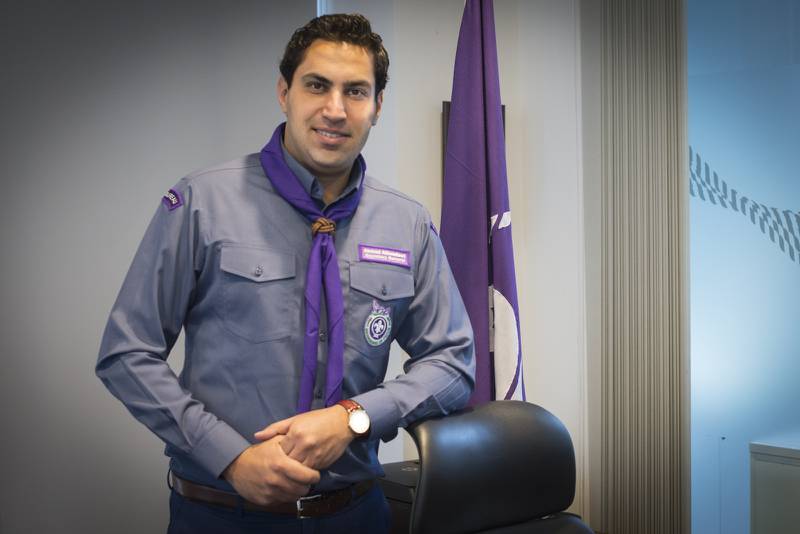
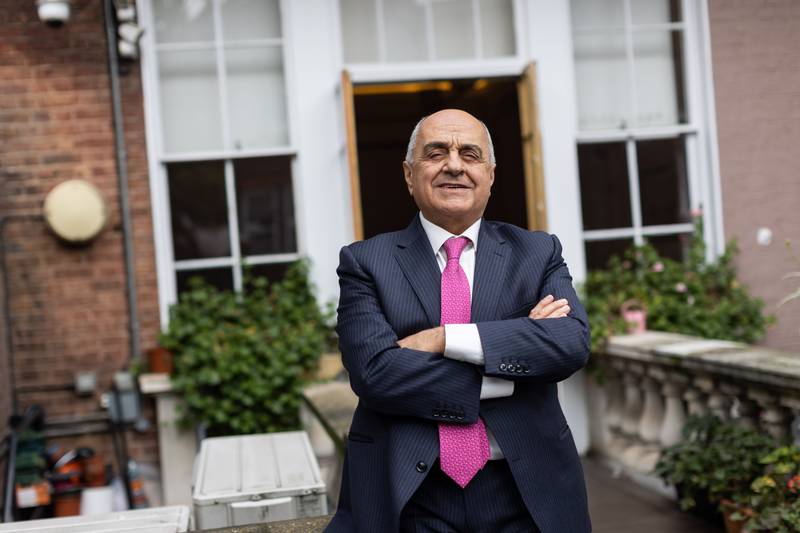
Ahmad Alheddawi, Secretary General of the World Organization of the Scout Movement

___________

JORDAN

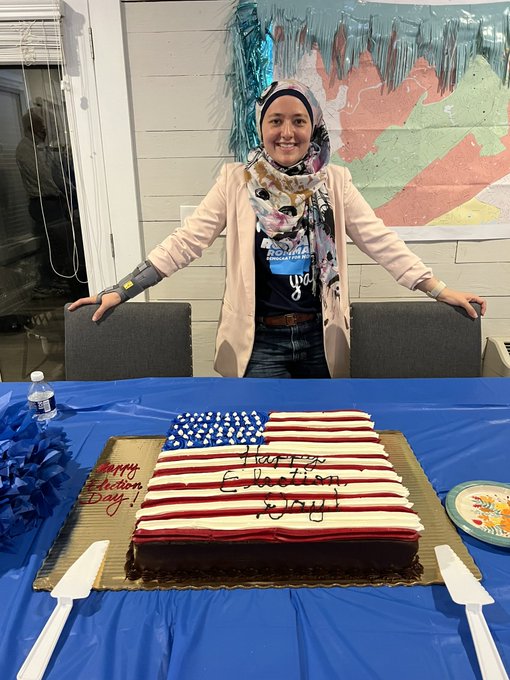
PALESTINIAN-AMERICAN: History Created. 2 Firsts. 29-year Old Ruwa Romman Becomes US State Of Georgia’s First Elected Muslim Woman and First Elected Palestinian-American Official elected to any Public Office in Georgia

Amid the headlines that the ‘red wave’ failed to materialize in America’s midterm elections as Trump-endorsed candidates crumbled at the ballot box and progressives like John Fetterman made surprise gains in hotly contested swing states, the election also saw historic firsts in Arab political representation. Palestinian-American Ruwa Romman who was the Democratic Party nominee for the Georgia General Assembly’s House of Representatives fought against an Islamophobic and racist campaign by her Republican challenger and won the election, becoming the deeply conservative state of Georgia’s first Palestinian American elected public official.

Achieving a whopping 58% of the vote, the 29-year-old Romman smashed her Republican opponent John Chan who allegedly ran a campaign that used Islamophobic and racist tropes to discredit Romman. While the presence of candidates from minority backgrounds has increasingly become a normal occurrence in some areas of the country, in the very conservative and Christian south of America it is rare for candidates from Arab or Muslim backgrounds to run for office, let alone be elected. As such, Romman’s victory in the deeply conservative state of Georgia is symbolic as she is from a family of Palestinian refugees and is both proudly American and Muslim. As a state representative for Georgia’s 97th district, her election marks both the first Palestinian-American to be elected to public office in Georgia as well as the first Muslim woman to be elected to public office. However, Romman was also joined by three other Muslim candidates that were similarly elected to the Georgia General Assembly. Her local supporters took to Twitter to signal how her victory over a hateful campaign by a Trump-supporting Republican sends a clear message that Georgia’s 97th district refuses to be turned against one other and stands united against an increasingly polarised and xenophobic political climate.

While the focus on the midterm elections in Georgia was mostly focused on the senate race between Democrat Raphael Warnock and Republican Herschel Walker, which has now led to a hotly contested run-off, Ruwa Romman’s election to the Georgia General Assembly has not been given the attention it deserves according to some supporters. Although having lived in and around Georgia since the age of seven, Ruwa initially grew up in Amman, like many other Palestinian refugees that reside in Jordan. After being born in Jordan and then moving to just outside Atlanta, Romman lived her entire adult life in the state of Georgia. However, although Romman now sits in the Georgia House of Representatives, she grew up facing high levels of exclusion and racism, especially against the backdrop of the US War on Terror. CNN reported how only a year after moving to the USA, she vividly remembers sitting at the back of a school bus as an eight-year-old as other children bullied her by accusing her and her family of being terrorists. Romman’s journey from a child that suffered from Islamophobia in the deeply conservative state to representing that very same state after being elected by its people is a story that many Georgia-based activists want to tell of a changing state that is slowly becoming more accepting and Democrat-leaning. However, supporters of Romman have also taken to Twitter to describe how her victory is indicative of Arab Americans slowly gaining political representation after being spoken for many years.

While the Democratic Party, much like the Republican Party, as a whole has a history of unequivocally supporting the Israeli state, a new wave of progressive Democrats that joined the party following Bernie Sander’s successive bids to run as the party nominee, has been vocal about Palestinian rights. Romman being elected to represent Georgia’s 97th district is but one of the most recent of numerous pro-Palestinian politicians who have entered office in the last few years, often from Arab or Muslim backgrounds. Romman stands alongside Michigan’s Rashida Tlaib and Minnesota’s Ilham Omar as part of a new wave of progressive Democratic representatives from minority backgrounds that often aren’t represented by the party, but seem to be slowly changing the debate around Palestine and Arab and Muslim Americans.

source/content: scoopempire.com / (headline edited) /(Thomas Pinn) /

_____________

______________________________

AMERICAN / PALESTINIAN

LEBANON: Jean-Louis Sabaji, the Lebanese Couturier-Designer, Dressing the A-list 

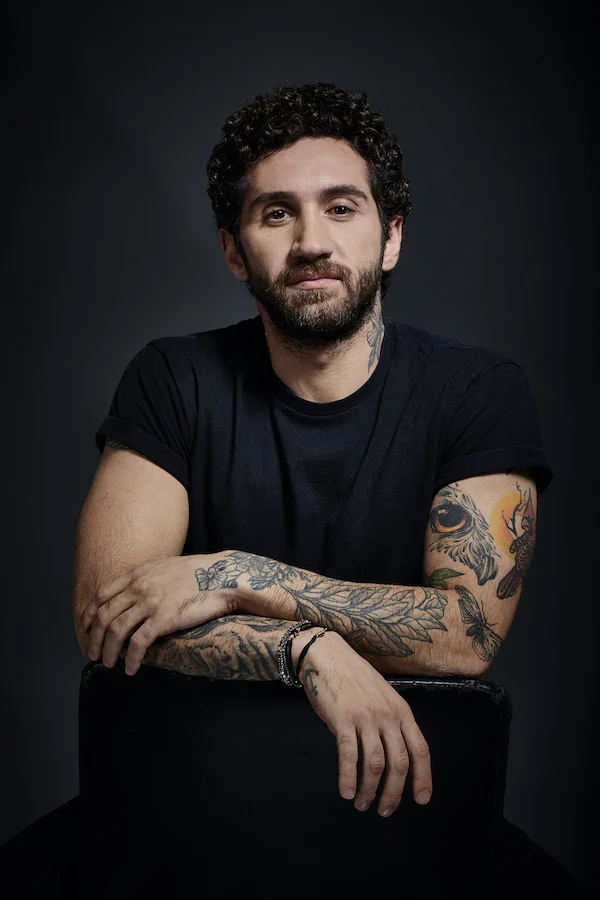
After a decade in the business, Lebanese couturier Jean-Louis Sabaji has dressed some of the biggest celebrities, including Beyoncé and Rita Ora.

His headline-grabbing creations regularly grace red carpet events across the world. Who can forget Cardi B’s purple floor-length gown bursting with feathers at the shoulders she wore to the 2021 American Music Awards? Or Aishwarya Rai Bachchan’s iridescent foiled leather dress at Cannes in 2019.  

Sabaji’s fascination with fashion was inherited from his late father Jean, also a designer. He grew up surrounded by beautiful dresses in his father’s atelier, from which he still works today.  

“I was named Jean-Louis after the great Jean-Louis Scherrer, a very famous French designer — it was as if I was destined to be a designer from birth,” he says. “As a kid, I used to make miniature dresses for Barbie dolls. My dad encouraged me to keep doing this, unlike others who bullied me for dressing dolls.

Sabaji completed his undergraduate degree in graphic design at the Lebanese American University and later attended the Domus Academy Milano for his master’s degree in fashion design. After completing his master’s with distinction, he came back to Lebanon and worked on his first collection in 2012.

Given that he already had access to an atelier with experienced seamstresses — as well as the fact that fashion had been such a large part of his upbringing — launching his own brand wasn’t too tough. But getting anyone to notice was a different matter.

“Lebanon has a lot of designers, so to stand out in a country with that much talent was hard. Additionally, I’m not very commercial. I target a niche clientele with my conceptual designs, so that made it more challenging,” he says.

He started by diving straight into the haute couture category. He didn’t get into ready-to-wear collections until much later. “I’d been taught that, in fashion, you work from top to bottom,” he explains.  

Once his name was well established, both regionally and globally, he branched out into ready-to-wear, producing his first collection in 2021. 

“During the pandemic, we understood the market better. We needed to have more clients, so that’s when we launched the ready-to-wear.” 

Sabaji loves to push the boundaries when it comes to daring designs. In 2013, he created a gown that looked like it was engulfed in a cloud of smoke — an idea inspired by wildfires in Lebanon that wrecked some of the country’s rural areas. “I used silk organza and airbrushed it to mimic smoke and the effect that ink has when it’s mixed in water,” he says. 

Complex garment construction and meticulous hand embroidery are the backbones of his creations. “It’s very important to me that a dress holds the woman’s body properly for her to feel confident. That’s when it comes down to pattern making, the construction and the corsets inside the dresses,” he explains.  

Another of Sabaji’s signatures is the use of feathers, which appear in almost all of his collections, whether used sparingly on the sleeves or as an explosion covering the entire dress.  

“Feathers are so feminine. The way they move on the body is very romantic,” he says. “Growing up, we had a house in the mountains with a huge garden with a lot of animals and birds. I was always inspired by these beautiful creatures.” 

Sabaji is very particular about animal welfare, so the feathers he uses are all natural falls and are ethically sourced from specific farms, he stresses. 

Gradually, his contemporary interpretation of classic couture fused with edgy elements and glamour sparked the interest of international stylists. In 2018, Mary J Blige chose a dramatic black-and-white Sabaji gown to wear to the SAG awards — his first major celebrity endorsement. Just months later, Beyoncé wore his ‘Sphinx Abaya’ mini-dress with train for a major gala in Los Angeles. At Cannes the following year, Aishwarya Rai Bachchan’s edgy fluorescent gown was all over the news. Crafted from 18 meters of stiff foiled leather that mimicked snakeskin, the dress took 200 hours to create and came with its own set of challenges.  

“Initially, we had some issues with the fit because it was a stiff dress made out of leather, so it wasn’t easy to alter. Up to the last minute, we weren’t sure if she was going to walk the red carpet in the dress, but Aishwarya has a very good team, so, ultimately, they managed to sort it out,” Sabaji says. 

2022 has been a remarkable year for the designer. Not only did he celebrate the tenth anniversary of his label’s creation and sign up for a major partnership (details of which are still under wraps — all he will say is that it’s “big”), but he was also the first Middle Eastern designer to collaborate with Mattel for a special Barbie collection which he presented at Arab Fashion Week in Dubai last month — a full-circle moment for the kid who was bullied for dressing up dolls.  

“Everyone had a smile on their face watching the show. And for me, it was full of emotions. I had tears in my eyes the entire time backstage,” Sabaji says. “Barbie is a childhood memory, and seeing all this on the runway was so nostalgic.”  

source/content: arabnews.com (headline edited)

____________

Sabaji completed his undergraduate degree in graphic design at the Lebanese American University. (Supplied)

_____________

LEBANON

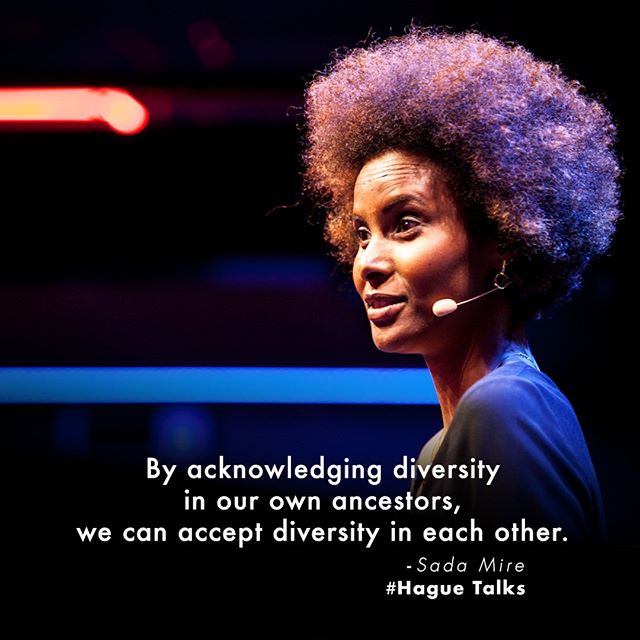
SWEDISH-SOMALIAN: Dr. Sada Mire, a Somali Archaeologist Is Championing Heritage in the Horn of Africa

An interview with Sada Mire dives into the difficulties and rewards of preserving history and letting local perspectives guide heritage management in Somalia and Somaliland.

SOMALIA AND SOMALILAND are home to a rich heritage of archaeological treasures. But until recently, there was only one active, formally trained Somali archaeologist working in the region: Sada Mire.

In 1991, Mire was forced to flee Somalia with her family as a teenager after her father was killed by a genocidal government. She gained asylum in Sweden and eventually earned her Ph.D. in archaeology from University College London. During her studies, she learned that some of the significant stone tools that shaped scientists’ views of evolution came from Somaliland but were taken to Europe during the colonial era.

Inspired, Mire returned to her homeland determined to retell the history of the Horn of Africa and preserve its heritage—despite the difficulty of working in a region where religious sects jealously control narratives around Somali history and identity, and political conflict is causing humanitarian crises.

Somaliland is not officially a nation-state. It’s a self-declared country that is considered part of Somalia. A British protectorate since the 1880s, Somaliland became an independent country recognized by the United Nations on June 26, 1960. Less than a week later, it merged with the newly independent country Somalia. Early political tensions worsened in 1969 when Gen. Mohamed Siad Barre staged a coup and installed himself as president, imposing ethnic nationalist policies that favored one of the main Somali clans over the rest.

In the 1980s, civil war broke out between Barre’s dictatorship and the Somali National Movement, primarily composed of the Isaaq clan, the largest in northwest Somalia, including what is today Somaliland. The Barre government committed acts of genocide against the Isaaq clan, reportedly killing 200,000 Isaaq people between 1987 and 1989. Millions fled during the conflict, including Mire and her family, who belong to the Isaaq clan.

In 1991, with Barre ousted, Somaliland reasserted itself by declaring unilateral independence, this time without international recognition. But Mire always refers to Somalia and Somaliland as separate nations because, she says, “as an anthropologist, I call people what they say they are, and I respect that’s the decision of the country and its people.”

Mire has worked tirelessly to create change that fosters heritage preservation in a region with scant infrastructure to support archaeological work. She established the Department of Tourism and Archaeology in Somaliland and is creating a digital museum that features Somali objects and materials. Mire is deliberate about teaching archaeological skills to local people so they may carry out their own work at the community and institutional levels. All these are steps toward sharing the rich legacy of African peoples with African communities and the rest of the world.

Wenner-Gren Foundation project director and anthropologist Eshe Lewis interviewed Mire via Zoom in May. This interview has been edited for length and clarity.

EL: 

Can you talk about your background and how you came to be an archaeologist working in Somalia and Somaliland?

SM: 

It’s incredible that I am here now, that I have a university degree, that I even went to high school. My father and mother were educated. My brother now teaches in a university in Somaliland. My twin sister is a gynecological oncologist. In my family, it was understood that you got an education or you did what you could to educate yourself. My twin sister and I were very studious.

But because of the political situation in Somalia at the time, our clan became a target. At the age of 12, I lost all my rights to have an education. We were expelled from school, and we never thought we would be able to go back. From then on, I was self-taught. I read books and learned languages at home. The habit of learning and teaching myself has never left me.

EL: 

Why is it important to conduct archaeological research in Somaliland and Somalia? And what are the most fulfilling aspects of the work you’re doing?

SM: 

Right from the start, it was all about why we have so little representation of African history and African people, who have existed for over 200,000 years on the African continent. We have contributed so much to culture, science, technology, governance, philosophy, and literature, and there is nothing about it in the history books. In 2022, you have people who have no idea about what Africa has done. So, that is the number one reason I do what I do.

Also, I feel I can make the world a better place. I know that sounds like such a cliché, but I really think that if history books are revised, people will understand what others are worth, and they will appreciate their trajectory. Removing African history and experiences and holistic images from books creates a situation where people know nothing about, and hence fear, African people. And the few that live up to the negative stereotypes become the rule for them.

If your classmate doesn’t know your history, they don’t know you. They cannot. I believe that by understanding a nation’s past, a people’s past, a person’s past, we can appreciate them. We may not like what they do, but we understand them. I feel that there is so much work to be done to shed light on the history of Black people, Africans, and people of color.

EL: 

What research and heritage protection work do you do in the region?

SM: 

One of the longest research projects I’ve been doing is on medicinal and sacred plants through medical anthropology. I’m also a zooarchaeologist and a bone specialist. So, some of what we are preserving is that kind of archaeological material, including massacre sites from the recent genocide. I’m working on another project about astronomy. We found one of the earliest calendars—a whole ancient rock art site with the calendars painted. We are working with local researchers who study folklore and have created the first traditional Somali calendar.

In Somali nomadic culture, we have our own way of preserving heritage and an understanding of heritage that really clashed with [Western] best practices and this notion of monuments and artifacts—the more dogmatic UNESCO formula. UNESCO now covers intangible heritage, but often when Westerners do archaeology in the Horn of Africa—and especially in the Somali region—it’s really extractive. It comes from a tradition of going somewhere with the agenda of getting data out and filling a gap. That scientific and/or, often, Eurocentric gap is not the gap of the people.

Somalis challenged me right from the start when I said, “You don’t protect archaeological sites. The museums are being looted. You don’t care about your heritage!” They said, “No, that’s not our heritage.” I was confused, as a Western-educated student, that we did not care about these objects. I asked, “What is your heritage if you don’t care about this?” And they said, “Ah! Now we’ll tell you.”

EL: 

How did you respond?

SM: 

I developed something I called the Knowledge-Centered Approach based on what I learned about heritage from them, and this is what guides me. It’s the preservation of knowledge and skill rather than objects and artifacts. Heritage is performance that takes place on different mediums. You know, if you are in a scene, there is a sofa, maybe a chair, the way you are dressed, how you look, speak, and act. That is our heritage! That shows us as living, thinking human beings with logic.

I developed a framework to study this. It is called the ritual set, and I outlined it in my book Divine Fertility. Understanding African peoples’ logic links us with our past. In my own work it’s about an ideology of a sacred kinship and sustainability. This is the whole idea behind my book.

I explore Somalis’ questions about their identity. Who were we? Where do we come from? Why have we been told we are Arabs when we are Africans? Clearly, we are Black, and we are in Africa.

I also have personal questions about my heritage. Somalis are Muslims, but did we ever have any other ideology? Were we at some point something else? Why do we only know Islam?

Why do we think our ancestors were all from Arab countries, when in fact we are genetically the same as the Oromo, who are our neighbors? We have 50 percent lexical similarity. They look like me, I look like them, we practice the same traditional rituals. They may be Christian, and we may be Muslim, but we share Indigenous culture. Those questions have really not been answered by archaeologists or historians working in the Horn of Africa, local or foreign. There is a huge scientific gap, and for that public, I fill that gap.

EL: 

Has there been any backlash to your work?

SM: 

In 2009, my Ph.D. dissertation was put under restricted access because I was threatened by extremists. As soon as my book was published in 2020, I faced fresh threats from ideologues who are not interested in scientific research or common sense.

EL:

What is the source of this reaction?

SM: 

This is misogyny. These are people who hate women and who use anything they can to stop them. They also fear intellectual women—and are afraid that there’s somebody researching and finding diversity in our past. However, this is not only restricted to my region; extremists of all religions have always dogmatically advanced a certain purity and homogeneity. Look at what is happening in India. I wrote my first ever academic article on the Ayodhya conflict in India, and I was prepared when I entered the Horn that I would have to deal with dogmatic views on our past.

There is a plurality of practices, identities, landscape hues, and traditions that link us to our African heritage. And it’s not a bad place to be from if you really open your mind and understand the heritage of this place, the history of food production, the linguistic plurality of Ethiopia, the Nile civilizations of Meroe, Aksum, Nubia, all the way to Upper and Lower Egypt. You have Rwanda and Uganda, with [one of] the earliest iron productions anywhere in the world, an independent invention! The history and heritage are incredible!

EL:

What are some of the challenges you face when doing heritage preservation in a conflict zone?

SM: 

Everything I do in this region is soaked in challenges.

This is a post-conflict situation where the country is not officially recognized, where there are no legal instruments and no notion of heritage. My paper in 2007 was the first study of heritage in Somaliland. The heritage work I’ve been doing the past 15 years has involved establishing a law for heritage protection and physically protecting sites through measures like fencing and hiring guardians and custodians, but also preservation so that we have digital documentation and heritage research.

But the lack of understanding of heritage creates more challenges. People see Westerners who have worked there, and without exception, none of them has worked on heritage. Everything has been “go and dig.” This has also led to conflict within the people I train. They say, “Sada, you never do excavations. You’re the odd one because you’re not digging.” And I say, “How can we excavate when we don’t have laws or a single museum?” We dig a grave, and then what? What is protecting that grave? What are the legal instruments that oblige anybody to protect it or to hold others accountable?

The people who are coming here to dig have laws and museums in their countries. The contracts are signed with their laws, even though it’s our country. There’s a knowledge and awareness gap with the locals who don’t understand the way they are being exploited. There’s a sense of archaeology as a White man’s sport, as fun and extractive and magical—all these words that mystify it for local people. If someone comes along and says, “Let’s dig up what’s in there,” it appeals to our human curiosity.

That was the archaeological stance 400 years ago. But in Africa, [some people think] it’s OK for it to be at that level today.

There are so many Africans who are interested in this field, have awareness, and want to change things.

EL: 

Can you talk about your efforts to encourage more Africans to get involved in heritage preservation and to collaborate across countries?

SM: 

When I was at Leiden University, I created the online course Heritage Under Threat because I knew a lot of people didn’t have the opportunity to come to a place like Leiden to study a world-class course. Over 7,000 people have taken part. This was around 2015, when not many Black people were professors of archaeology and teaching online courses. So, for students it was a free, advanced course taught by a Black woman with a lot of African material that everybody could take part in. From that experience, I realized there are so many Africans who are interested in this field, who have awareness, and who want to change things.

When I created the Horn Heritage Foundation, the idea was to work in Ethiopia, Kenya, Somalia, Somaliland, Eritrea, and to have a regional exchange. And that’s what we’re doing—coordinating on a regional level so we are not isolated in our thinking. This has been one of the colonial goals within Africa: to isolate people from each other so they don’t value each other or each other’s experiences and contributions—to keep them unaware.

Academic divide and rule continues through gatekeeping. For example, funding is allocated through Western institutions by Western, and often White, male panels. Often, those coming to Africa with the funding prefer to work with people who will go along with whatever they are doing. There’s a lot of that going on, unfortunately.That is exactly what I was hinting at in my piece in The Guardian —that African heritage is still very much neglected, and the whole system is rather self-serving. It does not help that in various parts of Africa there are conflicts that limit how much can be done on the ground. So people, including foreign teams, tend to not leave the beaten track—not just physically but also conceptually. This impacts African heritage and its future.

What archaeology analyzes are things we have shed over the generations that come from our bodies, our movement, our intellectual process. When that continuity is denied, we are alienated from our history and then reintroduced to it by someone coming from hundreds of miles away. In this way, archaeological tools have been used to aid the colonial process.

EL: 

What can be done to change this, to create a path toward a different future?

SM: 

I am one of the few African archaeologists who have worked in several African countries. We need greater interaction and collaboration between African archaeologists in the continent. Africans need to have access to tools so they can do the work themselves. Online courses and free or accessible outlets help to do that.

When we were doing the digital heritage project documenting rock art, we were interested in training people using what they have. You have an iPhone? You can do a lot with an iPhone. You can edit and be the author and present [at a conference]. You can advocate. As Africans, we should have our own organic questions about our own identity and culture, and have the opportunity to explore them.

That’s what I mean when I say “cultural heritage is a basic human need.” It’s not something we should get from somewhere else; it’s already here. We are experienced. We are living that reality. It’s ours.

source/content: sapiens.org

____________

pix: sadamire.com

_______________________

SWEDEN / SOMALIA

BRITISH-LEBANESE: George Kanaan – The Beirut Grocer’s Son who became a Lion of London Banking

When the young George Kanaan wasn’t helping out in the family businesses, he was often to be found in a village classroom analysing the Shakespearean concepts of destiny and fate. His own was to take the helm of the Arab Bankers’ Association.

From the age of 8, the bell at the end of each school day sent George Kanaan wending purposefully through his ancient village in Mount Lebanon to pitch in at the family grocery store and builder’s merchants.

His father, Elias, spent the mornings running a wholesale business from the port before heading 20 kilometres south-east of Beirut to Souk El Gharb, where the young George would help to buy tobacco supplies or oversee the loading of bags filled with cement.

“To think I was a grocer’s son,” Mr Kanaan, now 76 and the chief executive of the Arab Bankers’ Association in London, tells The National.

It was an idyllic childhood that has left him full of memories of playing safely with his brothers, Pierre and Adel, on quiet streets in the shadows cast by the pine trees of the Aley district.

The cooler climes of the prosperous resort were popular with wealthy outsiders seeking respite from the humid countries of the Arabian Gulf – the kind of high society that Mr Kanaan would subsequently spend decades working for and with.

These days, accompanied by his second wife, Soulaf, he spends 60 per cent of the year at ABA’s head office in Mayfair, rubbing shoulders with the banking elite, and the rest reconnecting with his roots at the office in Beirut.

But ask him if he considers himself Lebanese or British, and he retorts: “I’m more English and Lebanese. I don’t like to say which one as I am equally part of both cultures and I like both completely.”

The dual curriculums at his secondary school, set up by western missionaries, focused heavily on discipline and English literature, which is how he came to study Macbethat the age of 15.

“There is no better way of identifying with a culture than identifying with one of its greatest literary figures,” Mr Kanaan says.

“To some extent, we lived with Shakespeare. We had to concentrate on one play, remember it by heart and be able to write analyses of concepts like destiny and fate. By the time we left school, we were seriously educated.”

He credits the influences of both parents for standing him in good stead in life. His mother, Rose, a French school teacher until she married, ensured that her three sons worked hard academically while his father encouraged their entrepreneurial skills.

So much so that when a professor at Harvard Business School asked his MBA students how to prepare a business bid, Mr Kanaan drew upon Elias’s success at winning an annual contract to supply the French army with food.

“When the professor called on me to open up the discussion, I told him how to do it. He looked at me completely stunned, then said: ‘First, what should we do with the rest of the 80 minutes, and second who told you this kind of stuff?”

Mr Kanaan read civil engineering at the American University of Beirut for four years, with his studies including summer internships in the mountains learning surveying work, and driving tractors and bulldozers.

He was awarded a fellowship to take a master’s in civil and environment engineering at Carnegie Mellon University in Pittsburgh, a city that shattered the idolised perceptions of the US built up by the Hollywood movies he watched as a child.

“If you turned on the taps in Pittsburgh, the water was yellow,” he recalls. “If you opened the window of the dormitory, you died of the smoke from the steelworks, and if you swam in the rivers you spent two weeks in hospital because the water was so polluted.”

Despite the disappointment, the course led to a job working at the think tank The Eno Centre for Transportation, which later netted him an invitation to Harvard Business School in 1973.

But his time at the prestigious institution coincided with a deterioration in his father’s health. When Mr Kanaan confided in his professor a desire to return to Beirut, the academic secured him a job at Citibank.

By then he was married to Catherine Sloane, an American he met during a French speaking class in 1970, and the mother of his now three grown-up children, Zizi, Elia and Danny.

With the move to Beirut imminent, Catherine went ahead to make preparations, arriving on the fateful day of April 13, 1975, when two sectarian incidents outside the Church of Notre Dame de la Delivrance – a drive-by shooting and a retaliatory bus attack – became the sparks that set off the civil war.

As the crisis deepened, the family instead relocated to Athens, where Citibank moved its regional base. But it meant that Mr Kanaan never had a chance to say goodbye to the father he had so admired.

“I discovered weeks later that he died. My family kept it from me because things were uncomfortable in the country and they did not want me to rush back.”

It has been difficult watching Lebanon and its many struggles since. The country is barely recognisable as the one of his youth when he used to read the parliamentary debates – published verbatim in the newspapers – to his father, whose eyesight was failing.

“He took great pleasure listening to me. I remember how intently and carefully he followed the minutes,” he says. “Lebanon at the time was a very thriving democracy.”

There is a deep belief within him that the country can be brought back from the brink but that would require, he says, a political coalescence before the economy can begin to be rescued.

He wishes he could be complimentary about Lebanon’s banking system. But what was once a jewel in the economic crown has been paralysed since a collapse in 2019, when strict withdrawal limits were imposed and transfers abroad banned after decades of unsustainable state spending and corruption.

“I always thought the Lebanese were really fine bankers,” he laments, “but fine bankers don’t end up in the mess Lebanon has.

“When I ran a bank, I thought I would rather die than see any of my depositors lose a penny and to think of the calamity that has befallen people who deposited money in Lebanese banks. The financial system is a catastrophe.”

His career took him to Riyadh, where he worked in the bank’s contracting division before the financial institution became Saudi American Bank, commonly known as Samba, by royal decree in 1980.

With Arab bankers increasingly in demand, he landed a job at the London arm of First Chicago, the US commercial bank, in 1984 as executive director in charge of the Middle East and North Africa region.

“We had a ball, coming to London,” he says. “It was a senior job that paid well so they put me and the family up in a Savoy suite for six weeks. That was a nice entry into the UK.”

The family moved into a three-storey, 7,000 sq ft upper maisonette off Sloane Square, a temporary solution while a search was under way for a permanent home.

“It had a grand staircase and a living room that could accommodate 100,” says Mr Kanaan.

“We were supposed to be there for about a year but we left 14 years later. We had a fantastic time living in one of the best addresses in London, with the children studying at American School of London.”

As ever, Mr Kanaan’s career was focused on the Arab world, and within three years he was back working for Citibank to build Samba’s presence in the UK capital.

By the time he left, five years later, he had established Samba Capital Management International, a portfolio management business “with $3.5bn of funds”.

Next came a stint with Saudi Arabia’s Prince Khalid bin Sultan bin Abdulaziz Al Saud, co-commander with General Norman Schwarzkopf of the allied forces during the first Gulf War.

As the chief executive of Makshaff, Mr Kanaan divided his time between Riyadh, Geneva and London, responsible for the prince’s personal affairs, staff, luxury homes around the world, private yacht and jet.

“Working in a job like that, I’m not exaggerating when I say I had breakfast on one flight, lunch on another and dinner on the third flight,” he says. “It was non-stop.”

The long hours took their toll on his first marriage, and thoughts turned to retirement at the age of 50 but it’s hard to conceive that giving up work altogether was ever a serious option.

There were dabblings in “failed” entrepreneurial ventures, such as a restaurant chain and a financial business in Cyprus, as well as a more successful mortgage brokerage company.

He spent much time indulging his passion for amassing a personal library of books connected to the Levant, Egypt and Iraq, with a preference for writings about the region by Europeans.

“I have a phenomenal collection – 1,000 books from the 1500s onwards – and some are so rare,” Mr Kanaan says.

Perhaps unsurprisingly for a former banker, another enthusiasm is for old paper money, the acquisition of which he equates to philately except that notes are larger than postage stamps and carry more historical information.

“I started in 1985, collecting anything Arabic, but it became too unwieldy. So I sold everything not from Lebanon, Syria and North Africa at an auction about 10 years ago. I made so much money, it’s a joke.”

Mr Kanaan’s return to the banking sector came in 2009, when asked to head the ABA as the world was dusting itself down from the global financial crisis.

The association was set up in 1975 when bankers running regional offices in Beirut flocked to London to escape the civil war. These Palestinians, Egyptians, Syrians and Iraqis brought with them regional expertise as well as contact books filled with the names of central bank governors, and oil and finance ministers.

“With that knowledge, they became the most sought-after people in the world because they had access to key people in the Arab region – which was not as accessible as it is now.

“Lunches at the association became really quite important, the place to meet if you wanted to do anything with the Arab world. There was a lot of business to be done because the price of oil had gone through the roof and the money was flowing like you would not believe.”

But things had begun to change by the time that Mr Kanaan was sitting on the board during his years at Samba. The term “Arab bankers” itself had become a thing of the past. The bankers were now British, American, Indian, Pakistani, whose careers concentrated on the Arab world.

When Mr Kanaan took the helm, the evolution went further as the ABA became a professional body connecting anyone with an interest in the Arab banking sector, not only Arab bankers themselves.

Now, the Arab Banker magazine has been revived, the website revamped, and membership expanded beyond Arab banks to include global institutions such as HSBC, BNY Mellon along with service providers like law firms, auditors and consultants.

The events calendar is still full but has pivoted to professional content about property, financial crime or trade finance with speakers from the Financial Conduct Authority or the Central Bank invited, while the social side burgeons with iftars, Christmas parties and gala dinners.

For the grocer’s son whose work ethic was first instilled as an 8-year-old, there seems little sign yet of Mr Kanaan putting his feet up.

“It’s a full-time job but this kind of work is fun,” he says. “The members are my friends, and I’ve been in this industry for more than 40 years, so why retire?”

source/content: thenationalnews.com (headline edited)

_____________

George Kanaan CEO of Arab Bankers association, photographed at his offices in central London by Mark Chilvers for The National.

______________________

BRITISH / LEBANON

DUBAI, UNITED ARAB EMIRATES (U.A.E) : Sham Al Bakour, Syrian School Girl, 7, who survived horrors of civil war Crowned Champion of the ‘Arab Reading Challenge 2022’ at Dubai Opera House

Syrian girl, 7, who survived horrors of civil war crowned Arab Reading Challenge champion.

Sham Al Bakour named sixth winner of prestigious title at Dubai Opera House awards ceremony.

A Syrian schoolgirl who survived a deadly missile attack during the civil war in her country has been crowned Arab Reading Challenge champion in Dubai.

Sham Al Bakour, 7, was only six months old when her family’s car was struck during violence in Aleppo in December, 2015.

Her father was killed while she and her mother survived the horrific attack.

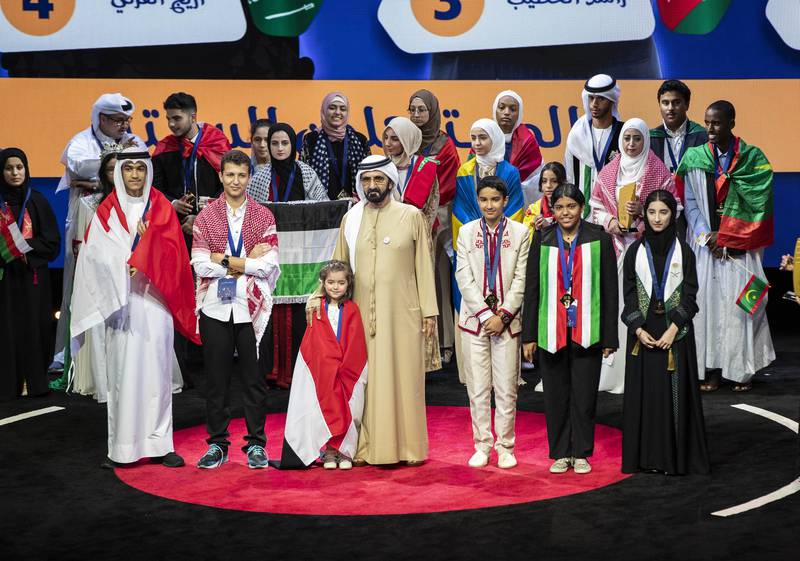
She has now completed a remarkable journey from tragedy to triumph to win words of praise from Sheikh Mohammed bin Rashid, Vice President and Ruler of Dubai.

In footage released by Dubai Media office, Sheikh Mohammed is seen speaking to Sham as she clutches her winner’s trophy at a ceremony at Dubai Opera House on Thursday.

Her success was met with warm applause by a large audience at the Downtown Dubai culture spot.

“She sustained injuries in the head and at the hospital doctors stitched them,” said Sham’s mother, Manal Matar, 33.

“I have been her support along with my family and her father’s family.

“I noticed she had a passion for memorising texts and Quran verses since she was less than three years old so I supported her.”

A young symbol of hope

She said that Sham has been an inspiration for the children in her family and school.

“Her cousins wait to see what she reads to learn from her.

“Her school mates will certainly be inspired. This challenge will help raise a generation that can rebuild Syria.

“Love of reading must start at a very young age.”

The young literature lover read 70 books to win a competition that attracted 22 million entrants from 44 countries.

When asked about what she would do with the Dh1 million prize money, she said she would give it to her mother.

“We haven’t thought of what to do with the money yet. The focus is on Sham, she is my investment for a better future,” Ms Mattar said.

Sham secured top spot ahead of Adam Al Qasimi from Tunisia in second, and Rashid Al Khateeb from Jordan, in third.

Reading is ‘food for soul and mind’

The young winner said reading offers an opportunity to transport yourself to new places with every turn of a page.

“I’m very happy to win and would like to invite all my friends and all young people to read. Reading is food for soul and mind,” Sham said.

“Reading takes you places, every story introduces you to different people and takes you to a new place.”

The youngster impressed judges with the confidence and clarity with which she expressed her ideas and opinions.

“It was a unanimous decision on Sham, who showed confidence,” said Lailah Al Obaidi, professor in Arabic language and literature at the University of Sharjah, and one of three judges.

“Sham will pave the way for the generation of the future because at this young age, she will be a motivation for more young readers in the Arab world.”

The annual winner is selected based on the pupil’s ability to articulate general knowledge, their critical thinking and communication skills, plus the diversity of books they have selected.

The Arab Reading Challenge was launched by Sheikh Mohammed in 2015 to encourage a million young people to read at least 50 books in a year.

Helping to shape young minds

Noor Aljbour, from Jordan, won Dh300,000, along with the title of Outstanding Supervisor, in recognition of her work guiding and motivating pupils through the challenges of the Covid-19 pandemic.

“The obstacles and the amount of work to prepare for this edition of the reading challenge were huge because its the first to happen after Covid-19,” Ms Aljbour said.

“Pupils returned to schools lacking the passion for reading, this meant that we needed to encourage pupils not only to read but to also pick up on their studies.”

Morocco’s Mukhtar Jasoulet school won the Dh1 million Best School award.

In the category for Arab pupils living in foreign countries, Nada Al Satri from Belgium was named the champion.

source/content: thenationalnews.com (headline edited)

________________

Sheikh Mohammed bin Rashid, Vice President and Ruler of Dubai, with the six finalists at the Arabic Reading competition at Dubai Opera. Left to right, Mohammed Jamil (Bahrain), Rashid Al Khateeb (Jordan), Sham Bakour (Syria), Adam al Qasimi (Tunisia), Ghala Al Enzi (Kuwait) and Areej Al Qarni (Saudi Arabia). All photos: Ruel Pableo for The National

___________________________________________________

DUBAI, UNITED ARAB EMIRATES (U.A.E) / SYRIA

SAUDI ARABIA: Saudi Red Crescent Receives Guinness World Record for ‘Saving A Soul’ Campaign to Save lives

More than 9,000 people signed up online to learn first aid within 24 hours of the campaign launching.

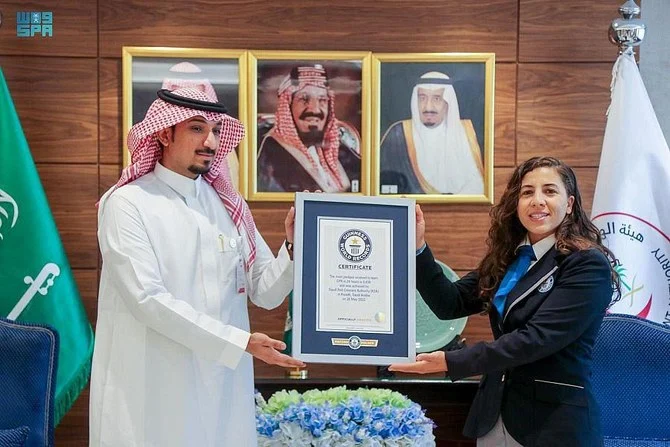
 The Saudi Red Crescent Authority has received a Guinness World Record for its “Saving a Soul” awareness campaign after 9,836 people signed up to learn first aid within 24 hours.

More than 9,000 people signed up online to learn first aid and how to use automated external defibrillators within 24 hours of the campaign launching, Saudi Press Agency reported.

Spokesperson for the Saudi Red Crescent Authority, Abdulaziz Al-Suwaine, said the campaign was held at Riyadh Front and witnessed a big turnout from both citizens and residents who showed true willingness to learn first aid and ways to use AEDs.

The authority has installed defibrillators in several public places to help save lives, he added.Al-Suwaine said the campaign’s success in attracting such a large number of people in a short amount of time shows how responsible Saudi society is and the will of its individuals to be influencers at the humanitarian level.

source/content: arabnews.com (headline edited)

___________

The Saudi Red Crescent Authority receives a Guinness World Record for its “Saving a Soul” awareness campaign. (SPA)

__________________

SAUDI ARABIA

IRAQ: Brain Tissue on a Microchip Aids Iraqi Scientist Dr Mootaz Salman’s Search for Better Stroke Treatments

The Iraqi researcher Mootaz Salman has won the “Young Scientist Lectureship Award” for research that involved putting human brain tissue on a microchip and using innovative technology to treat neurodegenerative diseases.

Salman started his academic career at the University of Mosul, where he earned a Bachelor of Pharmacy with Honours, and is now is a senior researcher and lecturer in the department of physiology, anatomy and genetics at the University of Oxford.

He spoke to Al-Fanar Media about his work, which has taken nearly ten years of research, and the experiences that led him to his current post.

The first researcher in Britain to win the award, Salman said the support he received from universities where he had worked  in the United States and the United Kingdom had been a key factor.

“I deeply believe that the more a person works, the more fortunate he is,” Salman said.

“From the very beginning, I was aware of the challenges ahead, the double effort I had to make, as an academic from a conflict country, and the responsibility I had to convey a different image of my country and to help humanity provide solutions to brain diseases and stroke, which have risen dramatically.”

Human Brain Tissue on a Microchip

The International Society for Neurochemistry and the and Asian-Pacific Society for Neurochemistry will present Salman with the award in September in Honolulu, Hawaii.

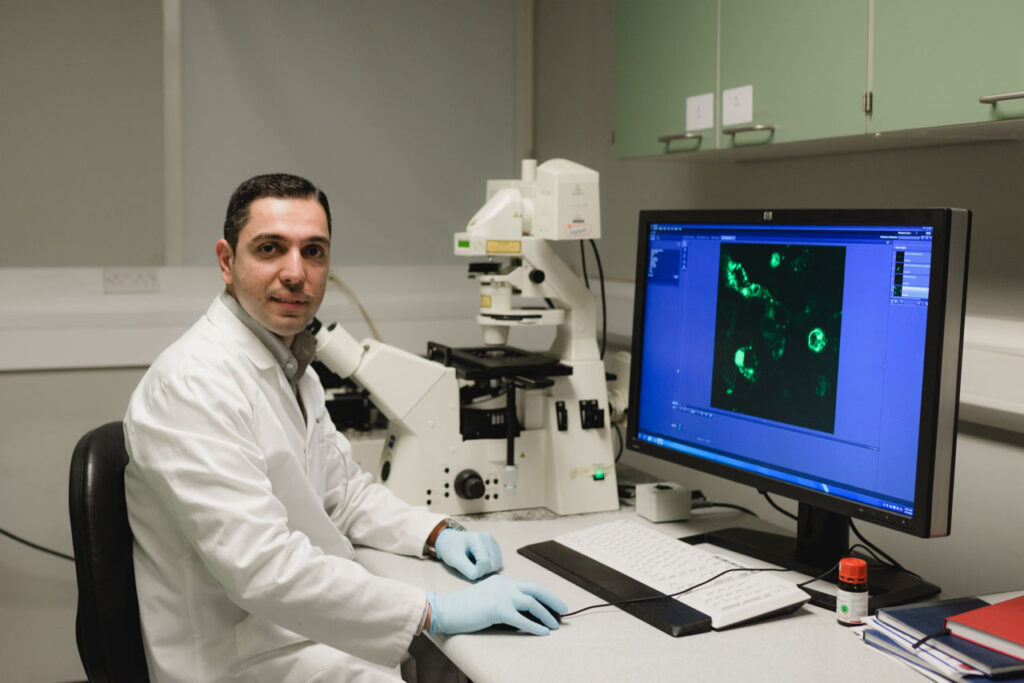
Salman led a research team that used  a human brain “microvessel on a chip” to study what happens when drugs cross from the bloodstream into the brain.

The research was part of his ongoing work to understand the cellular physiology of the blood-brain barrier and exploit its mechanisms to improve the effectiveness of therapeutic treatments of neurological diseases such as Alzheimer’s disease, multiple sclerosis, and Parkinson’s disease.

The device the researchers designed for the study allowed them to track the movement of tiny molecular sizes across the blood-brain barrier. Their device is ideal for studies involving biotherapies, as well as being able to employ it in high-resolution imaging methods, such as transmission electron microscopy, Salman said.

Academic Journey

Before moving to the University of Oxford two years ago as an assistant professor and lecturer at Wolfson College, Salman was a postdoctoral fellow at Harvard Medical School and Boston Children’s Hospital in the United States.

Before that, he earned a master’s degree and a Ph.D. from Sheffield Hallam University, in the United Kingdom.

During his doctoral studies, he discovered a new pharmacological framework for developing drugs to treat patients with brain tumours resulting from accidents and strokes.

This research focused on water receptors in the brain. Salman described it as a turning point that helped him recognise the molecular mechanics of brain diseases and think of ways to provide therapeutic solutions rather than surgery, which has major risks and complications.

He said the research led him to discover how cells develop brain tumours and the mechanics that cause these tumours and strokes at the molecular level.

A World Health Organization report says that about 75 million people in the world suffer from strokes annually. About five million of them die and another five million suffer permanent disability.

Salman says the incidence of brain disease in the Arab world is rising because of the dietary and living patterns of the majority of the population, the intake of fats and sugars at “unreasonable” rates, the lack of physical activity, and the pressures of daily life.

Difficulty of Research in Arab Countries

After graduating from the University of Mosul, Salman worked as a teaching assistant in the university’s Faculty of Pharmacy for about two years and experienced firsthand the difficulties of research in the Arab world. He said there was no financial support for conducting research, research laboratories were limited, and the teaching and administrative burdens on professors usually led them to abandon research.

Salman said scientific research should be considered “an investment,”  not a “random academic luxury.” Such work only flourishes in a suitable environment where there is stability and financial support, he said.

He believes the political unrest Iraq has experienced in recent years has affected teaching in universities and Iraqi researchers’ chances for professional development. He described government support for Iraqi universities as “very limited” and said most research initiatives were “individual and random” and did not amount to regular institutional work.

A Call for Greater Investment in Research

Salman said Arab countries needed to increase investment in scientific research at the national level and benefit from the experience of wealthy Gulf countries that have attracted foreign and Arab professors from major European and American universities to establish research centres where young researchers can train.

He said he had tried to open communication channels between the University of Oxford and Iraqi universities to reach agreements for cooperation and scientific research, which could provide research fellowships for Iraqi researchers at British universities.

This year, the University of Mosul signed a cooperation agreement with Oxford on a project that uses remote sensing and photographic information systems to study antiquities. The work would preserve the cultural heritage of Nineveh Governorate and other Iraqi provinces, and attract Ph.D. students to training courses at British universities.

Salman said: “These efforts give me a high sense of pride and a greater incentive for hard work and research that benefits all humanity. I feel a sense of responsibility and love towards my country, my city and my mother university, which helped me and paved the way for me at the beginning of my academic journey.”

source/content: al-fanarmedia.org (headline edited)

___________

Mootaz Salman, an Iraqi scientist at the University of Oxford, has won the “Young Scientist Lectureship Award” for his use of innovative technology to treat neurological diseases. (Photo: Mootaz Salman).

_________

IRAQ

MOROCCO: CEO Omar Channawi Features on Forbes’ Global Meets Local List

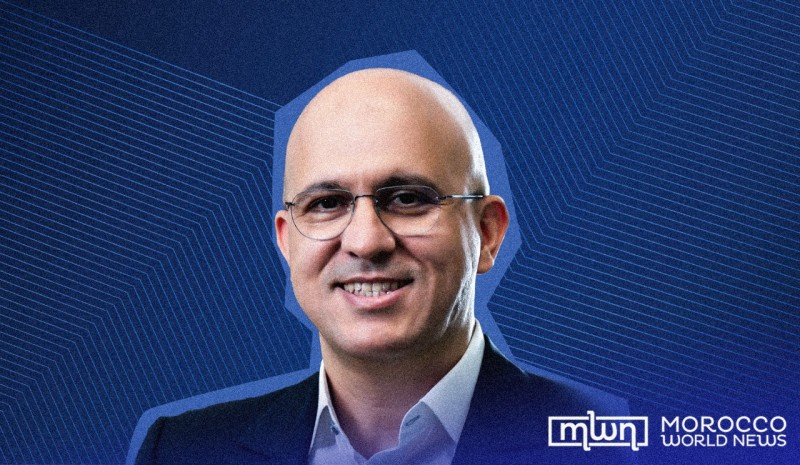
CEO of the Middle East, Global Entrepreneurial Markets, and Sub Sahara Africa at Procter & Gamble (P&G) Omar Channawi has featured in the Forbes’ “Global Meets Local 2022” list for the MENA region.

The Moroccan businessman also holds the position of P&G’s Senior Vice President of Sales in Asia Pacific, the Middle East, and Africa.

Channawi started his career with P&G Morocco in 1993 and assumed his current position in 2019 after building a solid career with the American consumer goods corporation over two decades.

P&G is the parent organization of numerous well-known brands such as Downy, Pampers, Always, Braun, Gillette, Olay, Oral-B, and Head & Shoulders. 

The company’s portfolio also includes brands that are often seen as competitors in the MENA market such as Tide and Ariel. 

According to Forbes, P&G accumulated $80.2 billion in net sales in the 2021/22 financial year with the Middle East, Africa, Asia Pacific, and India contributing to 14% of total net sales.

The decades-long economic growth recorded in some MENA economies has encouraged numerous multinational companies such as P&G to set up offices in the Middle East, most often in the region’s largest economic hub Dubai.  

The presence of multinational companies in the region, according to Forbes, “create[s] thousands of jobs as well as bringing technological advancements and capital into the region.”

This year, Forbes recognized 51 executives from 50 companies for the 10th edition of its annual Global Meets Local ranking. The companies operate in the technology, banking, food and beverage, pharmaceuticals, and automotive sectors.

As for the executives, they represent 27 nationalities with most CEOs coming from Britain and France, each had five executives on the list. 

source/content: moroccoworldnews.com (headline edited)

_____________

The Middle East, Africa, Asia Pacific, and India contributed by 14% t o P&G’s total net sales in the 2021/22 financial year.

______________

MOROCCO