Arabs & Arabian Records Aggregator. Chronicler. Milestones of the 25 Countries of the Arabic Speaking World (official / co-official). AGCC. MENA. Global. Ist's to Top 10's. Records. Read & Enjoy./ www.arabianrecords.org
Riyadh-based academics’ findings on broad beans being tested in US.
At the same time when the Fifa World Cup is being held in South Africa, another fascinating tournament of sorts has been held in Singapore — a “medical championship”, so to speak, on broad beans.
Tens of scientists from all over the world presented and discussed research and papers in the first international conference titled: “Neuro Talk 2010: from Nervous Functions to Treatment”, held from June 25-28.
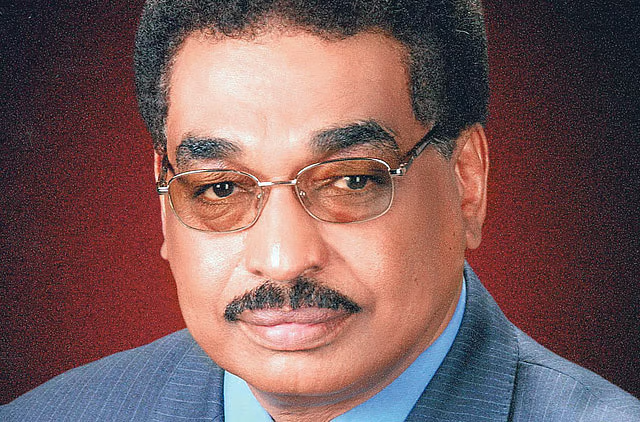
Scientists and doctors from 30 countries discussed brain and nervous system malfunctions and diseases, Professor Mustafa Abdullah Mohammad Saleh, consultant neurologist at the College of Medicine at King Saud University in Riyadh, who attended the conference, told Gulf News.
He said the conference discussed the latest methods of treatment by gene and stem cell therapy.
“The conference discussed a paper on the scientific discovery we have recently made and which was published in the US medical journal about the therapeutic potential of broad beans in preventing epileptic fits,” he said. Western news reports had earlier said that professor Saleh and his countryman, Ali Ahmad Mustafa, professor of pharmacology at the College of Medicine at King Saud University, had discovered that broad beans have a positive effect on epilepsy treatment.
Plant extracts
The two Sudanese scientists agreed in research on the treatment of epilepsy using plant extracts, to conduct joint research to decide the anti-convulsant substance in broad beans that prevents convulsions.
Professor Saleh’s discovery about the characteristics of broad beans in treating epilepsy is currently being tested in the labs of Harvard University.
He said his discovery was sparked by his observation that epilepsy cases among schoolchildren in Sudan who eat foul (broad beans) for breakfast (and sometimes dinner) rated between 0.9 per cent and one per cent per 1,000.
This figure is remarkably lower than that in countries which do not eat broad beans like North and South America which was about 2.6 per cent per 1,000 students and other African countries which was two to three times higher than that of the Americas.
“This is how I got the idea that broad beans must contain a substance that protects against epileptic convulsions. I immediately started the research work with my colleague, Professor Ali Mustafa,” he said.
Professor Saleh said they injected a group of mice with strychnine and picrotoxin, two drugs which cause convulsions leading to death, while they fed another group of mice with a fluid made of foul before giving them the two drugs.
“Convulsions and deaths from strychnine were decreased by about 66 per cent in the group of mice which were pre-treated with foul,” he said.
Professor Saleh said the rate of protection was 100 per cent in the mice which were given both foul and valium before they were injected with strychnine.
He explained that following this and other experiments, a drop of broad bean concentrate was examined by a form of chemical analysis (chromatography) and compared with drops of phenobarbitone (anticonvulsant drug), valium and glycine substance.
“The drop of foul had the same speed as that of glycine,” he concluded.
Professor Saleh had earlier discovered, along with other scientists, a new inherited gene which causes muscular myopathy. This gene has been named after him as ‘Salih myopathy’.
Should scientists look into people’s lifestyle around the world for treatments on different diseases? Is this discovery proof that people should start eating less processed food and more whole food?
Arab Women in Science Platform: Igniting a Collective Spark for Gender Equality in Science.
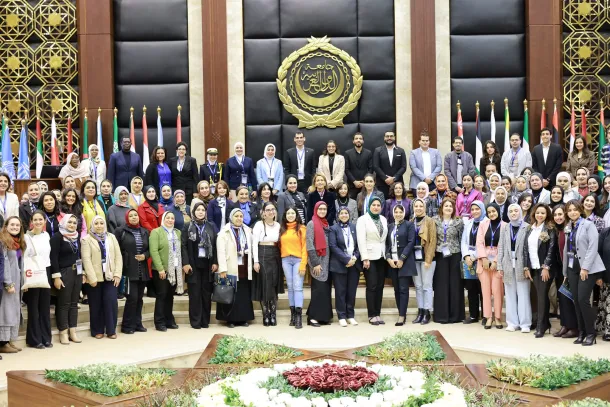
On the occasion of the United Nations International Day of Women and Girls in Science and Technology, the Arab Women in Science Platform was officially launched on February 1, 2024, in Alexandria, Egypt. The enchanting event hosted by the UNESCO Regional Office of Egypt and Sudan / Liaison office with the League of Arab States and the Arab Academy of Science, Technology and Maritime Transport (AASTMT) at AASTMT Main Campus in Abu Qir brought together over 150 high-level participants from diverse generations and fields, including natural sciences, human and social sciences, to discuss challenges faced by women scientists in the Arab region and explore strategies to advance women’s participation in science, technology, and innovation through the new Arab Women in Science Platform initiative.
A compelling initiative driven by the voice of Arab women scientists themselves, shaping a brighter future in the world of science
The figures remain dramatic. According to the UNESCO Science Report, women still account for only 28% of engineering graduates and 40% of computer science graduates worldwide. Women accounted for one in three researchers (33%) in 2018, just 5 years ago, and represent only 22% of professionals working in AI, the field of the future. Focusing on the Arab States, only 24% of senior management positions in science and engineering are held by women, and even though 47,3% of Egyptian universities STEM graduates are women, they only represent 38% of the STEM workforce (CAPMAS, 2018).
The Arab Women in Science Platform, launched one year after the call of the Egyptian and Sudanese women scientists’ made during the “Paving the way for Women Leadership in Science” dialogue in February 2023, to empower women in natural and social sciences across generations in the Arab region. It offers both online and offline spaces for women scientists to connect, share experiences, and access career-enhancing programs, including mentorship and training. Additionally, the platform raises awareness of gender stereotypes in science and advocates for gender-transformative policies and open science, with Arab women scientists actively involved in shaping the initiative.
10 & 11 February: Igniting a collective spark for gender equality in Science
The launch event featured insightful conversations, two panel discussions, and a workshop to structure the new community of Arab Women in Science, assess the platform prototype and identify innovative pathways to ensure inclusivity and foster systemic transformations in the scientific realm, and promote gender equality and support women scientists across the Arab region. Discussions and exchanges led to key recommendations that in the development of the platform include:
Translating the Arab Women in Science Platform into an inclusive, accessible, attractive, clear and interactive website.
Creating a strong community of Arab women scientists and men allies by investing heavily at the outset.
Actively engaging with the private sector and the industry to ensure initiatives’ financial sustainability and women scientists’ employment.
Addressing the professional challenges and opportunities of women scientists in the Arb region with a focus on research and training accessibility, women role models, gender stereotypes and displaced women scientists ‘support.
UNESCO office in Cairo also wish to acknowledge and warmly thank the bravery of women scientists in sharing their experiences and the difficulties they have encountered throughout their career, with a special thank to the Sudanese scientists, directly and violently impacted by the civil war.
Hearing the Voices of Arab Women Scientists: A National Surveys
Who better to shape the future of science in the Arab world than those who have dedicated their lives to its pursuit? These remarkable women, pioneers in their respective fields, embody the very essence of scientific exploration and discovery. Their voices, resonating with passion and dedication, hold the key to unlocking the full potential of Arab science.
UNESCO Office in Cairo recognizes that true empowerment stems from a deep understanding of the challenges faced by Arab women scientists. To this end, a participatory approach has been adopted, involving extensive consultations and a regional survey designed to capture the experiences and aspirations of these remarkable women.
The survey, now available, seeks to engage the voices of all Arab women scientists. UNESCO office in Cairo extends a warm invitation to all Arab women scientists to participate in this transformative initiative. Your voice matters.
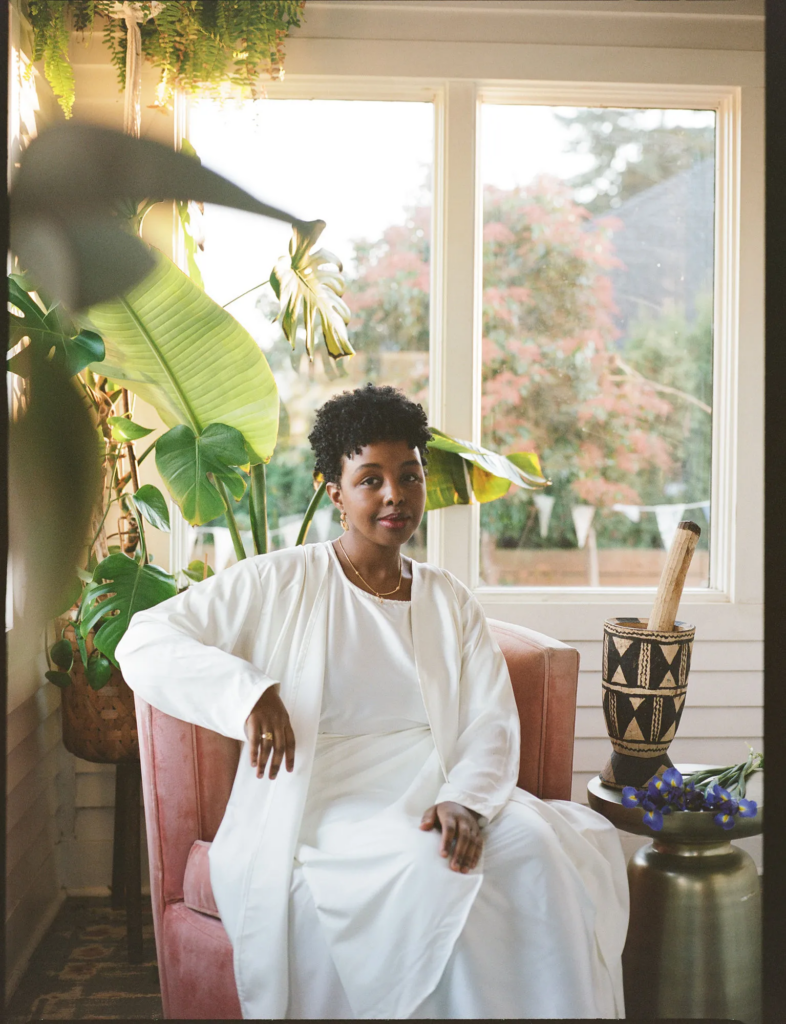
Growing up, Ifrah F. Ahmed never planned on becoming a chef.
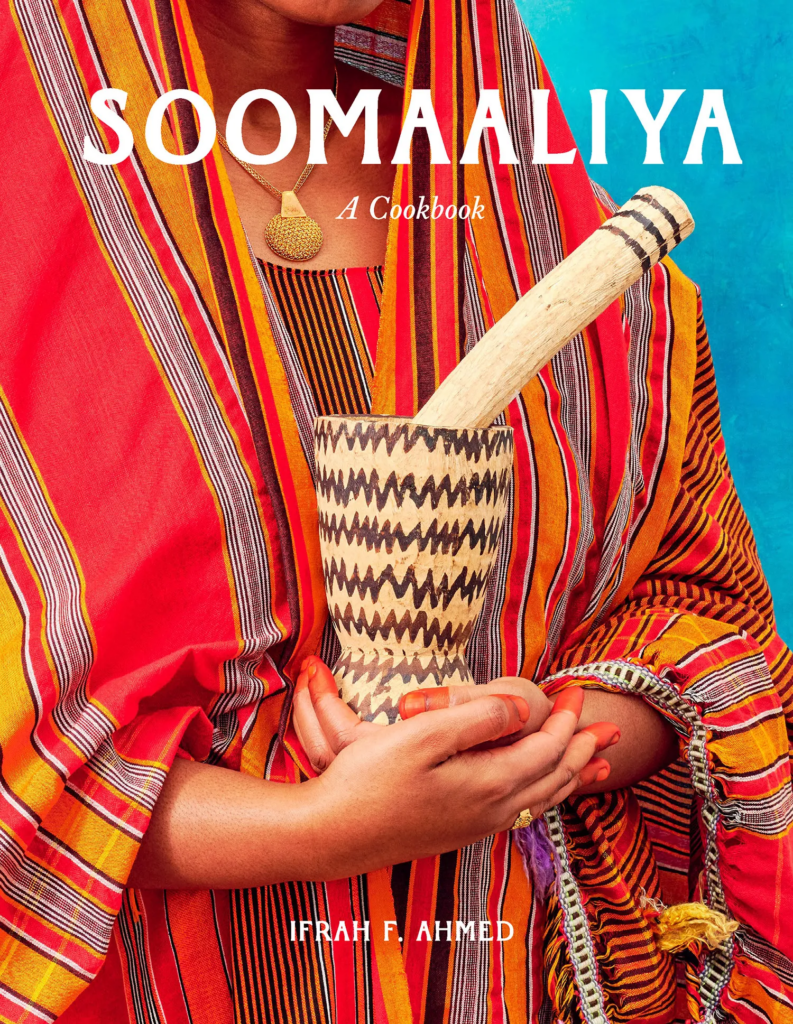
Born in Mogadishu, Somalia, Ahmed came to the US as a child after the start of the Somali Civil War. In 1996, her family was resettled in Tukwila, Washington, as part of an early wave of Somali refugees who went on to form a community there. In their new home, Ahmed’s mother made it her mission—even as she worked multiple jobs and took care of her children—to ensure Ahmed and her siblings stayed connected to their Somali identity. Food played a vital role in that mission, and planted the seed that, years later, led to Ahmed becoming a chef and writer—and eventually authoring her debut cookbook, Soomaliya: Food, Memory, and Migration, which is out now.
First, she had to learn the oral traditions of Somali cuisine. When Ahmed was in elementary school, her mother began teaching her how to cook classic Somali dishes. At times, Ahmed had mixed feelings about these lessons, feeling that they were part of a set of gendered expectations. But she came to appreciate the fact that through her mother’s cooking lessons, she was learning much more than the ingredients and techniques needed to make the perfect canjeero (sour fermented pancake) or sambuus (dumplings).
“It’s helpful to know the recipes,” Ahmed tells Vogue. “But it’s almost like her teaching me not just what we eat but how we eat was really teaching me about who we were.”
Ahmed soon discovered her passion and curiosity for food, which her mother nurtured. “I became an avid Food Network stan from a very young age,” she says. She would develop “hyper-fixations” on “classic American foods” like pancakes and chicken burgers, and enjoyed figuring out how to make them. She loved Anthony Bourdain, who merged her interests in food and geopolitics. She prized academic excellence (her work paid off; she was valedictorian), and originally pursued a career in law.
After college, Ahmed worked with Somali refugee students at Seattle public schools. She got married and started law school, but found that she was always taking her law work home with her. Cooking continued to be her passion, but she didn’t think of it as her life’s work. It was hard to shake the expectations inherent in being the eldest daughter in an immigrant family.
“I never thought of food as a serious career because usually, when you are coming from those backgrounds, you feel like you have to have a career that translates to something in terms of maybe redeeming some of your parents’ sacrifices,” Ahmed says. “I think a lot of immigrant and refugee kids can probably relate, and it’s not always easy to transition to a food career. I also had never really seen anyone that looked like me that had the kind of career that I was fantasizing about.”
Then, in 2018, she went on a homecoming trip to Somalia with her mother. “I had an urge to kiss the ground when I got off the plane. It was the first time that I was fully immersed in my own community in that way,” Ahmed says. “When I was there, it was really simple moments where I was like, okay, I really want to turn to food: the first meal that I had in our house in Mogadishu after meeting all of my family, and just really small moments like that.”
It was a constellation of moments that convinced her to reorient her life towards Somali culinary and cultural work. “Everything was incredible. It was that with the combination of being in your homeland, with seeing the beauty and the movement and the energy, and also tasting the freshness of the food, the ingredients, and the slowness and the intentionality around not just eating, but how you eat and who you eat with,” Ahmed says.
That experience eventually led to her launching Milk & Myrrh, her Somali culinary pop-up, which has routinely sold out since its launch in 2019. Around that time, she also had the idea for a cookbook focused on Somali cultural and culinary preservation. She set out to build the writing, cooking, and recipe development skills that she needed for the book, contributing to The New York Times’s cooking section, and writing for publications including Vogue, Eater, The Los Angeles Times, and more. Now, nearly a decade later, all her work has come to fruition.
The book explores the cultural, political, and geographic forces that have shaped Somali cuisine. Ahmed translates an oral cooking tradition into writing, building a vital new addition to the archive of Somali culinary history.
Researching, writing, and developing the recipes in the book wasn’t an easy feat. “If you’re coming from an oral cooking culture, you’re never just a recipe developer, you’re never just a chef, you’re never just a writer,” Ahmed says. “For a lot of this, I felt like a detective, a historian.”
In addition to recipes, Soomaaliya features profiles of people throughout the Somali food world, including chefs, business people, restaurateurs, herders, and agricultural workers.
“I think for me, it’s really important that my pioneers get celebrated because I think not only was there that lack of knowledge of Somali culinary traditions, but I just feel like they did such important work that really does not get the recognition that it deserves. Because what they did is they really worked on the preservation of our cuisine and really moving that through the digital age, especially to serve a growing diaspora,” she says.
For Ahmed, Soomaaliya has always been more than a cookbook. It is a work of cultural preservation, an invitation, and a way of addressing the disruption of the oral tradition of Somali culture caused by decades of forced migration due to the war.
It’s also, crucially, a way of taking long-held tenets of Somali cooking and culture, and putting them into writing. “The historical section is the past; the recipes are kind of like the present; and to me, the interviews are sort of like the future,” Ahmed says.
Below, Ahmed shares a favorite recipe from the book.
_______________________
Mallaay Qumbe (Coconut Fish Curry)
Serves 4
Despite Somalia’s long coastline, seafood has not traditionally been a big part of the Somali diet outside of coastal towns. In most of the country, red meat has been king, and both seafood and poultry have been seen as lower-class food, or not “real” food, in comparison to red meat. In the 1970s and 1980s, in a time of severe famine, the government tried to combat the negative view of seafood and boost the fishing sector. They relocated nomads to fishing cooperatives and even made certain days of the week officially “meatfree” days, dedicated to seafood consumption. Despite these efforts, the industry did not take off. A decade later, the Somali Civil War saw the full collapse of this sector. More recently, interest in seafood consumption is growing.
Mallaay qumbe can be found up and down the East African coast, including in the coastal towns of southern Somalia. This version is distinctly Somali, due to the addition of xawaash and creamy coconut milk. Serve mallaay qumbe with rice or soor.
Ingredients
1¼ teaspoons fine sea salt
1 pound (450 g) barramundi or other firm white fish, cut into serving-size pieces
2 tablespoons olive oil
1 medium red onion, diced
2 large Roma tomatoes, finely diced
8 garlic cloves, minced
1 (13½-ounce / 400 ml) can unsweetened coconut milk
1 cup (16 g) cilantro leaves, finely chopped, plus more to serve
4 teaspoons Xawaash
Steamed white rice, for serving
Method
Sprinkle ¼ teaspoon of the salt over the fish; put it aside.
In a pot just large enough to accommodate the fish in one layer, heat the oil over medium-high heat. Once the oil is hot but not smoking, add the onion and cook, stirring, for 8 to 10 minutes, until almost translucent. Add the tomatoes, cover, and cook for 7 minutes, occasionally stirring and smashing the tomatoes down as they cook.
Add the garlic and cook for a minute or two, then add the coconut milk, cilantro, xawaash, and the remaining 1 teaspoon salt; stir and cover. Cook for 4 minutes to allow the flavors to come together, then add the fish, making sure the coconut milk covers the fish (if necessary, add a splash of water to cover). Cover and cook for 8 to 10 minutes, until the fish can be easily flaked with a fork. Serve the curry with rice, topped with additional chopped cilantro.
Xawaash (Somali Spice Mix)
Makes about 2 ½ cups (260 g)
It’s no exaggeration to say that xawaash is at the heart of Somali cuisine. It is Somali history on a plate—a culinary reminder of Somalia’s centuries of global trade, particularly along the Indian Ocean. Xawaash is what makes many Somali dishes taste distinctly Somali. While every household’s xawaash recipe is its own, typically seven core spices—cumin, coriander, black pepper, cinnamon, cardamom, cloves, and turmeric—are toasted until their fragrance blooms, then blended into an earthy golden-brown powder. Xawaash stores very well and for a long time in an airtight container, though it’s at its peak shortly after it’s made. If you use it often (and many recipes in this book call for it), you can double or triple the recipe for a big batch.
Ingredients
1 cup (100 g) whole cumin seeds
1 cup (70 g) whole coriander seeds
¼ cup (35 g) black peppercorns
1 small-to-medium piece of cinnamon bark
2 tablespoons green cardamom pods
1½ teaspoons whole cloves
¼ cup (30 g) ground turmeric
Method
Toast the cumin, coriander, peppercorns, cinnamon bark, cardamom pods, and cloves in a medium skillet over medium heat, stirring constantly so the spices don’t burn. The spices are toasted when they have a slightly darker color and become fragrant, 1 to 2 minutes.
Transfer the toasted spices to a blender or spice grinder and blend until they become a fine powder. Transfer to a bowl and mix in the ground turmeric until it’s fully incorporated and the spice mix is golden brown. Allow to cool completely, then store in an airtight container.
Excerpted with permission from Soomaaliya by Ifrah F. Ahmed, published by Hardie Grant North America, March 2026, RRP $40.00. Hardcover.
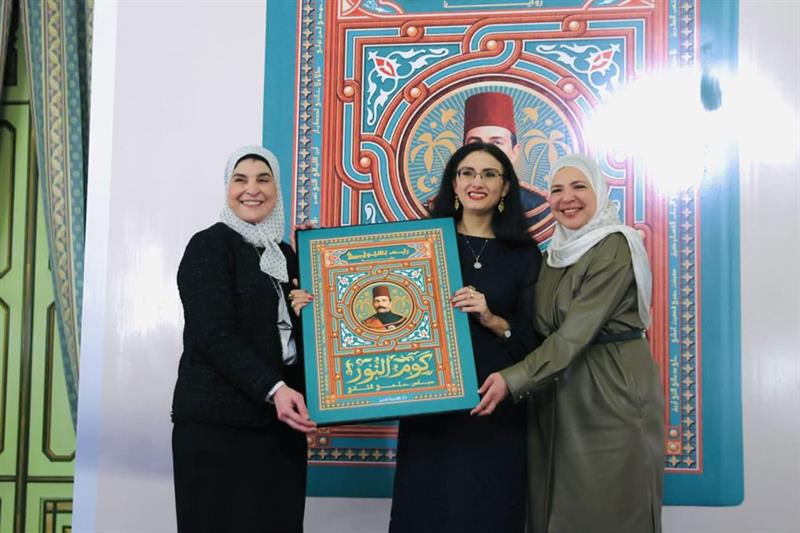
Egyptian author and academic Reem Bassiouney launched her latest novel, Kom El-Nour: Abbas Helmy II, at a book-signing ceremony held at the Marriott Hotel in Cairo on 1 April, presenting a historical work that revisits the reign of Egypt’s last Khedive.
The event, organized by Nahdet Misr Publishing House, was attended by Minister of Social Solidarity Maya Morsy, American University in Cairo (AUC) President Ahmad Dallal, Egyptian Red Crescent (ERC) Executive Director Amal Imam, jewellery designer Azza Fahmy, as well as several public figures, media representatives, and readers.
Kom El-Nour takes readers into one of the most consequential periods in Egypt’s modern history, focusing on the rule of Khedive Abbas Helmy II, son of Khedive Tawfiq and grandson of Khedive Ismail, who governed Egypt from 1892 to 1914.
The novel presents Abbas Helmy II from a different perspective, portraying him as a ruler who grew up among Egyptians, shared aspirations for the country’s advancement, and sought to resist British occupation through development and reform.
It highlights his efforts to modernize agriculture, support national institutions, and contribute to the formation of an educated elite capable of expressing society’s aspirations and defending its rights.
The book also explores the ongoing struggle between Abbas Helmy II and the British occupation, as well as the political pressures that ultimately led to his removal from power and exile in 1914. He spent the rest of his life in Europe until he died in 1944.
Despite his forced departure, the novel argues that Abbas Helmy II remained present in Egypt’s national memory, even as colonial authorities sought to erase his legacy and marginalise his role in historical narratives.
Through an engaging literary narrative, Kom El-Nour: Abbas Helmy II re-examines history from a fresh angle and invites readers to reconsider the events and figures that helped shape Egypt’s national consciousness. It also raises broader questions about how history is written and understood, particularly as certain patterns continue to echo across time.
Speaking at the launch, Dalia Ibrahim, Chairperson of Nahdet Misr Publishing House, said the novel reflects the role literature can play in revisiting history and reshaping public awareness.
“At Nahdet Misr, we believe literature has a real role in reshaping consciousness, especially when it revisits history from different perspectives,” Ibrahim explained.
“Kom El-Nour: Abbas Helmy II is an example of the kind of work that does not merely recount events, but encourages readers to think and re-examine what is often taken for granted. We are very proud of our partnership with Reem Bassiouney and of continuing to publish works of such depth and impact.”
The novel also reflects the continued partnership between Nahdet Misr Publishing House and Bassiouney, whose literary output now includes 13 works of fiction. The publishing house has become the principal publisher of her novels, beginning with the reissue of her debut novel, The Scent of the Sea, in January and continuing with Kom El-Nour.
According to the publisher, the collaboration aims to bring distinguished literary works to a wider readership in Egypt and abroad.
Shams is part of the Artemis II program that aims to accelerate scientific innovation .
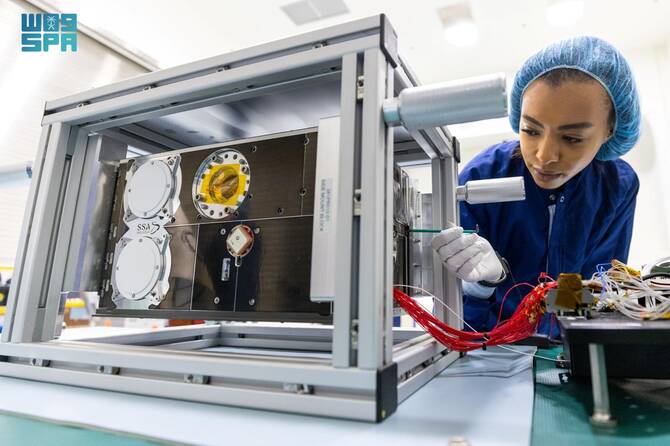
The Saudi Space Agency announced the successful launch and initial communication with the Saudi satellite Shams, which was deployed aboard the Space Launch System as part of the Artemis II mission.
With this achievement, the Kingdom becomes the first Arab nation to participate in a space mission under the historic Artemis program, which aims to accelerate scientific innovation and foster high-impact international partnerships that contribute to shaping the future of space for humanity, the Saudi Press Agency reported.
Artemis II represents the second phase of the Artemis program, led by the National Aeronautics and Space Administration in collaboration with international partners.
The mission aims to return humans to the vicinity of the moon for the first time in more than five decades, paving the way for future missions to Mars. It carries a crew of four astronauts on the first crewed lunar flyby mission aboard the Orion spacecraft, powered by the Space Launch System, the most powerful launch vehicle ever developed.
The mission also carries the Saudi satellite Shams as part of its scientific payload.
The Shams satellite will operate in a highly elliptical orbit, ranging from approximately 500 km to 70,000 km above Earth.
This orbit enables broad coverage for monitoring solar and radiation activity, enhancing space weather research, providing an advanced scientific environment, and supporting critical applications associated with it.
Shams represents a multi-first achievement. It is the first Arab mission launched as part of the Artemis program and the first national mission dedicated to space weather monitoring, underscoring the Kingdom’s progress in advanced space technologies.
The satellite was developed domestically by Saudi talent, supported by initiatives under the National Industrial Development and Logistics Program, one of the key enablers of Saudi Vision 2030.
The mission aims to study space weather and monitor the effects of solar and radiation activity on Earth through four main scientific domains: space radiation, solar X-rays, Earth’s magnetic field, and high-energy solar particles.
This scientific mission contributes to enhancing the reliability and sustainability of critical sectors linked to space, such as communications, aviation, and navigation, by providing data that supports operational readiness and strengthens the security of the technical infrastructure relied upon globally in daily life.
Acting CEO of the Saudi Space Agency Dr. Mohammed bin Saud Al-Tamimi said: “This milestone reflects the Kingdom’s scientific and technological advancement under Vision 2030 and underscores its active role in developing advanced technologies and shaping the future of space for humanity.”
CEO of the National Industrial Development and Logistics Program Jameel bin Ahmed Al-Ghamdi stated that developing the Shams satellite within the Kingdom reflects the impact of the program’s initiatives in localizing advanced technologies and building competitive national industrial capabilities.
source/content: arabnews.com (headline edited)
____________
The Saudi Space Agency announced the successful launch and initial communication with the Saudi satellite Shams, which was deployed aboard the Space Launch System as part of the Artemis II mission. (SPA)
A new generation of talent is turning its lens towards intimate storytelling, with Africa’s largest nation as its backdrop.
“Algeria is a visually unspoilt country,” says Mounia Meddour. Meddour is one of the nation’s most prominent contemporary filmmakers. Her debut film, Papicha (2019), set during the 1990s Algerian Black Decade with Algiers as its backdrop, was screened at the Cannes Film Festival’s Un Certain Regard, bringing her international recognition. Yet, she is right: very few images of Algeria exist within the cinematic landscape.
There are many reasons for this. The industry has long been at a standstill; visas are difficult to obtain and cultural policy remains lukewarm. Algerian landscapes and intimate stories struggle to travel beyond the country’s borders. For several years now, however, a new generation of filmmakers, cameras in hand, has been working to capture and create a contemporary visual archive of a nation longing for representation.
Algeria nonetheless has a rich cinematic history. In 1975, thirteen years after gaining independence from France, the young state won the Palme d’Or at the Cannes Film Festival for the historical fresco Chronicles of the Years of Fire, directed by Mohamed Lakhdar-Hamina — making Algeria the first, and still the only, African and Arab country to achieve this distinction. It is this legacy that leads the film critic Samir Ardjoum to speak of a paradox in Algerian cinema.
“This symbolic prestige has not translated into industrial continuity,” he says. “Algerian cinema suffers from a lack of stable international distribution. Films circulate widely at festivals, but rarely in commercial circuits.”
Ardjoum explains that Algerian cinema originated as a cinema of nation-building. After 1962, the country invested heavily in films recounting the War of Independence and enshrining a heroic national memory, creating a shared narrative and collective imagery. Many films about the thawra (the Revolution, or Algerian War) were commissioned, with Mohamed Lakhdar-Hamina among the most prominent figures of this movement.
A more mainstream cinema emerged in the 1970s, but was largely forgotten due to poor archiving. The Black Decade of the 1990s brought the industry to a near halt, as it did many others. Since then, Algerian cinema has remained in a state of lethargy. As the filmmaker Malek Bensmaïl puts it: “It is both fragile and very lively. Yet there is a deep desire to create our own stories and not let others tell them for us.”
The act of image-making inevitably raises questions of funding and audience. “All too often, we oscillate between a foreign gaze that restricts us and a nostalgic form of self-aestheticisation akin to self-Orientalism,” argues Amira Louadah, director of The Ark.
For too long, Algeria has been shaped by Western-manufactured representations, beginning with France. “Between 1830 and 1962, during French colonisation, most images of the country — whether in painting, photography or film — were created from a Western perspective,” Louadah notes. In a colonial context, such representations served to criminalise, demean and demonise “Muslim Algerians”, the term used by the colonial administration for indigenous people. Even today, Ardjoum adds, “Algeria is often depicted through the lens of crisis, politics or its colonial past.”
With limited state funding, filmmakers increasingly turn to European backers who, Louadah says, can at times “dictate the stories they want to see from our region”. The result is a striking absence of visual documentation of everyday life. “How did families live? How were social relationships organised? How did people communicate? What did daily routines, household objects or lighting look like? How did people travel, in both rural and urban areas?” she asks.
This new generation hopes to fill that void. “It’s exhilarating to have this rare access to locations and footage,” says Yacine Medkour, co-founder of the Algiers-based production company 2Horloges. “At the same time, it’s a huge responsibility.”
“Our country lacks images produced from its own perspective,” Bensmaïl emphasises. By reclaiming their narratives, this new wave of filmmakers is creating “archives for the future, preserving fragments of memory to pass on to future generations”. Yet this comes with what Louadah calls “a cultural responsibility”. “We need to support a plurality of perspectives rather than a single, black-and-white approach. We should represent all viewpoints and social classes—not just central Algiers. The more diverse, the better. We must break free from monopolies over narrative and representation.” Ardjoum agrees: “It’s not about polishing the country’s image; it’s about expanding the range of representations.”
As part of this shift, many filmmakers are moving away from stories centred solely on the Algerian Revolution. “People are growing tired of heroic narratives,” Ardjoum observes. Bensmaïl, whose forthcoming film The Arab reimagines the unnamed protagonist of Albert Camus’s The Stranger through the testimony of his ageing brother, suggests that “his generation needed to ask questions”. “We are not abandoning the Revolution,” he says. “We are simply no longer treating it as a static icon.” Ardjoum describes this as a shift in political focus — from the grand historical narrative to the personal sphere. “By constantly glorifying the past, it becomes difficult to describe the present.”
Meddour’s Papicha follows Nedjma, a fashion student determined to stage a show during the Black Decade — a period the director herself experienced. Sofia Djama’s The Blessed (Les Bienheureux) centres on a couple, Amal and Samir, celebrating their twentieth wedding anniversary as they reflect on their shared past. Louadah’s documentary La Grosse Moula ou Li Michan explores Algeria’s linguistic history from a personal perspective. “There was a need to ground Algeria in the present, to tell stories that allow us to come to terms with our reality,” Meddour says. As Ardjoum notes, “Contemporary Algerian cinema is no longer solely a cinema of national narrative; it has become a cinema of the personal, of trauma, of urban life and of social tensions.”
To portray Algeria fully, however, filmmakers must look beyond the capital. “Our generation has tended to film what we know — often Algiers, which is inherently cinematic in its vitality,” says Djama, who is currently working on her next film, Jeudi moins quart. “But it would be a shame to limit ourselves. We need to look further afield.”
Progress remains constrained by financial and institutional challenges. “Over the past fifteen years, there has been real progress — more young filmmakers, more women, more films in festivals,” Bensmaïl notes. “But it is not yet enough.” Sustained national funding will be essential if this movement is to endure — allowing it to evolve from a fragile ecosystem of resourceful auteurs into a stable creative industry.
“If the films exist, we also need venues in which to show them,” Bensmaïl adds. Filmmakers are calling for a wider network of cinemas, alongside what Ardjoum describes as “an ambitious policy on archiving and international distribution”, supported by legal protections for creative freedom. “We have a wealth of talented individuals eager to write, produce and direct across genres,” Meddour says.
Medkour remains optimistic: “Algeria is the future of image-making.”
For Ahmad Nabil, paranormal encounters are real. If they weren’t, the entire Arab world would have to be insane.
There is a word in Arabic -al-hātif- that means the telephone. It also means a disembodied voice, and it can refer to the unseen caller: the jinn who summons you from somewhere beyond sight. It could be that Arabs named their phones after a supernatural entity, and almost nobody finds this strange.
Luckily, Ahmad Nabil finds it extraordinary.
“The root of jinn,” he tells CairoScene, speaking across a bad phone line from Jerusalem to Alexandria, “means to hide, to be concealed from the senses. From that root you get majnūn: madness, being overtaken, possessed. You get janna, paradise. You get janīn, the embryo, that which is still hidden inside. And you also get the genie – English borrowed that one from us.”
Ahmad Nabil studies the supernatural in our region, pulling back the surface of the Arabic-speaking world to reveal what runs beneath it. And once you lift a stone in that garden, an entire ecosystem waits.
He is 37 years old and lives and works in Beit Safafa, a Palestinian town southwest of Jerusalem. In his telling, it has always felt slightly outside of everywhere: isolated enough in the 1990s that the roads were dirt, children eventually manufactured their own entertainment, and jinn had plenty of room to roam.
Nabil is a visual artist, researcher, and educator, and the founder of Majlis al-Khayal, The Fiction Council, a Palestinian nonprofit dedicated to preserving and reviving Palestinian and Arab mythology and paranormal folklore. Since 2015, he has been collecting these stories, illustrating them, and insisting that imagination is not a luxury.
“Without imagination,” he says, “we can’t build better societies for ourselves. And we end up with others building them for us.”
Nabil’s childhood was not one of comfortable distance from the world. It was shaped by occupation, constant constraint, and the particular texture of Palestinian life in Jerusalem. But it was also expansive in the imagination.
“The lack of entertainment made us create our own,” he says. “We had self-generating input. We didn’t have as much external influence as kids do these days.”
As an adult, after studying design and applied arts in Jordan and later throwing himself into art training in Jerusalem, he kept encountering children with unusually vivid and imaginative minds.
“You know the one,” Nabil laughs. “The child in every classroom who talks about black holes and space-time, who has their own theories about mythical creatures at seven years old. The kid who gets either revered or relentlessly bullied depending on which room they’re in.”
Those were his people.
In 2015, he founded Majlis al-Khayal from a small studio, and one of its main projects was gathering exactly those children. Twelve of them eventually joined, each one arriving in a familiar way: a mother calling, exasperated, saying her son wouldn’t stop talking about things nobody understood, that his imagination was out of control, that she didn’t know what to do with him.
“I would meet the child and tell him: you’re not alone. I knew you’d bring your monsters with you.”
Those 12 are young adults now, university students: artists, designers, developers, scientists. But Nabil tended their imaginations for as long as he could.
In 2019, through The Fiction Council, Ahmad Nabil launched Darb al-Ghilan, ‘Road of the Ghūls’. The project maps ghoul folklore village by village across Palestine and documents encounters with jinn.
Its first field trip took place in early 2020, in Rahat in the Naqab desert of southern Palestine.
“Every Palestinian village has its own ghoul,” Nabil explains. “And the creature’s characteristics vary according to the topography, geography, and the relationship between that community and its land. The ghoul of a coastal village is not the ghoul of a hilltop village. The ghoul of a farming community is not the ghoul of a shepherding one.”
The ghoul (ghūl) in Arabic folklore is a malevolent, flesh-eating jinn-like creature classically associated with luring travellers to their deaths in the desert. It also helped shape the Western idea of the zombie, particularly through American pop culture and Antoine Galland’s 18th-century French translation of ‘One Thousand and One Nights’, which added cemetery-roaming and cannibalistic elements that were less emphasised in the Arabic original.
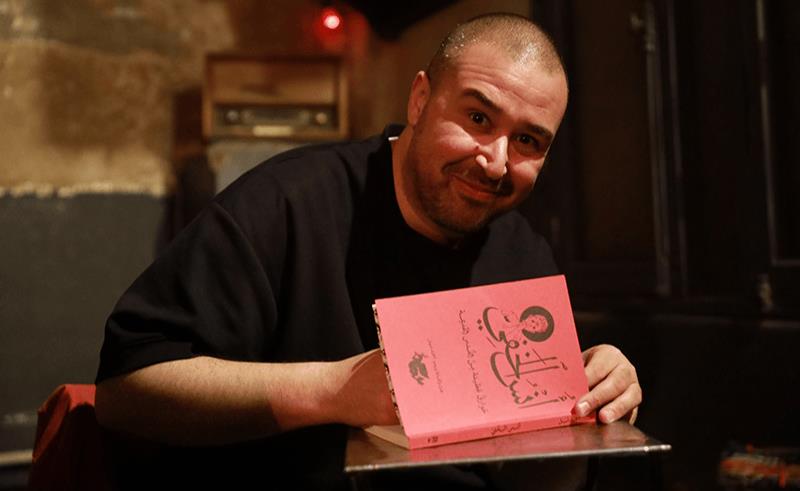
So far, ‘Uns al-Khafi’ is the first published output of Road of the Ghūls. ‘Uns al-Khafi’, or ‘Hidden Companions: Paranormals from the Old City of Jerusalem’, was published in August 2022. It was researched, written, and illustrated by Ahmad Nabil, designed by Omaima Dajani, and edited by Nairouze Khaldy. The book draws on interviews with 60 people and more than 35 hours of recorded testimony.
It sold out in less than 10 months. A second edition appeared in 2024 and is nearly gone. An English translation is now underway, and Nabil himself no longer owns a copy of the first edition.
“I titled the book ‘Uns al-Khafi’ because during my fieldwork I noticed that people in the Old City were profoundly at ease with the idea of jinn,” Nabil says. “They greet them in the morning and the evening.”
The book documents white-clad faceless figures, righteous jinn performing wudu at dawn, mischievous presences, and ghostly encounters linked to Mamluk-era houses with subterranean caves beneath them.
“People don’t want to be judged,” Nabil says. “They don’t want to be thought of as fabricating stories. They have to trust you first, and trust that you believe them.”
Interestingly, Nabil does not classify these encounters as mythology.
“I do not consider these legends,” he says. “I do not consider them khurafat, superstition. I consider them khawāriq, supernatural occurrences. Whether you believe in them or not is entirely your business.”
For Muslims, jinn are not mythological at all; they are theological. An entire surah of the Qur’an is named after them.
“They are accountable creatures, as humans are,” Nabil says. “There are doctors among them. Engineers. Pilots. And the sayyi’in, the delinquents, just as we have delinquents.”
Sorcerers might deal with those delinquents. Poets might receive inspiration from jinn poets whispering lines in the night.
“The Bible, on the other hand, has no jinn,” Nabil says. “Christian Palestinians might use the word spirits, but their framework is good versus evil. There’s no room for the specific, intimate social world of the jinn, who live among us with their own behaviours, hierarchies, and reasons for appearing or disappearing.”
It is this world, its textures, its site-specific stories, the particular jinn of a particular well in a particular village, that Nabil guides people into on foot.
One October evening at dusk, in the village of Qalandia north of Jerusalem, he gathered a group and began walking.
Qalandia is not, on the surface, an obvious setting for a supernatural tour. Today it is best known for one of the most heavily militarised crossing points in the West Bank, a daily humiliation that has grotesquely become shorthand for the occupation itself.
But Qalandia also once had maqamat: shrines of holy men and women scattered across the Jerusalem rural side.
The tour, Dastour ya Ahl al-Maqam (‘Permission, O Residents of the Shrine’), was a collaboration with Riwaq, the Centre for Architectural Conservation. The walk moved through the village’s memory: the byar, the wells, and the stories attached to them. They touch on the paranormal encounters said to have happened there, the relationships between women and the wells, men and the harvest, and the lament tradition known as tenwih, which Nabil describes as “wounds the heart.”
The destination was Sittna al-Mabrouka, Our Blessed Lady, a maqam that, at the time of the walk, existed only as a playground for children, with a pile of stones beside it.
In one story connected to the site, the Blessed Lady appears to someone who has wronged her and walks toward them without speaking, her back always turned, until the moment of confrontation.
Nabil placed a performer along the route, standing with her back to the walkers at a particular corner, waiting.
“When you bring the experience as close to the participants as possible,” he tells me, “it lingers in their minds.”
The tour ends at the candlelit stones of Sittna al-Mabrouka.
“You know your stories matter,” Nabil says, “because when Israeli forces first raided Qalandia in 1967, soldiers came to a local man with a map and asked him to point out the location of this maqam. It’s the first thing they always do. Strike the sacred.”
The English translation of Uns al-Khafi is nearly complete, with a New York book tour planned for May through June 2026.
After that, Nabil hopes to renovate his family home in Beit Safafa, a building more than 130 years old, into a full research and documentation center for Palestinian mythology, imagination, and the paranormal.
“I do this because an empty place is a vulnerable place,” he says. “If we are not present there, in that density of life and story, others move in. In fact, many of our old stone reservoirs, settlers have started swimming in them.”
Lamia was first elected in 2014 in Paris’s 20th district and quickly took on responsibilities related to health, disability, and mental health.
Moroccan-born politician Lamia El Aaraje has been elected as the new First Deputy Mayor of Paris, in replacement of the outgoing Patrick Bloche.
Born on November 22, 1986, in Rabat, El Aaraje is known as a key figure in the city’s Socialist Party and for her firm political stance, especially her opposition to the radical leftist party La France Insoumise.
She moved to France at the age of 18 to pursue her studies. She later built a strong career within the Socialist Party and rose through the ranks to become the first secretary of the party’s powerful Paris federation in 2023, a position she held until mid-2025.
El Aaraje is part of what has been described as the party’s social-democratic wing. She played a major role in building alliances during the recent political campaign, helping bring together socialists, environmentalists, and communists early on. She also supported key figures such as Emmanuel Grégoire and previously backed Rémi Féraud in the Socialist primary race.
‘I changed my opinion about her during the campaign’
Before entering politics, El Aaraje earned a doctorate in pharmacy but chose not to practice. Instead, she shifted toward health law and worked in leadership roles at mutual insurance organizations. Her political engagement began in the 2010s, including her time as a student union leader at the University of Limoges.
She was first elected in 2014 in Paris’s 20th district and quickly took on responsibilities related to health, disability, and mental health. She gained more influence over the years. She served as a Paris councilor and led key city committees on public spaces, infrastructure, and safety.
El Aaraje also briefly served as a member of parliament in 2021 before her election was rejected by the Constitutional Council. She later lost a re-election bid in 2022 to Danielle Simonnet.
Despite political rivalries, colleagues across the spectrum describe her as determined, hardworking, and highly organized. “I changed my opinion about her during the campaign. I mainly saw the brutal side of the character,” AFP quoted a Parisian elected official from the majority as saying. “In reality, she has a great work ethic, she is determined, and has excellent organizational skills.”
Lamia El Aaraje
Élue conseillère de Paris le 28 juin 2020. (Liste “Paris en Commun-Ecologie pour Paris”)
Élue conseillère métropolitaine le 28 juin 2020
Le Conseil de Paris du 23 juillet 2020
Hôtel de ville de Paris
Photo : Delphine Goldsztejn
Egypt-based Tunisian filmmaker and actor Dhafer L’Abidine has won the Best Director Award at the Manchester Film Festival (19 to 29 March), for his latest feature Sophia.
Set between Europe and North Africa, Sophia follows Emily, a woman who travels from London to Tunisia against her father’s wishes in an attempt to reconnect her daughter, Sophia, with her estranged husband.
The situation quickly spirals into crisis when the young girl disappears, plunging the fractured family into a web of secrets and deception. As tensions mount, Emily races against time to uncover the truth and find her daughter.
The film features an international cast led by Jessica Brown Findlay (Downton Abbey, Brave New World), alongside Dhafer L’Abidine, Kais Setti (Dogs of Berlin, Blood Red Sky), and veteran actor Jonathan Hyde (Titanic, Anaconda).
Sophia, a family thriller, is a co-production between Double A Productions and New Sparta Productions, with cinematography by Willie Nel and editing by Hafedh Laaridhi. The film’s original score was composed by Selim Arjoun.
The film had its world premiere at the Marrakech International Film Festival, launching its global festival journey to critical attention.
Dhafer L’Abidine
L’Abidine, 53, a graduate of the Birmingham School of Speech and Drama, built his early career in British television, appearing in series such as Dream Team and Spooks. He later featured in international productions including Children of Men and Sex and the City 2, before becoming widely known in the Arab world through television dramas such as Maktoub, Halawat El Donia, and Arous Beirut.
Behind the camera, he made his directorial debut with Ghodwa, which won the FIPRESCI Prize at the Cairo International Film Festival and was shortlisted for the Golden Globe Awards.
His second feature, To My Son, earned Best Film at the Hollywood Arab Film Festival, further establishing him as a prominent Arab filmmaker working across international markets.