Arabs & Arabian Records Aggregator. Chronicler. Milestones of the 25 Countries of the Arabic Speaking World (official / co-official). AGCC. MENA. Global. Ist's to Top 10's. Records. Read & Enjoy./ www.arabianrecords.org
Syrian American Mayor Khairullah says Biden should end ‘racism’ against Muslims and Arabs
‘I don’t think it is fair to make a documentary to show that Cleopatra was Black. This is changing history,’ says Egyptologist Zahi Hawass
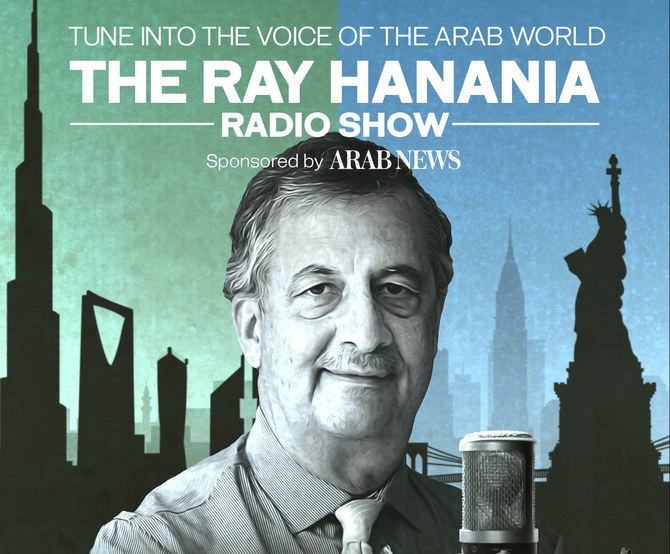
The Ray Hanania Radio Show, a weekly program sponsored by Arab News, kicked off its third season on Thursday with an explosive episode last night. It featured as its first guest Syrian American Mayor Mohamed T. Khairullah, who was controversially banned from the White House Eid celebration.
During his appearance on the show, Khairullah slammed President Joe Biden, saying it is his responsibility to end the “racism” and “discrimination” against Muslims and Arabs that is a part of the system.
The Ray Hanania Radio Show, which first aired in October 2020 ahead of the US elections at the time, hosts a wide array of guests tackling crucial topics in the Arab world.
One such topic tackled this season is the recent Netflix docuseries controversy surrounding the casting of Adele James, a Black actress, as Cleopatra, whom historians agree was of Greek origin.
The furor came from Egyptians and other Arabs accusing the producers of the film of appropriating their culture. The Ray Hanania Radio Show thus hosted world-renowned Egyptologist Zahi Hawass who set the facts straight.
“Cleopatra was a Macedonian…I really think that the reason this film is shown now (is) because some people want to say that the origins of Ancient Egypt were Black,” he said on the show, adding, “I don’t think it is fair to make a documentary to show that Cleopatra was Black. This is changing history.”
Continuing with the topic of Arab representation in Hollywood was Arab News’ very own Editor-in-Chief Faisal J. Abbas.
On the show, Abbas cited Arab American writer and academic Jack Shaheen and his book “Reel Bad Arabs,” which says that, out of 1,000 films, Arabs were only presented or portrayed positively in 12 percent of them.
“As Arabs, we should not wait for Hollywood, and we should not wait for people with Orientalist agendas to tell our story. We should be the masters of our own destiny, we should be the masters of our own storytelling,” Abbas said.
“I’ll tell you one more thing before we conclude. Actions speak louder than words.”
The Ray Hanania Radio Show is broadcast live on WNZK AM 690 Radio in Greater Detroit and on WDMV AM 700 in Washington D.C. every Wednesday at 5pm EST / 12am KSA, also available on all Arab News podcast channels.
The first in the ‘Arab News’ series focusing on contemporary Arab-American artists in honor of Arab-American Heritage Month .
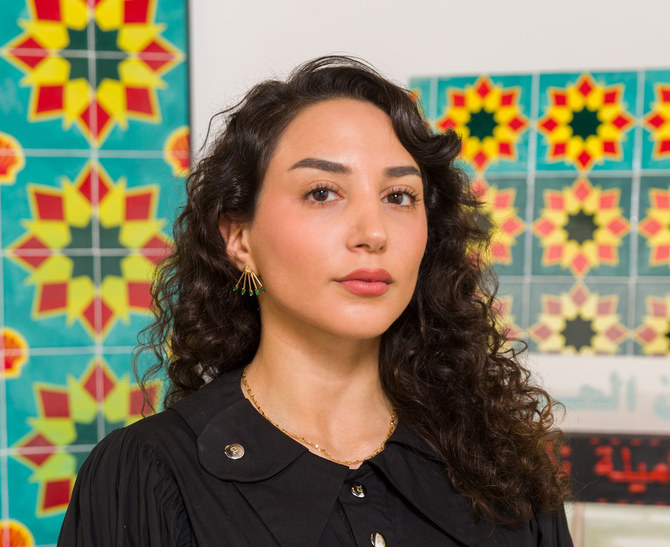
Los Angeles-based artist Saj Issa was raised between two different worlds. As the child of Palestinian parents who fled the First Intifada in the Eighties, she grew up in St. Louis, Missouri, and spent her summers in Palestine. “Each setting brought out a different part me,” she tells Arab News.
“At first, it took a minute for me to come to terms with that. I thought I wasn’t being authentic: The person that I was portraying myself as at school around my friends was different than the person I was portraying at home. But I realize that those are all parts of me. I don’t really see it as an issue so much now as I did when I was younger.”
Issa is an emerging visual artist, who obtained a Master’s in Fine Arts from the University of California and has had her work displayed in LA’s museums and art fairs. Her drive to create art began in childhood, marked by a tactile tendency to paint and make crafts.
“I grew up watching (creator of the US TV show “The Joy of Painting”) Bob Ross — America’s savior — and I was mimicking that action of holding a painting palette,” Issa recalls.
Her ceramic tile pieces juxtapose design elements that are omnipresent in both Eastern and Western cultures. She merges major Western company logos — such as Nike, Coca Cola, and Shell — with Middle Eastern geometrical and vegetal patterns.
“I’m interested in the consequences of globalization,” says Issa. “My choice of which brands make an appearance are based on which ones made a critical impact in the East. I utilize traditional tile work combined with corporate logos as a way to draw connections between the way that colonization seeps into the indigenous ways of life. Repetition is also a means to communicate habits of consumption, mass production and advertising.”
That geometrical ornamentation continues throughout her other series, such as “Convenience Store,” which was partly inspired by her immigrant father’s former job in a corner store. The series’ portraits of workers evoke a feeling of nostalgia and loss of identity in a quick-transaction environment; standing behind the counter, surrounded by daily items, the workers’ faces — or entire bodies — are obscured by receipts.
“I just want to build my own visual language through these mediums,” Issa says.
A longtime Wichita Falls physician has been honored with the International Surgical Volunteerism Award by the American College of Surgeons for his over 30 years of volunteer work with Physicians for Peace and others, according to the Wichita County Medical Society.
Dr. Eid B. Mustafa has been on at least 40 medical missions since 1988, including at least 25 with Physicians for Peace.
He has volunteered his surgical and medical expertise to help the people of the Palestinian West Bank, as well as other underserved areas of the Middle East, according to the ASC .
“Dr. Mustafa served as a leader, facilitator, and trusted advisor to Physicians for Peace for over 25 years since its founding in 1989,” according to the nonprofit organization providing education and training to health-care workers in under-resourced communities.
“He led numerous multi-specialty surgical training missions to the West Bank, and spearheaded a successful mission to Morocco in 2010,” according to an Oct. 10 statement from Physicians for Peace.
Mustafa, a plastic surgeon, received the International ACS/Pfizer Surgical Volunteerism Award at the ASC Clinical Congress Oct. 18 in San Diego.
The award recognizes surgeons who are committed to giving back to society by making significant contributions to surgical care through organized volunteer activities abroad.
Mustafa was born in the West Bank, received his medical education in Egypt and moved to the US to perform his residency and fellowship training in plastic and reconstructive surgery, according to the ACS.
After his training, he relocated to the medically underserved city of Wichita Falls where he was the only practicing plastic and reconstructive surgeon for many years, according to the ACS.
His international volunteerism began in earnest in 1987 when he met Dr. Charles Horton, founder of Physicians for Peace. Horton worked with Mustafa to initiate medical missions to the West Bank the following year.
For many years, Mustafa traveled to the West Bank for 10 to 21 days. His initial efforts focused on congenital defects, burn care and reconstruction from injury.
As his missionary work evolved, he recruited a multidisciplinary team aimed at the needs of each individual community, including specialists in urology, orthopedics, peripheral vascular surgery, off-pump cardiothoracic surgery, cardiology and physical therapy.
With the advent of minimally invasive surgery during this period, he arranged for equipment and education to be provided in the West Bank to accommodate the growing interest.
His trips provided preoperative care, interoperative teaching and postoperative care for the patients. The teams Mustafa developed have provided over 2,000 procedures.
Mustafa has been responsible for all logistics, including planning with the host country, setting up patient visits, acquiring visas, and making travel and lodging arrangements for his team and educational venues.
He has conscientiously provided for the safety of his volunteers in areas with significant personal security concerns.
Mustafa’s efforts have expanded beyond surgical services.
Recognizing the burgeoning need for care of the increasing diabetic population in the West Bank, Mustafa founded centers in Al-Bireh, Nablus and Hebron to deliver dietary information, preventative foot care, smoking cessation, neuropathy education and medication management.
These centers also offer education about the long-term effects of diabetes, including cardiovascular disease, kidney failure and ophthalmologic complications.
In addition, burn centers were established in Nablus and in Hebron due to the wartime thermal injuries seen in these areas.
These centers were not only equipped to take care of the burn injuries but provided education and training to the surgical staff, nurses and therapists.
In addition to educating U.S. medical students on the need for and realities of international surgical volunteerism, medical education is included in each of Mustafa’s mission trips, which are open and free to all who wish to attend.
These missionary conferences are coordinated with the Ministry of Health and often one of the local medical schools.
Subjects are chosen based on the needs of the medical communities and include topics such as trauma care, patient safety in the operating room, and complication assessment.
Mustafa also has been a diligent advocate and fundraiser for his medical services, gathering funds and resources from countries including the U.S., Germany, Kuwait and beyond.
He has been an international ambassador for the ACS, taking pride in his fellowship and advancing the ideals of the college.
Mustafa began teaching the principals of the Advanced Trauma Life Support® curriculum on the West Bank years ago at a time when political divisions prevented formal recognition and certification of the course.
According to Physicians for Peace, his deep commitment to trusted partnerships opened doors and ensured efficient delivery of services and materials in regions that were extremely difficult to access.
He carefully recruited team members based on experience and skill to ensure that a full cadre of medical professionals were ready to meet the needs on the ground.
“He would often include medical students in his programs, so the next generation of physicians would see firsthand the value of such service and gain a global perspective of healthcare and needs around the world,“ according to Physicians for Peace.
Mustafa, his wife Saba, and four children moved to Wichita Falls in 1982 and immediately became active in the Wichita County Medical Society and the local medical community.
He served on the WCMS Board for several years, then secretary/treasurer, president in 2000 and then past president.
He served on the editorial board of the Wichita Falls Medicine Magazine from 1985 to 1996 and the Medical Advisory Board of the Texas Rehabilitation Commission.
He served on the North Central Texas Medical Foundation Board that oversaw the Wichita Falls Family Practice Residency, the Family Health Center and Wilson Family Planning, for many years and as president for four years.
Mustafa has won numerous awards.
He was presented the 2009 Distinguished Service Award, the highest honor WCMS presents. Also, in 2009 he won the Texas Patients’ Choice Award for outstanding physicians.
Mustafa was honored with the Americanism Award by the Daughters of the American Revolution-Texas. It is given to naturalized citizens for outstanding contributions to the nation.
On the national level with Physicians for Peace, Eid Mustafa was presented the 2006 Presidents Award and, in 2013, the Medical Diplomat Award.
He has been very active in the National Arab American Medical Association, serving as president in 2007. In 2014, he received the NAAMA Outstanding Physician Award.
Mustafa has served on the board or as an officer on the Medical Advisory Board-American Near East Refugee Aid; Jerusalem Fund for Education & Community Development: Washington, DC; and the American Palestine Public Affairs Forum.
He also serves as a director for the International Women and Children Burn Foundation based in Virginia.
His medical missions have included the West Bank-Ramallah, Hebron, Bethlehem; Jerusalem; Amman, Jordan; and Beirut, Lebanon. He has been team leader for all the missions, traveling with teams of physicians and nurses.
Board Certified in Plastic Surgery, Mustafa practices medicine at 1201 Brook Ave at the Wichita Falls Plastic Surgery Center .
He also has added qualifications in surgery of the hand by the American Board of Plastic Surgery. He is a member of the American Society of Plastic Surgeons, American College of Surgeons and the American Society for Aesthetic Plastic Surgery.
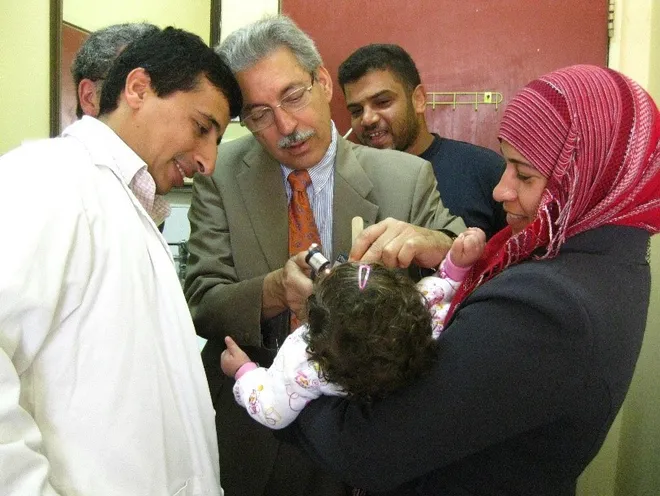
Dr Eid B. Mustfa, center in this updated photo, was honored by the American College of Surgeons with the international Surgical Volunteerism Award. courtesy / Wichita County Medical Society.
In-person and virtual festival showcases films from Arab world and diaspora.
The Arab American National Museum in Dearborn, Michigan, will kick off the Arab Film Festival on Friday.
Home to one of the largest Arab-American communities in the country, some consider Dearborn to be the “Arab capital” of the US and the museum has been devoted to documenting, preserving and presenting the history, culture and contributions of the community since 2005.
The annual festival will run from August 12 to 21, with a line-up featuring comedy shorts and documentaries tackling America’s Israel bias.
“As a young Arab American myself, I never really saw my story, my family story reflected in the music I listened to or the films that I watched or the textbooks in my classroom,” said Dave Serio, curator of education at the museum.
“So our goal really is to kind of inspire Arab Americans to see their stories, their perspective, people that look like them, names that they might have, on the big screen.”
Beginning in 2005, it is one of the museum’s longest-running programmes and offers a range of windows into Arab cinematic creativity and storytelling.
One of the films in this year’s set is When Beirut Was Beirut from writer-director Alessandra El Chanti. The short is a “poetic hybrid documentary” that focuses on an imagined conversation between three famous buildings in the Lebanese capital and what they witnessed during the country’s civil war.
“I wonder what inanimate objects could say, because they also have stories, too,” Ms El Chanti, a Lebanese citizen who now lives in Doha, Qatar, told The National.
“I feel like we always go to Lebanon and we’re just passers-by — we recognise that there are war-torn buildings, you can see the bullet holes.
The film, which began production in 2020, was produced entirely over Zoom by an all-Lebanese team of six artists.
Many of the films at this year’s festival will be making their US or Michigan state debut, Mr Serio said.
Ms El Chanti hopes members of the Lebanese diaspora watching her film at the festival walk away feeling “there’s a lot that you should learn about your country that you don’t know about — it literally could be from the perspective of anything and everything”.
Yasmina Tawil, the director of film programming at the Arab Film and Media Institute — one of the festival’s sponsors — told The National that while Arab film festivals such as this are considered “niche” in the entertainment industry, they can build towards more inclusion in the mainstream.
“We’re not a Sundance, we’re not a Cannes.
“But when a distributor goes to pick up a film, [the festivals] will add to the credence and the hype of the film. And I would at least hope that distributors would look at that as a sign of one of their big audiences … already knows about and really likes the film enough to programme it in their festival.”
“They’ll get picked up for distribution in the Middle East, in Europe and then maybe not make it over here [to the US]. Or if a torrented copy does, it might not have English subtitles and things like that.”
She added that her institute’s mission is, in part, to serve as a “caretaker” for Arab films in America.
The museum has offered both virtual and in-person attendance options, opening its mission to viewers across state and national borders.
“The Arab-American community is ridiculously talented,” said Mr Serio. “And our film festival is just honoured to be able to showcase a fraction of the amazing work that the Arab-American community is working on.”
source/content: thenationalnews.com (edited)
__________
Poster for the 2022 Arab Film Festival at Dearborn, Michigan’s Arab American National Museum. All photos: Arab American National Museum
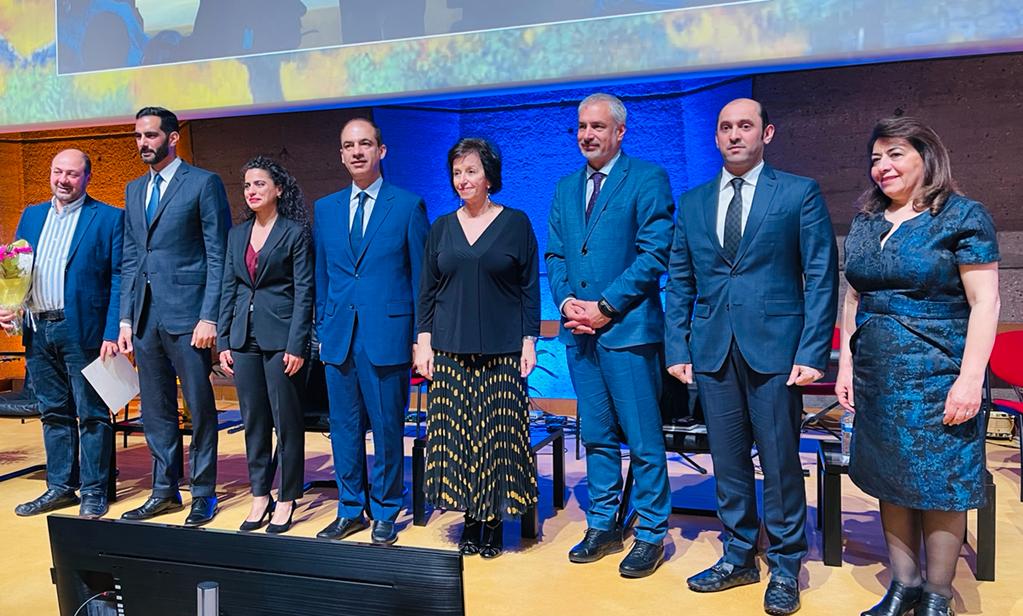
The United Nations Educational, Scientific and Cultural Organisation (UNESCO) headquarters in Paris held a ceremony for the 18th edition of the Sharjah Prize for Arab Culture (SPAC), organised by the Sharjah Department of Culture in cooperation with UNESCO.
The Prize has been awarded to Dunya Mikhail, an American-Iraqi poet, and Helen Al Janabi, a Swedish actress of Syrian-Iraqi origin.
Sheikh Salem Khalid Abdullah Al Qasimi, Deputy Secretary of State for Heritage and Arts Sector, UAE’s Permanent Representative to the UNESCO, along with Professor Mohammed Ibrahim Al Qaseer, Director of Cultural Affairs at the Department, in addition to dignitaries, writers, intellectuals and members of the diplomatic corps accredited to the United Nations.
Ernesto Otuni Ramirez, UNESCO’s Assistant Director-General for Culture, gave a speech in which he expressed his gratitude and appreciation to H.H. Dr. Sheikh Sultan bin Muhammad Al Qasimi, Supreme Council Member and Ruler of Sharjah, and for his cultural and humanitarian renaissance role at the local, regional and global levels.
Afterwards, Abdullah bin Muhammad Al Owais, Chairman of the Sharjah Department of Culture, gave a speech in which he expressed his happiness at the continuation of the UNESCO-Sharjah Prize for Arab Culture editions, appreciating the role of UNESCO in managing the prize and sponsoring many cultural programmes.
Al Owais and Ernesto Ramirez awarded the 18th Sharjah Prize for Arab Culture to Dunya Mikhail and Helen Al Janabi, in addition to honouring the winners of the 17th session.
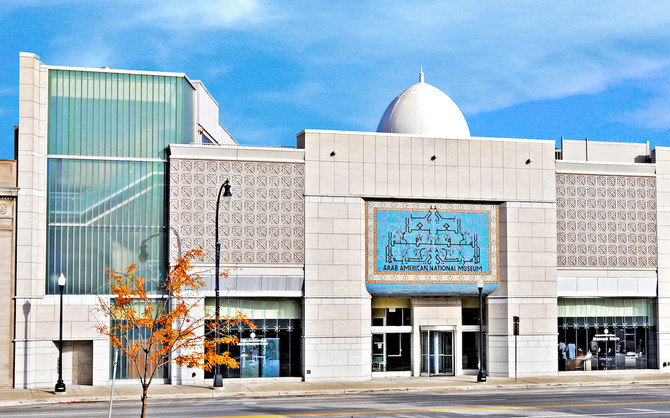
After the COVID-19 pandemic sparked a near-two-year closure, the Arab American National Museum in Dearborn, Michigan, has finally reopened its doors to visitors.
Founded in 2005, AANM bills itself as America’s first and only museum devoted to telling the stories of Arab-American history and culture. Its location is apt; Dearborn is home to the largest Arab community in the US — around 40 percent of the city’s population is of Lebanese, Syrian, Yemeni, Iraqi, or Palestinian origin.
eaturing a courtyard, a fountain, and thematic spaces, the interior of AANM pays homage to Middle Eastern and North African design and architectural aesthetics. Through its galleries, the museum details Arabs’ varied contributions to humanity, and the phases of Arab immigration: the challenges of coming to America, the challenges of establishing a life there, and the impact of Arab-Americans in the public and private spheres.
It tells the stories of peddlers, entrepreneurs, scholars, military men and women, artists, and entertainers. There are some important but relatively unknown names highlighted. Take Ruth Joyce Essad, a fashion designer born in 1908, for example. She became one of Detroit’s first couturiers — dressing socialists and singers, including big-band vocalist Dinah Shore. Another interesting personality is the Syrian business owner Leon B. Holwey, who claimed to have co-invented the ice-cream cone in the early 1900s.
On a national level, the profile of Arab-Americans was raised last year by President Joe Biden, who made history by establishing National Arab American Heritage Month, which will take place in April every year.
source/content: arabnews.com
_________
The Arab American National Museum is in Dearborn. (Supplied) / arabnews.com
Formerly – President Sadat’s Scientific Advisor (1978-1981)
Founder – Center for Earth and Planetary Studies, National Museum of Atmospheric and Space, at the Smithsonian Institution, Washington DC
Dr. El Baz played a pivotal role for the Apollo mission where he served as the secretary for the Apollo landing board on the moon, and was responsible for leading the astronaut training team in general science, particularly in moon imaging
So pivotal was he to Apollo that in Tom Hanks’ HBO TV-series, From the Earth to theMoon , El-Baz’s role as an Apollo scientist and astronaut trainer was featured in a segment entitled, “The Brain of Farouk El-Baz,” and a shuttle craft named El-Baz soared through the popular TV-series Star Trek : The Next Generation
Awards:
He has won over 31 awards, including achievements in science, in NASA, incl:
Golden Door Award of the International Institute of Boston
Nevada Medal of the Desert Research Institute
The Pioneer Award of the Arab Thought Foundation.
The Apollo Achievement Award
Honour:
Asteroid 7371 El-Baz, discovered by American astronomers Eleanor Helin and Schelte Bus at Palomar Observatory in 1978, was named in his honor. The official naming citation was published by the Minor Planet Center on 27 August 2019 ( M.P.C. 115893).
Book:
Deserts and Arid Lands , Martinus Nijhoff Publishers, ISBN 90-247-2850-9
Dr. Moungi Bawendi is a Tunisian-American chemist.
He is the Lester Wolfe Professor at the Massachusetts Institute of Technology.
Moungi Bawendi is one of the original participants in the field of colloidal quantum dot research, and among the most cited chemists of the last decade.
This work has included: (1) the development of novel methods for synthesising, characterising, and processing quantum dots, magnetic nanoparticles, and tubular J-aggregates as novel materials building blocks, (2) studying fundamental optical and magnetic properties of nanostructures using a variety of spectroscopic methods, including the development of optical photon correlation tools to study single nanoscopic emitters, (3) incorporating quantum dots and magnetic particles into various optical and electronic device structures, and (4) developing nanoparticles and other agents for biomedical imaging.
Became a Clarivate Citation Laureate in 2020.
Received his A.B. in 1982 from Harvard University
Ph.D. in Chemistry in 1988, University of Chicago.
Two years of postdoctoral research at Bell Laboratories, working with Dr. Louis Brus, where he began his studies on nanomaterials.
Joined the faculty at MIT in 1990, becoming Associate Professor in 1995 and Professor in 1996.