Arabs & Arabian Records Aggregator. Chronicler. Milestones of the 25 Countries of the Arabic Speaking World (official / co-official). AGCC. MENA. Global. Ist's to Top 10's. Records. Read & Enjoy./ www.arabianrecords.org
We often come across news reports about Egyptians abroad who have attained prominent leadership positions, yet we rarely give them a second thought – unless, of course, they are movie stars like Rami Malek or football legends like Mohamed Salah.
During a recent visit to Canada, I was struck by how many university presidents and faculty deans were of Egyptian origin of whom, for the most part, we have never heard.
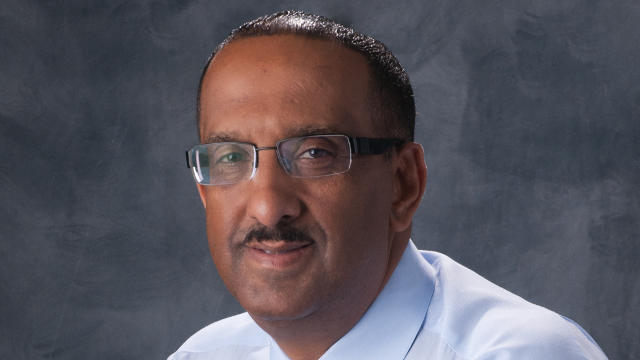
A couple of days ago, my attention was caught by two items that were headline news everywhere, while we barely paid them any heed. The first is the appointment of the Egyptian-American Sherif Soliman as the New York City budget director. This is in the global capital of finance, home to Wall Street and the New York Stock Exchange, the largest stock exchange in the world. Soliman is a highly regarded economist with more than thirty years of financial experience. In the course of his career, he has rescued several major commercial institutions from bankruptcy and succeeded in reducing the debt of others by record proportions.
The recently elected New York mayor, Zohran Mamdani, said that Soliman far surpassed rival candidates for budget direct. Soliman, for his part, said, “I feel a deep sense of pride joining the administration of the first Muslim mayor of the city of New York.” He will be managing a budget of approximately $121 billion – one of the largest municipal budgets in the world.
Soliman was born to Egyptian parents who emigrated to New York 45 years ago. He is married to the Egyptian Hanan Thabet. They have two children, Lina and Ziad.
At around the same time, on the other side of the Atlantic, the British Muslim Laila Cunningham announced her intent to run for Mayor of London in the British capital’s 2028 mayoral race. She will be the first candidate of Egyptian origin to seek the post. Born in London to parents who emigrated from Egypt in the 1960s, she studied law and joined the Conservative Party, then switched to Reform UK. A controversial figure, she advocates empowering and increasing the police force to curb crime, which she claims has turned London into an unsafe city. She also calls for combating what she terms “Islamic terrorism.” She is married to an American and is the mother of seven children.
* A version of this article appears in print in the 15 January, 2026 edition of Al-Ahram
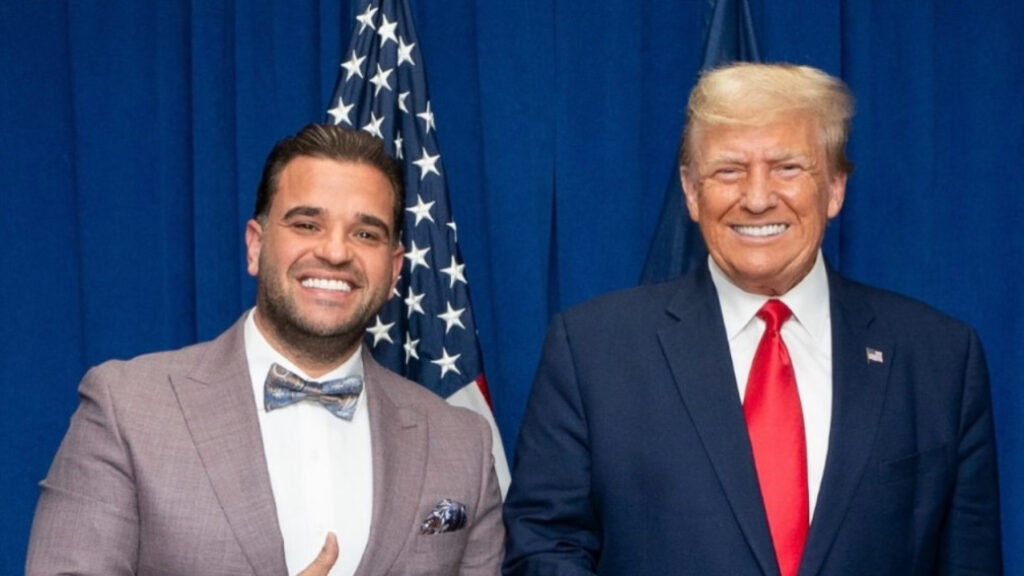
Savaya, a Michigan-based entrepreneur of Iraqi Chaldean descent, was appointed in a statement on Trump’s Truth Social page on Sunday.
United States President Donald Trump has named Detroit businessman and cannabis entrepreneur Mark Savaya as special envoy to Iraq, sparking debate in Baghdad and Washington.
Savaya, a Michigan-based entrepreneur of Iraqi Chaldean descent, was appointed in a statement on Trump’s Truth Social page on Sunday.
“Mark’s deep understanding of the Iraq–US relationship and his connections in the region will help advance the interests of the American people through his diplomatic engagement and direct communication with Iraqi officials as special envoy. As special envoy, he will act as a direct representative for US interests in Iraq, coordinating joint initiatives, maintaining diplomatic negotiations, and ensuring transparent communication between US and Iraqi governments on security, political, and economic priorities,” Trump wrote.
Trump praised Savaya’s contribution to his 2024 campaign, particularly his efforts to mobilise support among Muslim American voters in Michigan.
Savaya, born in Detroit in 1983, owns Leaf and Bud dispensaries and, according to his public profile, has no previous government experience. His family left Iraq for the US in the 1990s.
The appointment has sparked discussion among Iraqi political circles, though the Iraqi Prime Minister has welcomed the move.
On Monday, Iraqi Prime Minister Mohammed Shia al-Sudani described the appointment of US President Donald Trump’s special envoy to Iraq as “an important step,” noting the envoy’s Iraqi roots.
“The appointment of a special envoy by President Trump to Iraq is an important step, especially as he is of Iraqi origin. We wish him success in his mission,” Sudani said during a meeting with Arab and foreign journalists in Baghdad.
In a post on X (formerly Twitter), Savaya said he was “deeply humbled, honoured and grateful” to be appointed and committed to “strengthening the US–Iraq partnership under President Trump’s leadership.”
The announcement came after the release of Elizabeth Tsurkov, an Israeli-Russian doctoral student who was kidnapped in Baghdad in 2023 by the Kataib Hezbollah militia.
Tsurkov, who spent more than 900 days in captivity and was freed on 9 September, wrote on X that Savaya had played “an instrumental role” in securing her release, calling the move “terrible news for anyone serving Iran’s interests in Iraq.”
On his part, Nechirvan Barzani, the President of the Kurdistan Region, welcomed the appointment, describing it as underscoring “The strategic importance of Iraq and the Kurdistan Region in advancing our shared interests and regional stability.”
Senior Kurdistan Democratic Party (KDP) figure and former foreign minister Hoshyar Zebari welcomed the appointment, describing it in a post on the X social media platform as “a bold decision to restore Iraqi sovereignty and independence away from corruption, mismanagement and militia rule.”
Zebari also said Savaya’s appointment, as “an American of Chaldean Christian and Iraqi descent”, reflected recognition in Washington that Iraq’s political situation “is neither stable nor normal”, and called for “decisive measures beyond traditional diplomatic frameworks”.
However, others have questioned the timing and nature of the role.
Iraqi writer and political analyst Falah Al-Mashaal described the decision to appoint a special envoy, rather than a traditional ambassador, as “puzzling” and “unusual under diplomatic norms”.
“A special envoy is usually sent for a specific mission—during a crisis, war, or to deliver a particular message,” he wrote in a post on the X. “Is President Trump planning something unusual for Iraq?”
He linked the appointment to Trump’s recent comments at the Sharm el-Sheikh peace summit in Egypt, where he referred to Iraq’s “vast oil wealth” and accused its leaders of mismanaging it.
“It sounded like an invitation for Trump’s allies in Iraq to sue Prime Minister Sudani for negligence and mismanagement of public funds,” al-Mashaal said.
Some analysts believe the appointment may be connected to Trump’s regional agenda and his longstanding focus on Iraq’s oil sector.
Alex Warkes, a UK-based Iraqi political analyst, said the decision could also have domestic political implications for Baghdad.
“I think the back door of the US embassy will be quite busy with the arrival of Trump’s special envoy,” Warkes said in a post on X. “I believe the appointment was coordinated with Prime Minister Mohamed Shia Al-Sudani’s team, perhaps to support his bid for a second term. We don’t yet know what the exchange might be—but time will tell.”
Warkes also questioned whether Savaya’s appointment had been coordinated with Israel, given that Trump’s Middle East policy “has always prioritised Israeli interests more than any of his predecessors”.
“These are legitimate questions,” he said. “Especially at a time when Iraq’s stability, oil policy, and relations with Iran remain central to the region’s balance of power.”
source/content: newarab.com (headline edited)
____________
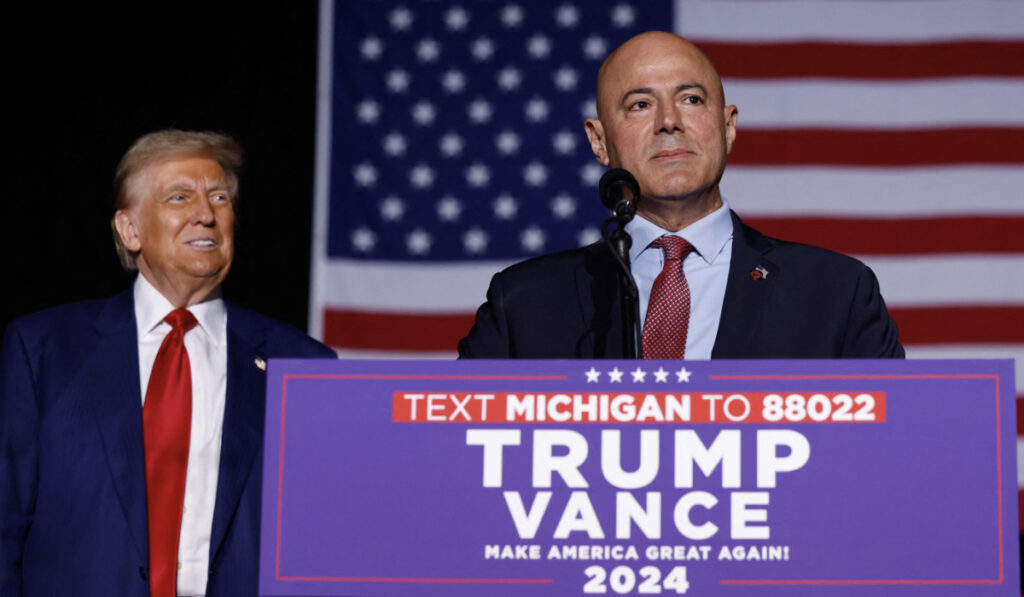
Mark Savaya and US President Donald Trump. [Screengrab from Mark Savaya/Instagram]
Inside the first show dedicated to NYC’s Public Library’s Middle Eastern collections .
Outside The New York Public Library’s Stephen A. Schwarzman Building, the unmistakable scent of a halal food cart mingles with the sounds of various Arabic dialects, while two marble lions stand guard over Fifth Avenue. Inside, entire worlds are waiting to be discovered — including the often-overlooked stories of New York’s Middle Eastern and North African communities.
“Niyū Yūrk: Middle Eastern and North African Lives in the City,” the first exhibition dedicated to the Library’s Middle Eastern collections, opened Oct. 4. It will remain on view in the Ispahani-Bartos Gallery until March 8.
Curated by Hiba Abid, the exhibition contains around 60 objects — photos, books, periodicals and audio — dating from the 1850s to 2024. It centers specifically on the library’s own holdings, rather than attempting to tell a comprehensive history of MENA life in New York, Abid tells Arab News.
Drawing from over a century of rare materials the exhibition uses tangible objects to express the intangible: memory, identity and immigrant culture.
“It’s not a love letter. It’s a realistic letter,” Abid says, adding that these communities have long navigated complex questions of belonging, language, and preservation.
“The communities, from the very beginning, were wondering, ‘Where should our kids go to school? If they go to the public New York schools, they would probably lose their language, but we want them to still know Arabic and be aware of our traditions and values,’” she said.
The exhibition is divided into four chronological sections, designed to help guide visitors of all ages, from young children to seasoned scholars.
The first section, “Roads to New York,” focuses on the earliest waves of immigration. One of the first featured figures is Hatchik Oscanyan — later known as Christopher Oscanyan — an Armenian man born in what is now Türkiye. He came to New York in the mid-19th century and sought to educate Americans about the complexity of the Ottoman Empire. He wrote plays and newspaper articles, as well as “The Sultan and His People,” a book that offers insight into the region’s diverse ethnic and religious makeup.
The second section, “A Life in the City,” explores how immigrant communities began to form and thrive in New York, including in what was once known as Little Syria on Manhattan’s Lower West Side — an area that still exists today. They were entrepreneurs who opened restaurants, shops, and began publishing Arabic newspapers.
One of the most groundbreaking was Al-Hoda, founded by Naoum Antoun Mokarzel and his brother Salloum. “In the basement of Al-Hoda Press, they adapted the linotype machine from Latin characters to Arabic characters, which is very hard (because Arabic is) a cursive language,” Abid says. “By this technological innovation, he actually allowed other presses to form and to publish newspapers, periodicals, and books,” which then circulated throughout North and Latin America — and back to the Middle East.
In other words, New York was instrumental in literally building the Arabic press and exporting news to the Middle East.
Abid emphasizes how vital the library’s historical collections are to telling these stories.
“The library has been collecting these materials since the late 19th century,” she says, adding that many of them have been digitized, enabling audiences to interact with them in a new way.
The third section, “Impressions,” flips the gaze, revealing how Middle Eastern immigrants perceived New York and the US.
“Many immigrant groups embraced American values… but many (Arabs) actually didn’t like New York and didn’t like American values and left after a few years here or after a few months.” The exhibit highlights these ambivalences and the tensions of assimilation.
The final section, “In Our Own Skin,” is the most contemporary and, for Abid, the most personal. It includes raw, vulnerable stories that reflect racial identity, Islamophobia, and resistance. Among the most powerful pieces is the short documentary “In My Own Skin,” directed by Jennifer Jajeh and Nikki Byrd, which features interviews with five Arab women in New York, and was filmed just one month after the events of Sept. 11, 2001.
“The interviews are absolutely amazing. Every time I talk about it, I have goosebumps,” Abid says. “The way they talk about it — it is still very relevant today, as if nothing changed much, except that we’re probably more powerful because we are aware of this and we know how to organize and to fight back. We have the vocabulary now, and the community.”
That spirit of organization is embodied by Malikah, a grassroots collective founded by Rana Abdelhamid in 2010 as a self-defense class for Muslim women on Steinway Street in Queens. The movement has since expanded into a larger project of empowerment, healing, and solidarity — and is featured in the exhibit’s final section. The powerful sound of the athan, or call to prayer, has been important to this cultural shift.
While images of the Statue of Liberty — based on an Egyptian woman — didn’t make the cut, but Abid stresses its significance on each guided tour. On this occasion, though, she wanted to focus the visitors on lesser-known gems.
Having lived in New York for the past four years as a Tunisian immigrant who spent much of her life in France, Abid says she finds New York to be more diverse than anywhere else she has ever lived.
“I live on Atlantic Avenue in the Syrian corner. The things I witnessed here and in Middle Eastern parts of New York, like Astoria, I could never see anywhere else — even Paris,” she says. “When you go to the exhibition, you actually think, ‘Damn! We actually did a lot. And we’re here, you know—we’re here.
“It shows how New York was central to all of these struggles and how New York — thanks to its MENA community — was actually connected and aware. It puts New York on a global map, you know? I think New York is incredible terrain for this. It’s the space for it. That’s what this show is about, ultimately.”
source/content: arabnews.com (headline edited)
______________
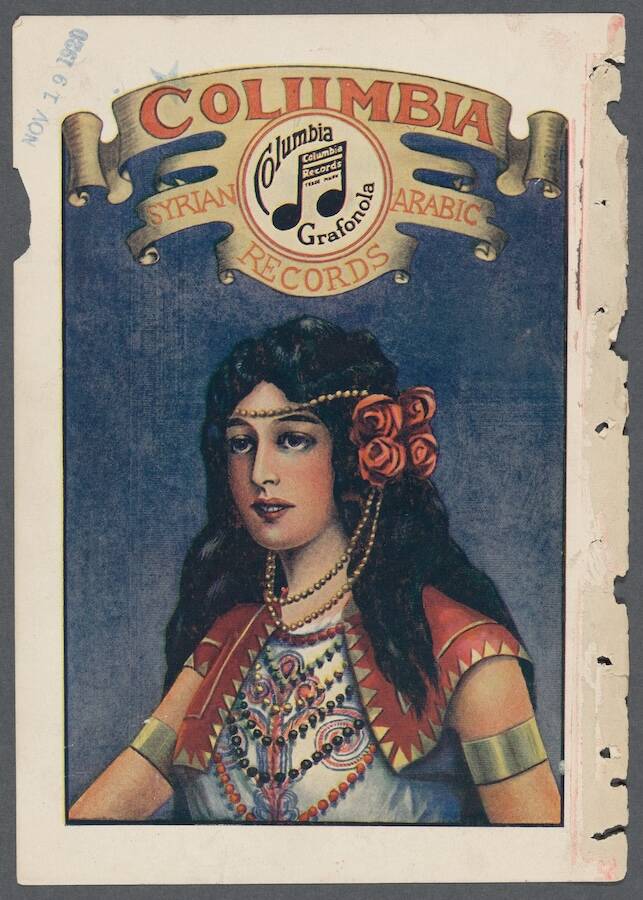
A poster from 1920 promoting Columbia Syrian Arabic Records — Columbia was one of the major American record labels to recognize the commercial potential of ethnic music markets in the US. (Courtesy of The New York Public Library)
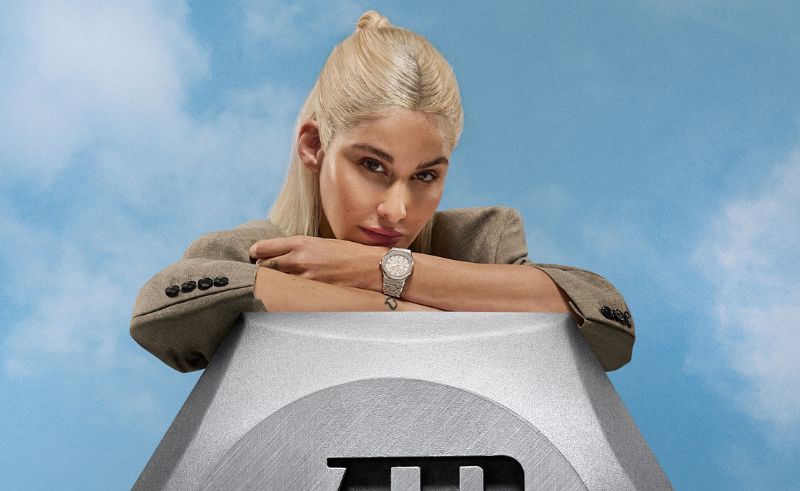
Model & Lifestyle Influencer Nour Arida Joins Serena Williams in Audemars Piguet Campaign.
When Audemars Piguet picked the faces for its 150th anniversary campaign, it chose icons. Nour Arida was the only Arab woman among them.
In the world of luxury watchmaking, Arab women aren’t often on the moodboard. But this year, that changed.
For its 150th anniversary, Audemars Piguet didn’t just call in the usual faces – it summoned a lineup of global icons. Serena Williams. Winnie Harlow. Tamara Kalinic. And, for the first time ever, an Arab woman: Nour Arida.
Draped in AP’s legacy, the Lebanese model-slash-creative-slash-cultural force owned the frame.
“I always try to push boundaries,” Arida says, in what might be the understatement of the year. “It’s like being part of a real family, being part of the AP family.”
His team’s research benefits industries such as automotive, power grids, satellites, military, and healthcare.
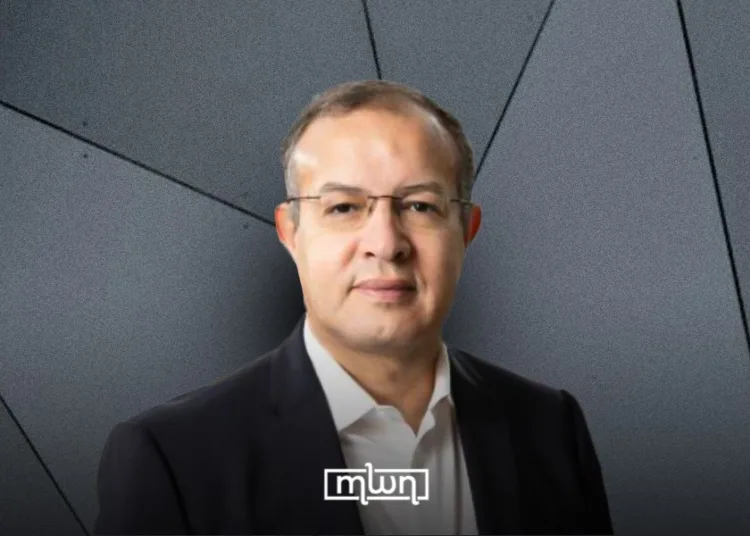
Khalil Amine, a Moroccan materials scientist, has been elected to the National Academy of Engineering of the United States for his contributions to battery and energy storage technologies.
The recognition comes for his leadership in the field of materials science, specifically in the development of batteries and energy storage devices.
Amine, who also serves as a professor at the University of Chicago, is among 128 members and 22 international members inducted into the NAE class of 2025.
“I am very delighted to be selected as a member of the National Academy of Engineering,” said Amine. “This is a recognition not only for me, but also for all my co-workers and collaborators around the world, as well as Argonne, which has provided an unmatched, state-of-the-art capability to do excellent work.”
Amine leads the Advanced Battery Technology team at Argonne, where his research focuses on the development of advanced chemistries, materials, and battery systems. His team’s work spans several industries, including automotive, power grids, satellites, military, and medical applications.
A key focus of Amine’s research is the creation of new cathodes, anodes, solid-state electrolytes, and additives for lithium-ion batteries, as well as exploring “beyond-lithium” batteries that use alternative chemistries for energy storage.
Amine’s significant contributions to the field of battery technology have made him a leading figure in materials science. He holds more than 200 patents or patent applications in the field, and he was for 23 years the most cited scientist in battery technology globally.
His accomplishments have earned him numerous accolades, including the prestigious Global Energy Prize in 2019. Amine is also a member of several prestigious scientific organizations, including the National Academy of Inventors, the European Academy of Sciences, and the Electrochemical Society, among others.
Born in Morocco, Amine earned degrees in chemistry and materials science from the University of Bordeaux. After his academic training, he joined Argonne in 1998, bringing with him experience gained from research positions in Belgium and Japan.
His innovative work has played a pivotal role in advancing energy storage technologies that have far-reaching applications in today’s technological landscape.
The National Academy of Engineering, founded in 1964, provides independent analysis and advice on engineering matters, offering leadership and insight into complex global challenges. Amine, along with other members of the NAE class of 2025, will be formally inducted at the Academy’s annual meeting in October.
Honoring the Rich Heritage, Celebrating the Next Generation
This event is a tribute to our culture, featuring music, dance, comedy, and inspiration, uniting us in pride and resilience”
— Warren David, President, Arab AmericaWASHINGTON, DC, UNITED STATES, March 12, 2025 /EINPresswire.com/ —
On Wednesday, April 9th, the Arab America Foundation will present its ninth annual National Arab American Heritage Month Commemoration at Amazon HQ Theater, “Honoring the past, inspiring the future.”
Each year, we honor the invaluable contributions of Arab Americans and commemorate National Arab American Heritage Month with community leaders, cultural performances, and authentic Arab cuisine.
This year, we honor the legendary Umm Kalthoum, marking 50 years since her passing in 1975. Known as the Nightingale of the Arab World, her iconic voice inspires generations.
Performers include: –Mohanad Elsheiky, a Libyan stand-up comedian based in Queens who is a digital producer on the TBS late-night comedy series Full Frontal with Samantha Bee, has appeared on Conan and Late Night with Stephen Colbert.
-Marwa Morgan, Arab American and Egyptian classic vocalist, will perform a special tribute to the legendary nightingale of the Arab World, Umm Kulthum with the New York Umm Kulthum Ensemble.
–Anas “Andy” Shallal, Iraqi-American artist, activist, philanthropist, entrepreneur, founder and CEO of Busboys and Poets.
–Shirin Rajaee, Emmy-nominated news anchor and MC of the event.
–DJ Basbousa, a DC-based Arab DJ pop culture designer.
–Faris El-Layl Folkloric Dance Troupe will perform traditional Arab dances.
“During this year’s National Arab American Heritage Month, we honor our rich heritage while celebrating the next generation. This event is a tribute to our culture, featuring music, dance, comedy, and inspiration, uniting us in pride and resilience,” said Warren David, president of Arab America.
About National Arab American Heritage Month 2025 Arab America and the Arab America Foundation launched the National Arab American Heritage Month initiative in 2017, but only a handful of states recognized it. Each year, our grass-roots network of over 250 Arab American volunteers in 26 states gathers hundreds of proclamations from their states, counties, municipalities, and local school districts.
If you want to help us mobilize the community for NAAHM, request proclamations, or plan events, please contact Dr. Amal David or call 877-272-2944.
Proclamations Arab America Foundation state teams are acquiring proclamations from governors, state legislators, mayors, and county executives nationwide. New proclamations for 2025 will be announced in the coming months.
Sponsorship of National Arab American Heritage Month 2025 (including Diversity Training Workshops) The Arab America Foundation welcomes corporate participation as a sponsor to celebrate Arab American heritage and enhance the understanding of Arab identity and culture in America through the National Arab American Heritage Month initiative. Sponsorships include the Arab America Foundation’s diversity training workshop designed to help corporations educate their workforce about the Arab American community. Through this workshop, participants can gain insights into the community’s history, immigration, culture, traditions, and other significant issues.
Or call the Arab America Foundation at 877-272-2944 or email info@arabamerica.com
Educator’s Curriculum Kit Arab America Foundation offers The Educator’s Curriculum Kit, which highlights the history of Arab migration to America, geographic understanding of the Arab world, Arab American diversity in faith and language, interesting customs and traditions, issues affecting our community, and our many achievements in business, politics, education, and more. The Kit is available for school educators. For more information, please get in touch with Dr. Amal David.
Resources Arab America Foundation is committed to gathering and promoting the community’s events and stories through https://www.arabamerica.com/resources/ and social media platforms during April. Every week, Arab America will feature cultural events throughout the US on our events page and share compelling success stories of Arab Americans on our blog page. Additionally, Arab America has compiled a resource guide listing resources and content regarding the Arab and Arab American identity and culture.
About the Arab America Foundation The Arab America Foundation (www.arabamericafoundation.org) is a non-profit educational and cultural organization that promotes the Arab heritage in the U.S., educates Americans about the Arab heritage and identity, and connects and empowers Arab Americans
Amer Ghalib and Bill Bazzi were among a number of Muslim leaders from the state who publicly endorsed Trump for the presidency last year
‘It’s a great honor to have the trust of the president,’ Ghalib tells Arab News. ‘I will utilize my skills … to strengthen the relationship between’ the US and Kuwait
_________________
FAST FACTS
• Amer Ghalib, who became mayor of Hamtramck in November 2021, is the first Arab American and Muslim to hold the office in the city.
• Bill Bazzi, who was born in Lebanon, was appointed mayor of Dearborn Heights in January 2021 following the death of the incumbent and won the election for the office in November that year.
___________
Amer Ghalib, the mayor of Hamtramck, Michigan, said on Friday he was “honored” to be nominated by President Donald Trump for the post of US ambassador to Kuwait.
Meanwhile, Bill Bazzi, the mayor of Dearborn Heights, also in Michigan, was nominated by Trump this week to serve as the US envoy to Tunisia. Arab American Muslims Ghalib and Bazzi were among the Michigan officials who publicly endorsed Trump for the presidency last year over Joe Biden and Kamala Harris.
“It’s a great honor to have the trust of the president placed in me to represent our great county and serve as the next ambassador to the State of Kuwait,” Ghalib told Arab News on Friday.
Bazzi did not respond to Arab News when asked to comment on his nomination, but in a message posted on Facebook, he wrote: “I am honored and appreciate President Donald Trump’s appointment to serve as US Ambassador to Tunisia.
“Among the distinct countries I have visited over the years, I hold a great affinity to Tunisia and its honorable parliament, elected officials, educators, and other industry leaders — along with the people I met while touring orphanages, women’s career institutions, schools, and a multitude of companies which distinguish the country’s rising presence in the region.
“With my visits overseas, the cohort’s visits to the US, and the relations we have established over the years, I am excited to return and honorably represent our Country in Tunisia as its US Ambassador. My purpose is to continue serving in capacities which make an impact, promote peace and diplomatic partnerships, which benefit our Country and enhance global relations.”
Trump wrote on social media platform X: “Bazzi is a decorated US Marine, who honorably served our Country for 21 years, collaborating with US Embassy Ambassadors, Diplomats, and Leaders throughout the world.”
Bazzi, who was born in Bint Jbeil, Lebanon, was appointed mayor of Dearborn Heights in January 2021 following the death of the incumbent and won the election for the office in November that year. He had previously served as the temporary chairperson of Dearborn Heights City Council since 2017.
Bishara Bahbah, the founder of Arab Americans for Trump, an organization that worked in several states to rally Arab and Muslim American elected officials and leaders in support of Trump’s presidential campaign, praised the appointments of Ghalib and Bazzi as “a demonstration of the president’s commitment to the Arab and Muslim community.”
He told Arab News: “Arab Americans for Peace, formerly Arab Americans for Trump, is delighted with President Trump’s nomination of two distinguished Arab American mayors from Michigan as the new ambassadors to Kuwait and Tunisia.
“Both men risked their political careers, having been elected as Democrats to their posts. Mayor Bazzi and Mayor Ghalib are outstanding individuals who wanted to see the end of the wars in both Gaza and Lebanon.”
The nominations reflect the growing influence of Arab Americans in US politics, Bahbah said, and are “a testament to the newfound power of Arab Americans in this past US presidential election and future presidential elections.
“We are confident that both mayors will be effective ambassadors representing the best interests of the United States. Their Arab backgrounds will undoubtedly help foster better US-Kuwaiti and US-Tunisian diplomatic relations.”
The nominations must now be considered and approved by a majority vote in the US Senate.
source/content: arabnews.com (headline edited)
____________
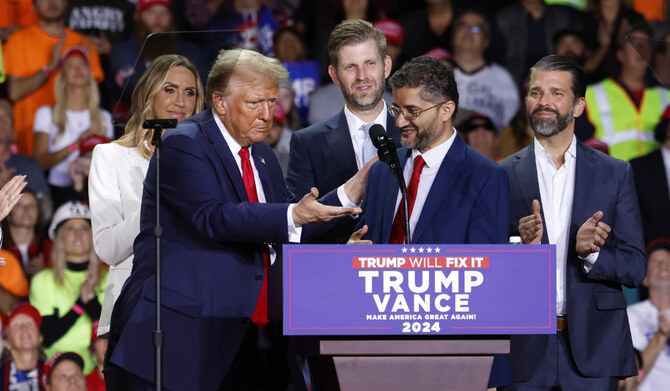
US President Donald Trump introduces Democratic Muslim mayor of Hamtramck Amer Ghalib during his last campaign rally at Van Andel Arena in Grand Rapids, Michigan on November 5, 2024. (AFP file photo)
Dearborn Heights, Michigan, Mayor Bill Bazzi†speaks as U.S. President Donald Trump listens during a campaign rally at Suburban Collection Showplace on October 26, 2024 in Novi, Michigan. (AFP file photo)
President-elect Donald Trump nominated Dr. Janette Nesheiwat to be US surgeon general
He also nominated Dr. Marty Makary as head of the US Food and Drug Administration
President-elect Donald Trump has named two Arab Americans to serve in his Cabinet once he is sworn into office in January.
Trump nominated Dr. Janette Nesheiwat to be US surgeon general and Dr. Marty Makary as head of the US Food and Drug Administration.
The appointments were applauded by Dr. Bishara Bahbah, chairman of Arab Americans for Trump, who helped the former president to win nearly half of the Arab American vote in the Nov. 5 election against US Vice President Kamala Harris.
“We are delighted with President Trump’s nomination of the first two Arab Americans to be part of his administration,” Bahbah said in a message to Arab News on Saturday.
“This is a testament to the hard work of Arab Americans for Trump and recognition of President Donald J. Trump of the role Arab Americans played in his election as the 47th president of the United States. AAFT looks forward to additional Arab American appointments in President Trump’s administration, particularly in the political field.”
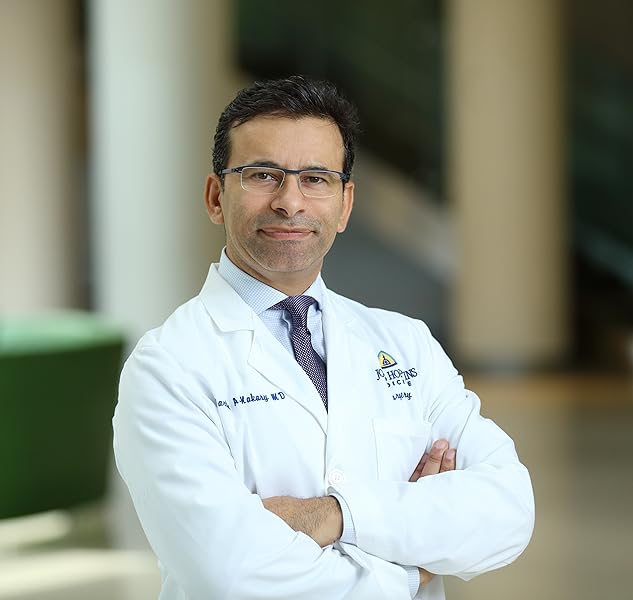
Dr. Makary is a British American surgeon of Lebanese background. He is a public policy researcher at Johns Hopkins University serving as a professor at the Johns Hopkins School of Medicine and a professor, by courtesy, at the Johns Hopkins Carey Business School.
His current research focuses on the underlying causes of disease, public policy, health care costs, and relationship-based medicine. Dr. Makary previously served in leadership at the World Health Organization patient safety program and has been elected to the National Academy of Medicine.
Clinically, Dr. Makary is the chief of Islet Transplant Surgery at Johns Hopkins. He is the recipient of the Nobility in Science Award from the National Pancreas Foundation and has been a visiting professor at more than 25 medical schools. He has published more than 250 peer-reviewed scientific articles and has served on several editorial boards. He is the author of two New York Times bestselling books, “Unaccountable” and “The Price We Pay.”
Dr. Makary is also an anti-vaxxer who refused vaccination for COVID-19, a view shared by many of President-elect Trump’s conservative and Republican supporters.
Dr. Nesheiwat is a double board-certified medical doctor described on her website as “bringing a refreshingly no-nonsense attitude to the latest medical news, breaking down everything you need to know to keep you — and your family — healthy at all times.” She is also the author of “Beyond the Stethoscope: Miracles in Medicine.”
A graduate of the University of Arkansas for Medical Sciences, UAMS, Dr. Nesheiwat has been “shaped by her faith and her upbringing.”
Born in Carmel, New York, she is the daughter of Christian Jordanian immigrants and one of five children raised by her widowed mother, Hayat Nesheiwat. Her siblings are Julia Nesheiwat, Jaclyn Stapp, Dina Nesheiwat and Daniel Nesheiwat.
source/content: arabnews.com (headline edited)
____________
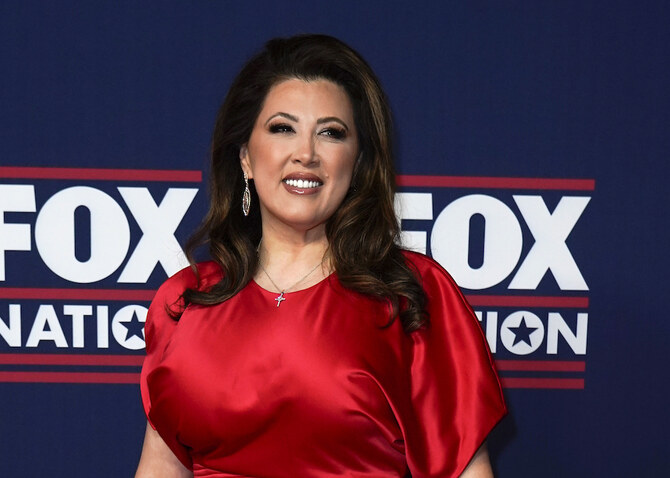
President-elect Donald Trump nominated Dr. Janette Nesheiwat to be US surgeon general . (AP)
The University of Rhode Island neurotoxicologist and dean came to the U.S. for college in the 1980s.
Nasser Zawia hails from Al Bayda, a town in the south of Yemen, a country that has long been affected by war and is currently experiencing widespread famine. Zawia traveled to the U.S. in the 1980s to earn an undergraduate degree from the University of Massachusetts Amherst. He stayed in America, obtaining a PhD in pharmacology and toxicology from the University of California, Irvine. But Zawia never planned to stay on in the U.S. permanently. “Like many students who came here in the 80s, the objective was to come to go to school and go back to your home country and serve there,” he told The Scientist. “However, I married an American citizen.”
In 1990, Zawia and his wife moved to Yemen, where he planned to take a job at Sana’a University’s medical school. But the first Gulf War broke out in 1991. “The war was between Kuwait and Iraq,” he said. “But at that time, the position of the Yemeni government was supportive of Iraq. The connections with the U.S. were being threatened. I left during a climate where there was a lot of uncertainty and fear and insecurity as to what might happen.”
Returning to the U.S. in 1991, Zawia used connections he had made in US universities to secure postdoctoral positions at the University of South Florida and then at the National Institutes of Health’s National Institute for Environmental Health Sciences (NIEHS) in Research Triangle Park, North Carolina. After studying environmental toxicology at NIEHS, Zawia landed a faculty position at Meharry Medical College, a historically black college in Nashville, Tennessee, where he studied the developmental effects of lead exposure in minority populations. “I found that to be something where I could serve the underserved,” he said. “I stayed there for five years and then moved to the University of Rhode Island.”
Although he was successfully navigating the halls of academia and earning his citizenship in the early ’90s, life in the U.S. was not easy for Zawia. “The U.S. was not very receptive to people from the Middle East at that time because of the first Gulf War,” he recalled. “Those of us from that region of the world, our life is always punctuated by all kinds of events involving war. Every 10 years it seems like something big happens, which impacts us in many ways.”
The next big event that would have an effect on Zawia and countless other Americans happened on September 11, 2001. “Those of us who are Arab Americans/Muslim Americans in this country have always been dealing with wars and difficulties in our ancestral homes. But we didn’t ever think or expect that someone would come to the U.S. and cause such a catastrophe. And it changed our lives a lot. And everybody else’s,” he said. “But still we were Muslims in the U.S., and we had to deal with the Patriot Act and then the NSEERS [National Security Entry-Exit Registration System] registration for citizens coming from Muslim countries.”
Despite anti-Muslim sentiment spawned by the terrorist attacks of 9/11, Zawia chose to stay. Since setting up his University of Rhode Island (URI) lab in 2000, he’s made seminal discoveries, including research that pointed to a developmental basis for Alzheimer’s disease. He and his colleagues found that early exposure to lead increased the risk of developing Alzheimer’s disease–related pathologies later in life. Zawia is now working on the epigenetics involved in this phenomenon, and said that his team is pursuing clinical trials of a repurposed drug to treat rare types of neurodegenerative disorders in Europe.
Although the Trump administration’s executive orders on immigration have restricted some travel for people from several countries in the Middle East, including Yemen, the policy has not directly affected Zawia, a naturalized US citizen. But both as a scientist who attends international conferences and as an administrator who seeks to entice talented students from all corners of the world to come to URI, he said he is seeing the damage the restrictions are having. “It is a concern for faculty here that were born in one of those seven countries,” he said. “Even though the law might be clear, how it’s applied may have an impact on our mobility.”
Zawia noted that the effects of the new immigration policies appear to be restricting the flow of students to URI and other US academic institutions. “In graduate education—especially in the STEM disciplines . . . we’re very heavily dependent on international students—it looks like huge drops in applications, a lot of concerns among our students on campus,” he said. “It just sends the wrong message. Graduate education is a strategic asset for the United States. Having the best minds come for an education here, staying, and interacting with our faculty and researchers is the secret to us always maintaining our leadership position.”
On top of the uncertainty surrounding his life as an immigrant researcher and administrator in the U.S., Zawia is grappling with an increasingly unstable situation in his home country, where some of his family still live: 19 million Yemenis are on the brink of a catastrophic famine in a country besieged by civil war. “My personal life and my connections to the country and my family have been upside down, to say the least,” he said.
With all that Zawia has witnessed in the U.S. as a Muslim Arab-American, he views the current political and social climate as the most damaging he’s seen. “I feel the impact of what’s going on now is much greater than what we experienced in the ’90s, with first war in Iraq or 9/11,” he says. “What’s going on right now is really very unsettling and very worrisome. Past events and past wars had more of a selective impact on us as Middle Eastern people and Muslim Americans. But the changes this administration is bringing about in many different facets of life is really . . . disrupting a lot.”
source/content: the-scientist.com / bob grant (headline edited)
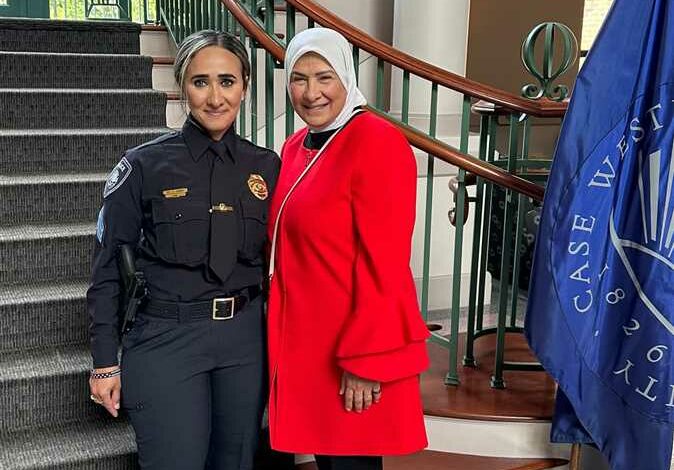
A few days ago, Egyptian-American Sarah Shendi took an important step by becoming the first Egyptian Muslim police sergeant to serve in the US police service, setting an example for others like her.
Ohio has approximately 3,200 officers. Shendi joined them as the first Arab Muslim woman to hold the position of sergeant.
She had previously served with the Copley Township Police, and Ohio Governor Mike DeWine appointed her as the first director of the law enforcement and employment office in the state of Egyptian-Muslim descent.
The decision was warmly welcomed by the Arab community in the US, which in turn suffered for decades from marginalization due to the terrorist attack of September 11.
Shendi’s new rank marks a step forward.
She was born in Saudi Arabia and lived between Saudi Arabia and Egypt until she reached the age of six, and her family moved to the US in 1991.
Q: Why did you choose to be a policewoman?
A: Since we moved to the US in 1991, I have always been fascinated by law enforcement here in this country, especially because it’s so different from anywhere else in the world. I also fell in love with the uniform, and I always wanted to help others.
From my point of view I think it is the best job on the planet.
Q: What are the biggest issues that you faced on your way to becoming a policewoman?
A: I have learned that your greatest enemy is yourself and what goes on in your mind. I wish I had believed earlier in my life in this wise saying, then I would not have wasted so much time, doubting my decision, or trying to please others.
This is the secret of happiness and success in life.
Q: How difficult is it to be a Muslim woman in Western society?
A: Being a Muslim woman is difficult anywhere whether in a Western or Middle Eastern society. Women face special and unique challenges. Everywhere we go. I like to say pressure is a privilege. I’ll take a good challenge any day of the week. I believe in leading by example and doing the right thing. The rest is up to God. Always be confident, wise, honest and honorable.
Q: Usually, Arabs living in a foreign country face an identity crisis – did you?
A: I don’t really have an identity crisis because I’ve been living here for almost 30 years, I feel at home here in the US, and when I go to Egypt I feel at home there too.
I just love being around good people, I preferred being in the Middle East when I went on vacation last October because I love seeing mosques everywhere and hearing the call to prayer when it’s time to pray.
But I can’t say I’ve had an identity crisis. I am who I am, no matter where I live.
Q: Being a policewoman is risky. How did your family deal with your decision?
A: My family has been supportive of anything I choose to do since day one. They may not have welcomed my decision at first, but they still supported me. Then they saw how good I am at my job, and how much of a difference I make to the lives of the people around me. They started to understand why I love what I do.
Thank God I have the most amazing family and they have been so supportive in all my good and bad days.
Q: Did your family make sure that you speak Arabic since you speak the language well?
A: I think speaking Arabic is very important. My dad wouldn’t let us speak English at home growing up here in the US. At the time I didn’t know why, and I used to get resentful sometimes, but now as an adult, and being in law enforcement, I appreciate it so much because it allowed me to help so many people.
Q: Are there Egyptian customs that you adhere to in your family?
A: Although we have lived in the US for more than 30 years, we adhere to many cultural practices and do our best with our religion. I am proud to be Egyptian, proud to be Muslim, and also proud to be American. I love Egyptian culture and the Islamic religion and in my opinion this is what makes me a good policewoman.
Q: Have you ever been to Egypt on a visit with family?
A: The last time I went to Egypt with my family was about ten years ago or more. My sister chose to have her wedding in Egypt and it was a wonderful time with my family. We haven’t traveled together as a family since then, but I do go on vacations sometimes.
Q: What do you like most when visiting Egypt?
A: I love being around people who speak my language and have the same religion as mine. I feel at home when I visit Egypt. I also love hearing and speaking Arabic, seeing nice and kind people everywhere you go, I also love Egyptian food and landscapes. I am very proud of Egypt because it is where my parents were born and raised and they are the real reason I am where I am now.
Q: Are there specific Egyptian foods that you like very much?
A: I love my mom’s cooking the most. I love beans a lot and I also love koshari. I think Egyptian food is the best middle eastern food there is, and of course my mom is the best cook in the world.
Q: Do you follow any dramas in Egypt or about Egypt?
A: I don’t watch any Egyptian TV. But I listen to Egyptian singers like Amr Diab and Tamer Hosni.
Q: From your experience, what advice you would like to give to women in general?
A: Be yourself, be confident, and don’t give in to the pure pressures around you. We are surrounded by so much fakery on social media, on TV and in the entertainment industry, everyone wants to tell you what to wear, what to eat and drink, and how you are supposed to look. I would never listen to any of that because it’s not real advice, and it’s not healthy.
You will never find happiness through others. True happiness comes from within, knowing you are good enough. I will tell everyone in general to always work with pure intentions.
Religion is also very important to me and I always tell young people not to miss prayers for any reason. We get the chance to talk to God at least five times a day and this is not something we should take for granted. It’s a privilege.
Edited translation from Al-Masry Al-Youm
source: http://www.egyptindependent.com / Egypt Independent / Home> Features-Interviews> Main Slider / b Al-Masry Al-Youm / June 05th, 2023