In interview with Arab News, Jordan Media Institute dean Dr. Ziad Rifai discusses urgent need to equip citizens with tools to navigate today’s information ecosystem
Working alongside UNESCO and the Jordanian government, JMI has spearheaded 2 successive national media literacy strategies, establishing Jordan as a regional model
Sitting comfortably in his office in Amman, Dr. Ziad Rifai does not immediately strike you as someone whose grand mission is to fight information warfare.
The dean of the Jordan Media Institute and architect of its media literacy program — one of the first and most comprehensive initiatives of its kind in the Arab region — draws on decades of experience, appearing at times measured while promising to take on a David vs. Goliath challenge.
“Everybody now that has a phone basically has a TV, a radio station, a newspaper. All the media have been consolidated into this small phone,” he told Arab News. “And with that, with the amount of abuse that we’ve witnessed — the hate speech, the echo chambers, the misinformation, the disinformation, the rumors — all that necessitated that we need to do something about it.”
Founded in 2006 by HRH Princess Rym Ali as the first institution in the region to offer an Arabic-language MA in journalism and modern media, in partnership with the University of Jordan, JMI has evolved to keep pace with a rapidly shifting industry. Over the years it has introduced new courses — including mobile journalism and data journalism — alongside its media literacy program.
“Our focus is on journalism, creating journalists who are experienced, dedicated, ethical. That’s the core of our mission,” Rifai said. “But, as you know very well, the media scene is changing rapidly. So, while keeping the basic principles, we had to branch out into the new media scene.”
Rifai, who has worked across newsrooms, the UN, Jordan TV and the Higher Media Council, has watched this transformation unfold over five decades. He recalls a Jordan with one radio station, then the arrival of a single television channel and a handful of newspapers. Invoking Wilbur Schramm — the American scholar widely regarded as the father of modern communication theory, whose four-press model was first published in 1956 — he says the world has grown far more complex since then.
“Things have gotten so mixed up,” he added. “We are in a phase that’s as big as inventing the printing press, if not more. The problem is that the forces that are pushing the change, nobody knows who they are. And I’m not so sure if anybody can control where they’re going. Not to mention if they know where they’re going.”
That chaos, he suggested, is most acutely felt in the information ecosystem, where speed routinely outpaces safeguards — and where the general public is left with few tools to navigate the difference.
“The biggest challenge we have is with the speed that things change. The problem is how to catch up and have enough time to do interventions, awareness, education and introduce legislations.”
AI has become the defining example. In April, UNESCO examined how algorithmic AI systems are transforming information dynamics and amplifying risks — from misinformation to deepfakes — ultimately threatening trust in media and democratic integrity. The report argues that media and information literacy is the critical response. Yet follow-up initiatives, Rifai said, too often become mired in bureaucracy.
“For any initiative like this to take hold in a society, you need a champion. You need someone who believes in the idea and who pushes (it) forward,” he added.
JMI has been that champion in Jordan, working with the government domestically and relying on UNESCO as an international partner to strengthen credibility.
“We are the catalyst, we’re the advocates. UNESCO has the expertise and the global knowledge, but not the local,” said Rifai. “However, without the state, nothing will take hold, especially in our region.”
The model, he argues, is replicable. JMI is already exporting its expertise to a group of countries across the region.
“If (a country) took the strategy that we have and looked at it, they might change dates, they might change budgets, they might change partners, but the basic pillars of the strategy would probably be applicable in most of our region because the phenomenon is universal.”
JMI’s work operates on two levels: national policy design and hands-on training. Following an experimentation phase around 2014, Jordan moved to official adoption in 2019, when media literacy was placed on the government’s priority list alongside pilot projects in schools and youth spaces. The first National Strategy for Media and Information Literacy (2020–2023) earned recognition from UNESCO and a number of Arab and European officials, establishing Jordan as the first Arab country with a comprehensive, formal MIL plan. In late 2025, Jordan launched a second strategy for 2026–2029, again with UNESCO and JMI as core partners.
“The second strategy has full ownership of the government and all the elements of sustainability — that’s what the first strategy did not have,” Rifai said.
The program targets all age groups and all sectors of society, adjusting only in terms of sophistication.
“It essentially targets all sectors of operation. What differs is the level of sophistication,” said Rifai, adding that a 50-year-old housewife can be as active a disseminator of misinformation as a teenager. MIL concepts are now integrated into school curricula across subjects including religion, social sciences and Arabic — but Rifai is candid about the gap between integration and application.
“In my previous career at the UN, we integrated concepts of reproductive health and family planning in two books. The challenge was that teachers didn’t teach it. It was in the book, but in the classroom, they just skipped it. Either because they didn’t believe in it, or because they thought it wasn’t important.”
Monitoring implementation, he acknowledges, is the next frontier. “If awareness is not translated to behavioral impact or behavioral change, it’s not worth the objective. At the end of the day, the campaign should change behaviors and not just create that awareness. Awareness might be the first step in that direction.”
The ambition extends beyond classrooms. This week, JMI signed a memorandum of understanding with Jordan’s Higher Council for the Rights of Persons with Disabilities to develop a code of ethics for journalists covering disability — an area Rifai describes as a blind spot in regional media.
“People with disabilities are absent, at least in our region, from the media scene,” he said. “Whenever you see a person with disability in media, it’s either portrayed as, ‘oh, poor guy,’ or, ‘oh, how wonderful, he got a degree in science.’ Both, from their perspective, it’s the wrong approach. Just treat them like normal human beings.”
He framed the partnership as explicitly two-directional: JMI bringing journalism expertise, the council bringing lived experience.
Rifai acknowledges the world remains full of challenges, but believes the goal is to take back enough control to exploit technology’s possibilities rather than be consumed by them.
“It’s not easy to predict where we’re going. What we know for sure is that things seem to be going out of hand, in terms of media proliferation. We’re being pushed to becoming more and more reliant on (a specific technology), and less and less having any input on controlling where it’s going.”
He sees it, ultimately, as a double-edged sword. “The chaotic scene has its pitfalls,” he said, “but at the end of the day, it is allowing everybody to say what they want. For the first time, there’s freedom of information and everybody now is telling his or her story without the control. It could go either way, and I wouldn’t put money on either side of that prediction.”
For JMI, however, the mission remains constant. “No matter what happens with the media, we should not lose sight of that importance of having a proper journalism. At the end of the day, what matters is what you’re going to say and how you’re going to say it. We will continue to hold the principles and the ethical message of proper journalism. That will continue to be our role, no matter what new technologies or wars come.”
source/content: arabnews.com (headlines edited)
____________
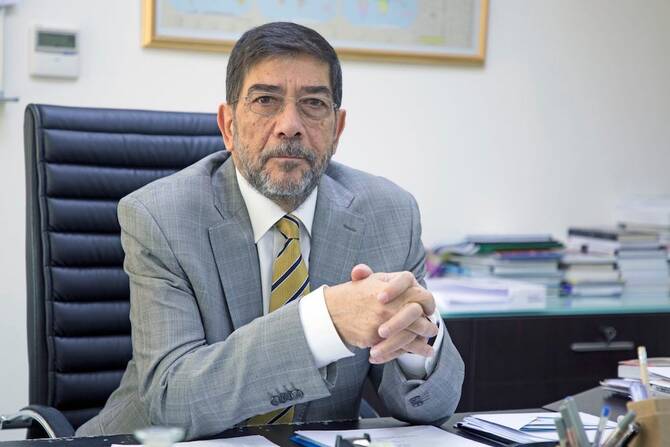
Dr. Ziad Rifai, dean of the Jordan Media Institute and architect of its media literacy program, spoke to Arab News about one of the first and most comprehensive initiatives of its kind in the Arab region. (Supplied)
___________
JORDAN