Arabs & Arabian Records Aggregator. Chronicler. Milestones of the 25 Countries of the Arabic Speaking World (official / co-official). AGCC. MENA. Global. Ist's to Top 10's. Records. Read & Enjoy./ www.arabianrecords.org
We often come across news reports about Egyptians abroad who have attained prominent leadership positions, yet we rarely give them a second thought – unless, of course, they are movie stars like Rami Malek or football legends like Mohamed Salah.
During a recent visit to Canada, I was struck by how many university presidents and faculty deans were of Egyptian origin of whom, for the most part, we have never heard.
A couple of days ago, my attention was caught by two items that were headline news everywhere, while we barely paid them any heed. The first is the appointment of the Egyptian-American Sherif Soliman as the New York City budget director. This is in the global capital of finance, home to Wall Street and the New York Stock Exchange, the largest stock exchange in the world. Soliman is a highly regarded economist with more than thirty years of financial experience. In the course of his career, he has rescued several major commercial institutions from bankruptcy and succeeded in reducing the debt of others by record proportions.
The recently elected New York mayor, Zohran Mamdani, said that Soliman far surpassed rival candidates for budget direct. Soliman, for his part, said, “I feel a deep sense of pride joining the administration of the first Muslim mayor of the city of New York.” He will be managing a budget of approximately $121 billion – one of the largest municipal budgets in the world.
Soliman was born to Egyptian parents who emigrated to New York 45 years ago. He is married to the Egyptian Hanan Thabet. They have two children, Lina and Ziad.
At around the same time, on the other side of the Atlantic, the British Muslim Laila Cunningham announced her intent to run for Mayor of London in the British capital’s 2028 mayoral race. She will be the first candidate of Egyptian origin to seek the post. Born in London to parents who emigrated from Egypt in the 1960s, she studied law and joined the Conservative Party, then switched to Reform UK. A controversial figure, she advocates empowering and increasing the police force to curb crime, which she claims has turned London into an unsafe city. She also calls for combating what she terms “Islamic terrorism.” She is married to an American and is the mother of seven children.
* A version of this article appears in print in the 15 January, 2026 edition of Al-Ahram
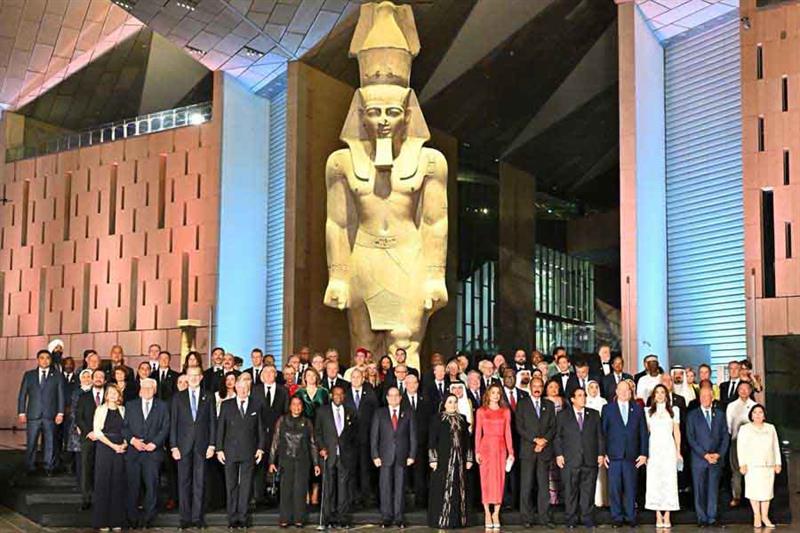
In an evening that blended history, culture and global celebration, President Abdel-Fattah Al-Sisi and First Lady Entissar Al-Sisi presided over the official inauguration of the Grand Egyptian Museum (GEM) on Saturday, marking a milestone in the modern cultural landscape of Egypt and the world. The ceremony was attended by nearly 80 high-level delegations, including kings, presidents, princes, heads of government, and representatives of regional and international organisations.
Among them was German President Frank-Walter Steinmeier, Dutch Prime Minister Dick Schoof, Spain’s King Felipe VI, Queen Rania of Jordan, Prince Albert II of Monaco, and Greek Prime Minister Kyriakos Mitsotakis. Also present were Palestinian President Mahmoud Abbas, Saudi Arabia’s Minister of Culture Badr bin Abdullah, and the crown princes of Oman and Bahrain.
Held at the GEM’s open-air court overlooking the Giza Plateau, the celebration unfolded as a multisensory homage to Egypt’s timeless civilisation. Performances combining music, light, laser projection, and drone choreography traced the evolution of Egyptian architectural genius, from the Giza Pyramids to the modern era, and highlighted the message that civilisations thrive in times of peace.
The façade of the museum became a canvas for immersive light and projection displays, with vast screens illuminating Egypt’s ancient monuments and artistic heritage. Dancers in Pharaonic-inspired costumes, adorned with gold crowns and sceptres, performed to a live international orchestra, while fireworks and synchronised drone formations traced the silhouettes of ancient deities across the night sky.
President Al-Sisi welcomed the distinguished guests and emphasised that the GEM, now the largest museum in the world dedicated to a single civilisation, stands not merely as a showcase of ancient treasures, but as a testament to the creative spirit and enduring legacy of the Egyptian people.
He also described the museum as a new chapter in Egypt’s cultural story, affirming that it stands as a testament to the creativity and legacy of the Egyptian people and as a space for dialogue, knowledge, and exchange.
The ceremony began with the performance “The World Plays One Melody”. The programme featured a laser and drone show illustrating the Orion Belt alignment and its symbolic connection between the museum and the Giza Pyramids, followed by a performance titled “A Journey of Peace in the Land of Peace”.
The sequence highlighted the evolution of Egyptian architectural ingenuity, from the Step Pyramid of Djoser to modern Egyptian design, accompanied by a Coptic hymn of Sufi spiritual singing, and a drone message reading: “Civilisations Flourish in Times of Peace.”
The evening’s performances brought together some of Egypt’s most celebrated voices. Soprano Fatma Said and tenor Ragaaeddin delivered stirring pieces composed by Hisham Nazih, whose music blends contemporary orchestration with the tonal motifs of ancient Egypt, a style previously showcased during the Golden Mummies parade.
Sisters Amira and Mariam Abu Zahra, granddaughters of renowned Egyptian actor Abdel-Rahman Abu Zahra, appeared in stylised Pharaonic attire, performing a violin duet accompanied by the Cairo Opera House Orchestra and international ensemble players under the baton of maestro Nayer Nagui.
The celebration also highlighted Egypt’s cultural diversity. Nubian singer Ahmed Ismail performed in the Nubian language, while Haneen Al-Shater sang in Arabic from a floating stage overlooking the Nile, symbolising Egypt’s enduring identity as a crossroads of civilisations.
Iconic Egyptian actress Sherihan delivered an evocative spoken tribute to ancient Egypt’s artistic legacy, set against sky projections of the Pyramids. She was followed by Sherine Ahmed, the first actress of Egyptian descent to play Eliza Doolittle on Broadway, who gave a powerful musical performance before Islamic chanter Ehab Younis offered a spiritual finale.
On giant screens above, scenes from celebrations in countries all over the world played out against the backdrop of Egypt’s ancient monuments.
Dozens of performers dressed in elaborate white costumes, as a symbol of peace, their foreheads crowned with golden wreaths and sceptres in hand, played traditional tunes as a laser show depicting the Pharaohs and fireworks lit up the night sky above the museum.
As the night drew to a close, a drone light show mapped the sky with hieroglyphs, Pharaonic figures, and the golden mask of Tutankhamun, shimmering above the Giza Plateau, an image that captured both the grandeur of the past and the cultural confidence of the present.
Among the many moments that captured global attention during the GEM’s opening ceremony was the appearance of 12-year-old Asser Ahmed Hamdi, whose poised and expressive performance resonated with viewers across Egypt and beyond. The young performer quickly became one of the most talked about faces of the event, representing a new generation engaging with the country’s cultural narrative.
Asser described his participation in the ceremony as a defining moment in his life. “I was very happy to be there, and proud that my effort represented Egypt in front of the world,” he said, explaining that his preparation for the role involved months of rehearsals and that he had been training in performance and acting for seven years. “When the opportunity came, I felt like a dream had been achieved.”
Performing before President Al-Sisi and dozens of world leaders brought initial nerves, he admitted, but the atmosphere on stage quickly shifted those feelings. “I was nervous backstage, but once I stepped onto the stage, I felt calm,” he said. After the performance, he exchanged a few words with the president, who praised his portrayal linked to the story of Tutankhamun.
Asser spoke with pride about standing before the golden mask of Tutankhamun and the monumental statue of Ramses II inside the museum. “I had seen them only in books and on TV, but standing in front of them at the GEM was something completely different,” he said. “I felt proud to be representing Egypt.”
Reflecting on the journey, he said, “All the effort in rehearsals was worth it. I’m grateful I could present something worthy of Egypt. I will always be proud that I was part of the opening of the GEM.”
Among the creative figures behind the opening night spectacle was Ahmed Essam, the artist and designer responsible for the fireworks and pyrotechnic displays that illuminated the GEM during the ceremony. Speaking about the experience, Essam described it as one of the defining moments of his career, noting that the preparations took several months of planning, rehearsal and technical coordination.
“It was an honour to be part of an event of this scale,” he said, explaining that the ceremony’s postponements provided valuable time to refine the visual narrative and ensure that the display matched the cultural weight of the occasion. Essam highlighted that working in a field he is passionate about has been central to his development. “I travel constantly to learn and experiment with new ideas. When you love what you do, you invest your whole self into it.”
Creating the fireworks show for the GEM opening, he noted, required an approach tailored to the museum’s identity as a celebration of ancient Egyptian civilisation. Colours, rhythms, and sequences were chosen to complement the architectural setting and underscore the narrative themes of heritage and renewal.
He was also quick to highlight the scale of teamwork behind the scenes. “What viewers saw was the result of a coordinated effort involving more than 150 people, from designers and technicians to support staff. Everyone worked with passion and commitment to present Egypt in the best possible light.
“The opening of the GEM is a landmark in Egypt’s cultural journey. The presence of President Abdel-Fattah Al-Sisi and world leaders underscored its importance. We are proud to have contributed to an event that showcased Egypt’s ability to inspire and captivate the world,” Essam added.
Soprano Said, who took the stage as one of the evening’s principal performers, revealed that the concert marked a deeply personal milestone for her as it was her first since becoming a mother.
“I recently gave birth to twins,” she said, “and I wasn’t sure I would be able to perform because the concert came so soon after the delivery. I was a little anxious. But my children gave me the strength and energy to take part in this extraordinary occasion.”
Her appearance added an intimate emotional layer to the celebration, reflecting both the resilience of artists and the symbolic continuity between generations that the museum itself seeks to embody.
Most of the international state leaders expressed their enthusiasm over the grand opening. In a diplomatic gesture that blended cultural appreciation with a touch of modern creativity, Danish Foreign Minister Lars Løkke Rasmussen presented Egypt’s Foreign Minister Badr Abdelatty with a LEGO replica of the Great Pyramid of Khufu, a symbolic gesture marking Denmark’s participation in the GEM’s opening and celebrating Egypt’s architectural heritage.
Zambian Minister of Tourism Rodney Sikumba noted his country’s appreciation for the commemorative gift presented to Zambia on the occasion of the GEM’s opening, a piece representing part of the GEM’s architectural model. He pointed out that the artefact will be placed on a temporary display in one of Zambia’s national museums, accompanied by an explanatory panel narrating its significance. The gesture, he said, reflects Zambia’s pride in taking part in this historic cultural moment and serves as a testament to the growing cultural ties between the two nations.
As with any major cultural event, public reaction to the GEM’s opening ceremony was not uniform. Such occasions naturally invite a spectrum of opinions, shaped by personal taste, expectations, and aesthetic preferences. While some critics viewed the event as more modest than anticipated, others praised its scale and artistic ambition, seeing in it a carefully curated blend of ancient symbolism and modern cultural expression. Supporters argue that the ceremony succeeded in presenting Egypt as both a guardian of a timeless civilisation and a dynamic cultural force in the present day — a duality at the heart of the museum’s identity.
* A version of this article appears in print in the 6 November, 2025 edition of Al-Ahram Weekly
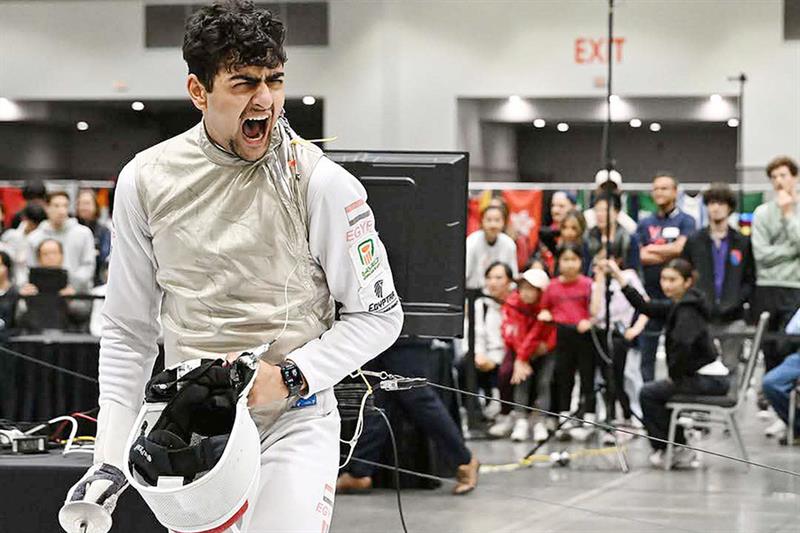
Egyptian foil fencer Abdel-Rahman Tolba continued his impressive international trajectory by capturing the bronze medal at the Foil World Cup in Canada, held from 1-4 May.
Tolba’s journey to the podium was a standout performance, marked by a series of remarkable victories over several top-ranked opponents.
Tolba, from Al-Zohour Club, claimed the bronze after a narrow semi-final defeat to world No 9 Alexander Massialas of the US, falling by the slimmest of margins, 15-14, in a golden touch decider.
His campaign commenced in the Round of 64 with a confident 15-11 win over Brazil’s Guilherme Toledo, followed by a hard-fought 15-13 victory against Spain’s Mario Díaz in the Round of 32.
Tolba then produced one of the tournament’s most notable upsets in the Round of 16, dismantling Czech Republic’s Alexander Choupenitch, the Tokyo 2020 bronze medalist and world No 6, by a commanding 15-7 scoreline.
In the quarter-finals, he delivered another standout performance, overpowering American star Nick Itkin, the bronze medalist at the Paris 2024 Olympics and silver medalist at the 2023 World Championships in Milan, and currently ranked No 4 globally, with a decisive 15-9 victory.
Tolba’s semi-final clash with the experienced Massialas proved a thrilling contest, as both fencers exchanged points in a high-calibre bout. Ultimately, Massialas edged past Tolba in sudden death.
The latest medal adds to Tolba’s rapidly expanding list of accolades, including a bronze at the Grand Prix in Italy earlier this year, and a gold medal at the Junior World Championships in China last month.
* A version of this article appears in print in the 8 May, 2025 edition of Al-Ahram Weekly
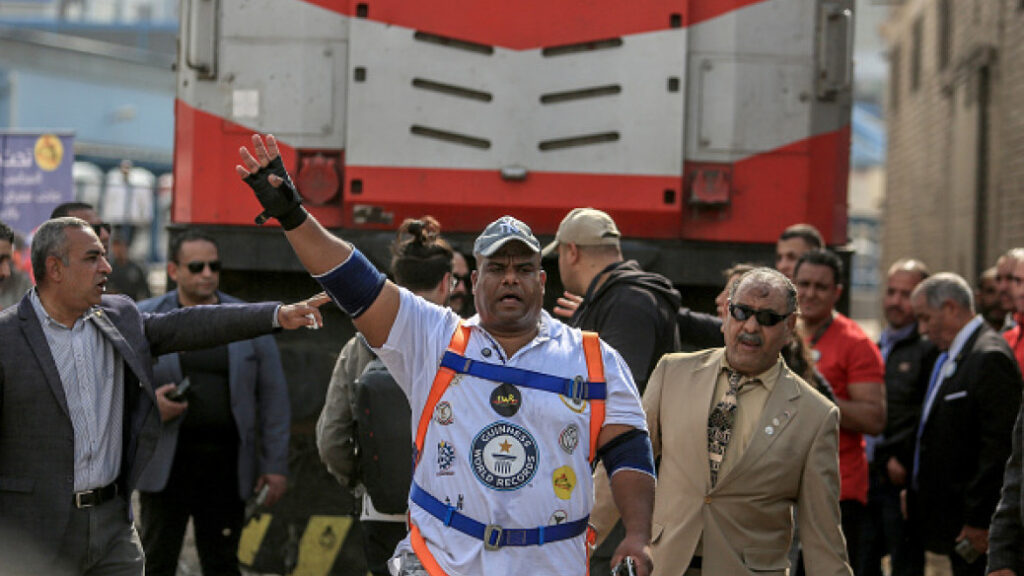
Ashraf Mahrous, known also as Kabonga, pulled a 279-ton train using only his teeth, while also observing the Ramadan fast.
An Egyptian wrestler has received recognition in three categories by Guinness World Records , including for breaking the world record for heaviest rail pull using only his teeth.
Ashraf Mahrous, known by his nickname Kabonga, also received certificates for the heaviest locomotive pull and fastest 100-metre road vehicle pull.
The successful world record attempts took place at Cairo’s Ramses train station on Wednesday and Thursday, where Kabonga pulled a 279-ton train using a rope held by his teeth. The wrestler pulled the train for a distance of close to 11 metres.
“On the first day, I was able to pull a two-ton cart, while fasting, for a distance of 107 meters in 37 seconds, breaking another record by pulling a one-ton cart for 100 meters and surpassing the 60-second barrier,” Kabonga told Anadolu, highlighting that he had been abstaining from eating and drinking due to the Ramadan fast, which lasts from pre-dawn to sunset.
“The next day, on Thursday afternoon, I pulled a train weighing 279 tons with my shoulders, while fasting, for a distance of 10 metres and 66 centimeters,” he added.
Kabonga, who is the president of the Egyptian Federation for Professional Wrestlers, previously pulled a 15,730-kilogram truck with his teeth in 2021. In February 2024, he cracked and ate 30 raw eggs in 30 seconds in a feat that was also recognised by Guinness World Records.
Dawlet Elnakeb, an organiser of Thursday’s event in Cairo, said Kabonga had trained for just 20 days prior to the record breaking event.
source/content: newarab.com (headline edited)
____________
Ashraf Mahrous, known as Kabonga, is president of the Egyptian Federation for Professional Wrestlers [Getty]
Imagine owning a camera so powerful it can take freeze-frame photographs of a moving electron – an object traveling so fast it could circle the Earth many times in a matter of a second. Researchers at the University of Arizona have developed the world’s fastest electron microscope that can do just that.
They believe their work will lead to groundbreaking advancements in physics, chemistry, bioengineering, materials sciences and more.
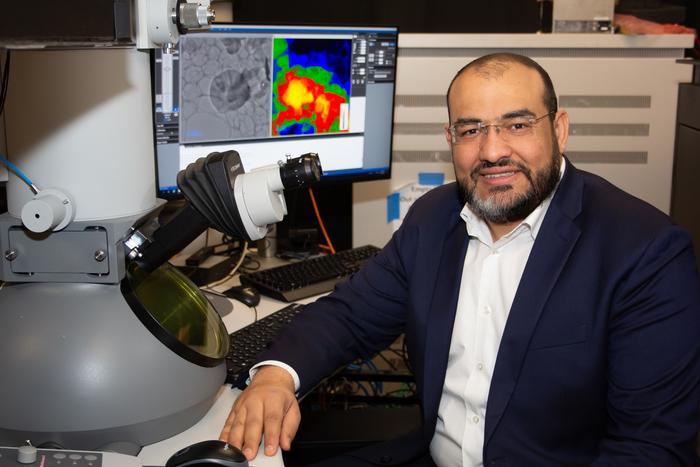
“When you get the latest version of a smartphone, it comes with a better camera,” said Mohammed Hassan, associate professor of physics and optical sciences. “This transmission electron microscope is like a very powerful camera in the latest version of smart phones; it allows us to take pictures of things we were not able to see before – like electrons. With this microscope, we hope the scientific community can understand the quantum physics behind how an electron behaves and how an electron moves.”
Hassan led a team of researchers in the departments of physics and optical sciences that published the research article “Attosecond electron microscopy and diffraction” in the Science Advances journal. Hassan worked alongside Nikolay Golubev, assistant professor of physics; Dandan Hui, co-lead author and former research associate in optics and physics who now works at the Xi’an Institute of Optics and Precision Mechanics, Chinese Academy of Sciences; Husain Alqattan, co-lead author, U of A alumnus and assistant professor of physics at Kuwait University; and Mohamed Sennary, a graduate student studying optics and physics.
A transmission electron microscope is a tool used by scientists and researchers to magnify objects up to millions of times their actual size in order to see details too small for a traditional light microscope to detect. Instead of using visible light, a transmission electron microscope directs beams of electrons through whatever sample is being studied. The interaction between the electrons and the sample is captured by lenses and detected by a camera sensor in order to generate detailed images of the sample.
Ultrafast electron microscopes using these principles were first developed in the 2000’s and use a laser to generate pulsed beams of electrons. This technique greatly increases a microscope’s temporal resolution – its ability to measure and observe changes in a sample over time. In these ultrafast microscopes, instead of relying on the speed of a camera’s shutter to dictate image quality, the resolution of a transmission electron microscope is determined by the duration of electron pulses.
The faster the pulse, the better the image.
Ultrafast electron microscopes previously operated by emitting a train of electron pulses at speeds of a few attoseconds. An attosecond is one quintillionth of a second. Pulses at these speeds create a series of images, like frames in a movie – but scientists were still missing the reactions and changes in an electron that takes place in between those frames as it evolves in real time. In order to see an electron frozen in place, U of A researchers, for the first time, generated a single attosecond electron pulse, which is as fast as electrons moves, thereby enhancing the microscope’s temporal resolution, like a high-speed camera capturing movements that would otherwise be invisible.
Hassan and his colleagues based their work on the Nobel Prize-winning accomplishments of Pierre Agostini, Ferenc Krausz and Anne L’Huilliere, who won the Novel Prize in Physics in 2023 after generating the first extreme ultraviolet radiation pulse so short it could be measured in attoseconds.
Using that work as a steppingstone, U of A researchers developed a microscope in which a powerful laser is split and converted into two parts – a very fast electron pulse and two ultra-short light pulses. The first light pulse, known as the pump pulse, feeds energy into a sample and causes electrons to move or undergo other rapid changes. The second light pulse, also called the “optical gating pulse” acts like a gate by creating a brief window of time in which the gated, single attosecond electron pulse is generated. The speed of the gating pulse therefore dictates the resolution of the image. By carefully synchronizing the two pulses, researchers control when the electron pulses probe the sample to observe ultrafast processes at the atomic level.
“The improvement of the temporal resolution inside of electron microscopes has been long anticipated and the focus of many research groups – because we all want to see the electron motion,” Hassan said. “These movements happen in attoseconds. But now, for the first time, we are able to attain attosecond temporal resolution with our electron transmission microscope – and we coined it ‘attomicroscopy.’ For the first time, we can see pieces of the electron in motion.”
source/content: eurekaalert.org / University of Arizona / (headline edited)
_________
Mohammed Hassan, associate professor of physics and optical sciences, let a group of researchers in developing the first transmission electron microscope powerful enough to capture images of electrons in motion.
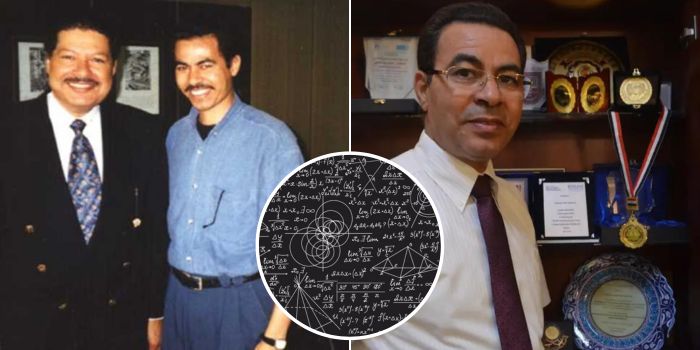
Born in Sohag, Egypt, Mathematician Mahmoud Abdel-Aty was awarded the world’s best mathematician by China for his contribution to quantum algorithms and quantum optics!
The scientist told Sky News Arabia “My name was nominated by a number of scholars from more than one country, and the committee filtered all the applicants and selected the best among them,”
The Chinese award Qin-Jiu-Shao is considered to be one of the most important awards in mathematics in the world will be awarded to winners in November.
The Egyptian scientist, who occupies the position of Chairman of the National Committee for Mathematics, confirmed that through him he was able to explain a large number of problems that had no explanation in the past, especially with the great and amazing progress in the manufacture of computers, especially quantum computers.
He also mentioned how happy he gets whenever he’s awarded saying, “It’s the most beautiful in his life,”
Adding “It gives us confidence that what we are doing is of real value.
The Award represents the great appreciation of our country, and the international awards represent a global appreciation for the name of Egypt and its great scientists.”
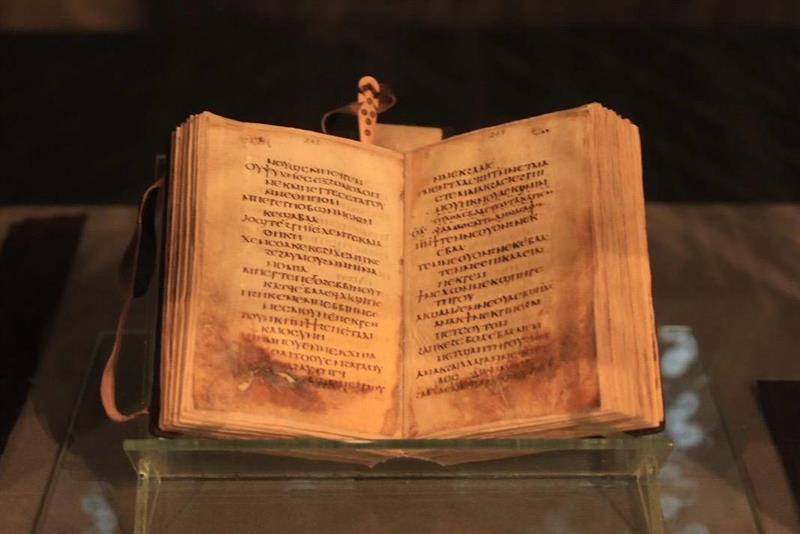
After undergoing a meticulous five-year restoration, the Coptic Museum in Old Cairo has re-exhibited its most treasured artefact – the oldest complete Coptic Psalter ever discovered.
“This is the first time we possess a complete book of Psalms dating to late fourth century AD, making it the oldest complete Psalms book unearthed to date. We’ve never encountered such an early book in Egypt, and I’ve found no evidence of an earlier genuine book anywhere else,” said the late director of the Coptic Museum and Coptic studies expert Gawdat Gabra when he first saw the book days after its discovery in 1984.
The Book of Psalms (Psalter) by David is one of the most valuable artefacts in the Coptic Museum in Old Cairo, having been discovered in a tomb going back to the early Christian period.
It is the oldest Coptic Psalter ever translated from the Septuagint text. After almost four years of restoration, the museum has re-exhibited the Psalter in a special hall in the museum.
The book comprises 498 parchment sheets, encased within wooden bindings laced with leather. Rendered in a dialect of Coptic — a defunct language utilizing Old Greek characters augmented by seven hieroglyphs from ancient Egypt’s twilight era — the Psalms are meticulously inscribed by hand.
According to Gihan Atef, director of the museum, the manuscript harbours numerous Greek terms alongside some Coptic lexemes hitherto unrecorded. It is penned predominantly in brown ink derived from iron, though sporadic patches exhibit black carbon ink, ostensibly applied in efforts to rectify damage. Evident signs of wear manifest where fingers once turned the delicate parchment leaves.
Upon its discovery, the book’s pages were fused together, save for the final quintet, two of which remain blank. Affixed to the book via leather cords dangles a diminutive ankh — a symbol from ancient Egypt, seamlessly integrated into Christian iconography — crafted from bone. Hamdi Abdel-Moneim, head of the restoration section at the Museum of Islamic Art (MIA) said that a team of restorers from both the MIA and the Coptic Museum embarked on a long journey to restore the Psalter.
He pointed out that the manuscript suffered from various forms of damage, including the detachment of its pages due to sewing deterioration. Most of its pages were plead and dried, chemical decomposition was found, along with the loss of parts from the edges and traces of liquids. There was also degradation, deterioration, and erosion of the inks, as well as dryness of the leather cover and cords.
The restoration works included the complete dismantling of the manuscript and addressing all aspects of damage. UV and infrared digital imaging were conducted, along with photographic documentation. Throughout the restoration process, Abdel-Moneim continued, all pages were numbered before disassembly, and specialists in codicology and Coptic texts were consulted.
The Coptic Museum is comprised of two wings joined by a narrow hallway. Inside, approximately 16,000 collectibles are showcased, arranged by type across 12 distinct departments.
The departments encompass a wide range of subjects such as Stones and Plasterboard, Development of Coptic Writing and Manuscripts, Textiles, Ivory and Iconography, Wood, Metals, Pottery, and Glass. Visitors can also marvel at mesmerizing Coptic art and manuscripts of the Holy Bible, some dating back thousands of years.
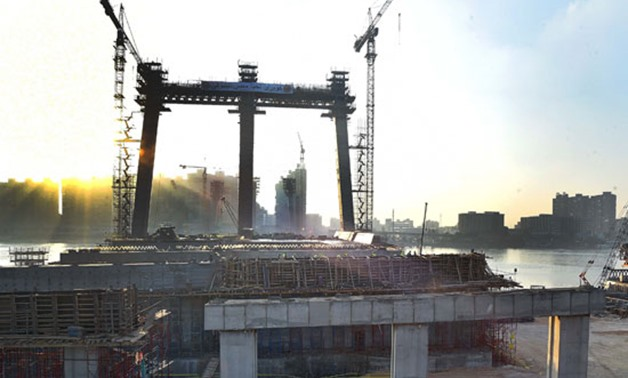
Egypt received on Wednesday a Guinness World Records’ certificate on Rod al-Farag Axis Bridge (Tahya Misr Bridge) passing over the Nile, for being the widest suspension bridge in the world at a width of 67.36 meters.
Guinness World Records website has not yet published news about the new Egyptian record-holder.
Regional Director for the Guinness World Records in the Middle East and North Africa region Talal Omar handed over the certificate to Mohamed Mohsen Salah, President and CEO of Arab Contractors company.
President Abdel Fatah El Sisi attended Wednesday the opening of Rod el Farag Axis Bridge, int the presence of Prime Minister Moustafa Madbouli, Presidential Adviser for National and Strategic Projects Sherif Ismail, Transport Minister Kamel el Wazir and a number of high-ranking state officials.
The Arab Contractors, a leading construction company in the Middle East and Africa, officially requested that Rod El-Farag Axis sets a record in the Guinness Book of World Records, said Ahmed Makled, chief executive manager of B Premium, the official partner of Guinness Records in Egypt.
Rod El-Farag Axis (TahyaMisr Bridge) links areas in northern and eastern Cairo with west Cairo. The Egyptian government said that the bridge, which aims to ease traffic and reduce commuting time, is the widest over a waterway.
Makled said that the relevant minimum limit set by Guinness is 65.235 meters, hoping that the bridge will meet other requirements and conditions set by Guinnessto become the world’s widest bridge, replacing Canada’s Port Mann Bridge, which was considered the world’s widest.
Port Mann, which has a width of 65 meters, was opened to traffic in 2012. California’s Bay Bridge was then opened in 2013, to replace Port Mann as the world’s widest. The aforementioned San Francisco-Oakland Bay Bridge has a width of over 78 meters.
Makled said that the TahyaMisr Bridge will seek to enter the Guinness World Records in the coming few days after it is officially inaugurated.
The construction of the flyover bridge is 100 percentcompleted, said Salah, the CEO of the Arab Contractors, adding that the bridge has been paved.
As many as 4,000 engineers, technicians and other workers have contributed to the construction of the bridge with a cost of LE 5 billion ($292.7 million), Salah said, adding that the second phase of the project costs LE 4 billion.
source/content: egypttoday.com (headline edited)
___________
The Arab Contractors officially requested that the Rod El-Farag Axis sets a record in the Guinness Book of World Records – Press photo
The Bahr El-Baqar wastewater treatment plant is a joint venture between the Arab Contractors Company and Orascom Construction.
The Bahr El Baqar wastewater treatment plant, located in the northern governorate of Port Said, was recently inaugurated by President Abdel Fattah El-Sisi. A joint venture between the Arab Contractors Company and Orascom Construction it is the largest of its kind worldwide with a daily production capacity of 5.6 million cubic meters.
It is equipped with advanced operating systems for pumping raw water, flocculation, decantation, filtration and disinfection. The plant will recover the wastewater that flows along the Bahr Al-Baqar drain. The triple-treated water will be transferred to North Sinai in order to contribute to the reclamation of agricultural land within the framework of the national project for the development of Sinai and to support making the best use of the state’s water resources.
The Bahr El Baqar wastewater treatment plant holds three Guinness World Records: It’s the world’s largest water treatment facility, the largest sludge treatment plant and the largest single-operator ozone generating plant.
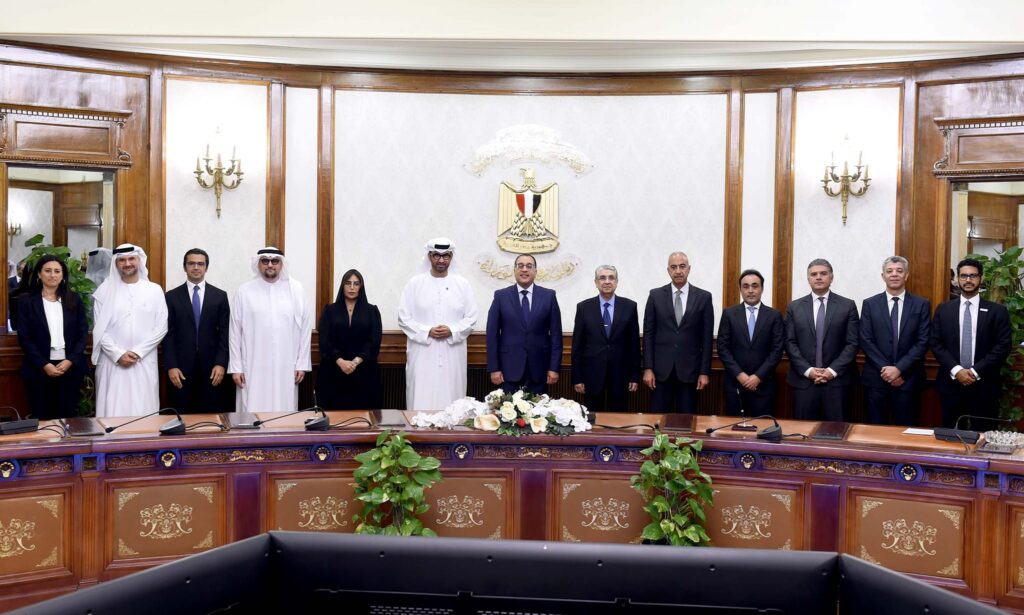
Prime Minister Mostafa Madbouli attended Tuesday evening the signing of an agreement between the Ministry of Electricity and Renewable Energy and the Abu Dhabi Future Energy Company (Masdar) to allocate a land plot for the establishment of a $10-billion wind farm whose capacity will be 10 gigawatts, making it the world’s largest.
Masdar will operate within a consortium that includes Infinity Power and Hassan Allam Utilities. The project is estimated to save $5 billion in natural gas costs per annum, and reduce carbon emissions by 23.8 million tons, which is nine percent of Egypt’s annual emissions.
The farm will produce 47,790 GWh of clean energy every year contributing in Egyptian efforts aimed at making the share of renewables in the energy mix 42 percent by 2035.
The initial agreement was signed on the sidelines of COP 27 held in Sharm El Sheikh in November, so as the signing was attended by President Abdel Fatah al-Sisi and Emirati counterpart Sheikh Mohamed Bin Zayed.