Arabs & Arabian Records Aggregator. Chronicler. Milestones of the 25 Countries of the Arabic Speaking World (official / co-official). AGCC. MENA. Global. Ist's to Top 10's. Records. Read & Enjoy./ www.arabianrecords.org
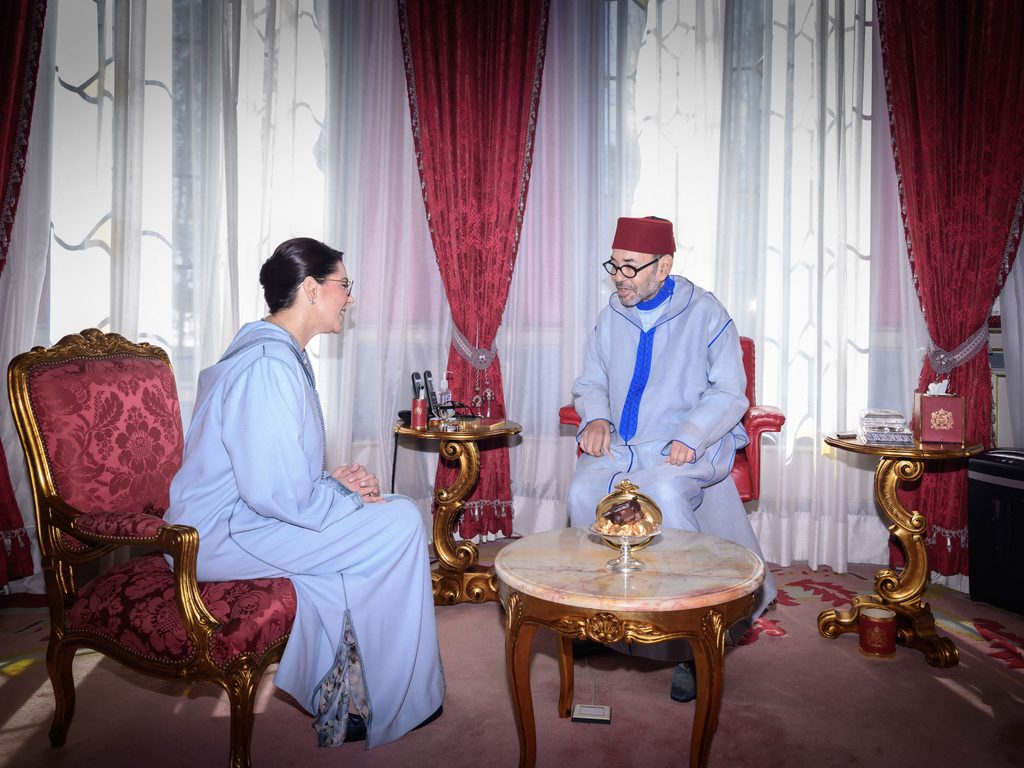
King Mohammed VI of Morocco appointed Fatima Ezzahra El Mansouri on Tuesday as Morocco’s first woman prime minister after her Authenticity and Modernity Party (PAM) came out on top in a September 23 parliamentary election, the royal palace said.
The king asked El Mansouri to form a new government, the palace said in a statement.
She was appointed under Article 47 of the Moroccan Constitution, which requires the King to choose the head of government from the party winning the most seats.
Her center-right Authenticity and Modernity Party (PAM) secured 97 out of 395 seats in the September 23, 2026, parliamentary elections.
These books in translation feature women transforming their lives and societies
Women’s stories feel different to me. People say that if only women ruled the world, there would be no more war (a lovely thought, and one I’ve been returning to lately) because women are socialized to revert first to empathy, to the collective rather than the fiercely individual, to taking care of other people and thinking of their needs, sometimes to a fault. We see that in the lens they bring to their fiction. Women in war hold families together; women in fiction often emphasize the vulnerable, rather than the physically strong. And they act—as the International Prize for Arabic Fiction (IPAF) called the women in Amira Ghenim’s ACalamity of Noble Houses—as “custodians of memory,” preserving a version of events that course-corrects accepted patriarchal accounts.
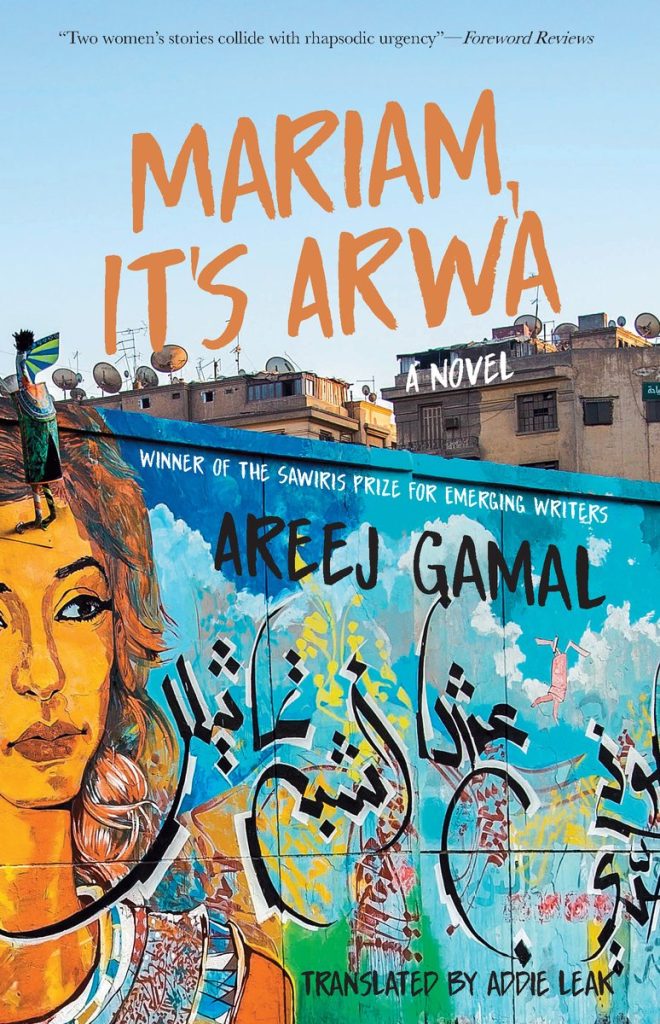
Over four years, I had the privilege of reading and translating Areej Gamal’s Sawiris Prize-winning novel Mariam, It’s Arwa. The book, emphatically and sublimely female, is about a multiplicity of revolutions, the most literal of them appearing in its frame plot, during the Arab Spring in Tahrir Square and Cairo’s streets. The novel spans generations of women: the mother who falls in love across class and religion and risks everything to follow her heart; the daughter who leaves an unhappy home and emigrates to Germany to find herself; the abused grandmother who has internalized the idea that a woman is nothing if she doesn’t bear a son; and the mother who nearly dies in her quest to make that dream a reality. And of course, the two main characters’ love is its own revolution—a remaking of the world as a more inclusive place in spite of itself, even if their world is one small apartment on Champollion Street. It’s my favorite kind of book: a book by a woman about women taking their lives into their own hands. One that centers women at the forefront of revolution/war and social change.
While my definition of “revolutionary” here is broad—encompassing societal revolution and personal rebellions against tradition—I admit that war is at the forefront of my mind. As I’m writing this, the normal city sounds in Amman, Jordan, where I am, are interspersed with emergency sirens, occasionally fighter jets and explosions. The US and Israel are attacking Iran, which is attacking back, and we are war-adjacent. More or less safe—we hope—but affected, as is the entire region. It’s hard not to see echoes of this chaos appearing in some of the novels on this list. But when I look around, I’m grateful to see echoes of the heroines’ tenacity and resilience, as well. These novels have much to teach us about the importance of knowledge-gathering and memory, seeking out joy in the midst of crisis, and rejecting any entity that tries to write our stories for us.
Nawal El Saadawi (1931-2021), the Egyptian writer, medical doctor, and psychologist, has often been compared to Simone de Beauvoir and Virginia Woolf—an outspoken feminist and activist whose writing had a dramatic impact on generations. Jailed under Sadat for “crimes against the state,” she wrote about authoritarianism, feminism, and capitalism, and Woman at Point Zero—what the British-Palestian writer and lawyer Selma Dabbagh calls a “small volume of fury”—is one of her seminal works. The main character, Firdaus, is in prison awaiting execution after killing a man. As she tells her story, it is difficult not to feel both anger and empathy. There are few points of hope in the book, in which money is the only source of autonomy for a woman and prostitution near-inevitable for one born without, yet it is through landmark novels like this one, with its fierce condemnation of patriarchal society, that change is possible. Pleasant? No. To say that the book needs a content warning would be an understatement. Important? Incredibly.
I first read William Granara’s translation of Granada, the trilogy’s first book, as part of a book club, where members were heartbroken that the subsequent parts were untranslated. Now, for the first time, the whole trilogy is available in English. The story begins in 1492, when the Arab kingdom of Granada falls to the Christian Castilians, and the Moorish presence in Spain becomes unstable. The text follows a Muslim family as it tries to make sense of the forced conversions, book burnings, job loss, immigration, rebellion, and Inquisition until, one hundred years later, their descendants are deported en masse. The women in the book stand out, particularly Salima, a great lover of books and a healer, and Maryama, her sister-in-law, who is clever, defiant, and compassionate, a rallying point for the community in chaotic times. Women are at the core of this book, conserving knowledge and holding their families together.
Planet of Clay by Samar Yazbek, translated by Leri Price
Told in lyrical, often cinematic prose from the perspective of a neurodivergent young woman named Rima, Planet of Clay depicts the Syrian Civil War and the aftermath of the chemical attack and siege on Ghouta. Rima, who does not speak, spent much of her childhood in a school library and has a deep love of books and painting. We find her lost in her thoughts when the book opens, trapped in a cellar with only boxes of paper and a pen, recording her story as she runs out of food. The war has stripped her of all the people she loved, and she cannot grasp why. “We are toys made out of clay, small toys, quick to break and crumble,” she writes. Still, this careful storyteller sees beauty at times when others don’t look for it, using her imagination to make sense of and find light in a dark world.
Set in 1930s Tunis, A Calamity of Noble Houses was shortlisted for the IPAF in 2021. It begins with Tunisian revolutionary Tahar Haddad, author of Our Women in the Shari’a and Society, and places her in the context of two upper-crust families, the conservative Ennaifers and the more progressive Rassaa family. Here, Haddad, a real historical figure from humble origins who was instrumental in shaping the future of women’s rights in Tunisia, falls in love with the young Zbaida Ali Rassaa, who becomes the wife of Mohsen Ennaifer. When dubious accusations of an affair surface, tragedy strikes. The novel decenters Haddad to tell the story of the two families as narrated by eleven different characters from disparate social classes who, together, paint a rich portrait of a nation in flux, spanning several decades.
In 1987, during the First Intifada, a curfew is imposed in a Nablus neighborhood, and three women are trapped inside the same house. Nuzha, its owner and daughter of a prostitute, is furious at society and the whispers that her mother was a spy for Israel. Sitt Zakia, a middle-aged midwife, uses faith as a barrier against the political violence surrounding her. And Samar, the optimist, is a university graduate studying how the Intifada has affected Palestinian women’s lives. Together, they hatch a plan to thwart Israeli soldiers’ effort to barricade the street. Like Mariam, It’s Arwa, this novel doesn’t gloss over the multiple fronts of the ongoing revolution. When it was published in 1990, the novel was criticized for daring to depict domestic violence on the part of Palestinian freedom fighters. But Khalifeh makes it clear that these women’s oppression is twofold: both Israeli Occupation and the patriarchy itself.
Minor Detail by Adania Shibli, translated by Elisabeth Jaquette
A finalist for the National Book Award and longlisted for the International Booker Prize, Minor Detail won the 2023 LiBeraturpreis, but the awards ceremony was indefinitely postponed in solidarity with Israel after the October 7 Hamas attacks—a move that drew criticism from numerous organizations. The novel is a haunting meditation on war and memory that includes two intertwined stories. The first begins in 1949, when an Israeli battalion massacres an encampment of Bedouins in the southern Negev and abducts a Palestinian teenager whom they rape, kill, and bury. The second is the story of a young woman from Ramallah, born twenty-five years to the day after this crime, who sets out to uncover more details about it, encountering obstacle after obstacle as she attempts to access archives that will give her information about her country’s past. This is knowledge-seeking as revolution at its best.
Blood Feast by Malika Moustadraf, translated by Alice Guthrie
Malika Moustadraf was a force of nature and an icon of feminism who passed away in 2006, at just 37 years old. A “rebel realist,” as she called herself, Moustadraf’s prose is so embodied that it often turns the stomach. It details what translator Alice Guthrie calls “an unflinching look at the worst traumas of the female experience in patriarchal society, shot through with wit, wordplay, and razor-sharp political commentary.” Her stories fearlessly take on abject poverty, religious hypocrisy, pimps and incels, a girl’s horrifying first period, cybersex, and the failure of the Moroccan medical system to help those in need. Moustadraf was maligned in her time due to her literary activism, and her two books had fallen out of print in Arabic at the time of her death; it’s thanks in large part to Guthrie’s tireless advocacy that her writing is now available again in both Arabic and English.
I bought my Arabic copy of this book for the cover art: a girl in a swing, her eyes closed, a daisy covering her mouth. Then I read about Zahra—“flower” in Arabic—a girl who yearns to be close to her mother, who, in turn, uses Zahra as a shield in her love affair. Originally published in 1980, this classic of the Lebanese Civil War is about a young woman seeking to establish her own identity, one who spends years escaping. First from an authoritarian father and disappointing mother to West Africa—where she has a miserable marriage—then back to war-torn Beirut, where she begins an affair with a sniper. The book tackles childhood trauma, assault, the complex emotional landscape of emigration, and the stigma surrounding female sexuality. Unlike Firdaus in Woman at Point Zero, Zahra experiences and embraces pleasure—a point of hope, if not ultimately of salvation.
Gaza documentary “NAZA,” directed by Yuval Abraham and Rachel Szor, has won the Audience Award for Best European Film at the San Sebastian Film Festival, following its Venice premiere, where it received the Special Jury Prize.
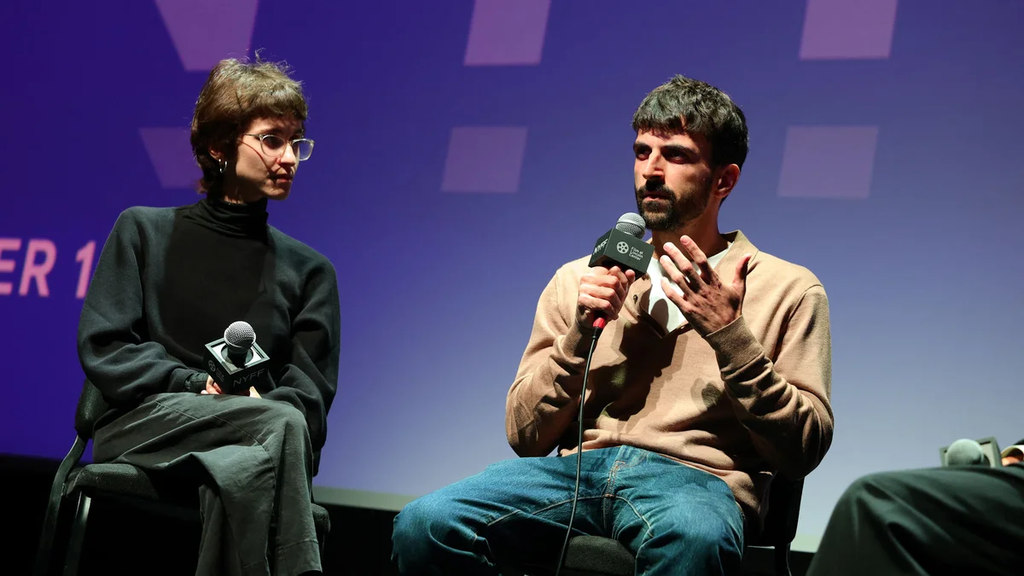
The award came as the film made its North American premiere at the New York Film Festival, where Abraham used a post-screening Q&A to address the US government’s support for Israel and its military campaign in Gaza.
“It’s important for us to see this film at this moment, as you were saying, because these older officials are talking about what is being done with taxpayer money from people sitting here,” Abraham told the NYFF audience. “This is what your country is supporting and funding … Part of the goal (of this film) is to make denial of what’s going on in Gaza harder.”
Abraham and Szor, who previously co-directed the Oscar-winning documentary “No Other Land” alongside Basel Adra and Hamdan Ballal, have described “NAZA” as an examination of the systems behind Israel’s bombing of Gaza and the killing of Palestinian civilians. The film is based on testimony from 24 anonymous Israeli military whistleblowers who accuse the army of widespread killing of civilians in Gaza with the use of artificial intelligence-powered targeting systems.
The San Sebastian recognition adds to the documentary’s festival run, which has included a Special Jury Prize at Venice and a major reception at its premiere. “NAZA” is set for a US theatrical release beginning at New York’s IFC Center, before expanding to other cities.
Abraham said Thursday that the documentary will be made available online for free in November.
source/content: arabnews.com (headline edited)
_____________
(L-R) Rachel Szor and Yuval Abraham speak onstage at the “NAZA” premiere during the 64th New York Film Festival at Alice Tully Hall on September 26, 2026 in New York City. (AFP)
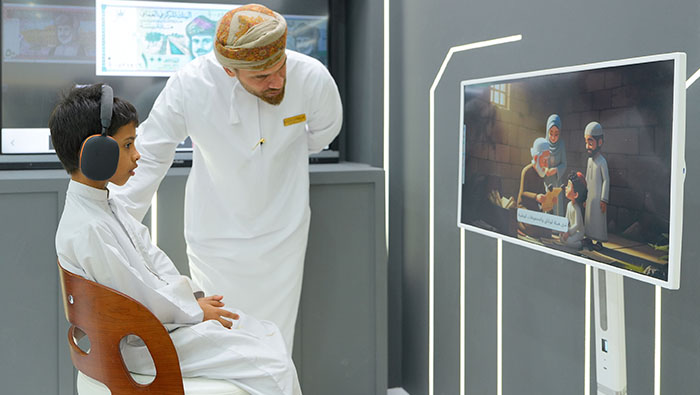
The documentary exhibition “A Nation’s Memory in the Land of Frankincense,” organised by the National Records and Archives Authority (NRAA) at the “Return of the Past” events site in the Wilayat of Salalah, sees a growing turnout of citizens, residents, and tourists.
The exhibition provides an educational experience that evokes milestones of Omani history, presenting them through modern methods that blend document authenticity with digital transformation and artificial intelligence technologies.
The exhibition features more than 1,200 documentary exhibits, both printed and digital, distributed across several corners documenting the history of the Sultanate of Oman and its cultural heritage. It focuses on the history of Dhofar Governorate, Omani relations with various countries around the world, and Omani-Gulf relations, alongside manuscripts, coins, postage stamps, historical maps, and interactive digital content.
Smart digital platforms captured the attention of visitors, enabling them to interact directly with documentary content, obtain information, and receive answers to their queries through artificial intelligence technologies. Meanwhile, the manuscripts and historical documents corners attracted those interested in Omani heritage due to samples reflecting the richness and diversity of the documentary legacy. The children’s corner also enjoyed wide engagement from families through educational and interactive activities aimed at strengthening young people’s connection to their nation’s history and documents.
The exhibition also reflected the National Records and Archives Authority’s commitment to making knowledge accessible to all members of society by providing adapted services for persons with disabilities, including sign language and assistive technologies, ensuring a more inclusive experience and enhancing access to documentary content across all its categories.
A number of visitors expressed their admiration for the diverse educational content presented by the exhibition, emphasizing that modern display methods added a new dimension to the experience of exploring Omani history, simplified information, and enriched the visit.
Fahad Salim Bait Omani Al Jabri said that the exhibition presents an outstanding model in employing modern technologies to serve history and national identity, noting that the diversity of documents, alongside interactive digital platforms, created an experience that combines entertainment and insight while catering to various age groups.
For her part, Manal Saleh Al Salmi explained that what distinguishes the exhibition is the integration of original documents with modern technology, allowing visitors to review verified historical information in an engaging manner. She expressed her admiration for the documents featured in the international relations corner, which reflect the depth of historical relations connecting the Sultanate of Oman with its regional and international surroundings.
Ahmed Said Al Balushi pointed out that the children’s corner is one of the exhibition’s key highlights due to the interactive activities it offers, which contribute to introducing youth to the value of national documents and consolidating concepts of identity and belonging in a way that combines learning with entertainment.
The exhibition continues to welcome visitors until 20 August as part of the National Records and Archives Authority’s efforts aimed at promoting documentary culture, highlighting the cultural value of national documents, and presenting them in modern educational formats that keep pace with digital transformation, underscoring their role in preserving national memory and connecting generations to the history of the Sultanate of Oman and its cultural heritage.
Chance meeting at Formula One race in Jeddah inspires Belgian storyteller Cindy Van Pollaert to launch ‘Min Al Qalb,’ a project documenting the lives, ambitions, and personal journeys of women across Saudi Arabia and the wider region.
When Belgian happiness manager Cindy Van Pollaert arrived in Saudi Arabia for the first time in 2021, she expected to encounter the country as it was portrayed in much of the Western media.
Instead, a visit to the Formula One race in Jeddah challenged her assumptions and ultimately inspired a storytelling project dedicated to amplifying the voices of women across the Kingdom and the wider Gulf region.
Van Pollaert was struck by the atmosphere among the crowd at the event: women and men gathered together freely, a vibrant public space and a sense of confidence among young Saudi women that contrasted sharply with the image of the country she had previously encountered abroad.
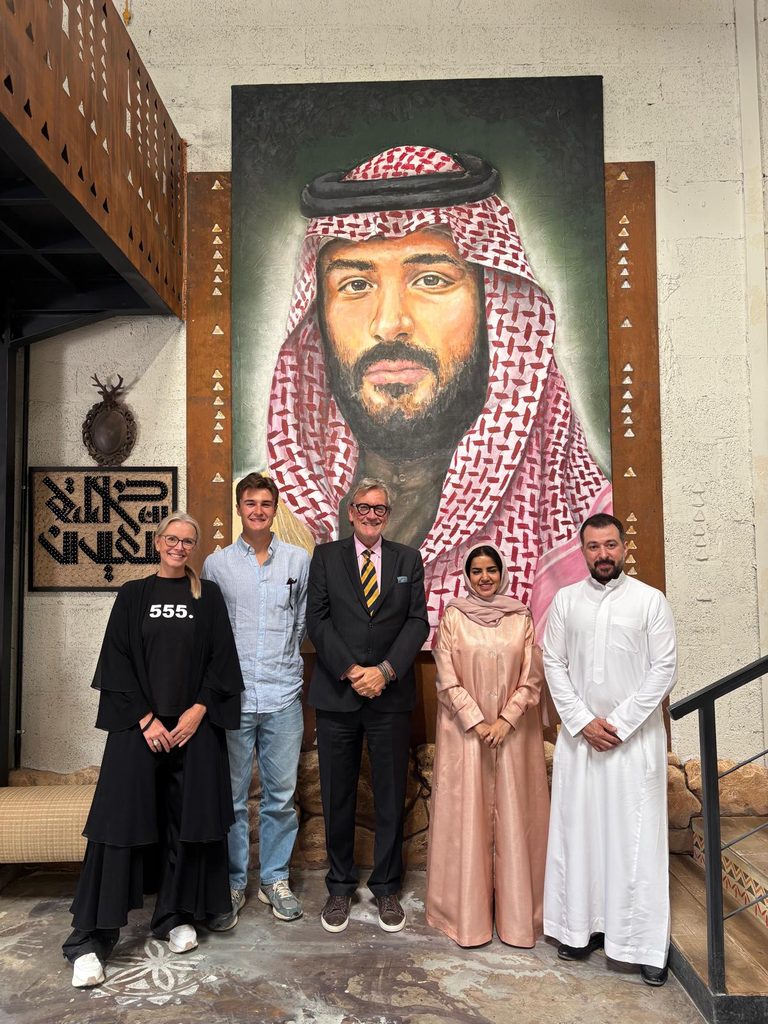
The experience became even more significant when she met Saudi hiker and archer Nouf Almulaik, a chance encounter that would shape the direction of her work.
Almulaik “opened my eyes,” Van Pollaert said, to the determination and fearlessness of Saudi women: “They’re climbing the mountains. They’re doing the Himalayas…These are such ambitious, intelligent women and they’re going to the next level in whatever they do.
“And then I was thinking, ‘OK, I need to find a way to connect with more local women in the Middle East in general.’”
What began as a friendship quickly evolved into a broader mission. Van Pollaert became increasingly determined to challenge misconceptions about women in the Middle East and share stories that reflected the realities she had witnessed.
“I want other people to think differently about the women here in the region,” she told Arab News.
That desire eventually led to the creation of “Min Al Qalb,” meaning “from the heart,” an art and storytelling platform dedicated to celebrating the resilience, individuality and achievements of women across the Middle East and Gulf region.
The project has now come full circle, returning to Saudi Arabia where the idea first took shape through a personal connection that transformed Van Pollaert’s understanding of the region and its people.
Min Al Qalb has so far featured more than 40 inspirational women from 10 countries, including Nada Alrasheed, Saudi Arabia’s first full-time female freediver and a World Championship record holder; Rayyanah Barnawi, the Kingdom’s first female astronaut; and Princess Sarah bint Bandar, executive director of the International Dates Council.
Yet Van Pollaert insists the project is not driven by strategic outreach or large-scale campaigns: “It grows very organically. It’s always one woman who leads me to another.”
The strength of the platform lies in this personal nature, Van Pollaert believes. Many of the stories begin not with formal interviews or carefully arranged meetings, but everyday interactions, conversations and friendships that gradually develop into something deeper.
“I could easily send an email to 1,000 amazing women — you can easily find them — and make a mass production of it,” she said. “But then it would lose its authenticity … I am a person (who) lives from the heart; I don’t know any other way.
“I use my voice to spread positivity because this is how I am in life as well.”
The women featured on the platform are not simply accomplished professionals or record-breakers; they are people with whom Van Pollaert has shared meals, prepared traditional qahwa (coffee) and built genuine friendships.
“These people automatically become like a kind of family,” she said.
For that reason, she added, the initiative was not designed simply to spotlight achievement. Instead, it seeks to capture something more universal: the humanity behind success and the connections that transcend geography and culture.
“The most powerful stories are often not the biggest headlines; they are the human stories behind the achievements,” Van Pollaert said.
“Min Al Qalb does not try to explain Saudi women through one narrative, it creates space for individual stories: what drives them, what they protect, what they build, and what they want the world to understand.”
Another factor that shaped the project was her frustration with the gap between her own experiences and prevailing perceptions in Europe. Whenever she returned to Belgium and shared stories about the women she had met in Saudi Arabia and the wider region, she often found little interest among audiences accustomed to a different narrative.
A major reason for this, she believes, was that in the “Western media, they will only talk about the negative things.”
Reflecting on her own assumptions before visiting Saudi Arabia, she said: “The misconception I had was the one that Western media gave me that women were not allowed to do almost anything.”
Her first visit to Jeddah quickly challenged that perception. Unable to find European publications interested in publishing her experiences, Van Pollaert eventually decided to tell those stories herself.
Min Al Qalb reaches audiences primarily through Instagram. Each post combines an illustration with a photograph and a quote from the featured woman, while the accompanying caption tells her story. This artistic approach to storytelling has had an unexpected effect on how audiences engage with the content.
“When I start with the illustration, the first thing people always say is, ‘That’s cute!’ Always,” Van Pollaert said.
“So, psychologically, there is already serotonin, positivity. It’s physiological, biological or whatever you want to refer to it. It was never my intention. It just happened and I noticed that this was something that people were open (to), and they perceived it in a very positive way.”
In other words, for international audiences unfamiliar with the women featured in the project, the illustrations create an emotional entry point before they encounter the story itself.
“I think art has a way of breaking down narratives and misconceptions because of the feeling that comes up with the people who look at it,” she added.
“It’s a big difference if I show, for example in Belgium, a picture of a woman that I got to know and that I got to meet and became friends with, or if I show first the illustrations.”
More than four years after their first meeting, Van Pollaert and Almulaik still make time to meet for coffee whenever they find themselves in Riyadh at the same time, a reflection of the type of enduring friendships that have become central to the project.
Those moments of connection, whether around a coffee table or through a social media post viewed thousands of miles away, remain at the very heart of Min Al Qalb.
“What I do believe is with each story that I share, with each person that I show, with each experience that I talk about, that somewhere, someone out there changes his or her mind,” Van Pollaert said.
source/content: arabnews.com (headline edited)
_______________
Van Pollaert at the studio of Saudi muralist Noura bin Saidan, along with the Belgian ambassador to KSA. (Supplied by Cindy Van Pollaert)
Min Al Qalb “From the Heart” logo. (Supplied by Cindy Van Pollaert)
The Egyptian teenager breaks the rankings record, four months after also becoming the youngest female world champion.
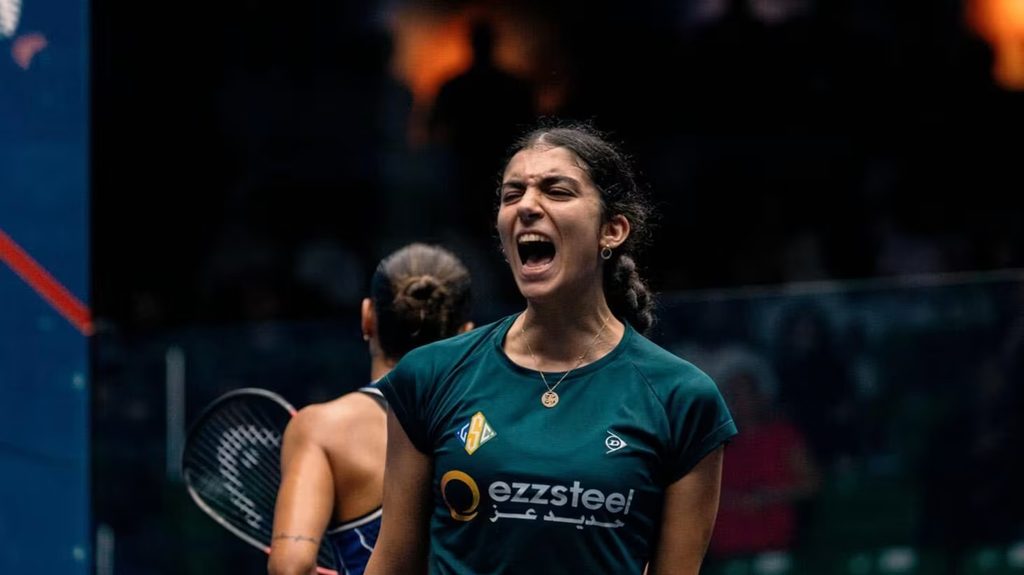
Amina Orfi has become the youngest women’s world No. 1 in squash history after her place at the sport’s summit was confirmed in the latest PSA Squash Tour rankings published on Monday (21 September).
At 19 years and two months old, the Egyptian prodigy has broken a 40-year record that was set by New Zealand’s Susan Devoy when she was 20 years and two months in 1984.
Orfi dethroned the previous world No. 1, compatriot Hania El Hammamy, by defeating her in the final of last week’s QTerminals Qatar Classic in Doha.
A dramatic 3-2 finale secured the teenager’s first Platinum title, and her third major victory in the last four competitions.
Orfi has fast become the face of the sport after rising through the ranks in 2026. In May, she became the youngest-ever female world champion, and is the first player to win the senior PSA world title while still the reigning junior champion.
“It feels amazing,” said Orfi after her victory in Doha on Friday (18 September).
“To become world champion and become world No.1 in the same year is a dream that I’ve had since I was very young and I really want to enjoy it.
“I want to just stay at this level now and keep trying to improve every day. I want to stay on top now that I’m the world No. 1 and I want to win a lot more titles too.”
Amina Orfi eyes gold at LA28
With two years to go ahead of squash’s Olympic debut at LA28, and amid a dominant Egyptian depth of talent, Orfi has continued her rapid progression as one of Egypt’s greatest medal hopes.
“I really want to get to world No. 1 and make the Olympics,” she said back in March.
“Having these goals helps direct my mind in a positive way instead of thinking about the pressure.”
With one milestone achieved, Orfi’s next challenge is to stay there.
Her first tournament as world No. 1 will be a homecoming, with the 19-year-old set to return to Egypt for the CIB Egyptian Open 2026 from 6-16 October.
With LA28 firmly on the horizon, squash’s newest superstar has no intention of taking her foot off the accelerator.
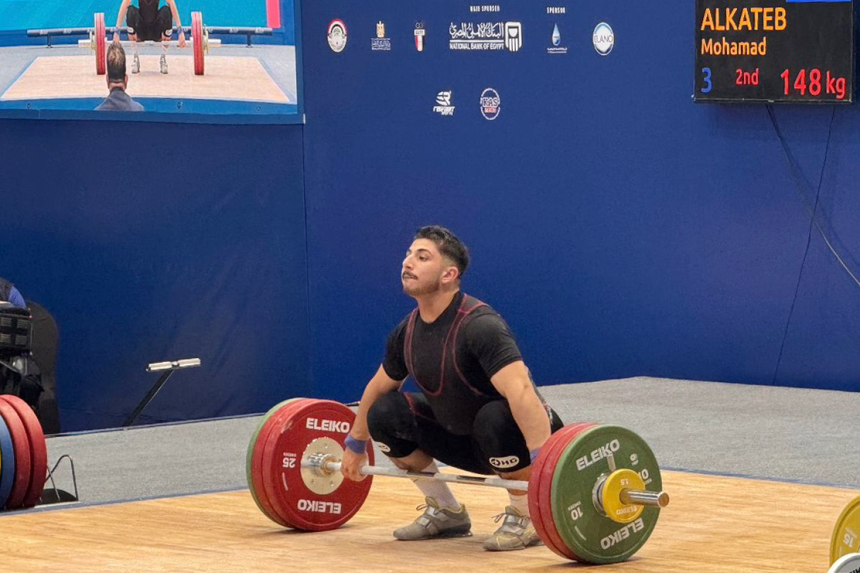
Syrian weightlifter Mohammed al-Kateb finished 10th overall at the World Youth Championships held in Ismailia, Egypt, with participation from athletes representing 52 countries.
Al-Kateb placed ninth in the clean and jerk and recorded a total lift of 327 kg after lifting 148 kg in the snatch and 179 kg in the clean and jerk.
Competing in a field of 28 athletes, al-Kateb broke the Syrian national clean and jerk record twice. He first lifted 177 kg to surpass the previous mark of 176 kg before improving it to 179 kg on his second attempt.
He also set a new Syrian total record with 327 kg, surpassing the previous national mark of 325 kg.
Recognized for significant contributions to synthetic biology.
Mo Khalil, the Hok Lam and Kathleen Kam Wong Professor of Bioengineering at the Harvard John A. Paulson School of Engineering and Applied Sciences (SEAS) and Professor of Molecular and Cellular Biology has been awarded the 2026 Kuwait Prize from The Kuwait Foundation for the Advancement of Sciences (KFAS).
Founded in 1976, KFAS funds and implements research, training, and development programs that address Kuwait’s national priorities in the fields of science, technology, and innovation. The Kuwait Prize is given annually to distinguished Kuwaiti and Arab scientists around the world for significant and outstanding achievements in research.
Khalil, who is Palestinian-Jordanian, was honored for his work in synthetic and systems biology.
Khalil’s work focuses on developing synthetic biology tools to better understand how complex cellular systems work, and to design synthetic ones that enable new and useful biological functions. Khalil joined SEAS from Boston University in 2025, where his lab’s work made fundamental contributions into the biological circuits that control gene regulation and epigenetic memory, and pioneered synthetic circuit technologies for translational medicine, enabling the design of programmable cellular therapies to treat cancer and other diseases. In addition, his lab invented novel continuous evolution technologies, such as the eVOLVER, which are being used to generate biomolecules with new and improved functions to address unmet needs in biology, medicine, and biotechnology.
Khalil received his Ph.D. and M.S. in Mechanical Engineering at MIT, where he was awarded a Charles Stark Draper Laboratory Graduate Fellowship. He graduated Phi Beta Kappa from Stanford University with a B.S. in Mechanical Engineering and a minor in Chemistry.
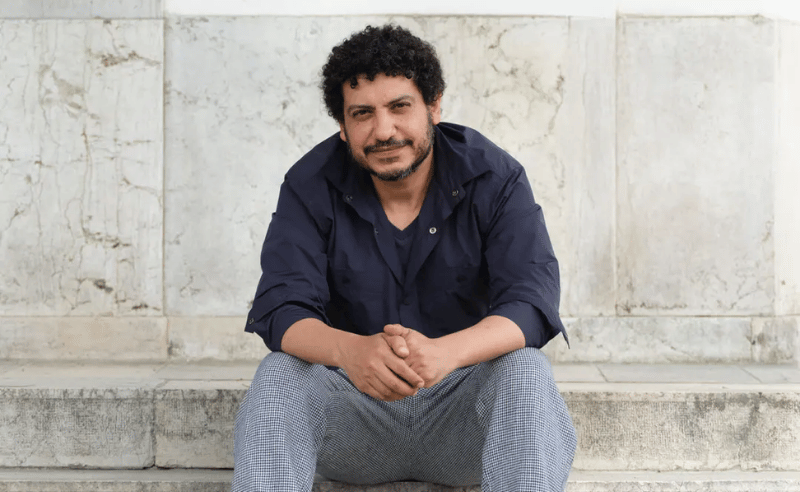
Shawky recently led Art Basel’s first Qatar fair, while his films and installations continue to tour major international venues.
Egyptian artist Wael Shawky has been named to the TIME100 Art 2026 list, recognising his growing international profile across exhibitions, film and major art institutions.
Shawky served as the inaugural artistic director of Art Basel’s first fair in Qatar and the Middle East, where the usual gallery-booth format was replaced by curated solo presentations. The event drew around 17,000 visitors.
He also leads Fire Station in Doha, an artist residency run by Qatar Museums.
Shawky’s practice frequently revisits history through Arab perspectives, often using puppetry, performance and film to examine how historical narratives are constructed and retold.
At the 2024 Venice Biennale, he presented ‘Drama 1882’, a video installation and opera centred on the Urabi Revolt in Egypt. The work has since travelled internationally, with presentations in Los Angeles, Amsterdam, Sydney and Paris.
His film ‘I Am Hymns of the New Temples’ is currently on view at M+ in Hong Kong through October. Shot in Pompeii, the work features actors reenacting Mediterranean myths while exploring how ancient stories continue to shape national and cultural identities.
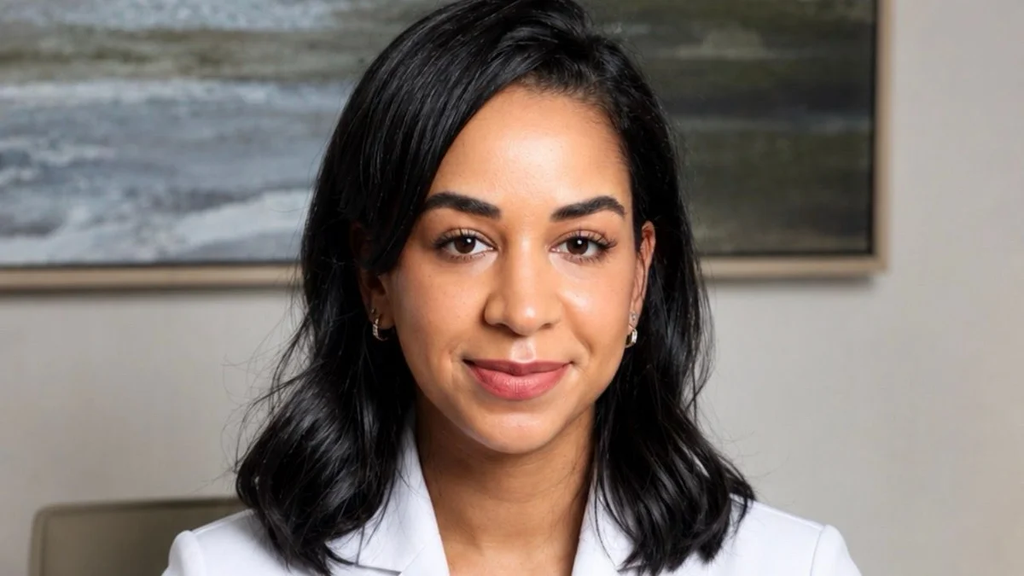
Dr. Lama Alsharif uses short videos and live sessions to provide accessible, evidence-based information on subjects women may hesitate to discuss.
With more than 700,000 followers on TikTok, Saudi obstetrician and gynecologist Dr. Lama Alsharif is using social media to tackle gaps in women’s health education and challenge misconceptions that can prevent patients from seeking care.
Alsharif first recognized the scale of the problem during her residency at a government hospital, where she worked in clinics, emergency departments, labor rooms and operating theaters. She repeatedly encountered women who had access to medical care but lacked reliable information about their own bodies.
“I realized that I simply could not give every woman the amount of time and education she deserved within a clinical setting,” she told Arab News.
After moving into private practice, Alsharif began looking for other ways to reach women and turned to social media.
“While many people viewed it primarily as a platform for entertainment, I believed it could also be one of the most powerful tools for public health education,” she said.
A 2026 study led by researchers at Imam Abdulrahman Bin Faisal University in Dammam found that about 60 percent of Saudi respondents relied on at least one social media platform for medical information. The researchers also warned of the risk of misinformation on those platforms.
Alsharif seeks to address that gap through short, evidence-based videos and live question-and-answer sessions.
“What surprised and motivated me was how eager women were to learn when information was presented in a simple, respectful and accessible way,” she said.
Among the most common misconceptions Alsharif encounters are beliefs that menstrual blood is impure, that an episiotomy is necessary during every vaginal delivery and that pain during intercourse is an unavoidable part of being a woman.
“These misconceptions are not harmless,” she said. “They can prevent women from recognizing symptoms that deserve medical attention and can delay diagnosis and treatment for years.”
Alsharif has treated women who endured severe pelvic pain or painful intercourse for more than a decade because they believed their symptoms were normal.
“When they eventually learned that their symptoms could be evaluated and treated, it completely changed their perspective,” she said. “That is why I believe medical education should not simply tell women what is normal, it should also teach them to recognize what is not normal.”
Making clinical information accessible is among the greatest challenges of her work.
“My goal is to take a complex medical concept and translate it into simple, relatable language without compromising its scientific accuracy,” she said. “I never want simplification to become misinformation.”
For Alsharif, the value of her platform is measured less by follower numbers than by whether the information prompts women to seek appropriate care.
“For me, the most meaningful measure of success is the message from a woman who tells me that one of my videos encouraged her to see a doctor, helped her recognize that a symptom was not normal, or gave her the confidence to ask a question she had been too embarrassed to ask before,” she said.
Alsharif also delivers free online lectures through a nonprofit women’s health organization and is developing an application to guide women through puberty, pregnancy, postpartum recovery, and menopause.
“My vision is to create a trusted, evidence-based resource that women can access whenever they need it, while always recognizing that digital education should complement — not replace — professional medical care,” she said. “AI can be a useful tool, but it should never replace critical thinking, clinical judgment or evidence-based practice.”
Discussing menstruation, sexual health and pelvic pain can present additional challenges in a conservative society. Alsharif said she approaches these subjects through culturally sensitive communication.
“For me, breaking the stigma does not mean abandoning cultural values,” she said. “It means creating a respectful space where women can access accurate medical information and feel comfortable seeking the care they deserve.”
She also sees women’s health education as having an impact beyond individual patients.
“Women often become the source of health information for their families, friends and children. When one woman learns something important about her health, that knowledge can be passed on to the people around her and to future generations.”
Alsharif is among a growing number of Saudi female physicians taking on public-facing educational roles.
“(We) have a unique opportunity, because we can combine medical expertise with an understanding of our community, culture, and the questions women may sometimes hesitate to ask,” she said. “I believe we will see more Saudi female doctors becoming educators, researchers, entrepreneurs and voices in digital health.”
Ultimately, she hopes her work will help women take a more active role in decisions about their health.
“My goal is not simply to educate women about diseases,” she said. “It is to help create a generation of women who understand their bodies, recognize when something is wrong, seek care without shame, and feel confident that their voices matter.”
source/content: arabnews.com (headline edited)
___________
Dr. Lama Alsharif, consultant obstetrician and gynecologist, began looking for other ways to reach women and turned to social media. (Supplied)