Arabs & Arabian Records Aggregator. Chronicler. Milestones of the 25 Countries of the Arabic Speaking World (official / co-official). AGCC. MENA. Global. Ist's to Top 10's. Records. Read & Enjoy./ www.arabianrecords.org
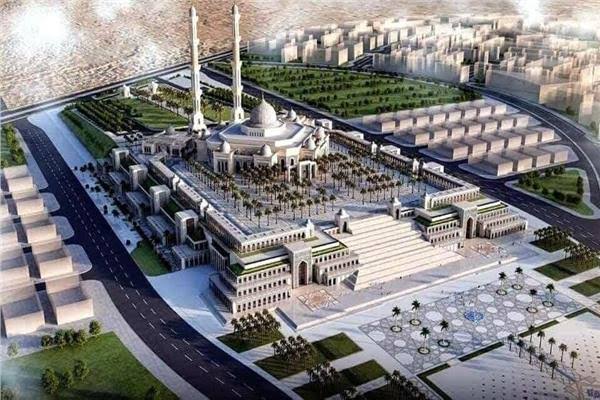
Egypt’s Grand Mosque in the New Administrative Capital
According to the explanation, Egypt’s Grand Mosque obtained three international certificates from the Guinness World Records.
The first was for the largest pulpit in the world with a height of 16.6 meters, handcrafted from the finest types of wood.
The second and third were for the main chandelier of the mosque, being the heaviest chandelier in the world of 50 tons, and it being the largest chandelier with a diameter of 22 meters and four levels.
Egypt’s Islamic Cultural Center in the New Administrative Capital
Egypt’s Islamic Cultural Center in the New Administrative Capital is a great achievement and one of the most important projects established in the New Administrative Capital.
The Islamic Cultural Center was established in the new capital on an area of 15,000 square meters. It has a large place for services, as well as a group of spacious and multi-storey garages, with a capacity of about 4,000 cars.
Last week’s Arabian Flavour Festival in the Dutch capital celebrated Arab culture, cuisine, crafts
‘It’s all about sharing love, identity and culture,’ organizer tells Arab News
The first edition of the Arabian Flavour Festival took place in Amsterdam last Saturday.
In an intimate outdoor setting, the festival celebrated the diversity and richness of Arab culture, cuisine and crafts.
Organizer Shadow, originally from Syria, said his aim is to create a platform for promoting both international and Middle Eastern artists, for people to mingle and to share their cultures through storytelling and arts.
Set in the idyllic Tolhuis garden, a cultural and culinary meeting place in Amsterdam, the one-day event welcomed over 1,000 visitors from different backgrounds.
Organized by The Shadow Projects, the festival featured two stages with performances by dancers, singers and poets, along with a dabke workshop, pop-up food and merchandise, all within an Arabian atmosphere.
“It’s called Arabian Flavour because there’s a flavor of Arabic culture, but at the same time it’s an opportunity for people to integrate,” Shadow told Arab News.
“There’s always a performance other than Arabic to let people understand that this isn’t an Arabic party (but) just an Arabian Flavour.”
The idea started after Shadow starred in the documentary “The Story Won’t Die” about Syrian artists in Europe and America, from award-winning filmmaker David Henry Gerso.
In 2021, because of Shadow’s efforts, the documentary was showcased at the International Documentary Film Festival Amsterdam, whereafter the concept gained more and more traction.
Initially, it began as a gathering showcasing talents at home, but expanded to various stages throughout Amsterdam, and now the Arabian Flavour Festival is the biggest such festival in Europe, according to Shadow.
The organization places significant emphasis on diversity and inclusion. “If you’re an Arabic singer who isn’t well known, you don’t have work anymore if you move to Europe,” he said, adding that Bottom of Form the festival is open to whoever wants to perform.
The organizers state: “It is magical to see people who share their passion, and it is most important that they express themselves authentically.”
Among the performers was DJ Maherrie, a Syrian DJ who amazed the audience with a fusion of Middle Eastern melodies and modern European rhythms to raise awareness of his heritage.
Dutch singer-songwriter Maxine Zain shared her hopes of inspiring people with her heartfelt songs, and specifically highlighted her enjoyment in seeing traditional Arabic music connecting well with the artistry of Dutch artists like herself.
Pauline Koning, a passionate self-taught Dutch musician and belly dancer, made an impact with her performance of her own song “Kefaya Ghyab.”
In her music, she blends Arabic, Western, and Yemeni musical elements, drawing inspiration from her nostalgic love for Umm Kulthum, and praises the language’s poetic nature and rich emotional vocabulary.
The Arab tradition of belly dancing, Koning said, “represents a powerful symbol of empowerment for all women, not only embodying archetypes but also having the power to transfer certain emotions.”
Shadow earned his name for his ability to bring subcultures from the shadow into the light, and the event lived up to this name as confirmed by visitors’ reviews. “I’m very curious about Arab culture. It’s a refreshing perspective opposite Dutch traditions,” said one visitor.
Another visitor attended the festival as an opportunity to connect with language partners and practice Arabic.
Three friends from Yemen were interested to meet Dutch people and exchange stories about their respective cultures.
Aside from the Arabian Flavour Festival, they also host monthly Arabian Flavour Nights. “The dream is to, in the next year or so, organize a three-day festival,” but in the end “it’s all about sharing love, identity and culture,” Shadow said.
All the projects are funded by the Amsterdam Fund for the Arts.
source/content: arabnews.com (headline edited)
_____________
The first edition of the Arabian Flavour Festival took place in Amsterdam last Saturday. (Instagram/@theshadow.amsterdam)
Algerian period drama The Last Queen and Iraqi film Hanging Gardens were among those recognised.
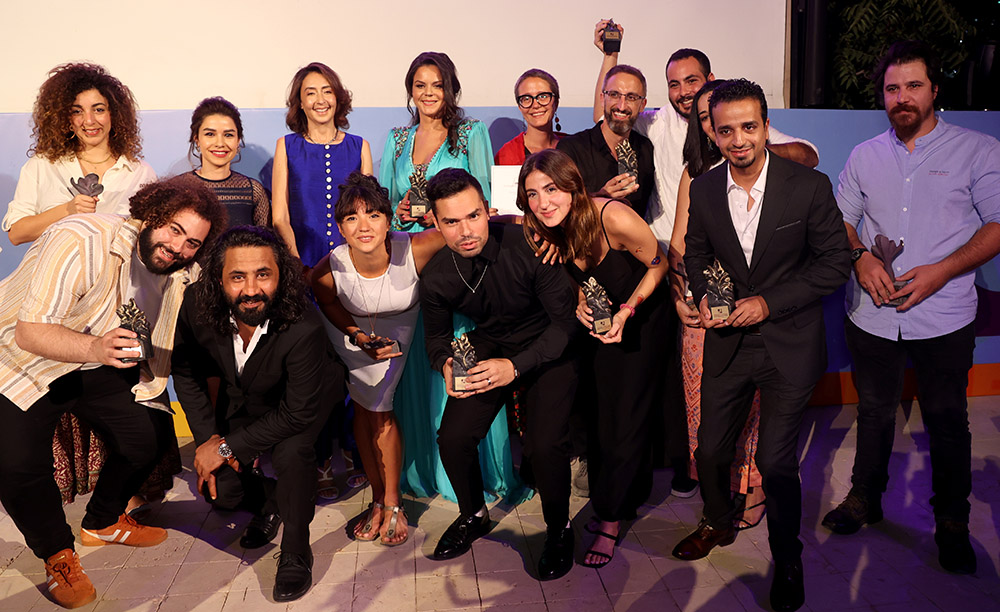
Films from Palestine, Lebanon, Jordan, Iraq, Morocco, Tunisia and Egypt were among the top winners of this year’s Amman International Film Festival.
The Black Iris Awards ceremony was held on Tuesday at the Royal Film Commission in Amman. The event marked the conclusion of the fourth run of the festival. This year, the festival screened 56 films from 19 countries, including feature narratives, documentaries and short works. The films all marked their Jordanian premiere, with some making their worldwide or regional debut.
Hafreiat by Spanish filmmaker Alex Sarda was the winner of the Black Iris Audience Award for best foreign film. The documentary revolves around a Spanish archeological mission in northern Jordan where local workers excavate the land, working long hours for minute wages. At the centre of the story is Abo Dya, a Palestinian-Jordanian, working tirelessly to provide for his family, hoping to better their lives despite the criminal record that undermines his ambitions.
The Palestinian film Lyd, directed by Rami Younis and Sarah Ema Friedland, was named winner of two awards, including the Jury Award for best Arab feature documentary and the Fipresci Award, held in conjunction with the International Federation of Film Critics.
The film puts a spotlight on Lyd. A city with a 5,000-year history, Lyd was once a Palestinian capital and in the early 20th century was a thriving metropolis. Lyd highlights this rich history while also highlighting the bloodier aspects of its past, namely the massacres and expulsion of Palestinians by Israeli forces in 1948, after which the state of Israel was created and the city became known as Lod.
The documentary interviews survivors of the Nakba, Palestinians living in Lyd, as well as those in exile. The film juxtaposes the real-life footage with animation that treads into sci-fi territory, imagining what Lyd could have been like if not for the bloody events of the Nakba.
The Jury Award for Arab short film was given to two films – Hamza: A Ghost Chasing Me by Palestinian director Ward Kayyaland Trinou by Tunisian filmmaker Nejib Kthiri. The Black Iris for best Arab short, meanwhile, was granted to My Girlfriend by Egyptian filmmaker Kawthar Younis.
The Special Mention prize for first-time documentary editor was awarded to Zakaria Jaber, director and editor of Anxious in Beirut. The documentary explores the trauma endured by denizens of the Lebanese capital in a film that aims to find a semblance of coherence within the tumultuous effects that have gripped Beirut.
Fragments from Heavenby Moroccan filmmaker Adnane Baraka was named winner of the Black Iris Award for best Arab feature documentary. The film follows a group of Amazigh nomads in Morocco as they search for bits of a Martian meteorite that landed in the desert in 2013, hoping it would better their lives.
The Special Mention prize for first-time lead actor/actress was awarded to two talents. Lebanese actress Marilyn Naaman was awarded for her lead role in Mother Valley. The film, set in the Lebanese mountains in the mid-20th century, follows a young wife as she faces the pressures of patriarchal society.
Egyptian actress Rana Khattab was also awarded for her role in the film Rat Hole. The feature, directed by Egyptian filmmaker Mohamed El Samman, follows a telemarketer working for a non-profit organisation trying to convince people to donate to various causes. The film pulls the curtain on the darker side of the Egyptian non-governmental organisations that scam people on the pretence of charity donations.
The Special Mention prize for first-time scriptwriter was awarded to Algerian filmmaker Adila Bendimerad, the director of the period drama The Last Queen. Bendimerad wrote the script for the acclaimed film with Algerian director Damien Ounouri.
The Iraqi film Hanging Gardenswon the Jury Award for Arab feature narrative. Directed by Ahmed Yassin Al Daradji, the film revolves around a 12-year-old boy who scavenges a landfill for sellable metal and plastic. He comes across a human-size doll, presumably brought and left behind by US soldiers. The boy names the doll Salwa and decides to keep and care for it; bathing it and trying to keep it from prying eyes. Soon, however, his secret is revealed, and he is in the crossfire of those who want to take Salwa for themselves, those who seek to commercialise from it, as well as those who want to obliterate it.
Finally, the Black Iris prize for best Arab feature was awarded to Ashkal. Directed by Youssef Chebbi, the crime thriller is set in Tunis and follows two police officers as they try to unravel the mystery behind a series of self-immolation cases.
.When you hear of Al-Andalus, you might think of Andalusia. And yet, from 711 to 1492, until the famous Fall of Granada, the Future Andalusia was only a small part of this vast Arab territory, whose influence can be seen everywhere in Spain. Let us take a tour.
Al-Andalus, a long series of powerful people
In the early 8th century, the Iberian Peninsula belonged to the Visigoth Empire, when the commanders of the Umayyad Caliphate (with a territory extending from the Arabian Peninsula to the Maghreb) set out to conquer the lands on the other side of the Mediterranean.
The Umayyad dynasty ruled in Al-Andalus (what would become Spain) for more than 300 years. It was suceeded by Taifas (independent kingdoms). The Abbasids, then the Almoravids, rose to power. In 1147, it was the Almohads who took over the empire. This proved to be a prosperous period, with great scholars, such as Averroes, a doctor, lawyer, and advisor to the Caliph. These scholars helped to make Al-Andalus a grand dominion. But the Christian reconquest gained ground. From 1238 to 1492, the Reconquista blazed on, and soon only the Emirate of Granada remained in southern Spain, the last vestige of the great Muslim empire.
From the north to the south of Spain, the Arab-Andalusian influence can be seen everywhere
One after the other, Cordoba, Seville and Granada became the capitals of the kingdom of Al-Andalus during the Middle Ages. Arab culture has permeated everything from traditional Andalusian music to the names of localities, and the Spanish language. But the most visible influence can of course be seen directly in the architecture of buildings and streets. Numerous vestiges, sometimes intact, sometimes remodelled, remain in the cities’ maze of streets, and this period of Spanish history has left prodigious monuments of Arab origin and fabulous examples of Islamic art. Many of these monuments bear a unique blend of cultural influences as they were renovated or repurposed over the centuries.
The most beautiful Arab monuments in Spain
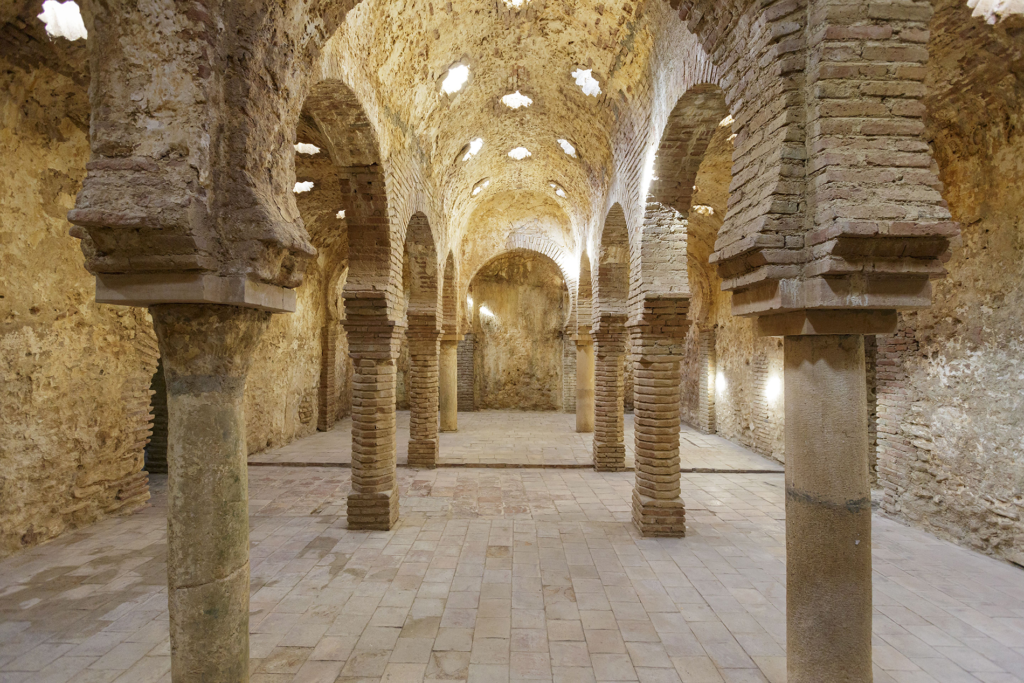
The Arab Baths of Ronda, a magnificent ruin site
The hammam tradition was a cornerstone of Arab culture for centuries. From the 13th to the 15th century, several such baths were built in Spain. The baths of Ronda, in Andalusia, are one of the best examples, with their three magnificent barrel-vaulted rooms and visible heating and water circulation systems. The Guadalevín river, which often floods, has prevented these baths from being used, but excavations have been carried out, and now you can visit and admire some of the best-preserved Arab bathhouses in the country.
pix: P. Escudero / hemis.fr
Baños Árabes C. Molino de Alarcón 29400 Ronda Málaga +34 951 15 42 97 turismoderonda.es
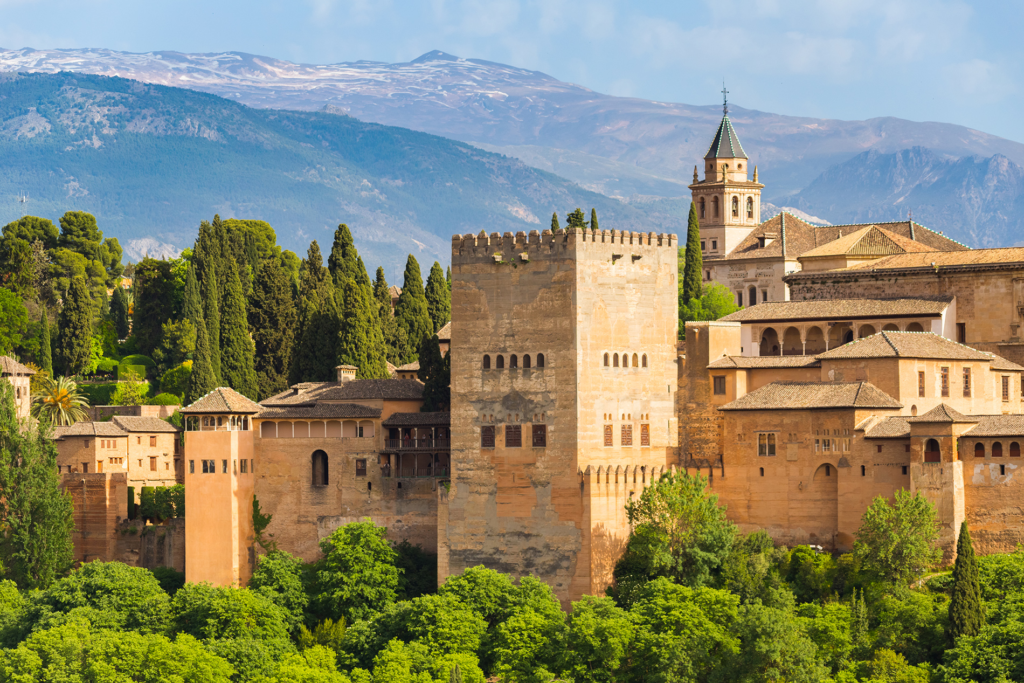
The Alhambra of Granada, an extraordinary castle
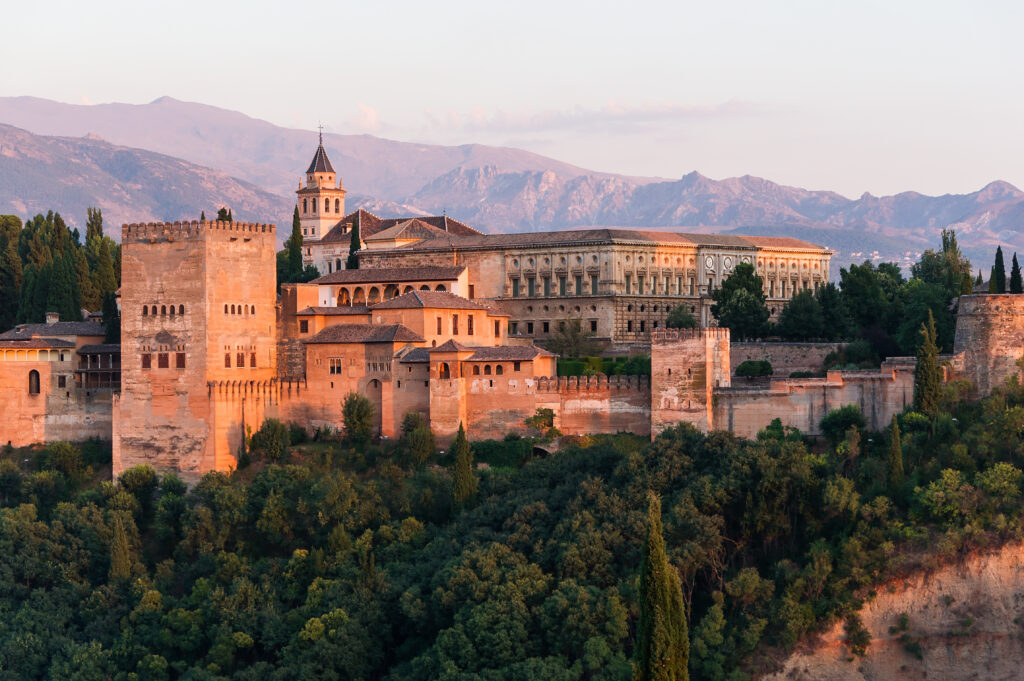
On the Sabika hill, opposite the Albaicín district, stands the Alhambra of Granada, a majestic conglomeration of several buildings built in the early 12th century. The grandeur of the last Nasrid rulers is at its peak. Not to mention the sublime, breathtaking view over the plain of Granada!
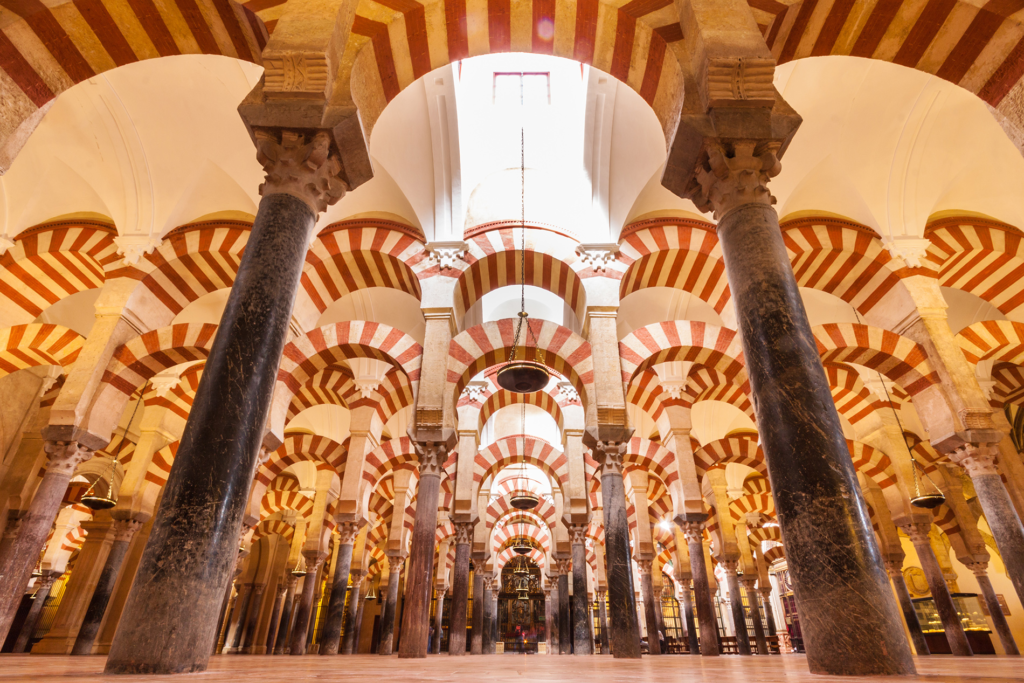
The Mosque-Cathedral of Cordoba, from Islam to Christianity
Another Muslim building, the Cordoba mosque is a symbol of Arab influence at its most grandiose. From the 8th century to 29 June 1236, the building served as a mosque, before becoming a church again following the Reconquista. Representative of the art of the Umayyads of Cordoba, it is a monumental structure, and it covers over 1.5 hectares. The building is a splendid example of Islamic architecture: the “forest of columns” in the main hall – 1,300 marble, jasper and granite columns – highlights the gargantuan size of the place.
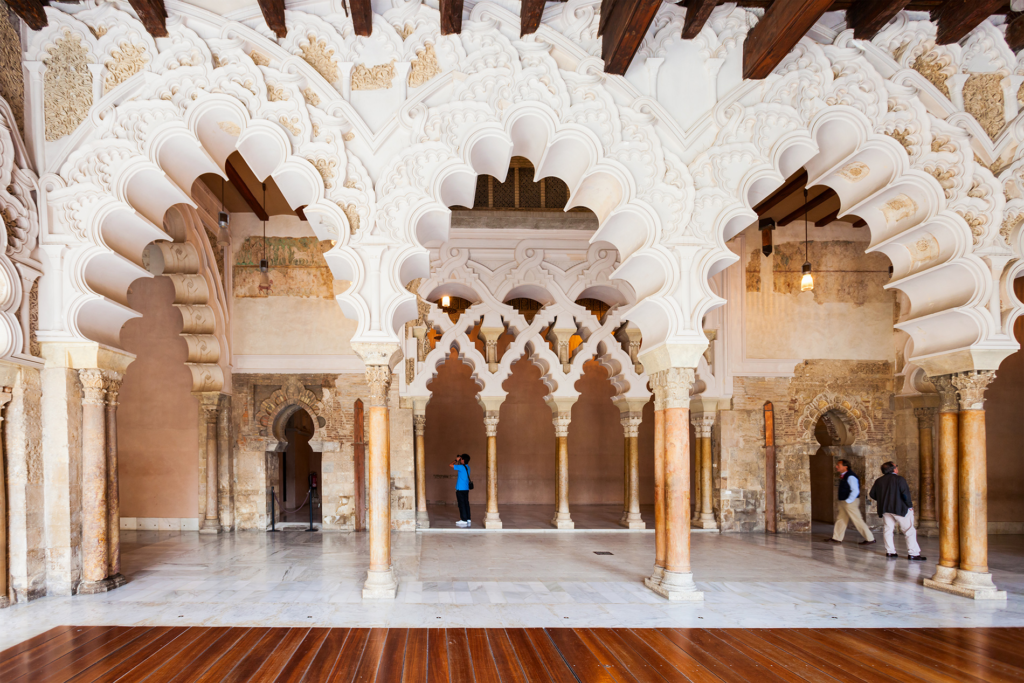
The Mudejar art of Aragon, in the north of Spain, has been declared part of UNESCO’s World Heritage, and the Aljaferia in Zaragoza is one of its most flamboyant masterpieces. When it was built in the second half of the 11th century, this palace clearly displayed the magnificence of the Taifa of Zaragoza. It served as a residence, a fortified enclosure and a barracks. It currently houses the Parliament of Aragon. The palace’s interior decoration is gorgeous, with a series of delicate, refined arches.
pix: kasto80 / Getty Images Plus
Palacio de la Aljafería Calle de los Diputados 50003 Zaragoza +34 976 28 96 83 www.turismodearagon.com
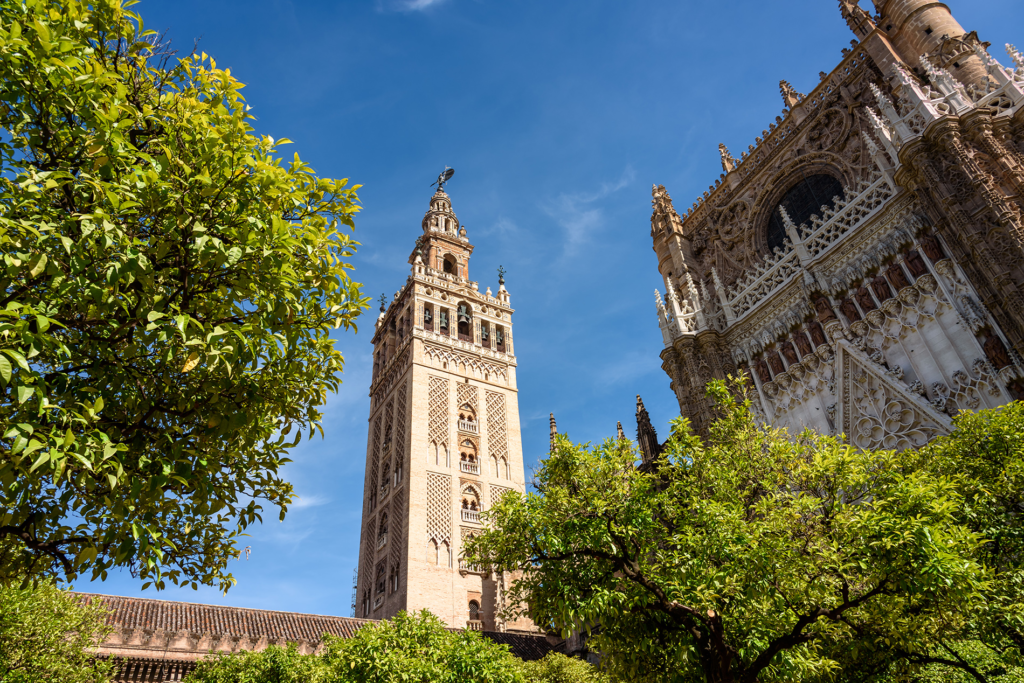
The Seville Giralda, a perfect example of mixed construction
The architectural marriage of the Giralda, the bell tower of the Cathedral of Our Lady of the See in Seville, is immediately evident. The lower parts were built in the 12th century, when the city was the capital of the Arab-Andalusian empire, under the rule of the Almohads. Four centuries later the upper floor was added, and the mosque’s minaret became a bell tower. It is now an unspoken rule that no building should be higher than this symbol of Seville.
pix: marinzolich / Getty Images Plus
Catedral de Santa María de la Sede de Sevilla – Giralda Av. de la Constitución 41004 Sevilla +34 902 09 96 92 www.catedraldesevilla.es
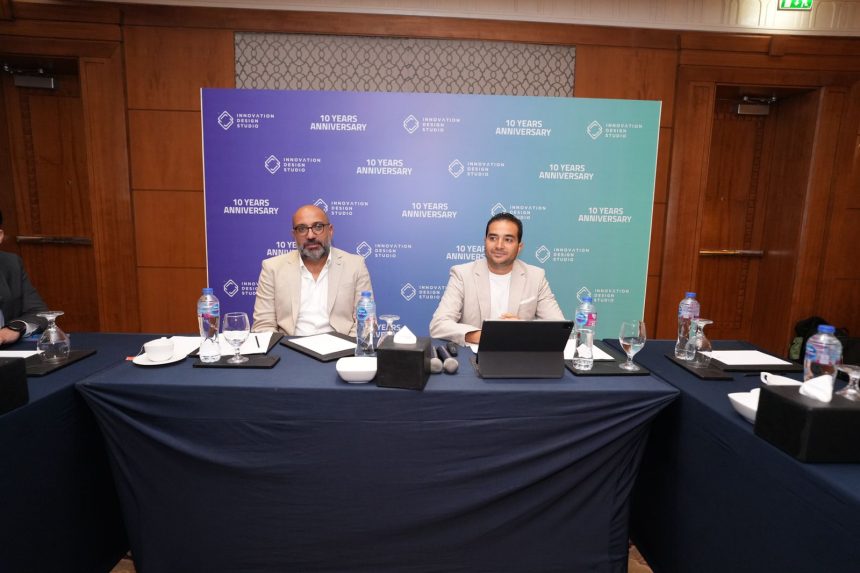
Innovation Design Studio, an award-winning architecture and design firm, has designed more than 400 projects in Egypt, Saudi Arabia, and Oman over the past 10 years. The company was recently awarded the A’ Design Golden Award for its design of a business district in Egypt.
Mahmoud Farouk, chief of design and co-founder of Innovation Design Studio, said the company started in 2014 with one project worth $4m. In 2023, the company is working on a project worth $400m.
Farouk added, “Our work encompasses the local market to include key regional projects in Oman and Saudi Arabia with an envisioned global expansion plan.”
Alaa Abdel Hameed, CEO and co-founder of Innovation Design Studio said the company is committed to using local materials and products.
“We believe that designers play a crucial role in directing developers’ projects towards more reliance on materials localization,” Abdel Hameed said. “This is in line with the Egyptian government’s direction of limiting importation and preserving foreign currency.”
Abdel Hameed also praised the efforts of Egyptian manufacturers in developing solutions and products that meet international standards.
“The local producers are becoming the preferred option and partner for developers and designers,” he said.
Brazilian Henrique Tabchoury has listened to Arabic music records with his Lebanese father since he was a child and saw him get emotional with the songs of his homeland. Jamil Abrão Tabchoury was born in Tripoli, Lebanon, in 1917 and came to Brazil with his family in 1927 when he was nine.
After he died in 1988, Henrique inherited around 300 Arabic records from his father. Since then, he has dedicated his free time to rescuing, collecting, and cataloging Arab music material, many of them recorded in Brazil, as a way of honoring his father and the Arab colony that came to Brazil in the first diaspora in the late 19th century and early 20th.
A trained agronomist, Tabchoury works in agribusiness and, since the 2000s, started buying Arabic records for his collection, which today has around 4,000 pieces – some are not Arabic. He recently received a donation of 22 albums by Arab and Brazilian artists from the Arab Brazilian Chamber of Commerce (ABCC).
Tabchoury searches for Arabic music records in advertisements, used bookstores, antique shops, and websites. He collects Arab discography produced in Brazil and already has around 60 albums by Arab artists who lived and recorded in the country for labels such as Continental, Odeon, Arte-fone, and RCA Victor. The recordings were made between 1927 and 1935, and the collection includes records by artists such as Nagib Hankash and Nagib Mubarak.
“It’s a retrieval of the history of the Arab colony in Brazil; these artists were of fundamental importance for the community; they were an encouragement for the Arabs who came to Brazil,” said Tabchoury to ANBA.
The albums are mainly from Syrian and Lebanese artists. “I guess most are Lebanese artists as many sing odes to Lebanon, and 90% to 95% are Christian Arabs,” said Tabchoury. In his assessment, over half of these are Orthodox Christians, and less than half are Maronite Christians.
Of the 4,000 discs in his collection, he has already cataloged and digitalized around 580, and nearly 400 are Arabic music. “Cataloged, including private and serial recordings, we have 390 Arab 78rpm records produced in Brazil, apart from LP albums (vinyl), compact, and 10-inch records,” he informed. He intends to digitalize his entire collection and later launch a website with the music catalog and information about the artists.
One of his goals is to find all Arabic records of private recordings made in Brazil until the 1970s. After the 1970s, recordings from abroad began to arrive here,” he said. He also wants to find more old Arabic records, whether recorded in Brazil or not.
“Many people keep records for sentimental value, and some don’t know what to do and throw them in the trash. I’m looking for these records in my spare time; I go to other cities and talk to families. I have no commercial interest; my collection has a historical background and is a source of homage to the Arabs in Brazil,” he declared.
Tabchoury has already been to Araxá, Barretos, Uberaba, Goiânia, Curitiba, Porto Alegre, and Pindamonhangaba, among other Brazilian municipalities with Arab communities. “I want people to know I’m building this collection,” he said. He accepts donations and also buys records.
Hamza Taouzzale, 22, became the youngest person to hold the office
Serving as councilor offers chance to connect with people left behind by politics, he tells Arab News
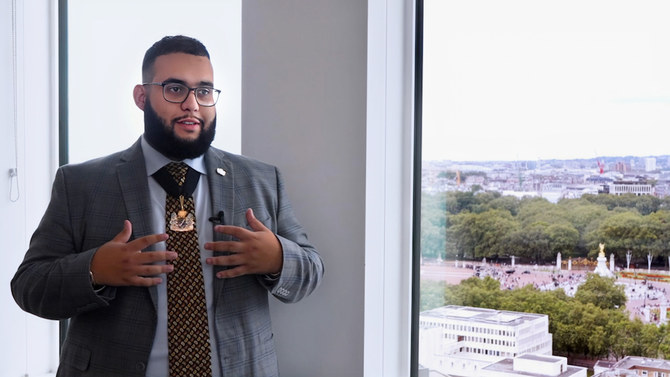
At London’s Westminster City Hall, 22-year-old Hamza Taouzzale warmly welcomes us into his dynamic working environment.
The councilor made history in the political heart of the UK last year when he became Westminster City Council’s first Arab and Muslim, and youngest, lord mayor.
He introduced us to his realm of responsibilities, shedding light on the multifaceted nature of his duties. With a passionate demeanor, he delved into the rich history of Westminster and its surrounding boroughs, painting a vivid picture of inspiring local stories.
Taouzzale described his emotions upon learning of the news of his election as a mixture of nerves and excitement. Calling his mother, he recalled her shock, as well as the astonishment of his entire family.
“But for me, it was that pride and that representation to understand that I was going to be the first Muslim, the first person from a minority ethnicity and the youngest ever at the age of 22 to become lord mayor of Westminster,” Taouzzale added.
The role, which he held until earlier this year, involves acting as a community representative, offering a chance to connect with those who may feel disconnected from local politics and decision-making.
Taouzzale emphasized his commitment to engaging with various segments of the community, including schools, youth clubs and care homes, highlighting the need to meet the demands of locals.
Growing up on the nearby Lisson Green Estate, the 22-year-old acknowledged the importance of community support in his journey.
He recalled his initiation into politics at the age of 16, when a youth leader, Tariq, encouraged him to join the local Youth Council.
From there, Taouzzale was elected as a youth MP. That position paved the way for him to later become a Westminster City councilor.
The journey, guided by mentors and a desire to make a positive change, led to his eventual appointment as lord mayor of Westminster in May 2022.
As the first Muslim and Arab in the position, Taouzzale described his background as having provided representation to local communities. He underestimated the impact he would have globally, but gradually realized the importance of his role as a symbol of empowerment and inspiration, especially for young people.
He said: “I had people in my first week from countries I’ve never been to in the Middle East message me on Facebook: ‘I’m so, so proud of you,’ ‘This is brilliant,’ ‘Masha Allah.’
“That sort of pushed me to understand who I was representing. I wasn’t representing just Westminster; I wasn’t representing just my community. I was representing all those people who had never done something that I had been able to do, as a present in the Arab world, the Muslim world,” Taouzzale added.
Through his work, the councilor hopes to encourage others, especially young people, to see the possibilities that lie ahead. He wants to leave a legacy that motivates people to believe that, like him, they too can overcome challenges.
source/content: arabnews.com (headline edited)
___________
Hamza Taouzzale, describing his political journey to Arab News at Westminster City Hall in London, United Kingdom. (AN Photo)
Lebanese filmmaker Nadine Labaki returns to Toronto International Film Festival as a jury member.
Lebanese filmmaker Nadine Labaki has been announced as a jury member for the 48th edition of the Toronto International Film Festival (TIFF), scheduled from September 7th to the 17th. Labaki, a distinguished writer, director and actor, will join the TIFF Platform jury alongside Academy Award-winning American filmmaker Barry Jenkins and Canadian Platform Prize-winning filmmaker Anthony Shim.
Labaki’s international acclaim began with her 2007 debut film ‘Caramel,’ which premiered at Cannes Film Festival’s Directors’ Fortnight and was Lebanon’s official entry for the 80th Academy Awards’ Best Foreign Language Film category.
The filmmaker continued to make waves with ‘Where Do We Go Now?’ in 2011, earning the People’s Choice Award at the Toronto International Film Festival. Later in 2018, her drama film ‘Capernaum’ secured the Jury Prize at Cannes Film Festival and received an Academy Award nomination for Best Foreign Language Film.
TIFF’s Platform programme is known for its selection of distinct and bold directorial visions since its inception in 2015, and for the upcoming edition, ten feature films will be competing for a CAD 20,000 prize.
UNESCO chooses theme for World Arabic Language Day 2023
Arabic is one of the most widely spoken languages, used daily by more than 400m people
Language is a main pillar of any society, and a driving force for connecting communities. As one of the six official languages in the UN, and one of the most spoken languages globally, Arabic is an incubator of culture, science and knowledge.
It is also one of the most widely spoken languages in the world, used daily by more than 400 million people.
World Arabic Language Day has been celebrated by UNESCO every year on Dec. 18 since 2012, the date coinciding with the day in 1973 that the UN General Assembly adopted Arabic as the sixth official language.
UNESCO recently chose “Arabic — the Language of Poetry and Arts” as the theme of World Arabic Language Day 2023 to highlight the role Arabic has played in poetry and art for centuries.
Experts told Arab News that Arabic has many characteristics and aesthetic values, both in written text and spoken discourse.
“Arabic language is very closely linked to the arts, literature and various cultural styles, from poetry to prose, to the rest of the literary genres, such as the story, the novel, the narrative, and poems in various artistic and scientific fields,” Mohammed Alfrih, a member of the board of directors of the Saudi Publishers Association, said.
“We can hardly find another language that mimics the Arabic language in its elegance and its different expressive ability, and it is not surprising that non-native speakers confirmed that, let alone its native speakers,” he said.
Yousef Rabab’ah, a professor of Arabic language and literature at Jordan’s Philadelphia University, said: “The Arabic language is characterized by features and characteristics in derivation, vocabulary, and idiomatic expressions that make it able to keep pace with developments in various fields, and this is proven objectively.”
Rabab’ah, who is editor-in-chief of Afkar Magazine, which is published by the Jordanian Ministry of Culture, said: “The Arabic language has been able throughout its history to influence many arts related to it, for example the arts of decoration, in which the Arabic calligraphy was essential in its formation. Artists were able to adapt the Arabic letters and Arabic calligraphy to produce artistic paintings and beautiful decorations that we see in places of worship, the walls of castles, palaces, and on the covers of books.
“Likewise, Arab voices, and the way they are performed and controlled, have a great role in the arts of singing, music and mirth, and we will not forget the plastic arts that adopt the formations of Arabic calligraphy which enter into the drawings of this type of art,” he said.
According to Hanan Al-Sharnouby, assistant professor of literature and criticism at Alexandria University, the Arabic language has a profound association with various forms of arts, and it is necessary for those seeking to engage in linguistic arts and speech sciences to master the language.
Al-Sharnouby noted that language and art are interconnected, influencing each other. She emphasized that quality content for films, series, and theater necessitates a language that reflects Arab identity effectively and that the rich heritage of Arabic serves as a solid foundation for sophisticated art that fully engages its audience.
Mohammed Daud, a professor of Arabic language and dean of the Faculty of Linguistics at Sudan University of Science and Technology, said: “There are formative and structural characteristics common to natural human languages, in addition to what is specific to each language.
“The Arabic language is distinguished by these formative and structural characteristics without the rest of the languages. It is represented by the fact that Arabic is concerned with the aesthetic values in the written text and spoken discourse, taking into account the semantic differences between words that appear synonymous in different structural contexts, which enabled it to express the same meaning in different ways and with amazing accuracy.
“This is reflected in its illustrative styles and its individual and collective creative arts, and applies to the ways of thinking of its speakers in their keenness to portray the details of artistic situations and the integrity of their creative production,” he said.
Daud said that the future of the Arabic language is bright due to the stability of its morphological, grammatical and semantic systems, and its ability to derive words and generate meanings through these means.
Tha’er Alethari, a professor of criticism and literature at University of Wasit in Iraq, said: “It is important to realize that Arabic is the only language in the world that has been understood for 2,000 continuous years.
“We read pre-Islamic poetry, understand it, and perhaps quote it on a contemporary issue, and this communication has given the language vitality and the ability to adapt to every era.
“There are two linguistic characteristics that helped it in this, the first of which is the abundance of linguistic roots in it, and the second is its etymological nature. Arabic does not depend on antecedents and suffixes in generating connotations, as is the case with most human languages. subject, noun, adverbs, etc,” he said.
source/content: arabnews.com (headline edited)
______________
World Arabic Language Day has been celebrated by UNESCO every year on Dec. 18 since 2012. (Reuters)
Saudi football, not to mention Middle Eastern and Asian teams in general, will be seismic in the years ahead
Global interest in the league has skyrocketed, with broadcasters DAZN, Canal Goat and LA7 jumping on board
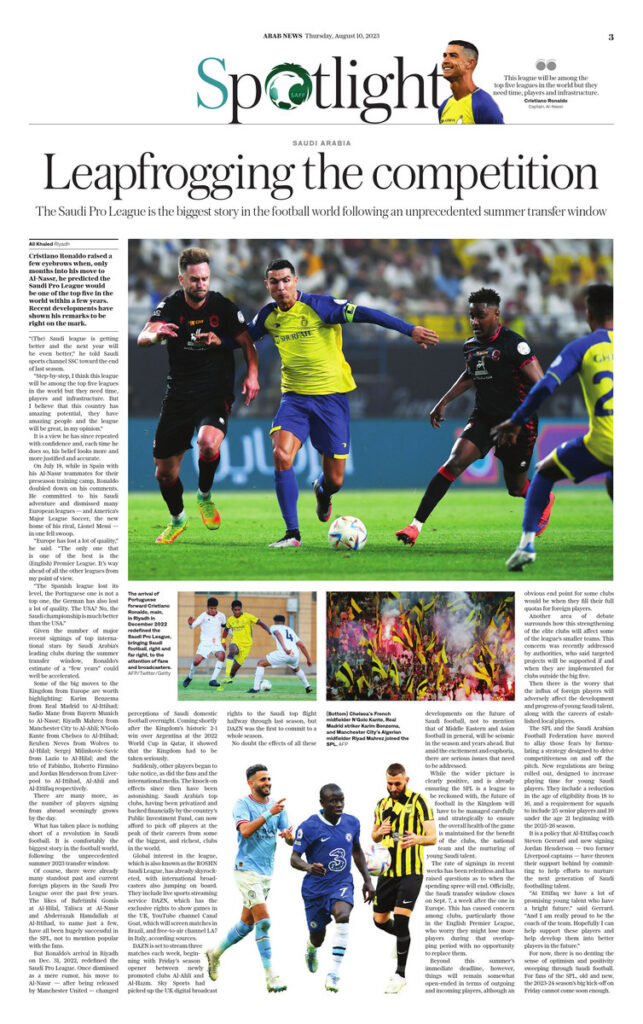
Cristiano Ronaldo raised a few eyebrows when, only months into his move to Al-Nassr, he predicted the Saudi Pro League would be one of the top five in the world within a few years. Recent developments have shown his remarks to be right on the mark.
“(The) Saudi league is getting better and the next year will be even better,” he told Saudi sports channel SSC toward the end of last season.
“Step-by-step, I think this league will be among the top five leagues in the world but they need time, players and infrastructure. But I believe that this country has amazing potential, they have amazing people and the league will be great, in my opinion.”
It is a view he has since repeated with confidence and, each time he does so, his belief looks more and more justified and accurate.
On July 18, while in Spain with his Al-Nassr teammates for their preseason training camp, Ronaldo doubled down on his comments. He committed to his Saudi adventure and dismissed many European leagues — and America’s Major League Soccer, the new home of his rival, Lionel Messi — in one fell swoop.
“Europe has lost a lot of quality,” he said. “The only one that is one of the best is the (English) Premier League. It’s way ahead of all the other leagues from my point of view.
“The Spanish league lost its level, the Portuguese one is not a top one, the German has also lost a lot of quality. The USA? No, the Saudi championship is much better than the USA.”
Given the number of major recent signings of top international stars by Saudi Arabia’s leading clubs during the summer transfer window, Ronaldo’s estimate of a “few years” could well be accelerated.
Some of the big moves to the Kingdom from Europe are worth highlighting: Karim Benzema from Real Madrid to Al-Ittihad; Sadio Mane from Bayern Munich to Al-Nassr; Riyadh Mahrez from Manchester City to Al-Ahli; N’Golo Kante from Chelsea to Al-Ittihad; Reuben Neves from Wolves to Al-Hilal; Sergej Milinkovic-Savic from Lazio to Al-Hilal; and the trio of Fabinho, Roberto Firmino and Jordan Henderson from Liverpool to Al-Ittihad, Al-Ahli and Al-Ettifaq respectively.
There are many more, as the number of players signing from abroad seemingly grows by the day.
What has taken place is nothing short of a revolution in Saudi football. It is comfortably the biggest story in the football world, following the unprecedented summer 2023 transfer window.
Of course, there were already many standout past and current foreign players in the Saudi Pro League over the past few years. The likes of Bafetimbi Gomis at Al-Hilal, Talisca at Al-Nassr and Abderrazak Hamdallah at Al-Ittihad, to name just a few, have all been hugely successful in the SPL, not to mention popular with the fans.
But Ronaldo’s arrival in Riyadh on Dec. 31, 2022, redefined the Saudi Pro League. Once dismissed as a mere rumor, his move to Al-Nassr — after being released by Manchester United — changed perceptions of Saudi domestic football overnight. Coming shortly after the Kingdom’s historic 2-1 win over Argentina at the 2022 World Cup in Qatar, it showed that the Kingdom had to be taken seriously.
Suddenly, other players began to take notice, as did the fans and the international media. The knock-on effects since then have been astonishing. Saudi Arabia’s top clubs, having been privatized and backed financially by the country’s Public Investment Fund, can now afford to pick off players at the peak of their careers from some of the biggest, and richest, clubs in the world.
Global interest in the league, which is also known as the Roshn Saudi League, has already skyrocketed, with international broadcasters also jumping on board. They include live sports streaming service DAZN, which has the exclusive rights to show games in the UK, YouTube channel Canal Goat, which will screen matches in Brazil, and free-to-air channel LA7 in Italy, according sources.
DAZN is set to stream three matches each week, beginning with Friday’s season opener between newly promoted clubs Al-Ahli and Al-Hazm. Sky Sports had picked up the UK digital broadcast rights to the Saudi top flight halfway through last season, but DAZN was the first to commit to a whole season.
No doubt the effects of all these developments on the future of Saudi football, not to mention that of Middle Eastern and Asian football in general, will be seismic in the season and years ahead. But amid the excitement and euphoria, there are serious issues that need to be addressed.
While the wider picture is clearly positive, and is already ensuring the SPL is a league to be reckoned with, the future of football in the Kingdom will have to be managed carefully and strategically to ensure the overall health of the game is maintained for the benefit of the clubs, the national team and the nurturing of young Saudi talent.
The rate of signings in recent weeks has been relentless and has raised questions as to when the spending spree will end. Officially, the Saudi transfer window closes on Sept. 7, a week after the one in Europe. This has caused concern among clubs, particularly those in the English Premier League, who worry they might lose more players during that overlapping period with no opportunity to replace them.
Beyond this summer’s immediate deadline, however, things will remain somewhat open-ended in terms of outgoing and incoming players, although an obvious end point for some clubs would be when they fill their full quotas for foreign players.
Another area of debate surrounds how this strengthening of the elite clubs will affect some of the league’s smaller teams. This concern was recently addressed by authorities, who said targeted projects will be supported if and when they are implemented for clubs outside the big five.
Then there is the worry that the influx of foreign players will adversely affect the development and progress of young Saudi talent, along with the careers of established local players.
The SPL and the Saudi Arabian Football Federation have moved to allay those fears by formulating a strategy designed to drive competitiveness on and off the pitch. New regulations are being rolled out, designed to increase playing time for young Saudi players. They include a reduction in the age of eligibility from 18 to 16, and a requirement for squads to include 25 senior players and 10 under the age 21 beginning with the 2025-26 season.
It is a policy that Al-Ettifaq coach Steven Gerrard and new signing Jordan Henderson — two former Liverpool captains — have thrown their support behind by committing to help efforts to nurture the next generation of Saudi footballing talent.
“At Ettifaq we have a lot of promising young talent who have a bright future,” said Gerrard. “And I am really proud to be the coach of the team. Hopefully I can help support these players and help develop them into better players in the future.”
For now, there is no denting the sense of optimism and positivity sweeping through Saudi football. For fans of the SPL, old and new, the 2023-24 season’s big kick-off on Friday cannot come soon enough.