Arabs & Arabian Records Aggregator. Chronicler. Milestones of the 25 Countries of the Arabic Speaking World (official / co-official). AGCC. MENA. Global. Ist's to Top 10's. Records. Read & Enjoy./ www.arabianrecords.org
Saudi Arabia’s King Abdulaziz Centre for World Culture (Ithra) on Wednesday announced the winner of the fifth Ithra Art Prize as Iraqi Finnish artist Adel Abidin.
Abidin’s proposal was a wall installation, called “ON,” that explores connection between history, memory and identity.
The artist won $100,000 for the piece.
“As I delve into the intangible aspects of history, I am confronted with the challenge of scarce reliable archival sources,” the artist wrote on Instagram. “This challenge is especially evident in the context of Arab history, where much remains shrouded in ambiguity, allowing for a broad range of interpretations and augmentations.”
“In my meticulous study of the Zanj Rebellion of 869 AD in southern Iraq, particularly in the city of Basra, I find a captivating example that exemplifies these themes,” he added.
Syrian American Mayor Khairullah says Biden should end ‘racism’ against Muslims and Arabs
‘I don’t think it is fair to make a documentary to show that Cleopatra was Black. This is changing history,’ says Egyptologist Zahi Hawass
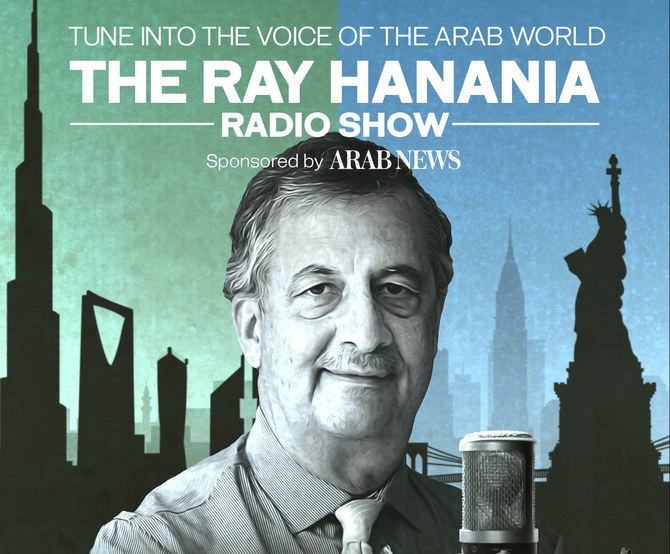
The Ray Hanania Radio Show, a weekly program sponsored by Arab News, kicked off its third season on Thursday with an explosive episode last night. It featured as its first guest Syrian American Mayor Mohamed T. Khairullah, who was controversially banned from the White House Eid celebration.
During his appearance on the show, Khairullah slammed President Joe Biden, saying it is his responsibility to end the “racism” and “discrimination” against Muslims and Arabs that is a part of the system.
The Ray Hanania Radio Show, which first aired in October 2020 ahead of the US elections at the time, hosts a wide array of guests tackling crucial topics in the Arab world.
One such topic tackled this season is the recent Netflix docuseries controversy surrounding the casting of Adele James, a Black actress, as Cleopatra, whom historians agree was of Greek origin.
The furor came from Egyptians and other Arabs accusing the producers of the film of appropriating their culture. The Ray Hanania Radio Show thus hosted world-renowned Egyptologist Zahi Hawass who set the facts straight.
“Cleopatra was a Macedonian…I really think that the reason this film is shown now (is) because some people want to say that the origins of Ancient Egypt were Black,” he said on the show, adding, “I don’t think it is fair to make a documentary to show that Cleopatra was Black. This is changing history.”
Continuing with the topic of Arab representation in Hollywood was Arab News’ very own Editor-in-Chief Faisal J. Abbas.
On the show, Abbas cited Arab American writer and academic Jack Shaheen and his book “Reel Bad Arabs,” which says that, out of 1,000 films, Arabs were only presented or portrayed positively in 12 percent of them.
“As Arabs, we should not wait for Hollywood, and we should not wait for people with Orientalist agendas to tell our story. We should be the masters of our own destiny, we should be the masters of our own storytelling,” Abbas said.
“I’ll tell you one more thing before we conclude. Actions speak louder than words.”
The Ray Hanania Radio Show is broadcast live on WNZK AM 690 Radio in Greater Detroit and on WDMV AM 700 in Washington D.C. every Wednesday at 5pm EST / 12am KSA, also available on all Arab News podcast channels.
May Elghety, the talented Egyptian actress, has announced her upcoming role in Disney’s animated series “Kizazi Moto: Generation Fire”. This sci-fi series, inspired by Africa’s diverse cultures and histories, promises to bring viewers thrilling stories of advanced technology, aliens, spirits, and monsters from a uniquely African perspective.
Elghety, who has won critical acclaim for her performances in several TV series and films, took to Instagram to express her excitement and honor at being part of the project. The 24-year-old actress is currently filming for the British movie “Due Dating,” which is directed by Daniel Pacquette and written by Jade Asha.
Born to renowned TV presenters and writers Mohamed Elghety and Mona Barouma, May Elghety began her acting career as a child artist. Her outstanding performance in the controversial TV series “El-Kaserat” earned her the Best Upcoming Actress award at the Arab Drama Festival in 2013.
Since then, Elghety has starred in several successful productions, including “Clash” in 2016, “Taye’a” in 2018, and “Every Week Has A Friday” in 2020. Her most recent film, “MAMA,” premiered at the Cairo International Film Festival in 2022.
“Kizazi Moto: Generation Fire” is a 10-part anthology that promises to bring together rising animation talents from six African nations. The series features an impressive production team, with Oscar-winning director Peter Ramsey serving as executive producer and Cape Town-based animation house Triggerfish leading the studio. Egyptian director Ahmed Teilab has also joined the writing and directing team for the series.
The show is set to premiere on Disney+ this year and is sure to delight audiences with its captivating storytelling and stunning visuals. “Kizazi Moto: Generation Fire” is yet another feather in the cap of May Elghety, who continues to prove herself as one of the most talented and versatile actresses of her generation.
The director received a master’s degree in fine arts specializing in film production at the prestigious American Film Institute in Los Angeles
Hana Kazim’s short film ‘Makr’ screened at several genre festivals including Fantastic Fest in Texas and FrightFest in London
Director Hana Kazim founded Wiswas Productions, dubbed the first Arab horror-focused production company, in a bid to celebrate the power of the thrilling genre.
The Emirati auteur recently directed a Saudi Arabia-focused episode of STARZPLAY’s “Kaboos,” which is set in different eras and across countries in the MENA region, taking viewers on a journey through frightening urban legends from Saudi Arabia, Kuwait, Egypt and the UAE.
“I found that there’s a lot of interest in horror and a lot of stories to tell, and a lot of things you can say through horror,” Kazim told Arab News.
“I think some of the most courageous stories right now are being told through the mask of horror, mainly because horror can seem like to the mass audience as a spectacle, but in reality, horror has always been a champion of telling some deep truth about society, a huge commentary on society, and it’s almost like the most acceptable form of commentary in almost every region,” she added.
After receiving a master’s degree in fine arts specializing in film production at the prestigious American Film Institute in Los Angeles, Kazim returned to the region to hone her craft.
Kazim’s decision to launch her company came after the release of her short film “Makr,” which she wrote and directed in 2018. The movie, which gained more than half a million views online, screened at several genre festivals including Fantastic Fest in Texas and FrightFest in London. It was translated to Farsi, Korean and Japanese.
The director, who has worked as a film executive in the UAE since 2015 and has been involved in the production of several Arab films, including “Rashid & Rajab” (2019) and 2021 box office hit “Al-Kameen,” said that she believes horror, “for the most part, hasn’t been done well” in the region, because finding a perfect storyline in is a challenge in the genre.
“I think our audiences are still a little too critical of everything they see. They take everything a little bit more literally. So, having to break into horror is tough because you have to be somewhat near being realistic while at the same time balancing the scales of not being too aggressive or too judgmental,” Kazim said.
The director believes that the main reason horror as a genre has lagged in the region is because filmmakers are going for scares rather than meaning.
“I think Arab audiences are always looking for meaning in stories, be it a comedy, be it a drama — they’re looking for meaning more than just entertainment. And unfortunately, we, filmmakers, come from entertainment. So, we feel like making entertainment and we forget the idea of having meaning behind stories,” she added.
“I think the Middle East has the potential to be well known for its horror because we have so many untold stories, be it from folklore to real stories — there’s a huge timeline of horror films that we can make that could span around 20, 30 and 40 years.”
source/content: arabnews.com (headline edited)
____________
The Emirati auteur recently directed a Saudi Arabia-focused episode of STARZPLAY’s “Kaboos.” (Supplied)
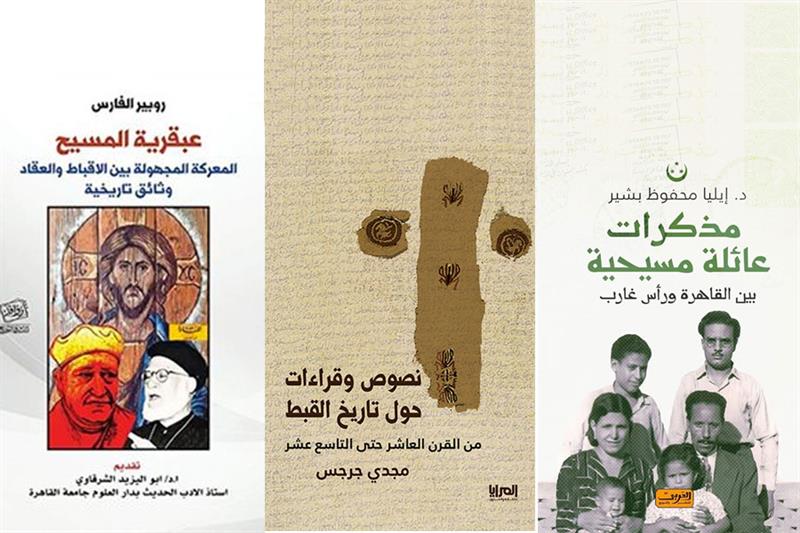
Three recent titles on the life and history of the Copts reflect on elements of a complex story.
Mozakerat Aaela Masseihiya bein Ras Ghareb wal Qahera (Memoirs of a Christian family between Ras Ghareb and Cairo), by Elia Mahfouz Bashir, Cairo: Al-Arabi Publishing. pp. 196.
“At that time there was a [spontaneous] acceptance of the other; actually, the concept of this other was not really there – not as a fully defined concept any way”.
This is one of very few lines that evokes the “Christian” in the title of the pleasant-to-read 196-page text.
Elia Mahfouz Bashir, now a 65-year-old pathologist, recalls memories of his easy-going and uninhibited childhood in the Red Sea city of Ras Ghareb where his father worked for an oil company.
This is the interesting thing about the choice of the title. It offers a contrast to a sequel of articles where Bashir offers accounts from his time in this city in the late 1950s and early 1960s prior to the retirement of his father that forced the family away from its Red Sea haven to Cairo. Those are accounts of the city, the sea, playmates, school, family gatherings, comparisons between the Red Sea and the Mediterranean and so on.
So, for a while, the reader is left to wonder about the significance of the “Christian” reference. And this is exactly the point. In the childhood of Elia Mahfouz Bashir, his faith and that of his family was not an issue. It only comes up across when he refers to a trip to his maternal family in Upper Egypt where he was escorted by his mother to one of the moulids of the Coptic saints or when he talks about the prayers for healing that a priest performed for he and a playmate of his, who happened to be a Muslim.
As Bashir put it in one of the articles, both the mosque and the church of Ras Ghareb were part of a wider communal ownership. He is attributing this state of mind to the norms that prevailed during the rule of Gamal Abdel-Nasser when the focus was on Egyptian identity and not the affiliation of faith as it later became under the rule of Anwar Sadat.
Bashir had originally started sharing his reflections on his childhood in Ras Ghareb on Facebook before he decided to assemble the pieces into a book that stands as a testimony for his experience.
Abkareit Al-Massih: AlMaaraka AlMaghoula bein AlAqbat wa Al-Akkad – Watheiq Tarikheyah (The Genius of Jesus: The Unknown Battle Between Copts and Al-Akkad – archival documents), by Robert Al-Fares: Rawafd Publishing, 2023. pp. 172.
In line with his head-on and mince-no-words approach, Robert Al-Fares, journalist and author of several titles on Coptic social history, is putting out a book that addresses the strongly established but often averted conflict between the Christian and Muslim creeds over the nature of Jesus Christ. For Christians, Jesus is as divine as human, and as such there is no point in trying to argue his genius as Al-Akkad did in his book that came out in 1953, under the title of “The Genius of Jesus,” to the dismay of the Copts of Egypt and particularly that of the Coptic Church of Egypt. For Muslims, however, Jesus is a prophet just like any other prophet that God had sent prior to Muhammad.
In this 172-page book, El-Farres digs out the archival details of a confrontation that took place when the book was put out by Akhbar Al-Youm Publishing, at the end of a sequel that Al-Akkad dedicated to argue the genius of Prophet Muhammad and the four early rulers of the Muslim state that followed him.
Those include letters and remarks from Coptic commentators and clergy, including Father Sergius, the prominent preacher of 1919 Revolution, who was put under house arrest by the Free Officers regime “for worry over his public influence.”
He also included the remarks and views of Muslim scholars who defended or disagreed with Al-Akkad.
The book also includes the replies that Al-Akkad offered and the remarks he added to the second edition of the book that came out in 1958 under the new title of “The Life of Jesus.”
While zooming in on this particular account of Al-Akkad “The genius of Jesus”, Al-Fares is being open in his criticism of the attempt of some Coptic and Muslim figures to overlook this difference instead of simply accepting ‘the other’ – given that as much as for Muslims, Christ is just a prophet, for Christians, Muhammad is not a prophet.
“We just need to acknowledge that we have different creeds; this is the core of coexistence,” he wrote.
Nossous wa Kerat hawla tarikh Al-Qapt min Al-Qarn Al-Aasher Hattah Al-Qarn Al-Tassaeiaashr (Texts and Narratives on the History of Copts – From the 10thCentury to the 19thCentury), by Magdi Girgus: Al-Maraya Publishing, 2023. pp. 273.
This book is part of the ambitious and really interesting work of historian Magdi Girgis who has been digging out accounts on the history of Copts from the archives to assemble a comprehensive and solid narrative on the lives of Copts in Egypt under the Muslim rule. As Girgus put it in the introduction to his most recent 273-page volume, it is “a free stroll across the history of Copts [during 10 consecutive centuries] through the text of some archival documents.”
The selection of documents, Girgus writes, is designed to address some significant points of Coptic history, and that of Egypt. He notes that his purpose is not just to share and analyse the content of these documents but to put the accounts they address within the wider context of social and political contexts.
Throughout his 10 chapters, with documents and with narratives on the context of the documents, Girgus goes through some of the most interesting accounts of the history of Copts.
These accounts include history of the Coptic Church and the Arabisation of the language of the church.
They also include a history of the sources used to chronicle the Coptic history and the archiving of documents on the Coptic history.
He also examines the relation between Church and State and the Islamic judiciary system as well as relations between Coptic clergy and Coptic notables and the state.
Moreover, he also examines the role of Coptic clergy in the rural areas.
A most controversial part of this book might relate to the argument Girgus offers on the issue of Arabisation.
Traditionally, many Coptic intellectuals have often argued that this was the outcome of the pressure of the Arab rulers of Egypt.
However, according to Girgus, the ‘choice’ of the Coptic Church to adopt the Arabic language was not necessarily about the pressure from Arab rulers but rather about the ‘choice’ of the Church of Egypt to embrace a national line away from the influences of the Church of Rome.
It was also, he argued, about the wish of the clergy to go along with the notables who had been trying to go along with culture of the new rulers in so many ways, including the most peculiar practice of polygamy by some Coptic notables despite the fact that polygamy is strictly forbidden in Christianity.
Actually, the evolution of relations between Church and State is perhaps one of the best explained issues in this book.
The seventh edition of Aswan International Women Film Festival ( AIWFF) will honor the great Tunisian director, producer and politician Selma Baccar for her tremendous influence in the cinematic field being the first female Tunisian director who directed a feature-length film.
Her works include Fatma 76 (1976), The Fire Dance (1995), Flower of Oblivion (2005), El Jaida (2017), among others.
The seventh edition of AIWFF will kick off from March 5-10, 2023.
Dr Azza Kamel, Vice Chairman of the Board of Trustees of Aswan International Women Film Festival said that Selma Baccar is a great filmmaker not only in Tunisian cinema, but also in Arab cinema, as her films conveyed the concerns of Tunisian women in different historical stages, in addition to her historical postion as the first Tunisian director to present a feature film.
Kamel stressed that the festival decided to honor Baccar as it seeks to honor creative women who have contributed to the portrayal of women’s issues from all over the world.
Kamel pointed out that Baccar’s struggle for women’s issues wasn’t limited to cinema screen, as a director or as a producer, but she was strongly present in the Tunisian political scene, as a member of the National Constituent Assembly to draft the constitution after the Tunisian Revolution, in addition to her work as a member in the Tunisian parliament defending rights and freedoms, stressing that honoring Baccar is a tribute to Tunisian cinema, which in recent years has achieved great successes at the international level by producing acclaimed films that support women.
The seventh edition of Aswan International Women Film Festival ( AIWFF) announced that it will honor veteran Egyptian actress dubbed Egypt’s first star Nabila Ebeid, acclaimed TV presenter Dorria Sharaf Eldin and the award-winning Dutch director, screenwriter and producer Mijke De Jong.
President Abdel-Fattah al-Sisi listened to an explanation of the details of Egypt’s Islamic Cultural Center and the Egypt’s Grand Mosque, during his visit to the New Administrative Capital at dawn, Thursday, to join workers for the first suhoor in the blessed month of Ramadan.
According to the explanation, Egypt’s Grand Mosque obtained three international certificates from the Guinness World Records.
The first was for the largest pulpit in the world with a height of 16.6 meters, handcrafted from the finest types of wood.
The second and third were for the main chandelier of the mosque, being the heaviest chandelier in the world of 50 tons, and it being the largest chandelier with a diameter of 22 meters and four levels.
Egypt’s Islamic Cultural Center in the New Administrative Capital is a great achievement and one of the most important projects established in the New Administrative Capital.
The Islamic Cultural Center was established in the new capital on an area of 15,000 square meters. It has a large place for services, as well as a group of spacious and multi-storey garages, with a capacity of about 4,000 cars.
In the heart of Islamic Cairo, Souq Al Khayamiya has been continuing a tradition in textiles dating back to the pharaohs.
Amidst the vibrant alleys, the scent of exotic spices and the insistent clamour of haggling merchants that so readily defines Islamic Cairo’s marketplace lies Souq Al Khayamiya. There, the rhythmic tapping of hammers against fabrics leads you to the heart of the souq, where skilled artisans create breathtaking Khayamiya textiles – a craft and art form that dates back to the time of the pharaohs.
Consisting of elaborately patterned and colourful appliques applied to the interior of tents, the decorative textile art form serves simultaneously as shelter and ornamentation.
Khayamiya possesses the three layers typical of quilts – a heavy “back”, a background “top”, and elaborate appliqué over the “top”. Khayamiya has been an integral part of Egypt’s cultural heritage for centuries, with a rich history that reflects the country’s artistic and cultural diversity. The art form has survived centuries of changes in Egypt’s political, social, and economic landscape and is still practised today.
The souq is a testament to the enduring legacy of this ancient art form and the craftsmanship of the artisans who keep it alive. Through its intricate patterns and vibrant colours, Khayamiya showcases the beauty and richness of Egypt’s artistic heritage. It serves as a reminder of the country’s past and the vibrant artistic traditions that have been passed down through generations.
Today, Khayamiya is not only an important cultural artefact but also an expression of contemporary Egyptian art, with many artists and fashion designers incorporating these ancient techniques and motifs into their work.
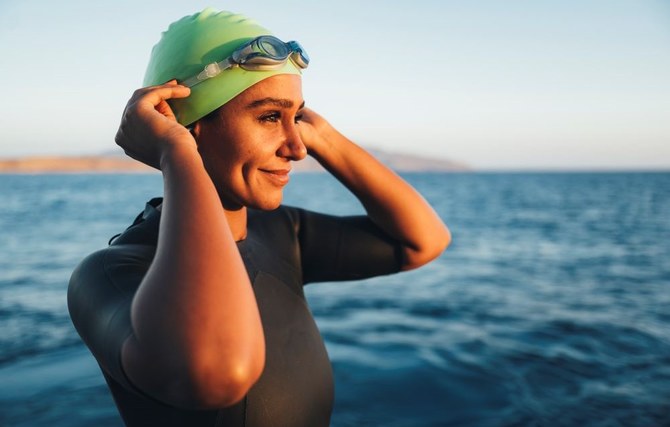
Mariam Saleh Binladen took just four hours to make the crossing from the Saudi island of Tiran to the Egyptian resort of Sharm El-Sheikh.
A Saudi dentist and endurance swimmer has set a new women’s world record time for swimming across the Red Sea.
Mariam Saleh Binladen took just four hours to make the crossing from the Saudi island of Tiran to the Egyptian resort of Sharm El-Sheikh.
She was accompanied in the water on her 9-kilometer swim by Lewis Pugh, a British South African endurance swimmer and UN patron of the oceans.
Pugh was on the first leg of his campaign to raise awareness about the destruction of oceans and coral reefs in the run up to the 2022 UN Climate Change Conference (COP27) due to take place in Sharm El-Sheikh next month.
Binladen told Arab News: “During the final moments of the swim, I felt elated, a sense of jubilation, and blessed to have achieved my goal with my body intact.
“I had concerns before embarking on the swim, namely the weather conditions and sharks. As the last moments approached, I thanked Allah that the team had made it safe and sound through what were quite hazardous conditions.”
Due to high winds and rough seas the swim had to be staggered over two days.
She said: “We completed the swim in two segments and fed less often to minimize the risk of shark attacks. I would say that the most challenging aspect was at the midway point when the sea became very turbulent.
“We had also agreed to swim without protective cages, so those sharks were always at the back of our minds.”
Binladen has been involved in open water endurance swimming professionally since 2012.
“I train hard at least three times a week. Over my weekends, I alternate between four to six hours of swims to maintain momentum. I maintain a dedicated fitness regime, and I keep to a physically gruelling schedule when I am preparing for a challenge,” she added.
Her first major world record-breaking swim was in London’s River Thames in 2016, but she pointed out that the Red Sea attempt was for a greater cause.
“I agreed to join this challenge as the cause is near to my heart. These challenges are not for the faint of heart; you really need to be disciplined with your training and build up your physical and mental strength. Those two things are what will keep you going and be the key to success,” she said.
Long-distance swimming, she noted, was physically and mentally challenging and it was only with the support of a sports counsellor and her family that she was able to prepare herself.
“We sift through any fears and concerns together. I cannot stress enough how important it is to always work with professionals and to surround yourself with the right people.
“I’m blessed to also have the support and reassurance of a loving family without whom I could never have embarked on this journey,” she added.
Binladen’s charitable work has included offering support to refugees.
She said: “I am primed and physically and mentally prepared to take on my next challenge.
“In terms of the future, I will continue to use my challenges to raise awareness of issues that concern me, my philanthropic work is ongoing, and I have my career, and I am very busy.”
She now has five world records to her name, including being the first Arab to complete the Dardanelles Strait open water race in Turkey from Asia to Europe, in August 2015, completing the 6.5-km distance in one hour, 27 minutes, and 26 seconds.
In September 2016, she became the first Saudi to complete an assisted swim across the English Channel of 39.7 km, a feat she did in 11 hours and 41 minutes.
And she was also the first swimmer to cross the Dubai Creek and Dubai Water Canal, clocking up a total distance of 24 km in nine hours and 10 minutes.
source/content: arabnews.com (headline edited)
___________
Saudi dentist and endurance swimmer Maryam Saleh Binladen. (Supplied)
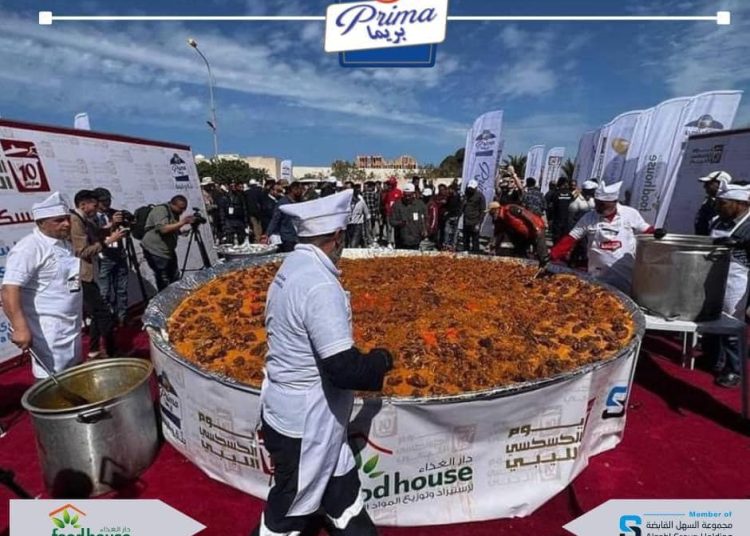
The organisers and sponsors of the Third Libyan Couscous Day 2023 reported that the event succeeded in breaking the world record for the largest couscous dish. They reported that a dish was prepared weighting over 2,500 kgs.
The event was held on Friday in the historic city of Sabrata and is organised by the Libyan Intangible Heritage and Cultural Organization (NGO). It aims to inform the world that couscous is a national Libyan dish and is part of its heritage – along with Tunisia, Algeria and Morocco.
The event was sponsored by a leading Libyan couscous manufacturer.