Arabs & Arabian Records Aggregator. Chronicler. Milestones of the 25 Countries of the Arabic Speaking World (official / co-official). AGCC. MENA. Global. Ist's to Top 10's. Records. Read & Enjoy./ www.arabianrecords.org
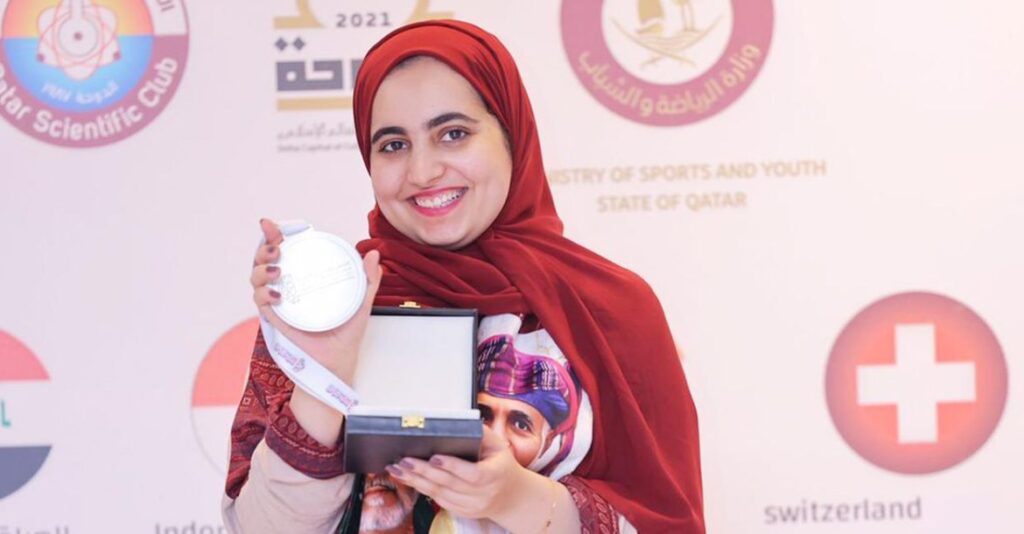
Manar al Jahwari won Saudi Arabian Innovation Hackathon award for her project Royal Filament.
Oman’s own Manar al Jahwari competed against 24 projects (shortlisted out of 700 total projects) in the final round of the Saudi Arabian Innovation Hackathon award, where her project was chosen along with three others as the most promising project.
Her project aimed at restricting the use of plastic filaments in 3D printing, and she fashioned 3D printing filament out of seaweed and other environment-friendly materials. She is currently in talks with government agencies to make her project a viable business, and she hopes to attract numerous local and international investors.
The Saudi Arabian Water Technologies Hackathon is a competition held virtually that lasts for two days, October 21 and 22, and involves three challenges that need to be solved within the given two days.
The second challenge was to control the excessive growth of algae in Jeddah’s desalination facilities, for which Al Jahwari came up with the innovative solution of “Royal Filament.”
Americans born in or with ancestral ties to Arab-speaking countries have made countless significant scientific, medical and engineering contributions.
While Americans born in or with ancestral ties to Arab countries have made countless significant scientific, medical and engineering contributions, most have never made it into record books. From cryptography, to the artificial heart, to the iPod, here are a few examples of some of the major advancements by Arab Americans.
1. Television Transmission and LCD Screens
Born in Nabatieh, Lebanon in 1895, Hassan Kamel Al-Sabbah studied and then taught mathematics at the American University of Beirut before immigrating to the United States in 1921. After a brief stint studying at the Massachusetts Institute of Technology (MIT), Al-Sabbah earned a master’s degree in engineering sciences from the University of Illinois, says Lujine Nasralla, communications specialist at the Arab American National Museum in Dearborn, Michigan.
“In 1923, General Electric (GE) hired him to work in its Engineering Laboratory under a contract that awarded him a dollar for each of his patents,” Nasralla explains, noting that between 1927 and 1935, he applied for patents for 52 of his inventions while working at GE. Some of the patents Al-Sabbah was awarded during his time at GE include three for innovations in television transmission technology (granted between 1928 and 1930), and two for cathode ray tubes (1935).
Though Al-Sabbah died in a car accident 1935, GE engineers continued to rely on the technology he invented, including developing the liquid crystal display (LCD) based on one of his patents. Al-Sabbah made numerous other significant contributions to science, technology and engineering, especially in the field of solar energy.
2. Emotion Recognition Technology
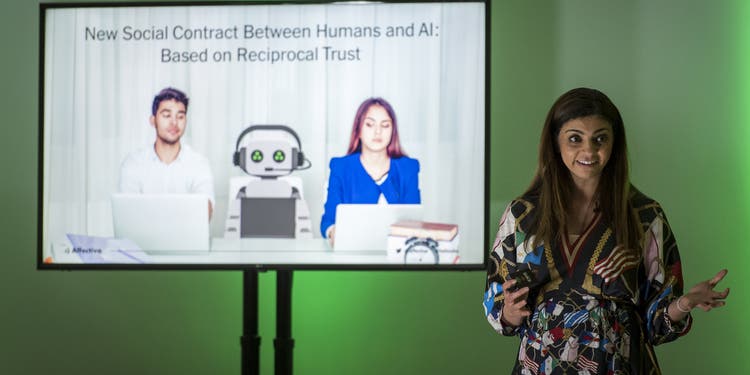
RANA EL KALIOUBY, CO-FOUNDER AND CHIEF EXECUTIVE OFFICER OF AFFECTIVA, SPEAKING DURING THE NEW WORK SUMMIT, CALIFORNIA, 2019. / DAVID PAUL MORRIS/BLOOMBERG VIA GETTY IMAGES
While Rana El Kaliouby was completing her doctoral research at the University of Cambridge in England in the early 2000s, she never felt as though she could ever truly connect with her loved ones back home. “Away from her family and friends in Egypt, El Kaliouby wished her computer could better convey her emotional state,” Nasralla says. That’s when she decided to find a way to make more emotionally intelligent technology.
After earning her doctorate, El Kaliouby took a position as a research scientist in the Affective Computing group in the MIT Media Lab. There, she was part of a team that developed an “emotional hearing aid,” as well as a pair of eyeglasses that could read emotions, along with social cues. Officially known as “the Emotional-Social Intelligence Prosthesis,” El Kaliouby and a colleague created the wearable technology in 2006 for people living with autism who have difficulty identifying and processing other people’s emotions as they communicate.
In 2009, El Kaliouby and the same MIT colleague co-founded a company called Affectiva, which used deep learning, computer vision, speech science and vast amounts of real-world data to develop emotion recognition technology. “Her pioneering technology accurately reads minute changes in facial expressions that convey emotions,” Nasralla says, adding that El Kaliouby is a member of the Women in Engineering Hall of Fame.
3. The iPod and iPhone
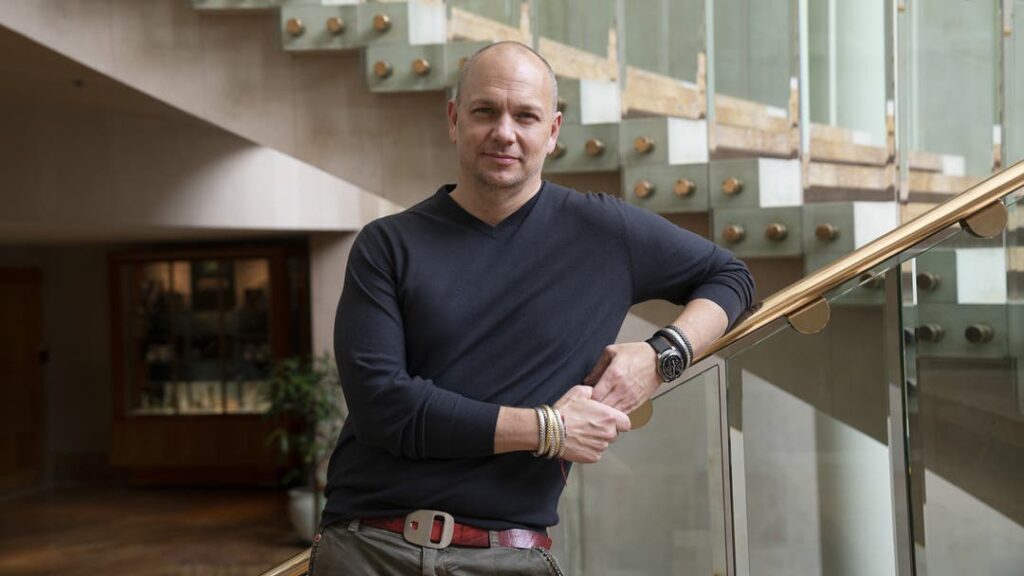
TONY FADELL, WHO OVERSAW THE DESIGN OF THE IPOD AND IPHONE, PHOTOGRAPHED IN SINGAPORE, 2019 / WEI LENG TAY/BLOOMBERG VIA GETTY IMAGES
There was a time in the not-so-distant past when listening to music outside of your home meant bringing the physical album with you on a record, audio cassette or compact disc. And while portable MP3 players existed before 2001, none were popular enough to make the device the standard way of listening to music on the go. That is, until Apple CEO Steve Jobs hired Arab American inventor Anthony “Tony” Fadell and put him in charge of a new special projects group within the company tasked with doing exactly that.
The result was the iPod, which launched in 2001. Fadell, who is now known as “ the father of iPod,” went on to oversee the first 18 iterations of the device before Jobs gave him his next assignment: to create a mobile phone with many of the same features as the iPod.
This time, the end product was the iPhone, which essentially allowed people to carry a highly compact computer with internet capability around at all times, and, in the process, changing the way people access information. Fadell was involved with developing the first three generations of the iPhone.
4. Developments in Surgery
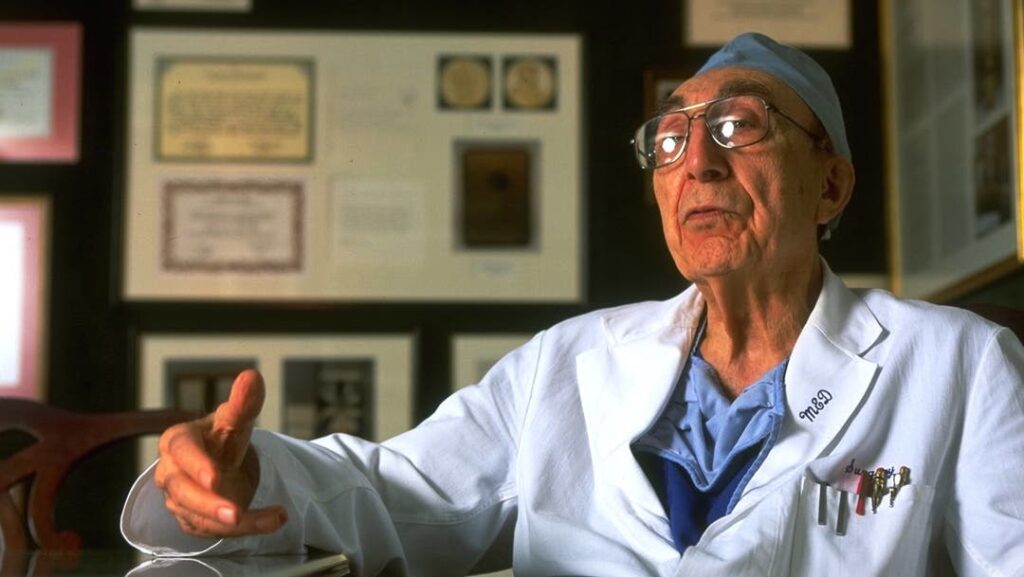
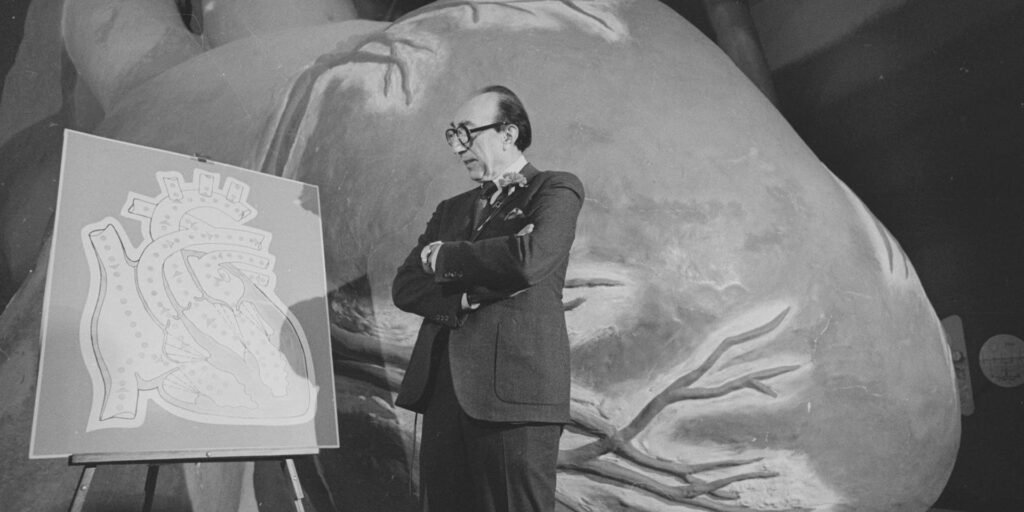
HEART SPECIALIST DR. MICHAEL DEBAKEY, C. 1994. / F. CARTER SMITH/SYGMA/GETTY IMAGES
Born in Lake Charles, Louisiana in 1908 to Lebanese immigrants, Michael DeBakey (the Anglicized form of Debaghi) grew up spending time in his father’s pharmacy and enjoyed sewing, gardening and learning how motors and other machinery work. He earned his medical degree in 1932 and served in the Surgical Consultants Division of the Army Surgeon General’s Office from 1942 to 1946.
It was during this time that DeBakey and his colleagues developed special units dedicated to providing surgical care to soldiers wounded near the front lines. They were first deployed in 1943, though are best known for their work during the Korean and Vietnam conflicts, when they were known as the Mobile Auxiliary Surgical Hospital (MASH) units.
DeBakey’s surgical contributions continued for the next several decades and included performing the first successful removal of a blockage of the carotid artery (1953), developing the concept behind coronary bypass surgery (1963), pioneering the field of telemedicine with the first demonstration of open-heart surgery transmitted overseas via satellite (1965), and being the first to use a partial artificial heart (1966).
5. Internet Security
While internet security is top-of-mind now, that wasn’t the case when Egyptian-born cryptographer Taher Elgamal began his pioneering work in the field in the 1980s. “Elgamal published a paper in 1984, ‘A Public Key Cryptosystem and a Signature Scheme based on Discrete Logarithms,’ which became the basis of the Elgamal Digital Signature algorithm,” says Richard Gardner, a software developer and CEO of Modulus. This work was then utilized in the development of the Digital Signature Algorithm (DSA).”
Elgamal’s work became even more influential after the National Institute of Standards and Technology (NIST) adopted it as the Digital Signature Standard (DSS). “Like the name implies, it became the standard for electronic signatures,” Gardner explains.
And according to Abdulrahman Henedy, an Arab American entrepreneur and founder of Financeive , Elgamal’s invention of the discrete logarithm was also an important milestone in cryptography. “His work inspired other encryption variations and paved the way to create more advanced algorithms, like Advanced Encryption Standard,” he explains.
In addition, Elgamal was the driving force behind the Secure Sockets Layer (SSL), a protocol that keeps online communications like email and instant messaging secure. Because of this major technological development, he is known as the “father of SSL.”
6. The Waffle Cone
Though it may not be the most high-tech invention on the list, the waffle cone stands out not only because it’s delicious, but because not one, but four different Arab Americans claimed to have invented it. And what’s perhaps even more bizarre, is that in an origin story with so many inconsistencies, all four of the men contend that their ice cream innovation was born at the 1904 Louisiana Purchase Exposition—better known as the Saint Louis World’s Fair.
According to Nasralla, Ernest Hamwi, Nick Kabbaz, Abe Doumar and Leon B. Holwey each had their own story about how they came up with the waffle cone in 1904. “We give credit to all four of them, but we don’t recognize any of the stories as more plausible than the others,” she explains. “It remains a mystery to this day!”
But that mystery extends beyond which of the Arab American vendors (if any) deserves credit for the waffle cone. That’s because on top of these four narratives, there are several other origin stories , including some that took place prior to 1904. And though we may never know who first devised a handheld edible ice cream container, it’s safe to say that the 1904 World Fair and its Arab American dessert vendors did have a hand in popularizing what we now know as the waffle cone.
source/content: history.com (headline edited) / Elizabeth Yuko
____________
HEART SURGEON DR. MICHAEL DEBAKEY. CREDIT: BETTMANN ARCHIVE/GETTY IMAGES
Dewa Sat-2 will help further improve Dubai’s utility network.
Dewa’s second nanosatellite was launched on Saturday morning on a SpaceX rocket from Vandenberg Air Force Base in California.
After several postponements due to bad weather, Falcon 9’s launch of the Transporter-7 mission took place shortly before 11am UAE time.
The launch is the seventh dedicated smallsat rideshare mission for SpaceX with 51 payloads on the flight, including CubeSats, MicroSats, hosted payloads, and orbital transfer vehicles carrying spacecraft to be deployed at a later time.
Dewa’s 6U nanosatellite — Dewa Sat-2 — comes a year after it launched its first satellite and will help further improve Dubai’s utility network.
The nanosatellite (or cubesat) features a high-resolution camera (4.7 metres) that will be used for Earth observation missions.
It was designed and developed at Dewa’s R&D centre, in co-operation with NanoAvionics in Lithuania, and is part of Dewa’s Space-D programme that it announced in 2021.
The programme aims to improve operations, maintenance and the planning of its networks by using nanosatellite technology, the Internet of Things and remote sensing technologies.
This involves launching a nanosat constellation that will support Dewa’s primary satellite.
Utility companies like Dewa can use satellite technology to monitor and map their infrastructure as well as track the environmental impact their operations have. The data can also help these companies improve their services.
Dewa is the first utility in the world to launch nanosatellites to improve its operations.
The high-resolution camera on Dewa Sat-2 will provide continuous line-scan imaging in seven spectral bands from approximately 500km orbit.
The satellite is also equipped with infrared equipment to measure greenhouse gases.
In the heart of Islamic Cairo, Souq Al Khayamiya has been continuing a tradition in textiles dating back to the pharaohs.
Amidst the vibrant alleys, the scent of exotic spices and the insistent clamour of haggling merchants that so readily defines Islamic Cairo’s marketplace lies Souq Al Khayamiya. There, the rhythmic tapping of hammers against fabrics leads you to the heart of the souq, where skilled artisans create breathtaking Khayamiya textiles – a craft and art form that dates back to the time of the pharaohs.
Consisting of elaborately patterned and colourful appliques applied to the interior of tents, the decorative textile art form serves simultaneously as shelter and ornamentation.
Khayamiya possesses the three layers typical of quilts – a heavy “back”, a background “top”, and elaborate appliqué over the “top”. Khayamiya has been an integral part of Egypt’s cultural heritage for centuries, with a rich history that reflects the country’s artistic and cultural diversity. The art form has survived centuries of changes in Egypt’s political, social, and economic landscape and is still practised today.
The souq is a testament to the enduring legacy of this ancient art form and the craftsmanship of the artisans who keep it alive. Through its intricate patterns and vibrant colours, Khayamiya showcases the beauty and richness of Egypt’s artistic heritage. It serves as a reminder of the country’s past and the vibrant artistic traditions that have been passed down through generations.
Today, Khayamiya is not only an important cultural artefact but also an expression of contemporary Egyptian art, with many artists and fashion designers incorporating these ancient techniques and motifs into their work.
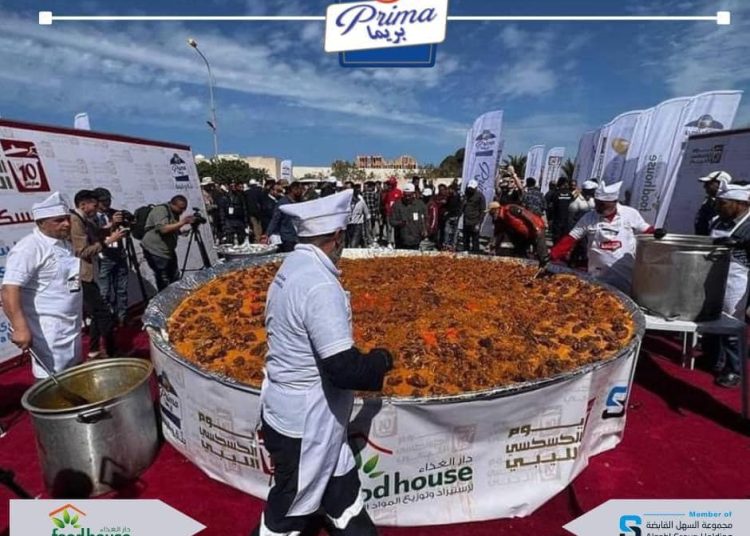
The organisers and sponsors of the Third Libyan Couscous Day 2023 reported that the event succeeded in breaking the world record for the largest couscous dish. They reported that a dish was prepared weighting over 2,500 kgs.
The event was held on Friday in the historic city of Sabrata and is organised by the Libyan Intangible Heritage and Cultural Organization (NGO). It aims to inform the world that couscous is a national Libyan dish and is part of its heritage – along with Tunisia, Algeria and Morocco.
The event was sponsored by a leading Libyan couscous manufacturer.
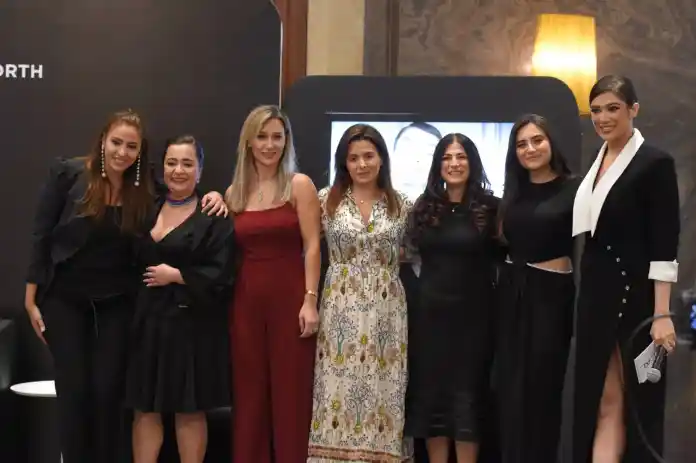
Since 1973, L’Oréal Paris supports each and every woman on her journey to success and self-worth. Through the “Women Of Worth” program, L’Oréal Paris honored 10 leading Lebanese women, who have overcome challenges and achieved greatness in their respective fields, in Lebanon and in the whole world. The awards were delivered during a gala dinner ceremony titled “Walk your Worth”, held on March 28, 2023 at the Middle East Airlines (MEA) Training Center in Beirut.
During the event, Mrs. Emilie Wahab Harb, Managing Director of L’Oréal Liban, said: “As a brand that has always taken on the cause of women’s worth, L’Oréal Paris is proud to recognize and celebrate the outstanding achievements of 10 exceptional Lebanese women who have overcome challenges and achieved greatness in their fields. Their accomplishments inspire future generations and contribute to the development of the Lebanese society, thanks to their passion, dedication, and commitment to excellence.” Moreover, she asserted that “L’Oréal Paris firmly believes that all women are worth it, whereas it’s evident to support their journeys and recognize their successes”, asking all women and those present at the ceremony, to “recognize the power of beauty as a catalyst of self-worth”. She further added: “We are entirely convinced that women’s causes should be celebrated and highlighted. That is the reason why we founded “Women Of Worth” which gathers us tonight, as we follow a journey we started 50 years ago, and which we will firmly continue because women are worth it.”
The honored Lebanese women were chosen by L’Oréal Paris not only for their accomplishments, but also for the values they embody, namely self-confidence, perseverance, resilience:
–Mrs. Nayla Tueni – CEO of An Nahar Newscorp and Editor in Chief of Annahar newspaper. Awarded under the Media category, Mrs. Tueni is a prominent Lebanese journalist.
–Dr. Hiba Al Kawas – President of the Lebanese National Higher Conservatory of Music. Awarded under the arts category. Dr. Kawas is a Lebanese composer, opera singer, scholar, and pioneer of Arab Opera.
–Mrs. Ghida Anani – Founder & Director of ABAAD – Resource Centre for Gender Equality. Awarded under the Social Responsibility category, Ms. Anani led a number of public opinion campaigns, notably the #Undress522 which resulted in the abortion of the article 522 of the Lebanese penal code.
–Captain Rola Hoteit – Airline Pilot at MEA. Awarded under the bravery category, Mrs. Hoteit is an Airbus A320 and A330 Captain, and the first Lebanese female airline captain.
–Mrs. Mireille Hayek – Founder & Owner of Em Sherif: Awarded under the Culinary Category, Mrs. Hayek is well known among the Lebanese and Arab society for her passion for cooking, her dedication and leadership in her restaurant that revives the Lebanese tradition, and which has been a success in Lebanon and abroad such as in London and Monaco.
–Mrs. Yola Zard Noujaim – Architect, Founder of Jabalna Festival & Owner of Al Fundok Hotel. Awarded under the sustainability category, she restored the old school of Maasser el chouf in an understated rural style to become Al Fundok boutique Hotel. This eco hotel is a non-profit community project, which encourages local tourism, creates a sustainable income for the community and promotes environmental, cultural, and culinary estate preservations.
–Mrs. Fadia ElMendelek – Hair Consultant. Awarded under the beauty category, Mrs. ElMendelek is a hair stylist whose talent and creativity earned her many European awards. With an online service and her own line “K by Fadia El Mendelek” of premium all-natural hair care products and extensions, she became the stylist to many celebrities and Arab Royalties.
–Mrs. Danielle Hatem – Founder & CEO of D Does Business. Awarded under the Digital Business category, Mrs. Hatem is an influential blogger who highlights strategic economical facts and figures, with the aim to create awareness about latest business headlines, while influencing and motivating the youth into entrepreneurship and business growth.
–Miss Rana Hayek, Electro-Mechanical Engineer & Car Mechanic. Awarded under the outstanding category, she’s Lebanon’s first female car mechanic. She is a diagnosis engineer at Sigma, the exclusive agent for Seat, Mitsubishi, and Ducati.
–Miss Aleen Sabbagh – Founder & Owner of The Concept. Awarded under the fashion category. What started as a personal devotion to fashion turned into a full-fledged clothing brand. Aleen Sabbagh, the young Lebanese face behind it all, goes from one factory to the other looking to constantly design drop trendy collections that always manage to sell out quickly.
The event was presented and moderated by Ms. Nadine W. Njeim, who discussed with each awardee her journey to success. It was attended by an audience of more than 150 invitees including public figures, the awardees’ families, journalists and representatives of various Lebanese media outlets, bloggers and social media influencers, as well as L’Oréal’s team and partners of L’Oréal Paris in Lebanon.
Dubai – Dubai is the also the most record-breaking city not just within the country but also across the Mena region.
The UAE is far ahead in achieving the Guinness World Records regionally as the country boasts 425 GWRs with 34 of them were achieved in 2020 alone.
Dubai is the also the most record-breaking city not just within the country but also across the Middle East and North Africa (Mena) region.
“The UAE is currently home to 425 Guinness World Records titles, making it the biggest record-breaking country in the Mena region… Dubai has the lion share of titles in the country with around 60 per cent of the overall number,” said Danny Hickson, senior events production manager at Guinness World Records Ltd in Dubai.
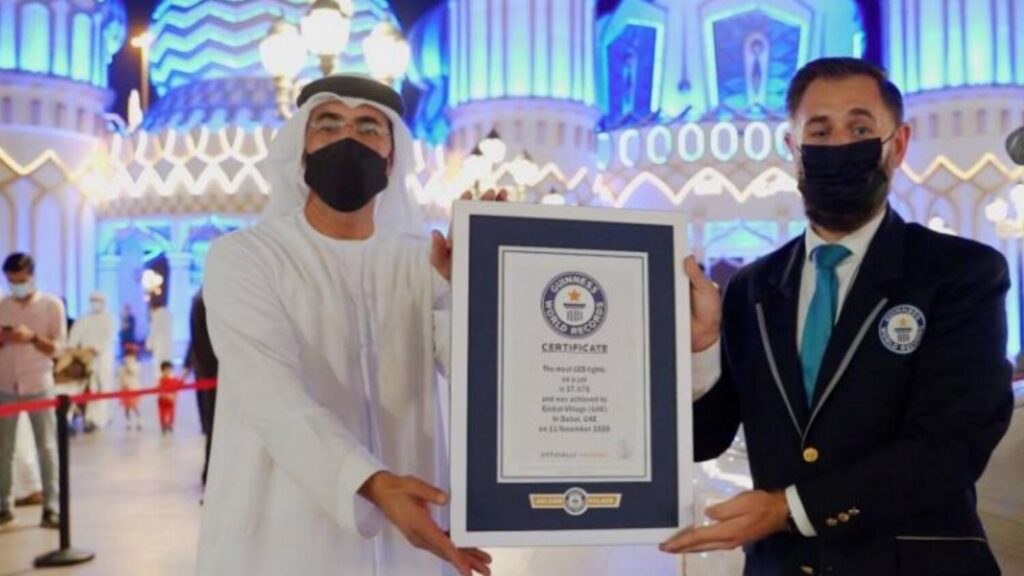
Global Village, a multicultural family entertainment destination, achieved two records in November alone. The first record was set by having the most LED lights ever on a car. The vehicle had 36,676 LED lights. The feat began two weeks ago as the park achieved the record for the most videos in a music medley video following the Rockin’1000 Season 25 opening concert.
Global Village aims to break 25 records this season as part of its Silver Jubilee anniversary celebrations.
Emirati shipbuilder Obaid Jumaa bin Majid Al Falasi also made it into the history by building the world’s largest dhow, a wooden Arabic boat, measuring 91.47-metre long and 20.41-metre wide. That is equal to the length and almost half the width of a standard American football field floating over the Indian Ocean.
Dubai’s Nakheel Mall, too, recently broke the record for the world’s largest fountain, measuring a whole 7,327 m2. The record breaking fountain named The Palm Fountain was designed a with tricks including colour and brightness controls.
The emirate is also home to the world’s tallest hotel – 75-storey Gevora Hotel, measuring 356.33 metres tall from the group level to the top.
Danny Hickson said Saudi Arabia comes second with 96 Guinness World Records titles, while Egypt is not far in the third place with 93 titles.
On September 23, Saudi Arabia achieved the Guinness World Record for the largest fireworks display in multiple cities as the display consisted of 962,168 fireworks.
“What’s brilliant about breaking world records with brands in the UAE is that there is almost a chance to do something different with the heritage. Brands and individuals think it is impossible to be break world records, but we believe everyone is amazing in his own way, and we are here to make their achievement Officially Amazing!,” said Hickson.
“We have seen the tallest house of cards build in 12 hours, sat on top of a washing machine, to demonstrate its reduced vibrations and noise levels; and an iconic car brand celebrated its 80th anniversary by breaking the record for the largest loop the loop in a car! Would we find amazing talents among Khaleej Times readers?,” concluded Hickson.
Lebanese designer represents Moroccan culture and feminine beauty at Maroc Fashion Week.
Maroc Fashion Week ran from March 8 to 11 in the city of Marrakech. The purpose of the event was to represent the Moroccan caftan and to further celebrate International Women’s Day.
Morocco World News spoke with Lebanese fashion consultant and designer Bernard Jabbour about his newly presented collection, Poisonous Beauty.
The esteemed designer has 28 years of experience in the fashion industry, some of Jabbour’s extensive experience includes his work as a consultant for Lebanese fashion designer Elie Saab and Project Runway Middle East. The designer is mostly known for his work at his Lebanon-based fashion studio, in which he specializes in haute couture – high-end, custom, and handmade fashion – including evening and wedding gowns.
Jabbour has visited Morocco twice before, but the most recent visit marks more of an official trip at one of the “biggest events,” hosted at what the designer described as a “beautiful country.” Poisonous Beauty is also the first-ever collection that he has debuted at Maroc Fashion Week.
“They say I’m classic yet with a twist. I try every time to put something new in my designs, but you can always see the touch of Bernard Jabbour. My DNA is always present in my designs,” Jabbour explained.
Enticing and dangerous inspiration
His primary inspiration for all of his collections is the presence of the woman; each collection simply approaches the woman figure a little differently to create a unique design for every season. Poisonous Beauty is one of his more ambitious and “tricky” projects.
The thought process behind the idea relays his thinking that women are a “beautiful poison that … we want to have … Her soul, her look and everything is poisoning us, but we also ask for it.” The designer sees a woman’s figure and aura as something both enticing and dangerous, a familiarity that when studied and analyzed through an artistic lens, appears unique and foreign.
Furthermore, Jabbour explains that he has experimented with “unconventional material” for this very collection as well, with new volumes and calmer color palettes.
Jabbour’s most prized dress in the Poisonous Beauty collection is one that is inspired by Moroccan architecture. It was never intended to be a part of this collection, but Jabbour says that “because I’m here in Morocco Fashion Week, I said no. I have to do one dress dedicated to Morocco.”
In regards to Maroc Fashion Week, Jabbour applauds the beauty and representation of the caftan: “I have … few Moroccan designer friends … [but] I like how they make the caftan. The handwork they put in the caftan, it’s like really magic.”
The designer felt amazed by the multiculturalism that he and other designers were exposed to at Maroc Fashion Week. Jabbour mentioned that the event unites people from across the globe he said, including countries such as “Kazakhstan, Italy, Lebanon, and Palestine.”
Jabbour is one of many international designers who helped in paying tribute to women’s presence and cultural recognition in the ever-developing world of the international fashion industry.
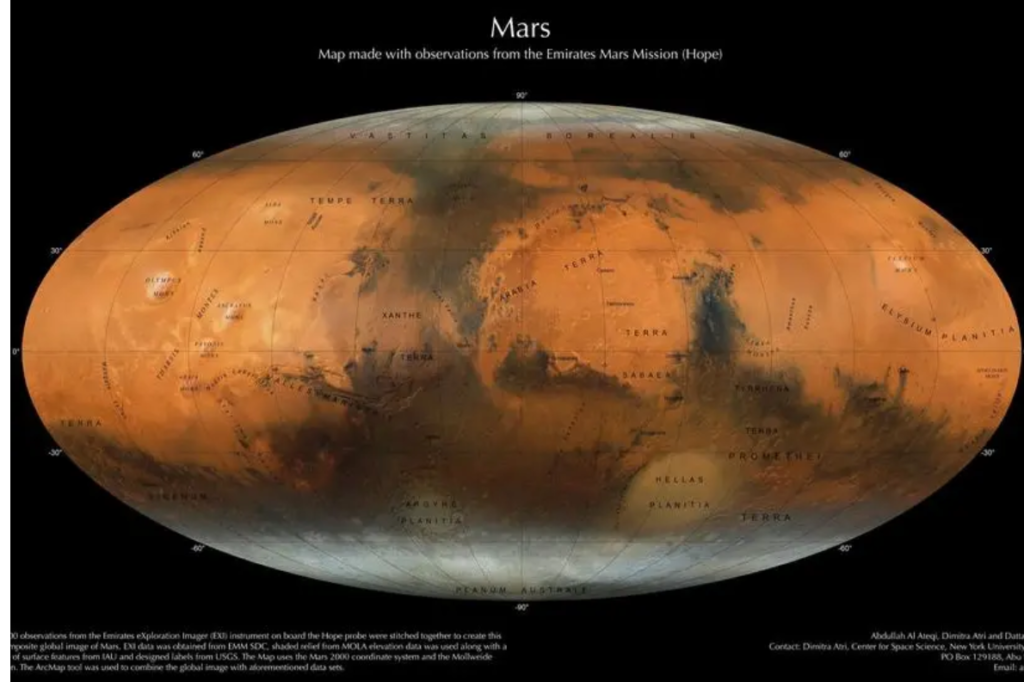
NYU Abu Dhabi (NYUAD) group leader and research scientist Dimitra Atri from the Centre for Space Science and his team have created a never-seen-before map of Mars, using images exclusively created from the Emirates Exploration Imager (EXI).
The EXI is a state-of-the-art imaging system on-board the Emirates Mars Mission (EMM), also known as Hope or Al-Amal, which is currently orbiting Mars. The global photographic map not only showcases new images of the Red Planet from the perspective of the Hope probe, but is a testament to the UAE’s huge advancements in the field of science, and will be a valuable resource to motivate young people to pursue careers in STEM (science, technology, engineering and mathematics) disciplines in the UAE.
The Mars Map combines more than 3,000 observations, produced by Hope’s onboard EXI instrument. Atri and his team created the colour composite map by stitching together the thousands of observations from the EXI instrument over the course of one Mars year (two Earth years).
Commenting on the project, Atri said, “We plan to make our map available to the entire planet, as part of the new and more advanced Atlas of Mars, which we have been working on, and will be available in both English and Arabic once published. The hope is that this accessibility will make it a great tool for researchers, and also students to learn more about Mars, and showcase the possibilities that the space sector in the UAE can offer.”
The Mars Map shows regions and features of the Red Planet in exceptional resolution, highlighting all its major features. For example, polar ice caps, mountains, volcanoes, remnants of ancient rivers, lakes, valleys, and impact craters are visible. Such highly detailed maps are an essential foundation upon which future scientific research on Mars can be built. The map will further allow scientists to learn about momentous shifts in climate that can fundamentally alter planets, which will provide insights that may be able to help us on Earth too.
“The complete Mars Map also brings the UAE and the Arab world another step closer to achieving EMM’s ambitious mission goal, to provide a complete global picture of the Martian climate,” Atri added.
“More than 30 previous spacecraft have only managed to capture a snapshot of the Mars weather, whilst EMM will follow the seasonal changes throughout a Martian year. The Hope probe is helping researchers to create this global image of the planet due to its strategic position. Hope circles Mars in an elliptical orbit that allows it to observe from much further away than any other spacecraft. This strategic position is helping researchers to create a global image of the planet,” he said.
EMM is the UAE and the Arab world’s first interplanetary mission commissioned by the country’s leaders in 2014. The spacecraft was launched from Japan on 20th July, 2020. Seven months later, on 9th February, 2021, the Hope probe entered Mars’ orbit.
In our continuing series of inspiring life stories across continents, we hear about the Egyptian-American economist’s battle to overcome institutional prejudice.
It was speech day in the last week of secondary school when Mohamed El-Erian might have been forgiven for thinking that all lessons had come to an end, but there was one more in store for the unsuspecting student.
Seated in the audience, flush with the thrill of winning a scholarship to read economics at Queens’ College, Cambridge, Mohamed was listening as the roll call of the cohort’s achievements was read out.
The teenager, an Egyptian-American, was the only foreign pupil at St John’s, Leatherhead, then a private boys’ boarding school in a leafy town just south of London, and one of two in the year to have gained entry to Oxbridge, the duopoly of grand ancient seats of learning in the cities of Oxford and Cambridge.
The feeling of being about to go up to Cambridge was “incredible, absolutely incredible”, yet when the headmaster wrapped up the announcements there had been no mention made of any El-Erian. Nor was his honour logged, like that of the other successful applicant, on the school record.
Mr El-Erian, now 62, known to millions as a globe-trotting economist who has shaped thinking about historic twists in the world’s fortunes, was recently elected as president at his alma mater at the University of Cambridge, the place that equipped him so well for his stellar future.
But back in the 1970s, the struggle for recognition with his old school was to last almost the entirety of his undergraduate degree and would inadvertently serve “as an indication of the institutional racism that was still ripe at that time” in England.
To this day, Mr El-Erian, credits one of his masters at St John’s School, Bill Chubb, for not only inspiring him to succeed but for taking up the three-year fight to have the school and its headteacher recognise that triumph.
Fast forward more than four decades and the circle has completed in proper order. “Our congratulations to Dr Mohamed El-Erian (West 1973-1976) on his election as the 42nd president of Queens’ College, Cambridge,” announced a recent issue of the school’s The Old Johnian publication. “He will take up office from October 2020. Mr El-Erian won a scholarship from St John’s to read economics at Queens’ College.”
The new president of the college founded in 1448 arrived in post six months after the pandemic hit. His social media feeds are filled with scenes from across the picturesque city, whether of the Mathematical Bridge, the 270-year-old wooden structure he wanders over to reach the half-timbered lodge where he now lives, or the surrounding countryside he walks in with his beloved dog Bosa.
Unsurprisingly, one of the key objectives he aims to deliver on is expanding access to the college to more people from diverse and less advantaged backgrounds.
He also wants to encourage students “to do even better what they already do well”, which he himself learnt after arriving at Cambridge full of worries about being able to keep up academically, making friends or fitting in.
“It took me some time to get over this ‘imposter syndrome’ and, returning for my second year, I had a noticeable bounce in my step,” Mr El-Erian tells The National.
However, when he went to the customary beginning of term meeting with his director of studies in economics, Andy Cosh, he was asked how he thought it had gone so far.
“When I responded ‘great’ to his question about my first year, he immediately said: ‘You could and should do so much better.’ That remark had a notable impact on me. And I took it to heart.
‘With a mix of renewed determination and nervous excitement, I tried to do both more and better. I was fortunate enough to end up getting a first class honours degree, captain of the football team, on the squash team, and making amazing friendships that have lasted to this day. Moreover, every year was more fun than the previous one.”
Mr El-Erian, though, credits the entire experience of studying at the revered institution for broadening his horizon, exposing him to robust academic discussions, providing key analytical tools, and introducing him to interdisciplinary approaches.
Knowledge gains such as these propelled him on to the world stage. His career began at the International Monetary Fund in 1983, straight after a doctorate in economics at the University of Oxford.
Joining the Washington-based lender had never been part of his initial plan, though. “I had intended to be an academic,” he says.
When his father died suddenly, Mr El-Erian felt an imperative to find a higher-paying job than one in academia to help his “amazing mother” support his seven-year-old sister.
“The IMF ended up being an outstanding experience, exposing me to remarkable economic and financial policy issues at a relatively young age,” he says.
After 15 years, he moved into the private sector with Salomon Smith Barney/Citibank in London, where he wanted to understand how finance and “the plumbing of the international economy” worked.
It was not long before the axiom “when El-Erian speaks, Wall Street listens” was coined.
From there, he joined the global investment management company Pimco in 1999 as head of emerging markets portfolio management, latterly becoming chief executive and co-chief investment officer of the then $2 trillion investment fund.
Until, that is, the father of two got an unexpected memo, received after telling his 10-year-old daughter to brush her teeth. “She asked me to wait a minute, went to her room and came back with a piece of paper. It was a list that she had compiled of her important events and activities that I had missed due to work commitments,” he said in a 2014 interview. Jotted down were 22 milestones for which he had been absent: her first day of school, first football game, Halloween parades, several recitals.
“Talk about a wake-up call … my work-life balance had gotten way out of whack, and the imbalance was hurting my very special relationship with my daughter.”
Famously, he quit. Afterwards, he invested more time in his family and became economic adviser to the management board at financial services company Allianz, a role he still holds part-time today.
He also wrote The Only Game in Town, his second New York Times best-seller, on the protracted policy over-reliance on central banks. His first book, the award-winning When Markets Collide, which highlighted the growing fragilities and the likelihood of major meltdown, was published just before the 2008 global financial crisis.
Writing – books and economic analysis articles for media organisations – helps expose gaps in his knowledge and discipline his thinking process.
It is a personal philosophy inspired by his father, who gained a doctorate on scholarship to Columbia University, was a professor at Cairo University and later joined the diplomatic service with postings to the United Nations mission in New York and the embassies in France and Switzerland. He was then elected judge of the International Court of Justice in The Hague.
As a consequence, Mr El-Erian’s upbringing was very international. He was born in New York and schooled there as well as in Cairo, Paris and St John’s, where his Egyptian parents hoped to give him the stability of learning one academic curriculum in one language – he speaks four: English, French, Arabic and Spanish – and the chance to make friends.
There was a particular interaction with his father that stands out in Mr El-Erian’s memory. Every morning, El-Erian Snr read the five newspapers delivered to the ambassadorial residence in France. Occasionally, he would check if his teenage son had read them, too.
“I asked him what was the point of having so many newspapers as, after all, ‘the news is the news’.
“‘Wrong’, he responded and explained that through the range of newspapers we were receiving, I had access to a range of political perspectives.”
The message was clear that unless the young El-Erian was regularly exposed to different opinions, he would not have sufficient awareness to make sound decisions.
“This emphasis on what we call today ‘cognitive diversity’ has been a major driver of my life since,” he says. “I often feel that I operate at intersections – or, as my daughter says, ‘in the in-between’. And it is why I feel so strongly about promoting diversity and inclusion.”
The issues surrounding diversity and inclusion crop up at many points during the conversation, as they have in Mr El-Erian’s life, something he largely attributes to his Arab roots, which have had a great influence on him.
He believes that the West does not fully understand the Middle East and North Africa, primarily because the conditions in Arab countries vary so widely.
“The result is either excessive generalisation and over-dramatisation or, worse, a sense that the region has lost its way and is too unpredictable to deal with,” he says.
“Looking forward, and this is not just highly desirable but also very feasible, the critical requirement is to unleash the incredible potential of the youth. The region is full of talented young people with massive upside, and with some who have already done amazing things when placed in an enabling environment.”
Mr El-Erian, of course, knows about this first hand. He has encountered prejudice many times and still does even all these years after that speech day snub.
“I have learnt to deal with this and, more generally, am committed to ensure that biases, conscious and unconscious, do not get in the way of people with amazing potential,” he says.
It is the kind of input he wants to have at Queens’ College – despite residing in the Tudor-style President’s Lodge among the older buildings known affectionately but somewhat ominously by the students as the “dark” side. As opposed to the “light” side represented by the newer buildings on the opposite bank of the River Cam.
“I love being back, and for many reasons,” Mr El-Erian says. “One of them includes the ability to walk in a beautiful town with inspiring scenery and surrounded by smart people, many of whom are trying to solve complex problems and make the world better.
“I am not thinking beyond Cambridge,” he says. “I am delighted to be here and have a lot to do working with colleagues to continue to enable current and future generations to contribute to society in multi-faceted ways.”
The professional aspirations are ever-present, as much as Mr El-Erian is enjoying the simple pleasures of the university city once again. He and Bosa can regularly be spotted tramping across fields early on a foggy morning. It is, he says, an invaluable time spent listening to podcasts and radio shows, envisaging forthcoming articles, gathering his thoughts.
He is living a new phase of his life back at the heart of Queens’, no longer the awkward undergraduate with imposter syndrome but a global powerhouse returned to right the wrongs of the past.
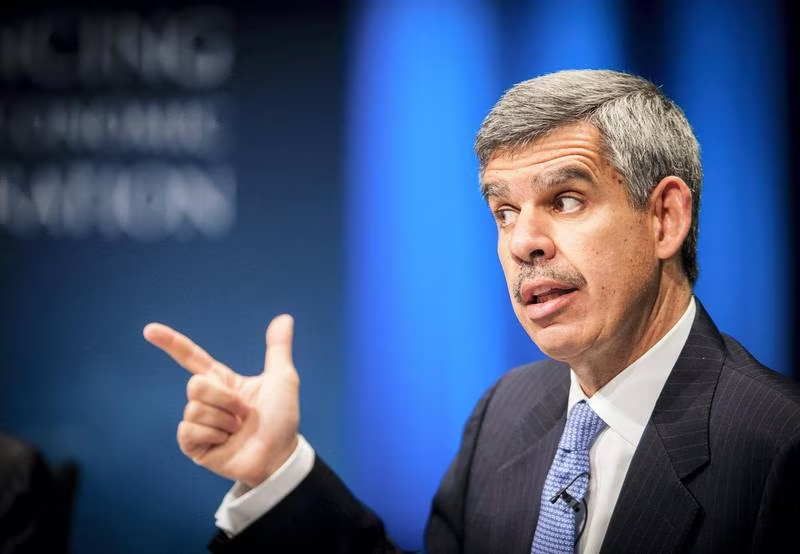
Mohamed El-Erian, economist: ‘It is my hope that, through visionary leadership and better coordination, 2022 will be remembered proudly as the year we both won the war against Covid and secured the foundation for a fulfilling, prosperous, and durable peace for all.’ Bloomberg via Getty Images