SAUDI ARABIA: World’s Largest Light Ball illuminates Riyadh Season 2022

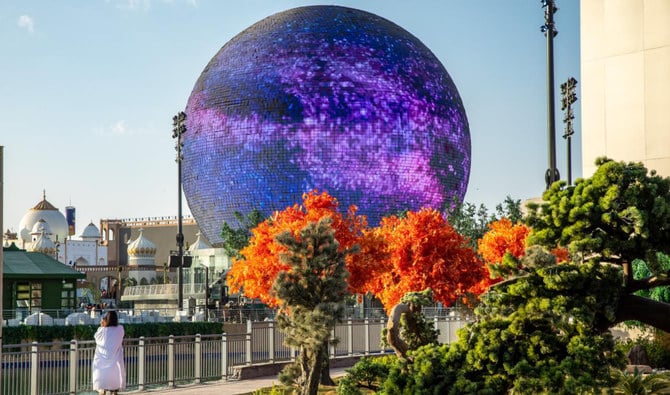
A new modern landmark in the capital of the Kingdom, the Light Ball, has been named by Guinness World Records as the largest illuminated LED ball in the world, with an estimated height of 35 meters.

Located at Boulevard World, the exterior of the ball emanates bright lighting that flickers in different patterns, while the interior boasts a 220-seat theater equipped with state-of-the-art features.

Guests can recline in their seats facing a 360-degree circular screen. The short films presented in the theater are five minutes long, with varying genres suitable for families to enjoy. The shows run every 30 minutes daily from 3:30 p.m. to 10:30 p.m.

In addition to cultural experiences, Boulevard World includes the largest artificial lake in the world. Visitors can take part in boat and submarine rides in the lake — a first for Riyadh Season.

There are also distinctive entertainment options, such as Combat Village, Super Hero, the largest sphere in the world and cable car trips between Boulevard World and its neighboring zone, Boulevard Riyadh City.

The zone offers visitors other entertainment experiences as well, such as Boulevard Pier, Discovery, Realistic Monopoly, The Mountain, Area 15, Ninja Warriors and Fun Zone for children.

source/contents: arabnews.com (headline edited)

___________

Located at Boulevard World, the exterior of the ball emanates bright lighting that flickers in different patterns, while the interior boasts a 220-seat theater equipped with state-of-the-art features. (Supplied)

_________________

SAUDI ARABIA

KUWAIT: 15 Kuwaitis Who Made Their Country Proud in 2022

The Kuwaitis continued to make many distinguished achievements and achieved results in various fields and at the various local, regional and international levels, which were recorded for their work and creativity, reports Al-Rai daily. The following are the most prominent of these achievements during the year 2022.

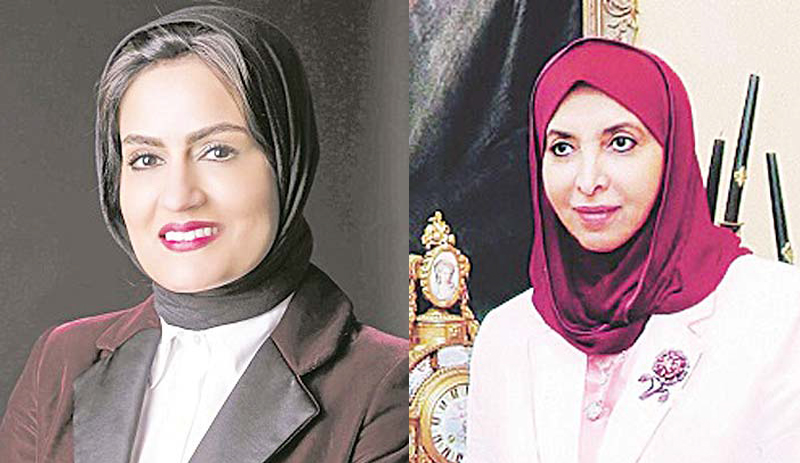
February 10: Dr. Hind Al-Qadri, a researcher at the Dasman Diabetes Institute of the Kuwait Foundation for the Advancement of Sciences, won the 2021 L’Oréal UNESCO Prize for Women in Science within the Middle East Regional Program for Emerging Female Researchers. (see picture below)

February 24: Kuwaiti parachutist Ibrahim Al-Rubaian recorded an unprecedented feat by jumping from a height of 13,000 feet with the biggest fl ag in the sky of Kuwait, with an area of 800 square meters, under the slogan “I raised glory and soared with pride,” coinciding with the national holidays.

February 26: The State of Kuwait entered the Guinness Book of Records by hoisting the country’s largest flag measuring 2,742 square meters and installing it on a mountain peak in the Sultanate of Oman (Jabal Shams), at an altitude of 3,028 meters above sea level, in conjunction with national holidays.

March 21: The Arab Organization for Education, Culture and Science (ALECSO) honored Sheikha Dr. Suad Al-Sabah, in recognition of her brilliant contributions in the literary and cultural fields, at its eighth session of the “Arab Poetry Day” in the Tunisian capital.

April 23: The International Professional Diving Instructors Organization awarded the Kuwait Scientific Club Center for Swimming and Diving a Certificate of Excellence for its contribution to the development of the diving industry inside and outside Kuwait.

June 12: Kuwaiti researchers Dr. Nasser Al-Sayegh and Dr. Ammar Bahman obtained a patent from the US Patent Office, for their invention of a device capable of characterizing the physical state of nanosuspensions dispersed in nanofluids during the dynamic fl ow process.

June 29: Kuwait University announces that Assistant Professor of the Department of Surgical Sciences at the College of Dentistry, Dr. Muhammad Kamal, and the Consultant of Nose and Throat at the Ministry of Health, Dr. Abdul Mohsen Al-Turki, obtained a patent from the United States of America for an alternative medical splint to the nose wicks.

July 2: The International Pharmaceutical Federation selected Dr. Dalal Al-Taweel, Assistant Dean for Student and Academic Affairs at the College of Pharmacy, among 20 rising stars in the field of pharmaceutical research and pharmaceutical education.

August 11: The League of Arab States honors the Kuwaiti youth, Abdullah Al- Shammari, who won the third place for the “Excellence Award for Arab Youth 2022” in the field of “voluntary work” granted by the Council of Arab Ministers of Youth and Sports. The award came about the “Al-Amal Electronic Newspaper” project, which is concerned with the affairs of people with disabilities.

October 2: Plastic artist Munira Al-Qadiri won the prize of the 15th session of the German “Trina Fellbach” exhibition for small sculptures.

October 3: Dr. Badr Al-Enezi, from the Department of Environmental Technology Management at the College of Life Sciences at Kuwait University, obtained a patent on “improving water and solving the problem of environmental pollution in a scientific way” from the United States Patent and Intellectual Property Office.

October 9: Kuwaiti photographer Muhammad Murad won first place in the prestigious international “Mont Photo” competition for photography in the natural world in Spain.

October 12: The European Union of Medical Specialties selected Dr. Muhammad Kamal, a Kuwaiti academic, as the first examiner from outside the continent for the Board of Oral, Maxillofacial, and Head and Neck Surgery. The selection was made during the last session held in the Spanish capital, Madrid.

October 12: Lama Fahad Al-Ariman received the “Rising Space Leaders” award presented by the International Astronautical Federation as the representative of the State of Kuwait in this international competition.

October 30: Kuwaiti photographer Muhammad Murad won the top honorary prize in the African “Benjamin Mkapa” competition for developing African wildlife and the American “Nature Best” competition.

source/content: arabtimesonline.com (headline edited)

____________

Dr Hind Al-Qadri and Sheikha Dr Suad Al-Sabah

__________

KUWAIT

SAUDI ARABIA Ranks First Globally among Donor Countries in offering Relief Assistance

Aid constitutes 1.05 percent of Saudi Arabia’s gross national income, says KSrelief chief.

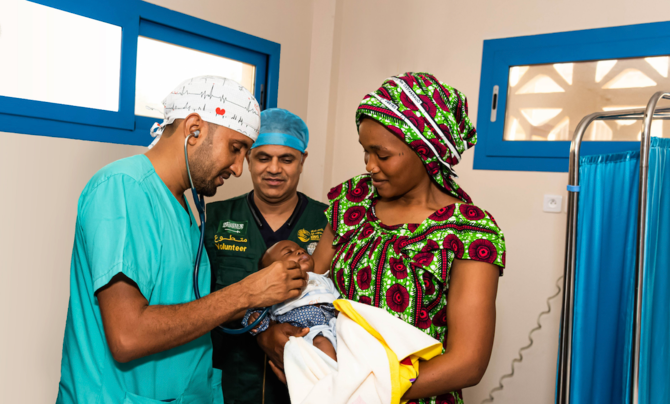
Supervisor General of the King Salman Humanitarian Aid and Relief Center Dr. Abdullah Al-Rabeeah said that Saudi Arabia ranked first among donor countries in offering official development assistance (humanitarian and development) to low and medium-income countries, with a total of SR26.71 billion ($7.12 billion), according to data published by Development Assistance Committee of the Organization for Economic Cooperation and Development.

The data showcased the official 2021 development assistance offered by donor countries — member states and states with associate memberships at DAC, where the Paris-based committee is considered the biggest forum.

In a statement published by the Saudi Press Agency on Monday, Al-Rabeeah said that this assistance constitutes 1.05 percent of Saudi Arabia’s gross national income.

He added that by this proportion the Kingdom has topped the donor countries and surpassed the target approved by the UN General Assembly in October 1970 that donor countries should allocate a 0.7 percent of their gross national income as official development assistance while seeking innovative sources of financing development in developing countries.

KSrelief is exerting relentless efforts to register Saudi Arabia’s humanitarian and development assistance in the Saudi Aid Platform launched by King Salman in 2018, where assistance is documented in cooperation with relevant Saudi ministries and departments to highlight the Kingdom’s humanitarian and development identity, he said.

Al-Rabeeah expressed appreciation for the efforts of these agencies in documenting and recording the assistance provided by Saudi Arabia to the countries of the world through international platforms in accordance with internationally approved standards.

“The directives of King Salman and Crown Prince Mohammed bin Salman have contributed to this big achievement that put Saudi Arabia at the top of international humanitarian action,” he said.

Concluding his speech, Al-Rabeeah extended his appreciation and gratitude to the Kingdom’s leadership for its unlimited support and concern for humanitarian action, which ensure Saudi Arabia maintains its prestigious global status in this field. 

source/content: arabnews.com (headline edited)

____________

Beneficiaries of a KSrelief medical project for open-heart surgery and catheterization in Mali can be seen. (KSrelief)

_________________

SAUDI ARABIA

EGYPTIAN Mezzo Soprano Farrah El-Dibany Performs French Anthem in FIFA World Cup Qatar 2022 Final – December 18th

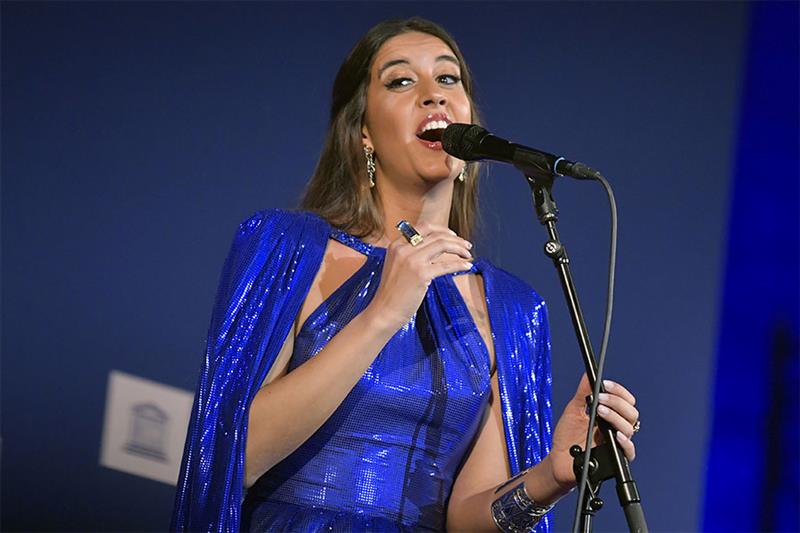
Egyptian mezzo soprano Farrah El-Dibany has performed La Marseillaise the French national anthem, in the beginning of the final FIFA World Cup match against Argentine in Doha, Qatar on Sunday.

Farrah El-Dibany has sang during the re-election of Emmanuel Macron on April 24.

She was awarded France’s Ordre des Arts et des Lettres in the grade of Chevalier (Knight) by France’s Ambassador to Cairo Marc Baréty during an official ceremony in April.

Born in Alexandria in 1989, El-Dibany is one of the well-known Egyptian singers of her generation, establishing herself on an international scale in a short time.

Read more about Farrah  El-Dibany here.

source/content: english.ahram.org.eg (headline edited)

____________

_________

EGYPT

SYRIAN-LEBANESE: Defender of the Displaced: Dr. Rouba Mhaissen, Economist & Activist – puts the World to Rights

The Syrian-Lebanese economist and activist favours advocacy now over anger in her humanitarian mission to protect refugees.

Rouba Mhaissen was on a spring break in Beirut to visit her parents when she heard about the 40 families fleeing lives that had become intolerable over the border in Syria.

It was 2011, when the term “Syrian refugees” did not yet exist, and the arrivals were a harbinger of something inconceivable to Ms Mhaissen back then – the largest displacement crisis of our time.

Little knowing that the families would still be refugees more than a decade on, the 22-year-old student at the London School of Economics raced off to see what they needed.

“I took the family car and drove to meet the families to offer them help,” she tells The National.

“My parents were very worried. At the beginning of my work and until this day, they worry about me because there are risky situations.

“You get threats, and our advocacy work, in particular, can be very controversial. But they believe in the cause and support me.”

Fast forward a decade, and Ms Mhaissen is in London to appear at a charity event run by the Hands Up Foundation as the founder of Sawa for Development and Aid, a grassroots organisation that offers protection, education and relief for Syrian refugees in Lebanon.

Sawa, which means “together” in Arabic, now has about 400 employees, many of whom are from refugee communities, and operates in 130 camps.

In some ways, it is a continuation of work that the young Rouba began as a child in Beirut and Damascus, where she would often volunteer to assist orphans, and refugees from Palestine and, later, those from Iraq.

“I never knew that this would be my career,” Ms Mhaissen says. “I thought I was going to be an academic.

“When the war started in Syria in 2011, I had already applied for my PhD and had no idea I would only end up being a part-time academic.”

Born in Beirut, a “surprise” 10 years after two brothers and a sister, she had been gently steered towards academia by her Lebanese stay-at-home mother and father, a Syrian businessman.

She claims to have been raised as a very spoilt last child yet her parents convinced Ms Mhaissen against studying her heart’s desire, theatre, because it was not what they described as a rigid path.

“I definitely think that, if I was reborn, I would be a dancer because I love to dance and perform,” she says.

It was not to be. Ms Mhaissen grew up going to school in Beirut because the education was deemed better there, and then driving as a family two hours to Damascus for the weekends.

After an undergraduate degree in economics at the American University of Beirut, she embarked on a master’s in development studies at the LSE, followed by a PhD in gender and development at the School of Oriental and African Studies at the University of London.

Somehow, in the middle of all these studies, she found the time to start Sawa, through which Ms Mhaissen unsurprisingly gives priority to education.

Of prime importance to her is that refugees acquire skills to live in dignity, take ownership of their lives and rebuild their communities themselves.

The demands have been many, and, with the spread of coronavirus, she thought that perhaps she might finally learn what it is to relax a little.

“I love, love, love travelling, learning about new cultures, new food and new countries,” Ms Mhaissen says. “But with my son now it’s very hard.”

She shuttles between southern Turkey, Beirut and London with her husband, a one-year-old and another baby on the way.

The pandemic gave rise to a more acute need for aid than ever, although one silver lining is that the whole world has for the first time experienced what it is to be refugees – at least the uncertainty, the inability to plan ahead and lack of communication.

“Camps are one of the hardest environments to sit out Covid as there is nowhere to self-isolate, no internet or devices for home-schooling, and gender-based violence rose dramatically,” Ms Mhaissen says.

“People talk about refugees and their ‘resilience’, a term that is so misused. Conditions for refugees in host countries and their neighbours are constantly terrible and getting worse all the time.

“A Syrian family in Lebanon has to move their tent three times on average in winter when it floods, and then people wonder why they get on boats. It’s because they have no hope.”

Over the years, Ms Mhaissen has received many accolades and honours, including being named on the 2017 Forbes 30Under30 list of most influential people in Policy and Law.

There was also the Vital Voices Global Leadership Award and the Rafto Prize “for defending human rights from the local to the global level for people living as refugees”, both in 2019.

She has been invited to conferences, summits on Syria – at one in Brussels she met her husband, an activist from Aleppo – and this year became the 10th Arab woman to address the UN Security Council.

Late last month, days befor 27 migrants died in the English Channel, she was at the Opera Garnier in Paris being presented with the International Diane von Furstenberg Award alongside businesswoman and philanthropist Melinda Gates, CNN chief international correspondent Clarissa Ward, Burmese human rights advocate Wai Wai Nu, and climate change activist Vanessa Nakate.

She took the opportunity to tell the room full of European policymakers and philanthropists that attempting the crossing is not an illegal act.

“You have the right legally to apply for asylum in whatever country you are in,” Ms Mhaissen says. “We need to live up to our responsibility to these people.”

She also talked about the refugees stuck at the border of Belarus and Poland, and of one in particular, Ahmed, who had grown up in a camp, but was the first of the refugees to be buried officially after he drowned in a river there. His mother joined the funeral on a conference call.

“I reminded those listening that this was a woman who had been pregnant with him, who had celebrated his birthdays, who had brought him up like any mother, and who was now connecting with him on social media, just like [those in the audience] used social media to connect with their loved ones during the pandemic … except this was his funeral.

“Everyone was really moved and many were in tears. I always try to humanise it for the wider public, and I use the word ‘humans’ as often as I can when I talk about refugees.

“‘Refugee’ carries a lot of legal rights with it so while there is certainly fatigue associated with the word, it’s not a redundant word that we should stop using.

“Politicians, on the other hand, want us to call them migrants because it sounds more scary.”

The citation on the DVF award was for Ms Mhaissen’s “dedication and fierceness to support displaced Syrian individuals and families”, which world leaders gathered at the Support for Syria donor conference in London a few years earlier experienced in full force.

She was the first speaker up and was introduced by then UN secretary general Ban Ki-moon, who said: “Rouba Mhaissen, you have the floor. Two minutes.”

But a stern-looking Ma Mhaissen retorted that, as one of the few Syrians at the event speaking in the name of Syria, she wasn’t sure that she would stick to two minutes. She was at the podium for nearly nine.

It was a passionate speech in which she criticised “Fortress Europe”, her “token presence at an ad hoc event for which the priorities have already been pre-determined without our involvement”, and counter-terrorist legislation stopping funds being sent where they were most needed.

“Don’t fight the wrong people, guys,” Ms Mhaissen said.

She said she could see good leaders in the room but hoped for greatness from them along the lines of “the next Martin Luther King, the next Benazir Bhutto, the next Churchill, the next Madeline Albright, the next Mandela of our time …

“Each one of you can be that person,” she told them, “Remember that.”

Ms Mhaissen smiles at the memory.

“I realised that those in power have incredibly thick skin,” she says. “They are inured to what the situation is on the ground.

“I used to be very angry and lead a crazy life where I would come out of the field where kids had to step over their parents’ dead bodies to get to safety, and then you’re invited as the token Syrian to an event in a five-star hotel where people are drinking champagne and eating caviar.”

With a dawning realisation that advocacy, not anger, was the way to go about beating the system, the focus has since been more on changing laws that help refugees and doing the day-to-day work that affects people’s lives.

Her spirituality has been of great support throughout. “Knowing that God has been alongside me all along, and my faith, have helped me along the way,” she says.

Ms Mhaissen’s message to those gathered on Wednesday night in the 17th-century Great Hall of Lambeth Palace at the annual Singing for Syrians carol concert will be comparatively gentler in nature.

The event raises funds for Hands Up Foundation’s humanitarian work in Syria for which Sawa is a partner on educational projects.

This year it will feature the author and illustrator Nadine Kaadan, Citizens of the World Choir, actress and activist Joanna Lumley and actor Tom Hollander.

She will, she says, of course push everyone to donate to the foundation’s Big Give Christmas Challenge as a firm believer in how the deeds of the few can transform the lives of the many.

“I always say that what goes around comes around, and the more we give the more blessed our lives are,” Ms Mhaissen says. “It’s like investing in the best thing ever.”

The memory of an email received from a young Icelandic citizen will also be shared. It arrived in her inbox at the time of a terrible massacre in Syria, with the sender asking what help he could give.

Shocked, Ms Mhaissen recalls staring at the message for a long time, wondering how to answer a person on a Nordic island country in the North Atlantic Ocean.

“I told him, ‘If you want to help Syria today, call your mother. Just call your mother and see how she is doing. We are in a world of small circles and they are all interconnected …

“Sometimes,” she says, “it’s best just to start local.”

source/content: thenationalnews.com (headline edited) 

___________

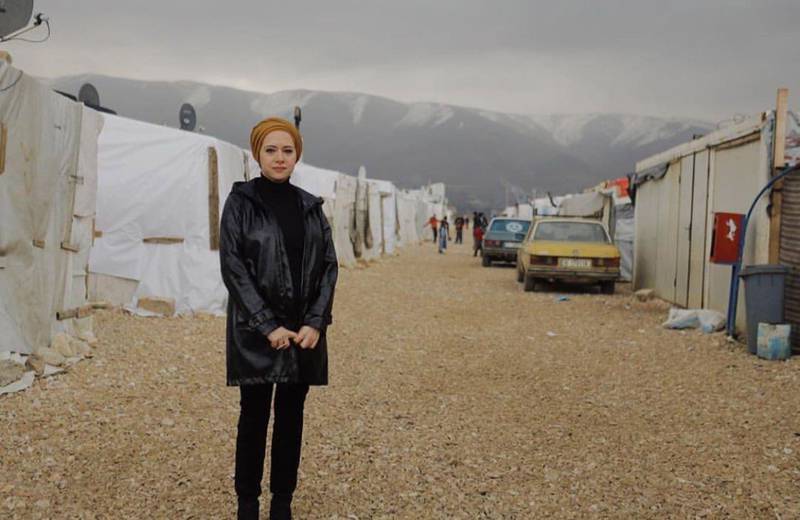
The founder of Sawa for Development and Aid, Rouba Mhaissen, in a refugee camp in the Bekaa Valley, Lebanon. Courtesy: Rouba Mhaissen

______________________

SYRIAN / LEBANESE

LEBANESE Icon Fayrouz — the Arab World’s Greatest Living Singer

She is the Arab world’s greatest living musical icon, but Fayrouz remains an enigma. She retains a sometimes-infuriating aura of mystery, rarely giving interviews and ardently protecting the privacy of her family. On stage she appears devoid of emotion — motionless and expressionless. Those characteristics have themselves become iconic, with Fayrouz’s striking but emotionless features adorning everything from handbags and posters to Beirut’s city walls.

Born Nouhad Haddad in 1934, during the course of her career Fayrouz has recorded hundreds of songs, starred in dozens of musicals and movies, and toured the world. From 1957 onwards, when she first performed at the Baalbeck International Festival, she has become one of the Arab world’s most beloved singers. And in doing so she would unite her often-fractious homeland.

All Lebanese remember the first time they heard Fayrouz. For Tania Saleh, it was during a drive to Syria to escape the beginning of the Lebanese Civil War. She remembers one song in particular — “Roudani Ila Biladi” (Take Me Back To My Homeland).

“That song really marked me,” says Saleh, a singer-songwriter and visual artist. “My mother was crying while she was driving and the song created this really intense emotional moment. And I remember thinking, ‘How can a song affect someone so much? It’s just a song.’ But it affected me, too, in a manner that I didn’t understand back then.”

Fayrouz remained in Lebanon for the entirety of the war and refused to take sides. Although she continued to sing in venues across the world, she did not perform in Lebanon until the conflict was over. This neutrality, and the patriotic nature of many of her songs, meant she was a rare symbol of national unity, with all sides listening to her music throughout the 15 years of civil war. She was, as Saleh says, an “emotional anchor for all Lebanese during the war,” regardless of religion or political beliefs. When she released “Li Beirut“ (arranged and adapted by her son Ziad Rahbani) in 1984, Fayrouz and Beirut became inseparable. More than ever she embodied the very essence of what it meant to be Lebanese.

None of which would have been possible without the music of the Rahbani Brothers. Fayrouz, who was a chorus singer at Radio Lebanon in the early 1950s, met Mansour and Assi Rahbani through the composer Halim El-Roumi in 1951. She went on to marry Assi a few years later and together the trio would revolutionize popular Lebanese music. The Rahbani Brothers fused musical genres, including Levantine folkloric traditions and the music of Latin America, and incorporated both Western and Russian elements into their compositions. It was Fayrouz, however, who gave voice to their musical vision.

Fayrouz sang of an almost mythical Lebanon. She sang of love and desire, but also of an idealized Lebanese mountain village, of olive trees and jasmine, of vineyards and streams. “Lyrically, they created the Lebanon we now love,” says Saleh of the brothers, who followed in the footsteps of writers such as Khalil Gibran and Mikhail Naimy, who helped to forge a romanticized image of Lebanon that many of its citizens still cling to today.

As the Palestinian poet and film director Hind Shoufani notes, Fayrouz represents “the village girl, the stories of love, the fetching of fresh water, the mountain, the resistance, the power of the people; that kind of simple, beautiful daily existence that is in harmony with nature.” As such, her songs have an additional, heartbreaking poignancy, because the Lebanon she sings of bears no resemblance to the Lebanon of today. She sings of a fading dream — one that is shared by much of the Arab world.

That vision was rooted in Lebanon’s golden age, with Fayrouz intimately linked to the formation of a national cultural identity in the years following independence from France. As the acclaimed indie-music producer Zeid Hamdan says, Fayrouz would carry that identity “with elegance and depth like no other singer.”

Fayrouz and the Rahbani Brothers changed popular Arabic music forever. Umm Kulthoum, another icon of the Arab world, sang songs of love that could last for up to an hour and were deeply embedded in the tarab tradition. The songs of Fayrouz and the Rahbani Brothers, however, were far shorter, utilized the Lebanese dialect, and embraced new melodic forms.

“As a musician, I am very inspired by the dialect that Fayrouz sings,” says Hamdan, “arguably best known as one half of the trip-hop duo Soapkills. “It’s not only classical Arabic, it’s often modern Lebanese, and the Rahbanis — from Assi to Ziad — used the Lebanese dialect in a very clever way throughout their repertoire.”

Hamdan was introduced to Fayrouz in the late 1990s by Yasmine Hamdan (no relation), his Soapkills partner. Encouraged by her, he bought a double K7 cassette of Fayrouz’s “Andaloussiyat” and immediately fell in love with three tracks, one of which was “Ya Man Hawa.”

“The lyrics are simply incredible,” he says. “It’s a form of poetry that is several hundred years old called muwashshah and I wish I could do justice to the beauty of the words.” Another was “Yara El Jadayel,” on which, at a certain point, Fayrouz “sings at a very high pitch and very softly, the melody almost whispered on a piano arpeggio”.

It is the wonder and versatility of Fayrouz’s voice that continues to entrance audiences across the world. El-Roumi thought her voice so beautiful that he gave her the nickname Fayrouz (Arabic for turquoise) and went on to become the first person to compose for her.

“Fayrouz has one of the most distinctive voices in the Arab world,” says Egyptian-Belgian singer Natacha Atlas, who has worked with the likes of Peter Gabriel and Nitin Sawhney. “One can always tell that it’s (her) voice. It is as delicate as it is beautiful and strong, and her voice’s ability to (carry) such strong emotions is always extraordinary. She is one of my greatest influences. When I hear her, I often melt in tears at the sheer beauty of her voice and how it also evokes a deep nostalgia in me for the Middle East as it once was, and how everything has changed almost beyond recognition.”

Fayrouz’s fame outside of the Levant can also be traced back to her support of the Palestinian cause. As early as 1957, Fayrouz and the Rahbani Brothers released “Rajioun” (We Will Return), a collection of pro-Palestinian anthems. This was followed in 1967 by the release of “Al-Quds Fil Bal” (Jerusalem In My Heart), and as recently as 2018 she was still dedicating songs to Palestinians killed on Gaza’s border with Israel.

When her husband’s health began to fail in the 1970s, Fayrouz began to collaborate more closely with her son Ziad — the eldest of her four children. One of the albums composed and arranged by him was “Wahdon,” which was released on the Zida record label in 1979 and includes the song “Al Bosta.”

“I cherish and love her experience with Ziad,” says Saleh. “The albums that she did with him took her to jazz and bossa nova and sometimes to funk. This gave Fayrouz another dimension — that of the risk taker. She went out of her comfort zone, and that is very rare.”

This helped to cement her reputation with a younger generation and she continues to evoke a deep sense of nostalgia, not only among the Lebanese, but across the Levant and North Africa. Many Lebanese still start their day listening to Fayrouz’s songs and, despite family disputes over royalties, her controversial performance in Damascus in 2008, and accusations of plagiarism directed at the Rahbani family, her status as a cultural icon endures. When the French President Emmanuel Macron visited Lebanon in 2020, he chose the home of Fayrouz as one of his first ports of call, not those of the country’s political leaders.

“They described this beautiful Lebanon and they made us dream that this is our country, which was actually just a picture they had created,” says Saleh of Fayrouz and the Rahbani Brothers. “We were looking for it: ‘Where is this Lebanon you are talking about guys?’ We were always trying to find it but we never did. But thankfully they did create this image, because the bond that we have with our country is mainly because of them.”

source/content: arabnews.com (headline edited)

__________

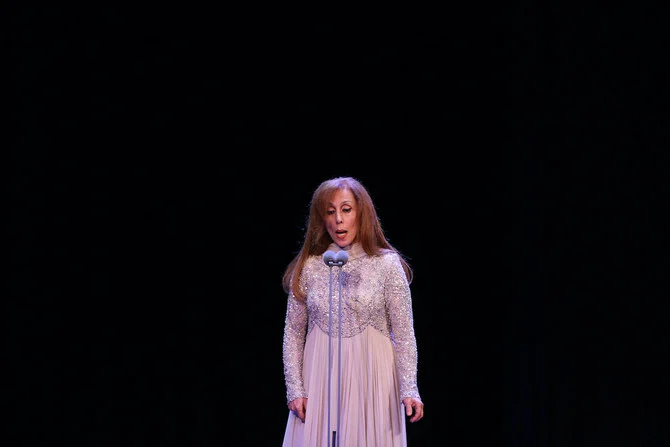
Fayrouz performs in Beirut in 2011. (AFP)

____________

LEBANON

World Arabic Language Day: December 18th. Seven Facts that will Surprise You

Arabic is spoken by more than 400 million people across the Middle East and in diaspora communities across the world.

Spoken by around 400 million people across the globe, the Arabic language in its classical form is also the liturgical language of Islam, the world’s second largest religion with at least 1.6 billion adherents.

Marked every year since 2012, the date was chosen based on when the UN General Assembly recognised Arabic as one of the organisation’s official languages in 1973.

In a statement released ahead of the occasion, Audrey Azoulay, Unesco’s director-general, said: “Throughout the centuries, Arabic has been at the heart of exchanges between continents and across cultures.”

She added the language was “used by so many great poets, thinkers, scientists and scholars”.

To mark the occasion, here are some facts about the language, which you may not have known:

1. There’s no agreement on how old the language is

Depending on who you ask, the earliest records of Arabic appear as far back as the second millenium BCE, around the eighth-century BCE or as late as the fourth-century BCE.

The reason for the debate is establishing what constitutes the Arabic language as we know it today.

Languages spoken today are evolved versions of languages that were spoken thousands of years ago, but determining at what point a language becomes so distinct from its ancestor that it can no longer be considered the same is up for debate.

Languages spoken today are evolved versions of languages that were spoken thousands of years ago, but determining at what point a language becomes so distinct from its ancestor that it can no longer be considered the same is up for debate.

2. The oldest Arabic inscription dates to 470 CE

A 2014 discovery by a French-Saudi-led team unearthed the world’s oldest known inscription written in the Arabic script – “Thawban Ibn Malik” were the three words etched into stone, alongside what is thought to be a Christian cross.

The stone slab was discovered in Najran in ­Saudi Arabia and is said to date from around 470 CE.

The text is thought to be written in an early version of the Arabic script known as Nabataean-Arabic, which evolved from historic Nabataean and Aramaic scripts.

The Nabataean kingdom lasted from around the 4th-century BCE to 106 CE and is famed for the structures Nabataeans carved out of rock formations, such as the one found at Petra in Jordan.

3. Arabic is related to Hebrew and Amharic

Arabic is a member of the Semitic language family, which itself is a member of the Afro-Asiatic family.

The Semitic family includes languages still spoken today, such as Hebrew in Israel and Amharic in Ethiopia, as well as extinct languages that were once widely spoken, such as Akkadian and Phoenician.

Belonging to a language family means that at some point the languages evolved out of a common dialect.

While there are no records of the original language, there are enough similarities between languages such as Arabic and Hebrew to make it clear that their origin is the same.

One of the most notable features of the Semitic languages is the triliteral root system, in which words are formed out of a combination of three consonants. 

4. There are dozens of Arabic dialects

Modern Standard Arabic remains a unifying dialect across the Arab world and is used in formal broadcasts, religious sermons and literature, but in day-to-day life Arabs speak a diverse array of dialects.

Sometimes differences between dialects can be so big that two native Arabic speakers cannot communicate without resorting to formal Arabic or a more commonly understood dialect, such as Egyptian or Levantine Arabic.

There are at least 30 Arabic dialects and the differences between any two are generally more stark the more geographically separated they are.

The biggest split is between the Maghrebi or western dialects found in North Africa and the Mashreq or eastern dialects found in the Levant.

There are many reasons for such dramatic differences in dialects.

As Muslim conquerors took over vast tracts of land between Morocco and Iraq, they encountered people who spoke other languages. As those people interacted with their new rulers, they had an effect on the language the new arrivals spoke.

There are also other factors, such as the influence of subsequent conquests by Turkic and European rulers and the independent evolution of languages separated by geography over long periods of time.

In that sense, the Arabic dialects are similar to the Romance languages, such as French, Spanish and Italian, which developed out of spoken Latin.

5. There’s an EU language closely related to Arabic

Maltese, the national language of Malta, was given official language status when the island joined the European Union in 2004, and is the only Semitic language to have that designation.

The country’s 450,000 natives speak a language that has its roots in Arabic, as it was spoken when the nearby island of Sicily was ruled by North African Muslims.

Although it grew out of North African dialects of Arabic, the Maltese language has taken on a lot of vocabulary from Romance languages, such as Italian, and is considerably distinct from Arabic as it is spoken today.

Nevertheless, the similarities will be obvious to an Arabic speaker. Greetings, such as merhba (welcome) and questions, such as x’jismek? (shi-yismek/what is your name?), will be instantly recognisable to an Arab.

6. Arabic was once spoken as far east as Central Asia

After the founding of Islam, successive Arab empires established control over a territory that spanned from Morocco in the west to the borders of what is now China.

This led to mass movements of people from the interior of the Middle East to areas on the periphery of the Islamic world to work as soldiers, administrators, religious leaders and merchants.

These new migrants brought their language with them and even in areas that did not become fully Arabised, their descendants continued to speak Arabic until very recently. 

One such example is in Central Asia, where a variety of Arabic was spoken among some communities until the late 19th-century.

While thought to have numbered in the tens of thousands of speakers in the early Islamic era, today these populations have been assimilated into neighbouring Persian and Turkic-speaking populations.

Many descendants of these Arabic-speaking communities are still aware of their roots despite having forgotten their original language.

7. Arabic loanwords are found in many languages

Alcohol, arsenal, algebra, coffee, gauze, mascarade and safari are just a selection of words used in everyday English that have their roots in Arabic.

Safari for example comes from the Arabic for “journey” or safar, while Arsenal comes from the Arabic dar al-sina’ or “house of production”.

Some languages owe more of their vocabulary to Arabic than others. Turkish and Persian were heavily influenced by Arabic due to geographic proximity and conquest by Arab rulers, as well as the movement of Arabic speakers to areas where those languages are spoken.

Those additions are not always welcomed by nationalists in those countries and efforts have been made at various points to remove Arabic influence.

One of the most intense efforts in that regard was by the founder of the Turkish Republic, Mustafa Kemal Ataturk, who began a process of Turkification to replace Arabic words in the Turkish language with Turkic equivalents.

Nevertheless thousands of Arabic-origin words remain in modern Turkish.

source/content: middleeasteye.net (headline edited)

_____________

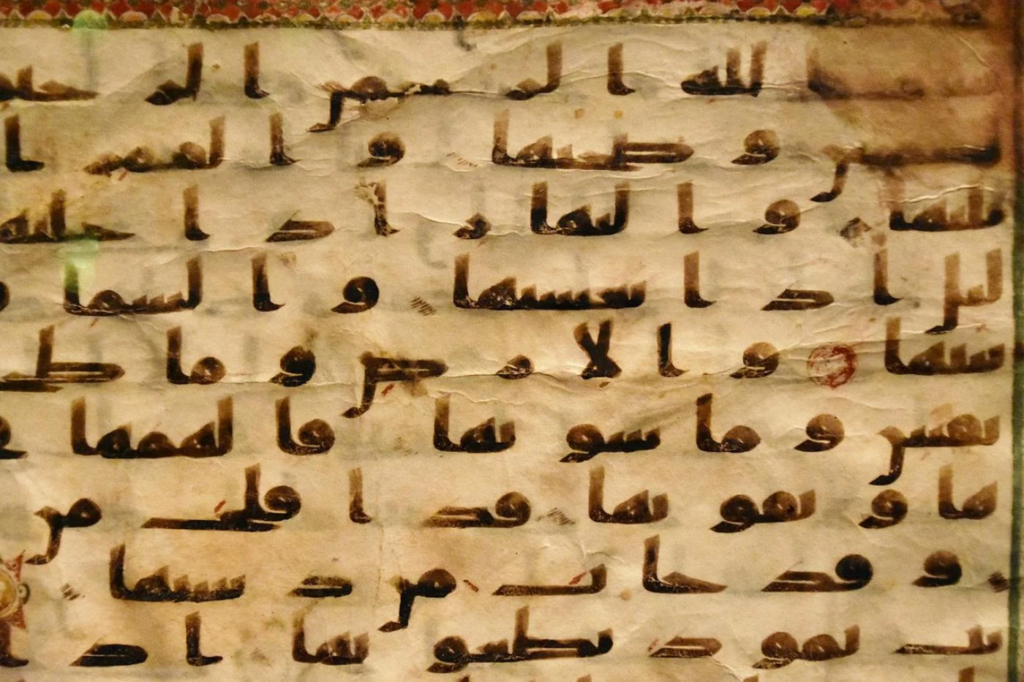
A late seventh-century parchment featuring verses of the Quran in the Kufic script (Wikimedia/Richard Mortel)

______________________

ARABIC LANGUAGE

Historic Arab Manuscripts Showcased at Pearls of Wisdom Exhibition in Abu Dhabi Palace

Influence on European Renaissance highlighted.

The month-long Pearls of Wisdom exhibition launched this month at Qasr Al-Watan, Abu Dhabi’s Presidential Palace, on the sidelines of the third edition of the Abu Dhabi Manuscripts Conference.

Running until Jan. 6, 2023, it will showcase valuable manuscripts in the fields of literature, heritage, religion, music, philosophy and science.

Split into seven zones, the exhibition will take visitors on a historical journey that deliberates on the influence of Arab culture in generating religious dialogue and contributing to knowledge that paved the way for the European Renaissance.

At the heart of the House of Knowledge, visitors will find themselves in an immersive gallery panel covering the Golden Age of Islamic civilization and two regions that are at the heart of medieval Europe: Al-Andalus in the Iberian Peninsula and Sicily in southern Italy.

Before visitors conclude their visit, they can head to the palace’s library to explore a collection of more than 50,000 books about the UAE’s history and politics along with topics including history, architecture, biology and ethnography.

Organized by the Department of Culture and Tourism – Abu Dhabi, the conference is being held under the theme “Arabic Manuscripts from East to West: Spain and Italy as a Model,” and in coordination with the National Marciana Library of the Italian Ministry of Cultural Heritage, the University Library of Bologna in Italy, the National Library of Spain, and Royal Library of San Lorenzo de El Escorial.

source/content: arabnews.com (headline edited)

_____________

The exhibition will showcase valuable manuscripts in the fields of literature, heritage, religion, music, philosophy and science. (Supplied)

_______________________________________

ARAB LITERATURE & MANUSCRIPTS

EGYPT: Wegz Releases ‘EZZ EL ARAB’ for FIFA World Cup 2022 Official Song

Following up a highly eventful year, the diverse artist delivers an electrifying track for the official soundtrack of the 2022 World Cup which he will perform at the final match.

Ahead of his performance at the FIFA 2022 World Cup finals taking place in Qatar on Sunday the 18th of December, Wegz releases ‘Ezz El Arab’ as part of the tournament’s official soundtrack.

Internationally acclaimed Egyptian artist Wegz has been continuously growing throughout his career. In only a few years, the Alexandrian rapper and singer has managed to permeate the cultural zeitgeist, becoming an ever-present figure in contemporary Arabic music.

This year, Wegz has achieved major accomplishments, such as his track ‘Al Bakht’ amassing over 150 million views on YouTube and topping the charts on Spotify’s most played artist in the MENA region.

If there is one thing that Wegz has demonstrated throughout his career, it’s that he is always moving forward, continuously trying to evolve his sound and expand his reach.

In pursuit of these ventures, the beloved Egyptian rap icon has just released an official track for the 2022 FIFA World Cup in Qatar, looking to afro-beats, electronic music, and his signature singing style to deliver an energising track that explores themes of unity and pride.

The music video for the track was directed by Ali El Arabi, who also directed Wegz’s, ‘B3oda Ya Belady’ from the highly acclaimed documentary ‘Captains of Zaatari’. The video features Wegz in a variety of shots around Qatar, DJing to an adoring crowd of football fans, and performing to camera in a cinematic portrayal of the tournament’s festivities.

This year’s World Cup has been more than just a sporting event for people of the MENA region. The tournament has always been a time for gathering and community, even if many Arab national teams have not reached their full potential in previous iterations of the World Cup. But this year’s tournament, hosted in Qatar, has seen incredible performances from teams such as Saudi Arabia, and of course, the Moroccan national team, who have instilled a sense of pride in Arab fans around the region and beyond. Watch the full music video here

source/content: cairoscene.com (headline edited)

_______________

click and watch on Youtube.com

_________

EGYPT

BRITISH / LEBANESE: Central Bank of Ireland, Governor Gabriel Makhlouf confronts crisis with the perspective of a well-travelled man

With a Lebanese name and a Cairo birthplace in the background, Gabriel Makhlouf is steering Ireland’s financial recovery.

As governor of the Central Bank of Ireland, Gabriel Makhlouf is much preoccupied by the issue of resilience in a small, open economy challenged by a year of pandemic.

Mr Makhlouf’s own peripatetic life has shown him how precious an asset the quality of adaptability is at a time of change, be it in a person or for a national economic system.

Upheaval and the Makhloufs on the move could be a theme stretching back to when his father’s side of the family travelled across the Mediterranean from their Lebanese homeland to Cyprus.

When the island was part of the Empire, the family became British subjects and Makhlouf Snr ended up working at the embassy in Cairo after the Second World War.

It was in that palatial building near the Nile that he fell for a Greek-Armenian woman whose forebears had fled the historical turmoil of Izmir in 1922. Her family moved to Athens where she has come full circle to live today.

Mr Makhlouf was talking to The National at a time when Ireland’s strict national Level 5 lockdown is both defining his job and providing a perspective on the decades of movement and upheaval that have brought him to where he is now.

At a conference last week, the governor spoke of how the outlook had deteriorated in 2021 with the renewed lockdown. The short-term need to bolster the economy coincided with structural changes from technological innovation and climate policies. Ireland suffered a 7.1 per cent slump in domestic demand last year but is expected to see a 2.9 per cent increase in 2021.

Unemployment is predicted to reach 9.3 per cent this year and for an economy with a high level of property-focused debt, ensuring that households are supported is a priority. Mr Makhlouf points out that growth is not the same as having the capacity to recover quickly.

“We cannot anticipate every type of shock but we can build resilience,” he said in his keynote address. “Resilience is what has prevented the financial system repeating its previous failure. Resilience is what has protected households, businesses and communities against the worst of the damage from the shock of the pandemic.

“Economic resilience is what helps communities to manage the disruption caused by change and to manage the economic transitions we are living in right now.”

In providing leadership during financial strife, it is perhaps a boon to have some sense of dislocation. He describes his mother’s family as refugees. His parents met in a milieu that was the product of worlds with roots as far back as the Phoenicians, ancient Greeks, Romans and Egyptians. And yet the people of Mr Makhlouf’s parents’ generation made their choices and moved to build new lives.

“My mother, who was born in Athens, had spent most of her life outside of Greece, but when my dad retired she came back,” he recalls. “My dad moved on and lived all over the world and settled in Greece at the end, before he passed away.”

Mr Makhlouf was born in Egypt but left at the age of three when his father joined the United Nations and moved to the Congo. Makhlouf pere’s time as an international diplomat exposed the young Gabriel to many cultures.

“My first language was French, because my parents’ mutual tongue was French,” he says. “So I learned English when I was about seven when we went to Bangladesh, and when we got to the Pacific we lived in Samoa.

“I went to school in Samoa. My parents then decided they ought to send me to boarding school if I was going to get a proper education and not one that changed every few years.”

Travelling during the school holidays from the school in England was a regular odyssey in itself. “The trip to get to Samoa and back to England involved stopping in Los Angeles, Honolulu and Pago Pago, an American territory pronounced ‘Pango Pango’,” he recalls.

“But then they moved to the Philippines, they moved to Fiji, they were in Ethiopia and they were in Thailand. So, you know, my brother and I got used to this life.”

It is a puzzle, then, to establish the appeal to the young Mr Makhlouf of embarking on a career as a Whitehall civil servant. He explains it as following his father’s footsteps in to the bureaucracy. Certainly, the career path was more about determination and making opportunities than wanderlust.

“I don’t think I joined the civil service for stability, to be honest, but maybe somewhere deep inside me there might have been that,” he says. “I joined the civil service really for interest. I joined as a tax inspector at the beginning. And it was an interesting career option – it involved law, it involved accountancy and it gave early opportunity to manage.”

Fate intervened to resume the family’s roving tradition when Mr Makhlouf was headhunted in 2010 to run New Zealand’s finance ministry, the Treasury. There, he was responsible for developing a measure of well-being as a replacement for the traditional gross domestic product yardstick.

In one memorable allusion in a speech he compared the role of an economist to that of an artisan, challenged with weaving together different strands of evidence into a structured framework.

Before upping sticks to the southern hemisphere, Mr Makhlouf at one point worked directly with then-UK chancellor Gordon Brown, who became prime minister at the time of the global financial crisis in 2008.

Asked about his former boss and a recent warning that the world now faces another lost decade or perhaps even worse than after that crash, Mr Makhlouf acknowledges how bad it was last time around but disagreed on the dangers now.

“I think that there is one massive difference between the crisis in 2008 and today’s crisis,” he says. “Which is that the crisis in 2008 was a crisis of the financial system, the financial system basically collapsed.

“Today, the financial system is still standing, and it’s the financial system that’s playing a very important role in supporting businesses and households through the pandemic and hopefully into a recovery and out the other end.”

World leaders are proving to be different kinds of players, having recognised that this is an economic crisis caused by a health crisis. “Governments throughout the world have chosen to close down economies for the sake of people’s health. In some respects that is been planned. In comparison to what happened in 2008 where actually events completely overwhelmed us.”

So Mr Brown’s fears are too pessimistic? “A lot of the changes and challenges that are ahead of us, I think if we manage them, then I think they can be managed well,” he says.

Mr Makhlouf takes heart from the rapid adjustment of businesses to home-working and new patterns of demand. “Economies across the world and certainly in the industrialised world have adapted to the restrictions,” he says. “More businesses are set up for that and more consumers were ready and knew how to proceed.”

The scale of “technological adaptation” since he accepted the Irish job in 2019 is something he could well have guessed was just around the corner.

The governor has not been immune to the extraordinary pressures imposed by lockdowns. Even at the outset of the pandemic, the family’s far-flung ways isolated him in Athens just as the 2,000-strong staff of the central bank in Dublin were forced to work from home.

With his mother ill in hospital, Mr Makhlouf was on hand to help her recover. “Effectively, I carried on working like everyone else via laptops and iPads. It’s quite an extraordinary thing that we all seem to have got used to.”

History means that a British citizen running the Irish central bank will always be a talking point. The moment that the UK left the EU put Mr Makhlouf in an invidious spot.

First, there is migration of businesses and banking activity from the City of London to Dublin so that firms remain within the EU umbrella. Is this an opportunity?

“Overall, I think the impact of Brexit is negative. It’s negative for Ireland and for the UK and for the EU,” he says. “We’re most exposed as a country in the agricultural sector, in particular. The fact that there was, at the end of the day, a deal albeit a very slim deal was better than there being no deal.

“On financial services, we have seen post-referendum a move of business from London to Dublin,” he agrees. “I’m not sure I would necessarily call it an opportunity at all. I think from my perspective as a regulator this increases the need for us to manage and ensure the financial system works properly.”

With his son, brother and wife’s relatives living in London, the governor observes that the pandemic has played a greater role than Brexit in cutting off families and friends. But things are different.

“I feel sorry for someone like my son — his opportunities to work in 27 other countries have now been limited. So his generation has lost out,” he says. “Ireland and Irish people have got many connections in the UK, we recognise Brexit has happened but those connections haven’t disappeared, they haven’t been lost.”

As two movie-perfect countries on the periphery of continents with roughly similar populations, one wonders what the biggest change is for Mr Makhlouf in switching from New Zealand to Ireland.

There is the remoteness of the former compared with the latter’s position within the wealthy European market. But the answer, he feels, is the perspective on China. In New Zealand, much time was spent thinking about and visiting that part of east Asia. He himself went at least nine times.

“The role that Asia has been playing and will play in the 21st century usually dominated a lot of thinking. And what’s interesting coming back to Europe, and perhaps now it’s not surprising at one level, but it was noticeable how little of our time was spent thinking about Asia.”

For the well-travelled, there is the unchanging truth that proximity is often the most powerful force in geography.

source/content: thenationalnews.com (headline edited) (feb 18th, 2021)

______________

The lockdown both defines Gabriel Makhlouf’s job as Governor of the Irish central bank and provides a perspective on the decades of movement and upheaval that have brought him where he is today. Courtesy Central Bank of Ireland

_______________________

BRITISH / LEBANESE