EGYPT enlists ‘Journey of the Holy Family Festivals’ on UNESCO List of Intangible Cultural Heritage of Humanity

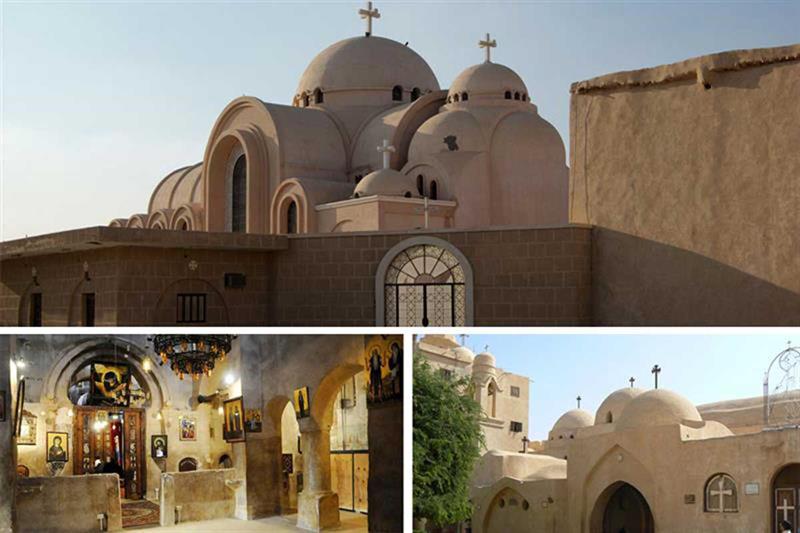
“Festivities and celebrations affiliated with the Journey of the Holy Family in Egypt are now on UNESCO’s Representative List of Intangible Cultural Heritage of Humanity,” professor Nahla Imam, heritage consultant at the Egyptian Ministry of Culture and country representative of Egypt at the 2003 Convention of Safeguarding the Intangible Heritage of UNESCO, told Ahram Online on Wednesday.

Imam credited the move to the efforts of the Egyptian ministries of culture and foreign affairs, adding that Egypt’s efforts were almost unanimously supported by UNESCO’s Inter-Governmental Committee.

This is the seventh intangible cultural heritage element that Egypt enlists in UNESCO. Prior to the Journey of the Holy Family, the Egyptian manual-textile industry in Upper Egypt was put on the UNESCO List of Intangible Cultural Heritage Sites in Need of Urgent Preservation.

Egypt first enlisted El-Sirah El-Helalya (The Epic of Beni Helal) in 2008, Tahteeb (Stick Art) in 2016, the Aragouz Puppet in 2018, and the knowledge and traditions affiliated with palm trees in 2019.

According to the accounts of historians, the Holy Family spent around four years in Egypt.

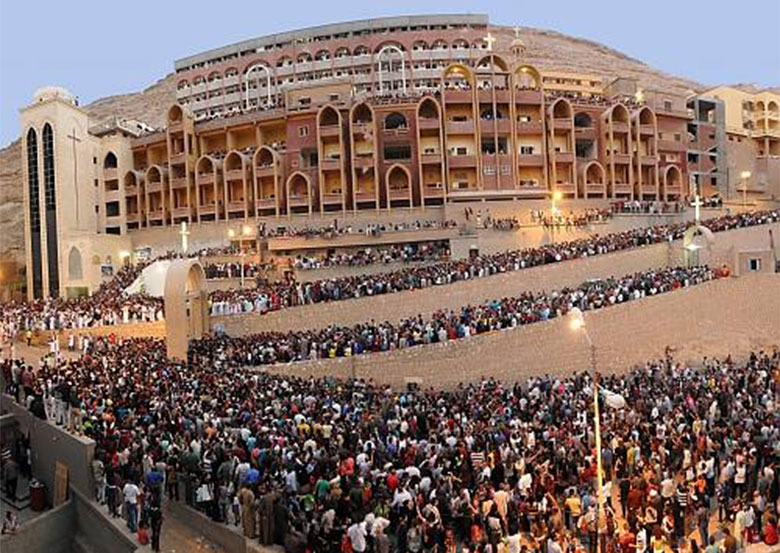
Their trip started in the Sinai at Al-Farma, on the border with Gaza, where they arrived after fleeing Jerusalem. Their trip ended in Durnaka, Assiut, venue of the famous Monastery where the feast of Virgin Mary is celebrated in August each year. ​

source/content: english.ahram.org.eg (headline edited)

___________

__________

EGYPT

Arab World the Winner in Memorable World Cup

As the FIFA World Cup reaches its climactic end, one cannot help but reflect on what an extraordinary political event it has been. Those who argue that sport and politics should be decoupled will have found it hard watching politics as an ever-present from the day Qatar was awarded the event back in 2010 and at every single match since the tournament began on Nov. 20.


But perhaps one of the most fascinating and hopefully impactful thrills at the World Cup has been the rare opportunity to remind the world that, for all its troubles, fissures and rivalries, the peoples of the Arab world do have much in common and that football has highlighted that reality every day in Qatar.

Some might question these signs of togetherness among fellow Arabs. Yet there were copious examples where it shone. Three achievements stood out.


Firstly, for Morocco to beat Spain and then Portugal in the knockout rounds was exceptional, especially following their defeat of Belgium, the second-ranked side in the world, in the group stage. There was more than an element of delight in seeing a former colony defeating, in Spain, its one-time colonial master. Morocco will get the chance to overcome its other colonial power, France, in the semifinals on Wednesday. In fact, star player Achraf Hakimi was born in the poor suburbs of Madrid. Morocco were the only team in the quarterfinals not from Europe or South America. Few in the region were not cheering them on. A sense of collective pride emerged as a result of the North African country’s success in becoming the first Arab and African state to reach the semifinals.

One might have thought that, given the dire state of relations between Morocco and Algeria, that Algerians would have shied away from joining in the festivities. Evidence suggests otherwise. Algerians were out supporting Morocco as enthusiastically as anyone else in the region. A friend was in Paris and told me: “After one of the Morocco victories, there were lots of Algerian supporters and flags joining their Moroccan brothers and sisters in celebration.” The Algerian captain and superstar Riyad Mahrez was quick to praise the Atlas Lions’ achievements.


Secondly, Tunisia beating reigning world champions France in the group stage was also an unforgettable moment. This was the first time they had beaten European opposition in the World Cup. This was every bit as big a win as in 1982, when Algeria beat the mighty West Germany in their first ever World Cup game.

Third, the Saudi victory over Argentina was another huge milestone. In many ways, this ignited the World Cup for the Arab world.


A sense of pride has also broken out that many of the finest players in the world come from this region. Hakim Ziyech for Morocco is one. Mahrez and Mohammed Salah were not in Doha but are still at the top of the sport. Kylian Mbappe, a star of this tournament, has an Algerian mother.


The key players in the Arab teams largely play in Europe. This shows football at its best in terms of breaking down barriers. Fourteen out of the 26-man Morocco squad were born outside of the country, showing how the team relies on the Moroccan diaspora. This includes Ziyech, who opted not to play for the Netherlands. That points to one challenge that countries like Morocco face, as they lack the footballing infrastructure to develop and nurture enough talent at home.

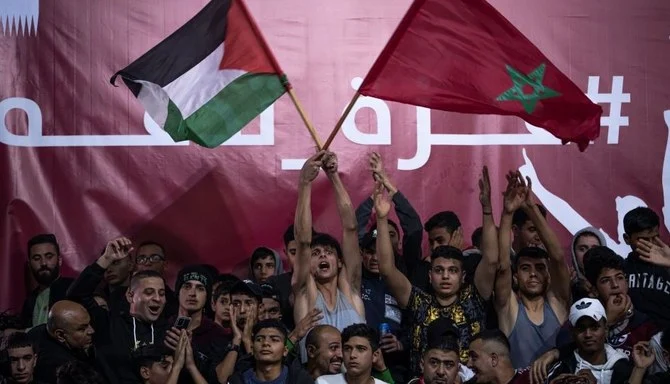
This World Cup has also often been about one country that is not there. At every single game featuring an Arab side, and plenty others beside, the Palestinian flag was there. It is a political symbol and a defiant message that the Arabs will not forget or ignore what is happening to the Palestinians in the diaspora and under occupation. As an even more brutally right-wing coalition is about to take power in Israel, this message should be carefully noted in the US and European capitals. Palestine still matters.


Israeli hasbaristas were also caught out. Having belittled and mocked those who claimed otherwise, they discovered that, despite the normalization deals, Arabs are not willing to gloss over Israel’s crimes and oppression. Time and time again, Israeli journalists, while trying to pretend everything was all lovely and wonderful with their newfound Arab friends, found that “free Palestine” was pushed back in their faces. Many locals snubbed their requests for interviews.

A World Cup in the Arab world has brought some cheer to a region that has been hit hard by wars and other crises.

Chris Doyle

Palestinian armbands and keffiyehs were being worn at nearly every match by huge numbers of fans. The sheer arrogance of believing that a state could oppress millions of people and that all would be peace and happiness was exposed as the nonsense it is. The Moroccan players had no hesitation in raising the Palestinian flag after their wins over Spain and Portugal.


Many Arabs also expressed admiration for the courage of the Iranian team after the players refused to sing their national anthem ahead of their opening match against England. This points to the widespread sympathy many Arabs feel toward Iranians, notably currently the women, who are struggling for their freedoms.

The Western media has been quick to point out all that was wrong with this World Cup. It is about time it also highlighted what has gone right. For all the criticisms of Qatar in the run-up to the cup over issues such as workers’ rights, one of the key elements of its bid has been fulfilled. Football in the region has been the winner. The atmosphere has been considerably warmer than many expected, with largely good-natured relations among fans of all countries. It seems that rival fans have not needed to be segregated, showing the festival-like atmosphere. Fan violence does not seem to have featured. The largest numbers of fans, of course, came from the Arab world, with Saudi Arabia providing the largest number from a single country.

Many outside the region were dismissive of the claims that football mattered in the Middle East. One leading commentator contemptuously told me, while on the BBC, that Qatar did not have a footballing heritage. Yet the region should never have been ignored. A World Cup in the Arab world has brought some cheer to a region that has been hit hard by wars and other crises, and whose peoples have not had much to celebrate in recent years.

Chris Doyle is director of the Council for Arab-British Understanding, in London. Twitter: @Doylech

Disclaimer: Views expressed by writers in this section are their own and do not necessarily reflect Arab News’ point of view

source/content: arabnews.com (headline edited)

_____________

Palestinians watch the World Cup quarterfinal between Morocco and Portugal in Gaza City, Saturday, Dec. 10, 2022. (AP Photo)

________________

ARAB WORLD

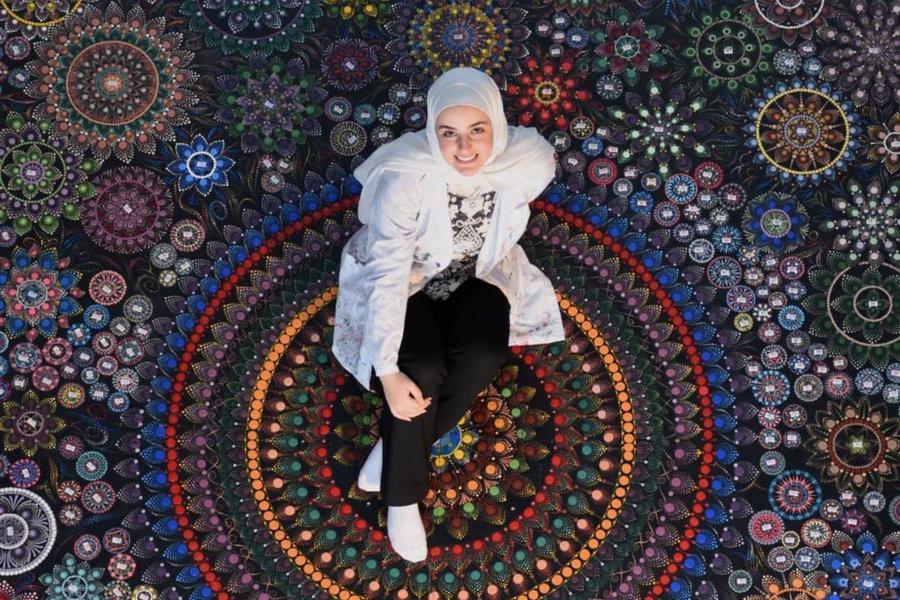
SYRIA: Young Artist Lama Zakaria Enters Guinness World Records with ‘Largest Mandala’ in the World

Syrian young artist, Lama Zakaria has recently achieved the first world record in the Guinness World Records for the largest display of mandala in the world, raising the name of Syria high and proving once again the ability of Syrian youth to excel in various scientific and artistic fields.

Lama told SANA’s reporter that she spent two years of continuous and diligent effort for reaching this stage, stressing that she worked with precision and patience to achieve the required symmetry in her painting, which achieved the record for the largest painting of mandala in the world.

She added that the mandala contains 4096 mandala circles of various diameters, colors and various decorations by using special dotting tools and acrylic paints on a 6 mm-thick wooden board.

She pointed out that the painting with dimensions 488 x 488 cm contains a large number of circles overlapping with each other and free circles with flowing lines that enhance cohesion among them.

Zakaria noted that in each quarter of the painting forms a part of a major basic circle that is the center of the painting and its eye-attracting heart, which required work carefully on all colors and various decorative units.

Lama Zakaria, a third-year student at the Faculty of Architecture at al-Baath University, has sought to specialize in mandalas, as she worked individually to learn the origins of this art and master its methods, and participated in several art exhibitions.

source/content: sana.sy (headline edited)

______________

Actress Lama Zakaria – Photo from Lama’s official Instagram page

_________

SYRIA

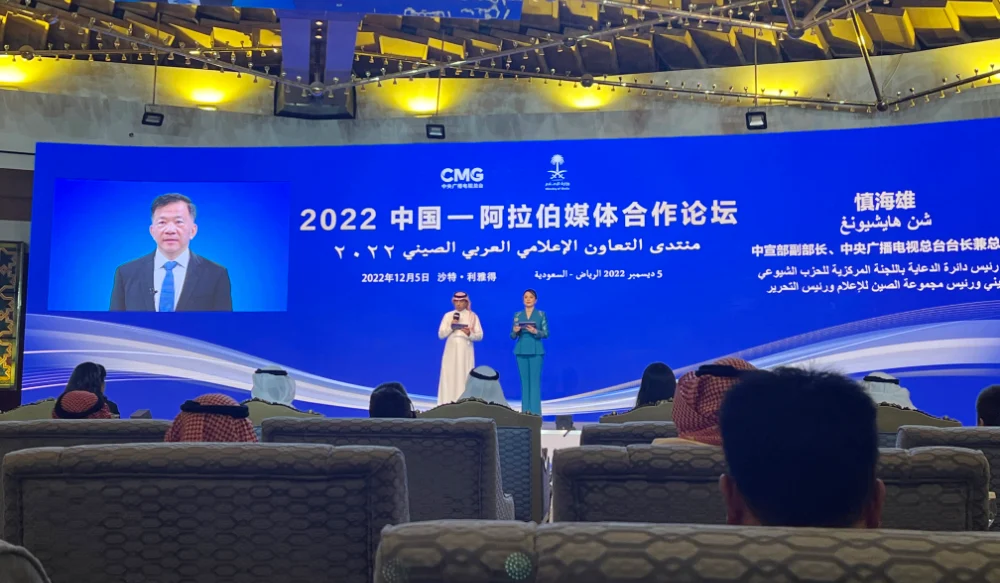
ARAB WORLD: Arab-Chinese Media Cooperation Forum launches Joint Broadcasting Initiative

Ahead of the Chinese President’s visit to Saudi Arabia, the Saudi Ministry of Media and the China Media Group announced the launch of a joint partnership initiative to promote relations between Arab countries and China through media in a ceremony in Riyadh on Monday.

“It gives me great pleasure to welcome you to the Arab-Chinese Media Cooperation Forum, which is being held today in Riyadh…between the Saudi Ministry of Media and the China Media Group,” Acting Minister of Media Majid Al-Qasabi said.

Al-Qasabi addressed the audience in a speech via video extending his support for the cooperation.

“We look forward to the cooperation today to launch new media initiatives that contribute to deepening the ties between the Arab and Chinese cultures and between their peoples,” he said.

The initiative, he explained, will promote the presence of Chinese media on Arab channels, translating Chinese television shows into Arabic.

Through the initiative, Saudi and Chinese television will also work together to create programs highlighting the stories of individuals from both Saudi Arabia and China who achieved success in each other’s countries.

The initiative will also create opportunities for travel between the two countries, opening a space for greater understanding and strengthening the relationship between China and Saudi Arabia through media and cultural exchange.

In line with the aim of improving communication, the ceremony was held in both Arabic and Chinese in the presence of Ambassador of China to Saudi Arabia Chen Weiqing, Director-General of the Arab States Broadcasting Union Abdulraheem Sulaiman, and Chinese politician Li Shulei, head of publicity at the Central Committee of the Chinese Communist Party.

Mohammed Fahad Al-Harthi, president of the Arab States Broadcasting Union and CEO of the Saudi Broadcasting Authority, presented the initiative in a speech during the ceremony.

“Saudi-Chinese relations are old and well-established and strong, and they are witnessing prosperity and expansion,” he said, citing Crown Prince Mohammed bin Salman’s visit to China, the over 20,000 Arab students studying in China and the several schools in Saudi Arabia that teach the Chinese language and culture.

“We hope that this relationship will witness greater growth with the connection of interests and relations between the two peoples,” he added.

Toward the end of the ceremony, top media representatives from Palestine, Egypt, Bahrain, Libya, Yemen and Iraq extended their support for the initiative.

Al-Harthi stressed the importance of media in any country’s diplomatic relations.

“To achieve a solid relationship between the two societies, the media must play this role,” Al-Harthi said.

Through the initiative, translated Chinese works will be broadcast in Palestine, Algeria, Jordan, Sudan, Iraq and Saudi Arabia.

source/contents: arabnews.com (headline edited)

____________

_________________

SAUDI ARABIA

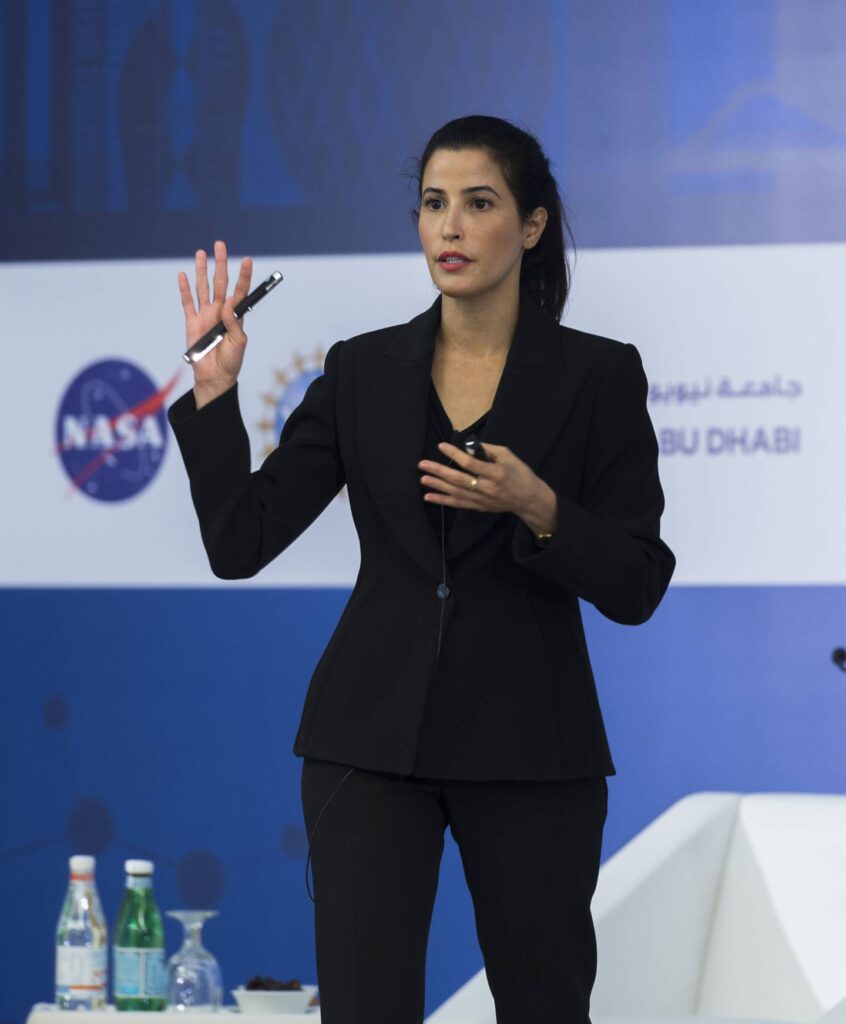
SAUDI AMERICAN: Woman of Substance: the Materials World of Adah Almutairi, Celebrated Chemist, Nano Engineer and Inventor

The celebrated pharmaceutical chemist, nano engineer and inventor reveals why she has spent a career focusing her mind over matter.

When the Berlin Wall came down, Adah Almutairi watched the event unfold on a television screen 5,000 kilometres away in the family living room in Jeddah.

Too young at the time to fully understand the implications, 12-year-old Adah could nonetheless tell that the moment was significant, by the reaction of her parents.

Years later, at a conference to mark the 25th anniversary of the reunification of Germany, Ms Almutairi was on a stage in Berlin talking about her ground-breaking achievements in knocking down walls in science.

Back then, public speaking made her nervous. The knowledge that  Chancellor Angela Merkel, a fellow chemist revered by Ms Almutairi, was among the 700 top international scientists and guests taking part merely compounded the feeling.

She broke the ice with a quote from the 1967 romantic comedy drama The Graduate, which earned her a laugh from the audience: “I just have one word to say,” she told them. “Just one word. Are you listening? Are you listening? Plastics.”

Ms Almutairi went on to describe herself as a plastics chemist, but she is much more besides. Her wide-ranging work combining materials chemistry with nanotechnology as well as developing tools for the future of biology and medicine makes her in great demand at conferences in the US, Europe, the Middle East and China.

The Saudi-American pharmaceutical chemist and nanomedicine engineer has won all manner of honours and recognition, including the prestigious and lucrative National Institutes of Health director’s new innovator award.

At the Falling Walls event, she gave an engaging, if sometimes faltering, presentation of her life-changing nanoparticle discovery feted in the US Congress as one of the four most important US technology breakthroughs of 2012.

“I used to be a nervous wreck before I gave a talk and would practise for two weeks beforehand,” she tells The National. “Plus, Angela Merkel is such an amazing woman, so meeting her was really special.

“She got elected just as I got my degree in chemistry and the way she spoke at that conference, and later welcomed so many Syrians into Germany, made me really respect her views on being kind citizens.”

With practice, Ms Almutairi, now 45, is much more comfortable as a public speaker. “Preparation,” she says, “is key.”

It was a lesson she learnt as a schoolgirl after a fluffed first gymnastics performance before a crowd left her sobbing on a bench. Determined never to repeat the same mistake, she rose to become the top gymnast on the team as well as the fastest 1,500-metre runner.

Preparedness forms the backbone of her professional life as she puts known scientific truths into practice while always remaining open to unexpected outcomes.

Discoveries and their effects, she and Ms Merkel wholeheartedly agree, can often surprise the scientists and engineers themselves.

“If you decide there is going to be a challenge down the road and that is going to deter you, nothing will happen,” she says. “If you go down that road anyway, you’ll solve the problem when you get there.”

No amount of planning, though, could have readied her for a year when the rug was pulled out from beneath her feet. In 2015, her beloved father died at the age of 65 and her 20-year marriage to a banker she met at university fell apart.

It was, she says, a painful time – not least because Mutlaq bin Abdul Rahman Almutairi, born into a traditional Saudi family, was his daughter’s greatest ambassador, enabling her to break free from what could have all too easily been a restrictive mould.

He was just five years old and still mourning his mother’s death when his own father packed up their goat-hair tent, strapped their few possessions to the back of a camel and made the arduous 100km journey from the Bedouin desert enclave of Al Harra to seek work and a new life in Jeddah.

Desperately poor, the family squatted on land and, when old enough, the enterprising Mutlaq enrolled himself and his younger sister in school.

His conservative father, who could not read or write, was furious and sent his daughter home. Mutlaq stood his ground and continued with his education – a moment that shaped the course of his own future and subsequently that of his five children.

“Sometimes in life, one decision changes everything,” Ms Almutairi says.

Mutlaq’s offspring have flourished in their respective fields of science and medicine. Khalid, 46, a plastic surgeon, Heba, 38, a professor in radiology, and Ahmed, 37, a dentist, still live in Saudi Arabia while Amer, 41, a professor in family medicine, is based in Houston.

Ms Almutairi was named recently on the Forbes list of the world’s Top 10 Influential Female Engineers, and often thinks of the debt owed to a father who championed her right to education.

The stance made him something of an anomaly among the Almutair tribe, whose roots can be traced back to the Quran.

“It still makes me emotional,” she says. “He was enlightened from God.

“No one around him was educated. He was the first in his entire family to learn how to read and write and go to college.

“My father and grandfather got into a lot of fights because my grandfather did not believe women should be educated.”

While she inherited drive and motivation from her father, a love of learning was instilled at a young age by her mother Najat, who, aptly enough, was a teacher.

“My family on my mother’s side were extremely well educated and my mother is very well read,” she says.

Indeed, her parents met because Mutlaq had become besotted with Ms Almutairi’s great-aunt Hilal, an intellectual who was one of the first dentists in Saudi Arabia.

Despite the 20-year age gap, he approached the family to ask for her hand in marriage but was advised instead to wed the daughter of Hilal’s brother, with whom he would build a strong bond.

“My father appreciated a smart woman,” Ms Almutairi says. “He didn’t go after the young, pretty girl. He initially went for the older woman he enjoyed talking to.

“Now when I think back, I realise how special and unique he was, and how much respect he had for women.”

Mutlaq studied criminology and justice administration in Portland, Oregon, where Adah Almutairi was born, before returning to his homeland to become a police investigator.

The young Adah attended international schools in Jeddah and Riyadh, excelling not only at sport but in maths and science.

On leaving school at 16, she was at a loss as to what to do next. Her mother was applying for teaching posts so, on a whim, Ms Almutairi submitted an application to Najd National School in Riyadh – and surprised everyone, including herself, by landing a job teaching English.

“I didn’t have a degree, and when the headmistress realized how young I was, she said: ‘Don’t tell anyone, just put some lipstick on.’

“It was the best job ever. I loved every minute of it. I had such a connection with the girls. I used to take in copies of my mother’s Reader’s Digests and make up writing exercises around them.”

A year later, she began applying to universities. King Abdulaziz University in Jeddah turned her down but she secured a sports scholarship to Occidental College in Los Angeles, Barack Obama’s alma mater.

The opportunity once again put her father at loggerheads with her grandfather and members of the Almutairi clan, who did not think a young woman should travel overseas alone. Unperturbed, Mutlaq sent her anyway, even though he and Najat had doubts about her choice of subject.

The couple wanted her to be a doctor but Ms Almutairi chose maths as her major before switching to chemistry in her second year.

The lightbulb moment came when her tutor, the widely loved chemistry professor Tetsuo Otsuki, told her she was “a diamond in the dirt”.

“He made me feel smart and capable, and worth being taught,” she says.

“I have twice been told the phrase: ‘You remind me of myself’. It is one of the nicest things you can say to a young person if they look up to you. It really sat in my heart.”

Chemistry appealed because it was based on “concepts where once I wrapped my head around them, I could use them in so many ways”.

A scholarship to continue her studies at the University of California, Riverside, led her to create lightweight plastic polymers, or molecules, capable of conducting electrons that had uses in everything from robotics to space research.

“Around that time,” she says, “Hideki Shirakawa was winning the Nobel chemistry prize for his work with conductive polymers, and both Nasa and Walt Disney were funding and supporting that work.”

She may not have become a doctor of medicine as her parents had wished, but Ms Almutairi did turn her attention to the field during postdoctoral studies at the University of California, Berkeley, where she worked with Jean Frechet, a chemist innovating in the area of in-vivo imaging to diagnose disease.

After being turned down for jobs in Saudi Arabia, she took up a post at the University of California, San Diego, going on to lead an interdisciplinary research group at the Centre for Excellence in Nanomedicine and Engineering.

Perhaps one of Ms Almutairi’s proudest moments was collaborating with an ophthalmologist for a decade to come up with a way to regenerate failing retinas and prevent blindness.

“That particular innovation is now commercialised and makes me feel really good about myself,” she says. “I enjoy all sorts of application materials but medicine is especially rewarding. I like to solve problems and have a positive impact on the world.”

Her work with lanthanides – popularly classed as rare earth elements but actually, she says, abundant – involves a chemical reaction that could be applied to the delivery of drugs and diagnostics in medicine but also solar energy harvesting.

She has more than 100 patents registered, including one with her brother Khalid to use gold molecules in liposuction.

“My work is very rewarding,” Ms Almutairi says, “and my father was very proud of me. When I became well known in the US, it was a big moment because the people who were criticising him for sending his daughter away were the same people congratulating him.”

A strong proponent of the “health is wealth” philosophy, she may no longer run, but she does lift weights regularly and spends time in the garden with her 10-year-old son cultivating avocados, figs, and citrus trees, and growing aubergines, tomatoes and cucumbers.

She has visited Saudi Arabia many times to see her family and speak at conferences. One in particular that has stayed with her was a graduation speech at Princess Nourah bint Abdulrahman University in Riyadh.

There was no film quote for these graduates of the largest women’s university in the world. In a clear voice, without a hint of nerves, she instead passed on the words of that staunch defender of her own access to education.

Remain forever curious about the world, she told the audience, and live a meaningful life with impact.

It was clear that the woman of substance standing before them had been shaped by her father’s advice. She didn’t need to ask if they were listening.

source/content: thenationalnews.com (headline edited)

____________

The Saudi Arabian-American pharmaceutical chemist and nanomedicine engineer is in great demand at conferences in the US, Europe, the Middle East and China. Photo: Adah Almutairi

_______________________________

AMERICAN / SAUDI ARABIA

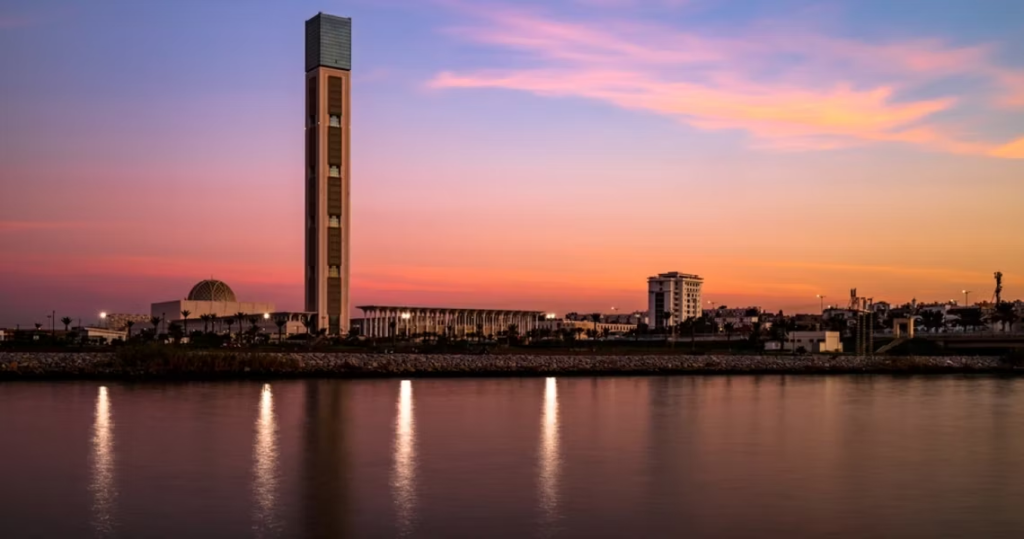
WORLD RECORDS: ALGERIA: The Mosque that has the Record-Breaking 265m Tallest Minaret In The World. The Great Mosque of Algiers (aka) Djamaa el Djazair’ an Architectural Marvel & Monumental Wonder

One doesn’t have to be a Muslim to visit the mosque or see the tallest minaret in the world.

Many people who think of a vacation to Africa make plans with Morocco in mind, South Africa at times, maybe Kenya, and definitely Egypt—to see the famous pyramids—or the 4,100-mile-long river that gave birth to that momentous civilization. Yet, as a continent, Africa has 54 countries, almost as many as the number of states in the U.S. Though it may come as a surprise, almost all of these countries are safe and have nearly the same conveniences as those found in many First World countries. Take Algeria, for instance, the biggest country in Africa and more than three times the size of Texas. This northern African country has pyramids, just like Egypt, and several fascinating ruins that would interest any history buff or anyone who’s out for some real adventure.

The Great Mosque Of Algiers And Its Record-Breaking Minaret

Also known as Djamaa el Djazaïr, the Great Mosque of Algiers is itself a monumental structure and an architectural marvel in its own right. However, what really puts it in the Guinness Book of World Records is its minaret. The reason is that the Great Mosque of Algiers is noted for having the tallest minaret in the world. For those who may be scratching their heads, a minaret is a tower—or a tower-like structure—built into mosques primarily to project the “Adhan,” the Muslim call to prayer. Of course, today, minarets serve other purposes as well. For instance, they are important landmarks of Islamic presence. Coming to the minaret of the Great Mosque of Algiers, we would not be remiss to expect a structure described as the world’s tallest to answer to that exceptional description. Well, the minaret of the Great Mosque of Algiers is 265 meters tall and hence, by all accounts, impressive.

For perspective, that’s the same height as Truist Plaza, the 60-story skyscraper in downtown Atlanta or the Panorama Tower in Miami, Florida. It’s also about half the height of the One World Trade Center, the tallest building in the United States. Minarets, however, have never been this tall. Before the Great Mosque of Algiers secured a page in the Guinness Book of World Records for its minaret, the tallest minaret was the 670-feet tower of the Hassan II Mosque in Casablanca, Morocco. The Algiers minaret, according to the Guinness Book of World Records, is now not just the tallest minaret in the world but the tallest building in Africa as well. This minaret is designed to withstand a magnitude nine earthquake, the highest earthquake magnitude. This type of earthquake can cause major damage over a region more than 1,000 km across.

Here’s A Brief History Of The Great Mosque Of Algiers And Its Minaret

The government of Algeria launched the construction of the Great Mosque and its record-breaking minaret in 2012. However, according to an adviser to the minister of housing responsible for the construction, the idea of constructing a mega-mosque had been in the cards from way back in 1962 when Algeria got its independence after 132 years of French occupation and after a 7-year brutal war that would send seismic revolutionary waves across the continent. For some reason, the efforts to put up a mega-mosque in Algiers had failed and foundered. However, with the election of Abdelaziz Bouteflika as President of Algeria in 1999, the building efforts would soon receive significant impetus.

Famous for his religious zeal and devotion to Muslim art and culture, Bouteflika would, unsurprisingly, actualize the mega-mosque dream even though his tenure as president would dramatically come to a premature end before the completion of his pet project. The mosque, however, including its record-breaking minaret, was an outstanding architectural masterpiece. According to the Guinness Book of World Records, the Great Mosque of Algiers sits on an expansive area of around 400,000 square meters (about 50 acres). For perspective, the building itself, plus the outside courtyard, can seat up to 120,000 worshipers.

Other Reasons Why The Great Mosque of Algiers Is Worth Visiting (& How To Visit)

The mosque looks towards the scenic Bay of Algiers, which features dazzling white buildings and panoramic views as far as the eye can see. Part of the mosque is a library that can stock more than a million volumes. In addition, the mosque has a Koranic school and a museum of Islamic art and history.

  • Where Is The Great Mosque of Algiers Located? This mosque is located on the Rue de la Marine in Algeria’s capital city, Algiers.

A crucial travel tip is to get in as a worshiper, probably during worship. Some visitors even carry a prayer mat or wear a scarf, especially women. Of course, one doesn’t have to be a Muslim to visit the mosque or see the tallest minaret in the world.

source/content: thetravel.com (jeff oganga) (headline edited)

____________

The New Great Mosque in Algiers

___________

ALGERIA

Arab Designs take Center Stage at the American Music Awards 2022

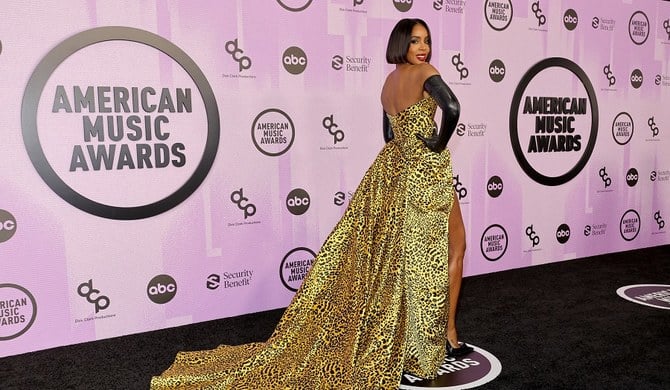
The American Music Awards played host to a glittering showcase of Arab fashion this week as the likes of Carrie Underwood, Kelly Rowland, Becky G and Lauren Jauregui showed off gowns from Middle Eastern designers.  

Country singer Underwood opted for a multi-hued dress by Lebanese Italian designer Tony Ward. With a plunging scooped neckline and playful fringed beading, the gown hailed from the designer’s Spring/Summer 2023 collection.

 US singer and actress Rowland took things in a wilder direction with a leopard print sculptural gown by Lebanon’s Nicolas Jebran. The Rowland added black latex gloves for a dose of drama. 

Meanwhile, US singer Becky G showed off an asymmetrical mini dress by Bahraini label Monsoori with a larger-than-life train and voluminous material draped on one shoulder.  

For her part, US singer Lauren Jauregui, a member of Fifth Harmony, flaunted a floor-length number by designer Norma Kamali, who is partly of Lebanese descent. The heavily embroidered gown hailed from the designers Resort 2023 collection and featured tulip sleeves and a flared skirt.  

Superstar singer and songwriter Taylor Swift won all six trophies she was contending for at Sunday night’s awards ceremony, including the artist of the year prize. 

The new American Music Awards accolades lifted Swift’s lifetime total to 40, breaking her own record for most wins at the world’s largest fan-voted awards ceremony, Reuters reported.  

The “Anti-Hero” singer said fan support in recent years had encouraged her to write more music, which made her happier. 

“I have the fans to thank essentially for my happiness,” Swift said to a cheering crowd at the ceremony in Los Angeles. 

Other honors for Swift on Sunday included favorite pop album, country album and video for her re-recording of 2012 record “Red.” The singer has been remaking albums from her past because of a dispute with her former record label. 

For artist of the year, Swift triumphed over formidable names including Beyonce, Harry Styles, The Weeknd, Drake, Adele and Bad Bunny, who had gone into the night with a leading eight nominations.  

Pop singer Pink opened the AMAs show dancing and singing on roller skates to her upbeat song “Never Gonna Not Dance Again.” Later in the ceremony, she performed “Hopelessly Devoted to You” in a tribute to Olivia Newton-John, the “Grease” singer who died in August. 

Musician Lionel Richie, known for “All Night Long” and other 1980s hits, was celebrated with the AMA’s icon award. Stevie Wonder and Charlie Puth performed a medley of Richie songs on dueling pianos. 

It has been another big week for Arab designers, with a number of celebrities opting for Middle Eastern looks for the 2022 Governors Awards in Los Angeles.

Actress Jessica Chastain showed off a red hot Zuhair Murad look, while Elizabeth banks chose a sleek gown by Elie Saab.

source/content: arabnews.com (headline edited)

_____________

Kelly Rowland wore a leopard print sculptural gown by Lebanon’s Nicolas Jebran. (AFP)

_______________________

BAHRAIN / LEBANON

SAUDI ARABIA: World’s First Commercial Shipment of Blue Ammonia leaves Saudi Arabia for South Korea

A consignment of blue ammonia has left Saudi Arabia for South Korea, representing a new milestone in the development of decarbonization solutions.

The development was first announced during the recent Saudi Green Initiative conference in Sharm El-Sheikh, and Vessel Seasurfer, carrying 25,000 metric tons (25 KMT) of low-carbon blue ammonia, is expected to reach its destination between Dec. 9 and 13 in the world’s first commercial shipment of its kind.

The accomplishment, which is an alternative to conventional gray ammonia, is part of a collaboration between Saudi Basic Industries Corporation Agri-Nutrients and Aramco.

Lotte Fine Chemical, which has a long-standing relationship with SABIC AN, will receive the low-carbon “cradle to gate” blue ammonia.

Abdulrahman Shamsaddin, SABIC AN CEO, said: “This shipment is another milestone in our journey toward carbon neutrality.

“We are proud to be a part of this pioneering solution, paving the way for further decarbonization efforts.

“Looking to the future, we are constantly working on breakthrough solutions to decarbonize our assets and deliver low-carbon solutions to our customers.”

Yong Suk Kim, LFC CEO, said: “We are delighted to enter this meaningful agreement with our long-term supplier, SABIC Agri-Nutrients, to receive the world’s first certified blue ammonia cargo. 

“Building on our shared history, we are looking forward to moving forward together into a new era for ammonia. We believe that this shipment of blue ammonia will help lay the foundations for a global supply chain.” 

Earlier this year, SABIC AN and Aramco received the world’s first independent certifications, recognizing blue ammonia and blue hydrogen production, from TUV Rheinland, a leading independent testing, inspection and certification agency, based in Germany.

The shipment of blue ammonia to South Korea will be the first to capitalize on this major certification achievement. 

The new developments are aligned with Saudi Vision 2030, which focuses on low-carbon fuels, products, solutions and clean energy. 

source/content: arabnews.com (headline edited)

____________

_________________

SAUDI ARABIA

EGYPT: World’s Second Oldest, 1,200 Years-Old Jewish Cemetery Restored & Reopened in Basatin, Cairo

Over 1,200 years old, and after facing extreme neglect for decades, the Basatin Jewish Cemetery finally reopens.

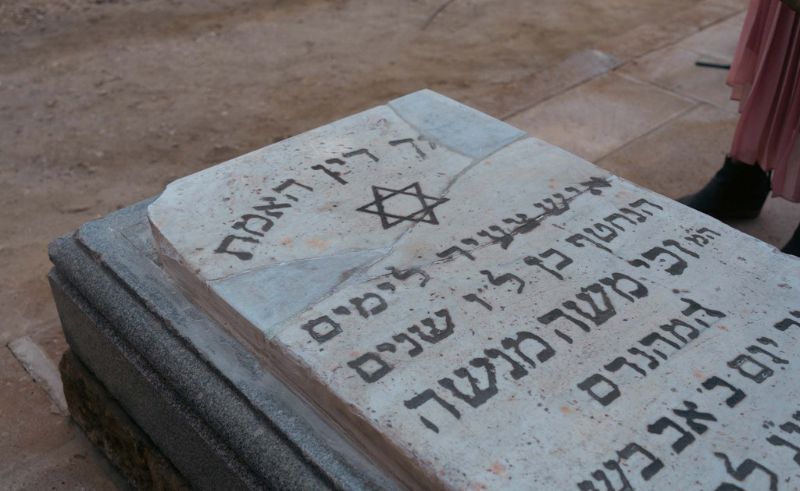
The Basatin Jewish Cemetery – the second oldest Jewish cemetery in the world, and one of Cairo’s few remaining Jewish cemeteries – has undergone extensive renovations and opened its doors once more.  

With a foundation dating to the 9th century during Egypt’s Tulunid Dynasty, the 147 acres of land designated for the cemetery at the time included separate areas for Rabbanite and Karaite Jews and extended beyond the Tulunid capital of Egypt.

In more recent times, allegedly during the reign of Mamluk Sultan Qaitbay in 1482, the cemetery was divided into separate pieces of property totaling roughly 27 acres. These plots include the Basatin graveyard’s common burial grounds, the private Mosseri family cemetery, Rav Haim Capusi’s grave, the private Moise Cattaui Pasha cemetery, and the remaining Karaite section of the original cemetery.

Over the past three years, the American Research Centre in Egypt and the United States’ Ambassadors Fund for Cultural Preservation and Drop of Milk Foundation have been working to restore the neglected cultural and religious heritage site.

After the completion of the conservation project, members of the Karaite Jewish community –  known for exclusively respecting the principles of the Torah and disowning oral traditions like the Talmud and other writings of the Rabbis – from various nations attended the ribbon-cutting ceremony, and were able to revisit their families’ graves for the first time in decades.

source/content: cairoscene.com (headline edited)

____________

_________

EGYPT

SAUDI ARABIA Elected to Chair Executive Council of UN’s World Tourism Organization for 2023 at 11th session of UNWTO, Marrakesh 22-25 November 2022

Saudi Arabia was first vice-chair of the executive council for 2022.

Saudi Arabia’s Ministry of Tourism has announced the election of the Kingdom as chair of the executive council of the United Nations World Tourism Organization for 2023.

The announcement was made at the 117th session of the organisation’s executive council being held in Marrakesh, making the Kingdom the first Gulf country to hold the post.

“The Kingdom is honored to be elected as chair of the World Tourism Organization’s executive council and we believe in the importance of the organization’s pioneering role. We look forward to cooperating with all countries to support and develop the global tourism sector,” the Minister of Tourism Ahmed Al-Khateeb said.

He added that the Kingdom has been an active member of the organization by launching initiatives, supporting new ideas, and opening the organization’s first regional office in Saudi Arabia to promote its agenda and work in the Middle East and beyond.

“At the heart of the UNWTO is a desire to promote tourism as a catalyst of economic development, which Saudi Arabia wholeheartedly supports. We have committed $800 billion of government investment into the Saudi tourism industry by 2030.

“Our imperative is that the development we seek, both as a nation and globally, is sustainable, inclusive and resilient. That’s how we will address the fast-changing needs of businesses, communities and the planet,” Al-Khateeb said.

As chair, Saudi Arabia will set the agenda for all meetings, ensuring that it captures the most pressing issues and concerns for the tourism industry. It will facilitate and moderate meetings effectively, chair dialogue and encourage actionable outcomes. 

source/content: arabnews.com (headline edited)

__________

__________________

SAUDI ARABIA