Arabs & Arabian Records Aggregator. Chronicler. Milestones of the 25 Countries of the Arabic Speaking World (official / co-official). AGCC. MENA. Global. Ist's to Top 10's. Records. Read & Enjoy./ www.arabianrecords.org
At least eight Somali American women won races in Tuesday’s U.S. midterm elections, results show.
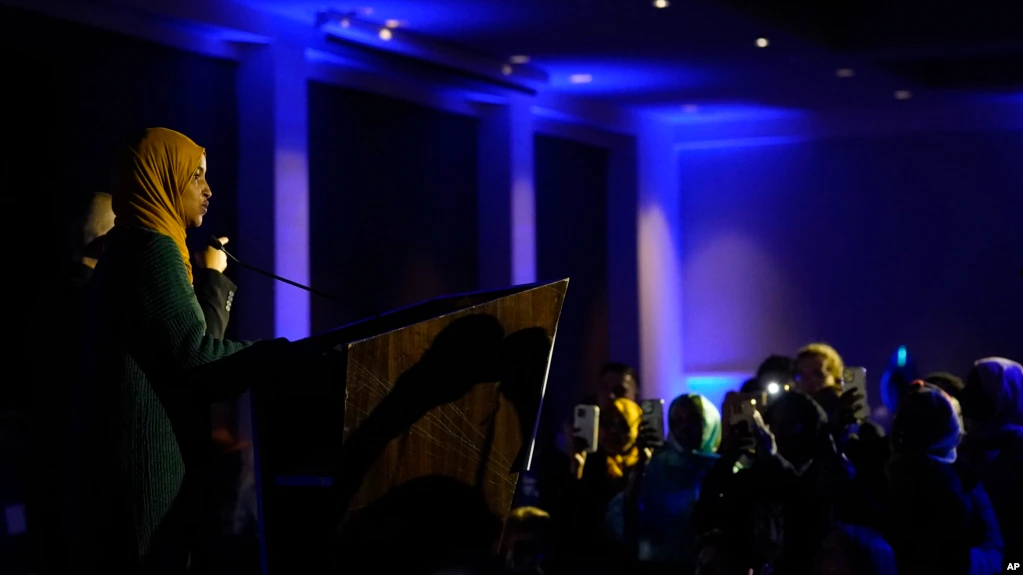
Ilhan Omar, the most prominent Somali American politician, held on to her U.S. House of Representatives seat in Minnesota’s 5th Congressional District. This will be the third term for Omar, who was first elected in 2018.
In Minnesota state races, Zaynab Mohamed was elected to the Senate, becoming the first woman of Somali descent elected to the chamber, according to MPR News. Meanwhile, Hodan Hassan defended her seat in the state House of Representatives.
Other Somali American women running for offices in Minnesota were victorious, including Fathia Feerayarre, who won a seat on the Minneapolis Public Schools board.
In neighboring North Dakota, Hamida Dakane also made history, becoming the first woman of Somali descent elected to the state House. Born in northeastern Kenya’s Somali region, Dakane, who won Fargo’s District 10, came to the U.S. in 2011.
In Maine, Deqa Dhalac, who made history last year as the first Somali American mayor for a U.S. city, South Portland, has now been elected to the state House after handily defeating Republican opponent Michael Dougherty. Mana Abdi, who was running unopposed for a seat representing Lewiston, Maine, joins her in the House.
In Ohio, Munira Abdullahi and Ismail Mohamed, a man, won seats in the state House. Minnesota and Ohio have among the largest Somali American populations in the U.S.
Speaking to her supporters Tuesday night, Omar highlighted the significance of victories achieved by Somali American women.
“There was a time when we believed that women with a hijab could not get elected,” she said. “Tonight, Minnesota is electing three new women who are wearing hijab. That shows if you trust in yourself, if your people trust you, stand with you, everything is possible.”
Mohamed, one of the hijab-wearing Minnesota winners, expressed hope that more Somali Americans will run for office.
“I’m very happy with this victory tonight, thank God,” she told VOA Somali. “This is a victory for me, for my family and for the Somali people. God willing, a lot of men and women will follow me and will come through.”
Shukri Olow, who lost a state House seat outside Seattle, Washington, told VOA Somali that she was inspired to run by the women before her, including Omar, Hassan and Dhalac.
In an interview with VOA Somali, Dhalac confirmed that when she visited Washington in 2018, Olow asked her questions about running for office.
“She said she wanted to run for the open seats in her area or seats that will be open in the future in Washington state,” Dhalac recounted. “I encouraged her to do it. Many women say we will do this, we will do this tomorrow, we will do this next year. I said to her, if you want to compete, just do it.”
The success of Somali American female candidates in the U.S. eclipses that of female aspirants for elected office in Somalia.
Female politicians in Somalia are so disenfranchised that in 2016, Somalia’s federal and regional leaders had to start allocating a specific quota of seats in parliament. But women still were never given the opportunity to get the 30% quota promised.
In 2016, Somali women occupied 24% of the 329 seats in the two houses of parliament. In 2022, female candidates secured only 20%, well short of the 30% quota.
Fawzia Yusuf Haji Adam, the only female presidential candidate in the May 15 presidential election, got just a single vote — her own.
“I did not get the support I’m sure [Somali American women] are getting when they stand [for office], because here the culture and other factors are causing a lack of encouragement [for women],” she said.
Adam welcomed the success of Somali American women.
“This is a victory for Somali women in the diaspora,” she said. “I congratulate them, I encourage them, and we are proud of them.”
She said women in the diaspora, including those in the United States, Europe, and Canada, have opportunities that women in Somalia do not have.
“What made it possible is, first, the places they live in, where men and women are viewed equally, where they get encouragement from the schools, from the university, and from the parents, and they can see achievements by other women,” she said.
“Over there, the neighborhood they live in is going to elect them when they see the person is trustworthy, honest, working and clean. White and Black would vote for that.”
Harun Maruf contributed reporting from Washington.
source/content: voanews.com (headline edited)
___________
Democratic Congresswoman Ilhan Omar speaks to supporters at an election night party after winning reelection early Wednesday morning, Nov. 9, 2022, in St. Paul, Minnesota.
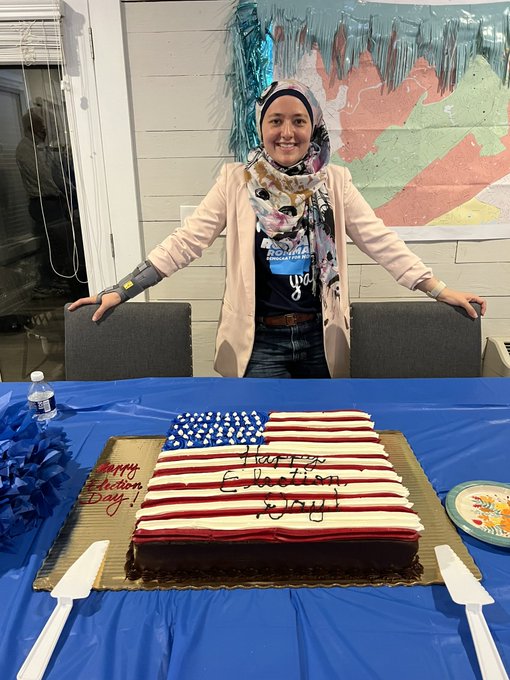
Amid the headlines that the ‘red wave’ failed to materialize in America’s midterm elections as Trump-endorsed candidates crumbled at the ballot box and progressives like John Fetterman made surprise gains in hotly contested swing states, the election also saw historic firsts in Arab political representation. Palestinian-American Ruwa Romman who was the Democratic Party nominee for the Georgia General Assembly’s House of Representatives fought against an Islamophobic and racist campaign by her Republican challenger and won the election, becoming the deeply conservative state of Georgia’s first Palestinian American elected public official.
Achieving a whopping 58% of the vote, the 29-year-old Romman smashed her Republican opponent John Chan who allegedly ran a campaign that used Islamophobic and racist tropes to discredit Romman. While the presence of candidates from minority backgrounds has increasingly become a normal occurrence in some areas of the country, in the very conservative and Christian south of America it is rare for candidates from Arab or Muslim backgrounds to run for office, let alone be elected. As such, Romman’s victory in the deeply conservative state of Georgia is symbolic as she is from a family of Palestinian refugees and is both proudly American and Muslim. As a state representative for Georgia’s 97th district, her election marks both the first Palestinian-American to be elected to public office in Georgia as well as the first Muslim woman to be elected to public office. However, Romman was also joined by three other Muslim candidates that were similarly elected to the Georgia General Assembly. Her local supporters took to Twitter to signal how her victory over a hateful campaign by a Trump-supporting Republican sends a clear message that Georgia’s 97th district refuses to be turned against one other and stands united against an increasingly polarised and xenophobic political climate.
While the focus on the midterm elections in Georgia was mostly focused on the senate race between Democrat Raphael Warnock and Republican Herschel Walker, which has now led to a hotly contested run-off, Ruwa Romman’s election to the Georgia General Assembly has not been given the attention it deserves according to some supporters. Although having lived in and around Georgia since the age of seven, Ruwa initially grew up in Amman, like many other Palestinian refugees that reside in Jordan. After being born in Jordan and then moving to just outside Atlanta, Romman lived her entire adult life in the state of Georgia. However, although Romman now sits in the Georgia House of Representatives, she grew up facing high levels of exclusion and racism, especially against the backdrop of the US War on Terror. CNN reported how only a year after moving to the USA, she vividly remembers sitting at the back of a school bus as an eight-year-old as other children bullied her by accusing her and her family of being terrorists. Romman’s journey from a child that suffered from Islamophobia in the deeply conservative state to representing that very same state after being elected by its people is a story that many Georgia-based activists want to tell of a changing state that is slowly becoming more accepting and Democrat-leaning. However, supporters of Romman have also taken to Twitter to describe how her victory is indicative of Arab Americans slowly gaining political representation after being spoken for many years.
While the Democratic Party, much like the Republican Party, as a whole has a history of unequivocally supporting the Israeli state, a new wave of progressive Democrats that joined the party following Bernie Sander’s successive bids to run as the party nominee, has been vocal about Palestinian rights. Romman being elected to represent Georgia’s 97th district is but one of the most recent of numerous pro-Palestinian politicians who have entered office in the last few years, often from Arab or Muslim backgrounds. Romman stands alongside Michigan’s Rashida Tlaib and Minnesota’s Ilham Omar as part of a new wave of progressive Democratic representatives from minority backgrounds that often aren’t represented by the party, but seem to be slowly changing the debate around Palestine and Arab and Muslim Americans.
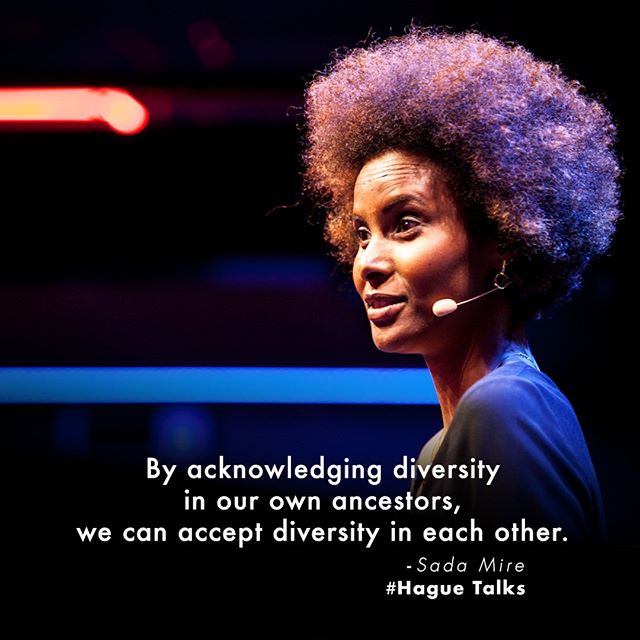
An interview with Sada Mire dives into the difficulties and rewards of preserving history and letting local perspectives guide heritage management in Somalia and Somaliland.
SOMALIA AND SOMALILAND are home to a rich heritage of archaeological treasures. But until recently, there was only one active, formally trained Somali archaeologist working in the region: Sada Mire.
In 1991, Mire was forced to flee Somalia with her family as a teenager after her father was killed by a genocidal government. She gained asylum in Sweden and eventually earned her Ph.D. in archaeology from University College London. During her studies, she learned that some of the significant stone tools that shaped scientists’ views of evolution came from Somaliland but were taken to Europe during the colonial era.
Inspired, Mire returned to her homeland determined to retell the history of the Horn of Africa and preserve its heritage—despite the difficulty of working in a region where religious sects jealously control narratives around Somali history and identity, and political conflict is causing humanitarian crises.
Somaliland is not officially a nation-state. It’s a self-declared country that is considered part of Somalia. A British protectorate since the 1880s, Somaliland became an independent country recognized by the United Nations on June 26, 1960. Less than a week later, it merged with the newly independent country Somalia. Early political tensions worsened in 1969 when Gen. Mohamed Siad Barre staged a coup and installed himself as president, imposing ethnic nationalist policies that favored one of the main Somali clans over the rest.
In the 1980s, civil war broke out between Barre’s dictatorship and the Somali National Movement, primarily composed of the Isaaq clan, the largest in northwest Somalia, including what is today Somaliland. The Barre government committed acts of genocide against the Isaaq clan, reportedly killing 200,000 Isaaq people between 1987 and 1989. Millions fled during the conflict, including Mire and her family, who belong to the Isaaq clan.
In 1991, with Barre ousted, Somaliland reasserted itself by declaring unilateral independence, this time without international recognition. But Mire always refers to Somalia and Somaliland as separate nations because, she says, “as an anthropologist, I call people what they say they are, and I respect that’s the decision of the country and its people.”
Mire has worked tirelessly to create change that fosters heritage preservation in a region with scant infrastructure to support archaeological work. She established the Department of Tourism and Archaeology in Somaliland and is creating a digital museum that features Somali objects and materials. Mire is deliberate about teaching archaeological skills to local people so they may carry out their own work at the community and institutional levels. All these are steps toward sharing the rich legacy of African peoples with African communities and the rest of the world.
Wenner-Gren Foundation project director and anthropologist Eshe Lewis interviewed Mire via Zoom in May. This interview has been edited for length and clarity.
EL:
Can you talk about your background and how you came to be an archaeologist working in Somalia and Somaliland?
SM:
It’s incredible that I am here now, that I have a university degree, that I even went to high school. My father and mother were educated. My brother now teaches in a university in Somaliland. My twin sister is a gynecological oncologist. In my family, it was understood that you got an education or you did what you could to educate yourself. My twin sister and I were very studious.
But because of the political situation in Somalia at the time, our clan became a target. At the age of 12, I lost all my rights to have an education. We were expelled from school, and we never thought we would be able to go back. From then on, I was self-taught. I read books and learned languages at home. The habit of learning and teaching myself has never left me.
EL:
Why is it important to conduct archaeological research in Somaliland and Somalia? And what are the most fulfilling aspects of the work you’re doing?
SM:
Right from the start, it was all about why we have so little representation of African history and African people, who have existed for over 200,000 years on the African continent. We have contributed so much to culture, science, technology, governance, philosophy, and literature, and there is nothing about it in the history books. In 2022, you have people who have no idea about what Africa has done. So, that is the number one reason I do what I do.
Also, I feel I can make the world a better place. I know that sounds like such a cliché, but I really think that if history books are revised, people will understand what others are worth, and they will appreciate their trajectory. Removing African history and experiences and holistic images from books creates a situation where people know nothing about, and hence fear, African people. And the few that live up to the negative stereotypes become the rule for them.
If your classmate doesn’t know your history, they don’t know you. They cannot. I believe that by understanding a nation’s past, a people’s past, a person’s past, we can appreciate them. We may not like what they do, but we understand them. I feel that there is so much work to be done to shed light on the history of Black people, Africans, and people of color.
EL:
What research and heritage protection work do you do in the region?
SM:
One of the longest research projects I’ve been doing is on medicinal and sacred plants through medical anthropology. I’m also a zooarchaeologist and a bone specialist. So, some of what we are preserving is that kind of archaeological material, including massacre sites from the recent genocide. I’m working on another project about astronomy. We found one of the earliest calendars—a whole ancient rock art site with the calendars painted. We are working with local researchers who study folklore and have created the first traditional Somali calendar.
In Somali nomadic culture, we have our own way of preserving heritage and an understanding of heritage that really clashed with [Western] best practices and this notion of monuments and artifacts—the more dogmatic UNESCO formula. UNESCO now covers intangible heritage, but often when Westerners do archaeology in the Horn of Africa—and especially in the Somali region—it’s really extractive. It comes from a tradition of going somewhere with the agenda of getting data out and filling a gap. That scientific and/or, often, Eurocentric gap is not the gap of the people.
Somalis challenged me right from the start when I said, “You don’t protect archaeological sites. The museums are being looted. You don’t care about your heritage!” They said, “No, that’s not our heritage.” I was confused, as a Western-educated student, that we did not care about these objects. I asked, “What is your heritage if you don’t care about this?” And they said, “Ah! Now we’ll tell you.”
EL:
How did you respond?
SM:
I developed something I called the Knowledge-Centered Approach based on what I learned about heritage from them, and this is what guides me. It’s the preservation of knowledge and skill rather than objects and artifacts. Heritage is performance that takes place on different mediums. You know, if you are in a scene, there is a sofa, maybe a chair, the way you are dressed, how you look, speak, and act. That is our heritage! That shows us as living, thinking human beings with logic.
I developed a framework to study this. It is called the ritual set, and I outlined it in my book Divine Fertility. Understanding African peoples’ logic links us with our past. In my own work it’s about an ideology of a sacred kinship and sustainability. This is the whole idea behind my book.
I explore Somalis’ questions about their identity. Who were we? Where do we come from? Why have we been told we are Arabs when we are Africans? Clearly, we are Black, and we are in Africa.
I also have personal questions about my heritage. Somalis are Muslims, but did we ever have any other ideology? Were we at some point something else? Why do we only know Islam?
Why do we think our ancestors were all from Arab countries, when in fact we are genetically the same as the Oromo, who are our neighbors? We have 50 percent lexical similarity. They look like me, I look like them, we practice the same traditional rituals. They may be Christian, and we may be Muslim, but we share Indigenous culture. Those questions have really not been answered by archaeologists or historians working in the Horn of Africa, local or foreign. There is a huge scientific gap, and for that public, I fill that gap.
EL:
Has there been any backlash to your work?
SM:
In 2009, my Ph.D. dissertation was put under restricted access because I was threatened by extremists. As soon as my book was published in 2020, I faced fresh threats from ideologues who are not interested in scientific research or common sense.
EL:
What is the source of this reaction?
SM:
This is misogyny. These are people who hate women and who use anything they can to stop them. They also fear intellectual women—and are afraid that there’s somebody researching and finding diversity in our past. However, this is not only restricted to my region; extremists of all religions have always dogmatically advanced a certain purity and homogeneity. Look at what is happening in India. I wrote my first ever academic article on the Ayodhya conflict in India, and I was prepared when I entered the Horn that I would have to deal with dogmatic views on our past.
There is a plurality of practices, identities, landscape hues, and traditions that link us to our African heritage. And it’s not a bad place to be from if you really open your mind and understand the heritage of this place, the history of food production, the linguistic plurality of Ethiopia, the Nile civilizations of Meroe, Aksum, Nubia, all the way to Upper and Lower Egypt. You have Rwanda and Uganda, with [one of] the earliest iron productions anywhere in the world, an independent invention! The history and heritage are incredible!
EL:
What are some of the challenges you face when doing heritage preservation in a conflict zone?
SM:
Everything I do in this region is soaked in challenges.
This is a post-conflict situation where the country is not officially recognized, where there are no legal instruments and no notion of heritage. My paper in 2007 was the first study of heritage in Somaliland. The heritage work I’ve been doing the past 15 years has involved establishing a law for heritage protection and physically protecting sites through measures like fencing and hiring guardians and custodians, but also preservation so that we have digital documentation and heritage research.
But the lack of understanding of heritage creates more challenges. People see Westerners who have worked there, and without exception, none of them has worked on heritage. Everything has been “go and dig.” This has also led to conflict within the people I train. They say, “Sada, you never do excavations. You’re the odd one because you’re not digging.” And I say, “How can we excavate when we don’t have laws or a single museum?” We dig a grave, and then what? What is protecting that grave? What are the legal instruments that oblige anybody to protect it or to hold others accountable?
The people who are coming here to dig have laws and museums in their countries. The contracts are signed with their laws, even though it’s our country. There’s a knowledge and awareness gap with the locals who don’t understand the way they are being exploited. There’s a sense of archaeology as a White man’s sport, as fun and extractive and magical—all these words that mystify it for local people. If someone comes along and says, “Let’s dig up what’s in there,” it appeals to our human curiosity.
That was the archaeological stance 400 years ago. But in Africa, [some people think] it’s OK for it to be at that level today.
There are so many Africans who are interested in this field, have awareness, and want to change things.
EL:
Can you talk about your efforts to encourage more Africans to get involved in heritage preservation and to collaborate across countries?
SM:
When I was at Leiden University, I created the online course Heritage Under Threat because I knew a lot of people didn’t have the opportunity to come to a place like Leiden to study a world-class course. Over 7,000 people have taken part. This was around 2015, when not many Black people were professors of archaeology and teaching online courses. So, for students it was a free, advanced course taught by a Black woman with a lot of African material that everybody could take part in. From that experience, I realized there are so many Africans who are interested in this field, who have awareness, and who want to change things.
When I created the Horn Heritage Foundation, the idea was to work in Ethiopia, Kenya, Somalia, Somaliland, Eritrea, and to have a regional exchange. And that’s what we’re doing—coordinating on a regional level so we are not isolated in our thinking. This has been one of the colonial goals within Africa: to isolate people from each other so they don’t value each other or each other’s experiences and contributions—to keep them unaware.
Academic divide and rule continues through gatekeeping. For example, funding is allocated through Western institutions by Western, and often White, male panels. Often, those coming to Africa with the funding prefer to work with people who will go along with whatever they are doing. There’s a lot of that going on, unfortunately.That is exactly what I was hinting at in my piece in The Guardian —that African heritage is still very much neglected, and the whole system is rather self-serving. It does not help that in various parts of Africa there are conflicts that limit how much can be done on the ground. So people, including foreign teams, tend to not leave the beaten track—not just physically but also conceptually. This impacts African heritage and its future.
What archaeology analyzes are things we have shed over the generations that come from our bodies, our movement, our intellectual process. When that continuity is denied, we are alienated from our history and then reintroduced to it by someone coming from hundreds of miles away. In this way, archaeological tools have been used to aid the colonial process.
EL:
What can be done to change this, to create a path toward a different future?
SM:
I am one of the few African archaeologists who have worked in several African countries. We need greater interaction and collaboration between African archaeologists in the continent. Africans need to have access to tools so they can do the work themselves. Online courses and free or accessible outlets help to do that.
When we were doing the digital heritage project documenting rock art, we were interested in training people using what they have. You have an iPhone? You can do a lot with an iPhone. You can edit and be the author and present [at a conference]. You can advocate. As Africans, we should have our own organic questions about our own identity and culture, and have the opportunity to explore them.
That’s what I mean when I say “cultural heritage is a basic human need.” It’s not something we should get from somewhere else; it’s already here. We are experienced. We are living that reality. It’s ours.
Syrian girl, 7, who survived horrors of civil war crowned Arab Reading Challenge champion.
Sham Al Bakour named sixth winner of prestigious title at Dubai Opera House awards ceremony.
A Syrian schoolgirl who survived a deadly missile attack during the civil war in her country has been crowned Arab Reading Challenge champion in Dubai.
Sham Al Bakour, 7, was only six months old when her family’s car was struck during violence in Aleppo in December, 2015.
Her father was killed while she and her mother survived the horrific attack.
She has now completed a remarkable journey from tragedy to triumph to win words of praise from Sheikh Mohammed bin Rashid, Vice President and Ruler of Dubai.
In footage released by Dubai Media office, Sheikh Mohammed is seen speaking to Sham as she clutches her winner’s trophy at a ceremony at Dubai Opera House on Thursday.
Her success was met with warm applause by a large audience at the Downtown Dubai culture spot.
“She sustained injuries in the head and at the hospital doctors stitched them,” said Sham’s mother, Manal Matar, 33.
“I have been her support along with my family and her father’s family.
“I noticed she had a passion for memorising texts and Quran verses since she was less than three years old so I supported her.”
A young symbol of hope
She said that Sham has been an inspiration for the children in her family and school.
“Her cousins wait to see what she reads to learn from her.
“Her school mates will certainly be inspired. This challenge will help raise a generation that can rebuild Syria.
“Love of reading must start at a very young age.”
The young literature lover read 70 books to win a competition that attracted 22 million entrants from 44 countries.
When asked about what she would do with the Dh1 million prize money, she said she would give it to her mother.
“We haven’t thought of what to do with the money yet. The focus is on Sham, she is my investment for a better future,” Ms Mattar said.
Sham secured top spot ahead of Adam Al Qasimi from Tunisia in second, and Rashid Al Khateeb from Jordan, in third.
Reading is ‘food for soul and mind’
The young winner said reading offers an opportunity to transport yourself to new places with every turn of a page.
“I’m very happy to win and would like to invite all my friends and all young people to read. Reading is food for soul and mind,” Sham said.
“Reading takes you places, every story introduces you to different people and takes you to a new place.”
The youngster impressed judges with the confidence and clarity with which she expressed her ideas and opinions.
“It was a unanimous decision on Sham, who showed confidence,” said Lailah Al Obaidi, professor in Arabic language and literature at the University of Sharjah, and one of three judges.
“Sham will pave the way for the generation of the future because at this young age, she will be a motivation for more young readers in the Arab world.”
The annual winner is selected based on the pupil’s ability to articulate general knowledge, their critical thinking and communication skills, plus the diversity of books they have selected.
The Arab Reading Challenge was launched by Sheikh Mohammed in 2015 to encourage a million young people to read at least 50 books in a year.
Helping to shape young minds
Noor Aljbour, from Jordan, won Dh300,000, along with the title of Outstanding Supervisor, in recognition of her work guiding and motivating pupils through the challenges of the Covid-19 pandemic.
“The obstacles and the amount of work to prepare for this edition of the reading challenge were huge because its the first to happen after Covid-19,” Ms Aljbour said.
“Pupils returned to schools lacking the passion for reading, this meant that we needed to encourage pupils not only to read but to also pick up on their studies.”
Morocco’s Mukhtar Jasoulet school won the Dh1 million Best School award.
In the category for Arab pupils living in foreign countries, Nada Al Satri from Belgium was named the champion.
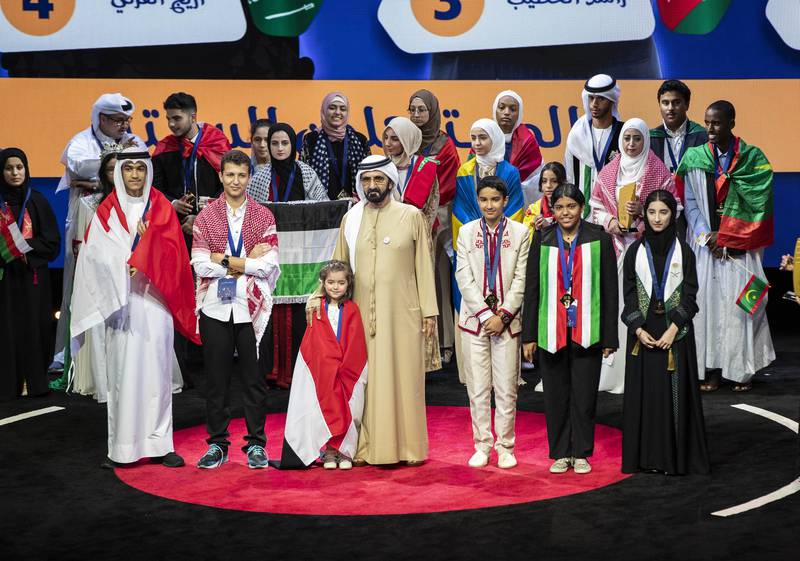
Sheikh Mohammed bin Rashid, Vice President and Ruler of Dubai, with the six finalists at the Arabic Reading competition at Dubai Opera. Left to right, Mohammed Jamil (Bahrain), Rashid Al Khateeb (Jordan), Sham Bakour (Syria), Adam al Qasimi (Tunisia), Ghala Al Enzi (Kuwait) and Areej Al Qarni (Saudi Arabia). All photos: Ruel Pableo for The National
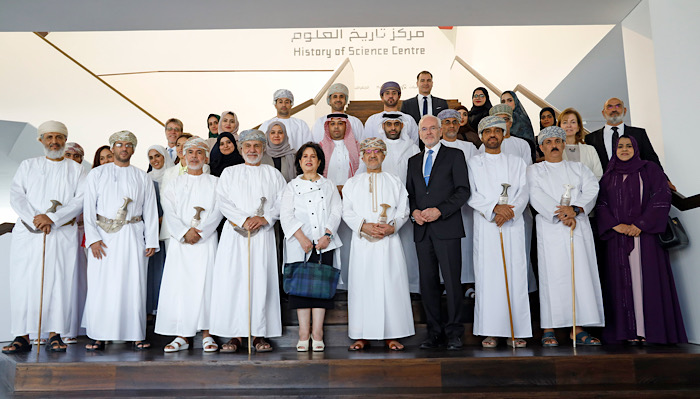
The UNESCO Chair for World Heritage Management and Sustainable Tourism at the German University of Technology in Oman was inaugurated Under the patronage of H.E. Salim bin Mohammed Al Mahrouqi; Minister of Heritage and tourism and with the participation of H.E. Shaikha Mai Bint Mohamed Al Khalifa; Chairperson of the Board of directors of the Arab the Regional Center for World Heritage.
Prof. Dr. Michael Braun, Rector of the University, introduced the university and its commitment to research and innovation; and commented that the chair comes as a great accomplishment on the university’s 15th anniversary.
Chairholder Professor Dr. Heba Aziz of the UNESCO chair at GUtech stated: “The establishment of the UNESCO chair at GUtech offers new research, teaching and learning opportunities at GUtech and is a further recognition of GUtech’s academic focus on the field of cultural heritage and sustainable tourism management”
The Chairholder Professor Aziz added “Oman’s vision 2040 remains at the core of the chair’s activity. National priorities focusing on Citizenship, Identity, National Heritage and Culture, sustainable cities and governorates and employment and labour markets are the compass that directs the chairs activity. The chair will work closely with the Ministry of Heritage and Tourism to make sure that it provides the necessary scientific research and labour force to achieve its vision.”
World Heritage Sites draws international attention to heritage sites of outstanding universal value and is expected to increase the number of visitors to these sites. The chair aims to support the role of world heritage in contributing to the Sustainable Development Goals by employing tourism in its comprehensive and sustainable manifestation to drive socio-economic development and to maximize benefits to the communities surrounding these sites.
The Chair is established in partnership with the Arab Regional Centre for World Heritage, a UNESCO Category II Centre based in the Kingdom of Bahrain. The center serves 19 Arab States in the promotion and management of cultural and natural sites by providing technical support and reinforcing the implementation of the 1972 World Heritage Convention in the region.
The chair complements the role that of the center and will introduce several academic programs in the field of tourism management in World Heritage sites, digitization of heritage, heritage narrative and interpretation and heritage economics. GUtech will also introduce Master’s degree in World Heritage and Sustainable Tourism management in collaboration with the Arab Regional Center for World Heritage.
The chair team consists of Jokha Al Saqri, researcher in Heritage studies, Prof. Dr. Osman Barghouth co-chair holder and Prof. Dr. Heba Aziz, UNESCO chair holder
This is the first chair specialized in this field and the first UNESCO chair concerned with the field of World Heritage for the Arab region as a whole.
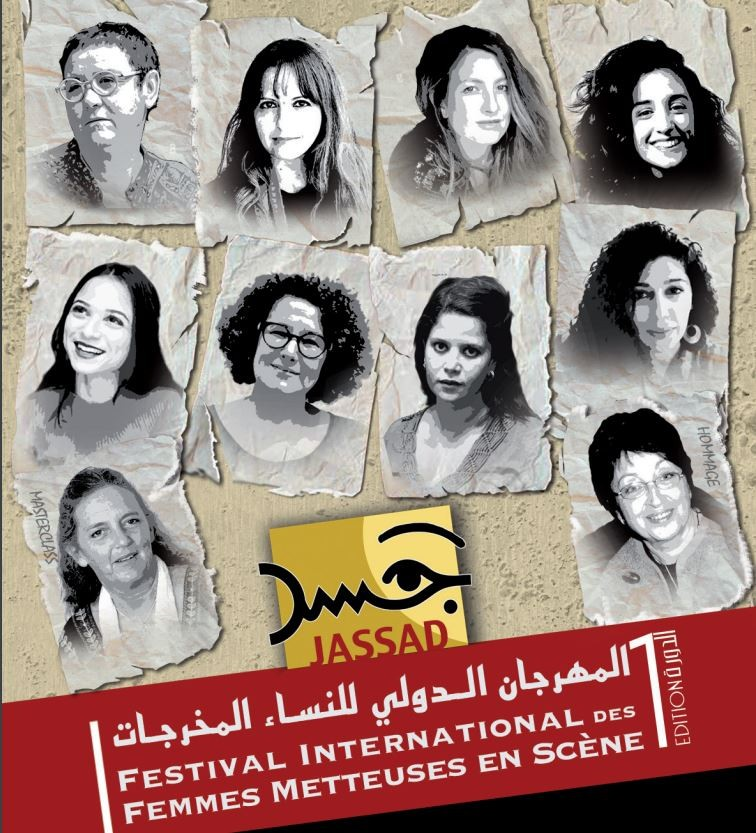
Morocco’s cultural capital Rabat is hosting the first edition of Jassad, the International Festival of Women Directors, between October 25 and 30. The event aims to highlight and pay tribute to the achievements of women theater directors from across the world.
Organized by Morocco’s Aquarium Theater and Anfass Theater, the festival will feature renowned women directors from Morocco, Tunisia, Lebanon, Spain, France, Denmark, and Romania.
“Through this festival, we wish to establish a ritual of recognition towards all the creative women who serve the theater,” said Amsaa Houri, director of Anfass Theater.
The six-day event also aims to “strengthen the resilience and hope of women actors in the cultural and creative industry, at a time when the sector has been seriously affected by the Covid-19 pandemic,” Houri added.
The festival serves as a platform for cultural and artistic exchanges, as its program offers a wide range of activities, including plays, a master class, workshops, as well as meetings and debates, indicated the organizers in a press release.
Director of Aquarium Theater Naima Zitan described the festival as “a meeting, an exchange, a discovery, all this and a little more,” explaining that the event is dedicated to theatrical creation, as well as exchanging ideas, experiences, and different visions of the world.
“The Jassad (meaning body in Arabic) is what unites us, wearing a festive hat to welcome and greet a vast and colorful audience,” Zitan said.
The festival will feature various theatrical pieces, including Naima Zitan’s “Le Masque” (The Mask), Asmaa Houri’s “Automne” (Autumn), as well as “Joyeux Anniversaire” (Happy Birthday) by Morocco’s Fatima Zohra Lahouitar and “Boujloud” by French-Moroccan Kenza Berrada.
The six-day event will also feature “Nawal” by Lebanon’s Lina Abyad, “Heimat Wort” by Tunisia’s Meriam Bousselmi, “Enlorquecidas” by Spain’s Marta Ocana, and “Une Maison de Poupee” by France’s Lorraine de Sagazan.
In addition, the event will include a seminar titled “Profession: Woman of Theater,” featuring Morocco’s Zohra Makac and Omar Ferhat, Lebanese director and theater professor Lina Abyad, and Denmark’s theater actress Julia Varley.
Read on for a list of regional female filmmakers who have been taking the industry by storm.
Farida Khelfa
Farida Khelfa is an Algerian-French documentary filmmaker. She is currently set to release a new film titled “From The Other Side of the Veil” that aims to dismantle misconceptions and stereotypes that often surround Arab women.
Kaouther Ben Hania
The Tunisian filmmaker made headlines in the film industry after her critically acclaimed movie “The Man Who Sold His Skin” was shortlisted for the Oscar’s Best International Feature Film award this year.
Ayten Amin
The Egyptian director has long chronicled the lives of women in modern Egypt. Her feature film “Souad” was selected for the cancelled 2020 Cannes Film Festival.
Danielle Arbid
Danielle Arbid is a Lebanese filmmaker. Her work has screened at numerous film festivals in France and the rest of the world, including New York, San Francisco, Tokyo and more.
Annemarie Jacir
The Palestinian filmmaker has written, produced and directed award-winning films such as “A Post Oslo History.” Her movie “Wajib” (2017) won her 18 international awards.
Nujoom Al-Ghanem
The Emirati filmmaker, writer and poet had to overcome societal stigma and family disapproval to make it. She defied the odds and produced films such as “Amal” (2011) and “Sounds of the Sea” (2015).
In a career spanning decades, Iraqi-born Sadiq has shown her creations worldwide and dressed the stars, but she remains rooted in the traditions of her homeland.
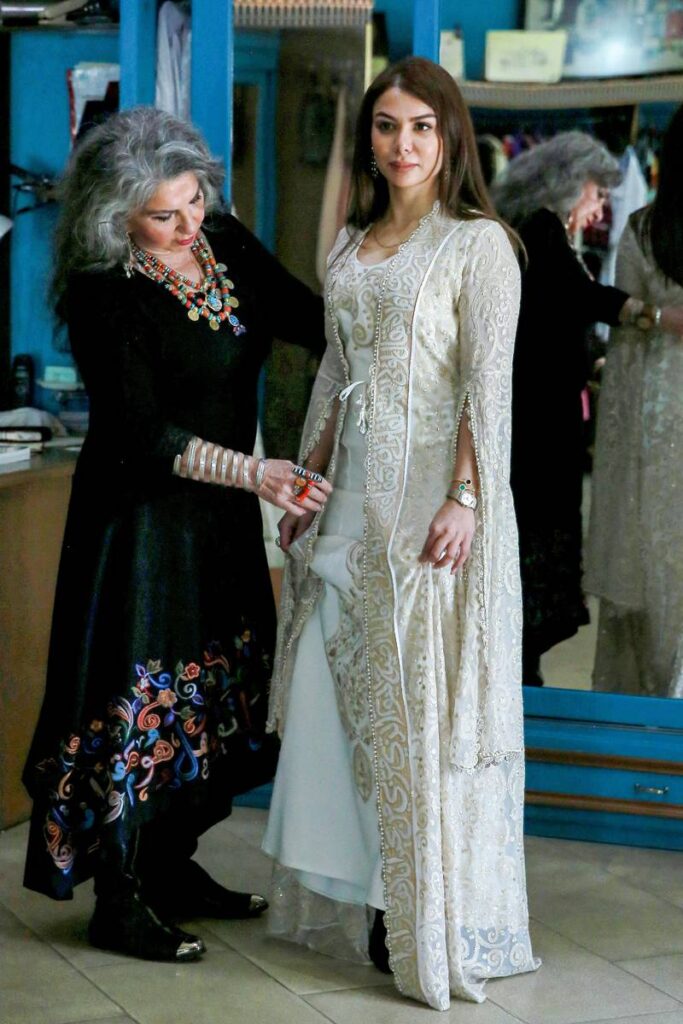
With verses from love poems and flowing calligraphy, Jordan-based fashion designer Hana Sadiq stitches a testament to the beauty of Arab women.
The artistic handwriting of Arabic script dominates her embroidered modern designs, with poetry or letters scattered in bright colours.
She uses various calligraphic styles, from the elaborate Diwani to the curving Thuluth and features on some of her outfits the lines of renowned Arab poets including Mahmoud Darwish and Nizar Qabbani.
“Arabic calligraphy is the most beautiful,” says Sadiq, 72, showing off her love of jewellery with strings of beads around her neck, dangling earrings, and unusual stone rings.
At her home workshop in downtown Amman, Sadiq notes that the earliest writing was born several millennia before Christ in what is now Iraq, arguing that it was a place “without which all the other civilisations would not have existed”.
Sadiq has split her time between Amman and Paris since 1982, having both French and Jordanian nationality as well as Iraqi citizenship.
‘How beautiful she is’
She has exhibited from Europe to the United States as well as the Middle East, returning home with an extensive collection of antique silver ornaments, along with thousands of pieces of Arab textiles and costumes.
Her kaftans, traditional robes, feature bright and stunning colours. They reflect the influence of her grandmother who wore a traditional Iraqi “Hashemite dress” and walked “elegantly like a peacock”.
The folk outfit is made of very thin fabric with wide sleeves and transparent sides, decorated with beautiful floral ornaments, golden or silver, on a black base. It was the favourite of Iraqi women in the 1950s and 60s.
Sadiq traces her interest in fashion to her childhood, when she would visit her grandfather’s textile shop in Baghdad.
She went on to design for celebrities and royals, including Jordan’s Queen Rania and Queen Noor. But whoever the client, her work has been guided by pride in the Arab woman’s femininity.
Unlike more revealing Western fashion, her designs envelope the woman’s body, “but it shows high femininity,” says Sadiq, who is also the author of a book, “Arab Costumes and Jewelry, a Legacy without Borders”.
She argues that Western clothes are not the best fit for the bodies of Arab women but have spread to the region anyway. “Unfortunately this is the result of globalisation,” she says.
“What matters to me, in all my work, is that the woman remains female and that a man is attracted to her as a female,” she adds. “Which means when a woman passes in front of him, he must notice and see how beautiful she is.”
Her kaftans, traditional robes, feature bright and stunning colours, reflecting the influence of her grandmother who wore a traditional Iraqi Hashemite dress and walked “elegantly like a peacock”.
Students from different UAE schools are being mentored in the space camp by celebrated names in space exploration and science, including Nasa astronauts and scientists.
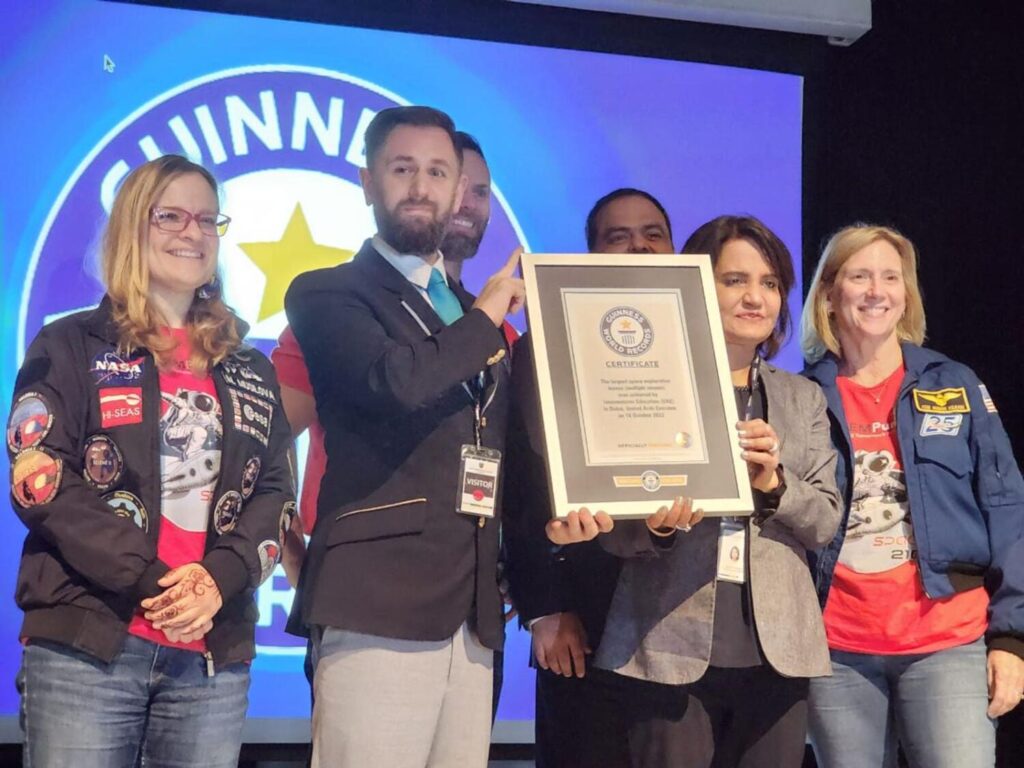
Loud cheers echoed across the auditorium of a Dubai school campus on Tuesday as it made to the Guinness World Records .
The Innoventures Education group of schools set a record for conducting the world’s largest space exploration lesson (multiple venues) with 2,000 students from its five schools during the ‘Space 2101’ space camp where pupils from UAE schools have convened.
Poonam Bhojani, CEO, Innoventures Education, said: “We are delighted with the record for the maximum number of attendees in a Stem lesson across multiple venues. There were 108 nationalities of students who attended this course.”
The space camp, being held from October 17-21 at Dubai International Academy (DIA), Al Barsha, is seeing students from different UAE schools being mentored by celebrated names in space exploration and science, including Nasa astronauts and scientists.
At the camp, students can design experiments which stand a chance of being conducted in space. They can also have the schematic of their design printed and signed by the visiting astronauts and scientists as a keepsake.
Innoventures Education has partnered with Starlight Education, to offer students between 12 to 18 years at the camp a unique opportunity to design a sustainable habitat together with real astronauts and high-achieving scientists from around the world. The five-day programme will help students build critical thinking, leadership and teamwork, presentation techniques, and help build Stem skills as well as in-depth knowledge of designing space habitats that are fit for human wellbeing.
Hitesh Bhagat, principal, DIA, EH said: “The Space 2101 initiative, which has been going on around the world, has a strong good connection with the UAE’s space programme. The initiative is all about giving a different learning environment to our students where they can interact with experts.”
Students delighted to enter the records book
Students at the camp are getting to learn about real-world Stem skills like 3D design, coding, robotics and other industry-linked content. Ayesha Aldaboos, Grade 9 Emirati student at the Collegiate International School (CIS) said: “The programme taught me about other options in the science field. When I was younger (in junior classes), I always wanted to do something in the field of space. I don’t think I have the guts to become an astronaut, but maybe working at Nasa would be really nice.”
Raffles International School Year 8 student Mohammed said: “We are delighted that we’ve managed to enter the Guinness World Records. This camp has been fun, I made new friends and interacted with a lot of people from other schools. I also learnt about a new app that is being used for coding.
Ellen from DIA, said: “I used to hear about the Guinness World Records all the time, so it was exciting to be a part of this record-breaking achievement. While interacting with astronauts I got a chance to ask questions that have always intrigued me. I also learnt about computer aided design (CAD) and 3D modelling. I want to learn coding, and when I grow up I want to work for myself not for others.”
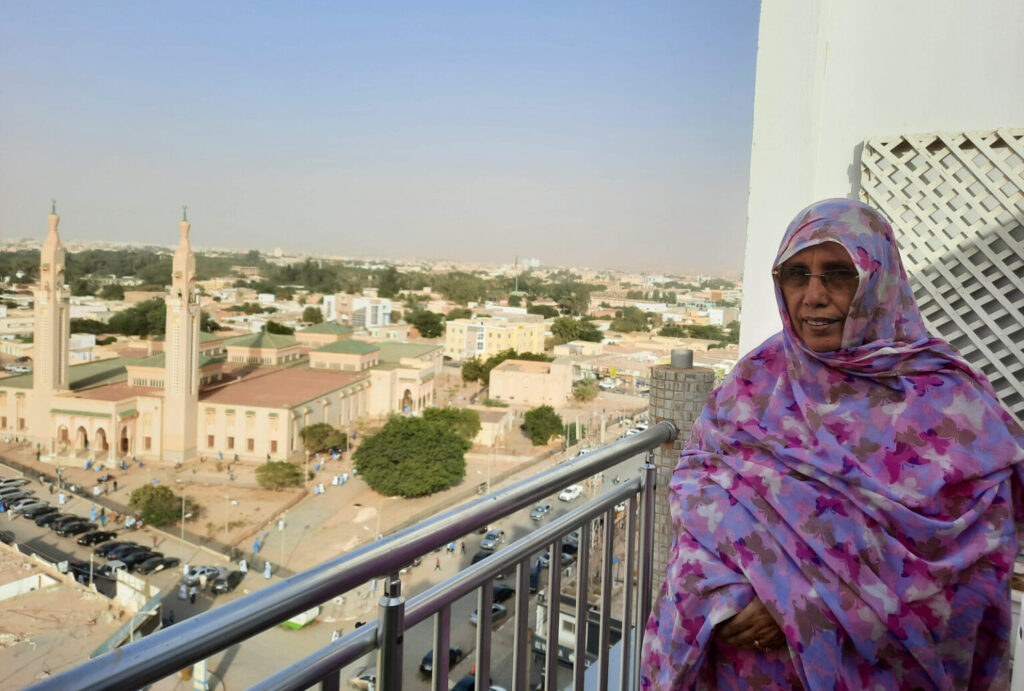
A longtime supporter of women’s rights in Mauritania, Aminetou Mint El-Moctar is currently focusing her efforts on confronting the barriers that deprive young women and members of vulnerable communities of university education.
The 65-year-old human-rights activist works through the Association of Women Heads of Households, which she founded in 1999, to support women’s issues in Mauritania and to renounce the various forms of discrimination against them.
In an interview with Al-Fanar Media, she recounted how her personal experience of being deprived of university education and forced into early marriage motivated her activism.
The right to education is inseparable from women’s aspirations to play a greater role in socio-economic and political life, she said.
The basic right to education opens the door to all other rights, she added. “Our homeland will not be able to achieve economic growth or political development without promoting the right of both sexes to education and raising education quality in all levels.”
Early Marriage and Activism
Aminetou Mint El-Moctar grew up in a middle-class family in the capital, Nouakchott. Her father was a merchant and her mother passed away early after her birth, so she lived with her grandmother. She started her education at a young age. At secondary school, she was forced to drop out to get married at the age of 13.
At that time, El-Moctar was becoming active in political demonstrations, but her father prevented her from taking part in them by “tying her with chains,” she said.
She told Al-Fanar Media: “I rebelled against early marriage and the traditions that exclude women and make them a mere tool for the traditional and patriarchal iron fist that sets them a binding path, without regard to their personal choices.”
She added: “Human-rights activism helped me rediscover myself, refined my skills, and made me more aware of the conditions of marginalised women who are forced to drop out under the pressure of outdated social traditions.”
In her struggle, El-Moctar has won several awards and medals. In 2006, she was awarded the Human Rights Prize of the French Republic. Academics at Georgetown University, in the United States, nominated her as one of the 500 most influential people in the Islamic world. In 2015, she was shortlisted for the Nobel Peace Prize.
Education of Girls in Mauritania
According to statistics, girls’ education in Mauritania faces many problems, including a high dropout rate. Some 47 percent of girls do not make the transition from primary to secondary school. Moreover, only 17 to 20 percent of university students are female.
Mauritania has made efforts to increase girls’ participation in education, but El-Moctar thinks these efforts are deficient in light of traditions that hinder many young women from joining the university. Economic deprivation is also a factor for many Mauritanians. In addition, El-Moctar says, some government policies “place restrictions on women’s access to leadership positions in all sectors.”
The women who do enrol in higher education run into additional problems, El-Moctar said. These include discriminatory educational curricula and practices, gender-based violence, government interventions in curricula and teaching methods, and a decrease in the number of teaching staff.
Other challenges that make it difficult for many girls to continue their education include high rates of child marriage and teenage pregnancy. Additional factors affect boys and girls alike, including poverty and living at a distance from schools. El-Moctar explained that children of rural families who depend on agriculture for their livelihood are unable to travel to urban areas where schools are located.
Empowering People with Disabilities
With about 18,000 volunteers, the Coalition of Mauritanian Organisations for Education is working in partnership with international organisations on several programmes to increase access to education. Its projects include efforts aimed at improving the integration of graduates into the labour market, supporting vulnerable girls’ enrolment in universities, and enabling people with disabilities to continue their education, along with designing educational programs commensurate with their capabilities and needs.
El-Moctar also criticised what she sees as discrimination against young women in government scholarships to study abroad. She said scholarships were awarded primarily to children from officials’ families.
She called on international donors to increase the number of scholarships they offer to those who wish to complete their studies abroad. Mauritania has only one public university and it is unable to accommodate all students, she said.
A Long Activism Journey
Since 1999, El-Moctar has been supervising the activities of the Association of Women Heads of Households, to support Mauritanian women in the face of discrimination and physical violence, and to encourage them to play a greater role in society and the economy.
Women in her country are “victims of traditions reflected in government policies or university admission policies,” El-Moctar said.
However, she asserted: “I will continue my path until women get the highest levels of education as a natural right, not as an exception, and enjoy full legal equality without reservations.”
Forced into early marriage and deprived of a university education herself, Aminetou Mint El-Moctar embarked on a lifelong struggle to improve women’s lives in her country.