Emirati ‘218’ Star Amal Mohamed Wins Best Asian Actress at Dutch Septimius Awards, Amsterdam

The film, Sharjah Media City’s first production, was nominated in three categories – Best Director, Best Actress and Best Asian Film.

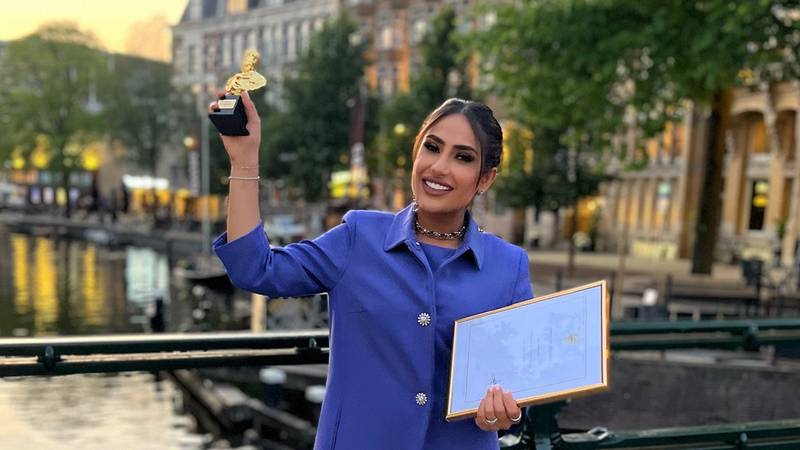
Emirati actress Amal Mohamed has won Best Asian Actress at the Septimius Awards for film, in the Netherlands, for her role in the Emirati film 218: Behind the Wall of Silence.

The movie is the first production by Sharjah Media City or Shams and is the result of a two-year initiative that involved more than 2,000 aspiring creatives from around the UAE.

The film, which deals with issues of domestic violence, nostalgia and revenge, tells the story of three young women from different backgrounds, whose fates become intertwined because of a mysterious event in apartment 218.

It is directed by The Tainted Veil filmmaker Nahla Al Fahad and stars, alongside Mohamed, several renowned Emirati actors including Habib Ghuloom, Merei El Halyan, Mansoor Alfeeli, Abdulla Bin Haider and Haifa Al Ali.

The film was nominated in three categories at the Septimius Awards, namely Best Director, Best Actress and Best Asian Film. The festival, held on Monday and Tuesday in Amsterdam, is aimed at encouraging independent film talents and supporting visionary films.

“Shams is proud to produce works of art that leave an unmistakeable mark on the Emirati creative scene,” Shams chairman Khalid Omar Al Midfa said. “The film 218 is our first foray into this field, and for Emirati actress Amal Mohamed to win Best Asian Actress at the prestigious Septimius Film Awards truly underlines the meticulous quality of the production, as well as its ability to deliver an important social message. This, in turn, demonstrates our ability to compete and produce works that can make an impact in the film industry.”

Al Midfa congratulated Mohamed on her achievement and said this was “only the beginning” for Shams.

How ‘218’ was made

218 was the first film to be produced under the Shams initiative UAE Entertainment Experience, and is touted as being the “first crowdsourced film in the Arab world.”

The campaign began in 2019 by calling on fresh university graduates from around the UAE to enrol in a free filmmaking training programme.

“We had a team in every major city that actually met those interested in participating in the initiative,” Shihab Alhammadi, director of Shams, previously told The National. .

In its early stages, the programme had more than 2,000 participants taking part in the training courses, that were offered online and in person. The training focused on developing various skills in filmmaking, from scriptwriting to directing and post-production to scoring.

A committee consisting of film professionals oversaw the training programme and offered mentorship to its participants.

“We have experts in directing, acting, scriptwriting and music production to name a few,” Alhammadi said. “They were all involved in the team as well as those who were involved in managing the programme.”

The committee included Al Fahad, Ghuloom, scriptwriter Mohammed Hasan Ahmed and Bin Haider.

source/contents: thenationalnews.com

________________

Emirati actress Amal Mohamed shows off her Septimius Award for Best Asian Actress, in Amsterdam. Photo: Shams

___________________________________

UNITED ARAB EMIRATES (U.A.E.)

Ibrahim Abdel-Meguied, Dawood Abdel-Sayed and Iraqi Qais Azzawi win Egypt’s Top Cultural Awards and Honour

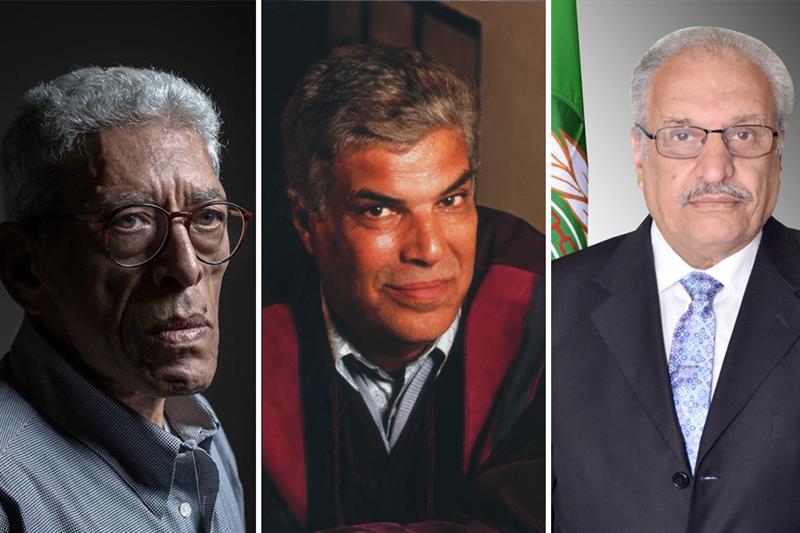
Egypt’s highest state awards in art, literature, and social sciences for 2022 were announced on 7 June, with writer Ibrahim Abdel-Meguied, director Dawood Abdel-Sayed, and late Iraq thinker Qais Azzawi winning the top honour, the Nile Award.

In a meeting chaired by Egypt’s Minister of Culture Ines Abdel-Dayem, members of Egypt’s Supreme Council for Culture (SCC) voted on the top awards.

The members voted on 53 prizes worth a total of EGP 7.5 million (around $374,632) divided into four sections:

Here is the full list of winners:

The Nile Award

The Nile Award is granted to three people in the fields of literature, arts, and social sciences. Each winner receives EGP 500,000 and a gold medal. A new award for the most creative Arab personality was added for the first time in 2018.

The Nile Award in Literature was given to writer Ibrahim Abdel-Meguied.

The Nile Award in Arts was handed to director Dawood Abdel-Sayed.

The Nile Award in Social Sciences went to the late lawyer and head of the lawyers syndicate Ragi Attia.

The Nile Award for the Most Creative Arab personality was awarded to late Iraqi thinker Qais Al-Azzawi, who died in 2022.

The Nile Award for a creative Arab personality was launched in 2018 in a bid to strengthen ties between Egypt and Arab creative minds.

Appreciation Awards

The award carries a prize of EGP 200,000 and a gold medal.

The Appreciation Award in Arts went to actor Rashwan Tawfik, architect Suhair Hawass and Ahmed Nabil Suleiman.

The Appreciation Award in Literature was awarded to writers Mohamed Abulfadl Badran, Youssef Hassan Nofal and Kamal Ruhayem.

The Appreciation Awards in Social Sciences were awarded to Said Ismail, Abdel-Salam Abu-Qahf and Moataz Sayed Abdallah.

Excellency Awards

The Excellency Award in Literature was granted to writer Reem Bassiouny and Amr Fouad Dawara.

The Excellency Award in Arts was handed to Gamal Yaqoot and Ahmed Abdel-Kareem.

The Excellency Award in Social Sciences was handed to late judge Tahany El-Gebaly, Iman Amer, and Ahmed Hassanien.

In addition to the previous awards, the SCC granted 32 encouragement awards, each one of them worth EGP 50,000.

Factbox

There are 52 prizes worth a total of EGP 7.5 million (around $374,632) divided into four sections.

Of the seven Excellency Awards, two are for the arts, two for literature, and three for social sciences. Political analyst Ammar Ali Hassan and economic expert Ahmed El-Naggar were among the winners of the prize last year.

Novelists Khairy Shalaby and Gamal El-Ghitani, poet Mohammed Afifi Mattar, and critic Gaber Asfour are among the past winners.

The Nile Award was originally named the Mubarak Award, but was changed in the aftermath of the 25 January 2011 Revolution that ousted president Hosni Mubarak from power.

Poet Abdel-Rahman El-Abnoudi, writers Bahaa Taher, Ibrahim Aslan, and Waheed Hamed, and cinema director Youssef Chahine are the most prominent figures to date who have won the Nile Award.

The State Awards were launched in 1958 and have only been cancelled once, in 1967, during the Six-Day War between Egypt and Israel.

source/content: english.ahram.org.eg (edited)

____________

Dawood Abdel-Sayed, Ibrahim Abdel-Meguied, and Iraqi Qais Azzawi

_______________

EGYPT / IRAQ

Saudi Student Itizaz Alnefaie breaks World Record. She is honoured by Tabuk Governor Prince Fahad bin Sultan for Top Two Finish in Worldwide Mental Arithmetic Competition, Egypt

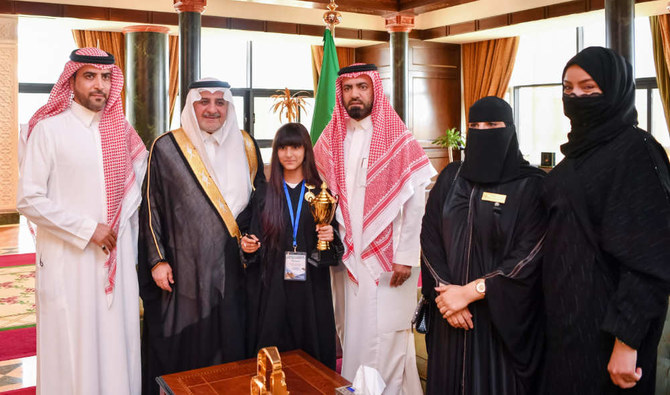
Tabuk Gov. Prince Fahd bin Sultan honored Itizaz Alnefaie, the primary school pupil from Tabuk International Schools who won second place in this year’s Worldwide Mental Arithmetic Competition, recently held in Egypt’s Sharm El-Sheikh.

Alnefaie broke the world record by solving 100 maths problems, testing herself against the clock.


He congratulated Alnefaie for this achievement, wishing her more success, noting the Saudi leadership’s support for outstanding students in all scientific fields.


“I’m pleased to meet you and everyone is proud of your achievement,” Prince Fahd said, praising the efforts made by Alnefaie’s parents and teachers, who created the environment for her to reach excellence, and who supported her talent. He also wished her and all of Tabuk’s students future success.

The prince then offered Alnefaie his personal pen as a gift. The head of Tabuk International Schools, Maram Al-Atwi, praised Prince Fahd for the achievement, which comes as a result of his great support for the education sector in Tabuk, noting that this success is an extension of the local and international achievements made by public school students from all Saudi regions.


Hundreds of talented pupils representing more than 25 countries, including Saudi Arabia, participated in this year’s competition.


Solving a math problem might take most people a few minutes. However, Alnefaie takes just a second or two.

source/content: arabnews.com (edited)

___________

Tabuk Gov. Prince Fahd bin Sultan honors Itizaz Alnefaie, the primary school pupil from Tabuk International Schools. (SPA)

_________________

SAUDI ARABIA
Remembering Hoda Sultan: The ‘Bella Donna’ of Egyptian Cinema / 05 June

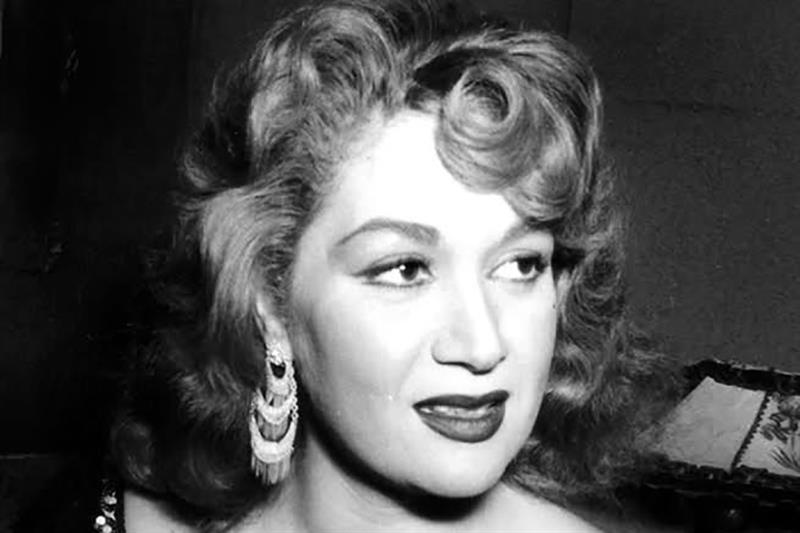
Sunday marks 16th death anniversary of Egyptian film star Hoda Sultan (15 August 1925 – 5 June 2006).

One of the brightest stars of the 20th century, Sultan made a mark in Egyptian cinema history as an actress and singer in many musical films. 

Born Gamalat Bahiga Abdel-Aal Al-Haww in Kafr Abu-Gendy in Gharbiya governorate on 15 August 1925 to a mother of Turkish descent and a father who married several times and had many children.

Sultan married at a young age and divorced after the birth of her first daughter.

She embarked on the cinematic career inspired by her brother, renowned singer Mohamed Fawzi, taking steps into Egyptian radio with her first song in 1949.

As Ashraf Gharib writes for Ahram Online: “She auditioned for a role that was announced by Nahas Studio, who was searching for a new face capable of singing to participate in Bella Donna (1950), directed by Niazi Mostafa, and landed it. Despite the fact that it was a small part, she emerged closer to the world of fame.”

She then began receiving numerous roles starting with El-Usta Hassan (Foreman Hassan, 1952), directed by Salah Abu-Seif, and Hokm El-‘Awy (The Rule of the Powerful, 1951) and Tager El-Fadayeh (The Scandalmonger, 1953), both directed by Hassan El-Imam.

She landed starring roles in many musical films such as Habib Albi (The Love of My Heart, 1952) by Helmy Rafla and Taxi El-Gharam (Love Taxi, 1954) by Niazi Mostafa.

In addition, Sultan also appeared in Hamido (1953) by Niazi Mostafa, Ga’alouni Mograman (They Made Me a Criminal, 1954) by Atef Salem, El-Mouhtal (The Swindler, 1954) by Helmy Rafla, Sawaq Nos El-Leil (Midnight Driver, 1958) by Niazi Mostafa, Abeed El-Gasad (Slaves of the Flesh, 1962) by Kamal Attiya, and two of her more important films with Hassan El-Imam: Zawga Min El-Sharea (A Wife From the Street) and Sai’dat El-Regal (Men’s Huntress) both in 1960.

“However, Hoda Sultan’s artistic and feminine climax represented itself best in Ezzeddine Zulfikar’s masterpiece Emra’ah Fi El-Tariq (A Woman on the Road, 1958) where she played the she-devil crossing your path and stinging you with her carnal desires,” writes Gharib.

“When Egyptian cinema turned towards duos, Hoda Sultan formed one with Farid Shawqi, her husband at the time. Between the pair, the remarkable duo made 19 films together, starting with Bella Donna and The Rule of the Powerful.”

Her artistic maturity became obvious in El-Sirk (The Circus, 1968) by Atef Salem, DalalEl-Masriya (Dalal the Egyptian, 1970) by Hassan El-Imam, El-Ikhtiyar (The Choice, 1971) by Youssef Chahine, and Shai’ Fi Qalbi (Something In My Heart, 1971) by Kamal El-Sheikh.

She then became the first-choice actress for the film and television roles which needed a maternal character. This landed her the role of Amina in Naguib Mahfouz’s famous trilogy adapted to TV and that of Tafida in Something in my Heart, adapted from Ihsan Abdel-Quddous’ novel.

Her important TV appearances included Layali El-Helmiya (El-Helmiya Nights, 1987), Arabesque (1994), El-Wattad (The Tent Pole, 1996), and Zizinia (1997).

Sultan passed away on 5 June 2006 in Cairo.

source/content: english.ahram.org.eg

____________

_________

EGYPT

Winners of 3rd edition ‘ICCROM – Sharjah Award for Good Practices in Cultural Heritage Conservation and Management in Arab Region 2021-22 Award’

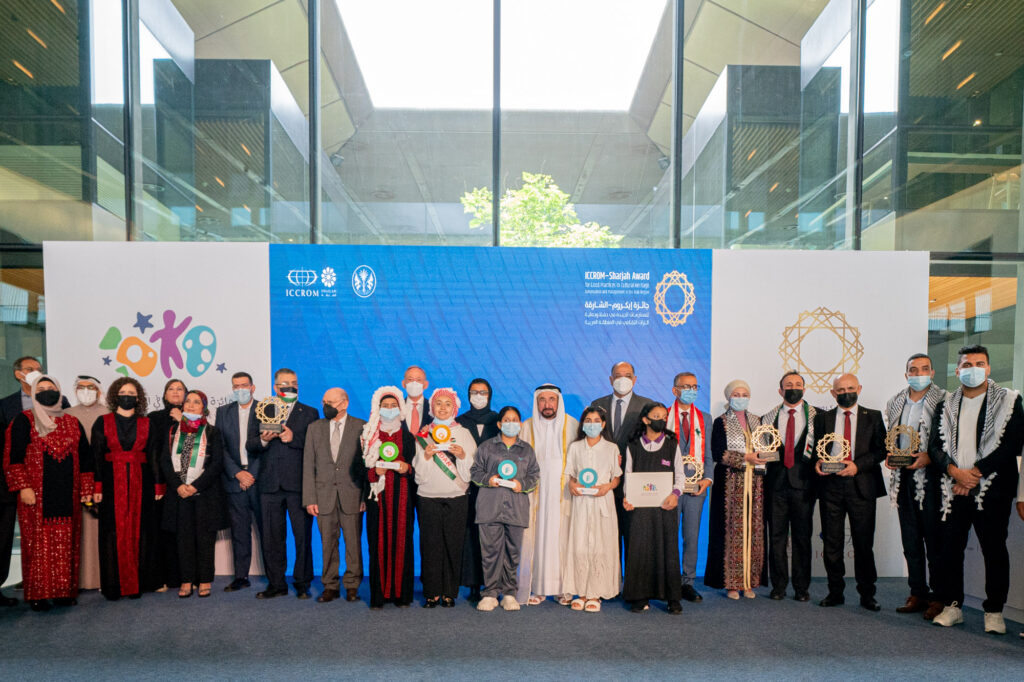
H.H. Sheikh Dr. Sultan bin Muhammad Al Qasimi, Supreme Council Member and Ruler of Sharjah, attended on Thursday an honouring ceremony of the third cycle’s winners of the ICCROM-Sharjah Award for Good Practices in Cultural Heritage Conservation and Management in the Arab Region (2022-2021), and the second cycle of the ICCROM-Sharjah Award The Arab cultural heritage for young people, in the House of Wisdom.

The ceremony began with a speech delivered by Dr. Zaki Aslan, Regional Director of International Centre for the Study of the Preservation and Restoration of Cultural Property (ICCROM) in Sharjah.

Dr. Aslan mentioned the award’s goal to spread the notion of cultural and heritage preservation in the region within international standards through initiatives and events that help exchange knowledge and experience.

Then John Robbins, Chairman of the Executive Board of ICCROM, thanked the Ruler of Sharjah, for sponsoring this event and all other activities in the region.

H.H. the Ruler of Sharjah and the audience watched several visual films about the ICCROM-Sharjah Award and the winning projects.

H.H. honored the winners of the 3rd cycle of the ICCROM-Sharjah Award for Good Practices in Cultural Heritage Conservation and Management in the Arab Region; and the 2nd cycle of the Arab Cultural Heritage Award for the Young.

The grand prize for the 3rd cycle went to Beirut Assist Cultural Heritage (BACH), a project to recover the affected area following the 2020 blast in the Port of Beirut, Lebanon; and the rehabilitation and restoration of residential courtyards and historical buildings in the vicinity of Al Aqsa Mosque, Palestine.

In the Special Excellence category, four projects won: sheltering and protecting Hicham’s Palace’s mosaic floor, Palestine; Collart-Palmyre: a comprehensive project on the Baalsahamîn temple in Palmyra; the revitalization and conservation of the cultural heritage of Al Qarara Village in Gaza, Palestine; and the digital documentation of historical documents in Jerusalem, Palestine.

As for the 2nd cycle of the Award for the Young, the student Sarah Hassan Al Hosani, from the Al Amal School for the Deaf – United Arab Emirates, and the student Al Yasar Al Masry, from the Omar Bin Al Khattab College – Al-Makassed Islamic Charitable Association – Lebanon, won first place.

The student, Ghala Abdel Rahim Mahmoud Al Raheel, from Bayouda Al-Sharqiya Mixed Secondary School – Jordan, won first place in the photography category, while the first place in the folk dance category, Al Takadum School for Basic Education – Libya, won the old street dance, and Qasr Al-Hallabat Al-Gharbi Mixed Secondary School – Jordan won first place in the awareness film category for the movie “A Story of Joy from the Heart of the Badia”.

The honouring ceremony was attended by Sheikh Salem bin Abdulrahman Al Qasimi, Chairman of the Sharjah Ruler’s Office, Sheikh Mohammed bin Humaid bin Mohammed Al Qasimi, Chairman of Department Of Statistics and Community Development, Sheikha Alyazia bint Nahyan bin Mubarak Al Nahyan, Noura bint Mohammed Al Kaabi, Minister of Culture and Youth, and several senior officials, ambassadors and representatives cultural organisations.

source/content: wam.ae (edited)

_______

________________________________________________________________________

SHARJAH, UNITED ARAB EMIRATES(U.A.E) / JORDAN / LIBYA /LEBANON / PALESTINE / SYRIA

Amira Osman Hamed, Sudan’s Women’s Activist -Engineer Wins the International ‘2022 Human Rights Defenders at Risk Prize’

Sudanese women’s activist Amira Osman Hamed has won a Front Line Defenders Award for Human Rights Defenders at Risk, the organization announced.


The activist and engineer, now in her forties, has been advocating for Sudanese women for two decades, and was detained this year in a crackdown following the country’s latest coup.


She was among defenders from Afghanistan, Belarus, Zimbabwe and Mexico who also received the 2022 award for Human Rights Defenders at Risk.


Osman “never deterred from her mission,” Dublin-based Front Line Defenders said in its awards announcement, “consistently (advocating) for democracy, human rights, and women’s rights.”


After first being charged for wearing trousers in 2002, she drew international support in 2013 when she was detained and threatened with flogging for refusing to wear a headscarf.


In 2009, she established “No to Women Oppression,” an initiative to advocate against the much-derided Public Order Law. It was finally repealed in 2019 after Bashir’s ouster following a mass uprising.


The award has honored human rights defenders annually since 2005.

source/content: arabnews.com (edited)

_________

Amira Osman Hamed. (AFP file photo)

__________

SUDAN

18th ‘UNESCO-Sharjah Prize for Arab Culture (SPAC)’ Awarded to Dunya Mikhail and Helen Al Janabi. Simultaneously Celebrates the Winners of its 17th Session in Paris.

The United Nations Educational, Scientific and Cultural Organisation (UNESCO) headquarters in Paris held a ceremony for the 18th edition of the Sharjah Prize for Arab Culture (SPAC), organised by the Sharjah Department of Culture in cooperation with UNESCO.

The Prize has been awarded to Dunya Mikhail, an American-Iraqi poet, and Helen Al Janabi, a Swedish actress of Syrian-Iraqi origin.

Sheikh Salem Khalid Abdullah Al Qasimi, Deputy Secretary of State for Heritage and Arts Sector, UAE’s Permanent Representative to the UNESCO, along with Professor Mohammed Ibrahim Al Qaseer, Director of Cultural Affairs at the Department, in addition to dignitaries, writers, intellectuals and members of the diplomatic corps accredited to the United Nations.

Ernesto Otuni Ramirez, UNESCO’s Assistant Director-General for Culture, gave a speech in which he expressed his gratitude and appreciation to H.H. Dr. Sheikh Sultan bin Muhammad Al Qasimi, Supreme Council Member and Ruler of Sharjah, and for his cultural and humanitarian renaissance role at the local, regional and global levels.

Afterwards, Abdullah bin Muhammad Al Owais, Chairman of the Sharjah Department of Culture, gave a speech in which he expressed his happiness at the continuation of the UNESCO-Sharjah Prize for Arab Culture editions, appreciating the role of UNESCO in managing the prize and sponsoring many cultural programmes.

Al Owais and Ernesto Ramirez awarded the 18th Sharjah Prize for Arab Culture to Dunya Mikhail and Helen Al Janabi, in addition to honouring the winners of the 17th session.

source/content: wam.ae (edited)

____________

__________________________________________

AMERICAN / IRAQI / SWEDISH / SYRIAN

Renad Al-Hussein, a Saudi Medical Student brings Hope to Deaf Drivers with Award-Winning Invention

Renad bint Musaed Al-Hussein .

A Saudi medical student has won a string of an international awards for an invention that opens up a new world for hearing impaired or deaf drivers by dramatically improving their safety behind the wheel.

Renad bint Musaed Al-Hussein, a student at the College of Medicine at King Saud University, developed special sensors that operate as soon as they detect sounds outside the vehicle.

Sound frequencies are sent to a device inside the car, which then identifies and displays a description, image and color of the sound source visually, alerting the driver to any possible risk.

Her innovation has won several global awards and medals, including best invention at the World Intellectual Property Organization Cup and a gold award in the international invention competition as part of the Korea International Youth Olympiad.

The awards honor outstanding inventors, creators and innovative firms from around the world.

Al-Hussein said that her invention will reduce the risks facing hearing impaired drivers and may also help to save lives.

“One of the things that prompted me to come up with this invention is that some countries prevent hearing impaired or deaf people from driving because they are unable to hear important sounds. This invention will contribute to reducing the risks they face,” she said.

The Saudi inventor said that her invention could allow more than 466 million deaf people worldwide to drive, while also improving road safety by protecting their lives and the lives of others.

source/content: arabnews.com (edited)

_____________

Renad Al-Hussein said that her invention will improve road safety by protecting the lives of deaf drivers. (SPA)

_________________

SAUDI ARABIA
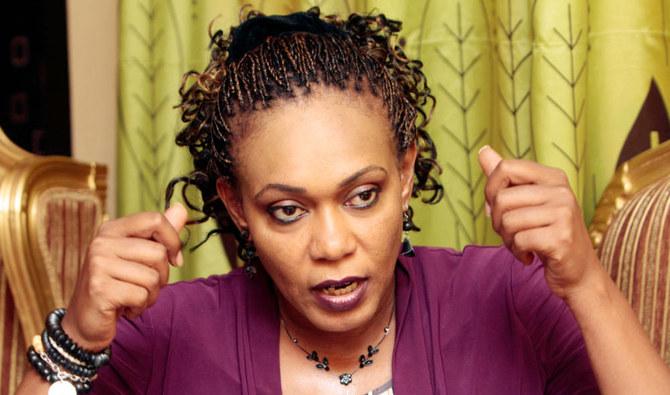
Souad El Markhous: A Moroccan Success Story in Dutch Construction Sector

Born in Larache in 1969, a young and driven Souad El Markhous found herself in a position where she had to lead a double life in Amsterdam for three years. Her struggle to grow from a young ambitious Moroccan girl to an owner of a Dutch construction company is a story that captures the listener’s heart. 

Determination and perseverance were key in El Markhous’ uncanny journey, and her story reflects the resilience of Moroccan women in the face of social expectations either at home or/and beyond. Still, she conveys an overwhelming sense of gratitude. For her, her story would not have been possible without Allah (God) and rdat walidin (parental blessings).

She left Larache in 1990 to settle down with her cousin in Amsterdam without telling her father. Unfamiliar with the Dutch language and culture, she soon had to look for a job to sustain herself. 

Her neighbor secured a job for her as a cleaner at the construction company De Combi, on the condition of keeping a low profile since the company was only hiring men cleaners.

Boss: from a ‘monster’ to a father-figure

Although she was afraid of getting caught, El Markhous had to clean the director’s office on Wednesday when he had a day off to spend quality time with his family.   

Despite the risk of being exposed, she used to sit in the director’s office and run her fingers through the keyboard, pretending to be working there. 

“I wanted to dream. I wanted to be like them, work,” she told Morocco World News.   

One day her fear came true. The director, Appelman, came to the office on his day off since his children and wife went on a vacation. He entered the office and found her there. They were stunned to see each other. 

From the stories she heard about him, she imagined a well-built and ruthless man who looked more like a “monster.” He met her expectations at first glance, physically at least. Yet he turned out to have a good heart and he became a father figure for her in a foreign country where she barely knew anyone.  

Bucket list check

“What are you doing here?” Appelman asked Souad on that fateful day in his office. Surprised and disoriented, she tried to communicate with him in broken English and French. He quickly ordered his secretary to look for a school for her. She was aged 19 at the time. “You have to learn,” he had said. 

For the following years, she secretly learned the Dutch language at Joke Smit College in Amsterdam (1990-1992) before pursuing an MBA in modern business administration at Schoevers in the University of Amsterdam between 1993 and 1996. 

El Markhous pretended to work overtime to attend school, while Appelman supported her cover story. 

Her father’s words after hearing about her departure and her work as a cleaner were engraved in her heart. Disappointed and sad, her father asked her if he ever mistreated her or starved her to the point that she would clean toilets for Dutch people. 

These words would stay with Souad for much of her formative years in the Dutch capital, motivating her, in a sense, to do her best to make her parents proud. 

Hit by reality and new beginnings

She accepted to have an arranged marriage with the hope of continuing her studies. Her future husband, also of Moroccan-descent, agreed to support her studies. 

Before her departure, Appelman handed her a letter in Dutch addressed to her father. In Larache, she opened and read the letter to her father. The letter, which essentially said that Appelman was her second father in the Netherlands, reassured El Markhous’ father. 

As she returned to the Netherlands, she continued her studies and gradually built up her career with the support of her husband. Now married for 20 years, they have raised two daughters together and established a happy family. 

Over the years, El Markhous rose through the ranks at De Combi, moving from cleaner to telephone operator to the head of administration at the Dutch construction company. She then became a member of the workers’ council, representing her fellow colleagues who all helped her through her journey of settling and integrating into her adoptive country. 

Turning point

In 2014, De Combi was on the edge of bankruptcy. At the time, the construction firm had hundreds of employees and 11 branches across the Netherlands. Four branches closed down and others were sold like in Tilburg and Amsterdam. The buyers made it clear that they would cut jobs.

Feeling responsible for protecting the familial nest she had made for herself at Combi, El Markhous was determined to find a solution to prevent the company from sinking.  And buying a branch was one of the few options available. 

So she decided to buy the Amsterdam branch without hesitation. But then again, not having enough money, she was faced with the impossible feat of making the acquisition within a 24-hour deadline. 

Along with her husband, she started to call friends and acquaintances to collect the money. The workers also contributed with their savings. At the end of the day, she made it and saved the lives of her team members. At the time, De combi workers were unpaid for three months and had to fill in for government support.  

In the following meeting of the workers’ council, she announced her ownership over the Amsterdam branch in front of 600 workers. This made her the first woman to own a construction company in the Netherlands. For the next five years, she managed the company along with the business director Willie van Dijk before establishing Markhous Beheer BV in 2019

Incomplete joy

After she bought De Cambi’s Amsterdam branch, El Markhous’ story gained tremendous public and media interest. Proud of her achievement, she collected all newspaper articles and documents that commended her work and returned home to share her joy with her parents. 

“I hadn’t seen my parents for three years,” she said. Excited to reunite with her family, she entered her home to learn that her father was diagnosed with Al Alzheimer’s. “He couldn’t recognize me,” she told us with teary eyes and a shaking voice. 

Souad’s father passed away in 2016, two years after that visit. Until his last moment, he was unable to recognize his daughter or learn about her success story.

In 2018, El Markhous would be awarded the Ethnic Business Woman among 45 candidates. Months later, she received the Diwan award for her inspiring story and accomplishments.

A year later, she obtained a gift of appreciation and gratitude from the Moroccan embassy in the Netherlands. 

She also featured in the Dutch series “Vrouwen die Bouwen” or “women who build.” Her story was further documented by Cor de Graag in a book titled “Ondernemers zijn net mensen,” which translates into English as “Entrepreneurs are just people.” The book is based on 50 interviews with inspiring entrepreneurs in the Netherlands. 

Committed to helping others

With her growing success, El Markhous has committed to helping other women to achieve their dreams. Despite her busy schedule, she has accepted numerous invitations from NGOs, schools, and other organizations to share her stories but also inspire young women to be brave and pursue their dreams. 

In 2015, she received a call from a young Ethiopian woman living in the Netherlands who wanted to become an engineer. The young woman asked her over the phone to convince her father. 

Later on, the father and daughter visited El Markhous’ office. The father was surprised to see her in the office of a director, particularly that of a construction company.

Souad managed to convince the girl’s father. Three years later, she received a call from the same girl who told her that she now had a job in an engineering company.

The story touched the Moroccan-Dutch entrepreneur, prompting her to commit further to supporting other women as they struggle to establish themselves in male-dominated professions in the construction or STEM sectors. 

Following in the footsteps of Appelman, El Markhous is becoming the guardian angel of numerous girls and women in Morocco and Europe. 

Souad El Markhous’s legacy in the Netherlands and Morocco is in the making as she aspires to invest in her home country. Her dedication, determination, and resilience can be a source of inspiration for every girl and woman around the world. 

source/content: moroccoworldnews.com (edited)

_____________

_________________________________

NETHERLANDS / MOROCCAN

Lebanese Designer Alexandra Hakim using Natural Resources to make Jewelry

Lebanese designer Alexandra Hakim has revealed her natural approach to her sustainable jewelry brand.

The mastermind behind the label Alexandra Hakim, told Arab News that she started the brand as a student, finding inspiration from materials in her studio such as sandpaper and matchsticks in ashtrays.

The jewelry maker tried to recreate the elements and turn them into wearable sparkly jewels to give each item a “different and completely unique touch.

She said: “I made my first collection at school based on matchsticks and I found beauty in the way that they are consumed every time in different ways. I took those fragile wooden pieces and I tried to transform them into earrings and create unique pieces of playful earrings and necklaces.”

Hakim also speaks to local workers in Lebanon to support different crafts.

“I have talked to fishermen, farmers, and different craftsmen about their work, and I try to integrate it into mine. So, for example, I would take any rubbish that a fisherman I met called Bob would find in his nets – because there is barely any fish left in the sea today. So, I made a collection based on that.

“I also used pearls to make the connection between the rubbish from the sea and the jewels,” she added.

Describing her brand as a mix of luxury and contemporary jewelry, Hakim said: “I feel like my brand is about inclusivity, sustainability. It’s about making jewelry that is good for the planet. It’s about limiting waste and making women and men feel empowered.”

One of her most recent collections, the “Good Karma Capsule,” was based on horoscopes.

“I asked people around me from different backgrounds and places if they wanted their portraits taken depending on their horoscopes. So, I found a Scorpio, a Gemini, and it all kind of came together.

“People felt so empowered wearing their horoscope and felt like the earrings were a lucky charm and a token of positivity,” she added.

www.alexandrahakim.co

source/content: arabnews.com

_____________

_______________________________

BRITISH / SPAIN / LEBANESE