Arabs & Arabian Records Aggregator. Chronicler. Milestones of the 25 Countries of the Arabic Speaking World (official / co-official). AGCC. MENA. Global. Ist's to Top 10's. Records. Read & Enjoy./ www.arabianrecords.org
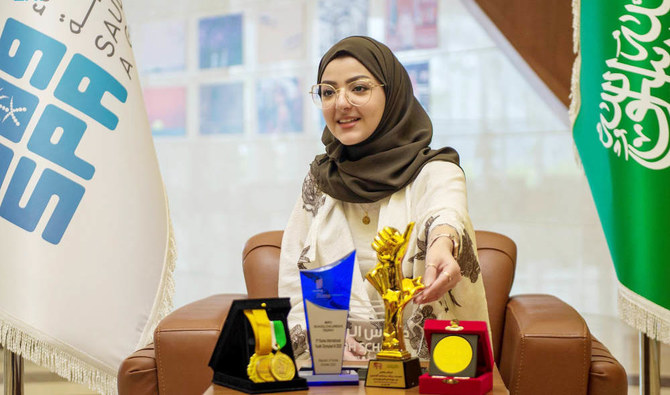
A Saudi medical student has won a string of an international awards for an invention that opens up a new world for hearing impaired or deaf drivers by dramatically improving their safety behind the wheel.
Renad bint Musaed Al-Hussein, a student at the College of Medicine at King Saud University, developed special sensors that operate as soon as they detect sounds outside the vehicle.
Sound frequencies are sent to a device inside the car, which then identifies and displays a description, image and color of the sound source visually, alerting the driver to any possible risk.
Her innovation has won several global awards and medals, including best invention at the World Intellectual Property Organization Cup and a gold award in the international invention competition as part of the Korea International Youth Olympiad.
The awards honor outstanding inventors, creators and innovative firms from around the world.
Al-Hussein said that her invention will reduce the risks facing hearing impaired drivers and may also help to save lives.
“One of the things that prompted me to come up with this invention is that some countries prevent hearing impaired or deaf people from driving because they are unable to hear important sounds. This invention will contribute to reducing the risks they face,” she said.
The Saudi inventor said that her invention could allow more than 466 million deaf people worldwide to drive, while also improving road safety by protecting their lives and the lives of others.
source/content: arabnews.com (edited)
_____________
Renad Al-Hussein said that her invention will improve road safety by protecting the lives of deaf drivers. (SPA)
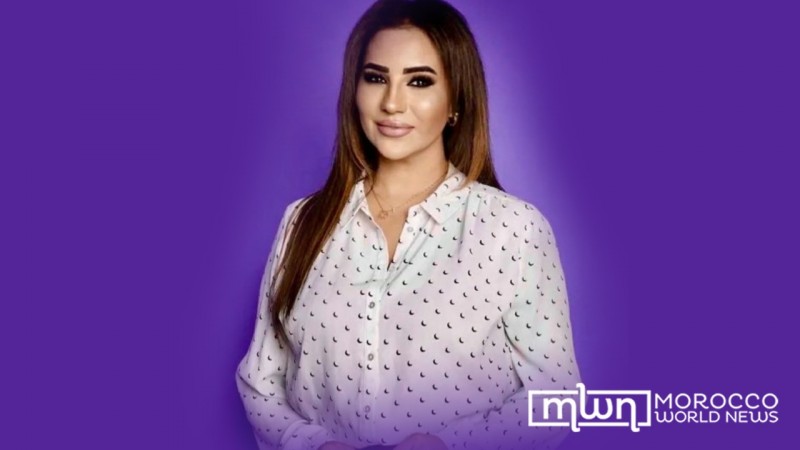
Born in Larache in 1969, a young and driven Souad El Markhous found herself in a position where she had to lead a double life in Amsterdam for three years. Her struggle to grow from a young ambitious Moroccan girl to an owner of a Dutch construction company is a story that captures the listener’s heart.
Determination and perseverance were key in El Markhous’ uncanny journey, and her story reflects the resilience of Moroccan women in the face of social expectations either at home or/and beyond. Still, she conveys an overwhelming sense of gratitude. For her, her story would not have been possible without Allah (God) and rdat walidin (parental blessings).
She left Larache in 1990 to settle down with her cousin in Amsterdam without telling her father. Unfamiliar with the Dutch language and culture, she soon had to look for a job to sustain herself.
Her neighbor secured a job for her as a cleaner at the construction company De Combi, on the condition of keeping a low profile since the company was only hiring men cleaners.
Boss: from a ‘monster’ to a father-figure
Although she was afraid of getting caught, El Markhous had to clean the director’s office on Wednesday when he had a day off to spend quality time with his family.
Despite the risk of being exposed, she used to sit in the director’s office and run her fingers through the keyboard, pretending to be working there.
“I wanted to dream. I wanted to be like them, work,” she told Morocco World News.
One day her fear came true. The director, Appelman, came to the office on his day off since his children and wife went on a vacation. He entered the office and found her there. They were stunned to see each other.
From the stories she heard about him, she imagined a well-built and ruthless man who looked more like a “monster.” He met her expectations at first glance, physically at least. Yet he turned out to have a good heart and he became a father figure for her in a foreign country where she barely knew anyone.
Bucket list check
“What are you doing here?” Appelman asked Souad on that fateful day in his office. Surprised and disoriented, she tried to communicate with him in broken English and French. He quickly ordered his secretary to look for a school for her. She was aged 19 at the time. “You have to learn,” he had said.
For the following years, she secretly learned the Dutch language at Joke Smit College in Amsterdam (1990-1992) before pursuing an MBA in modern business administration at Schoevers in the University of Amsterdam between 1993 and 1996.
El Markhous pretended to work overtime to attend school, while Appelman supported her cover story.
Her father’s words after hearing about her departure and her work as a cleaner were engraved in her heart. Disappointed and sad, her father asked her if he ever mistreated her or starved her to the point that she would clean toilets for Dutch people.
These words would stay with Souad for much of her formative years in the Dutch capital, motivating her, in a sense, to do her best to make her parents proud.
Hit by reality and new beginnings
She accepted to have an arranged marriage with the hope of continuing her studies. Her future husband, also of Moroccan-descent, agreed to support her studies.
Before her departure, Appelman handed her a letter in Dutch addressed to her father. In Larache, she opened and read the letter to her father. The letter, which essentially said that Appelman was her second father in the Netherlands, reassured El Markhous’ father.
As she returned to the Netherlands, she continued her studies and gradually built up her career with the support of her husband. Now married for 20 years, they have raised two daughters together and established a happy family.
Over the years, El Markhous rose through the ranks at De Combi, moving from cleaner to telephone operator to the head of administration at the Dutch construction company. She then became a member of the workers’ council, representing her fellow colleagues who all helped her through her journey of settling and integrating into her adoptive country.
Turning point
In 2014, De Combi was on the edge of bankruptcy. At the time, the construction firm had hundreds of employees and 11 branches across the Netherlands. Four branches closed down and others were sold like in Tilburg and Amsterdam. The buyers made it clear that they would cut jobs.
Feeling responsible for protecting the familial nest she had made for herself at Combi, El Markhous was determined to find a solution to prevent the company from sinking. And buying a branch was one of the few options available.
So she decided to buy the Amsterdam branch without hesitation. But then again, not having enough money, she was faced with the impossible feat of making the acquisition within a 24-hour deadline.
Along with her husband, she started to call friends and acquaintances to collect the money. The workers also contributed with their savings. At the end of the day, she made it and saved the lives of her team members. At the time, De combi workers were unpaid for three months and had to fill in for government support.
In the following meeting of the workers’ council, she announced her ownership over the Amsterdam branch in front of 600 workers. This made her the first woman to own a construction company in the Netherlands. For the next five years, she managed the company along with the business director Willie van Dijk before establishing Markhous Beheer BV in 2019
Incomplete joy
After she bought De Cambi’s Amsterdam branch, El Markhous’ story gained tremendous public and media interest. Proud of her achievement, she collected all newspaper articles and documents that commended her work and returned home to share her joy with her parents.
“I hadn’t seen my parents for three years,” she said. Excited to reunite with her family, she entered her home to learn that her father was diagnosed with Al Alzheimer’s. “He couldn’t recognize me,” she told us with teary eyes and a shaking voice.
Souad’s father passed away in 2016, two years after that visit. Until his last moment, he was unable to recognize his daughter or learn about her success story.
In 2018, El Markhous would be awarded the Ethnic Business Woman among 45 candidates. Months later, she received the Diwan award for her inspiring story and accomplishments.
A year later, she obtained a gift of appreciation and gratitude from the Moroccan embassy in the Netherlands.
She also featured in the Dutch series “Vrouwen die Bouwen” or “women who build.” Her story was further documented by Cor de Graag in a book titled “Ondernemers zijn net mensen,” which translates into English as “Entrepreneurs are just people.” The book is based on 50 interviews with inspiring entrepreneurs in the Netherlands.
Committed to helping others
With her growing success, El Markhous has committed to helping other women to achieve their dreams. Despite her busy schedule, she has accepted numerous invitations from NGOs, schools, and other organizations to share her stories but also inspire young women to be brave and pursue their dreams.
In 2015, she received a call from a young Ethiopian woman living in the Netherlands who wanted to become an engineer. The young woman asked her over the phone to convince her father.
Later on, the father and daughter visited El Markhous’ office. The father was surprised to see her in the office of a director, particularly that of a construction company.
Souad managed to convince the girl’s father. Three years later, she received a call from the same girl who told her that she now had a job in an engineering company.
The story touched the Moroccan-Dutch entrepreneur, prompting her to commit further to supporting other women as they struggle to establish themselves in male-dominated professions in the construction or STEM sectors.
Following in the footsteps of Appelman, El Markhous is becoming the guardian angel of numerous girls and women in Morocco and Europe.
Souad El Markhous’s legacy in the Netherlands and Morocco is in the making as she aspires to invest in her home country. Her dedication, determination, and resilience can be a source of inspiration for every girl and woman around the world.
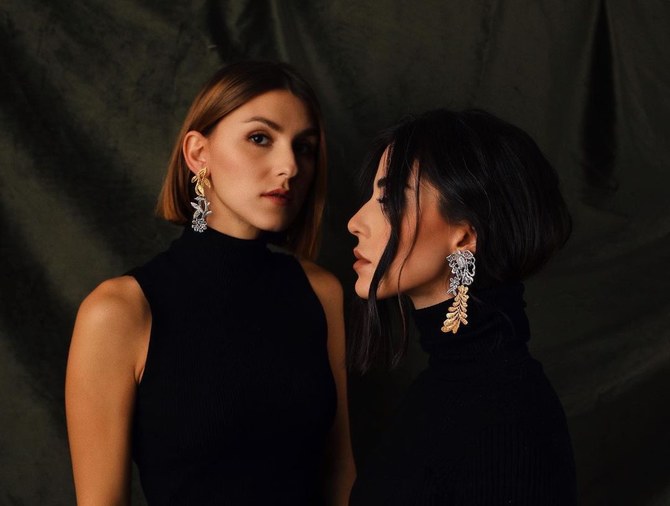
Lebanese designer Alexandra Hakim has revealed her natural approach to her sustainable jewelry brand.
The mastermind behind the label Alexandra Hakim, told Arab News that she started the brand as a student, finding inspiration from materials in her studio such as sandpaper and matchsticks in ashtrays.
The jewelry maker tried to recreate the elements and turn them into wearable sparkly jewels to give each item a “different and completely unique touch.
She said: “I made my first collection at school based on matchsticks and I found beauty in the way that they are consumed every time in different ways. I took those fragile wooden pieces and I tried to transform them into earrings and create unique pieces of playful earrings and necklaces.”
Hakim also speaks to local workers in Lebanon to support different crafts.
“I have talked to fishermen, farmers, and different craftsmen about their work, and I try to integrate it into mine. So, for example, I would take any rubbish that a fisherman I met called Bob would find in his nets – because there is barely any fish left in the sea today. So, I made a collection based on that.
“I also used pearls to make the connection between the rubbish from the sea and the jewels,” she added.
Describing her brand as a mix of luxury and contemporary jewelry, Hakim said: “I feel like my brand is about inclusivity, sustainability. It’s about making jewelry that is good for the planet. It’s about limiting waste and making women and men feel empowered.”
One of her most recent collections, the “Good Karma Capsule,” was based on horoscopes.
“I asked people around me from different backgrounds and places if they wanted their portraits taken depending on their horoscopes. So, I found a Scorpio, a Gemini, and it all kind of came together.
“People felt so empowered wearing their horoscope and felt like the earrings were a lucky charm and a token of positivity,” she added.
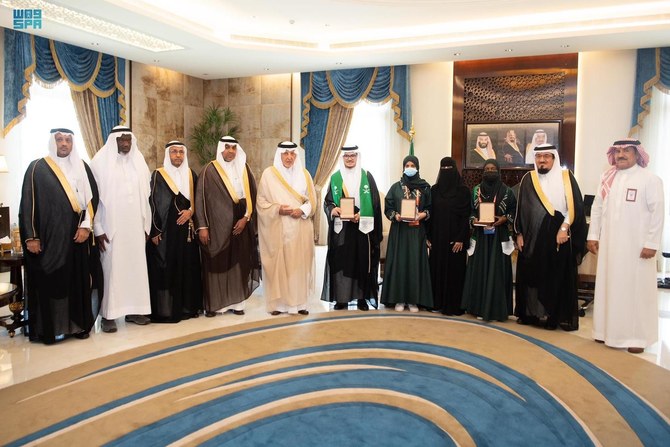
The Governor of Makkah region, Prince Khalid Al-Faisal, has honored successful students from Makkah and Jeddah who attended a science fair in the US earlier this month.
Prince Khalid congratulated three winning students who took prizes at the Regeneron International Science and Engineering Fair (ISEF), which was held from May 7 to 13.
Student Mawaddah Omar, hailing from Makkah, won third place in social and behavioral sciences, Youssef Khoja, from Jeddah, won a special award in embedded systems, and Rafaa Qanash won fourth place in engineering technologies.
The Saudi Embassy in the US tweeted: “Congratulations to our young #Saudi scientists Represented by @mawhiba and @tc_mohe, the student delegation won 6 awards at #ISEF2022, the second time this record is achieved in the Kingdom’s 16th year of participation.”
This year’s ISEF exhibition attracted more than 2,000 students from public education systems in over 85 countries.
The Saudi Center for International Communication tweeted: “Saudi students made history with an impressive success at the Regeneron International Scientific and Engineering Fair 2022 in Georgia, #USA. KSA has won 22 major awards, meaning 62 percent of the total number of prizes. #ISEF_2022.”
Saudi students have won 83 prizes at ISEF events, including 53 major prizes and 30 special prizes. Mawhiba also presented special annual international prizes in the competition for students from 20 countries.
source/content: arabnews.com (edited)
___________
Students Mawaddah Omar, Youssef Khoja, and Rafaa Qanash were honored by Prince Khalid Al-Faisal. (SPA)
The award saw a high turnout from authors around the world, with more than 3,000 applications submitted from more than 55 countries, including 20 Arab countries.
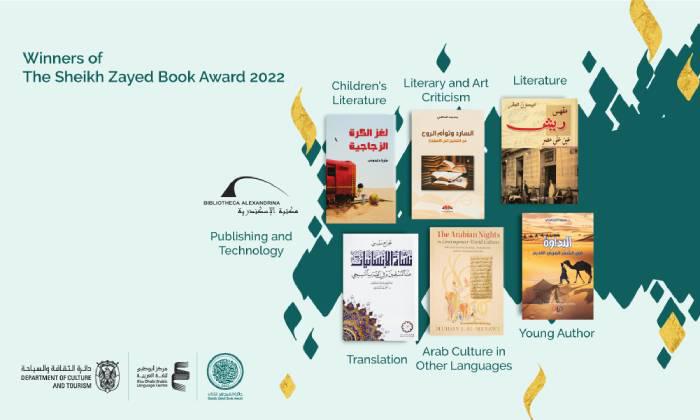
Sheikh Zayed Book Award (SZBA) announced on Monday the winners for its 16th edition across seven categories, selecting six literary figures, intellectuals and translators, along with Egypt’s Bibliotheca Alexandrina, for top honours.
Over the years, the Sheikh Zayed Book Award has managed to expand and become one of the most prestigious events in the Arab world, allowing for the development of cultural dialogue and the creation of new opportunities for authors and translators around the world.
This year’s winner in the young author category is Tunisian professor Mohamed al-Maztouri with his book Al Badawa fi al She’er al Arabi al Qadeem (Bedouinism in Ancient Arabic Poetry).
“The author of this book, Mohamed al-Maztouri, presents a serious academic study of bedouinism in ancient Arabic poetry,” the Zayed programme commented.
Adding that Maztouri “discusses its diverse concepts and many manifestations, describing it as a culture with special landmarks and a lifestyle inseparable from its place, environment, and geography.”
From pre-Islamic times the Arabian Peninsula has been home to world-class poetry that is deeply connected to values of bravery, nobility, eloquence and at times sensitivity.
Throughout the centuries, poetry’s popularity has only grown in the region, attracting new audiences in both the Arabian Peninsula and other Arab countries in North Africa and the Levant.
Today, the trend has been further boosted by Emirati initiatives and competitions.
The translation award went to Egyptian translator and author Ahmed Aladawi for his translation of the American author, George Makdisi, book “ The Rise of Humanism in Classical Islam and the Christian West” into Arabic.
Each winner receives a life-changing prize of AED 750,000 (USD 204,190/GBP165,220).
Winners will also be honoured in a ceremony at the Abu Dhabi International Book Fair later this year.
The Cultural Personality of the Year winner will be presented with a gold medal and a certificate of merit, as well as a Dh1 million prize.
source/content: thearabweekly.com
______________________
Full list of winners of the Sheikh Zayed Book Award 2022:
Literature
Maq’ha Riche, Ain Ala Massr (Eye on Egypt: Cafe Riche) by Maisoon Saqer. Published by Nahdet Misr Publishing
Children’s Literature
Loghz al Kora al Zujajiya (The Mystery of the Glass Ball) by Maria Daadoush. Published by Dar Al-Saqi
Young Author
Al Badawa fi al She’er al Arabi al Qadeem (Bedouinism in Ancient Arabic Poetry) by Mohamed Al-Maztouri. Issued by the Faculty of Literature, Arts and Humanities at Manouba University and the GLD Foundation
Translation
Nash’at al Insaniyat Einda al Muslimeen wa fi al Gharb al Maseehi (The Rise of Humanism in Classical Islam and the Christian West) by Ahmed Aladawi. Published by Madarat for Research and Publishing.
Art and Literary Criticism
Al Sarid wa Taw’am al Rooh: Min al Tamtheel ila al Istinaa (The Narrator and the Soulmate: From Acting to Faking) by Mohamed Aldahi. Issued by Le Centre Culturel du Livre.
Arab Culture in Other Languages
The Arabian Nights in Contemporary World Cultures: Global Commodification, Translation, and the Culture Industry by Muhsin J. Al-Musawi. Cambridge University Press.
Vatican envoy to UN presents royal couple with 2022 Path to Peace award at gala event
Queen Rania praised for focus on education, prioritization of young people
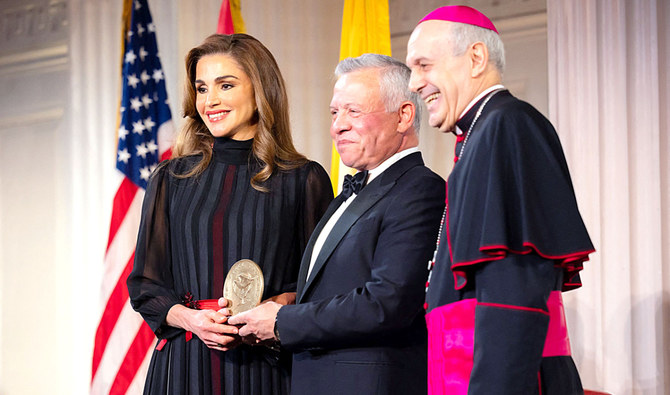
The Vatican’s Path to Peace Foundation has presented Jordan’s King Abdullah and Queen Rania with the 2022 Path to Peace award for their promotion of interfaith harmony and dialogue.
Commending the royal couple for a “years-long effort” in promoting peace and interfaith cooperation in the Middle East, Vatican Ambassador to the UN Archbishop Gabriele Caccia made the presentation at the foundation’s 29th annual gala in New York.
The envoy singled out the queen’s focus on education and the prioritization of young people in her work.
He said: “She has long shown concern for the questions of education, connectivity, and cross-cultural dialogue, as well as sustainability, the environment, and migration, which places young people at the heart of solutions and is imbued with a sense of hope.”
King Abdullah said he accepted the award on behalf of “Jordanians, men and women, young people and elders, Muslims and Christians alike.”
Noting that Jerusalem was also home to many Arab Christians, part of the oldest Christian community in the world, he noted that “our journey to peace must travel through Jerusalem,” describing the city as “key to the future and stability that we all seek.”
He added: “Jerusalem should be an anchor for peace and coexistence, not for fear and violence.
“The (world’s most difficult challenges) will be met by drawing on our faith in God, our common humanity, and our will to jointly defeat poverty and despair, and end occupation and injustice.
“(Also), to help refugees everywhere return home, ready to rebuild shattered communities, and renew the hope that young people everywhere so desperately need.”
The monarch called on the international community to work toward a just and lasting peace in the Holy Land through a two-state solution with East Jerusalem as the capital of an “independent, sovereign, and viable Palestinian state … living side-by-side with Israel.”
source/content: arabnews.com (edited)
_________
Jordan’s King Abdullah and Queen Rania receive the Path to Peace Award in New York for their promotion of interfaith harmony and dialogue. (AFP)
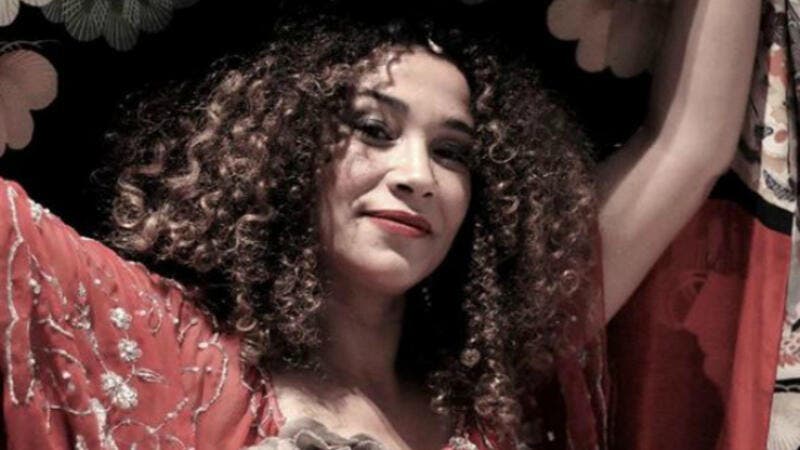
Ghalia Benali is a Tunisian poet, writer, and songwriter best known for dabbling in multiple music genres, multiculturalism, and defining contemporary Arabic music. She is also an actress and a graphic designer, a talent that goes hand-in-hand with her literature works such as “Romeo and Leila.”
Although born in Brussels in 1968, Benali was raised in Zarzis, in southeastern Tunisia, where she got her early exposure to songs and dances, with her mother being her personal music teacher. Growing up, she was exposed to the world of Egyptian and Indian films, as well as the voices of Arab singers such as Adib AlDayikh, Oum Kalthoum, and Sabah Fakhri, all of which influenced her multicultural style of singing growing up.
By the age of 19, Benali returned to Belgium to study graphic design at the Institut Saint-Luc of Graphic Arts where she would begin to sing and perform professionally. Her early performances would include collaborations with live bands and fellow musicians in 1993, a tour in Portugal in 1994, and a live performance with the band “Timna,” in Brussels, in 1999.
From 2001, she released a number of loved albums such as “Wild Harissa,” “Nada,” and “Romeo and Leila.” However, the very album that put her on the map was “Ghalia Benali Sings Umm Kulthum.” In fact, it was a smashing hit, earning her the title Ambassador of Arab Culture in Europe in 2009. By the following year, Benali would be featured on television across several Arab countries.
Benali is also renowned for her poetry, some of which centered around works by famous poets, Sufism, and Persian mystics. She is also known for her acting, winning an award from Women for Africa Foundation for her role in “As I Open My Eyes” in 2016, and nominated by Les Magrittes du Cinema for “Best Hope Actress” in 2017. She had played recent roles in the films “Fatwa,” and “A Tale of Love and Desire.”
Finally, Benali is credited for launching the Brussels-based MWSOUL Art Foundation. Having had to deal with unorganized management, she took it upon herself to launch her very own platform, a non-profit organization that brings awareness through art. You can follow them on Instagram for featured artworks and photography.
Most of the migration occurred in the final decades of the 19th century and the first half of the 20th
Project of Holy Spirit University of Kaslik in Jounieh highlights individual journeys of the Arab pioneers
Sao Paulo, Brazil:
Although an estimated 18 million Latin Americans can trace their ancestry to the Arab region, little effort has been made to chronicle and conserve the writings, photographs and news clippings that document the history of their migration and settlement — until now.
Most of the Arabs who moved to Latin America did so in the final decades of the 19th century and the first half of the 20th, with the majority of them traveling from Syria and Lebanon in search of fortune and a fresh start far from the Ottoman Empire.
To collect and highlight the individual journeys of these Arab pioneers and their contribution to the New World, an archive dedicated to telling their stories has been created by the Holy Spirit University of Kaslik, also known as USEK, a private, not-for-profit Catholic university in Jounieh, Lebanon.
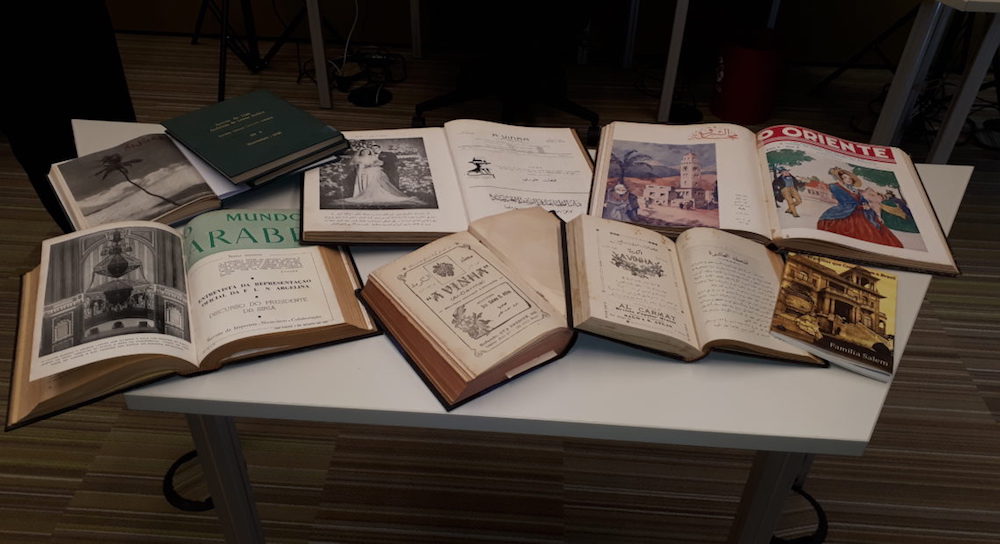
Inaugurated at the end of March this year, the collection currently includes about 200,000 pages from Arab newspapers and magazines, stacks of photographs, and other illuminating documents that help shed light on the diaspora’s presence in Latin America.
Brazilian-born Roberto Khatlab, director of USEK’s Latin American Studies and Cultures Center, or CECAL for short, conceived the project after spending several years working in the cultural department of the Brazilian embassy in Beirut and conducting independent research on Lebanese migration to Brazil.
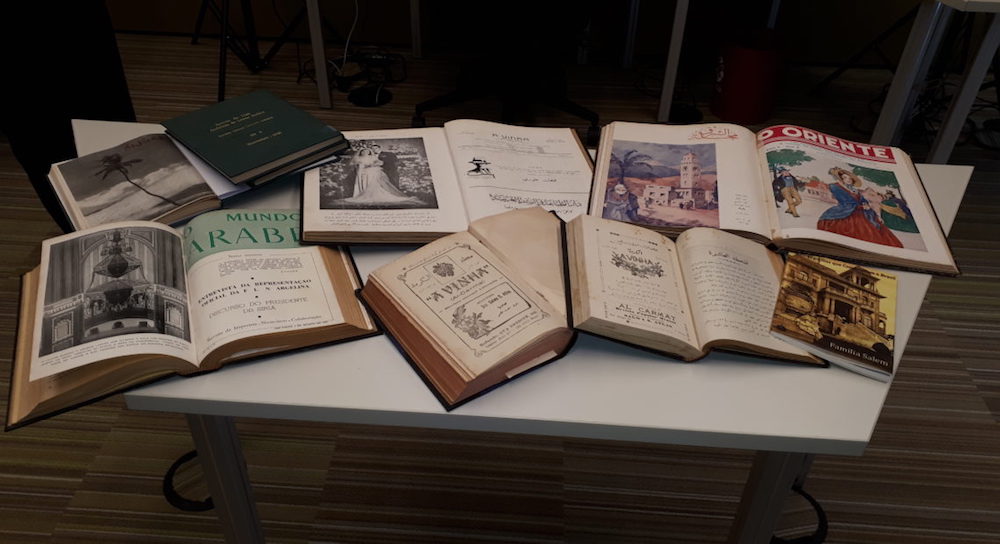
Some of the documents that have been digitized and now are part of USEK’s archive, including magazines Oriente and A Vinha. (Arab Brazilian Chamber of Commerce (CCAB) / USEK / Supplied)
“Over the years, I gathered lots of documents concerning that history,” he told Arab News.
During a trip to Latin America a few years ago, Khatlab realized a wealth of important historical material was at risk of being lost unless it could be properly collected and collated.
“Over time, such documents end up in the hands of grandchildren or great-grandchildren who do not speak Arabic and do not know what to do with them,” he said.
As a result, many people end up throwing away family collections or donating them to local libraries, which are not always equipped or qualified to adequately catalog them.
In addition, newspapers produced by early Arab immigrants were often printed on cheap, poor-quality paper that does not always stand the test of time, and so surviving copies can be extremely fragile.
“I have received 100-year-old newspapers which literally disintegrated as we tried to take them out of the envelope,” said Khatlab.
Syrian-Lebanese immigrants created the first Arabic-language Latin American newspaper, called Al-Fayha, in 1893 in the Brazilian city of Campinas.
In the local Portuguese language, its name was Mundo Largo, which translates as Wide World. As the author of several books about Brazil’s historical relationships with Lebanon and the wider Arab world, Khatlab recognizes the value of such historical documents for academic study and posterity.
“Under the Ottoman Empire, many intellectuals were not able to publish their ideas in the Arab world at the end of the 19th century,” said Khatlab. “In the nascent Arab press in countries like Brazil and Argentina, they found the space they needed.
“Many times, the articles published in the Arab press in Latin America by such thinkers were sent back to the Arab world and disseminated there in intellectual and political circles.”
Most of the early Arabic newspapers in Latin America were produced by Syrian or Lebanese migrants but there were also a number of Egyptian publications. Over the years, the Arab community launched newspapers that reflected a variety of viewpoints based around political ideologies, religious creeds, social clubs and the arts.
“Many poets and writers published works in the Latin American Arab press,” said Khatlab. “Some of them were renowned in the Arab world, while others disappeared. But their production and the ideas conveyed in their texts have great importance to Arabs, even now.”
The archive has attracted the support of institutions across Latin America that have connections to the Arab community and they have provided small teams who are helping to collect and digitize materials, using equipment donated by USEK.
_________________
IN NUMBERS
Estimated Arab population by country
Brazil: 7-12 million
Argentina: 4.5 million
Venezuela: 1.6 million
Mexico: 1.5 million
Colombia: 1.5 million
Chile: 800,000
Source: Atlantic Council
_____________________
One such institution is the Arab Brazilian Chamber of Commerce, or CCAB for short, which helped to collate full collections of magazines, including Revista Oriente (Orient Magazine), one of the most prominent publications produced by the Arab diaspora in Brazil during the 20th century.
“Different libraries and institutions had partial collections of Oriente,” Silvia Antibas, the director of CCAB’s cultural department, told Arab News. “Now, we managed to gather and digitize all of them for the first time.”
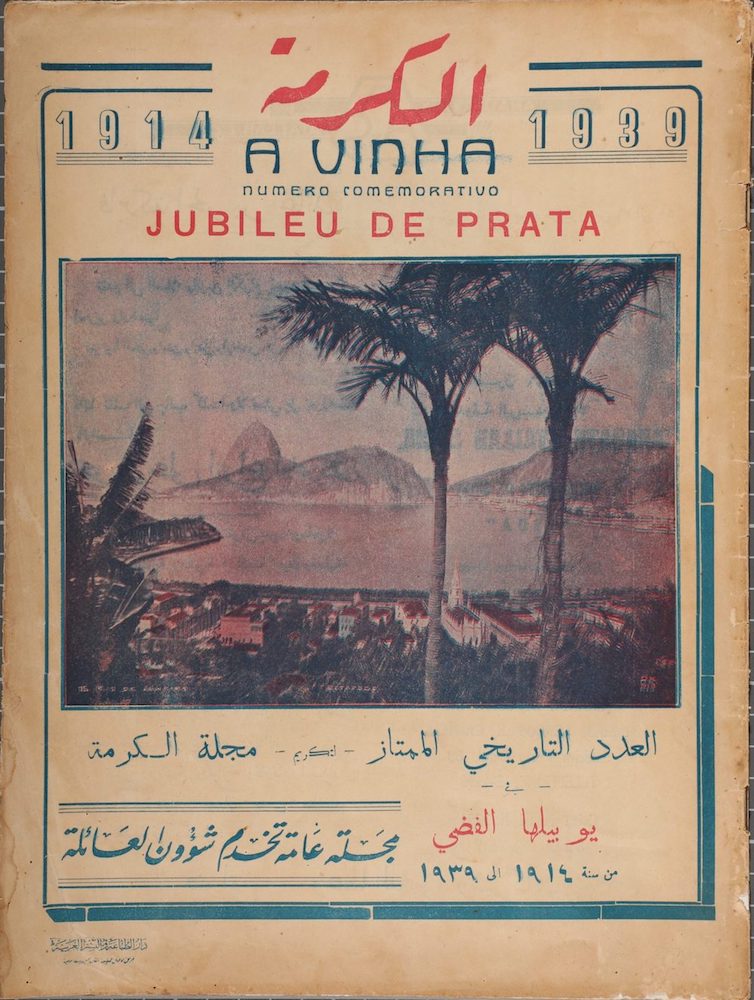
The Brazilian team also managed to assemble a collection of the magazine Al-Carmat, known in Portuguese as A Vinha (The Vineyard). It was edited for many years by a female Syrian-Brazilian author called Salwa Atlas.
The CCAB has also contributed to the archive an illuminating collection of photographs that provide a window on the social and domestic lives of the diaspora through the years.
“The pictures we collected show not only the community’s social events but also the architecture of houses, the fashion trends of those years, and how immigrants financially progressed and integrated into Brazilian society over time,” said Antibas.
The cover of one edition of A Vinha, published for years by Syrian-Brazilian intellectual Salwa Atlas, who was a pioneer among female intellectuals of the Syrian-Lebanese community in Brazil. (Clube Homs / USEK / Supplied)
The Jafet family — who ranked among the most illustrious families in Sao Paulo in the early 20th century — contributed a superb collection of photographs depicting the palatial homes built around that time by the city’s industrial bourgeoisie.
“Benjamin Jafet, my great-grandfather, came to Brazil in 1890 and worked as a ‘mascate’ (a word used in Brazil for an Arab door-to-door salesmen) for a few years in the countryside until he founded his first shop in downtown Sao Paulo,” Arthur Jafet, a 38-year-old lawyer and businessman, told Arab News.
Over the years, Benjamin and his brothers built one of Brazil’s greatest textile manufacturers and became wealthy leaders of the Lebanese community in the country.
As important philanthropists in Sao Paulo, the Jafets helped to fund not only Arab institutions such as the local Orthodox cathedral, the Syrian-Lebanese Hospital, and the Mount Lebanon Club, but also publications such as Revista Oriente.
“Their small palaces pointed to a rather European taste, with visible influences of the French neoclassical style but also oriental aspects,” said Jafet.
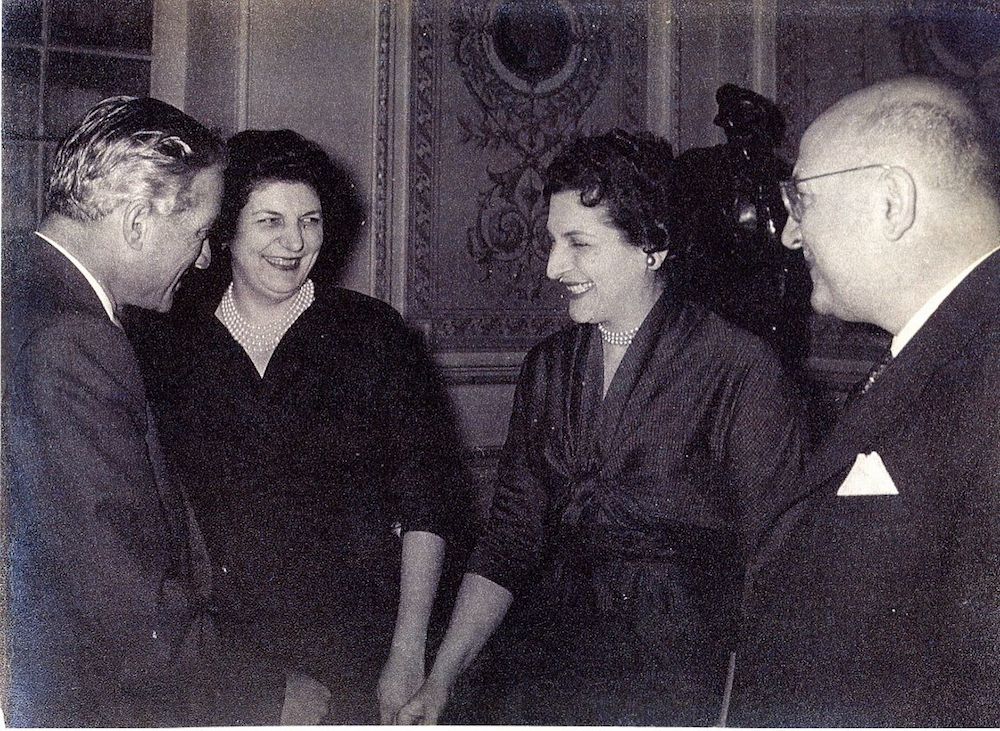
One of the photos in the collection shows Camille Chamoun, Lebanon’s president between 1952 and 1958, staying at one of the Jafet family’s opulent homes during a trip to Brazil.
As director of the Institute of Arab Culture in Sao Paulo and an adviser to the CCAB, Jafet is part of a new generation of Arab Latin Americans taking a renewed interest in their cultural origins.
Paulo Kehdi is the executive director of Chuf magazine, the in-house publication of the Mount Lebanon Club. He is among a number of Lebanese community leaders who launched Lebanity, a movement dedicated to encouraging Lebanese-Brazilians to rediscover their cultural roots.
“There has been a deliberate effort to reconnect Lebanese-Brazilians to their motherland, incentivizing them to obtain Lebanese citizenship, to visit the country and to help it during donation campaigns,” he told Arab News.
Lebanon’s President Camille Chamoun with members of the Jafet family in São Paulo. He visited Brazil in 1954 and stayed at one of the family’s palaces. (Arthur Jafet / Supplied)
The situation is similar in Argentina, which is home to an estimated 3 million people with Syrian or Lebanese roots.
For several years, Ninawa Daher, a journalist of Lebanese descent, hosted a TV show in the country devoted to reviving the interest among younger generations in their Lebanese origins. After her death in a car accident at the age of only 31 in 2011, her mother, Alicia, created the Ninawa Daher Foundation to continue her legacy, and it has partnered with USEK for the archive project.
“With Ninawa’s contacts, within a very short time we had already been able to obtain access to several wonderful collections of the community in Argentina,” Alicia Daher told Arab News.
The team has gathered stacks of newspapers, photographs and other rare materials, including two books written and autographed by renowned Lebanese-American writer, poet and visual artist Khalil Gibran.
“The Syrian and Lebanese people had a tremendous cultural impact in Argentina,” said Daher. “Now, more and more people and institutions are approaching us in order to offer materials about the immigration.”
In Beirut, meanwhile, Khatlab is hopeful the archive will continue to grow as the work on it expands to other Latin American countries and to include other types of documents, such as letters, film footage and even passenger manifests of the vessels that brought Arabs to the region.
Access to the archive is free and it is open to the general public.
source/content: arabnews.com
______________
Some of the documents that have been digitized and now are part of USEK’s archive, including magazines Oriente and A Vinha. (Arab Brazilian Chamber of Commerce (CCAB) / USEK / Supplied)
Forbes selected Mouna Abbassy and Sophia Alj for two of its prestigious rankings.
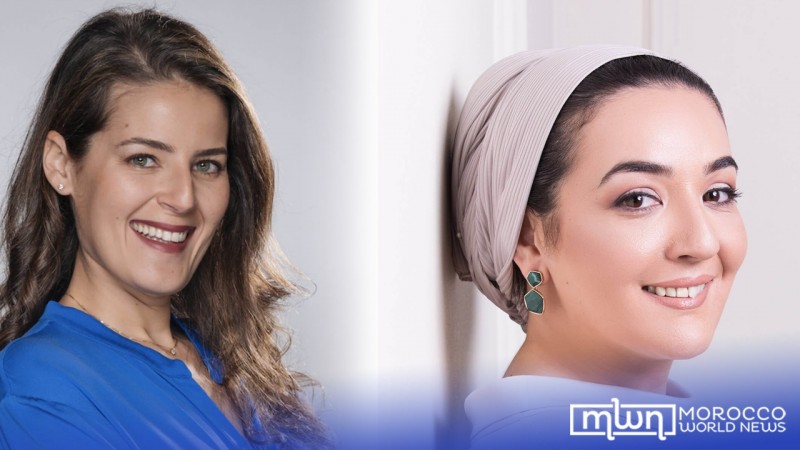
Forbes has featured two Moroccan businesswomen on its “30 Women Behind Middle Eastern Brands 2022” and “20 Women Behind Middle Eastern Tech Brands 2022” lists. The two successful, celebrated business leaders are the Founder of IZIL Mouna Abbassy and the co-Founder of Chari.co Sophia Alj.
This week, Forbes released the two lists simultaneously. The magazine’s list of “30 Women Behind Middle Eastern Brands” featured companies operating in six MENA countries, with the UAE hosting 13 of the successful businesses.
The list includes 18 nationalities in total, with Egyptian businesswomen topping the list with 11 entries, followed by Lebanese with 4 mentions.
The “20 Women Behind Middle Eastern Tech Brands” list highlighted the achievements of successful female founders and co-founders of tech platforms and apps. This year, 17 nationalities were represented in the list.
The 20 featured businesses operate in 13 sectors and are prominently based in the UAE (13), Egypt (2), and Saudi Arabia (2).
Mouna Abbassy
Moroccan businesswoman Mouna Abbassy ranked 10th in the “30 Women Behind Middle Eastern Brands 2022” list.
In 2012, Abbassy founded IZIL, an “all-natural skincare line.” The brand offers hair, skin, and body products, inspired by old Moroccan beauty recipes.
IZIL is based in the UAE with clients in Gulf countries, the US, and the UK. The brand’s e-commerce sales to the US and the UK markets recorded a 40% and 50% growth in 2021.
Last year, IZIL opened new offices in Dubai as it launched a Moroccan Hammam and Spa in the Dubai Mall. In terms of social media outreach, the brand currently counts 346K followers on Instagram and 136K followers on Facebook.
Sophia Alj
Sophia Alj ranked 8th in the “20 Women Behind Middle Eastern Tech Brands 2022” list.
She is the co-founder of Morocco’s popular e-shop and startup Chari.co, which she founded with her husband Ismael Belkhayat in 2020.
The Chari application connects retailers to fast-moving consumer goods (FMCG) companies.
In March, the startup acquired Axa Credit for $22 million. A year prior, Chari purchased Moroccan bookkeeping and credit platform Karny.ma which serves roughly 40,000 retailers. The startup concluded the deal after receiving $5 million in seed funding.
As it continues to expand into Francophone African markets, Chari.co has the potential to obtain unicorn status by reaching a valuation of $1 billion.
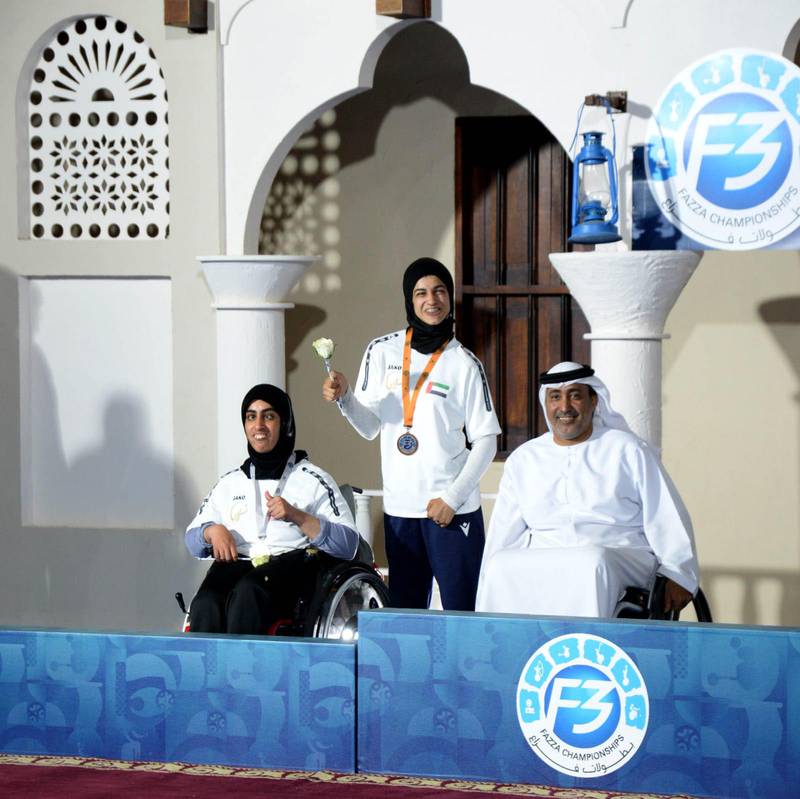
The UAE racked up five more medals on the final day to take their final tally to 17 at the Dubai 2022 World Para Athletics Grand Prix – 13th Fazza International Para Athletics Championships.
Noura Al Ketbi, winner of the host nation’s only gold in the women’s wheelchair F34 shot put, wrapped up with silver in an Asian record throw of 19.46m in the women’s club F32 final.
Algeria’s Mounia Gasmi (21.74m) won the gold and Al Ketbi’s teammate Thekra Al Kaabi (18.67m) took bronze at the Dubai Club for People of Determination.
“For us to win 17 medals and for me to be able to chip in with a gold and silver in that tally was a real good performance that we can be proud as a team,” Al Ketbi, silver medallist at the 2016 Rio Paralympics, said.
“As the host of this championship, we were able to field as many as 50 entries, obviously with the objective of providing them the opportunity to compete at this level.
“Personally, it was a very good competition for me. I can take a lot of positives forward and continue with my preparation for the Asian Para Games in Hangzhou later this year.”
Colombia topped the list with 25 medals, made up of 12 golds, eight silvers and five bronze. Algeria, with 11 golds, four silvers, and one bronze, finished second. The UAE was placed 19th with one gold, 10 silvers and six bronze.
Sara Al Jneibi grabbed her second silver medal of the championships in the women’s javelin wheelchair F33/34/54 with a throw of 8.51m.
Algeria’s Asmahane Boudjadar (11.99m) took gold and Emirati Aishah Salem Al Khaaldi (8.49m) clinched the bronze.
Abbad Ali added another silver to UAE’s medals tally in the men’s discus F11/37 with an effort of 37.04m. Kuwait’s Hamed Ali (41.54) took the gold.
Marcel Hug broke the world record when winning the men’s T54 wheelchair 5,000m final.
The Swiss Paralympic star clocked 9 minutes 32.32 seconds to set his second world record in as many weeks after his effort at the Sharjah International Meeting.
“It’s amazing and I’m really happy with my form right now,” Hug said. “It was my goal to come here and break the world record.
“The conditions are always perfect here. Besides it’s a very fast track so I had a great chance to get a good time here. First, I did it in Sharjah and then here.
“The Fazza Championships has always been an important competition for me and I have been coming here for many years. It’s a good opportunity to see where I stand and where I have to improve in my training besides trying different tactics.”
source/content: thenationalnews.com
_________________
Noura Alketbi (left) and Thekra Al Kaabi with Theban Salem Al Muhairi, general secretary of UAE Paralympic Committee, after the presentation ceremony. Gaber Abdeen