Arabs & Arabian Records Aggregator. Chronicler. Milestones of the 25 Countries of the Arabic Speaking World (official / co-official). AGCC. MENA. Global. Ist's to Top 10's. Records. Read & Enjoy./ www.arabianrecords.org
Stanford University, one of the world’s leading research and teaching institutions, published its annual “World’s Top 2% Scientists” list — featuring the most widely cited scientists in different disciplines — this week.
It included five faculty members from Riyadh’s Imam Mohammad bin Saud Islamic University: Dr. Rafiq Muhammad Choudhry and the late Dr. Hisham El-Dessouky from the department of engineering; Dr. Kamal Abdul Jawad Buradah and Dr. Ahmed Al-Khayyat from the department of science; and Dr. Qaisar Abbas from the department of computer science.
_________________
Highlight:
The ‘World’s Top 2% Scientists’ list includes Dr. Rafiq Muhammad Choudhry and the late Dr. Hisham El-Dessouky from the department of engineering; Dr. Kamal Abdul Jawad Buradah and Dr. Ahmed Al-Khayyat from the department of science; and Dr. Qaisar Abbas from the department of computer science.
______________
The university’s president, Dr. Ahmed bin Salem Al-Amri, said that the university’s recognition is a sign of the support that education and research receives from the Kingdom’s leaders.
“The leadership gives special attention to scientific research as a key pillar of the university’s success and a developmental and community-based necessity to transform universities into (places) that serve the development of the knowledge economy, by improving scientific research and its quality and outcomes in order to positively impact the economy and society,” he said.
In recent years, the university has dedicated “specialized programs and quality initiatives as part of its strategic plan to achieve the goals of scientific research and innovation,” and to improve the Kingdom’s ranking in the Global Competitiveness Index, thus achieving the goals of Saudi Vision 2030, Al-Amri explained.
source/content: arabnews.com (headline edited)
___________
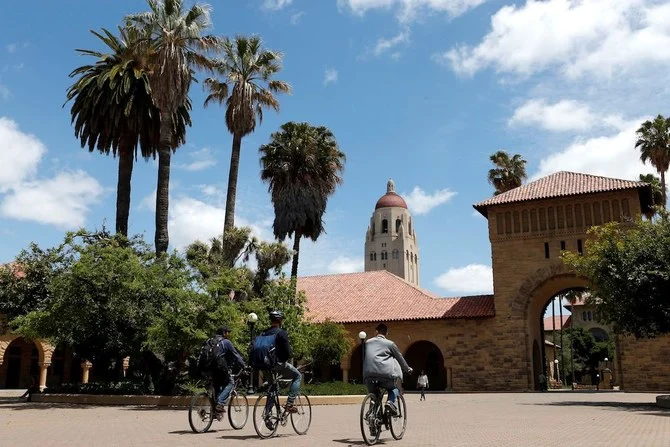
Stanford University, one of the world’s leading research and teaching institutions, published its annual “World’s Top 2% Scientists” list. (Reuters/File Photo)
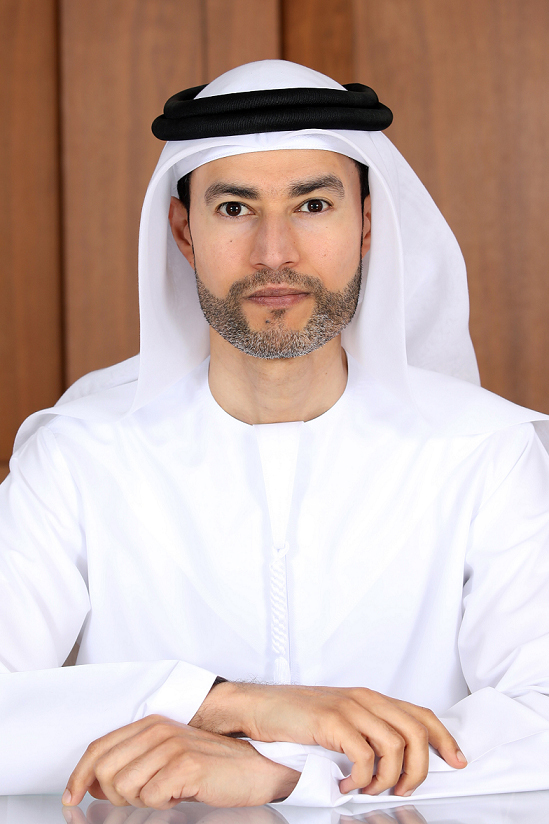
Mohamed Hadi Al Hussaini, Minister of State for Financial Affairs, has been elected as Chairman of the Development Committee (DC) of the World Bank Group (WBG) and the International Monetary Fund (IMF), which aims to achieve international cooperation and consensus on issues related to development. The DC is a joint ministerial committee of the Boards of Governors of the Bank and the Fund.
During his two-year tenure, the minister will work with the committee’s members that include ministers, and the Board of Governors of the WBG and IMF to complete and manage the committee’s programmes related to sustainable and comprehensive economic development, in order to build and develop the economies of developing countries.
Al Hussaini thanked the member states and the WBG for electing him as the Committee Chairman, stressing the United Arab Emirates’ keenness on cooperating and coordinating with its strategic partners and all international organisations to enable comprehensive and sustainable development at all levels.
A ministerial-level forum that represents the member countries of the World Bank Group and the International Monetary Fund, the Development Committee was established in 1974 and was previously known as the ‘Joint Ministerial Committee of the Boards of Governors of the Bank and Fund’. It comprises 25 members from the finance or development ministries that are members of the WBG and the IMF.
The Committee is mandated to address a wide range of issues, including, but not limited to, the role of the IMF and WBG, in confronting future crises, digitalisation, the green economy, trade, industrial policies, and poverty.
As a child in Tunisia, Lina Necib watched the 1997 film “Contact” and decided to become an astrophysicist. Now at MIT, she studies dark matter’s shadowy clues.
Lina Necib is on the hunt for something invisible.
“It’s a little bit like detective work,” she says. “We have a lot of observational types of evidence, and we’re trying to put all of it together into one picture.”
Necib, an assistant professor of physics at the Massachusetts Institute of Technology, studies dark matter, the elusive stuff that makes up most of the universe’s mass but doesn’t reflect, emit, or absorb light. For her work, Necib has won the 2023 APS Valley Prize, which recognizes early-career physicists for research expected to have a dramatic impact in the field.
In 2020, Necib and her colleagues reported their discovery of a massive stellar stream, a ribbon of stars left over when a galaxy is torn and stretched, orbiting on the outskirts of the Milky Way. Dark matter tugs at these streams, leaving behind fingerprints — evidence of its existence.
Necib believes the stream, dubbed “Nyx” after the Greek goddess of night, might be the remnant of a dwarf galaxy that collided with the much larger Milky Way billions of years ago. To study the stream, her team merged particle physics with cosmological simulations, data from star catalogs, and machine learning — a groundbreaking combination of tools. They published their results in Nature Astronomy.
Necib credits a few other physicists for her successes — “in particular, several women,” including Anna Frebel and Tracy Slatyer at MIT and Mariangela Lisanti at Princeton University.
Mentors as much as colleagues, these women helped Necib adjust to her new faculty role at MIT, which she started during the pandemic and with a newborn baby, she says.
Necib grew up in Tunisia, a small country on Africa’s northern coast, where she says she regularly faced sexist expectations for girls’ behavior and ambitions. One night, when Necib was 8 years old, her family settled in for a movie. The selection? “Contact,” starring Jodie Foster, who plays a scientist searching for aliens. The film opened Necib’s eyes not only to the field of astrophysics, but to a world in which a woman could do astrophysics.
By the end of the movie, Necib had made up her mind: “I’m going to do that!”
She set her sights on college in the U.S. As an undergraduate at Boston University, she leapt into diverse research opportunities, conducting resonance testing of graphene and even joining the search for the Higgs boson at CERN. Her interest in dark matter grew.
During her senior year, at an open house hosted by MIT’s physics doctoral program, Necib struck up a conversation with Jesse Thaler, a theoretical particle physicist. By the end of the chat, Necib knew she wanted to be at MIT.
Necib ultimately asked Thaler to be her dissertation advisor. “He was so enthusiastic about the work that he did. He loved it so much — it was kind of contagious,” she says. “Having an advisor who really put in the time and effort to help me become the physicist that I am changed my life.” Necib earned her doctorate in 2017.
Now in her second year as an assistant professor at MIT, Necib hopes to change cultural attitudes about science careers in Tunisia, where certain professions are given more weight. She wryly summarizes this ranking, starting with the best: “Doctor, engineer, lawyer, failure.”
To topple these perceptions, Necib recently teamed up with Rostom Mbarek, another Tunisian physicist and the Neil Gehrels Prize Postdoctoral Fellow at the Joint Space-Science Institute. The duo just launched an astrophysics podcast entirely in Tunisian Arabic.
In her MIT classroom, Necib strives to debunk outdated perspectives on who does physics.
“I did this experiment last year in one of my first-year physics classes where I asked my students to name physicists,” she recalls. “And all the names they came up with were Nobel Prize winners, but they were also all the same old, Albert Einstein-like examples.”
After that session, Necib had her class learn about more recent work, including the contributions of women and scientists of color to the field.
One of Necib’s “students” is particularly young. Her 17-month-old son can’t yet say “dark matter,” but he has the children’s book “Astrophysics for Babies,” and they go on excursions to Boston’s Museum of Science. He’s a bit young for the exhibits — “he’s just impressed with the escalator,” she says — but she hopes that early exposure will instill in him a love for science.
Meanwhile, her search for dark matter continues. She says that, if someone else solves the mystery of dark matter before she does, it won’t phase her. For her, being a physicist is “really about the people,” like her colleagues, mentors, and students.
“I know amazing people that are doing incredible work,” she says. “Feeling that my work is recognized fills me with so much joy. I hope to pay it forward.”
Bahrain’s GHF Financial Group has acquired a second US medical clinics portfolio at $400 million, as the firm continues its US expansion.
According to a press release, the newly acquired portfolio comprises 11 assets spread across four states: California, Texas, Maryland and Louisiana.
The new investment capitalizes on GFH’s joint venture partnership with Big Sky Medical, an asset management firm focused on medical assets.
Over the past six months, GFH, along with Big Sky Medical, has acquired assets worth $500 million.
To date, GFH has built a portfolio of assets in the US medical office building sector valued at $1 billion.
“We are pleased to announce the acquisition of this prime, income-yielding medical clinic portfolio as part of GFH’s ongoing expansion in the medical office building sector in fast-growing cities across the US,” said Nael Mustafa ,co-chief investment officer for real estate at GFH.
He added: “We believe strongly in the long-term fundamentals in the health care sector and the dynamics that are supporting an increase in demand for high-quality medical office space.”
source/content: arabnews.com (headline edited)
____________
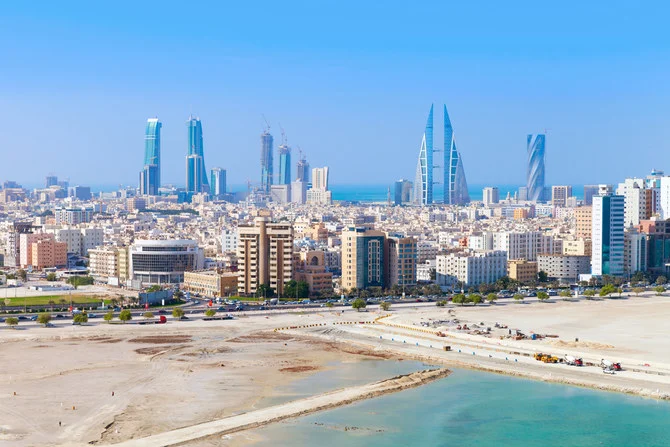
To date, GFH has built a portfolio of assets in the US medical office building sector valued at $1 billion. (Shutterstock)
The Egyptian Chamber of Commerce in Alexandria, the first in Egypt and Africa, is celebrating its centenary, reports Ameera Fouad.
It has been 100 years of success, 100 years of international and local relations, 100 years of developing markets and companies, 100 years of trade agreements, and 100 years of boosting made-in-Egypt products.
The Egyptian Chamber of Commerce in Alexandria is celebrating its centenary this year, having been established in April 1922. It was the first national chamber of commerce to be established in Egypt, Africa, and the Arab region. Situated near the Raml Station in Alexandria, it acts as a national economic and business institution that fosters economic and business development in Alexandria and the Arab and Mediterranean region.
The idea of setting up the chamber developed after the 1919 Revolution, which demanded the freedom and independence of Egypt’s industry and commerce. With the agreement of traders and industrialists, the chamber’s first board members were elected in 1922.
Its first elected president was businessman Mohamed Effendi Tawfik. According to a report published by the chamber, 129 members joined it when it was founded, a large number, and in addition to the president 15 board members were elected.
The centenary of the chamber coincides with the 40th anniversary of the foundation of the Federation of Mediterranean Chambers of Commerce (ESCAMI). This brings together more than 500 chambers from 23 countries overlooking the Mediterranean and more than 22 million companies. It is headed by Ahmed Al-Wakeel, president of the Chamber of Commerce in Alexandria.
The ESCAMI chambers implement regional projects financed by the EU with a budget of more than 180 million euros in the sectors of the food and textile industries, tourism, transport and logistics, new and renewable energy, environment and training for employment, regional development, transport and logistics, and the participation of workers abroad in the development of their countries. There is also a regional programme for the development of trade and investment.
At a press conference held to announce the centenary, Al-Wakeel said that the Alexandria chamber was working on automating all the services provided to its affiliates by the end of this year at a cost of LE7 million as part of the country’s larger commitment to digital transformation.
“The process includes the establishment of an electronic portal for the chamber, in addition to launching an electronic application on mobile phones,” Al-Wakeel said. He added that it also includes the internal systems of chamber employees and financial and administrative aspects.
The chamber has begun to provide online services to its members, such as obtaining certificates and getting acquainted with the laws that regulate the business environment as well as regulations and tenders. In terms of financial inclusion and the electronic transformation, the chamber is currently studying ideas for signing a protocol with an electronic payments company.
During the press conference, Al-Wakeel stressed the leading role played by the software industry, not only at the level of the Egyptian market, but also globally in the light of the availability of suitably qualified professionals. “Our professionals compete globally and are considered one of the sources of our national income,” he added.
He also highlighted the importance of updating the laws on intellectual property rights in Egypt after the launch of the Egyptian Strategy for Intellectual Property, which guarantees the rights of companies and individuals.
DEVELOPMENT ROLE: One of the core roles the chamber undertook just after its establishment was to resolve the economic problems that resulted from World War I.
“Among these problems were the lack of sugar in the markets, the tram tariffs, the issue of reducing freight fees and freight for ships and railways, and reducing floor fees and many more,” said Ahmed Sakr, a board member of the chamber.
“The then council addressed all these problems to meet contemporary concerns and needs.”
Since its establishment, the chamber has paid special attention to fostering and developing national industry and made-in-Egypt products. In 1940, it held its first permanent exhibition for national industries in Said Al-Awal Street in Alexandria. Then king Farouk visited the exhibition and hailed it as a success.
To hold the exhibition, the chamber made an agreement with Banque Misr to allow exhibitors participating in it to pay an interest rate on loans for exhibitions not exceeding two or three per cent. This succeeded in encouraging and assisting manufacturers and Egyptian-made products at the time.
A hundred years on, the chamber is still keen on taking the necessary steps to cope with global developments and the environmental changes associated with the climate change crisis. “The chamber is one of the first buildings that uses solar energy in its historic building in the Raml Station area,” Sakr added.
The chamber also uses solar energy in the wholesale market in the Ameriya district, making it the first of its kind in the world to operate on solar energy. The market was opened last February in the presence of Ali Moselhi, the minister of supply, Mohamed Al-Sharif, the governor of Alexandria, and Christian Berger, the EU ambassador to Egypt.
“We are always striving to play our important role in terms of social responsibility and sustainable development,” Sakr said.
WOMEN’S ROLE: Realising the important role that youth and women play in the economic sector, the chamber has helped strengthen their roles in society.
It activated an amendment introduced to the chambers law in 2002 that allowed the election of women as board members of the Chambers of Commerce. In 2015, the chamber established its first committee for businesswomen to represent female entrepreneurs and others. The committee aims at helping them to solve their problems and providing them with opportunities and workshops that can help them to promote their own businesses.
In an interview with Al-Ahram Weekly, Al-Wakeel stressed the importance of women’s participation in the economy and comprehensive social and economic development. “It is an essential role that works to enhance Egypt’s long-term prosperity and stability,” he said.
He expressed his hope for more cooperation with embassies and other chambers in the field of women’s economic empowerment. The chamber is seeking networking opportunities and shared experiences with other countries in order to achieve a women’s economic renaissance and an effective developmental footprint, he said.
Reem Siam, founder of the Economic Council for Businesswomen, reviewed the Alexandria Chamber’s actions over the past seven years, praising steps taken to support female entrepreneurs and the programmes that the chamber has sought to implement in the wake of the Covid-19 pandemic.
Social responsibility: Many people relate the Chamber of Commerce only to industry and trade. But it also plays an important role in society and in facing up to many economic and other challenges.
“We have faced two major problems, a deadly pandemic and now the Russian-Ukrainian War, in just one decade,” Sakr told the Weekly. “But at the same time, we are working tirelessly for the sake of members and the wider population so that the markets will remain stocked with products.
“No one expected that the Russian-Ukrainian war would affect the Egyptian economy in the way that it has, especially the tourism sector. We must open new markets, encourage more types of tourism, and seek new opportunities in every sector,” he said.
In response to the high prices of commodities and high inflation, the chamber last month inaugurated a Food Commodities Exhibition under the auspices of the Northern Military Region, the Alexandria Governorate, and the Ministry of Supply.
The exhibition offers food commodities at discounted prices ranging from 10 to 30 per cent off at the General Abdel-Moneim Riad Complex on the Agricultural Road in the Smouha district of Alexandria.
It is divided into 50 sections with the participation of 35 exhibitors and offers discounts on various products. Companies affiliated to the Food Industries Holding Company of the Ministry of Supply, some major commercial chains, fresh and processed meat and poultry companies, and various food commodity companies have all participated in the exhibition.
“We believe that crises serve as catalysts for major transformations. The present anniversary marks an important point in history where everybody in the chamber is trying out innovative methods using digital technologies, open data, and citizen engagement for the greater welfare of our country,” Sakr concluded.
*A version of this article appears in print in the 13 October, 2022 edition of Al-Ahram Weekly.
Fourteen Saudi individuals and two organizations were honored at the 10th Princess Seetah bint Abdulaziz awards for excellence in community upliftment work in Riyadh.
This year’s event was titled “Creativity and Innovation in Social Work,” which also, for the first time, honored students and principals for their social responsibility initiatives.
Dr. Fahad Al-Maghlouth, secretary-general of the Princess Seetah organization, said the aim of the awards was to “discover talent” as part of the Saudi government’s programs to develop the nation.
Princess Nouf bint Abdullah bin Saud Al-Kabeer Al-Saud, chair of the organization’s executive committee and member of its board of trustees, said that community upliftment projects were essential for a healthy society.
In the category “Responsible Citizenship,” several students were honored.
The winner of the elementary schools’ section was student Ayed Al-Ruwaili from Turaif in the Northern Borders, followed by Rima Al-Faris from Riyadh in second, and Hisham Al-Maarafi from Madinah in third.
The middle school winners were Sally Al-Harbi from Qassim in first place, followed by Adeeb Khadawardi from Makkah and Noura Al-Wadi’i from Jazan.
The high school winners were Samira Al-Maghlouth from the Eastern Province, Hanadi Karani from Madinah and Amr Al-Baraq from Jazan.
Also for the first time, as part of its “Tanseeq” platform linking government, non-government, non-profit, and private organizations in the field, two community bodies were honored.
The Osraty Association from Madinah and the Tawad Association from Al-Jouf won for their family development and counseling programs.
The winners of the Umm Al-Joud Initiative prize, for innovation in media and education, were also announced.
First place, for creating general awareness of social responsibility needs in society, was Dr. Abdullah Al-Alawai, who had his biggest supporter — his grandmother — take to the stage and accept the award on his behalf.
In second place was Dr. Mushawah Almushawah, who was honored for creating awareness of mental health issues.
In third place was Khattaf Al-Khattaf for highlighting technological and digital communication developments.
In fourth and fifth were Sultan Al-Kulaib for human development awareness, and Majid Al-Ghamdi for social media awareness.
Established in 2012 by royal decree, the Princess Seetah bint Abdulaziz Foundation for Excellence in Social Work encourages and supports community upliftment programs.
source/content: arabnews.com (headline edited)
________________
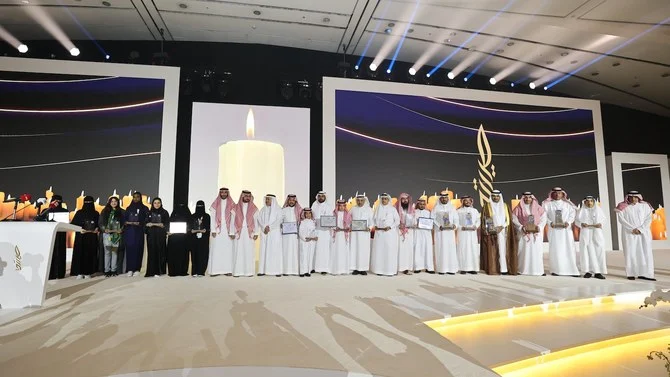
Fourteen Saudi individuals and two organizations are honored at the 10th Princess Seetah bint Abdulaziz awards for excellence in community upliftment work. (@seetahaward)
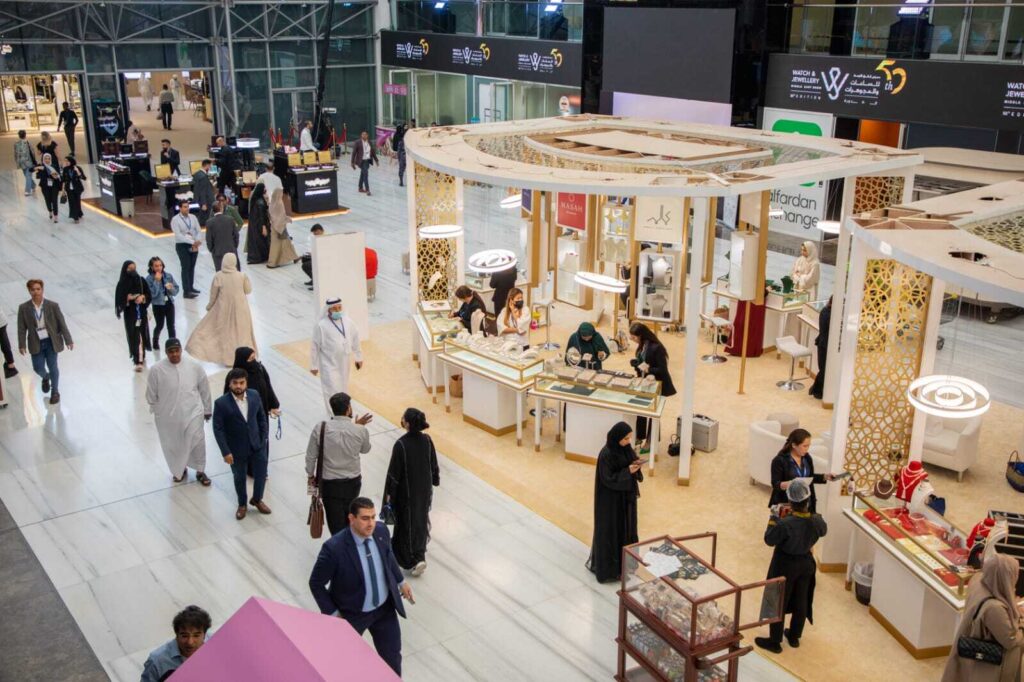
-With more than 900 renowned local and global brands taking part at the 50th (golden jubilee) edition of the Watch and Jewellery Middle East Show (WJMES), which continues until October 9 at Expo Centre Sharjah, 20 Emirati female designers managed to attract the visitors’ attention to the Emirati Jewellers platform, launched by Sharjah Chamber of Commerce and Industry, with the aim to support young Emirati talents in jewellery designing and spotlight their artistic works at the important event.
Abdallah Sultan Al Owais, Chairman of Sharjah Chamber of Commerce and Industry, said that supporting Emirati entrepreneurs and talents is one of the main objectives that Sharjah Chamber is working to achieve, and the Watch and Jewellery Middle East Show has always been supporting Emirati designers through such initiatives as the Emirati Jewellers platform.
He added that over more than eight editions, the platform has been able to provide an exemplary opportunity for the Emirati designers who wish to enter the world of gold-smithing and jewellery whether in Sharjah or the entire UAE, and it succeeded in attracting talents to the jewellery design and trade sector to develop their crafting and marketing skills.
He pointed out that the platform attracted more than 46 Emirati female designers and sponsored the Qelada project, launched by the Ministry of Community Development, to support female designers of determination.
Al-Owais underlined the participation of the youngest Emirati female jeweller along with many other female designers who presented impressive gold and jewellery designs.
Saif Mohamed Al-Midfa, CEO of Expo Centre Sharjah, underscored the importance of the Emirati Jewellers platform being an annual stimulus that attracts more and more Emirati creators to the world of jewellery design and benefits from the event’s large global participation, which contributes to providing these talents with more experiences to develop their businesses. One of those talents who caught the attention of visitors was Dr. Abeer Awad.
She said, “My passion for beauty and drawing has driven me to discover this talent, and so have the many talent-fostering government initiatives, the most important of which is the Emirati Jewellers platform, which has been the strongest motivator for me to enhance my talent and start my own project”.
Designer Zahira Ahmed Al Marar pointed out that her participation is the second in this event, and she expressed her pride in taking part in this platform together with a group of Emirati talents who work as one team to brightly represent the UAE in such a global event, stressing that Sharjah Chamber is her first and biggest supporter to be a key participant at the event and show her designs to the whole world.
She expressed her gratitude to the Chamber for the great support and diligent follow-up to ensure the continuity and success of the projects.
Sheikha Al Serkal, in turn, underlined her keenness to participate in the Watch and Jewellery Middle East Show being a key platform to showcase her talent, which is admired by the visitors every year.
Azza Al Jarwan, on the other hand, praised Sharjah Chamber’s fostering of young Emirati jewellery talents and bringing to the fore their artistic works in the most outstanding event of jewellery exhibitions.
Three Palestinian libraries in East Jerusalem are involved in a project to index and restore manuscripts dating back hundreds of years, some to the 12th century.
Funded by the Aliph Foundation (International Alliance for the Protection of Heritage in Conflict Areas), the project aims to preserve the manuscripts at a controlled temperature and humidity to preserve them from damage, while cataloguing them electronically for presentation on the Internet.
Khader Salameh, director of the Khalidi Library, told Al-Fanar Media that the manuscripts are part of the heritage and history of the Palestinian people. They tell the culture and customs of a wide range of people and reflect their lifestyles and ways of thinking, he said.
Biographies of Jerusalem Families
The bulk of the manuscripts and documents represent the biographies of families living in Jerusalem between 1896 and 1930 from newspapers, magazines and handwritten documents.
Salameh said the project aimed to link civil, personal, and family libraries in Jerusalem with each other to help researchers find manuscripts and archival documents. The three libraries embody “the collective history of the people of the city of Jerusalem,” he said.
The Khalidi Library was founded in 1900 and is the first Arab public library established by private initiative in Palestine. It is located in the Old City of Jerusalem and has resisted attempts to seize the property since 1967, thanks to the efforts of the Khalidi family in Jerusalem and abroad.
The bulk of the manuscripts and documents represent the biographies of families living in Jerusalem between 1896 and 1930 from newspapers, magazines and handwritten documents.
The preservation team is currently working on indexing these documents. They include papers describing the first prayers arranged for women inside the Dome of the Rock at Al-Aqsa Mosque in 1952, and older documents—including one about the tombs of three warrior princes who participated in the liberation of Jerusalem from the Crusaders during the 12th and 13th centuries.
Lack of Appropriate Conditions
Doaa Qirsh, director of projects at the Issaf Nashahshibi Center, told Al-Fanar Media that the project’s documents and 500 manuscripts often relate to Jerusalem families, and particularly involve Islamic law and Arabic literature.
In Palestine and Jerusalem in particular, she said, there are thousands of ancient manuscripts in the collections of Islamic endowments or family libraries.
Qirsh, who is also the center’s librarian, said most of these manuscripts suffer from wear and tear and lack appropriate conditions for preservation.
“This has necessitated the establishment of several laboratories for restoration, the most important of which are the Manuscripts Restoration Center of the Islamic Endowments Department inside the Haram al-Sharif (Temple Mount), another in Abu Dis, in East Jerusalem, and a new laboratory in the Khalidi Library.”
According to Qirsh, coordination between the libraries will help them provide a cultural service to the Jerusalem public and researchers.
The Issaf Nashashibi Center’s library is the only Palestinian public library in East Jerusalem regularly open to the public, she said. Other libraries in the city are not permanently open because of lack of resources.
The Restoration Process
Rami Salameh, who is in charge of restoring the manuscripts, said they first had to be documented and examined to see if they needed restoration.
If they require restoration, the first stage is mechanical cleaning using soft brushes and special sponges. Some manuscripts also need washing with a solution of alcohol and water, carefully mixed so that the ink used in the manuscript does not dissolve. The final step is binding.
“We cannot restore all manuscripts because it takes time and financial support,” Rami Salameh said. “Therefore, we chose only 20 manuscripts to restore because of their relationship to the Holy City and the number of their papers.”
Salameh is carrying out this work in the Manuscript Restoration Laboratory at the Khalidi Library. The limited budget means he cannot always employ additional professional restoration staff.
“There are thousands of manuscripts that need restoration to preserve them from extinction,” he said.
Documents in the Khalidi Library’s Collection
Shaima Al-Budairi, digital librarian at the Khalidi Library, told Al-Fanar Media that the paper in some manuscripts had degraded through being stored in damp places. Indexing and restoring them will protect them from further damage, she said.
‘Exceptional Importance’
Mufid Jalgoum, a professor of history at Al-Quds Open University, said the project was of “exceptional importance” because of the thousands of manuscripts the city holds.
Dozens of Jerusalem manuscripts were moved abroad after the Ottomans surrendered the city to Britain in 1917, Jalgoum said, and many more were taken after the Palestinian Nakba in 1948. “Zionist groups stole, at that time, what the Palestinian families had of books and libraries,” he said.
“Preserving the remaining manuscripts requires a restoration strategy and financial support from cultural institutions, so that this heritage becomes available to researchers and scholars,” Jalgoum said. Libraries should assist in the restoration and preservation, and the work must be done to international standards, he added.
Cultural institutions should attach particular importance to the establishment of a museum of Palestinian manuscripts in Jerusalem, Jalgoum said.
Such a facility, he said, would protect against what he considered to be “an attempt to get rid of the written narrative as archaeological, historical, geographical and social evidence about the history of the Holy City.”
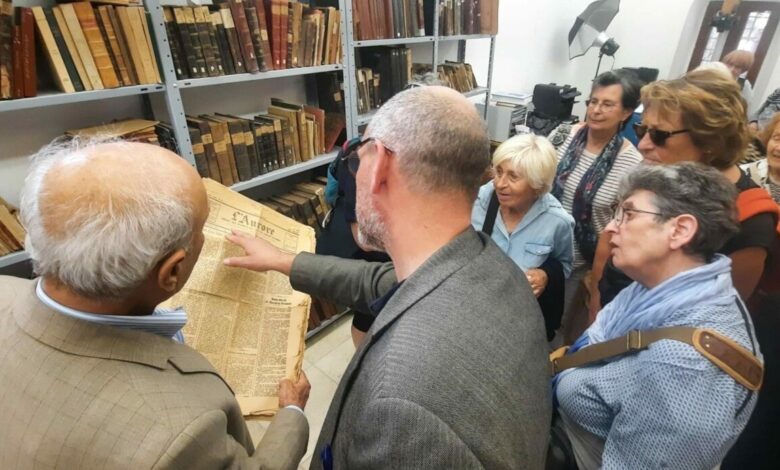
Three Palestinian libraries in East Jerusalem are involved in a project to index and restore documents that tell the stories of families living there more than a century ago. Above, a group of visitors in the Khalidi Library. (Photos via Facebook)
A number of Arab films are being screened at the ongoing 60th New York Film Festival.
The films include titles from Lebanon and Morocco.
With its screening in the New York Festival, the Lebanese feature narrative film Tales of the Purple House by Abbas Fahdel makes its North American Premiere.
The film will be screened on 11 October, followed by a Q&A with the director.
Another Lebanese film, Beirut the Encounter, will screen on 7 and 16 October.
Directed by Borhane Alaouié, this 1981 production went through a new restoration, allowing the US audiences to view it in an improved condition.
Morocco is represented with Life on the CAPS by Meriem Bennani. The film will be screened on 7 and 9 October, as part of the Currents Program 5: After Utopia segment of the festival.
The New York Film Festival opened on 30 September and runs until 16 October.
As the festival is ongoing, two other Arab films are currently being screened in New York’s cinemas: Casablanca Beats by Moroccan director Nabil Ayouch and Lebanese documentary Sirens by Rita Baghdadi. Both films had their US premiere on 16 and 30 September respectively.
‘The Sandman’ star will be the face of its women’s collections in the Middle East.
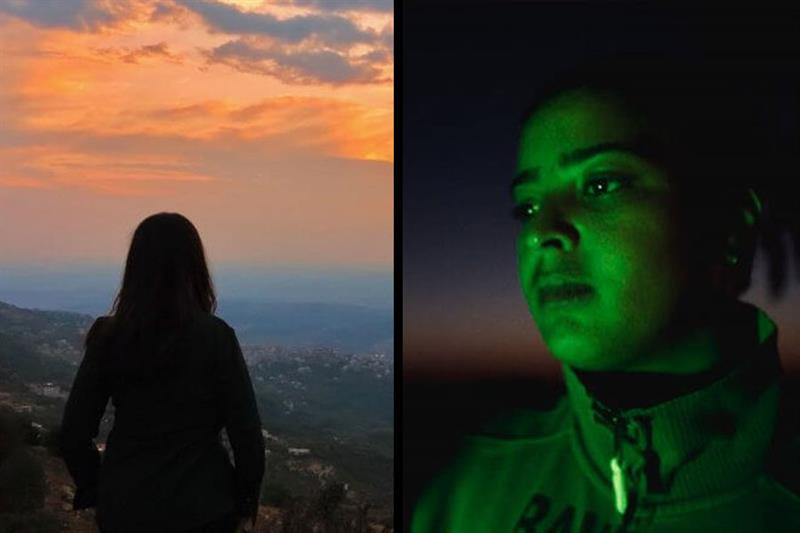
Building on an already stellar year, Lebanese British actress Razane Jammal has been announced as Dior’s latest ambassador. She will be the face of its women’s collections in the Middle East.
The announcement was complemented by a fashion shoot featuring Jammal in some of the house’s latest creations. She is no stranger to the world of high fashion — the actress was previously an ambassador for Chanel.
“I’m so unbelievably excited to finally announce that I will be joining Dior as a brand ambassador in the Middle East,” Jammal wrote on Instagram.
“Ever since I joined the fashion community, I wanted to collaborate with people I can truly grow with, to join a family that I value as much as it values me. It’s been a long journey but I can confidently say I’ve found my home.
“This is the start of a wonderful collaboration. I cannot wait to embody the timeless creations of @mariagraziachiuri.”
This is yet another mark of Jammal’s upward trajectory. She stars in the highest-grossing film in Egyptian history, Kira & El Gin, and is one of the key characters in Netflix’s hugely popular new show The Sandman.
“It’s been a very crazy couple of years,” she told The National in a recent interview. “But I’m very happy that the hard work has paid off.”
Fluent in Arabic, French and English, Jammal’s first serious foray into acting was in the French-German feature Carlos in 2010. This was followed by Cruel Summer in 2012, a short film by Kanye West, and then Une histoire de fou in 2014 by director Robert Guediguian. All three projects had their world premiere at the Cannes Film Festival.
Based on 1919, the novel by Egyptian writer Ahmed Mourad, and directed by Marwan Hamed, Kira & El Gin is an action drama that chronicles the 1919 revolution against the British occupation of Egypt and Sudan.
The Sandman is based on Neil Gaiman’s groundbreaking graphic novel series.
The experience has been a bittersweet one for Jammal, she told The National, as her mother died last year while The Sandman was being filmed.
“We were filming during Covid-19 in London. We were following very strict Covid-19 protocols and I wasn’t allowed to travel. So I didn’t go back home for eight months after losing my mum. My mum was the most important person in my life. She was a single mum, we had a very close relationship.”