Arabs & Arabian Records Aggregator. Chronicler. Milestones of the 25 Countries of the Arabic Speaking World (official / co-official). AGCC. MENA. Global. Ist's to Top 10's. Records. Read & Enjoy./ www.arabianrecords.org
The index measures the levels of trust and credibility between governments and citizens.
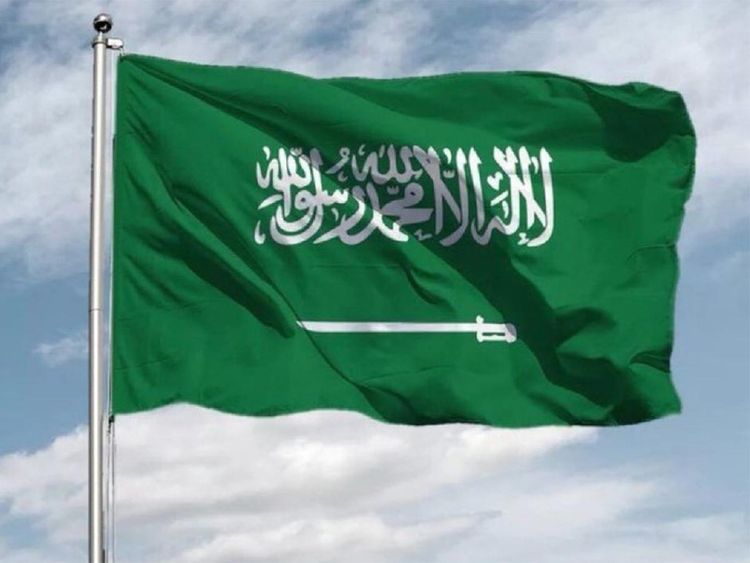
Saudi Arabia has claimed the top spot in the “Edelman Trust Barometer 2024” index, which measures the levels of trust and credibility between governments and citizens. The kingdom achieved a remarkable 86 per cent in the Index for Trust in Government, marking a significant 5 per cent increase compared to the previous year.
According to Edelman, a global public relations consultancy firm, China followed closely in second place with 85 per cent, the UAE secured third place with 84 per cent, and Singapore ranked fourth with a trust level of 77 per cent.
Edelman report unveiled that Saudi Arabia stands at the fourth position globally in the business confidence index. Additionally, the Kingdom earned the seventh spot in the media trust index among the 28 countries included in the report.
Saudi Arabia’s Ministry of Information has recently implemented major changes, covering both organizational and administrative aspects. These reforms are complemented by dynamic movements in various media fields, including the launch of several media initiatives, projects, and programs.
Trust in Saudi Arabia’s government increased to 86 per cent, followed by the business sector at 78 per cent. Non-Governmental Organizations (NGOs) and media have trust levels of 64 per cent and 61 per cent, respectively.
The survey gathered responses from nearly 32,000 individuals across 28 countries. China, the UAE, and Singapore also ranked high in government trust.
Zineb, a remarkable 34-year-old Moroccan woman with a passion for football and an extraordinary career journey, has made history as the first Arab woman in the UAE to obtain a FIFA Football Agent licence. This achievement marks the pinnacle of a multifaceted career that spans two decades of professional football, executive leadership roles in global corporations.
Born with a profound love for the beautiful game, Zineb embarked on her professional football journey at the tender age of 14. For an impressive 20 years, she showcased her exceptional skills on the pitch, earning acclaim and respect both locally and internationally. Her unwavering dedication and talent opened doors that would eventually lead her to a groundbreaking role as a FIFA agent.
Parallel to her football career, Zineb pursued her academic dreams, earning a Trilingual Finance Degree from HEC Montreal and further honing her skills at ICADE Business School. Armed with a strong educational foundation, she ventured into the corporate world, joining prestigious global corporations such as GE. Zineb seamlessly balanced her roles on and off the football field, demonstrating exceptional leadership and managerial prowess.
One of Zineb’s most impressive accomplishments is her cultural and linguistic versatility. Having lived in 13 countries, she possesses a deep understanding of international cultures, fostering an open-mindedness and adaptability that have been instrumental in her career success. Fluent in four languages – Arabic, English, French & Spanish – she transcends cultural and geographical boundaries with ease. Her ability to connect with individuals from diverse backgrounds has played a pivotal role in her professional success and global experiences. Her journey through these diverse landscapes has imbued her with a unique perspective that she now brings to her role as a FIFA agent.
In a life defined by extraordinary achievements, Zineb’s latest feat as the first Arab female FIFA agent in the UAE is nothing short of groundbreaking. She successfully passed the rigorous FIFA Football Agent exam, solidifying her position as a trailblazer in the world of sports and representation. Her new role will enable her to empower athletes, foster talent, and advocate for gender equality in the world of football.
Zineb serves as an inspiration to aspiring athletes, young professionals, and women worldwide, proving that determination, passion, and a commitment to excellence can break down barriers and open doors to limitless possibilities.
With this historic achievement, Zineb continues to write her own remarkable story, leaving an indelible mark on the world of sports, corporate leadership, and international relations. Her journey stands as a testament to the power of ambition and the potential of the human spirit.
Acamar, Rasalased, Kochab.. these words are examples of star names. At a first glance, they look unidentifiable. So where do they come from? The short answer is Arabic, but the long answer is a bit more nuanced than that.
The story begins in 8th century Middle East , Abbasid Caliphs became more and more interested in science and exploration. So they requested that the scientific works of previous translators be translated in Arabic, the rising scientific lingua franca of the world at that era. Greek and Roman scientific texts, notably Claudius Ptolemy’s Almagest, were translated into Arabic. But this was not merely a linguistic transfer; it also involved a comprehensive assimilation and expansion of knowledge. Ptolemy’s Almagest, translated in the 8th and 9th centuries, became a cornerstone in Islamic astronomy, enriched with commentaries and refinements by scholars of the time. It inspired many Arabs to take on the study of astronomy and carry on the study of space.
The advent of Islamic astronomy
Islamic astronomers like Al-Ḥasan Ibn al-Haytham and Ibn al-Shatir made significant strides in refining observational techniques and developing advanced instruments. Astrolabes and sundials, products of this new civilization, enabled precise measurements of celestial positions and movements. The practical application of astronomy was paramount in the Islamic civilization, particularly in the context of trade and navigation. The vast Islamic trade routes necessitated accurate navigation, and astronomy provided the means to achieve this. Bright stars, visible without telescopes, became vital reference points for navigation, leading to the naming of stars in Arabic, a practice that persisted due to its utility.
The influence extended beyond astronomy into mathematics, where the adoption of Arabic numerals revolutionized calculations. The spread of these numerals to Europe further increase the influence of Arab-Islamic scientific practices on the continent. As Europe entered the Middle Ages and Renaissance, Arabic astronomical texts, including star names, were reintroduced through translations. However, linguistic challenges and imperfect translations led to alterations and Latinizations of some names. Despite these modifications, many Arabic star names have endured and continue to be used in contemporary astronomy, which is why, while most of these names come from Arabic, they are often Latinized, and sometimes slightly modified. Other star names from Arabic include Altair, from Arabic Al-ta’ir, meaning the flying, Menkar, from Arabic Minkhar meaning the nostril, or Sulafat, from Arabic Sulahfat, meaning the tortoise.
He may be younger than their children but one of Britain’s brainiest children, a Muslim, has been hired by a University to help adults with their sums as reported by Daily Mail .
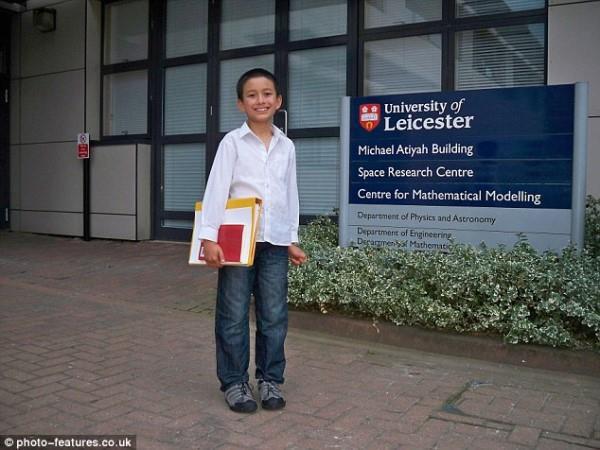
Yasha Asley, 14, is employed by the University of Leicester – where he is also a degree student – to run tutorials.
He became the youngest ever student at the University and is now the youngest ever employee.
Yasha was interviewed and offered the paid job when he was just 13–years old – beating adult applicants. Admin staff had to apply to Leicester city council for special permission to employ him because he was so young. The weekly tutorials Yasha runs are for adult students who need help and support solving problems following lectures. Proud Yasha said:’I am having the best years of my life. I love going to university and I love my new job helping other students.
No more school uniform for me thank you very much.’
Yasha, who has been dubbed a ‘human calculator’, is now in his final year and plans to start a Phd when he finishes his course.
The child genius attended a state primary school before winning his place to study degree level maths at just 12 years old in 2014.He was the first child in the world to achieve an A grade in maths A Level scoring 100 per cent and 99 per cent in two of the six papers when he was just 8 years old.
He passed more A levels in maths and statistics aged 9 and 10.
After finishing year 6 at primary he went straight to University. Of his achievements, Yasha said:’I love maths because it is an exact science. It is the only science where you can prove what you say is correct. It is so easy and an enjoyable subject to study.’
Proud father Moussa Asley, 53, who raised him single-handedly at their home in Leicester, said his son had been made welcome by staff and students alike.
Mr Asley, who drives his son to lectures every day, said:
‘I am just so proud watching him flourish and grow doing something he loves.
He is so good at understanding problems and explaining them in a clear way he is perfect for the job.’
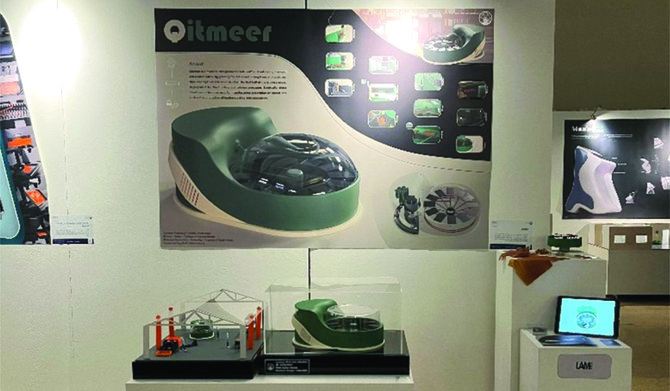
The vegan leather-making machine Qitmeer works by grinding the dates, mixing them with additives, then pouring them into molds to start the first half of the drying process before preparing them for the finishing and coloring processes.
Curiosity was her guide, creatively unveiling the hidden wonders in the ordinary, and product designer Lamees Alfadhel designed Qitmeer, a machine that produces vegan leather sheets using damaged and wasted dates.
Qitmeer was the young designer’s graduation project. Fascinated by science, creativity, and the ability to shape human interaction with the world, Alfadhel explored several academic paths before discovering her passion and purpose in product design.
“While I may not have realized it immediately after high school, I soon discovered that product design brings together a captivating mix of different disciplines, allowing me to combine my interests and create innovative solutions,” said Alfadhel, a first-class honors product design graduate from Princess Nourah bint Abdulrahman University.
Alfadhel’s interest in culture, sustainability, and building a greener future through design sparked the young designer to base her graduation research in the natural leather industry in the Kingdom.
“I find inspiration in cultural designs that incorporate elements of my country, such as the iconic date palm trees,” she said.
She found two main challenges facing the natural leather industry in the Kingdom: the chemical damage resulting from the leather processes and the massive amount of wasted dates.
I’m looking forward to producing the most unique leather sheets in the industry. Sustainabilityisacore value guiding my work, dedicated to building a greener future through design.
Lamees Alfadhel, Product designer
“These challenges inspired me to design a machine that combines a solution for both issues,” said Alfadhel.
The vegan leather-making machine Qitmeer works by grinding the dates, mixing them with additives, then pouring them into molds to start the first half of the drying process before preparing them for the finishing and coloring processes.
The vegan leather sheets then become ready for the manufacturing and production operation, which includes the making of leather clothing and accessories.
Fibers are an essential part of the vegan synthetic leather-making process, and dates are the optimal choice for this industry, considering that they have a high fiber content.
“I’m looking forward to producing the most unique leather sheets in the industry. Sustainability is a core value guiding my work, dedicated to building a greener future through design,” said Alfadhel.
Qitmeer has been positively received by people. It encourages others to use elements and sources available in the Kingdom, explained Alfadhel.
Today, young creatives, including Alfadhel, have the opportunity to make their mark on the national and global art and design scene, with the Kingdom’s cultural renaissance supporting and inspiring a new generation, a key part of Saudi Arabia’s visionary economic and social plan to build a creative economy.
“The design community in the Kingdom has witnessed significant growth and recognition in recent years,” said Alfadhel.
“There are numerous initiatives, organizations, and government-backed programs that actively promote and support designers across various disciplines.”
Alfadhel has worked on several projects and her first was an interactive game with topic-based cards, designed to encourage teamwork.
She added: “Among the projects I’ve worked on, I take great pride in highlighting Qitmeer as my most significant achievement so far.”
Qitmeer was selected and featured in Tanween’s “Graduation Exhibition” at Ithra last November. The exhibition highlights the most outstanding work by graduates of design and architecture colleges and universities in the Arab world.
Alfadhel mostly uses Adobe Creative Cloud, Illustrator, and Photoshop for her designs. When sketching the initial idea, and 3D modeling, she uses the Fusion 360 platform.
“Fusion 360 is a fundamental part of my creative process, allowing me to bring ideas to life and refine them with attention to detail,” she said.
“Lately I’ve realized that the most used color in my designs is green, but that relies on the purpose of the product I design. Searching to understand the meaning of colors is an important step of my design process.”
The world has witnessed influential product designers who have set new standards in place, leaving a mark behind, and Alfadhel’s passion for design and unwavering commitment and determination to contribute to the design industry mark her out as a possible addition to the growing list.
She is currently working as a graphic designer and a marketing specialist in Riyadh and aspires to collaborate with local talents to foster the growth and development of young Saudi creatives in the Kingdom.
source/content: arabnews.com (headline edited)
____________
Lamees Alfadhel designed Qitmeer, a machine that produces vegan leather sheets using damaged and wasted dates.
The Academy will nurture the development of the language in Mauritania and beyond, bringing together an elite group of scholars dedicated to the cause.
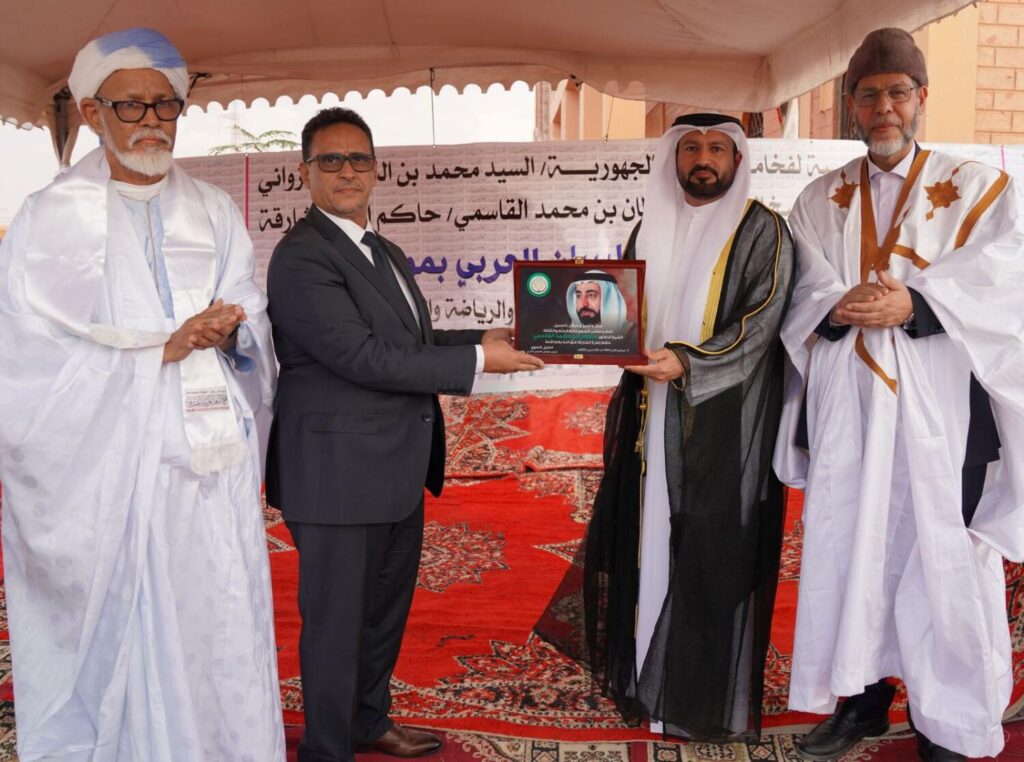
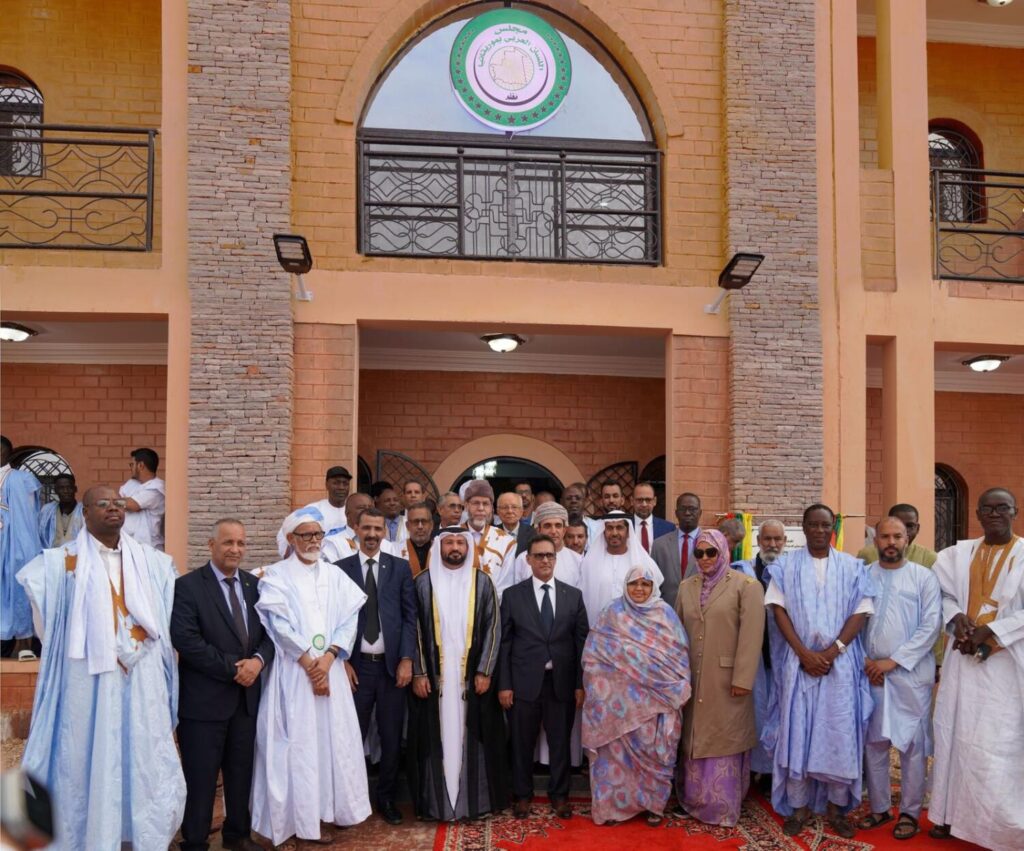
The new headquarters of the Arabic Language Council in Nouakchott, Mauritania, was inaugurated on Monday under the patronage of Mauritania President Mohamed Ould Cheikh El Ghazouani, and through the contribution of His Highness Sheikh Dr. Sultan bin Mohammed Al Qasimi, Member of the Supreme Council and Ruler of Sharjah, and Supreme President of the Arabic Language Academy (ALA) in Sharjah.
Development of the Arabic language
Ahmed Sid Ahmed Dié, Mauritanian Minister of Culture, Youth, Sports and Relations with Parliament, presided over the ceremony, expressing gratitude for the generous contribution from Sheikh Dr. Sultan. The Academy in Mauritania will nurture the development of the Arabic language in Mauritania and beyond, bringing together an elite group of scholars dedicated to this noble cause.
The ceremony was also attended by several senior diplomatic and media figures, as well as heads of Arab language academies.
During the event, Mohamed Hassan Khalaf, an ALA Board of Trustees member and Director-General of the Sharjah Broadcasting Authority, conveyed a message to the community of linguists and researchers in Mauritania from the Ruler of Sharjah. He also spoke about the importance of supporting major scientific projects and continuous efforts to empower the Arabic language in various countries worldwide, highlighting the strong relationship between the UAE and the Mauritania.
Championing Islamic and Arabic culture
Ahmed Sid Ahmed Dié presented a commemorative shield to the Ruler of Sharjah, and was received by Mohamed Hassan Khalaf in appreciation of Sheikh Dr. Sultan’s efforts in championing Islamic and Arabic culture and language, in various countries around the world.
Dr. Khalil Al Nahwi, Chairman of the Arabic Language Council in Mauritania, delivered a speech congratulating the attendees, the entire Mauritanian population and all guardians of the Arabic language. He also reviewed the council’’s achievements over the past five years, praising the support it receives directly from the Ruler of Sharjah and the Arabic Language Academy in Sharjah.
Ahmed Sid Ahmed Dié, along with Mohamed Hassan Khalaf and Dr. Mohamed Safi Al Mosteghanemi, Secretary-General of ALA, unveiled a commemorative plaque marking the opening of the building before the ceremonial cutting of the ribbon, and was followed by a tour of the impressive building, designed in the Mauritanian architectural style.
Built with eco-friendly materials, the new headquarters consists of two floors and includes several administrative offices, study halls, meeting rooms, and an expansive library. The main building is accompanied by a hall named Al Qasimiya Hall to be used for seminars and events. The headquarters also houses a mosque that can accommodate more than 300 worshippers.
Situated in the University district on land provided by the Mauritanian government, the entire construction and furnishing of this significant establishment were funded by the Ruler of Sharjah.
Saudi Arabia’s record-breaking hanging prayer room offers spectacular Kaaba views.’
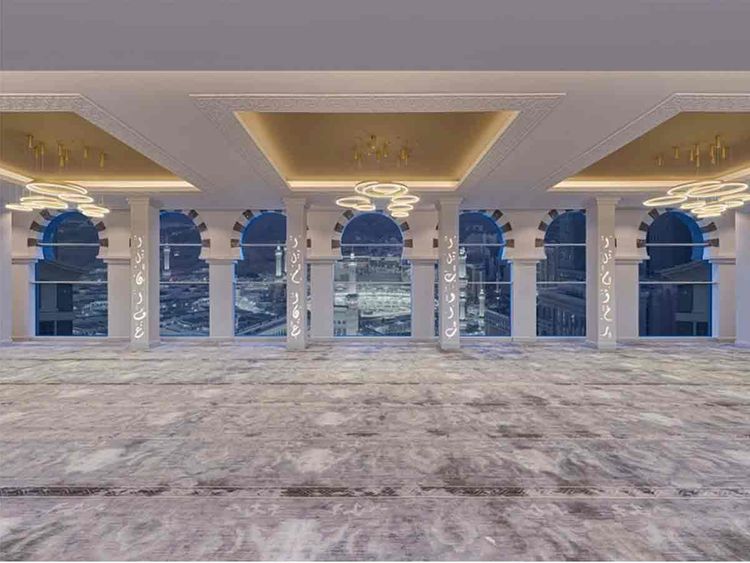
Saudi Arabia has set a new world record with the opening of the highest hanging prayer room, as recognised by Guinness World Records.
Situated at a breathtaking 483 meters above sea level, this architectural marvel offers unparalleled views of the Kaaba and other significant religious landmarks in Mecca.
Nestled within the bridge connecting the two towers of the Address Jabal Omar Mecca Hotel, the prayer room is not just a feat of engineering but also a testament to architectural ingenuity and creative prowess.
Using the latest technology and specially designed equipment, the 650-tonne steel bridge was initially assembled at 312 meters above ground before being elevated to its final position, linking the hotel’s twin towers across floors 36, 37, and 38.
The hall, which can accommodate up to 520 worshippers in a spacious 550 square meter area, blends traditional Arabic designs with modern luxury. Arabic calligraphy adorns its interiors, enhancing the room’s sanctity with the names of Allah and reflecting the rich Islamic heritage.
Worshippers in this prayer hall are treated to a spiritual experience filled with peace and tranquility. During Fajr prayers, they can witness the sunrise over Mecca, while the sunset bathes the chapel in warm.
source/content: gulfnews.com (headline edited)
_________
It was initially assembled at 312 meters above ground before being elevated to its final position, linking the hotel’s twin towers across floors 36, 37, and 38. / Image Credit: Courtesy of X/@ThamerAlbugami
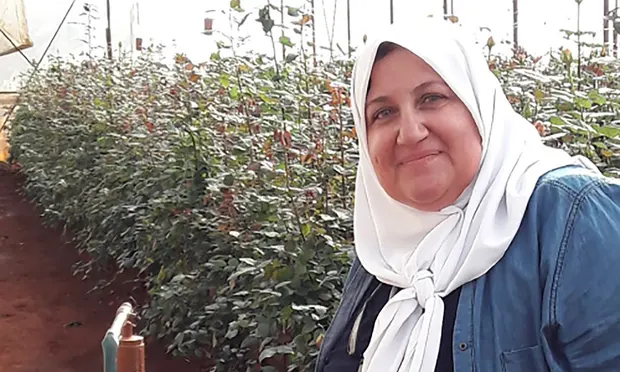
Plant virologist Dr Safaa Kumari discovered seeds that could safeguard food security in the region – and risked her life to rescue them from Aleppo.
The call came as she sat in her hotel room. “They gave us 10 minutes to pack up and leave,” Dr Safaa Kumari was told down a crackling phone line. Armed fighters had just seized her house in Aleppo and her family were on the run.
Kumari was in Addis Ababa, Ethiopia, preparing to present a conference. She immediately began organising a sprint back to Syria. Hidden in her sister’s house was a small but very valuable bundle that she was prepared to risk her life to recover.
Kumari is a plant virologist. Her work focuses on a quiet yet devastating development crisis. Climate-fuelled virus epidemics affecting fava beans, lentils and chickpeas are spreading from Syria to Ethiopia, gradually destroying the livelihoods of low-income populations. Known as “poor man’s meat”, these pulses are vital for both income generation and food security in many parts of the world.
Finding a cure was urgent, Kumari explains. Hopeless farmers were seeing increasing levels of infected crops turning yellow and black. The cause? “Climate change provides aphids with the right temperatures to breed exponentially and spread the epidemics,” she says.
For 10 years, Kumari worked to find a solution. Finally, she discovered a bean variety naturally resistant to one of the viruses: the fava bean necrotic yellow virus (FBNYV). “When I found those resistant seeds, I felt there was something important in them,” says Kumari from her lab in Lebanon where she now works. Only the fighting in Syria had moved. “I had left them at my sister’s in central Aleppo to protect them from the fighting,” she says.
Determined not to let a war get in the way of her work “for the world’s poor”, Kumari felt it her duty to rescue the seeds in Aleppo. “I was thinking: how am I going to get those seeds out of Syria?
“I had to go through Damascus, and then drive all the way to Aleppo. There was fighting and bombings everywhere.” After two days’ driving along dangerous roads, seeds in hand, Kumari made it to Lebanon, where she now works as a researcher at Icarda (International Center for Agricultural Research in the Dry Areas) in the Bekaa valley, close to the Syrian border. Hassan Machlab, Icarda’s country manager says: “Many of the Syrian scientists we welcomed here have suffered. It is tough.”
But bringing the seeds to safety was only the beginning. Kumari needed to turn them into a sustainable solution.
As crop production collapsed in the region, producers started to rely heavily on insecticides. “Most farmers go to the field and spray it without safety material – masks and appropriate jacket,” she says. “Some are dying, others are getting sick or developing pregnancy issues.”
At first, the sample failed. “So we crossed them with another variety that had a better yield and obtained something that is both resistant and productive,” says Kumari. “When we release it, it will be environment-friendly and provide farmers with a good yield, more cheaply and without insecticide.”
Kumari now plans to distribute her super-seeds free to farmers. She has already turned down an offer from a large company for the virus detection technology.
“They wanted to buy our product and then sell it to the farmers, but we refused,” says Kumari. “Ours is free. It’s our responsibility to provide our solutions to people everywhere,” she says.
But, as for many Syrian refugees, the war is never far from her thoughts, “Something she won’t tell you is that it wasn’t easy for her,” says Machlab. “She was working on all this and she didn’t have a clear mind as her family were in Aleppo and her house was destroyed.”
Kumari adds: “Last week I saw my family in Turkey. I have five sisters and three brothers, scattered in Germany, Turkey, Syria. The last time we met was in Aleppo in 2012. When I came back someone told me ‘Safaa, you’re looking great today!’ Of course, I had just spent time with my family again!” she says, laughing.
But she adds: “It’s not easy for me, it’s not easy for a woman to work on agriculture (research). It’s not easy, but it’s OK.
“When I’m working, I’m not thinking I am a Syrian or a woman though. But I do feel I sometimes receive funding [from westerners] because I’m a woman,” she says. “Perhaps!”
Dr Safaa Kumari’s seeds are resistant to the climate-fuelled viruses that have destroyed crops of pulses in Syria. Photograph: Courtesy of Arab Society for Plant Protection
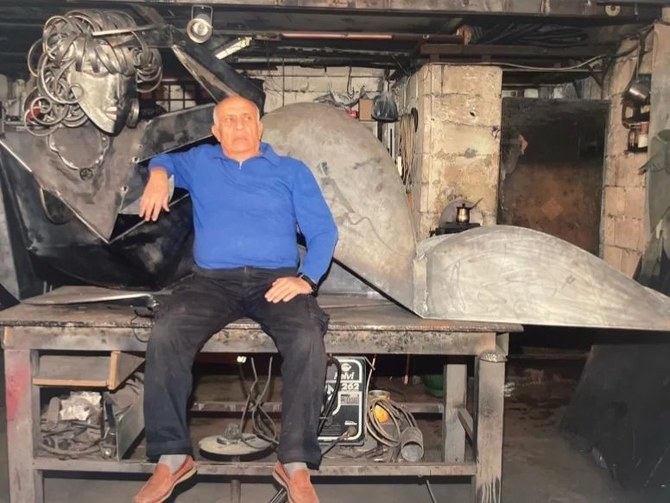
Renowned artist who died in Beirut this week spent 2 decades studying and working in Rome, and had his work showcased across the world.
The veteran Lebanese master Hussein Madi, renowned for his vibrant paintings, has died in Beirut. Often called the “Lebanese Picasso,” Madi crafted his own visual language, peppered with bird motifs, curvy women, and geometrical symmetry, that made his bold oeuvre look instantly recognizable amongst Arab art enthusiasts.
Fellow artists and gallerists took to social media to offer their condolences. On Instagram, the Lebanese artist Abed Al-Kadiri posted some old snapshots of Madi in his studio and wrote. “Today at his burial ceremony Madi joined his flock of birds, flying alone, united with himself, just as he always lived.”
Maliha Tabari, founder of Dubai’s Tabari Artspace, said that Madi was the first artist she worked with in 2003, which proved to be an invaluable experience. “I’ll never forget the afternoons that would turn to evenings spent on his balcony in Beirut, delving into intense discussions of form explained by him through the curve of a pomegranate or a bird’s wing,” Tabari posted. “We lost not only a key figure from our region’s art journey, but also a father figure.”
Madi, who was also a sculptor, printmaker, educator and press illustrator, was born in the southern Lebanese town of Shebaa in 1938. While his parents reportedly did not approve of his artistic pursuits, it was his encouraging grandfather that saw potential in Madi. He left his parents’ home at the tender age of 19. He reportedly supported himself financially by submitting caricatures to newspapers in Lebanon and Iraq.
In the early 1960s, Madi was a student at the Lebanese Academy of Fine Arts. He later went on to have an international education, by traveling to the exciting art capital of Rome, in 1963, where he enrolled at the Accademia di Belle Arti.
He would spend nearly the next two decades of his life in Rome, before returning for good to Lebanon in 1986, while the civil war was still happening. “I bitterly regret not having remained in Rome because of all the frustrations I endured since my return to Beirut. In fact, civil war drastically affected the course of my life,” Madi once said.
In Lebanon, Madi devoted himself to his canvas, showcasing his work in several art galleries in Beirut. For 10 years, starting in 1982, Madi was also president of the Lebanese Art Association.
Madi’s paintings offer a visually appealing melange of thick lines, repetitive patterns, angular shapes, natural scenes, and bright colors. There is an element of spontaneity, presented in an orderly fashion. His images are also populated with figures, holding a book, a musical instrument — or simply reclining. “Despite all the mishaps, I was deeply happy. My work celebrated life,” he said.
Over the years, Madi’s artworks have been featured in auction sales at Christie’s and Sotheby’s. His works have also been acquired by regional and international art institutions including the Barjeel Art Foundation (Sharjah), Dalloul Art Foundation (Beirut), Mathaf: Arab Museum of Modern Art (Doha), Jordan National Gallery of Fine Arts (Amman), British Museum (London) and Institut du Monde Arabe (Paris).
source/content: arabnews.com (headline edited)
____________
Renowned artist Hussein Madi who died in Beirut this week spent 2 decades studying and working in Rome, and had his work showcased across the world. (Instagram)
Cloud computing to add $181 bn to UAE’s economy by 2033.
The UAE has been chosen to lead the Cloud Computing Working Group within the World Bank, a testament to its remarkable progress in advanced technology and digitization. Recognized as a global pioneer in digital transformation and the successful implementation of cloud computing best practices, the UAE assumes this role to support both government entities and private sector companies in their transition to cloud computing systems. By prioritizing the utilization of cutting-edge data protection and cybersecurity solutions, the UAE reaffirms its commitment to facilitating the seamless adoption of cloud technology while ensuring utmost security for all stakeholders.
Sheikh Hamdan congratulates Dr. AlBlooshi
Sheikh Hamdan bin Mohammed bin Rashid Al Maktoum, Crown Prince of Dubai and chairman of the Executive Council, extended his congratulations to Dr. Bushra AlBlooshi from the Dubai Electronic Security Center (DESC) on being appointed as the leader of the Cloud Computing division within the World Bank Group.
In addition, Sheikh Hamdan posted the message on X (formerly Twitter) and said, “Congratulations to Dr Bushra AlBlooshi of the Dubai Electronic Security Center (DESC) on being appointed by the World Bank as the head of the World Bank Group for Cloud Computing, comprising of 27 countries, organisations, and major international technology firms.”
He added, “We are immensely proud of the continuous achievements of Emirati talent. With their expertise and accomplishments, they further strengthen the UAE’s international stature and role in advancing global sustainable digital development.
According to her profile on the World Economic Forum (WEF), Dr. AlBlooshi possesses more than 17 years of expertise in digital transformation, cybersecurity, and strategy management. She is recognized as an author and a prominent speaker in the areas of cybersecurity and digital transformation, demonstrating her extensive experience in the field.
Significance of cloud adoption for GDP growth
A report commissioned by Amazon Web Services (AWS) revealed in May that the widespread adoption of cloud technology among the public is projected to contribute an estimated $181 billion in economic value to the UAE over the next decade. This figure represents approximately 2.5 percent of the UAE’s economy. The paper further highlighted that a mere 1 percent increase in cloud adoption by organizations in the UAE would result in an average gross domestic product (GDP) growth of 0.21 percent or $854.7 million. This growth rate is three times higher than the regional average for the Middle East and North Africa, making it the highest in the region.
Dr. Bushra AlBlooshi of the Dubai Electronic Security Center (DESC) appointed by the World Bank as the head of the World Bank Group for Cloud Computing, comprising of 27 countries, organisations, and major international technology firms.